Categories
Brandon Blog Post

Define Conditional Discharge: The Truth About It Not Being An Automatic “Get Out of Debt Free” Card

A professional silver key turning in a lock, with thick metallic chains falling away, symbolizing the transition from bankruptcy to a fresh start once we know how to define conditional discharge.

Define Conditional Discharge: Introduction

Hello and welcome. If you are reading this, you might be feeling the weight of financial uncertainty on your shoulders. Please know that you are safe here, and you are certainly not alone. At Ira Smith Trustee & Receiver Inc., we understand that life can throw unexpected curveballs, and facing the bankruptcy process is a brave step toward reclaiming your future. Our goal is to guide you through the fog with clarity, compassion, and a concrete plan to get you back on your feet.

In this Brandon’s Blog, we define conditional discharge, discuss what it means and discuss a 2021 Court of Appeal for British Columbia decision.

Define Conditional Discharge Key Takeaways

  • Bankruptcy isn’t always automatic: While many expect a simple end date, certain factors can lead you to define conditional discharge.
  • Conditions are “homework”: The court may define conditional discharge by requiring you to pay money or perform specific duties before your debts are legally wiped away.
  • You remain “undischarged”: Until conditions are met, you are an undischarged bankrupt and still subject to certain legal restrictions.
  • A Licensed Insolvency Trustee is your ally: We help you navigate these conditions to ensure you reach the finish line, the absolute discharge.

Define Conditional Discharge Highlights

  • What is a Conditional Discharge?
  • Why Do Courts Impose Conditions?
  • Common Conditions You Might Face
  • Comparing Discharge Types: Absolute vs. Conditional vs. Suspended
  • The “12-Year Trap”: A Real-World Case Study
  • How to Transition from Conditional to Absolute Discharge
  • Frequently Asked Questions (FAQ)

How Do You Define Conditional Discharge?

When you enter personal bankruptcy Canada, the ultimate goal is the discharge. This is the legal document that releases you from the obligation to pay back the debts you owed at the time you filed.

However, a discharge is not always a straight line. If there is an opposition to your discharge, perhaps from a creditor, the Office of the Superintendent of Bankruptcy, or your own Trustee, the matter goes before an Associate Justice. Instead of granting you a clean break immediately, the court might issue a conditional discharge.

The important issue is how the court will define conditional discharge. What requirements does the court place on you to fulfill before you really do get discharged from your bankruptcy? It is the discharge, and not the filing for bankruptcy, that releases you from your debts.

I suggest that you should define conditional discharge as an “absolute discharge in principle, but with strings attached.” It means the court has decided you deserve a fresh start, but only after you complete a few more tasks or pay a bit more into the pot for your creditors.

A Licensed Insolvency Trustee in a professional Toronto office explaining discharge conditions to a client., including how to define conditional discharge

Why do courts impose conditions?

We know the tension put upon you when you feel like the goalposts have been moved. It is important to remember: it is not your fault that the law has these complexities. The court’s job is to balance your need for a fresh start with the rights of the people you owe money to.

The court typically imposes conditions if:

  1. Duties were missed: You may have forgotten to attend your mandatory counselling sessions (educational meetings designed to help you manage money better in the future).
  2. Surplus income exists: If your income is above a certain threshold, the law requires you to pay a portion of that “extra” money to your Trustee, and you haven’t paid it all.
  3. High tax debt: If you owe more than $200,000 in personal income tax, and that makes up 75% or more of your total debt, the law requires a court hearing. Under Section 172.1 of the Bankruptcy and Insolvency Act (BIA), you are defined as a High-Tax Debtor who is not eligible for an automatic discharge
  4. Conduct issues: If you weren’t fully transparent about your assets, or if you’ve been through bankruptcy multiple times before.

Define Conditional Discharge: Common conditions you might face

If you find yourself as one of the many undischarged bankrupts in the GTA, your court order will likely list one or more of the following “homework” assignments:

  • Payment of a specific sum: The court might order you to pay, for example, $5,000 over 12 months.
  • Performing duties: You might need to provide missing tax information or finally attend those two mandatory counselling sessions.
  • Surrendering assets: You may be required to turn over a specific piece of property that was previously undisclosed.

Comparing discharge types: A quick guide

Navigating debt relief Toronto requires knowing exactly where you stand. Use this table to understand the different flavours of discharge:

Discharge TypeWhat it MeansStatus of Your Debt
Absolute DischargeYou have completed everything. You are 100% finished.Debts are legally wiped away (with certain exceptions like child or spousal support).
Conditional DischargeYou have “homework” to do first (payments or duties).You are still responsible for your debts until conditions are met.
Suspended DischargeYour discharge is granted but won’t take effect until a future date.Debts are wiped away only once the suspension period ends.
Refused DischargeThe court denies your request due to extreme misconduct or non-compliance.You remain bankrupt and still owe all your debts.

The “12-Year Trap”: A real-world case study to define conditional discharge

To see how the court thinks, let’s look at the case of Perrier v. Canada (Revenue Agency). In this instance, a bankrupt individual was ordered to pay $150,000 at a rate of $1,000 per month as a condition of his discharge.

On the surface, it seems fair to ask someone to pay what they can. However, the Court of Appeal stepped in. They realized that at $1,000 a month, it would take the man over 12 years to finish. Since he was nearing retirement, this condition would have followed him into his golden years, effectively denying him the “fresh start” that personal bankruptcy Canada is supposed to provide.

The court reduced the amount to $45,000 over five years, proving that the conditions must be reasonable and attainable. This is why having a Licensed Insolvency Trustee Toronto, like the team at Ira Smith Trustee & Receiver Inc., is vital; we ensure the court understands your reality.

A legal document with a bold 'CONDITIONAL' stamp and a judge's gavel, representing the formal court process and how to define conditional discharge.

How to transition from Define Conditional Discharge to “Absolute”

Being an undischarged bankrupt can feel like being in “financial purgatory,” but the path out is clear. Here is how we help you reach that absolute discharge:

  1. Provide you with an upfront warning: As your licensed insolvency trustee, if we are in a position where we feel we will need to oppose your absolute discharge, we will provide you with a warning and advise you on what steps you need to take to avoid our opposition. If a creditor opposes your discharge from bankruptcy, we look at their reasons and provide you with advice as to what you should do ahead of the court discharge hearing.
  2. Review the Conditional Order: We sit down with you to translate the “legalese” into plain English.
  3. Create a Payment Schedule: If money is owed, we help you budget so the payments are manageable.
  4. Complete the Tasks: We facilitate your counselling sessions and help you gather any missing documentation.
  5. The Certificate of Compliance: Once you’ve done your part, we notify the court or the Office of the Superintendent of Bankruptcy. You will then receive your absolute discharge.

The “why” behind all of this is simple: we want you to have a life free from the shadow of debt. Completing these conditions is the final hurdle before you can truly say you have started over.

Define Conditional Discharge Frequently Asked Questions (FAQ)

What happens if I can’t afford the payments in my conditional discharge?

If your circumstances change, for example, you lose your job or face a medical crisis, you aren’t stuck. After one year, we can help you apply back to the court to vary the order (change the terms) to something you can actually manage.

Can I still get credit while I have a conditional discharge?

As an undischarged bankrupt, you are legally required to disclose your bankruptcy status to any lender if you are seeking credit over $1,000. It is generally very difficult to get traditional credit during this phase.

How long do I have to meet the conditions?

The court usually sets a timeline, but if they don’t, the conditions remain in place until they are satisfied. The sooner you finish, the sooner you get your fresh start.

Does a conditional discharge show up on my credit report?

Yes. Your credit report will reflect that you are in bankruptcy until you receive your absolute discharge. Once you reach the absolute stage, the “clock” for how long the bankruptcy stays on your report finally starts ticking.


Starting Over, Starting NOW

Don’t let financial uncertainty dictate your future. If you or your business is struggling with debt, losing sleep, or facing legal action, . Call Ira Smith Trustee & Receiver Inc. today.

We offer a free, confidential consultation to discuss your situation, explain your options in plain language, and help you develop a clear, actionable plan. Our team of Licensed Insolvency Trustees is dedicated to providing the compassionate, professional support you need to regain control and achieve a debt-free life.

Take the first step towards a brighter financial future. Call us now.

The Office of the Superintendent of Bankruptcy licenses Ira Smith Trustee & Receiver Inc. Ira and Brandon Smith are members of the Canadian Association of Insolvency and Restructuring Professionals.

, , , , , , , , , , , , , , , , , , , , , , , , , , –

Disclaimer: This analysis is for educational purposes only and is based on the cited sources and professional expertise as a Licensed Insolvency Trustee. The information provided does not constitute legal or financial advice for your specific circumstances. Every situation is unique; the outcomes discussed may not apply to your particular case. Please contact Ira Smith Trustee & Receiver Inc. to discuss your specific needs.

About the Author:

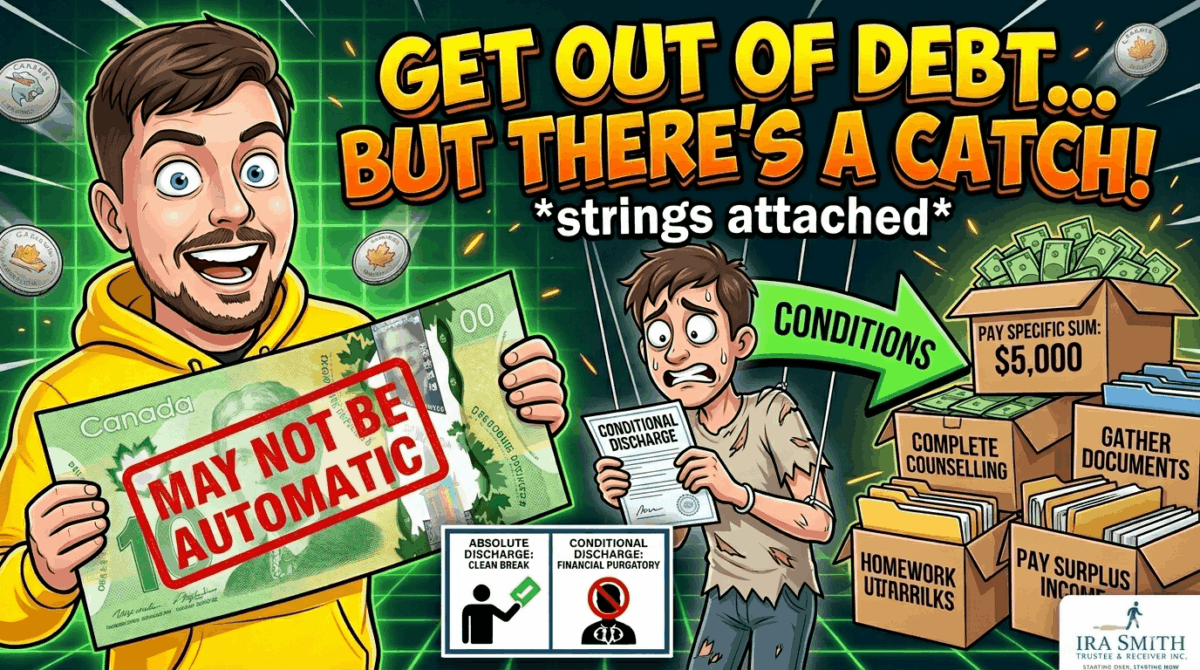
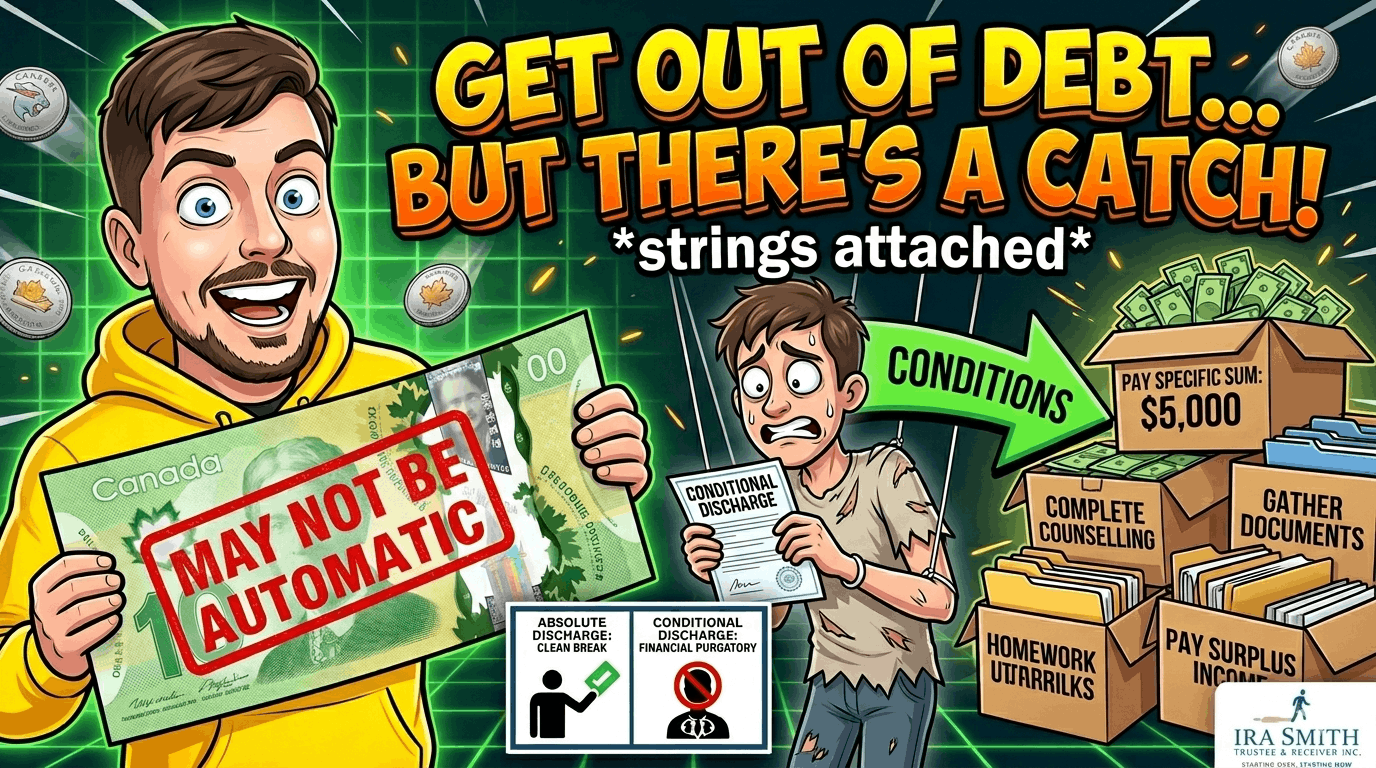
Brandon Smith is a Senior Vice-President at Ira Smith Trustee & Receiver Inc. and a Licensed Insolvency Trustee serving clients across Ontario. His experience includes consumer insolvency and complex court-ordered receivership and corporate bankruptcy administration, giving him practical insight into navigating challenging financial situations to achieve optimal outcomes for businesses, creditors, and professionals. Brandon stays current with landmark developments in Canadian insolvency law, ensuring his clients benefit from a cutting-edge understanding of their rights and options.Image reflecting the potential tha tan absolute discharge from bankruptcy is not automatic and showing the various attributes that define conditonal discharge.

#BankruptcyCanada #DebtReliefToronto #InsolvencyTrustee #FinancialFreshStart #ConsumerProposal #IraSmithInc #defineconditionaldischarge #define conditional discharge

Categories
Brandon Blog Post

Can a Secured Lender Credit-Bid to Buy a Lawsuit Against Itself? Ontario Court of Appeal to Decide

A high-resolution photographic rendering of a gavel resting on top of a stack of legal documents and Canadian currency with a professional corporate feel, representing the lawsuit a bankrupt company has against its secured lender.

If you are reading this while navigating a complex financial restructuring or managing the pressures placed on your company by your secured lender and are fearful of corporate insolvency, please know that you are not alone. At Ira Smith Trustee & Receiver Inc., we understand that legal jargon and courtroom battles can feel overwhelming when you are simply trying to find a path forward. We are here to guide you through these technical waters with clarity and compassion.

Secured Lender Key Takeaways

  • A Landmark Question: The Ontario Court of Appeal is set to decide if a secured lender can use their debt to “buy” a lawsuit that a Licensed Insolvency Trustee could file against it.
  • Credit Bidding vs. Cash: Traditionally, credit bidding allows a secured lender to bid the value of their debt. The case discussed below begins to question if that applies to assets that aren’t part of their original security.
  • The Avida Case: A judge on the Ontario Commercial List recently allowed Bank of Montreal (BMO) to participate in an auction to be run by the Trustee and credit-bid to purchase a cause of action (a legal claim) against BMO, but that decision is now being appealed.
  • Why It Matters: The final ruling will impact how receivers and trustees recover money for creditors and whether lenders can effectively “neutralize” legal claims without paying cash.

Secured Lender Highlights

  • What is a Credit Bid?
  • The Case of Avida 2015 Inc. (Re)
  • The Conflict: Can a Lender Bid Debt for a Lawsuit?
  • Why the Court of Appeal is Stepping In
  • Comparison: Credit Bidding vs. Cash Bidding
  • What This Means for You and Your Business
  • Frequently Asked Questions (FAQ)

Secured Lender: What is a Credit Bid?

Before we dive into the details of the Avida 2015 Inc. (Re), 2026 ONCA 478 (CanLII) case, let’s define a term that is central to this debate. In the world of insolvency, a credit bid occurs when a secured creditor, someone who has a legal claim over specific assets, uses the money they are already owed as “currency” to buy those assets in a receiver’s or trustee’s Sale and Investment Solicitation Process (SISP).

Normally, if a business goes bankrupt, the Licensed Insolvency Trustee (the person appointed to manage the bankruptcy) tries to sell the business assets for cash. However, a secured lender often has the right to say, “Instead of you selling my collateral to someone else for cash, I will bid on all or part of the debt I am owed to take ownership of it myself.”

Assets of this type are often physical, like equipment or real estate. But what happens when the asset is a cause of action, essentially, the right to sue someone? And what happens when that someone to be sued is the secured lender itself?

Two professionals in a Toronto office reviewing a 'Cash Flow Forecast' chart, including the payments that need to be made to the secured lender, focused on 'Strategic Restructuring.'


Secured Lender: The Case of Avida 2015 Inc. (Re)

The story of Avida 2015 Inc. brings this technical question into sharp focus. In this bankruptcy proceeding, the Trustee identified a valuable asset: a cause of action against the Bank of Montreal (BMO). In simpler terms, the Trustee believed the estate had a legal claim to sue BMO for money.

The Trustee decided to put this lawsuit up for auction. BMO, being a secured lender and a major creditor in the bankruptcy, wanted to participate in the auction. They didn’t want to bid cash, though; they wanted to use a credit bid based on the secured debt they were already owed by Avida.

On September 22, 2025, a bankruptcy judge made a significant ruling: BMO was permitted to bid in the auction using a credit bid up to the face value of its secured debt.

This caused immediate concern for other stakeholders. If BMO could buy the lawsuit against itself using its own debt, it could effectively end the litigation without ever having to write a cheque. The appellant in this case, David Reale, argued that BMO should be required to pay cold, hard cash like any other bidder.


The Conflict: Can a Secured Lender Bid Debt for a Lawsuit?

The core of the dispute is whether a credit bid can be used to acquire an asset that does not actually fall under the lender’s security agreement.

Think of it this way: if a bank has a mortgage on a building, it makes sense that they can credit-bid for that building. But does that bank also have the right to credit-bid for a legal claim that isn’t part of that mortgage?

The appellant argues that allowing a secured lender to do this “chills” the auction. Who would want to bid cash against a bank that can bid millions of dollars in “debt” that it already holds? This could prevent the Trustee from getting the best possible value for the estate’s creditors.


Secured Lender: Why the Court of Appeal is Stepping In

This isn’t just a minor disagreement over a single auction. On June 17, 2026, a judge of the Court of Appeal for Ontario granted leave to appeal the original judge’s decision. They noted that this is “a matter of importance… to bankruptcy proceedings more generally.”

As of June 29, 2026, Justice Zarnett issued a case management ruling (2026 ONCA 478) to set the stage for the full hearing. We now have a timeline for when these big questions will be answered:

  • July 15, 2026: Deadline for the appellant to perfect the appeal.
  • July 31, 2026: BMO’s opportunity to file its response.
  • August 19, 2026: Deadline for other interested parties to intervene.

This case will likely set a major precedent for how a secured lender interacts with receivership and bankruptcy estates in Ontario for years to come. We will keep an eye on this case and update you in a future Brandon’s Blog.

A professional digital composite image of a legal folder labeled 'CAUSE OF ACTION' against a secured lender with a 'FOR SALE' tag attached.


Secured Lender Comparison: Credit Bidding vs. Cash Bidding

To help you understand why this battle is so fierce, we have put together a comparison of the two bidding methods:

FeatureCredit BiddingCash Bidding
Payment MethodOffsetting the secured debt owed by the estate.Liquid cash payment into the estate.
Liquidity for EstateLow (does not provide cash for other creditors).High (provides immediate cash to the trustee).
Primary AdvantageProtects the lender’s security value.Maximizes cash recovery for unsecured creditors.
Legal StatusCommon practice, but subject to court discretion.Standard procedure for all bankruptcy auctions.
ControversyDisputed when used to buy a lawsuit against the bidder.Generally undisputed if the price is fair.


Secured Lender: What This Means for You and Your Business

Whether you are a business owner facing a corporate restructuring or a creditor trying to recover what you are owed, the Avida decision matters.

If the Court of Appeal rules that credit bidding is restricted to only the assets specifically listed in a security agreement, it gives Trustees more power to raise cash by selling the unsecured assets. This could lead to higher payouts for unsecured creditors.

On the other hand, if the court supports BMO’s position, a secured lender will have a powerful tool to protect itself from litigation costs during an insolvency administration, such as a receivership or bankruptcy proceeding. It essentially allows them to use all or a portion of the “value” of their unpaid debt to “buy” their way out of a lawsuit.

We know the tension put upon you when these legal battles occur. Our goal is to ensure you have the information you need to make practical decisions during a financial crisis.

A confident woman breaks free from heavy chains, symbolizing escape from financial burdens and her secured lender


Secured Lender Frequently Asked Questions (FAQ)

1. Can any creditor use a credit bid?
Typically, only secured creditors can credit-bid. Unsecured creditors (those without a specific lien or charge on an asset) have to pay cash if they want to buy something from a receivership or bankruptcy estate. They have no credit to bid!

2. Why would a Trustee sell a lawsuit?
Lawsuits are expensive and time-consuming. If a Trustee doesn’t have the funds to pay lawyers to fight a case, they might sell the cause of action to a third party who is willing to take the risk and pay cash upfront for the right to pursue it.

3. Is this decision final?
No. As of late June 2026, the Ontario Court of Appeal has only set the schedule for the case. We will likely not have a final decision until late 2026 or early 2027.

4. What does “perfecting an appeal” mean?
Perfecting an appeal is the technical process of filing all the necessary documents, transcripts, and legal arguments with the court so that the appeal is ready to be heard by the judges.


Secured Lender: The Path Forward

Navigating the world of bankruptcy and corporate insolvency is rarely straightforward. Cases like Avida 2015 Inc. remind us that the law is constantly evolving to find a balance between the rights of lenders and the need for a fair process for everyone.

At Ira Smith Trustee & Receiver Inc., we don’t just see numbers and legal files; we see people and businesses looking for a fresh start. We are committed to staying at the forefront of these legal developments so we can provide you with the best possible advice.

Starting Over, Starting Now

Don’t let financial uncertainty dictate your future. If you or your business is struggling with debt, losing sleep, or facing legal action, contact Ira Smith Trustee & Receiver Inc. today.

We offer a free, confidential consultation to discuss your situation, explain your options in plain language, and help you develop a clear, actionable plan. Our team of Licensed Insolvency Trustees is dedicated to providing the compassionate, professional support you need to regain control and achieve a debt-free life.

Take the first step towards a brighter financial future, call us now.

Ira Smith Trustee & Receiver Inc. is licensed by the Office of the Superintendent of Bankruptcy. Ira and Brandon Smith are members of the Canadian Association of Insolvency and Restructuring Professionals.

, , , , , , , , , , , , , , , , , , , , , , , , , , –

Disclaimer: This analysis is for educational purposes only and is based on the cited sources and professional expertise as a Licensed Insolvency Trustee. The information provided does not constitute legal or financial advice for your specific circumstances. Every situation is unique; the outcomes discussed may not apply to your particular case. Please contact Ira Smith Trustee & Receiver Inc. to discuss your specific needs.

About the Author:

Brandon Smith is a Senior Vice-President at Ira Smith Trustee & Receiver Inc. and a Licensed Insolvency Trustee serving clients across Ontario. His experience includes consumer insolvency and complex court-ordered receivership and corporate bankruptcy administration, giving him practical insight into navigating challenging financial situations to achieve optimal outcomes for businesses, creditors, and professionals. Brandon stays current with landmark developments in Canadian insolvency law, ensuring his clients benefit from a cutting-edge understanding of their rights and options.


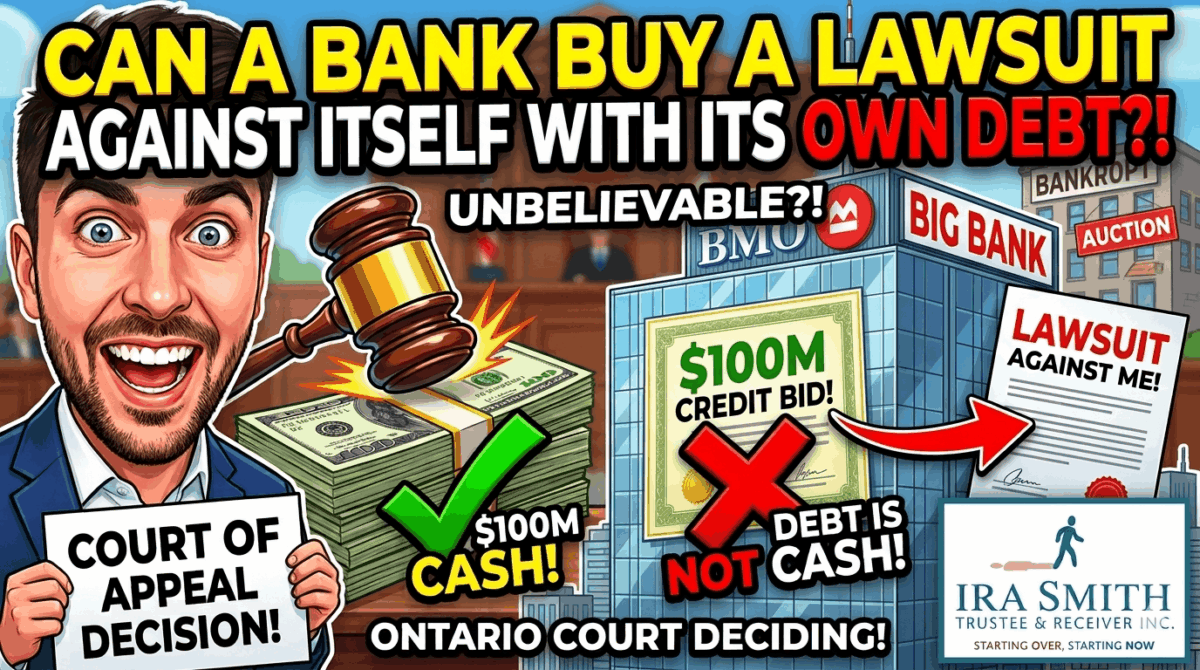
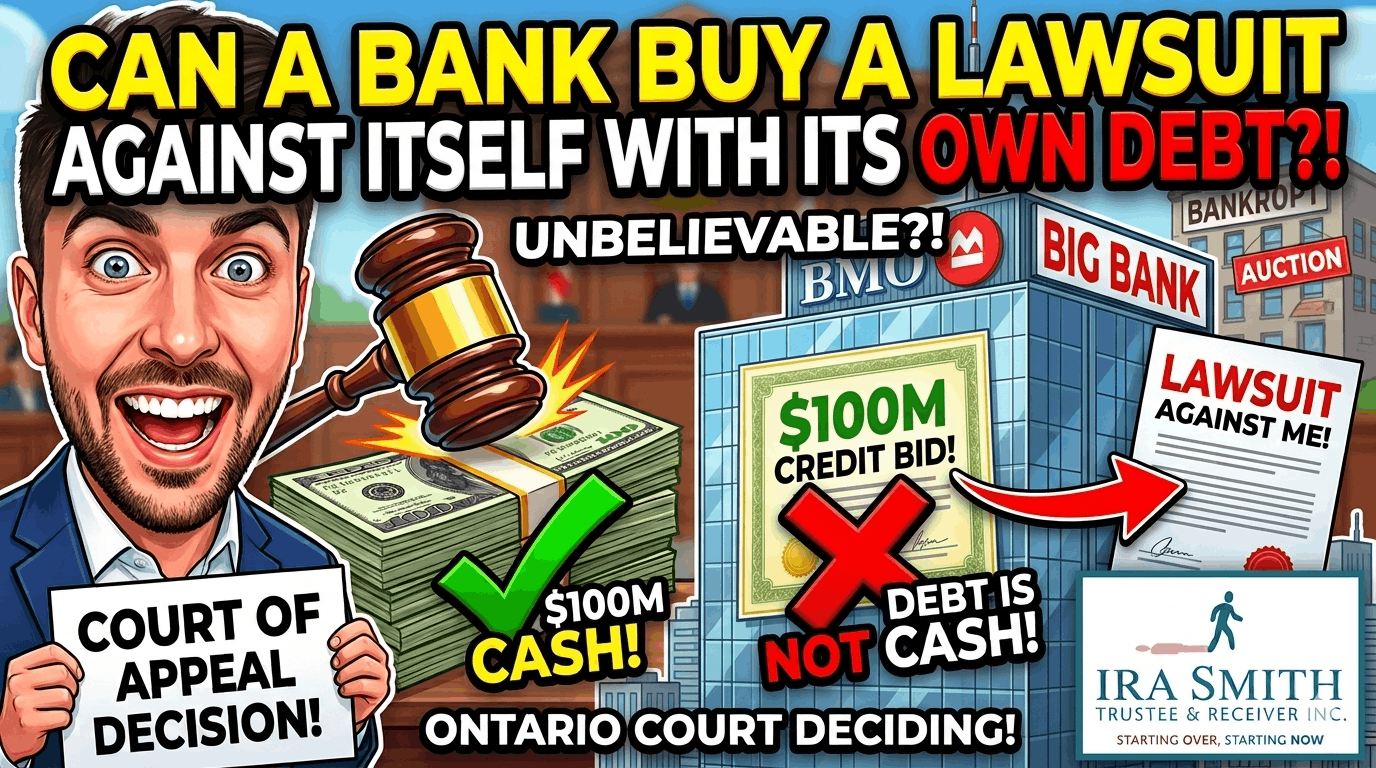
An image of the secured lender bank tower, an image of its borrower's bankruptcy and a lawsuit the borrower has against the bank to describe this Court of Appeal for Ontario case this Brandon's Blog is about.

#SecuredLenders #CreditBid #InsolvencyLaw #OntarioCourtOfAppeal #CorporateRestructuring #BankruptcyOntario #FreshStart

Categories
Brandon Blog Post

Hidden Assets & Bankruptcy: Our Complete Guide On Creditor Rights And Recovery Under BIA Section 38

Professional legal desk with gavel and documents representing the Section 38 BIA process to find hidden assets

Hidden Assets Introduction

At Ira Smith Trustee & Receiver Inc., we understand that the discovery of hidden assets during a bankruptcy can be both a shock and a source of deep frustration. Whether you are a creditor trying to recover what is rightfully yours or an individual seeking a fair and transparent process, your peace of mind and financial security are our primary concerns. We are here to guide you through the complexities of the law with compassion and expertise.

Hidden Assets Key Takeaways

  • Creditor Empowerment: Section 38 of the Bankruptcy and Insolvency Act (BIA) allows creditors to pursue legal actions that a Trustee has declined or neglected to take.
  • Uncovering Hidden Assets: This provision is a powerful tool for addressing a transfer under value, a transfer of property intended to keep it out of the reach of creditors.
  • The TCC v. Rohland Case: A recent BC Supreme Court decision highlights how creditors can continue to fight for recovery even years after a bankruptcy filing.
  • Self-Funded Recovery: Creditors using Section 38 assume the costs and risks of litigation but gain the primary right to any assets recovered.
  • Professional Guidance is Essential: Navigating Section 38 requires precise legal timing and a deep understanding of insolvency rules.

Hidden Assets: What is Section 38 of the BIA?

In a typical bankruptcy, the Licensed Insolvency Trustee is the only person authorized to manage the debtor’s assets and bring lawsuits to recover property. However, what happens if the Trustee decides not to act? Perhaps the estate has no funds to pay for a lawyer, or the Trustee believes the risk of losing is too high.

This is where Section 38 comes into play. It acts as a “safety valve” for the system. If a Trustee refuses or neglects to take a specific action, a creditor can apply to the court for an order to step into the Trustee’s shoes. This process effectively grants the creditor the right to pursue the claim at their own expense and for their own benefit (up to the amount of their claim plus costs).

Assets of this type are called “property of the bankrupt estate,” and Section 38 ensures that they aren’t lost simply because a Trustee is unable to pursue them.

A coastal property on Bowen Island representing the type of hidden assets involved in the TCC v. Rohland case

Hidden Assets Highlights: The Story of TCC Mortgage Holdings Inc. v. Rohland

The recent case of TCC Mortgage Holdings Inc. v. Rohland, 2026 BCSC 1101, provides a perfect example of Section 38 in action. The details of this case read like a financial thriller, involving multi-million dollar judgments and allegations of hidden properties.

Hidden Assets: The Background

In 2009, TCC Mortgage Holdings Inc. (“TCC”) obtained a judgment against Gregory Rohland for nearly $13 million. By 2020, with interest, that figure had grown to over $16.5 million. Mr. Rohland filed for bankruptcy in 2013 and remains an undischarged bankrupt, meaning he has not yet been released from his legal obligation to pay his debts through the bankruptcy process.

Interestingly, the Trustee in his case was discharged back in 2015. Many people believe that once a Trustee is discharged, the file is closed. However, as this case shows, the bankruptcy itself continues until the debtor is discharged.

The Allegation of Hidden Assets

TCC discovered that a property on Bowen Island, British Columbia, had been purchased in 2016 for approximately $2.5 million. While the property was not in Mr. Rohland’s name, TCC alleged it was being held by nominees, individuals or entities acting on his behalf to hide his true ownership.

TCC argued that this was a fraudulent conveyance, a term used when a person transfers property to another party with the intent to defeat, hinder, or delay their creditors.

The Court’s Hidden Assets Decision

TCC applied under Section 38 for permission to sue the nominees directly to bring the Bowen Island property (or the money used to buy it) into the bankruptcy estate. Justice Coval of the BC Supreme Court granted TCC’s application to amend their legal claims. The court ruled that TCC had a right to pursue these claims, even though the Trustee was long gone and the original bankruptcy had happened years prior.

Hidden Assets: Why Does Section 38 Matter to You?

If you are a creditor, Section 38 is your “Plan B.” It ensures that a debtor cannot simply wait out the Trustee’s patience or take advantage of an estate that lacks the funds to litigate.

For the person in debt, it is a reminder that bankruptcy is a process of “honesty for relief.” The system is designed to provide a fresh start only to those who have fully disclosed their assets. Attempting to hide property can lead to long-term legal battles that persist for decades.

Chains being broken, symbolizing the uncovering of hidden financial structures and hidden assets

Hidden Assets: Comparing the Paths to Recovery

To help you understand the difference between the standard process and the Section 38 route, we have prepared this comparison table:

FeatureTrustee-Led ActionSection 38 Creditor Action
Who Controls the Case?The Licensed Insolvency TrusteeThe Creditor who applied for the order, and any other creditors who choose to join in
Who Pays the Legal Fees?The Bankrupt Estate (if funds exist)The Creditor (out of their own pocket)
Who Takes the Risk?The Estate / TrusteeThe Creditor personally
Who Gets the Recovery?Distributed among all creditorsFirst to the acting creditor (costs + claim), then surplus to the estate
Court Permission Required?Usually not (standard duty)Yes, a Section 38 Order is mandatory

Hidden Assets: How to Navigate a Section 38 Application

If you suspect there are hidden assets in a bankruptcy file, you cannot simply sue on your own. You must follow a specific legal path:

  1. Request Action: You must first formally ask the Trustee to pursue the asset or the claim.
  2. Wait for Refusal: The Trustee must either refuse or fail to act within a reasonable timeframe.
  3. Apply to Court: You must obtain a Section 38 Order. The court will check if your claim is “prima facie” (on its face) valid and not frivolous.
  4. Notify Other Creditors: You are generally required to give other creditors the chance to join your action and share the costs (and the rewards).

We know the tension put upon you when you feel the system isn’t working as it should. Whether you are a creditor or a debtor, our role is to bring clarity to these “grey areas” of the law.

Ira Smith professionals collaborating to provide guidance and support to find hidden assets

Hidden Assets Frequently Asked Questions (FAQ)

Can I use Section 38 if the Trustee has already been discharged?
Yes. As seen in the TCC v. Rohland case, a creditor can still apply for a Section 38 order even after the Trustee is discharged, provided the bankrupt individual themselves is not yet discharged.

What is a “Money Had and Received” claim?
This is a legal term for a claim where one party has received money that, in fairness and justice, belongs to another. In bankruptcy, this is often used when a debtor’s money was funnelled into someone else’s bank account or property.

What happens if I lose a Section 38 lawsuit?
Because you are stepping into the Trustee’s shoes, you are responsible for the costs. If the lawsuit is unsuccessful, you, not the Trustee or the estate, will be responsible for your own legal fees and potentially the legal costs of the winning side.

Is there a time limit for these claims?
Yes. Limitation periods apply to all legal actions. In the TCC v. Rohland case, the question of whether too much time had passed was a major point of debate, which the judge ultimately left for the trial phase to decide. It is vital to act as soon as you suspect foul play.

Hidden Assets: Moving Forward with Confidence

The takeaway from the BC Supreme Court’s decision is clear: the law provides pathways to justice, even in the most complex and long-running bankruptcy cases. At Ira Smith Trustee & Receiver Inc., we believe that “Starting Over, Starting Now” applies to everyone involved in a financial crisis. For creditors, it means finding a new way to pursue recovery. For debtors, it means resolving the past honestly to secure a better future.

It is not your fault that the legal system is complex, but it is our job to make it manageable for you. We provide the expertise of a Licensed Insolvency Trustee combined with the heart of a supportive guide.

Starting Over, Starting Now

Don’t let financial uncertainty dictate your future. If you or your business is struggling with debt, losing sleep, or facing legal action, contact Ira Smith Trustee & Receiver Inc. today.

We offer a free, confidential consultation to discuss your situation, explain your options in plain language, and help you develop a clear, actionable plan. Our team of Licensed Insolvency Trustees is dedicated to providing the compassionate, professional support you need to regain control and achieve a debt-free life.

Take the first step towards a brighter financial future. Call us now.

Ira Smith Trustee & Receiver Inc. is licensed by the Office of the Superintendent of Bankruptcy. Ira and Brandon Smith are members of the Canadian Association of Insolvency and Restructuring Professionals.

, , , , , , , , , , , , , , , , , , , , , , , , , , –

Disclaimer: This analysis is for educational purposes only and is based on the cited sources and professional expertise as a Licensed Insolvency Trustee. The information provided does not constitute legal or financial advice for your specific circumstances. Every situation is unique; the outcomes discussed may not apply to your particular case. Please contact Ira Smith Trustee & Receiver Inc. to discuss your specific needs.

About the Author:

Brandon Smith is a Senior Vice-President at Ira Smith Trustee & Receiver Inc. and a Licensed Insolvency Trustee serving clients across Ontario. His experience includes consumer insolvency and complex court-ordered receivership and corporate bankruptcy administration, giving him practical insight into navigating challenging financial situations to achieve optimal outcomes for businesses, creditors, and professionals. Brandon stays current with landmark developments in Canadian insolvency law, ensuring his clients benefit from a cutting-edge understanding of their rights and options.An exuberant creditor who just found $13 million of hidden assets of an undischarged bankruptcy using section 38 of the Bankruptcy and Insolvency Act Canada

#BankruptcyLaw #Section38BIA #CreditorRights #FraudulentConveyance #InsolvencyRestructuring #IraSmithTrustee #TorontoFinancialHelp #DebtRecovery #LegalCaseStudy #StartingOverStartingNow

Categories
Brandon Blog Post

WHAT TO DO WHEN CRA COLLECTIONS IS PURSUING YOU: THE ULTIMATE COMPREHENSIVE GUIDE TO STOPPING TAX DEBT

CRA collections

CRA Collections: Introduction

Our income tax returns are filed for another year. Most of us paid any tax owing. But what if you do not have the money to pay your tax liability? That is when the CRA collections department springs into action.

When most people think of debt collection, they imagine pesky phone calls or letters from agencies trying to negotiate a settlement. Undoubtedly, the CRA collections department is the most lethal collection agency in Canada. It has superpowers that no other collection agency has, whether located in Toronto, Vaughan, Woodbridge, anywhere in Ontario or the rest of Canada.

It doesn’t need a court order to freeze your bank account or garnish your wages—but you don’t need a miracle to stop them. However, most people panic when tax collectors call, completely missing the powerful legal strategies that can immediately halt aggressive enforcement actions. Consequently, in this comprehensive guide from Brandon’s Blog, I will show you exactly how to protect your assets, navigate director liability or personal tax liability, and permanently solve your tax nightmare.

CRA Collections Key Takeaways

Initially, here are the most critical points you must understand before dealing with government tax collectors:

  • Do not ignore the CRA: Collection agents possess extraordinary powers and do not need a court order to freeze your bank accounts or garnish your employment income.
  • Know your liability: If you are a corporate director, the government can hold you personally responsible for unpaid corporate GST/HST and employee payroll deductions.
  • Payment plans only go so far: You can negotiate short-term payment plans with collections agents, but they will never reduce the total principal amount you owe.
  • There is a legal way out: Filing a Consumer Proposal through a Licensed Insolvency Trustee immediately stops CRA collection actions and allows you to settle your tax debt for substantially less than you owe.

What Are CRA Collections?

Specifically, CRA collections refers to the highly aggressive enforcement department of the Canada Revenue Agency tasked with recovering unpaid personal taxes, corporate taxes, and government trust funds. Furthermore, this specific branch possesses extraordinary legal powers that standard debt collectors simply do not have. For example, they can seize your money or place binding liens on your property without ever taking you to a judge. Consequently, understanding how this overwhelming system works is your first line of defence against total financial ruin.

Importantly, recognizing the severe reality of these CRA collections department powers is essential for anyone carrying substantial tax debt, be it personal tax or a director liability for trust claims against your corporation.

If you’ve noticed a shift in how the Canada Revenue Agency handles outstanding balances, you aren’t imagining things. The CRA collections group has been noticeably tightening the screws on both individual taxpayers and business owners lately.

Over the last year, there has been a major uptick in enforcement actions, specifically the use of ‘Requirement to Pay’ notices. These aren’t just polite reminders; they are legal tools that allow the agency to step in and garnish wages or seize funds directly from bank accounts. It’s a clear signal that the tax man is moving away from simple requests and toward more direct, impactful recovery methods. — Source: [Debt collection at the CRA, 2026].

If you cannot afford to pay the CRA, either all at once or through an agreed-upon payment plan, then partnering with a Licensed Insolvency Trustee is the most effective way to understand the specific enforcement actions being weaponized against you and how to stop them. Ultimately, knowing your adversary is the best way to prepare an unbreakable defence.

The CRA Collections Team vs. Standard Debt Collectors: Why They Hold All the Cards

1. No Judge, No Jury: Bypassing the Court System

If a credit card company wants to freeze your bank account, they have to sue you first, win a judgment, and then get a court order. It is a slow, public, and expensive process.

The CRA doesn’t have to deal with that red tape. They can bypass the judicial system entirely. Without a single minute spent in front of a judge, they can move directly to aggressive enforcement actions that can paralyze your personal finances overnight.

2. The “Requirement to Pay”: Direct Access to Your Income

One of the CRA’s most potent tools is the “Requirement to Pay.” This is essentially a legal demand sent directly to third parties.

  • Garnishing Wages: They can instruct your employer to send them up to 50% of your gross pay—before you even see your paycheque.
  • Freezing Accounts: They can tell your bank to stop all activity or hand over every cent in your account to satisfy the tax debt.

Unlike private collectors, the CRA doesn’t need to prove its case to a court before pulling these triggers.

3. Silent Liens on Your Property

If you owe money to a contractor or a lender, they usually need to jump through significant legal hoops to put a lien on your home. The CRA can register a restrictive tax lien against your real estate (like your family home) without ever setting foot in a courtroom. This secures their interest in your assets, making it nearly impossible to sell or refinance your property without paying them off first.

4. Piercing the Corporate Veil

In the business world, a corporation usually acts as a shield, protecting the individual owners from the company’s debts. The CRA, however, has the power to punch right through that shield.

Under specific rules regarding “trust funds” (like GST/HST or employee payroll deductions), the CRA can hold corporate directors personally liable for the company’s unpaid taxes. Your personal assets are suddenly at risk of a business failure.

5. Hunting Transferred Funds (Section 160)

Think you can move money out of a struggling company to a spouse or child to keep it safe from the taxman? Think again. Under Section 160 of the Income Tax Act, the CRA can pursue individuals personally if they received dividends or assets from a company that still owed taxes. They follow the money wherever it goes, regardless of who holds it now.

6. The Math of Compounding Interest

While some private debts might stop growing once they are sent to collections, tax debt is a living, breathing entity. The CRA applies compounding interest and heavy penalties to the principal balance every single day. Because the rates are often higher than standard market rates, a manageable debt can snowball into an insurmountable mountain of stress in a very short amount of time.

The Bottom Line

The CRA collections team isn’t just another collector—it is a government entity with extraordinary reach. Understanding these powers is the first step in navigating a tax dispute, as the rules of the game are heavily tilted in their favour.

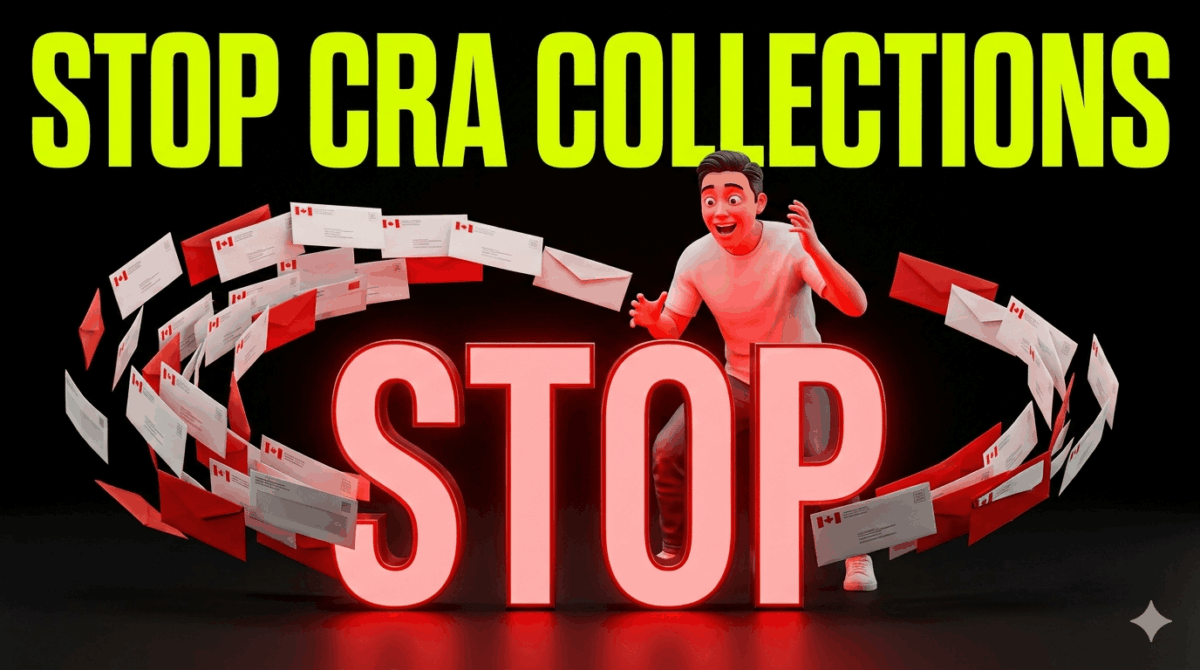
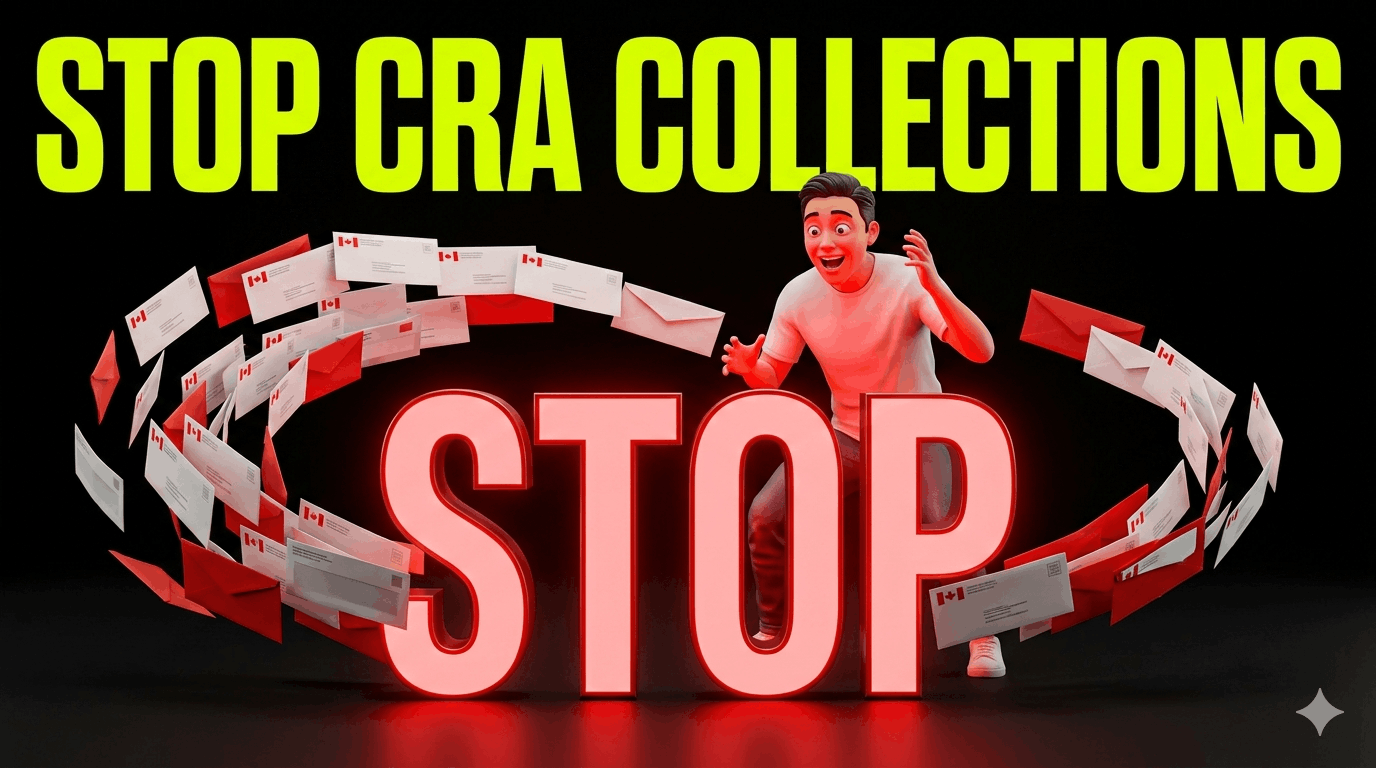
A swirling tornado of CRA collections notices and garnishments, with a person reacting with extreme relief after an insolvency filing with Ira Smith Trustee & Receiver Inc. with a stop sign representing the stay of proceedings.
cra collections

Why Are CRA Collections Important to Address Immediately?

Crucially, addressing CRA collections matters immediately because ignoring them inevitably leads to the devastating loss of your income, livelihood, and assets. Indeed, unlike regular unsecured creditors, the federal government can completely bypass the judicial system to lock down your personal finances. Therefore, taking proactive steps is the only way to retain control over your daily income, living expenses and assets.

Ever wonder how much tax debt is actually floating around in Canada? According to the latest 2024-25 Departmental Plan from the Canada Revenue Agency (CRA), the numbers are pretty eye-opening. During the 2022–2023 fiscal year alone, the agency managed to resolve a staggering $89.1 billion in outstanding tax debt.. — Source: [Canada Revenue Agency’s 2024–25 Departmental results report].

Additionally, pretending the problem does not exist will never make it miraculously disappear. Surprisingly, many desperate individuals falsely assume the government will eventually forget about older debts or stop calling. Actually, the collections department will systematically add compounding interest and severe financial penalties to your principal balance every single day. Thus, you must address this growing crisis head-on to protect your family’s future stability.

Personal Income Tax Debt vs. Director Liability: What is the Difference?

Primarily, the main difference is that personal tax debt belongs solely to you as an individual, whereas director liability transfers a corporation’s unpaid trust funds directly onto your personal shoulders. Significantly, many small business owners falsely believe their corporate structure automatically shields them from all company financial obligations. However, the government has enacted strict rules explicitly designed to pierce the corporate veil when unremitted trust funds are involved. Unquestionably, understanding this critical legal distinction is vital for any Canadian entrepreneur.

Your Personal Tax Debt

Generally, your personal tax debt consists of unpaid income taxes tied directly to your unique Social Insurance Number. Furthermore, if you are operating as a sole proprietor, your business revenues and personal income are treated as the same entity by the government. Consequently, any failure to pay these assessed amounts will trigger aggressive enforcement against your personal bank accounts and physical assets. Fortunately, a structured Consumer Proposal, or Division I Proposal for debts greater than the Consumer Proposal maximum debt threshold amount, can effectively address and eliminate these exact personal liabilities if filed in time.

Equally, it is important to recognize that receiving a Notice of Assessment is merely the beginning of the government’s enforcement timeline. Eventually, if you consistently fail to respond or establish a payment arrangement, the collections department severely escalates the file. Furthermore, they can register a restrictive tax lien against your family home, which legally secures their financial interest in your property. Therefore, addressing personal tax balances before they morph into secured debts is paramount. That is exactly what I meant in the above paragraph when I said the insolvency proceeding can eliminate the tax debt “if filed on time”. Once the CRA collections group liens your property, an insolvency proceeding cannot eliminate that secured debt.

Director Liability for Corporate Taxes (GST/HST & Payroll)

Critically, corporate directors in Canada can also be held personally liable for a company’s unpaid GST/HST and payroll source deductions under Section 227.1 of the Income Tax Act. Namely, these specific amounts are considered “trust funds” that the business legally collected on behalf of the federal government. Many corporate insolvencies I have been involved with have significant director liability for unremitted trust funds. Therefore, exploring a Corporate Restructuring early can definitely prevent these corporate debts from becoming devastating personal burdens.

FeaturePersonal Income Tax DebtDirector Liability (Trust Funds)
Source of DebtPersonal income, sole proprietorship revenues, or capital gains.Unremitted corporate GST/HST and employee payroll deductions.
Who is Responsible?The individual taxpayer (tied to SIN).The legally appointed directors of the corporation.
Corporate Income TaxNot applicable.Directors are generally not liable for regular corporate income tax.
Best Resolution MethodRestructuring Proposal or Personal Bankruptcy.Corporate Restructuring followed by personal insolvency protection if assessed.

Non-Insolvency Recommendations: Can You Negotiate with the CRA Collections Group?

Typically, negotiating with the CRA outside of formal insolvency involves establishing a voluntary payment plan or requesting penalty relief, but neither reduces the actual principal balance. Specifically, you can offer a detailed payment plan to pay off the full debt over a relatively short period. Nevertheless, the CRA collections agent will usually demand complete disclosure of your household income and living expenses before agreeing to anything. Also, they will aggressively expect you to borrow money from banks or family members if you have the borrowing capacity.

Moreover, attempting to negotiate a massive reduction of your principal debt entirely by yourself will always fail. Surprisingly, many taxpayers waste thousands of dollars on unregulated debt consultants who falsely promise to slash government tax bills. Realistically, these questionable consultants simply charge you exorbitant upfront fees to fill out basic forms that the government frequently rejects anyway. Thus, avoiding these costly emotional scams is crucial when seeking legitimate tax relief.

Furthermore, you might carefully consider applying for Taxpayer Relief if your tax issues stem from extraordinary, uncontrollable circumstances like severe illness. Admittedly, Taxpayer Relief requests can result in a partial or full waiver of penalties, but I could not find any statistics on what percentage of requests are successful. — Source: [Canada Revenue Agency (CRA) Objections, appeals, disputes, and relief measures]. However, this specific government program legally cannot forgive the principal tax amount you owe under any circumstance. Ultimately, non-insolvency options only work if you actually have the future cash flow to pay back the entire debt.

A swirling tornado of CRA collections notices and garnishments, with a person reacting with extreme relief after an insolvency filing with Ira Smith Trustee & Receiver Inc. with a stop sign representing the stay of proceedings.
cra collections

Insolvency Recommendations: The Only Way to Legally Reduce CRA Debt

Undeniably, filing a formal insolvency proceeding is the only government-approved method to legally reduce or eliminate your CRA principal tax debt. Historically, many desperate Canadians have tried informal debt settlement companies, only to discover that those private companies have absolutely no legal power over the CRA.

In Canada, the only legally binding way to force the Canada Revenue Agency to accept less than the full amount of your principal tax debt is by filing a Restructuring Proposal or Personal Bankruptcy through a Licensed Insolvency Trustee. Consequently, these robust federal procedures provide unmatched legal protection.

Stopping the CRA with a Consumer Proposal or a Division I Proposal

Specifically, a Consumer Proposal or Division I Proposal is a binding legal agreement where you formally offer to pay the CRA and your other creditors a percentage of what you owe over a maximum of five years. If the CRA collections department freezes your bank account or garnishes your wages, filing a Consumer Proposal or Division I Proposal triggers an automatic stay of proceedings, which immediately halts all CRA collection actions. Moreover, this incredible option allows you to keep all your personal assets, including your valuable home equity.

Consequently, you can reduce your CRA tax debt safely, privately, and predictably.

Additionally, a Restructuring Proposal brilliantly consolidates your tax obligations with all your other unsecured debts, such as outstanding credit cards and payday loans. Emphatically, this means you make only one affordable monthly payment to your Trustee, who then accurately distributes the funds to your creditors. Subsequently, upon successful completion of the proposal, you receive a Certificate of Full Performance, legally clearing the remaining balances forever. Unquestionably, this proven process provides unparalleled peace of mind for stressed taxpayers.

Erasing Tax Debt with Personal Bankruptcy

Alternatively, filing for bankruptcy is a legal process that eliminates your unsecured debts, including tax debts, when you mathematically cannot afford a Consumer Proposal or Division I Proposal. Occasionally, a historical tax burden becomes so enormous that making any meaningful repayment over time is completely impossible. Therefore, bankruptcy provides an absolute, immediate fresh start, albeit with more strict financial reporting rules and potential asset liquidations.

Overwhelmingly, people fear bankruptcy because they misunderstand how the modern system actually functions. Admittedly, it is considered a last resort, but it remains a highly effective, legally enshrined tool for navigating financial crises when no other options exist. Furthermore, over 80% of personal insolvencies in Canada are now filed as Consumer Proposals rather than bankruptcies. — Source: [Canadian Association of Insolvency and Restructuring Professionals, May 2025]. Thus, you likely have more protective options available than you currently realize.

Tools for Managing Tax Debt: Practical Applications

Practically, managing your tax debt requires you to actively use digital tools like the CRA My Account portal to monitor your exact, up-to-date balances. First, you should log in regularly to thoroughly review your Notices of Assessment and carefully verify any newly applied penalties or interest charges. Second, organizing your personal financial statements using basic spreadsheet software will dramatically help you evaluate your realistic ability to repay. Finally, keeping meticulously detailed records is crucial when we evaluate your unique situation during a free consultation.

Additionally, if you are a corporate director, you must religiously maintain impeccable records of all trust fund remittances made to the government. Actionable Suggestion: Take a digital screenshot of your payroll software’s tax remittance confirmation screen every single month. Assuredly, having clear, undeniable documentation proves to the CRA that you acted with proper due diligence, which is a key legal defence against personal liability assessments. Thus, strong, consistent administration directly protects your hard-earned personal wealth.

CRA Collections: Why You Need Ira Smith Trustee & Receiver Inc. Right Now

Next, your absolute immediate step must be to Contact Us at Ira Smith Trustee & Receiver Inc. before CRA collections recklessly escalates its enforcement actions against you. Naturally, attempting to fight an incredibly powerful government agency entirely on your own is an intimidating and often futile endeavour. However, we understand exactly how to expertly navigate their complex bureaucracies and legally protect your rights.

Furthermore, we proudly offer a completely safe, confidential, and non-judgmental environment to openly discuss your most pressing financial fears. Obviously, carrying a massive tax debt causes immense emotional distress, but we have successfully solved these exact, terrifying problems for countless Ontarians. Ultimately, scheduling a free, no-obligation consultation with our firm is the absolute fastest way to regain your peace of mind and permanently secure your financial future.

Frequently Asked Questions (FAQs) About CRA Collections

Generally, people suddenly facing severe tax enforcement have numerous urgent questions about their fundamental rights and available options. Accordingly, here are a few of the most common inquiries we receive regarding these highly stressful financial situations.

Q: Can the CRA Collections Group garnish my wages or freeze my bank account without a court order?

A: The short answer is yes. Unlike a credit card company or a private lender, the CRA doesn’t need to sue you or get a judge’s permission to take action. They use a powerful tool called a “Requirement to Pay.” This allows them to go straight to your employer and take up to 50% of your gross pay before it even hits your pocket. They can also instruct your bank to freeze your accounts or hand over whatever funds are currently available to cover your balance.

Q: Can a Consumer Proposal reduce my CRA tax debt?

A: Indeed, a Consumer Proposal is the absolute only legal way to negotiate down the principal tax debt without filing bankruptcy. Furthermore, the CRA generally accepts reasonable proposals if they clearly offer a better financial return than what the government would receive in a bankruptcy scenario. Consequently, it is a highly effective, government-approved tool for struggling taxpayers.

Q: Am I personally liable for my corporation’s tax debt?

A: If you are a director of a corporation, you can definitely be held personally liable for that corporation’s unremitted corporate GST/HST and payroll deductions, but generally not for standard corporate income tax. However, if corporate funds were transferred to you inappropriately, such as taking personal dividends while the company owed taxes, the CRA can aggressively pursue you under Section 160 of the Income Tax Act. Thus, corporate structures do not offer blanket protection against the CRA collections squad.

Q: What is the CRA Taxpayer Relief provision?

A: Basically, it is a formal, written request to cancel or waive accumulated penalties and interest due to documented financial hardship or extraordinary personal circumstances. Importantly, this specific provision strictly limits the CRA from ever forgiving the actual principal tax debt you initially owe. Accordingly, you still must ultimately pay your unpaid taxes in full under this program.

Q: Can I negotiate a payment plan directly with the CRA Collections Team?

A: You can certainly try, but don’t expect them to lower the total amount you owe. While the CRA might agree to a short-term monthly arrangement, they usually play hardball. They’ll likely ask for a full breakdown of your household spending and might even insist you try to get a bank loan or borrow from family before they’ll consider an installment plan. Essentially, they want to ensure you’ve exhausted every other option first.

Q: What is the difference between personal tax debt and director liability?

A: Personal tax debt is attached to you directly through your Social Insurance Number; it typically comes from personal income taxes or revenue from a sole proprietorship. Director liability is a bit more aggressive. It occurs when the government “pierces the corporate veil” to hold a company director personally responsible for unpaid “trust funds”—specifically GST/HST or payroll deductions that the corporation failed to send to the government.

Q: Will filing for bankruptcy eliminate my tax debt?

A: Yes, it will. Bankruptcy is a legal mechanism designed to wipe out most unsecured debts, and tax debt is included in that. It’s usually seen as a final option if a Consumer Proposal isn’t feasible, but it does offer an immediate fresh start, even if it means some of your assets might be liquidated in the process.

Q: How can I protect myself from being held personally liable for corporate trust funds?

The best defence is staying ahead of the paperwork. You need to prove you exercised “due diligence,” which basically means you did everything a reasonable person would do to ensure the taxes were paid. This involves keeping airtight records and even taking screenshots of every payroll remittance confirmation. If the business is starting to struggle, looking into corporate restructuring early can help keep those corporate debts from becoming your personal burden.

Conclusion: Taking Back Control from the CRA Collections People

Taking back control from the CRA collections people means thoroughly understanding your liabilities and actively utilizing the powerful legal protections offered by Canadian insolvency laws. Assuredly, you absolutely do not have to live your life in constant, paralyzing fear of frozen bank accounts or suddenly garnished wages. Indeed, there are proven, completely legal strategies readily available to instantly stop the collections process and negotiate your massive debt down to a manageable size. Therefore, you absolutely hold the power to permanently change your financial trajectory today.

Ultimately, the clear path to a stress-free, debt-free life begins with a single, confidential phone call to a trusted, licensed professional. Fortunately, at Ira Smith Trustee & Receiver Inc., we are entirely ready to stand firmly between you and the aggressive CRA collections people. Unquestionably, a much brighter, financially secure future is entirely within your reach if you choose to take action now.

Don’t let the threats from the CRA collections group lead to financial ruin. Contact Ira Smith Trustee & Receiver Inc. today for a free, no-obligation consultation. We are here to help you understand your situation, explore your legal options under Canadian insolvency law, and create a clear path towards a debt-free future. You deserve a fresh start, and we are here to help you achieve it.

Take the first crucial step towards a brighter financial future for your business. Contact Ira Smith Trustee & Receiver Inc. today to schedule your free initial consultation. Your business’s pivot to sustainable success starts now.

Don’t let financial uncertainty dictate your future. If you or your business is struggling with debt, losing sleep, or facing the possibility of legal action, contact Ira Smith Trustee & Receiver Inc. today. We offer a free, confidential consultation to discuss your situation, explain your options in plain language, and help you develop a clear, actionable plan. Our team of Licensed Insolvency Trustees is dedicated to providing the compassionate, professional support you need to regain control and achieve a debt-free life. Take the first step towards a brighter financial future – call us now.

Ira Smith Trustee & Receiver Inc. is licensed by the Office of the Superintendent of Bankruptcy and is a member of the Canadian Association of Insolvency and Restructuring Professionals.

  • Phone: 905.738.4167
  • Toronto line: 647.799.3312
  • Email: brandon@irasmithinc.com

——————————————————————————–

Disclaimer: This analysis is for educational purposes only and is based on the cited sources and my professional expertise as a licensed insolvency trustee. The information provided does not constitute legal or financial advice for your specific circumstances.

Every situation is unique and involves complex legal and factual considerations. The outcomes discussed in this article may not apply to your particular situation. Situations are fact-specific and depend on the particular circumstances of each case.

Please contact Ira Smith Trustee & Receiver Inc. get in touch with Ira Smith Trustee & Receiver Inc.

About the Author:

Brandon Smith is a Senior Vice-President at Ira Smith Trustee & Receiver Inc. and a licensed insolvency trustee serving clients across Ontario. With extensive experience in complex court-ordered receivership administration and corporate insolvency & restructuring proceedings, Brandon helps businesses, creditors, and professionals navigate challenging financial situations to achieve optimal outcomes.

Brandon stays current with landmark developments in Canadian insolvency law. He brings this cutting-edge knowledge to every client engagement, ensuring his clients benefit from the most current understanding of their rights and options.

A swirling tornado of CRA collections notices and garnishments, with a person reacting with extreme relief after an insolvency filing with Ira Smith Trustee & Receiver Inc. with a stop sign representing the stay of proceedings.
cra collections
Categories
Brandon Blog Post

BUILDING YOUR CREDIT WITH A SECURED CREDIT CARD: OUR COMPREHENSIVE 2026 GUIDE

building your credit with a secured credit card

Building Your Credit With A Secured Credit Card: Introduction

Admittedly, filing for a consumer proposal or bankruptcy might feel like a financial life sentence, leaving you deeply anxious about ever renting an apartment or buying a car again. However, the path to recovery is much faster than you think once the overwhelming collection calls finally stop. Therefore, I promise to show you exactly how to rebuild your financial foundation by building your credit with a secured credit card today.

Key Takeaways

  • Undeniably, your credit history is not ruined forever: Insolvency simply resets the clock so you can establish a healthy, fresh start.
  • Crucially, timing is everything: You can start rebuilding as soon as your consumer proposal is accepted or your bankruptcy is discharged.
  • Specifically, secured cards are your best tool: Using a secured credit card responsibly is the safest, fastest way to boost your score in Canada.
  • Additionally, keeping utilization low is vital: Maintaining your credit utilization below 30% dramatically accelerates your rating improvement.
  • Ultimately, patience always pays off: Consistent, on-time payments will drastically improve your credit profile within a predictable 12 to 18 months.

What is Building Your Credit With A Secured Credit Card?

Specifically, building your credit with a secured credit card means using an upfront cash deposit as collateral to open a revolving credit line, which then reports your positive payment history to major credit bureaus. Interestingly, unlike regular unsecured loans, this cash deposit completely removes the risk for the lender. Consequently, major financial institutions are highly willing to approve you even right after an insolvency filing. Furthermore, this specific tool serves as your primary stepping stone back into the mainstream Canadian lending market.

Importantly, secured credit cards typically require a minimum cash deposit of $300 to $500. — Source: [FAQs About Rebuilding Credit With Secured Credit Cards, Ride Time, August 15, 2017]. Therefore, if you provide a credit card company with a $500 deposit, your spending limit becomes exactly $500. Next, as you make everyday purchases and pay off the balance, your good behavior is continuously recorded by the credit bureaus. Ultimately, this creates a fresh, undeniably positive track record on your active file.

Indeed, at Ira Smith Trustee & Receiver Inc., we constantly advise our clients that this strategy is the absolute fastest way to bounce back. Fortunately, filing for insolvency clears away the broken structure, but a secured card pours the new, solid concrete foundation. Currently, thousands of Ontarians use this exact method every single year to reclaim their financial independence. Ultimately, this proactive approach turns a highly stressful situation into an empowering fresh start.

Why Building Your Credit With A Secured Credit Card Matters After Insolvency

Unquestionably, secured credit cards matter after insolvency because they are the only reliable, guaranteed method to demonstrate new financial responsibility to Equifax and TransUnion. Sadly, mainstream banks will temporarily deny you unsecured loans following a personal bankruptcy or a proposal. Therefore, you desperately need a specialized financial tool to break this frustrating cycle of rejection. Actually, this is exactly where the Canadian cash deposit system becomes incredibly valuable.

Surprisingly, 140,457 Canadians filed for consumer insolvency in 2025. — Source: [Office of the Superintendent of Bankruptcy, Report Insolvency Statistics in Canada — December 2025.]. Consequently, a massive portion of the population is actively looking for proven ways to rebuild their financial lives. Fortunately, secured cards offer a direct, highly accessible pathway for these hard-working individuals. Indeed, these specific cards report directly to the national credit bureaus just like traditional, unsecured lending products.

Clearly, a low credit score is only temporary, and your actions today will dictate your financial freedom tomorrow. Moreover, establishing a new, active trade line shows future lenders that you have deeply learned from past financial challenges. Eventually, this consistent reporting buries your old financial mistakes under a massive mountain of good financial habits. Thus, utilizing this strategy is absolutely vital for your long-term economic success.

Understanding R7 and R9 Credit Ratings

Technically, understanding R7 and R9 credit ratings means recognizing how major bureaus legally classify your specific type of insolvency filing in Canada. Specifically, an R7 rating indicates a special arrangement to settle debts, such as a consumer proposal in Ontario. Conversely, an R9 rating is the lowest possible score, signifying bad debt or a formal bankruptcy filing. Consequently, these standardized labels temporarily alert future lenders to your past financial difficulties.

Factually, roughly 78% of consumer insolvencies in Ontario are now proposals rather than bankruptcies. — Source: [Office of the Superintendent of Bankruptcy, report Insolvency Statistics in Canada — November 2025.]. Therefore, the R7 rating is becoming incredibly common among honest, hard-working Canadians. Fortunately, this rating is definitely not a permanent black mark on your identity. Eventually, the credit bureau completely purges this negative data from your active credit file.

A person confidently reviewing financial documents and building credit with a secured credit card in Canada after insolvency
building your credit with a secured credit card

How Soon Can You Start Building Your Credit With A Secured Credit Card If You Make An Insolvency Filing?

Fortunately, you can start building your credit with a secured credit card immediately after your consumer proposal is officially accepted or your bankruptcy is fully discharged. Honestly, one of the most common questions we receive as Licensed Insolvency Trustees is regarding this exact timeline. However, you must patiently wait for the official legal approval before applying for new trade lines. Otherwise, premature applications can result in hard credit inquiries that unintentionally damage your score further.

Notably, a consumer proposal remains on your Equifax report for 3 years after completion. — Source: [Financial Consumer Agency of Canada, October 15, 2025]. Similarly, a first-time bankruptcy stays on your public record for 6 to 7 years after discharge (Equifax – 6 years, TransUnion – 7 years). — Source: [Financial Consumer Agency of Canada, October 15, 2025]. Regardless, you absolutely do not have to wait for these black marks to fall off before you start repairing your profile. Actually, lenders love a comeback story backed by recent, highly positive data.

For building your credit with a secured credit card after filing for insolvency, Licensed Insolvency Trustees advise that the process can begin immediately upon approval, provided you keep your credit utilization under 30%. Specifically, taking action early creates a parallel track of excellent history alongside the older negative marks. Consequently, by the time your R7 or R9 rating legally drops off, you will already possess a fantastic credit score. Unquestionably, proper timing and steadfast patience are your best friends here.

The Core Process: Building Your Credit With A Secured Credit Card Step-by-Step

Systematically, the core process of your step-by-step building your credit score with a secured credit card involves saving a deposit, applying for the right secured product, keeping balances low, and paying your bill in full every single month. First, you must diligently save your security deposit by setting aside a small amount from each paycheque. Realistically, treating this deposit as a direct investment in your financial future completely changes your entire perspective. Soon, you will have the required $300 to $500 ready to securely invest.

Next, you must carefully apply for a card that specifically caters to credit rebuilding in Canada. Crucially, make sure the financial institution officially reports to both Equifax and TransUnion. Otherwise, your hard work will not actually improve your national credit rating. Fortunately, several highly reputable Canadian financial companies offer these exact, bureau-reporting products.

Importantly, payment history accounts for roughly 35% of your total credit score. — Source: [Equifax Canada]. Therefore, paying the balance in full and on time every single month is the most critical step you can take. Deliberately, you should never carry a rolling balance, and you should never pay unnecessary credit card interest. Ultimately, extreme consistency over time proves to cautious lenders that you are now highly reliable.

Mastering Credit Utilization

Strategically, mastering credit utilization means keeping your total borrowed balance strictly below 30% of your available credit limit at all times. Interestingly, this is a powerful secret to outsmarting the credit system that many Canadians unfortunately overlook. For example, if your hard limit is $500, you should never let your monthly balance exceed $150. Consequently, this remarkably low usage signals to lenders that you are not desperate for borrowed funds.

Factually, credit utilization makes up 30% of your credit score calculation. — Source: [Equifax Canada]. Furthermore, actively keeping this specific ratio low is the second most impactful action you can ever take. Specifically, we highly recommend using the secured card for small, predictably recurring expenses like a monthly Netflix subscription. Then, simply pay that tiny amount off immediately to secure the positive reporting.

Avoiding Common Rebuilding Mistakes

Crucially, avoiding common rebuilding mistakes involves dodging predatory lending traps and refraining from applying for too many credit lines at once. Unfortunately, many predatory lenders maliciously target recently discharged individuals with high-interest, unsecured installment loans. Consequently, these toxic loans often trap vulnerable consumers in a fresh cycle of unmanageable debt. Therefore, sticking exclusively to secured, low-limit products is vastly safer for your recovery.

Shockingly, multiple hard credit inquiries within a short period can temporarily drop your score by up to 10 points per check. — Source: [Capital One, January 28, 2025]. Thus, you must deliberately space out your applications very strategically. Instead, proudly apply for a single secured card and focus entirely on nurturing that one account. Ultimately, slow and exceptionally steady progress always wins this financial race.

Tools for Tracking, Applying for and Building Your Credit With A Secured Credit Card

The best tools for tracking and applying include free Canadian credit monitoring apps like Borrowell and Credit Karma, as well as reputable financial institutions that offer secured products. Fortunately, monitoring apps safely let you watch your score improve in real time without hurting your rating. Moreover, seeing the three-digit number climb provides incredible emotional relief and powerful daily motivation. Additionally, choosing the right physical card is just as fundamentally important as tracking it.

Visually, comparing your distinct options helps ensure you select the absolute best product for your specific financial situation. Below, we have clearly outlined some of the top secured options actively available to Canadians post-insolvency.

Tool / Card NameMinimum Deposit RequiredReports to Major BureausBest Feature
Capital One Secured Mastercard$75 to $300 (varies by file)Yes (Equifax & TransUnion)Guaranteed approval for most bankruptcies
Neo Secured Credit Card$50Yes (Equifax & TransUnion)Flexible limit and cash back rewards
Home Trust Secured Visa$500Yes (Equifax & TransUnion)No annual fee option available
Borrowell AppN/A (Free Digital Tool)N/A (Pulls from Equifax)Weekly free credit score updates

Undoubtedly, reviewing a screenshot of your initial credit report from these monitoring apps will greatly help you establish a factual baseline. Then, you can accurately track your upward progress month by month. Specifically, according to Brandon Smith, Senior Vice-President of Ira Smith Trustee & Receiver Inc., building your credit with a secured credit card in Canada is highly effective because your upfront cash deposit acts as collateral, allowing major credit bureaus like Equifax and TransUnion to safely record your positive payment history.

Ultimately, heavily leveraging these digital tools guarantees you stay firmly on the right path.

Encouragingly, over 75% of Canadians who use secured cards see score improvements within 12 to 18 months. — Source: [Canadian Credit Counselling Society, How to Rebuild Your Credit in Canada – 7 Points, January 10, 2025]. Consequently, utilizing these exact modern tools turns a deeply confusing ordeal into a simple, highly manageable routine. Indeed, financial technology has miraculously made rebuilding credit significantly easier than ever before.

A person confidently reviewing financial documents and building credit with a secured credit card in Canada after insolvency to prove how to building your credit with a secured credit card.
building your credit with a secured credit cardf

Next Steps for Your Financial Recovery

First, absolutely ensure you have completed all mandatory counselling sessions required by your Licensed Insolvency Trustee. Legally, these critical sessions are strictly mandatory to properly receive your official Certificate of Full Performance in a proposal or a discharge from bankruptcy. Afterwards, you are finally given the bright green light to proceed forward.

Remarkably, individuals who actively monitor their credit are 40% more likely to maintain a good score long-term. — Source: [TransUnion, January 31, 2024]. Therefore, you should immediately download a free Canadian monitoring tool today. Next, promptly open a dedicated, separate savings account specifically for your security deposit. Clearly, proactively breaking the recovery process down into small, highly actionable weekly goals makes it entirely achievable.

Excitingly, upgrading to an unsecured card involves demonstrating 12 to 18 months of flawless payment history on your secured account, prompting the lender to cheerfully return your initial cash deposit. Normally, the financial institution will automatically review your file after a full year of consistent, responsible usage. Subsequently, if your track record is entirely spotless, they will eagerly offer to transition your account to a standard line of credit. Immediately, this distinct transition signals a massive, life-changing victory in your rebuilding journey.

Historically, secured cardholders who maintain zero missed payments for 18 months are 85% more likely to be approved for standard credit products. — Source: [Neobank – No Credit Check Credit Card Canada: Real Alternatives 2026, January 29, 2026 ]. Furthermore, this earned upgrade often dramatically comes with a welcomed credit limit increase. Consequently, this much higher limit instantly and vastly improves your overall credit utilization ratio. Unquestionably, this strategic upgrade creates a compounding, highly positive effect on your total score.

Frequently Asked Questions (FAQs): Building Your Credit With A Secured Credit Card

If you’re looking to bounce back from financial setbacks, you likely have plenty of questions about where to start. Secured credit cards are often the first step. Here is a breakdown of how they work and how you can use them to reclaim your credit score.

Q: What exactly is a secured credit card?

A: Think of a secured credit card as a revolving credit line with a safety net for the bank. You provide an upfront cash deposit, which acts as collateral. This essentially removes the risk for the lender, meaning they are far more likely to say “yes” to your application—even if you’ve recently filed for insolvency. Generally, the amount you put down becomes your spending limit.

Q: How soon can I start rebuilding my credit after insolvency?

A: You don’t have to wait years to start over. You can actually begin the process as soon as your consumer proposal is officially accepted or your bankruptcy is fully discharged. A quick word of caution: make sure you have that official legal approval in hand before you start applying. Jumping the gun can lead to “hard” credit inquiries that might ding your score before you’ve even had a chance to build it up.

Q: How much of a security deposit will I need?

A: Most cards in Canada look for a deposit of somewhere between $300 and $500. However, there is some flexibility depending on the provider. For instance, the Neo Secured Credit Card allows you to start with as little as $50. Others, like Capital One, might range from $75 to $300 based on the specifics of your credit file.

Q: What is credit utilization, and why does it matter so much?

A: Credit utilization is just a fancy way of describing the ratio between what you owe and your total limit. It’s a huge factor—accounting for about 30% of your total credit score.

To keep your score trending upward, try to keep your balance below 30% of your limit. For example, if your limit is $500, you really shouldn’t carry a balance higher than $150. It shows lenders you can manage credit without leaning on it too heavily.

Q: How long does it take to see an improvement in my score?

A: Consistency is the name of the game here. If you make every payment on time, you’ll likely see a significant shift in your credit profile within 12 to 18 months. In fact, research indicates that over 75% of Canadians using secured cards see a noticeable improvement in their score within that window.

Q: What is the difference between an R7 and an R9 credit rating?

A: In Canada, credit bureaus use these codes to classify your debt. An R7 rating means you’ve made a special arrangement to settle your debts (like a consumer proposal). An R9 is the lowest rating possible, usually reserved for bad debts, accounts sent to collections, or formal bankruptcy filings.

Q: Do these cards report to both major Canadian credit bureaus?

A: Most reputable lenders will report your activity to both Equifax and TransUnion. This is vital for your recovery, as your payment history makes up roughly 35% of your total score. If the lender doesn’t report to both, you’re only doing half the work.

Q: Can I eventually get my security deposit back?

A: Yes! If you show a flawless track record of payments for 12 to 18 months, many lenders will review your account automatically. If they see you’ve been responsible, they’ll often return your initial deposit and “graduate” you to a standard, unsecured credit card.

Q: What common mistakes should I avoid?

A: The biggest trap is applying for too many things at once. Each “hard” inquiry can pull your score down by up to 10 points. Also, stay away from predatory lenders offering high-interest unsecured loans. They might seem like an easy fix, but they often lead right back into a cycle of debt.

Q: Are there tools to help me track my progress?

A: Absolutely. Apps like Borrowell and Credit Karma are great for monitoring your score in real-time without hurting your rating. Staying informed pays off—data shows that people who actively monitor their credit are 40% more likely to maintain a healthy score in the long run.

Brandon’s Take On Building Your Credit With A Secured Credit Card

Ultimately, building your credit with a secured credit card is the most powerful, legally proven method to reclaim your financial independence after a difficult insolvency filing. Undeniably, navigating daily life after a consumer proposal or bankruptcy can deeply feel like a confusing mix of profound relief and temporary uncertainty. However, you absolutely now possess the exact, step-by-step blueprint desperately needed to succeed. Furthermore, the societal stigma of insolvency is entirely unwarranted; you simply made a brilliant, highly strategic choice to fix your foundation.

Confidently, thousands of Canadians successfully complete this exact financial journey every single year, brilliantly proving that recovery is entirely within your reach. Therefore, please stay incredibly patient, keep your credit utilization perpetually low, and always pay your balances in full. Eventually, the mainstream banks that once harshly turned you away will be eagerly offering you their premium lending products again. Ultimately, your beautiful, well-deserved fresh start is already wonderfully underway.

Building Your Credit With A Secured Credit Card: Conclusion

Finally, if you are currently silently struggling with overwhelming debt and have not yet filed, please do not suffer in silence for another single day. Reach out directly to the deeply compassionate experts at Ira Smith Trustee & Receiver Inc. for a free, entirely confidential consultation. Together, we can permanently eliminate your financial stress and safely guide you back toward total peace of mind. Truly, starting over is not giving up; it is fiercely taking control of your amazing future.

Don’t let the silent threat of a personal guarantee lead to financial ruin. Contact Ira Smith Trustee & Receiver Inc. today for a free, no-obligation consultation. We are here to help you understand your situation, explore your legal options under Canadian insolvency law, and create a clear path towards a debt-free future. You deserve a fresh start, and we are here to help you achieve it.

Take the first crucial step towards a brighter financial future for your business. Contact Ira Smith Trustee & Receiver Inc. today to schedule your free initial consultation. Your business’s pivot to sustainable success starts now.

Don’t let financial uncertainty dictate your future. If you or your business is struggling with debt, losing sleep, or facing the possibility of legal action, contact Ira Smith Trustee & Receiver Inc. today. We offer a free, confidential consultation to discuss your situation, explain your options in plain language, and help you develop a clear, actionable plan. Our team of Licensed Insolvency Trustees is dedicated to providing the compassionate, professional support you need to regain control and achieve a debt-free life. Take the first step towards a brighter financial future – call us now.

Ira Smith Trustee & Receiver Inc. is licensed by the Office of the Superintendent of Bankruptcy and is a member of the Canadian Association of Insolvency and Restructuring Professionals.

  • Phone: 905.738.4167
  • Toronto line: 647.799.3312
  • Email: brandon@irasmithinc.com

——————————————————————————–

Disclaimer: This analysis is for educational purposes only and is based on the cited sources and my professional expertise as a licensed insolvency trustee. The information provided does not constitute legal or financial advice for your specific circumstances.

Every situation is unique and involves complex legal and factual considerations. The outcomes discussed in this article may not apply to your particular situation. Situations are fact-specific and depend on the particular circumstances of each case.

Please contact Ira Smith Trustee & Receiver Inc. get in touch with Ira Smith Trustee & Receiver Inc.

About the Author:

Brandon Smith is a Senior Vice-President at Ira Smith Trustee & Receiver Inc. and a licensed insolvency trustee serving clients across Ontario. With extensive experience in complex court-ordered receivership administration and corporate insolvency & restructuring proceedings, Brandon helps businesses, creditors, and professionals navigate challenging financial situations to achieve optimal outcomes.

Brandon stays current with landmark developments in Canadian insolvency law. He brings this cutting-edge knowledge to every client engagement, ensuring his clients benefit from the most current understanding of their rights and options.

A person confidently reviewing financial documents and building credit with a secured credit card in Canada after insolvency
building your credit with a secured credit card
Categories
Brandon Blog Post

THE ULTIMATE GUIDE TO SURVIVING TERRIBLE TARIFFS ANXIETY: PROTECTING VAUGHAN, ONTARIO MANUFACTURERS FROM U.S. BORDER COSTS

Undeniably, large tariffs don’t just cut into your profit margins—it wipes them out overnight. However, panic is an inadequate response when your auto parts manufacturing business in Vaughan, Ontario, faces an immediate cash flow crisis. Consequently, this guide delivers actionable strategies to leverage corporate debt restructuring and protect your company from impending U.S. trade tensions.

Key Takeaways:

  • Margin wipeout: Tariffs directly hit cash flow, making debt repayment impossible for many suppliers.
  • Action over panic: Mitigating the impact of tariffs requires immediate financial restructuring, not just operational shifts.
  • Legal protection: Tools like a Division I Proposal stop creditor collections while you fix your supply chain.
  • Expert help: Ira Smith Trustee & Receiver Inc. can guide your Ontario manufacturing business back to profitability, whether it is located in Woodbridge, Ontario, or anywhere else in the Greater Toronto Area.

What is Tariffs-Induced Anxiety?

Tariffs-induced anxiety is the severe financial stress experienced by business owners facing sudden, crippling border taxes on their exported goods. Indeed, this fear is completely justified for companies operating within Ontario’s deeply integrated automotive network. Often, executives lose sleep wondering how they will meet payroll when cross-border shipping costs unexpectedly double overnight. Statistically, Ontario’s auto sector supports over 100,000 direct jobs. — Source: [Government of Ontario, 2023].

Consequently, this widespread economic anxiety affects not just CEOs, but thousands of hardworking families across the province. Ontario manufacturers facing tariffs anxiety can achieve supply chain resilience by legally renegotiating vendor debt and pausing creditor payments through a licensed insolvency trustee. Ultimately, acknowledging this anxiety is the vital first step toward implementing a strategic financial turnaround.

Why Mitigating The Impact of Tariffs Matters

Fundamentally, mitigating the impact of tariffs matters because ignoring these costs will instantly push a healthy manufacturing business into severe corporate insolvency. Actually, the automotive supply chain relies heavily on parts that cross the border multiple times before final assembly. Crucially, cross-border friction and tariffs can add up to $5,000 to the final price of a vehicle. — Source: [TD Economics, 2019]. Therefore, addressing these costs immediately prevents minor cash flow hiccups from becoming fatal financial wounds.

Furthermore, increased costs at the border inevitably result in lower consumer sales and drastic production cuts. Naturally, when assembly lines slow down, smaller suppliers are left with overflowing inventories and no incoming revenue. Unfortunately, commercial insolvencies in Canada surged by 41.4% year-over-year. — Source: [Office of the Superintendent of Bankruptcy, 2024]. Thus, securing professional financial advice early is the only way to avoid becoming another grim statistic.

Core Automotive Supply Chain Resilience Strategies

Strategically, automotive supply chain resilience requires a combination of aggressive cost-cutting, geographic diversification, and formal legal debt relief. First, business owners must recognize that relying solely on operational changes is rarely enough to offset a massive border penalty. Actually, panic is not a strategy; restructuring is a survival tactic. Consequently, proactive executives must explore both operational and financial pathways to secure their company’s future.

The Difference Between Operational Adjustments and Financial Restructuring

Crucially, the difference between operational adjustments and financial restructuring lies in how they address existing corporate liabilities. Initially, operational adjustments involve changing suppliers, moving warehouses, or physically altering how your goods are manufactured. While these operational shifts are necessary for long-term survival, they do absolutely nothing to eliminate the debt you have already accumulated. Conversely, formal financial restructuring specifically attacks your current debt load, providing immediate legal relief from aggressive creditors.

Moreover, operational changes typically require months or even years to fully implement across a complex supply chain. Meanwhile, tariffs-induced anxiety has undeniably dampened hiring plans for 40% of manufacturers. — Source: [First National, 2024]. Therefore, relying solely on operational pivots leaves your company highly vulnerable to bankruptcy during the lengthy transition period. Distinctly, combining both approaches guarantees that your business survives today while preparing adequately for tomorrow’s trade landscape.

Protecting Cash Flow Instantly

Initially, protecting your cash reserves is the absolute most critical step when surviving sudden Ontario manufacturing tariffs. First, audit all your current expenses and aggressively eliminate any non-essential corporate spending. Next, accelerate your accounts receivable by offering small incentives to clients who pay their invoices ahead of schedule. Ultimately, cash is the oxygen of your business, and preserving it gives you time to implement broader cross-border trade strategies.

Renegotiating Vendor Contracts Legally

Legally, renegotiating vendor contracts is a mandatory step when building robust automotive supply chain resilience. Firstly, you must proactively review every single supply agreement to identify clauses related to sudden international tax increases. Often, legacy contracts force the manufacturer to absorb all unexpected border costs entirely. Strikingly, over 70% of Ontario auto parts are destined for the American market. — Source: [Canadian Vehicle Manufacturers’ Association, 2023]. Unquestionably, absorbing a large hit on such a massive volume will immediately bankrupt most mid-sized parts suppliers in Ontario.

Subsequently, executives must initiate transparent conversations with their largest clients and most critical suppliers. Tactically, explaining your financial reality using data builds trust and encourages collaborative problem-solving across the supply network. However, if major clients refuse to share the tariffs burden, you must seriously consider utilizing formal corporate legal restructuring. Ultimately, a contract that guarantees massive financial losses is a contract that must be legally restructured or abandoned.

Importantly, when operational tweaks fail, formal Corporate Restructuring Services provide the ultimate safety net for struggling manufacturers. Specifically, according to Brandon Smith of Ira Smith Trustee & Receiver Inc., mitigating the impact of the U.S. tariffs on Ontario’s automotive supply chain requires utilizing corporate restructuring tools, such as a Division I Proposal, to protect cash flow and avoid bankruptcy. Basically, a Division I Proposal allows your business to legally pause creditor payments while you negotiate a fair financial settlement. Consequently, you remain entirely in control of your daily operations while systematically shedding unmanageable corporate debt.

Additionally, this legal protection immediately halts hostile actions from aggressive vendors or anxious lenders. Suddenly, bank accounts are unfrozen, and threatening collection calls cease completely. Ultimately, filing a formal proposal provides the critical breathing room needed to pivot your operations without the constant threat of facility closure.

An infogrphic showing the steps that Vaughan, Ontario manufacturing companies can enter bankruptcy protection to restructure with a licensed insolvency trustee as a result of tariffs reducing profitability and causing debt problems.
tariffs

Practical Tools for Cross-Border Trade Strategies

Effective cross-border trade strategies utilize specialized financial forecasting software alongside expert legal restructuring frameworks to neutralize border taxes. Fortunately, executives do not need to invent these survival blueprints from scratch. Instead, proven methodologies exist to help map out supply chain vulnerabilities and legally restructure outstanding vendor liabilities. Clearly, U.S.-bound auto shipments account for nearly 30% of Ontario’s international exports. — Source: [Statistics Canada, 2023].

Visually, exploring your options helps demystify the complex corporate turnaround process. Below is a structured comparison of the tools available to combat rising U.S. trade tensions. Specifically, this table contrasts operational adjustments with formal legal protections.

Strategy TypeTool / MethodPrimary BenefitSpeed of Impact
OperationalSupplier DiversificationBypasses border tariffs entirelySlow (6-12 Months)
FinancialCash Flow ForecastingHighlights upcoming cash crunchesFast (Immediate)
Legal ReliefDivision I ProposalStops creditor lawsuits instantlyModerate (with immediate legal protection)
Legal ReliefCorporate BankruptcyCloses unviable businesses legallyModerate (with immediate legal protection)

Thankfully, utilizing these tools prevents the emotional exhaustion that typically accompanies severe corporate financial crises. Interestingly, up to 80% of cross-border auto parts move back and forth multiple times before final assembly. — Source: [Cox Automotive, 2024]. Therefore, mapping these movements with digital tools allows you to accurately predict exactly where the tariffs will inflict the most damage.

What’s Next for Defeating U.S. Trade Tensions

Undoubtedly, the next crucial step for defeating business insolvency Ontario is scheduling a confidential assessment with a Licensed Insolvency Trustee. Simply, waiting for politicians to resolve international trade disputes is a guaranteed way to bankrupt your factory. Instead, you must immediately take decisive control over your company’s balance sheet and outstanding creditor obligations. Ultimately, supply chain resilience is not just about moving factories; it is about restructuring your corporate debt.

Presently, the dedicated experts at Ira Smith Trustee & Receiver Inc. are ready to analyze your unique financial situation thoroughly. First, we will discreetly review your cash flow statements, vendor contracts, and outstanding loan obligations. Next, we will craft a customized restructuring plan designed to pause debt collections and stabilize your manufacturing operations. Emphatically, Contact Us today to secure the immediate legal protection your Ontario business desperately requires.

Evidently, taking proactive action today significantly increases your chances of achieving a successful corporate turnaround. Habitually, businesses that seek professional insolvency advice early preserve more assets and save more local jobs. Therefore, do not let temporary international border disputes destroy the incredible enterprise you have spent years building.

Tariffs Frequently Asked Questions (FAQ)

Naturally, business owners have many pressing questions when facing unprecedented cross-border trade challenges. Below, we address the most common concerns regarding Vaughan, Ontario manufacturing tariffs and corporate survival. Read these expert answers to quickly understand your legal options and operational realities.

Q1: How do the U.S. tariffs impact Ontario automotive supply chains?

A: Financially, the U.S. tariffs drastically increase the cost of materials and finished goods crossing the international border. Because auto parts often cross the U.S.-Canada border multiple times during assembly, this tax compounds rapidly. Consequently, this compounded tax wipes out supplier profit margins, reduces consumer sales, and causes severe cash flow shortages for Ontario manufacturers.

Q2: What are the best cross-border trade strategies to mitigate the U.S. tariffs’ impact?

Operationally, to mitigate tariff impacts, businesses should immediately audit their supply chains to source local Canadian materials where possible. Additionally, companies must update sales contracts to pass on sudden tariff costs directly to end buyers. Most importantly, manufacturers must use legal financial restructuring to free up cash flow trapped by unsustainable debt loads.

Absolutely, corporate restructuring is specifically designed to save viable manufacturing businesses from unexpected macroeconomic debt shocks. Furthermore, according to Brandon Smith of Ira Smith Trustee & Receiver Inc., tools like a Division I Proposal allow businesses to pause creditor payments and renegotiate their debts legally. Ultimately, this legal mechanism provides the crucial breathing room needed to adjust to new tariffs realities and avoid Corporate Bankruptcy.

Brandon’s Take On Tariffs

You’ve worked too hard to let your livelihood get choked out by roadwork you can’t control. Making a move now, instead of waiting for the bank to call the loan, is the smartest thing you can do. The longer you wait and bleed cash, the fewer options you’ll have.

At Ira Smith Trustee & Receiver Inc., we’re in the business of finding permanent solutions for Vaughan business owners. We give you a confidential, zero-judgment space to figure out your next move—whether that’s fighting your landlord or completely restructuring your debt.

Reach out to Ira Smith Trustee & Receiver Inc. today for a FREE, no-obligation chat. Let’s look at your books, figure out your rights, and build a plan to get you through the dust. Call us at (416) 948-6933, hit up IraSmith.com, or just walk into our office at 167 Applewood Crescent in Vaughan. You aren’t doing this alone. We’re here to help you get out of the gridlock.

Ira Smith Trustee & Receiver Inc. has the expertise and experience to guide you through these perilous waters. As Licensed Insolvency Trustees, we are uniquely qualified to assess your company’s financial situation, advise on the best course of action, and help you understand and mitigate your personal risks. We can help you understand your options, assess your personal risk, and develop a strategy to protect your future. Our approach is empathetic, non-judgmental, and focused on finding the best possible outcome for you and your company.

Contact us for a free, confidential consultation. The sooner you act, the more options you have, and the better protected you will be. Let us help you navigate your path to a brighter financial future.

Ira Smith Trustee & Receiver Inc. is licensed by the Office of the Superintendent of Bankruptcy and is a member of the Canadian Association of Insolvency and Restructuring Professionals.

—————————————————————————

Disclaimer: This analysis is for educational purposes only and is based on the cited sources and my professional expertise as a licensed insolvency trustee. The information provided does not constitute legal or financial advice for your specific circumstances.

Every situation is unique and involves complex legal and factual considerations. The outcomes discussed in this article may not apply to your particular situation. Situations are fact-specific and depend on the particular circumstances of each case.

Don’t hesitate to get in touch with Ira Smith Trustee & Receiver Inc.

About the Author:

Brandon Smith is a Senior Vice-President at Ira Smith Trustee & Receiver Inc. and a licensed insolvency trustee serving clients across Ontario. With extensive experience in complex court-ordered receivership administration and corporate insolvency & restructuring proceedings, Brandon helps businesses, creditors, and professionals navigate challenging financial situations to achieve optimal outcomes.

Brandon stays current with landmark developments in Canadian insolvency law. He brings this cutting-edge knowledge to every client engagement, ensuring his clients benefit from the most current understanding of their rights and options.

Data visualization of a post-tariffs margin analysis for an Ontario automotive parts manufacturer with President Donald Trump and Prime Minister Mark Carney
tariffs


Categories
Brandon Blog Post

PRIVATELY APPOINTED RECEIVER VS. COURT-APPOINTED RECEIVER IN CANADA: THE COMPLETE GUIDE ON THE KEY DIFFERENCES AND YOUR LEGAL RIGHTS

Building a business takes everything you’ve got—money, time, and countless sleepless nights. So, when a privately appointed receiver suddenly steps in to take control of your company’s assets secured under your loan agreement, it’s nothing short of a gut punch. Suddenly, you’re looking at the very real possibility of losing what you’ve worked so hard to create. The chaos, the sudden loss of control, and the sheer complexity of the legal process are enough to overwhelm anyone.

But you aren’t the first to go through this. As Senior Vice-President at Ira Smith Trustee & Receiver Inc., I’ve sat across the desk from plenty of business owners in this exact scenario

Here in Canada, secured lenders can sometimes appoint a private receiver without ever setting foot in a courtroom. This move flips your operations upside down. Naturally, you’re going to have questions: What does this mean for the assets you’ve built up? Can the receiver really sell off your business for pennies on the dollar? And what happens if they botch the sale entirely?

We’re going to break down exactly how a privately appointed receiver operates, what your actual rights are, and how you can protect your interests. The biggest takeaway? Don’t wait until the bank has its privately appointed receiver take possession of your business assets to get professional advice. Bringing in a Licensed Insolvency Trustee (LIT) early is usually your best shot at regaining some leverage and finding a realistic path forward.

Privately Appointed Receiver Key Takeaways:

Privately appointed receivers can only be appointed by secured lenders whose security agreements allow for it to happen. This is based on the loan agreements you signed (like a General Security Agreement) and by definition, happens without a court order.

They have to act in a “commercially reasonable” manner. While they don’t have to hold out for the absolute highest imaginable price, they do have to aim for a fair market value under the circumstances.

An “improvident sale” is a legally negligent sale. If a sale of assets takes place at a price way below fair value because the receiver was sloppy or conflicted, it can be challenged—but you need hard evidence and expert valuations to prove it.

Suing a receiver is an uphill battle. It’s complex, expensive, and if they are court-appointed, you usually need a judge’s permission just to start the lawsuit.

Get expert advice immediately. Speaking with an LIT—like our team at Ira Smith Trustee & Receiver Inc.—is crucial for understanding your rights and exploring alternatives before your assets are gone.

The Shock of the Appointment: What Happens if a Lender Appoints a Privately Appointed Receiver Without a Court Order?

When a business hits a financial wall, one of the scariest prospects is the arrival of a privately appointed receiver. As intimidating as it is, this is a standard and entirely legal method for a secured lender to recoup their money when loan payments stop.

What is a Privately Appointed Receiver?

In Canada, a privately appointed receiver is a third party—who by law must be a Licensed Insolvency Trustee—hired by a secured creditor, like your bank or credit union. Their primary job is to take possession of the specific assets your business pledged as collateral, manage them, and sell them off to repay that specific lender.

This is very different from a court-appointed receiver. A court-appointed receiver gets their power from a judge and acts as an officer of the court to look out for all creditors. A private receiver, on the other hand, gets their authority straight from the fine print of your loan documents (usually a General Security Agreement or a mortgage). Because of this, the privately appointed receiver primarily acts as an agent for the specific lender who hired them.

Legality and Process

Yes, a lender can absolutely appoint a private receiver without a court order, as long as the security documents you signed allow for it. These clauses are standard boilerplate in commercial lending.

However, lenders can’t just show up unannounced. They have to give you at least 10 days’ notice of their intent to enforce their security (via a formal BIA Section 244 demand letter detailing what you owe and that they intend to enforce their security).

Once that receiver is appointed, they take immediate control of the secured assets. Your ability to manage, use, or sell those items—whether it’s heavy machinery, inventory, or real estate—is suspended. While their power comes from your contract, they are still governed by the Bankruptcy and Insolvency Act (BIA) and provincial laws. For instance, they must notify all known creditors about the receivership within 10 days to keep things transparent.

It’s crucial to understand that a receivership doesn’t automatically mean your company is bankrupt or legally dissolved. It does, however, mean you’ve lost control over your core assets, which often brings regular business operations to a grinding halt. This is why you need someone in your corner right away. At Ira Smith Trustee & Receiver Inc., we know exactly how to interpret a receiver’s mandate and can help you figure out what moves you have left.

A distressed business owner looking at documents, symbolizing the challenges of a privately appointed receiver taking control of assets in Canada.
privately appointed receiver

The Asset Sale Dilemma: Can a Private Receiver Sell My Business Assets for Cheap?

One of the most common fears I hear from business owners is that the receiver is just going to fire-sale their life’s work to the first lowball bidder. It’s a valid worry, but Canadian law puts specific guardrails in place to prevent this.

Receiver’s Duty of Care

Under the law, a privately appointed receiver has a strict duty to act in a “commercially reasonable manner.” What does that actually mean? It doesn’t mean they have to hold onto assets for years waiting for a record-breaking offer. Rather, they have to run a fair, ethical, and responsible sales process that reflects current market realities.

When insolvency professionals and courts look at whether a sale was “commercially reasonable,” we look at a few main things:

  • Marketing Efforts: Did they actually try to find buyers? Slapping a “For Sale” sign on the door isn’t enough. They need to advertise in the right channels and give the market enough time to respond.
  • Market Conditions: A receiver can’t magically create a strong market if the economy is tanking. However, they are expected to adjust their sales strategy based on whether it’s a buyer’s or seller’s market.
  • Expert Valuations: Did the receiver get independent appraisals before listing the assets? Skipping this step is a massive red flag.
  • Timing and Strategy: Was there a genuine reason to sell fast (like perishable goods or a business bleeding cash)? Or did they rush a liquidation when selling the business as a “going concern” (an intact, operating business) would have brought in significantly more money?
  • Arm’s Length Transactions: Did they sell the assets to an independent buyer? If the assets were sold at a discount to someone connected to the receiver or the lender, it raises major conflict-of-interest alarms.
  • Transparency: Was the bidding process fair? Did they ignore higher offers without a good reason? What is an “Improvident Sale”? An “improvident sale” happens when a receiver sells assets for substantially less than their fair market value because they were negligent or failed to do their homework.

Keep in mind, just being disappointed with the final sale price isn’t enough to claim an improvident sale. You have to prove the receiver actively dropped the ball.

Examples of an improvident sale

  • Rushing a sale without letting competitive offers roll in.
  • Tossing aside genuinely higher bids without a solid, documented excuse.
  • Selling assets blind, without getting a professional appraisal first.
  • Selling the assets cheaply to an insider or related party.
  • Breaking up the company into parts when a buyer was willing to pay a premium to buy the business whole.

Protecting Your Interests During the Sale

Even though the receiver is in the driver’s seat, you aren’t stuck in the trunk. You can—and should—take an active role in protecting your interests:

  • Watch them closely: Keep tabs on how they are advertising the assets and communicating with the market.
  • Do your own math: Gather your own market data. If you know what similar assets are selling for, keep those records.
  • Document everything: Save every email, report, and letter. Bring them buyers: If you know people in your industry who might want to buy the assets, introduce them to the receiver. The receiver is legally obligated to consider serious offers. Your best defence, honestly, is having your own expert. Getting independent advice from a Licensed Insolvency Trustee like myself gives you someone who can look over the receiver’s shoulder. We know the exact legal benchmarks a receiver has to hit, and we can call them out if they start cutting corners.

Seeking Justice: How Do I Sue a Receiver for an Improvident Sale in Canada?

If you are certain that a privately appointed receiver negligently sold your assets for a fraction of their worth, you might be thinking about a lawsuit. While you do have legal avenues, be warned: suing a receiver in Canada is complicated, stressful, and expensive.

If you take a receiver to court, your lawyers will usually build the case around a few core legal concepts:

  • Breach of Statutory Duty: The BIA explicitly requires receivers to be commercially reasonable. If they ignore that standard and cost you money, they’ve broken the law.
  • Negligence: Receivers have a common law duty to act prudently and in good faith. If their laziness or incompetence results in a massive undervaluation, it’s professional negligence.
  • Breach of Fiduciary Duty: This is harder to prove with private receivers (since their main loyalty is to the lender), but in some specific situations, courts have found that receivers owe a duty to the debtor to maximize asset value. The goal of a lawsuit like this is damages—specifically, forcing the receiver to pay you the difference between what the assets actually sold for and what they should have sold for if the job was done right.
  • Challenges and Burden of Proof: Canadian courts don’t easily second-guess a receiver’s business decisions. The burden of proof is entirely on you, and it’s a heavy lift. You can’t just walk into court and say, “I feel like my warehouse was worth more.”
  • You need bulletproof evidence. The most critical piece is Expert Valuation Evidence. You will have to hire independent, highly qualified appraisers to testify exactly what the assets were worth, and how a proper sales process would have secured that price. You also have to prove specific failings—like showing the court that the receiver completely ignored a valid, higher bid, or intentionally bypassed standard advertising practices.
  • Leave of the Court: There’s a procedural hurdle to keep in mind here. If a receiver was appointed by a court, you can’t just sue them; you have to ask the judge for “leave” (permission) first. This stops angry parties from filing frivolous lawsuits. For a privately appointed receiver, the rules around needing “leave” are a bit murkier and vary by province, but courts will still heavily scrutinize your claim before letting it proceed.

The Process of Suing a Receiver

If you’re going down this road, prepare for a marathon:

  • Gathering Documents: You’ll need every loan agreement, demand letter, receiver report, and internal financial record.
  • Hiring Experts: You need independent appraisers immediately to establish market value.
  • Lawyering Up: You can’t use a general practice lawyer for this. You need specialized commercial litigation lawyers who know insolvency law inside and out.
  • Weighing the Costs: Litigation takes years and costs a fortune in legal and expert fees. You have to be sure the potential payout is actually worth the financial risk.
  • Importance of Proactive Measures: Honestly, it is vastly cheaper and less stressful to prevent an improvident sale than to sue over one later. Engaging an LIT before things go off the rails allows you to explore options like a Division I Proposal, which can restructure your debt and keep the receiver out of your business entirely.
A distressed business owner looking at documents, symbolizing the challenges of a privately appointed receiver taking control of assets in Canada.
privately appointed receiver

Comparison Table: Privately Appointed Receiver vs. Court-Appointed Receivership

Understanding who you are dealing with is half the battle. Here is how a privately appointed receiver and a court-appointed receiver stack up against each other:

Feature

Privately Appointed Receiver

Court-Appointed Receiver

Appointment By

Secured Creditor (e.g., Bank, Private Lender)

Court (usually upon application by a secured creditor)

Legal Basis

Security Agreement (like a GSA) and the BIA

Court Order under the Courts of Justice Act and the BIA

Primary Loyalty

The appointing Secured Creditor

The Court (and by extension, all stakeholders)

Powers

Limited strictly to the assets listed in the loan agreement

Broadly defined by the judge (often covers the whole business)

Oversight

Less formal; reports to the creditor and Superintendent of Bankruptcy

High oversight; requires court approval for major actions

Liability

Can be sued directly (though tough to win)

Usually requires court permission (“leave”) to sue

Goal

Recover the debt for that specific lender

Preserve value for all creditors and stakeholders

Notification

Must notify known creditors within 10 days

Creditors are notified of the initial court application

Privately Appointed Receiver FAQs

Q1: What exactly is a “privately appointed receiver”?

A1: It’s a Licensed Insolvency Trustee hired directly by your lender (like a bank) to seize and sell specific assets to pay off your defaulted loan. Because you signed a contract allowing this, they generally don’t need a judge’s permission to step in.

Q2: What are my rights if a private receiver takes over my business?

A2: You lose control over the collateral, but you still have the right to a fair process. The receiver legally has to act in a “commercially reasonable manner.” You also have the absolute right to hire your own insolvency expert to monitor their actions and advise you.

Q3: How can I prevent a private receiver from selling my assets for too little?

A3: You can’t physically stop a sale without a court injunction, but you can heavily influence the process. Keep detailed records, provide the receiver with lists of potential industry buyers, and hire your own LIT immediately to hold the receiver accountable to market standards.

Q4: What evidence is needed to prove an improvident sale?

A4: Subjective opinions don’t cut it. You need formal, independent appraisals proving the assets were deeply undervalued, combined with paper-trail evidence that the receiver skipped crucial steps (like ignoring bids or failing to advertise).

Q5: Can I negotiate with the lender or receiver after they’ve been appointed?

A5: Absolutely. If you can put together a viable alternative—like finding fresh financing or proposing a formal restructuring plan to your creditors—lenders will often listen. Having an LIT negotiate on your behalf brings instant credibility to the table.

A distressed business owner looking at documents, symbolizing the challenges of a privately appointed receiver taking control of assets in Canada.
privately appointed receiver

Brandon’s Take On A Privately Appointed Receiver

Over the years at Ira Smith Trustee & Receiver Inc., I’ve seen exactly what a sudden receivership does to a business owner. The shock is real, the anxiety is heavy, and it’s completely normal to feel like you’ve hit a dead end. Too many owners assume that once the receiver changes the locks, the fight is over.

That’s rarely the whole story.

The real secret to surviving this is speed. If you sit back and wait to see how the sale goes, you lose your leverage. But if you act quickly, understand your rights, and bring in a professional to help you navigate options like a Division I Proposal to Creditors, you can fundamentally change the outcome. We don’t judge; we just look at the math, the law, and the realities of your business to find the smartest way out of the corner.

Protect Your Legacy: Don’t Face This Alone – Dealing with a privately appointed receiver is easily one of the most high-stakes challenges you will ever face as an entrepreneur. But you are not powerless.

At Ira Smith Trustee & Receiver Inc., we specialize in cutting through the legal jargon and giving business owners a clear, actionable game plan. Brandon Smith and Ira Smith have decades of experience dealing with corporate restructuring, receiverships, and debt solutions. We know the rules receivers have to play by, and we know how to protect your interests.

If your business is struggling, or if a lender has already pulled the trigger on a receiver, you need to act now. Visit our website or call us directly to schedule a free, confidential consultation. Let us help you take back control and find a path forward with confidence. Informational integrity was strictly maintained.

Privately Appointed Receiver Conclusion: Take Action Before Your Bank Does

Business debt doesn’t have to be a dead end. It can be a powerful turning point – an opportunity to restructure, rebuild, and emerge stronger than ever. The journey might seem daunting, and the options complex, but with the right guidance, it’s a path you can navigate successfully.

Don’t wait until it’s too late. The longer you delay, the fewer options become available, and the greater the risk to your business and your personal finances. Taking that first step to seek expert advice is the most powerful and proactive decision you can make right now.

Take action at the first sign of trouble. Before your business gets transferred into your lender’s special accounts group, as the entrepreneur and owner, you know if your business is struggling. That is the time to take action. Don’t wait for your lender to make a demand for full repayment.

Take Action Today: Contact Ira Smith Trustee & Receiver Inc.

We are Licensed Insolvency Trustees, dedicated to providing clear, actionable, and compassionate advice to businesses across Ontario. We offer:

  • Free, Confidential Consultations: Discuss your unique situation without cost, obligation, or judgment.
  • Expert Guidance: Understand all your options for business debt restructuring, from informal negotiations to formal proposals under Canadian law.
  • A Clear Path Forward: Get a personalized, step-by-step plan tailored specifically to your business’s needs and goals.
  • Relief from Pressure: We can help you stop creditor harassment and regain control.

Let us help you lift the burden of debt and guide your business towards a sustainable, successful future. Call us now or visit our website to schedule your free consultation. Your business’s second chance starts here.

Take the first crucial step towards a brighter financial future for your business. Contact Ira Smith Trustee & Receiver Inc. today to schedule your free initial consultation. Your business’s pivot to sustainable success starts now.

Don’t let financial uncertainty dictate your future. If you or your business is struggling with debt, losing sleep, or facing the possibility of legal action, contact Ira Smith Trustee & Receiver Inc. today. We offer a free, confidential consultation to discuss your situation, explain your options in plain language, and help you develop a clear, actionable plan. Our team of Licensed Insolvency Trustees is dedicated to providing the compassionate, professional support you need to regain control and achieve a debt-free life. Take the first step towards a brighter financial future – call us now.

Ira Smith Trustee & Receiver Inc. is licensed by the Office of the Superintendent of Bankruptcy and is a member of the Canadian Association of Insolvency and Restructuring Professionals.

——————————————————————————–

Disclaimer: This analysis is for educational purposes only and is based on the cited sources and my professional expertise as a licensed insolvency trustee. The information provided does not constitute legal or financial advice for your specific circumstances.

Every situation is unique and involves complex legal and factual considerations. The outcomes discussed in this article may not apply to your particular situation. Situations are fact-specific and depend on the particular circumstances of each case.

Don’t hesitate to get in touch with Ira Smith Trustee & Receiver Inc.

About the Author:

Brandon Smith is a Senior Vice-President at Ira Smith Trustee & Receiver Inc. and a licensed insolvency trustee serving clients across Ontario. With extensive experience in complex court-ordered receivership administration and corporate insolvency & restructuring proceedings, Brandon helps businesses, creditors, and professionals navigate challenging financial situations to achieve optimal outcomes.

Brandon stays current with landmark developments in Canadian insolvency law. He brings this cutting-edge knowledge to every client engagement, ensuring they benefit from the most up-to-date understanding of their rights and options.

A distressed business owner looking at documents, symbolizing the challenges of a privately appointed receiver taking control of assets in Canada.
privately appointed receiver
Categories
Brandon Blog Post

RESTRUCTURING FOR RESILIENCE: NAVIGATING THE 8% MANUFACTURING SQUEEZE IN VAUGHAN, ONTARIO

By Brandon Smith, Senior Vice-President, Ira Smith Trustee & Receiver Inc.

Restructuring Key Takeaways

  • Vaughan manufacturers are staring down a “Tariff Trap” in 2026. Rising material costs and trade doubts are crushing margins, and it’s happening through no fault of bad management.
  • A BIA restructuring Proposal isn’t bankruptcy; it’s a lifeline. It allows you to strategically restructure debt, scrap bad contracts, and keep your doors open.
  • Local traffic nightmares are bleeding cash. Gridlock on Rutherford Road and Highway 400 is heavily compounding the financial strain for Vaughan-based businesses.
  • Directors face massive personal risk. You could be on the hook for unpaid wages and HST if the Ontario Business Registry (OBR) hits your company with an administrative dissolution.
  • Early action is your best defence. Sitting down with a Licensed Insolvency Trustee (LIT), such as Ira Smith Trustee & Receiver Inc., before things spiral out of control ensures you have the most options to protect your business and personal assets.

Restructuring: The Invisible Squeeze – Why Vaughan Manufacturers Are Hurting in 2026

Are you running a manufacturing shop in Vaughan—maybe over in Concord or the Vaughan Metrropolitan Centre (VMC)—and feeling an invisible vice grip on your margins? You aren’t the only one. Right now, plenty of tight, well-run operations are slipping into crisis mode. This is the 2026 “Tariff Trap”: a brutal mix of global trade disputes and local headaches making standard business basically impossible to sustain.

At Ira Smith Trustee & Receiver Inc., we’re seeing this play out daily. It’s incredibly frustrating when the rules keep shifting under your feet. Shops in the steel and auto parts sectors are especially vulnerable right now, and fighting massive global forces from a factory floor in Vaughan can feel pretty isolating. But here is the reality: the problem is messy, but your options are incredibly powerful. Simply ignoring the red flags and hoping the market corrects itself is the biggest gamble you could take right now. We’re here to break down those options so you can play offense, not just defense.

Vaughan manufacturing business owner reviewing financial documents, facing the 2026 "Tariff Trap" and considering strategic restructuring options with an LIT from Ira Smith Trustee & Receiver Inc.
restructuring

I. The 2026 Context: When “Normal” Business Just Isn’t Enough

The manufacturing sector in Ontario is hitting a serious wall, and the outlook for 2026 isn’t promising. The Financial Accountability Office of Ontario (FAO) has already flagged that real GDP growth is stalling out, largely because persistent trade uncertainties and US tariffs are hamstringing exports and business investments. While you might not see an exact “8% manufacturing decline” quoted directly by the FAO, the ripple effect of these Emergency Tariffs on metals like steel and aluminum has essentially sheared 8% (or more) right off the top of profit margins. For a lot of shops, that makes turning the machines on a losing financial proposition.

This isn’t an economics lesson; it’s the reality for real families and real businesses in Vaughan. It’s usually not a demand issue or a quality problem. It’s an insane cost burden creeping into the supply chain that eats every bit of profit before the product even leaves the bay.

A. The Tariff Trap: Rising Costs vs. Fixed Contracts

Since 2025, those 25% tariffs on Canadian steel and 10% on aluminum rolling into the US haven’t budged. In fact, retaliatory moves and trade friction have only pushed costs higher. These aren’t just political talking points—they are massive line items gutting your bottom line.

For Vaughan’s metal stampers, fabricators, and auto parts suppliers, raw materials are suddenly costing a fortune. We’re routinely hearing about primary inputs jumping by 25% to 50%.

Here is where the “Tariff Trap” actually snaps shut: you probably signed long-term supply agreements or locked into pricing with your clients long before these tariff spikes became the new normal. So now, you’re legally obligated to churn out products at prices that were highly competitive a year ago, but are now bleeding you dry because the metal itself costs too much.

You simply can’t eat a 50% material cost spike without adjusting your outbound pricing. This mismatch violently strangles cash flow, burns through working capital, and pushes solid companies right to the edge of insolvency. It creates a nightmare scenario where the more orders you ship, the more cash you lose.

B. The Vaughan Angle: Concord and VMC Feeling the Heat

Vaughan is an absolute economic engine for Ontario. Between Concord and the expanding VMC, these industrial zones are the backbone of the Canadian supply chain. But because these businesses are so tightly woven into North American logistics, they take the hardest hits from border politics.

If you own a business here, you need to hear this: your current cash crunch probably isn’t a reflection of your management skills. You are caught in a crossfire of external economic policies. It’s infuriating because it feels entirely out of your hands, but diagnosing the actual cause is step one. Don’t let geopolitical shifts convince you that you’ve forgotten how to run your business.

C. CUSMA Review 2026: Uncertainty is the Enemy of Credit

Then there’s the upcoming CUSMA (Canada-United States-Mexico Agreement) review, locked in for July 1, 2026. This deal basically dictates North American trade, and its future is completely up in the air right now. We could see minor tweaks, massive renegotiations, or—in a worst-case scenario—a full US withdrawal. Some analysts are already floating the idea of a 2027 Canadian recession if things go south.

Banks absolutely hate this kind of uncertainty. Lenders run on risk assessment, and unquantifiable trade risks make them incredibly nervous. Because of this, we are already seeing banks tighten their grips. Securing a new operating line, bumping up existing credit, or getting capital for new gear is becoming a Herculean task for mid-market manufacturers. This credit crunch essentially traps you: your raw costs are up, your cash is low, and the banks won’t lend you the bridge capital you need to pivot.

II. Restructuring Through BIA Proposals: A Trade Strategy, Not a Surrender

When you’re squeezed by tariffs and frozen out by lenders, filing a Notice of Intention to Make a Proposal (NOI) or a formal Division I Proposal under the Bankruptcy and Insolvency Act (BIA) is not waving a white flag. It is a highly strategic business maneuver. It’s a legally binding shield designed to give you breathing room to fix your debt, adapt to the new market, and get back in the black.

A. The Technical Gap: Repudiating Unviable Contracts

Here’s a major, often overlooked advantage of a BIA Restructuring Proposal for Vaughan manufacturers: the legal power to “repudiate” (or cancel) terrible supply contracts. If you are stuck in a pre-2026 pricing agreement that forces you to lose money on every part you make, that contract is literally sinking your business.

Guided by a Licensed Insolvency Trustee (LIT) like our team at Ira Smith, a BIA Restructuring Proposal lets you legally walk away from those toxic obligations. This is the reset button you need to align your costs with reality and stop the bleeding.

How it Works: The moment you file a Notice of Intention (NOI) with the Official Receiver, an automatic stay of proceedings kicks in. This is a massive legal wall. It means creditors cannot sue you, seize assets, call in collections, or enforce judgments. You get 30 days of immediate peace (which can be extended up to six months through the courts) to build a formal proposal.

This proposal outlines how you’ll handle your debts—often paying a fraction of what is owed over time, sometimes without interest. Once the majority of your creditors vote to accept it, and the court sanctions it, the deal is locked in for everyone. You get a clean slate to operate without the anchor of past, unsustainable promises dragging you down.

B. Restructuring Through BIA Proposals vs. Other Options

It’s critical to know that a BIA Restructuring Proposal isn’t just another word for bankruptcy. Picking the right tool is the difference between saving your shop and shutting it down.

Avoiding Bankruptcy: Bankruptcy is a liquidation process. The business stops, an LIT sells the assets, and the doors close permanently. A BIA Restructuring Proposal is exactly the opposite: it’s a restructuring tool. You keep your assets, you keep running the business, and you keep your brand. It’s rehab, not the end of the line.

Leaner, Faster than CCAA: Massive corporations with over $5 million in debt use the Companies’ Creditors Arrangement Act (CCAA). It’s incredibly flexible but notoriously slow, highly public, and massively expensive due to constant court appearances. For a mid-market manufacturer in Vaughan, a BIA Restructuring Proposal is the leaner, faster, and much cheaper alternative. It’s a rules-based framework that gets you back to focusing on the factory floor rather than sitting in a lawyer’s office.

Comparison Table: Key Insolvency Options for Businesses in Canada

FeatureBIA Division I ProposalBankruptcyReceivershipCCAA (Companies’ Creditors Arrangement Act)
Primary PurposeRestructure debt, continue operations, avoid liquidationLiquidate assets, extinguish debts, cease operationsCreditor-driven asset realization/sale – csan be “going concern” or liquidation.Restructure large, complex corporate debts (usually $5M+)
Debtor ControlDebtor (management) remains in control of the business, but under a LITDebtor loses control; Trustee takes over management and assetsDebtor loses control; Receiver manages/sells assets.Debtor remains in possession, but under a court-appointed monitor
Contract RepudiationCan legally repudiate (cancel) unviable contractsExisting contracts are generally terminated upon bankruptcyMay repudiate contracts under court supervision.Can legally repudiate (cancel) unviable contracts
Debt LimitNo upper monetary limit for corporationsNo monetary limitNo monetary limitMinimum $5 million in debt required
CostGenerally lower than CCAA. Fees are structured and rules-basedVaries, can be lower if few assets, but the business is lostVaries greatly, can be substantial, paid by a secured creditorGenerally highest, highly complex, extensive legal and monitor fees
Stay of ProceedingsAutomatic and broad stay of proceedings upon filingAutomatic and broad stay of proceedings upon filingStay if court-orderedspecific to receiver’s appointmentBroad, court-ordered stay of proceedings, very powerful
Impact on BusinessRehabilitates business; allows for a fresh start financiallyBusiness ceases to exist; assets soldBusiness may be sold as a going concern or liquidatedRehabilitates business, often with significant operational changes
PublicityPublic filing, but often less media attention than CCAAPublic filingPublic process, often initiated by banksHighly public, often attracts significant media scrutiny
Decision-MakingManagement and LIT propose plan; creditors voteLIT makes decisions based on legal requirementsReceiver makes decisions in best interest of appointing creditorManagement and monitor propose plan; court approves
Vaughan manufacturing business owner reviewing financial documents, facing the 2026 "Tariff Trap" and considering strategic restructuring options with an LIT from Ira Smith Trustee & Receiver Inc.
restructuring

III. The “Gridlock” Multiplier: Local Infrastructure Strain

Tariffs and trade talks are macro problems, but local infrastructure is hitting you right in your backyard. The daily traffic reality in Vaughan is multiplying the financial strain, severely impacting how fast you can turn over product and generate cash.

A. Rutherford Road and Highway 400 Lane Reductions

If you move freight, you already know the nightmare that is Rutherford Road and Highway 400. Lane reductions, detours, and the massive CN Rail bridge project are choking logistics. And with timelines dragging into Fall 2026, this bottleneck isn’t clearing up anytime soon.

Getting a truck from point A to point B used to be a fixed, predictable expense. Now, it’s a moving target. Every half hour a driver spends staring at brake lights is cash out of your pocket.

B. The Cost of Congestion on Your P&L

This isn’t just an annoyance; it’s actively draining your P&L statement:

  • Fuel Burn: Idling trucks burn expensive diesel while moving zero product.
  • Wages and Overtime: Your drivers are clocking longer hours just to finish standard routes.
  • Bottlenecked Capacity: Fewer drop-offs per shift means you can’t hit your optimal fulfillment numbers.
  • Late Penalties: If your contracts have strict on-time delivery clauses, traffic is literally triggering financial penalties.
  • Inventory Bloat: Because inbound logistics are so unreliable, you’re likely holding more safety stock, which ties up vital cash on your warehouse floor.

If your metal costs are up 30% and your trucking costs are spiking because of gridlock, you are being crushed from both sides.

Restructuring Trustee Note: We Understand Your Local Reality

Our office at 167 Applewood Crescent is just minutes from this mess. I see the transport trucks backed up on Rutherford and at the 400 interchange every single day. This isn’t just abstract data to our team; it’s the exact same traffic we sit in. We actively factor this localized “cost of congestion” into our turnaround strategies because we know a solution has to work on the ground in Vaughan, not just on paper in a boardroom.

IV. Director Protection: Avoiding the “OBR Silent Dissolution” Nightmare

When you’re trying to save a sinking ship, paperwork is usually the last thing on your mind. But letting corporate compliance slide can trigger a silent, catastrophic threat: the OBR Silent Dissolution. It takes a purely corporate money problem and turns it into a personal financial disaster.

A. The Ontario Business Registry (OBR) 2026 Compliance Audits

The Ontario Business Registry (OBR) requires standard annual corporate returns. During a financial crisis, it’s easy to throw these forms in a drawer. But the OBR is running strict compliance audits. If you fail to file for a set period (usually two years), the province can automatically dissolve your corporation.

Letting these slide as we head into the 2026 headwinds is like walking into a minefield.

B. The Risk: Losing Your Corporate Veil

If the OBR administratively dissolves your business, the “corporate veil”—the legal shield that separates the company’s debts from your personal bank accounts—evaporates.

In a restructuring scenario, this is the ultimate nightmare. Without that veil, creditors can suddenly look past the company and come directly after your house, your savings, and your investments to settle corporate debts:

  • Unpaid Wages: Under Ontario law, directors can be personally on the hook for up to six months of employee wages and a year of vacation pay.
  • Unremitted HST and Source Deductions: This is the big one. If the company used CRA money (like HST, CPP, or EI deductions) to keep the lights on, the CRA holds directors personally responsible. They don’t mess around, and they have the power to seize your personal assets rapidly.
  • Other Liabilities: Depending on the situation, directors might also face personal heat for environmental issues or other statutory breaches if they acted negligently while insolvent.

Protecting your family’s assets isn’t selfish; it’s your duty. This is exactly why you need an expert to help you navigate financial distress safely before an administrative oversight destroys your personal future.

Vaughan manufacturing business owner reviewing financial documents, facing the 2026 "Tariff Trap" and considering strategic restructuring options with an LIT from Ira Smith Trustee & Receiver Inc.
restructuring

V. Frequently Asked Questions (FAQs)

Q1: What’s the absolute first step if my Vaughan manufacturing business is struggling with tariff costs and other financial pressures?

A1: Pick up the phone and call a Licensed Insolvency Trustee. At Ira Smith Trustee & Receiver Inc., we do a free, confidential deep dive into your numbers. We’ll look at your specific manufacturing hurdles and map out exactly what the BIA can do for you. Time is your best asset here; the longer you wait, the fewer options you have.

Q2: Can a BIA Proposal actually save my business from closure, or is it just a delay tactic?

A2: It is absolutely built to save your business. It’s not stalling; it’s a heavy-duty legal mechanism. The automatic stay of proceedings forces creditors to back off while we build a plan to cut the dead weight, renegotiate your debts, and restructure the operation so it can actually make money again.

Q3: How long does a BIA Proposal typically take, and what exactly happens?

A3: It starts the day we file the Notice of Intention (NOI), which instantly gives you 30 days of legal protection. We can push that out to six months through the courts if needed. During that time, we look at which contracts need to be ripped up and draft a payment plan for your creditors. It is vastly faster and much more controlled than going through a bankruptcy.

Q4: Will I lose my business’s assets in a BIA Proposal, like machinery or inventory?

A4: No. This is the main reason to choose a Proposal over bankruptcy. You keep the factory, the CNC machines, the inventory, and the brand. The whole point is to keep the business alive and generating revenue so you can fulfill the new, negotiated payment terms.

Q5: What if my creditors vote no?

A5: We need a majority of your creditors (by both number and dollar value) to agree. We handle the negotiations to ensure the offer is fair and highly likely to pass. If they do reject it, the business automatically goes into bankruptcy. That is exactly why having a seasoned LIT handling the negotiations is critical.

Q6: Are there government grants to help Vaughan manufacturers offset these 2026 tariffs?

A6: The government occasionally rolls out temporary relief or remissions, but they are notoriously narrow, constantly changing, and unreliable. Pinning your survival on a future government handout is incredibly risky. A BIA Proposal is something you can control internally right now to fix your balance sheet.

Q7: Will a BIA Proposal ruin my reputation with suppliers?

A7: It’s a public filing and will hit your credit rating temporarily, but the market views it infinitely better than a bankruptcy. It shows suppliers you took ownership of a tough situation, restructured smartly, and kept the doors open. A clean, restructured balance sheet actually makes you a safer bet moving forward.

Brandon’s Restructuring Take: Don’t Let the “Tariff Trap” Define Your Future

I’ve sat across the desk from countless hard-working Vaughan business owners who are feeling crushed right now. Between the 2026 tariffs, jumpy lenders, CUSMA fears, and the fact that you can barely get a truck down Rutherford Road, it’s a brutally unfair landscape. You built your shop with your own two hands, and watching global politics threaten to tear it down is demoralizing.

But please, don’t throw in the towel. We firmly believe there is a path through this if you play it smart and act early. The Bankruptcy and Insolvency Act was written for exactly this scenario—to give good companies the legal teeth to shed bad debt, ditch toxic contracts, and stabilize.

More importantly, we need to make sure you are personally shielded. The last thing you need is the CRA coming after your house because of corporate HST arrears. We aren’t here to judge how you got into a cash crunch; we’re here to give you the strategic playbook to get out of it safely.

Vaughan manufacturing business owner reviewing financial documents, facing the 2026 "Tariff Trap" and considering strategic restructuring options with an LIT from Ira Smith Trustee & Receiver Inc.
restructuring

Restructuring Conclusion: Your Path to Resilience Starts Here

The 2026 squeeze on Vaughan’s manufacturing sector is severe, but it doesn’t have to be fatal. For the shops in Concord and the VMC, surviving this requires expert advice and decisive action. You do not have to figure this out alone.

At Ira Smith Trustee & Receiver Inc., we specialize in pulling Canadian manufacturers out of complex financial distress. We know the insolvency laws inside out, and because we work right here in Vaughan, we understand the exact local pressures you’re dealing with.

Don’t wait until the bank forces your hand. Engaging a Trustee proactively can absolutely mean the difference between losing the shop and setting it up for its next decade of success.

Contact Ira Smith Trustee & Receiver Inc. today for a free, completely confidential consultation. Let us build a restructuring plan that works for you.

Ira Smith Trustee & Receiver Inc. is licensed by the Office of the Superintendent of Bankruptcy and is a member of the Canadian Association of Insolvency and Restructuring Professionals.

Phone: 905.738.4167 Toronto line: 647.799.3312

Website: https://irasmithinc.com/

Email: brandon@irasmithinc.com

——————————————————————————–

Disclaimer: This analysis is for educational purposes only and is based on the cited sources and my professional expertise as a licensed insolvency trustee. The information provided does not constitute legal or financial advice for your specific circumstances. Every situation is unique and involves complex legal and factual considerations. The outcomes discussed in this article may not apply to your particular situation. Situations are fact-specific and depend on the particular circumstances of each case. Please get in touch with Ira Smith Trustee & Receiver Inc.

About the Author: Brandon Smith is a Senior Vice-President at Ira Smith Trustee & Receiver Inc. and a licensed insolvency trustee serving clients across Ontario. With extensive experience in complex court-ordered receivership administration and corporate insolvency & restructuring proceedings, Brandon helps businesses, creditors, and professionals navigate challenging financial situations to achieve optimal outcomes. Brandon stays current with landmark developments in Canadian insolvency law. He brings this cutting-edge knowledge to every client engagement, ensuring his clients benefit from the most current understanding of their rights and options.

Vaughan manufacturing business owner reviewing financial documents, facing the 2026 "Tariff Trap" and considering strategic restructuring options with an LIT from Ira Smith Trustee & Receiver Inc.
restructuring
Categories
Brandon Blog Post

BUSINESS DEBT RESTRUCTURING RESILIENCE: NAVIGATING CORPORATE INSOLVENCY AND STRATEGIC RECOVERY

Running a business can be incredibly rewarding, but it also comes with its share of challenges. If your company is struggling with debt, you’re not alone. Many businesses face financial difficulties, especially in uncertain economic times. The good news? You have options beyond simply closing your doors. Business debt restructuring can be your strategic path to resilience, a way to breathe new life into your company and protect your hard-earned legacy. It’s about saving what you’ve built and giving your business a crucial second chance.

At Ira Smith Trustee & Receiver Inc., we understand the stress and uncertainty that business debt can bring. We are Licensed Insolvency Trustees in Ontario, and our purpose is to help Canadian businesses like yours find real, lasting solutions. We pride ourselves on providing clear, actionable, and empathetic advice. This comprehensive guide will walk you through everything you need to know about business debt restructuring, from understanding your options to rebuilding for future success.

Business Debt Restructuring Key Takeaways

  • Business debt restructuring allows your company to reorganize its debts, often reducing the total amount owed or extending repayment terms, or both, to avoid bankruptcy.
  • Acting early when warning signs appear is crucial to having the most options and a higher chance of success for your business.
  • In Canada, options range from informal talks with creditors to formal processes like Division 1 Proposals (BIA) and CCAA Plans of Arrangement, each suited for different business sizes and debt levels.
  • A Licensed Insolvency Trustee (LIT) is your indispensable guide through this complex process, offering expert, unbiased advice and legal authority to administer formal restructuring plans.
  • Restructuring aims for growth and survival, helping you rebuild financial health, restore trust, preserve jobs, and create a stronger foundation for a thriving future.

    A business owner reviewing financial documents with a Licensed Insolvency Trustee, symbolizing strategic business debt restructuring to overcome financial challenges in Ontario.
    business debt restructuring

1. What is Business Debt Restructuring? A Strategic Path to Resilience

Business debt restructuring is a way for companies facing financial trouble to reorganize what they owe. It’s a strategic move to help your business stay afloat, recover, and avoid bankruptcy. Instead of giving up, you work with your creditors to create a new, more manageable payment plan. This process is designed to give your company a fresh start, allowing it to focus on its core operations and return to profitability.

1.1 Defining Business Debt Restructuring

Simply put, business debt restructuring involves changing the terms of your company’s existing debts. This can mean reducing the total amount you owe, extending the time you have to pay it back, or a combination of both. It might also involve lowering interest rates or changing the type of debt. The main goal is to make your debts manageable so your business can continue to operate and eventually thrive. It’s about finding a constructive solution for long-term economic stability and preventing a business failure.

For many Ontario businesses, this means finding a way to lower their monthly debt payments so that cash flow can be directed back into operations. It’s a proactive measure that focuses on keeping your business alive and well, rather than letting debt lead to closure. As Licensed Insolvency Trustees, we at Ira Smith Trustee & Receiver Inc. specialize in helping you define and execute the most effective restructuring strategy.

1.2 Why Businesses Face Financial Difficulties

Many factors can lead a business into debt. Understanding these causes is often the first step in finding a solution. These might include:

  • Slow Sales: A sudden or prolonged drop in how much you sell can quickly impact your income.
  • High Operating Costs: Expenses like rent, supplies, wages, and utilities can become too high, making it difficult to generate a profit.
  • Economic Downturns: Times when the economy is generally weak, or specific industries are struggling, can reduce customer spending and business opportunities.
  • Unexpected Events: Major unforeseen events, such as a pandemic, natural disaster, or a significant disruption in your industry (e.g., new technology, increased competition), can severely impact revenue.
  • Poor Cash Flow Management: Even profitable businesses can struggle if they don’t have enough money coming in at the right time to cover daily expenses. This is often a symptom, not the root cause.
  • Over-reliance on Debt: Borrowing too much to fund operations or growth, especially if the new ventures don’t generate expected returns, can quickly lead to an unmanageable debt load.
  • Poor Management Decisions: Strategic errors, ineffective marketing, or expansion at the wrong time can contribute to financial distress.

Identifying the root cause of your business’s financial problems is a key part of the assessment process we conduct at Ira Smith Trustee & Receiver Inc.

1.3 Identifying Early Warning Signs of Financial Distress

Recognizing problems early is key. Waiting too long limits your options significantly and increases the severity of the situation. The earlier you act, the more choices you’ll have to save your business. Look out for these critical signs:

  1. Difficulty Paying Bills Consistently: You’re regularly late paying suppliers, employees, or taxes (like HST or payroll remittances to the CRA).
  2. Defaulting on Loans: Missing payments or breaking terms with your bank or other lenders.
  3. Relying on Personal Funds: You or all the owners are using personal money, credit cards, or lines of credit to keep the business going. This blurs the line between personal and business finances and is a major red flag.
  4. Reduced Profits or Sustained Losses: Your business is consistently making less money, or even losing money, over several financial periods.
  5. Chronic Cash Flow Issues: Not having enough liquid cash to meet immediate operational needs, even if you’re making sales on paper. This can lead to a reliance on short-term, high-interest borrowing.
  6. Increased Creditor Calls or Letters: You’re receiving more frequent and urgent demands for payment from creditors, often accompanied by threats of legal action.
  7. Lost Supplier Credit: Suppliers demand cash on delivery because they no longer trust your ability to pay.

If you recognize any of these signs, it’s a strong indication that it’s time to seek professional advice. Contacting Ira Smith Trustee & Receiver Inc. at this stage can open up a wider range of solutions for your company.

1.4 The Strategic Advantage: Restructuring for Growth, Not Just Survival

Business debt restructuring isn’t just about surviving; it’s about setting your business up for future success. It provides much-needed “breathing room” from relentless creditor pressure, allowing you to refocus your energy on running and improving your operations. By dealing with debt strategically, you can:

  • Stabilize Your Finances: Achieve a manageable debt load and improve cash flow.
  • Preserve Jobs: Keep your employees working and contribute to the local economy.
  • Maintain Your Business Reputation: Avoid the stigma and damage of bankruptcy.
  • Protect Personal Guarantees: Reduce the risk to your personal assets if you’ve personally guaranteed business debts.
  • Create a Stronger Foundation for Growth: Once the debt burden is lifted or reduced, your business can invest in expansion, innovation, and profitability.

This proactive approach, guided by experts like Ira Smith Trustee & Receiver Inc., can transform a challenging situation into a powerful opportunity for renewal and sustained growth.


2. Navigating the Landscape of Business Debt Restructuring Options

In Canada, businesses have several options for business debt restructuring. These generally fall into two categories: informal (out-of-court) and formal (court-supervised) processes. The right choice depends on your specific situation, how much debt you have, the number and type of creditors, and the willingness of your creditors to cooperate. Understanding these options is crucial, and an experienced Licensed Insolvency Trustee can help you weigh the pros and cons of each.

2.1 Informal / Out-of-Court Restructuring Strategies

Informal restructuring means you negotiate directly with your creditors without involving the courts. This approach offers flexibility, efficiency, and privacy, but it requires the voluntary agreement of each creditor.

  • Direct Negotiation with Creditors: You can talk directly to banks, suppliers, landlords, and other lenders to ask for new payment terms. This might involve requesting lower interest rates, extending payment periods, pausing payments temporarily (a “payment holiday”), or even a partial forgiveness of debt (a “haircut”). Success depends heavily on your negotiation skills and your creditors’ willingness to cooperate.
  • Debt Consolidation: Combining multiple smaller debts into one new loan. This often results in a single, lower monthly payment and potentially a lower overall interest rate. However, you need to qualify for the new loan, which can be challenging for a struggling business.
  • Refinancing Existing Loans: Securing a new loan to pay off one or more old ones, usually with better terms like a lower interest rate, a longer repayment period, or different collateral requirements. This is viable if your business’s creditworthiness is still reasonably good.
  • Forbearance Agreements: Your creditors might agree to temporarily pause or reduce payments, giving your business critical time to recover and improve its financial position. These are short-term solutions, but can be lifesavers.
  • Strategic Asset Sales: Selling non-essential company assets (e.g., unused equipment, excess inventory, non-core property) to generate cash. This cash can then be used to pay down specific debts, particularly high-interest ones.

Pros of Informal Restructuring: It’s generally less costly, faster to implement if agreements are reached, and keeps the process private. It also maintains direct control over your business decisions. Cons of Informal Restructuring: Creditors are not obligated to agree to new terms. A single dissenting creditor can derail the entire process, and there’s no legal protection from collection actions if an agreement isn’t reached.

2.2 Formal / Court-Supervised Restructuring Processes

Formal restructuring options involve the court system and provide legal protection from creditors. These are generally used when informal talks fail, when there are many creditors, or when the debt is too large and complex to manage through private negotiations. In Canada, the main federal laws governing corporate insolvency are the Bankruptcy and Insolvency Act (BIA) and the Companies’ Creditors Arrangement Act (CCAA). A Licensed Insolvency Trustee (LIT) plays a central and legally mandated role in these processes.

  • Division 1 Proposal (under the BIA): This is a formal, legally binding offer made by an insolvent company to its creditors to settle its debts. It’s often used by small to medium-sized businesses and offers a structured path to debt relief. A Licensed Insolvency Trustee (LIT) helps prepare the proposal, files the necessary documents with the Superintendent of Bankruptcy, and oversees the entire process. Filing a proposal immediately creates a “stay of proceedings,” which is a legal order that stops creditors from taking further legal action, like lawsuits, garnishments, or seizure of assets. If approved by the majority of creditors (by number and 2/3 by value of those voting) and the court, all unsecured creditors are legally bound by the terms of the proposal, even if they voted against it. This provides a powerful collective solution.
  • Companies’ Creditors Arrangement Act (CCAA): The CCAA is designed for larger, more complex corporations with debts over $5 million. It offers a very flexible, court-supervised process to reorganize a company’s affairs and avoid bankruptcy. Like a BIA proposal, it provides an immediate and comprehensive stay of proceedings, giving the company valuable time to develop a comprehensive plan of arrangement. A court-appointed Monitor (who is always a Licensed Insolvency Trustee) oversees the company’s financial activities and reports to the court during the process. The CCAA is particularly useful for complex corporate structures or when there are multiple secured creditors and significant intercompany debts.

The team at Ira Smith Trustee & Receiver Inc. has extensive experience with both BIA Proposals and CCAA filings, guiding businesses of all sizes through these intricate legal frameworks to achieve successful outcomes.

Comparison Table: Informal vs. Formal Business Debt Restructuring in Canada

Feature

Informal / Out-of-Court Restructuring

Formal / Court-Supervised Restructuring (BIA Proposal or CCAA)

Legal Protection

No automatic legal protection from creditors.

Automatic “stay of proceedings” legally stops most creditor actions (e.g., lawsuits, collections, asset seizures).

Creditor Consent

Requires voluntary agreement from

each

individual creditor.

Once approved by a majority of creditors (voting) and the court, it is legally binding on

all

included creditors, even those who disagreed.

Cost

Generally lower (may involve legal/financial advisor fees).

Generally higher due to court and professional fees (e.g., LIT fees, legal fees, Monitor fees).

Timeframe

Can be quicker if all parties agree; no set legal timeline.

Structured timelines; can be longer due to court procedures and creditor meetings. BIA Proposals typically conclude in several months, CCAA can take longer.

Public Record

Private and confidential.

Public record, as court filings are involved (though details may be limited).

Eligibility

Any business; depends heavily on the willingness and cooperation of creditors.

BIA Proposal:

Any insolvent company, often smaller to mid-sized businesses.

CCAA:

Corporations with debts typically exceeding $5 million.

Oversight

Debtor manages negotiations directly.

Supervised by a Licensed Insolvency Trustee (for BIA Proposal) or a court-appointed Monitor (for CCAA).

Risk of Bankruptcy

Higher if creditors don’t cooperate; no legal shield.

Filing a BIA Proposal can lead to automatic bankruptcy if rejected by creditors or the court. CCAA rejection does not automatically lead to bankruptcy, allowing more flexibility.


A business owner reviewing financial documents with a Licensed Insolvency Trustee, symbolizing strategic business debt restructuring to overcome financial challenges in Ontario.
business debt restructuring

3. The Step-by-Step Business Debt Restructuring Process

Navigating business debt restructuring can seem overwhelming, but with the right guidance from a professional, it’s a clear and manageable process. Here’s how it generally works, highlighting the key stages your business will go through with the support of a Licensed Insolvency Trustee.

3.1 Initial Financial Assessment: Understanding Your Situation

The first critical step is to get a clear, honest, and comprehensive picture of your company’s financial health. This involves:

  • Reviewing All Debts: Creating a detailed list of every creditor, the exact amount owed to each, interest rates, repayment terms, and whether the debt is secured or unsecured.
  • Analyzing Cash Flow: Thoroughly understanding how much money consistently comes into and goes out of your business on a monthly or quarterly basis. This helps identify shortfalls and potential areas for improvement.
  • Evaluating Assets: Listing everything your company owns, including real property, equipment, inventory, accounts receivable, and intellectual property. This helps determine what assets might be available to leverage or sell.
  • Identifying Root Causes: Pinpointing why your business is in financial distress. Is it a temporary blip, or are there deeper, systemic issues?
  • Operational Review: Looking at your business model, products, services, and market position to identify strengths and weaknesses.

This detailed assessment, which is a core service provided by Ira Smith Trustee & Receiver Inc., helps determine if restructuring is the right path and which specific options are best suited for your unique circumstances. It also provides the essential information that creditors will need to evaluate any proposed plan.

3.2 Developing a Robust Restructuring Plan

Once you fully understand your situation, you’ll work with your advisors, especially your Licensed Insolvency Trustee, to create a detailed plan. This plan outlines precisely how you propose to deal with your debts. A well-crafted plan is realistic, addresses the root causes of financial distress, and offers creditors a better outcome than if your business were to go bankrupt. It might include:

  • New Payment Schedules: Proposing lower monthly payments, extending repayment periods, or even a temporary payment holiday.
  • Debt Reduction: Offering to pay a portion of the original debt, often a percentage that creditors accept because it’s more than they’d get in a bankruptcy.
  • Operational Changes: Outlining specific ideas for how the business will improve profitability, cut unnecessary costs, increase revenue, or streamline operations to support the new debt plan.
  • Cash Flow Projections: Providing clear, forward-looking financial statements that demonstrate how your business will generate enough money to meet the new debt obligations.
  • Asset Management: Details on any proposed asset sales or how secured assets will be managed.

At Ira Smith Trustee & Receiver Inc., we guide you through this complex planning phase, ensuring your proposal is comprehensive, credible, and legally sound.

3.3 Engaging with Creditors: The Art of Negotiation

This is the stage where the plan is presented to your creditors. Whether informal or formal, negotiation is key, and the role of a professional advisor is crucial.

  • Informal: This involves direct, often one-on-one discussions with each creditor. You present your situation and proposal, hoping to gain individual agreement.
  • Formal: In a BIA Division 1 Proposal or CCAA filing, your Licensed Insolvency Trustee acts as the official intermediary and negotiator. They prepare the formal proposal, send it to all creditors, and manage all communications. They will convene a meeting of creditors where they can ask questions and then vote on the proposal. For a BIA Proposal, a proposal is legally accepted if a majority in number and two-thirds in value of those voting agree to it.

Transparency, clear communication, and a well-reasoned, fair plan are crucial for successful negotiations. Our team at Ira Smith Trustee & Receiver Inc. brings years of experience in negotiating with all types of creditors, from major banks to the Canada Revenue Agency, to ensure the best possible outcome for your business.

3.4 Implementing and Monitoring the Restructuring Plan

Once a plan is approved by your creditors and, if necessary, the court, it’s time to put it into action. This phase requires discipline and ongoing vigilance.

  • Adhering to New Terms: Making all payments exactly as agreed upon in the restructured plan. This is vital for rebuilding trust and creditworthiness.
  • Implementing Operational Changes: Putting into practice any changes identified in your plan to improve business performance, such as cost-cutting measures, new marketing strategies, or improved inventory management.
  • Ongoing Monitoring: A Licensed Insolvency Trustee, or a court-appointed Monitor in a CCAA filing, will oversee your company’s progress and ensure the plan is followed. They will review financial reports and report on any significant changes or challenges, ensuring compliance with the terms of the proposal.

3.5 The Indispensable Role of Professional Advisors

Attempting business debt restructuring alone can be extremely difficult, time-consuming, and often leads to missed opportunities or costly mistakes. Professional advisors are crucial for navigating the legal complexities and ensuring a successful outcome.

  • Licensed Insolvency Trustees (LITs): In Canada, LITs are the only professionals legally authorized to administer formal insolvency processes like BIA Proposals and CCAA proceedings. They are regulated by the federal government and must provide unbiased advice on all debt options available to your business, not just one. They help you conduct the financial assessment, prepare the restructuring plan, file all necessary documents, manage creditor communication, and oversee the implementation of the plan. Ira Smith Trustee & Receiver Inc. embodies this expertise.
  • Legal Counsel: Lawyers can provide specialized advice on corporate law, contracts, specific creditor claims, and represent your business in court if necessary, especially in CCAA cases.
  • Accountants/Financial Advisors: Can assist with in-depth financial analysis, forecasting, tax implications of restructuring, and developing operational improvement strategies.

These experts, working together, help you navigate the complexities, protect your interests, and work towards the best possible outcome for your business, allowing you to focus on running your operations.


4. Advanced Strategies and Specific Tools for Debt Relief

Beyond the basic framework, some specific tools and strategies can be part of a comprehensive debt restructuring plan. A skilled Licensed Insolvency Trustee, like those at Ira Smith Trustee & Receiver Inc., can help you determine if these advanced options are suitable for your business.

4.1 Refinancing and Amending Existing Loans

This involves adjusting the terms of current loans or securing new financing to replace old debt. It’s often a central part of both informal and formal restructuring.

  • Lower Interest Rates: Negotiating with lenders for reduced interest rates can significantly free up cash flow, making debt more affordable.
  • Extended Amortization: Stretching out the repayment period for a loan will lower the required monthly payments, improving immediate cash flow.
  • Principal Reductions: In some cases, lenders may agree to reduce the loan principal if they believe it ensures a higher recovery than if the business were to go bankrupt. This is a significant concession and often requires a strong business case.
  • Debt Rescheduling: Consolidating multiple loans into one new, more manageable loan with revised terms.

4.2 Debt-for-Equity Swaps for Strategic Restructuring

In a debt-for-equity swap, creditors agree to exchange some or all of the debt they are owed for an ownership stake (equity) in the company. This is a powerful, though often complex, tool.

  • Reduces Debt Burden: Immediately lowers the company’s liabilities on its balance sheet, improving its financial health.
  • Creditor Buy-in: Creditors become stakeholders and shareholders, motivated by the company’s future success, aligning their interests with the business.
  • Common in CCAA: This is a more sophisticated tool often seen in larger restructurings under the CCAA, which allows for addressing shareholder interests and corporate structure changes. It can also be a component of a BIA Proposal in certain circumstances.

4.3 Strategic Asset Sales and Business Debt Reduction

Selling non-essential assets can provide crucial cash to pay down debt, especially for secured creditors.

  • Identify Non-Core Assets: Selling equipment, property, or even entire business divisions that are not central to the company’s main operations or future strategy. This helps unlock value from underutilized resources.
  • Managed Liquidation: In some cases, a partial or managed liquidation of specific assets can be part of a restructuring to settle particular debts while keeping core operations viable. This is different from a full liquidation in bankruptcy.
  • Avoiding Forced Sales: Conducting strategic sales as part of a restructuring allows the business more control over the sale process, potentially achieving better prices than in a forced liquidation.

4.4 Managing Personal Guarantees and Collateral

Many business loans, especially for small and medium-sized enterprises, require personal guarantees from owners or collateral (assets pledged against the loan). This is a critical area where an LIT can help protect you.

  • Impact on Personal Assets: If you have personally guaranteed a business loan, your personal assets (like your home or savings) could be at risk if the business defaults. Understanding these risks is paramount.
  • Negotiating Release or Reduction: Restructuring can sometimes involve negotiating with creditors to reduce or even release personal guarantees, protecting your personal finances. This is a key benefit an LIT can pursue.
  • Collateral: Understanding how secured creditors (those who have a claim on specific assets as collateral) are treated in different restructuring scenarios is vital. An LIT can explain their rights and how a proposal might impact them.

Ira Smith Trustee & Receiver Inc. has extensive experience in structuring plans that address personal guarantees, offering advice on how to best protect both your business and your personal financial well-being.


A business owner reviewing financial documents with a Licensed Insolvency Trustee, symbolizing strategic business debt restructuring to overcome financial challenges in Ontario.
business debt restructuring

5. Tailored Approaches for Different Creditor Relationships

Different types of creditors require different strategies. A skilled Licensed Insolvency Trustee understands how to approach each relationship effectively to achieve the best outcome for your business debt restructuring efforts. Navigating these relationships is a core part of what we do at Ira Smith Trustee & Receiver Inc.

5.1 Engaging with Banks and Institutional Lenders

Banks and other institutional lenders often hold significant, secured debt, meaning they have a claim on specific business assets (like property, equipment, or accounts receivable) if you don’t pay.

  • Clear Communication: Banks need detailed financial information, a credible assessment of the business’s viability, and a solid, realistic plan to consider restructuring. Transparency is key.
  • Security Enforcement: They have legal rights to seize collateral to recover their funds. Therefore, negotiations aim to convince them that the restructuring plan offers them a better recovery than enforcing their security and potentially forcing a bankruptcy.
  • Forbearance Agreements: Often, banks will agree to temporary relief, such as pausing interest or principal payments, if they see a viable path to recovery and believe the business can eventually pay them back.
  • Restructuring Existing Loans: Negotiating for lower interest rates, extended payment terms, or even a partial write-down of debt to make payments manageable.

5.2 Strategies for Government Agencies (e.g., Canada Revenue Agency)

The Canada Revenue Agency (CRA) is a unique and powerful creditor. Debts like unremitted HST, employee source deductions, and corporate income tax are serious and carry different priorities in insolvency.

  • Priority Status: Certain CRA debts, like unremitted employee source deductions, have “super-priority” in insolvency, meaning they must be paid first. Unremitted HST also has a high priority.
  • Inclusion in Proposals: Unsecured CRA debts (like corporate income tax owing or penalties), including unremitted HST but not unremitted employee source deductions, can be included in BIA Division 1 Proposals, similar to other unsecured creditors, allowing for their reduction or rescheduling.
  • Stopping Collection: Filing a formal proposal (BIA or CCAA) will impose a stay of proceedings on the CRA, stopping collection actions like garnishments or demands to third parties.
  • Negotiation: An LIT can often negotiate payment arrangements with the CRA directly or include CRA debt in a formal proposal, which can be critical for the business’s survival.

Ira Smith Trustee & Receiver Inc. has extensive experience negotiating with the CRA and understands their unique requirements and powers, ensuring your business’s plan accounts for government debts properly.

5.3 Managing Vendor and Supplier Relationships

Suppliers are crucial for your ongoing operations. Losing their support due to unpaid invoices can cripple your business.

  • Maintaining Trust and Communication: Open and honest communication with key suppliers is paramount. Explaining your situation and your plan can help maintain their confidence.
  • Negotiating Payment Plans: For outstanding invoices, you might propose extended payment terms or a structured payment plan.
  • Identifying Critical Suppliers: Prioritizing essential suppliers whose continued support is vital for your operations. You might need to make special arrangements with them to ensure continued supply.
  • Section 81.1 BIA: Suppliers may have rights to reclaim goods delivered within 30 days if your business files for bankruptcy. In a BIA Proposal or CCAA filing, this right is typically stayed, giving the business time to sort things out.

5.4 Addressing Unsecured Creditors

Unsecured creditors (like credit card companies, trade creditors without collateral, or some service providers) generally have fewer rights than secured creditors in an insolvency.

  • Inclusion in Proposals: BIA Division 1 Proposals are primarily designed to deal with unsecured creditors. Once a proposal is approved, these creditors are legally bound by its terms, even if they originally disagreed.
  • Negotiating Settlements: Informal settlements might involve offering a lump sum payment or a reduced amount over an agreed period, often less than the original debt, in exchange for full release.
  • Collective Approach: Formal proposals offer a collective approach, ensuring all unsecured creditors are treated fairly and equally according to the law.

Our expertise at Ira Smith Trustee & Receiver Inc. ensures that all creditor relationships are managed strategically and respectfully, maximizing the chances of a successful debt restructuring.


6. Post-Restructuring: Building a Foundation for Future Success

Completing a debt restructuring is a major achievement, but it’s also the start of a new, crucial chapter. The goal is not just to get out of debt, but to ensure long-term financial health and resilience. This phase is about implementing sustainable practices and rebuilding confidence.

6.1 Rebuilding Financial Health and Trust

The hard work doesn’t stop once the restructuring plan is approved. This phase is about demonstrating consistent financial responsibility.

  • Consistent Payments: Sticking to the restructured payment plan without fail is vital for rebuilding trust with all your creditors. Each on-time payment reinforces your commitment.
  • Improved Credit Rating: Over time, demonstrating responsible financial management and adherence to your new debt terms will help improve your company’s credit rating, making future financing easier and more affordable.
  • Transparency and Open Communication: Continue to be transparent with lenders and stakeholders about your financial performance. Regular updates, even if not legally required, can strengthen relationships.

6.2 Strategic Operational Refinements for Resilience

The restructuring process often forces a deep, critical look into your business operations. Use this opportunity to make lasting improvements that build resilience.

  • Cost Control: Maintain strict control over expenses. Implement ongoing review processes to identify and eliminate unnecessary costs.
  • Efficient Operations: Streamline processes, improve productivity, and adopt new technologies to enhance efficiency and profitability. This might involve re-evaluating supply chains or internal workflows.
  • Revenue Growth Strategies: Focus on diversifying income streams, improving sales and marketing efforts, and exploring new markets to ensure stable and increasing revenue.
  • Contingency Planning: Develop robust plans for unexpected future challenges, including financial reserves and alternative operational strategies.

6.3 Cultivating Sustainable Financial Stability

Long-term success relies on establishing healthy financial habits that prevent a return to financial distress.

  • Strong Cash Flow Management: Implement robust systems to manage cash flow effectively. Forecast regularly, monitor receivables and payables closely, and maintain sufficient working capital.
  • Prudent Borrowing: Be cautious about taking on new debt. Evaluate every borrowing decision carefully, ensuring it’s for strategic growth and manageable within your cash flow.
  • Building Financial Reserves: Create an emergency fund for your business to handle future economic downturns, unexpected expenses, or investment opportunities without immediately resorting to debt.
  • Regular Financial Reviews: Continuously monitor your financial performance, compare it against your projections, and adjust strategies as needed. Engage regularly with your accountant and financial advisors.

6.4 The Human Element: Managing Stress and Emotional Impact

Business debt takes a heavy toll on owners, management, and even employees. The process can be emotionally draining.

  • Seek Support: Don’t hesitate to seek emotional support from peers, business mentors, or mental health professionals. You don’t have to go through this alone.
  • Communicate with Your Team: Be transparent (within appropriate limits) with your employees about the restructuring process and the positive future vision. Their understanding and support are invaluable.
  • Focus on the Future: Remind yourself and your team that this challenging period is a step towards a stronger, more stable future for the business.
  • Celebrate Milestones: Acknowledge progress and successes along the way, no matter how small. This helps maintain morale and motivation.

The guidance of a compassionate professional, like the Licensed Insolvency Trustees at Ira Smith Trustee & Receiver Inc., can significantly reduce this emotional burden. We support you not just with legal and financial expertise, but also with reassurance and understanding throughout the entire journey.


A business owner reviewing financial documents with a Licensed Insolvency Trustee, symbolizing strategic business debt restructuring to overcome financial challenges in Ontario.
business debt restructuring

7. Your Next Steps: Choosing the Right Path to Debt Relief

Facing business debt is tough, but ignoring it only makes things worse. Taking action and doing so early is the most crucial step you can take. Remember, business debt restructuring is a powerful tool to save your company and allow it to thrive again.

7.1 Self-Assessment: Is Restructuring the Right Solution?

Before taking the leap, ask yourself these honest questions:

  • Is my business fundamentally viable, meaning its products or services are still in demand, but it’s just burdened by too much debt?
  • Do I believe the business can be profitable and sustainable if its debt load is adjusted to a manageable level?
  • Am I willing to make necessary operational changes, cut costs, or adjust strategies to ensure the new debt plan succeeds?
  • Do I want to protect the jobs my business provides and maintain my legacy?

If you answered yes to these questions, business debt restructuring is likely a viable and preferable alternative to closing your business.

7.2 The Imperative of Expert Guidance

The Canadian insolvency landscape is complex and full of legal nuances. From understanding the intricacies of the Bankruptcy and Insolvency Act and the Companies’ Creditors Arrangement Act to effectively negotiating with diverse creditors (including banks, suppliers, and the Canada Revenue Agency), professional expertise is not just helpful, it is essential.

Why a Licensed Insolvency Trustee (LIT) is Your Best Choice for Business Debt Restructuring:

  • Unbiased Advice: LITs are regulated by the Canadian government and are legally required to provide impartial advice on all your options, including both formal restructuring and bankruptcy, ensuring you choose the best path for your unique situation.
  • Legal Authority: Only LITs are legally authorized to administer formal restructuring processes like Division 1 Proposals under the BIA. Without an LIT, these powerful tools are unavailable to your business.
  • Creditor Negotiation Skills: Our team at Ira Smith Trustee & Receiver Inc. has extensive experience in dealing with all types of creditors. We know their concerns, their processes, and how to negotiate effectively to achieve a consensual agreement.
  • Protection from Creditors: An LIT can help you immediately get the “stay of proceedings” you need to stop harassing creditor calls, lawsuits, and collection actions, giving your business crucial breathing room.
  • Comprehensive Solutions: We can assess your specific situation, identify the root causes of financial distress, and recommend the most effective path forward, whether informal negotiations or a formal proposal.

7.3 Taking Action: Your First Step Towards a Stronger Future

Don’t let fear, uncertainty, or pride paralyze you. The sooner you seek professional help, the more options you’ll have, and the better the chances of a successful outcome for your business. Every day you delay can limit your choices and increase the risk.

Your first step is simple and without obligation: Contact Ira Smith Trustee & Receiver Inc.

We are experienced Licensed Insolvency Trustees specializing in helping Ontario businesses navigate financial distress and successfully restructure their debts. We offer a free, confidential, no-obligation consultation where we will:

  • Listen to your situation without judgment and with genuine empathy.
  • Explain all your business debt restructuring options clearly and simply, helping you understand the pros and cons of each.
  • Help you understand the best path forward for your company, providing a personalized strategy.
  • Provide immediate relief by outlining steps to stop creditor harassment and financial anxiety.

Let us help you lift the burden of debt and guide your business towards a sustainable, successful future. You’ve worked too hard to let debt be the end of your story.


FAQs About Business Debt Restructuring

Q1: What is the main difference between a BIA Division 1 Proposal and CCAA in Canada?

A: A Division 1 Proposal under the restructuring, business debt, avoid bankruptcy, licensed (BIA) is typically used for smaller to medium-sized businesses and has a more defined procedural code and shorter timelines. The Companies’ Creditors Arrangement Act (CCAA) is for larger, more complex corporations, usually with debts over $5 million, and offers more flexibility and longer timelines under court supervision. Both provide a “stay of proceedings” to protect the company from creditor actions.

Q2: Can business debt restructuring help with Canada Revenue Agency (CRA) debt?

A: Yes, certain CRA debts, such as unremitted corporate income tax and GST/HST (excluding employee source deductions, which have super-priority), can be included in a formal BIA Division 1 Proposal. This can help manage or reduce the amount owed to the CRA and effectively stop their collection actions. A Licensed Insolvency Trustee has experience dealing with the CRA and knows how to structure a proposal that addresses these specific debts.

Q3: Will restructuring my business debt affect my personal credit or assets?

A: If your business is incorporated, its debt generally doesn’t directly affect your personal credit unless you have personally guaranteed specific business loans. If you are a sole proprietor or in a partnership, your business and personal finances are legally linked, so business debt will directly impact you personally. A Licensed Insolvency Trustee can help assess the impact on personal guarantees and assets, and advise on strategies to protect your personal finances.

Q4: How long does the business debt restructuring process take?

A: The length varies greatly depending on the chosen path. Informal restructuring can be quick if all creditors agree readily. A BIA Division 1 Proposal has specific timelines but generally takes several months (typically 3-6 months from filing to approval). CCAA proceedings for large corporations can take much longer, sometimes over a year, due to their complexity and the extensive court oversight required.

Q5: What happens if my creditors reject my business debt restructuring proposal?

A: If a BIA Division 1 Proposal is rejected by your creditors or the court, your business is deemed bankrupt. This is a serious consequence. If a CCAA plan is rejected, it does not automatically lead to bankruptcy, giving the company more flexibility to explore other options or negotiate further. This is precisely why expert guidance from a Licensed Insolvency Trustee like Ira Smith Trustee & Receiver Inc. is so important – to craft a proposal that maximizes the chances of acceptance.


A business owner reviewing financial documents with a Licensed Insolvency Trustee, symbolizing strategic business debt restructuring to overcome financial challenges in Ontario.
business debt restructuring

Brandon’s Take: The Ira Smith Trustee & Receiver Inc. Difference

As Senior Vice-President of Ira Smith Trustee & Receiver Inc., I’ve seen firsthand the immense pressure business owners face when debt becomes overwhelming. It’s easy to feel isolated and as if there’s no way out. But I want to reassure you: there absolutely is a way forward. Business debt restructuring is not the end of your business; it’s a strategic pivot, a chance for renewal, and often, a catalyst for future success.

What sets us apart at Ira Smith Trustee & Receiver Inc. is our unwavering commitment to not just process, but to people. We don’t just look at numbers and legal statutes; we look at your business, its potential, your vision for its future, and the personal impact on you as an owner. Our approach is empathetic, non-judgmental, and always focused on finding the best solution for your unique situation. We bring not only our deep legal expertise as federally Licensed Insolvency Trustees but also a profound understanding of the practical realities of running a business in Ontario.

We firmly believe in proactive measures. The moment you notice those early warning signs of financial distress, that’s when you should reach out to us. The earlier we engage, the more robust and favourable your options for debt restructuring become. We will stand by you, guiding you through every step, from the initial assessment and planning to negotiating with creditors and rebuilding your business stronger than before. Your success, your peace of mind, and the sustained life of your business are our ultimate goals. Let us be the trusted partner you need to navigate these challenging times.”


Business Debt Restructuring Conclusion: Your First Step Towards a Stronger Future

Business debt doesn’t have to be a dead end. It can be a powerful turning point – an opportunity to restructure, rebuild, and emerge stronger than ever. The journey might seem daunting, and the options complex, but with the right guidance, it’s a path you can navigate successfully.

Don’t wait until it’s too late. The longer you delay, the fewer options become available, and the greater the risk to your business and your personal finances. Taking that first step to seek expert advice is the most powerful and proactive decision you can make right now.

Take Action Today: Contact Ira Smith Trustee & Receiver Inc.

We are Licensed Insolvency Trustees, dedicated to providing clear, actionable, and compassionate advice to businesses across Ontario. We offer:

  • Free, Confidential Consultations: Discuss your unique situation without cost, obligation, or judgment.
  • Expert Guidance: Understand all your options for business debt restructuring, from informal negotiations to formal proposals under Canadian law.
  • A Clear Path Forward: Get a personalized, step-by-step plan tailored specifically to your business’s needs and goals.
  • Relief from Pressure: We can help you stop creditor harassment and regain control.

Let us help you lift the burden of debt and guide your business towards a sustainable, successful future. Call us now or visit our website to schedule your free consultation. Your business’s second chance starts here.

Take the first crucial step towards a brighter financial future for your business. Contact Ira Smith Trustee & Receiver Inc. today to schedule your free initial consultation. Your business’s pivot to sustainable success starts now.

Don’t let financial uncertainty dictate your future. If you or your business is struggling with debt, losing sleep, or facing the possibility of legal action, contact Ira Smith Trustee & Receiver Inc. today. We offer a free, confidential consultation to discuss your situation, explain your options in plain language, and help you develop a clear, actionable plan. Our team of Licensed Insolvency Trustees is dedicated to providing the compassionate, professional support you need to regain control and achieve a debt-free life. Take the first step towards a brighter financial future – call us now.

Ira Smith Trustee & Receiver Inc. is licensed by the Office of the Superintendent of Bankruptcy and is a member of the Canadian Association of Insolvency and Restructuring Professionals.

——————————————————————————–

Disclaimer: This analysis is for educational purposes only and is based on the cited sources and my professional expertise as a licensed insolvency trustee. The information provided does not constitute legal or financial advice for your specific circumstances.

Every situation is unique and involves complex legal and factual considerations. The outcomes discussed in this article may not apply to your particular situation. Situations are fact-specific and depend on the particular circumstances of each case.

Please contact Ira Smith Trustee & Receiver Inc.get in touch with Ira Smith Trustee & Receiver Inc.

About the Author:

Brandon Smith is a Senior Vice-President at Ira Smith Trustee & Receiver Inc. and a licensed insolvency trustee serving clients across Ontario. With extensive experience in complex court-ordered receivership administration and corporate insolvency & restructuring proceedings, Brandon helps businesses, creditors, and professionals navigate challenging financial situations to achieve optimal outcomes.

Brandon stays current with landmark developments in Canadian insolvency law. He brings this cutting-edge knowledge to every client engagement, ensuring his clients benefit from the most current understanding of their rights and options.

A business owner reviewing financial documents with a Licensed Insolvency Trustee, symbolizing strategic business debt restructuring to overcome financial challenges in Ontario.
business debt restructuring
Categories
Brandon Blog Post

HOW D&O INSURANCE AND DUE DILIGENCE PROTECT CANADIAN DIRECTORS

As Senior Vice-President at Ira Smith Trustee & Receiver Inc., I’ve seen firsthand the immense pressure and confusion directors face when their company is struggling. Many believe their position offers an impenetrable shield, only to discover too late that their personal assets are very much at risk. My goal here is to cut through that confusion regarding Director liability and D&O insurance, giving you clear, actionable advice to protect yourself. Please keep in mind that we are licensed insolvency trustees, not lawyers. As I caution at the end of my Brandon’s Blog, this article is not meant as legal advice and does not replace or eliminate the need for you to get the advice of your lawyer.


D&O Insurance Key Takeaways

  • Personal Liability is Real: Directors can be held personally responsible for certain company debts, such as HST, payroll source deductions (CPP, EI, income tax), and employee wages, in Canada.
  • “Due Diligence” is Your Defence: Your best protection is to show you acted with the care a reasonable person would to prevent the debt. This must be proactive, well-documented, and create a solid “paper trail.”
  • Timing Matters: Resigning from a board after debts have piled up does not automatically free you. The Canada Revenue Agency (CRA) can look back two years from your resignation date to assess liability.
  • D&O and Tail Insurance are Crucial: Directors & Officers liability insurance (D&O insurance), especially “tail” or “run-off” coverage, is a vital safety net for protecting your personal assets from claims that arise later, long after the company has ceased operations.
  • Seek Expert Advice Early: Consulting with a Licensed Insolvency Trustee (LIT) like Ira Smith Trustee & Receiver Inc. as soon as financial trouble appears can provide crucial guidance and help build your defence, ensuring you act correctly at critical junctures.

D&O Insurance Introduction: Navigating the Perilous Waters of Corporate Distress

Many directors sleep soundly, believing their company’s legal structure shields them completely. But when a business faces a wind-down, that shield can crack, exposing personal assets to serious risks. Imagine losing your home or your life savings because of corporate debt you thought was not yours. This is a very real possibility for directors in Canada. Ignorance is not bliss; it’s personal liability.

As a director, you take on significant responsibility. When a company thrives, you share in its success. But when it struggles, especially towards a wind-down, your personal finances can be targeted. Laws exist to ensure that certain debts are to be paid by the directors, even if the corporation cannot. These include unpaid sales tax (HST), unremitted payroll deductions (like income tax, Canada Pension Plan, and Employment Insurance). These are called statutory obligations or “trust amounts” because the company holds them on behalf of the government(further described below). Unpaid employee wages and vacation pay are also a director’s liability.

Timing is everything. Waiting until a crisis hits is often too late. Early consultation with a Licensed Insolvency Trustee can provide the critical guidance and “due diligence” paper trail you need. This guide will walk you through these risks, show you how to build your defences, explain formal wind-down procedures, and highlight the crucial role of D&O insurance, especially D&O tail coverage. The “due diligence” shield is your only hope.

Illustration of a director navigating financial distress, emphasizing the shield of D&O insurance against personal liability during a corporate wind-down in Toronto, assisted by Ira Smith Trustee & Receiver Inc.
D&O insurance

1. D&O Insurance: The Director’s Evolving Role in Financial Difficulty

Being a director carries important duties. These duties become even more complicated when a company runs into financial trouble. An insolvent company transforms the expectations and legal requirements placed upon you.

1.1 Why Director Protection is Paramount During a Wind-Down

Director protection is paramount during a wind-down because the usual “corporate veil” that shields directors from personal liability can be pierced under specific circumstances. Normally, directors work to make the company successful and grow its value for shareholders. However, if the company becomes insolvent (cannot pay its bills), your main duty shifts. You must now focus on protecting the company’s assets for its creditors, not just its shareholders.

The idea that a company is a separate legal entity from its owners and directors usually protects directors from personal responsibility for the company’s debts. But under specific Canadian laws, this protection can be “pierced,” meaning your personal assets – your home, savings, and investments – can be at risk. This is why understanding these risks and proactively protecting yourself is so important. As a Senior Vice-President at Ira Smith Trustee & Receiver Inc., I have seen the devastating personal impact when directors are unaware of these shifts in liability.

1.2 Defining a Corporate Wind-Down: More Than Just Closure

Defining a corporate wind-down means understanding it is a formal, structured process of ending a business, not simply locking the doors. It involves settling debts, selling assets, and dealing with all legal duties. A wind-down can happen voluntarily, or through formal insolvency proceedings like bankruptcy or an arrangement with creditors.

The moment a company becomes insolvent – meaning it can no longer pay its bills as they become due – is a very important point. This is a critical turning point where your duties as a director change, and the risk of personal liability for certain debts increases significantly. This guide focuses on helping you navigate this complex process, emphasizing that early action and expert advice from professionals like Ira Smith Trustee & Receiver Inc. are your best allies.

1.3 The Shifting Sands of Fiduciary Duties: From Shareholders to Creditors

The shifting sands of fiduciary duties mean that your primary legal obligations as a director change from serving shareholders to prioritizing the benefit of creditors once a company faces insolvency. As a director, you have “fiduciary duties.” This means you must act honestly and in good faith, always doing what’s best for the corporation. When a company is doing well, this usually means working to increase profits and shareholder value.

However, once a company is insolvent or close to it, your duty shifts. You must then prioritize the interests of the company’s creditors (those it owes money to). This means making sure company assets are used to pay debts, not to benefit shareholders or yourself. Ignoring this shift can lead to personal liability, especially if you continue to make payments to shareholders or certain creditors while leaving others (like the CRA or employees) unpaid. Understanding this change is fundamental to director protection during a wind-down.

2. D&O Insurance: Key Areas of Personal Liability Risk for Directors

As a director in Canada, certain debts can fall onto your shoulders if the company can’t pay them. These are often called “trust amounts” or statutory obligations, and they are a primary focus for government agencies, representing significant personal liability risks.

2.1 CRA Director Liability: HST and Source Deductions

Directors can be personally liable for specific tax debts owed to the Canada Revenue Agency (CRA) if the company fails to remit them.

What personal liabilities do directors face in Canada for a company’s unpaid taxes (HST, source deductions) and wages during a wind-down?

In Canada, directors can be held personally responsible for:

  • Unremitted Payroll Deductions: These are amounts taken from employee paycheques for income tax, Canada Pension Plan (CPP) contributions, and Employment Insurance (EI) premiums. The company collects these amounts but holds them “in trust” for the government.
  • Unremitted GST/HST: This is the Goods and Services Tax / Harmonized Sales Tax collected from customers by the business. Like payroll deductions, these are “trust amounts” that the company holds on behalf of the CRA.

When a company uses these funds to keep the business going instead of sending them to the CRA, directors can become personally liable. The Income Tax Act and the Excise Tax Act (for GST/HST) outline these liabilities.

The CRA doesn’t automatically go after directors. It goes through certain steps to assess personal liability:

  1. Failed Collection from the Corporation: The CRA must first try and fail to collect the unpaid amounts directly from the company. This usually involves issuing assessments and taking collection actions.
  2. Assessment Within Two Years of Resignation: The CRA must send an assessment notice to the director within two years from the date they last stopped being a director. This means resigning doesn’t instantly remove your risk; the clock starts ticking then. Timing is everything. Resigning from a board after the debt has accrued does not stop the CRA.
  3. Lack of Due Diligence: If the director cannot prove that they “exercised the degree of care, diligence, and skill to prevent the failure that a reasonably prudent person would have exercised in comparable circumstances”, then they are personally liable. This “due diligence” defence is your most crucial protection, which we will discuss in detail.

Directors can also face penalties and interest on these unremitted amounts.

2.2 Unpaid Wages and Director Responsibility

Directors can also be personally liable for unpaid employee wages. This liability is governed by provincial laws, such as the Ontario Employment Standards Act (ESA) and the Ontario Business Corporations Act (OBCA).

The scope of this liability typically covers:

  • Up to 6 months of unpaid wages: This includes regular pay, commissions, and potentially some bonuses owed to employees.
  • Up to 12 months of vacation pay: This covers vacation pay that has accrued and is due to employees.

Directors are “jointly and severally liable” for these amounts, meaning an employee can pursue one or all directors for the full amount owed. This means that if there are multiple directors, an employee could sue just one director for the entire amount, leaving that director to seek contributions from the others.

Certain conditions must be met for directors to be held liable for wages, such as the corporation being unable to pay, going bankrupt, or being formally wound up. It’s also important to note that claims for unpaid wages usually must be brought within a specific timeframe, often 6 months from when the wages were due or from the start of bankruptcy/liquidation proceedings.

2.3 Other Potential Liabilities

Beyond taxes and wages, directors can face other personal liabilities depending on the specific circumstances and actions taken:

  • Personal Guarantees: If you personally guaranteed a company loan, lease, or line of credit, you are directly responsible for that debt if the company defaults. These guarantees are separate from statutory liabilities and are a direct contractual obligation.
  • Environmental Liabilities: In Ontario, under the Environmental Protection Act, directors can be personally liable for the cost of cleaning up contaminated land that the corporation owned or operated, even after the company has dissolved. This is a severe and often overlooked liability.
  • Fraudulent or Oppressive Conduct: Directors can be held liable if they engage in fraud, mismanage the company’s assets for personal gain, or act in a way that unfairly harms creditors or shareholders. Examples include knowingly transferring assets to avoid creditors or making decisions that are clearly not in the company’s best interest but benefit the director.

    Illustration of a director navigating financial distress, emphasizing the shield of D&O insurance against personal liability during a corporate wind-down in Toronto, assisted by Ira Smith Trustee & Receiver Inc.
    D&O insurance

3. The Proactive Director: Building Defences Before the Storm Hits

The best defence against personal liability is to be proactive. This means taking steps before financial problems become too severe, establishing practices that demonstrate responsible oversight and diligence.

3.1 Establishing Robust Corporate Governance and Internal Controls

Establishing robust corporate governance and internal controls is foundational for directors to demonstrate they are fulfilling their duties and to build a strong “due diligence” defence. Good governance means having clear rules and practices for how the company is run. This includes:

  • Financial Oversight: Make sure there are proper systems for tracking all money coming in and going out. This includes accurate accounting records and regular financial reporting to the board.
  • Statutory Remittance Systems: Implement clear, non-negotiable procedures to ensure HST and payroll deductions are collected and sent to the CRA on time. Don’t just assume it’s happening; verify it regularly.
  • Detailed Records: Keep accurate and complete records of all financial transactions, tax filings, and board meetings. This creates your crucial “paper trail.”
  • Regular Board Meetings: Attend all meetings and make sure that financial reports are reviewed and discussed thoroughly. Board minutes should reflect these discussions.
  • Segregation of Duties: Ensure that no single person has control over all financial processes (e.g., the person who writes cheques should not be the same person who reconciles bank statements). This reduces the risk of fraud or oversight.

3.2 Implementing Effective Financial Risk Assessment and Management

Implementing effective financial risk assessment and management practices allows directors to identify, monitor, and mitigate potential financial pitfalls before they escalate into personal liability risks. It’s crucial to identify financial problems early.

  • Watch for Warning Signs: Keep a close eye on key financial indicators such as consistent negative cash flow, late bill payments, declining sales, increasing debt, or unusual changes in expenses. These are clear signs that the company might be in trouble.
  • Regular Financial Reviews: Don’t just glance at financial reports. Understand them. Ask challenging questions about the company’s ability to meet its current and future obligations, especially those related to statutory remittances and employee wages.
  • Cash Flow Projections: Insist on realistic cash flow projections and review them regularly. This helps predict potential shortfalls in time to address them.
  • Seek Early Advice: If you see problems, get professional financial advice before things get out of control. This can involve bringing in outside accountants or, ideally, a Licensed Insolvency Trustee like Ira Smith Trustee & Receiver Inc., to conduct a financial review or advise on options.

3.3 Maintaining Meticulous Records and Due Diligence Documentation (The “Paper Trail”)

Maintaining meticulous records and due diligence documentation is not just good practice; it is the cornerstone of your personal defence against liability, creating the “paper trail” that proves you acted responsibly.

How can a director use the “due diligence” defence to avoid personal liability for corporate tax debts and unpaid wages in Canada?

The “due diligence” defence is your most powerful tool to avoid personal liability for CRA debts and unpaid wages. This defence argues that you are not liable if you “exercised the degree of care, diligence, and skill to prevent the failure that a reasonably prudent person would have exercised in comparable circumstances.” This means you must show you took reasonable steps to prevent the company from failing to pay its statutory obligations or employee wages.

Here’s what that means and how to build your “paper trail”:

  • Proactive, Not Reactive: Due diligence is about preventing problems, not trying to fix them after they’ve happened. Actions taken after a debt has accrued are often too late to establish this defence. You need to show foresight and preventive action.
  • Inquire and Challenge: Regularly ask management about the company’s financial health, specifically regarding statutory remittances (HST, CPP, EI, income tax) and wage payments. Don’t just accept verbal assurances; demand proof.
  • Request and Review Documents: Ask for and carefully examine financial statements, tax filings, payroll records, and proof of remittance. Make sure these documents clearly show that all obligations are being met on time.
  • Document Everything: Keep detailed minutes of board meetings where financial matters were discussed. Record your specific questions, management’s answers, any concerns you raised, and any actions agreed upon to address those concerns. If you dissent from a decision you believe is risky, ensure your dissent is formally recorded.
  • Seek Expert Advice: If you have concerns, recommend bringing in outside financial or legal experts. Document this recommendation and their advice. Relying on professional advice from a Licensed Insolvency Trustee (LIT) like Ira Smith Trustee & Receiver Inc. can be a critical part of your due diligence, showing you sought expert guidance.
  • Challenge Mismanagement: If you believe the company is mismanaging funds, particularly “trust amounts,” you must voice your concerns forcefully and take steps to prevent the failure. Simply asking questions might not be enough if you don’t follow up and escalate your concerns or take corrective action. This could include insisting on a formal insolvency process if appropriate.

Keep in mind that “inside directors” (those actively involved in day-to-day operations) are held to a higher standard than “outside directors” (those less involved), as they have greater access to information and influence over company operations.

This “paper trail” is your best legal defence. It proves you took reasonable steps to prevent the default, even if the default ultimately occurred. Without this documentation, it becomes your word against the CRA’s or an employee’s, which is a very difficult position to be in.

Aspect of Due Diligence

Description

Why it’s Important

Regular Board Meetings

Attending and actively participating in all board meetings.

Demonstrates engagement and opportunity to oversee.

Financial Review

Consistently reviewing financial statements, cash flow, and projections.

Identifies financial distress early; ensures awareness of the company’s ability to pay debts.

Inquiry & Verification

Asking specific questions about tax remittances and wage payments. Requesting proof of payment.

Proves you didn’t just assume; you actively sought assurance.

Documenting Concerns

Recording any concerns raised and management’s responses in board minutes.

Creates the “paper trail” needed to show proactive effort.

Seeking Expert Advice

Recommending and acting on advice from financial or legal professionals (e.g., LIT).

Shows you sought specialized expertise to fulfill your duties.

Taking Corrective Action

Insisting on changes, payment plans, or formal insolvency if necessary.

Demonstrates you took tangible steps to address issues.

3.4 Understanding and Managing Key Stakeholder Relationships

Understanding and managing key stakeholder relationships during a wind-down means strategically engaging with creditors, employees, and government agencies to potentially mitigate future claims and foster cooperation. Maintaining good relationships with the CRA, employees, and other creditors is important. Open and honest communication, when appropriate and with legal advice, can sometimes help navigate difficult situations, such as negotiating payment plans or explaining the company’s financial state transparently. This proactive engagement can sometimes prevent or reduce aggressive collection actions against directors personally.

4. D&O Insurance And The Strategic Decision-Making During a Wind-Down: Actionable Steps for Protection

When dealing with an insolvent corporation, every decision counts. Taking the right steps at the right time is crucial for director protection, especially as the situation moves towards a formal wind-down.

4.1 Immediate Actions Upon Recognizing Irremediable Distress

Distressed companies must take Immediate action upon recognizing financial distress. Prioritizing legal obligations and seeking expert advice to minimize personal liability is key. If it becomes clear the company cannot recover, you must act quickly and decisively:

  • Prioritize Statutory Remittances: Immediately ensure that all HST owing and payroll deductions are paid. Do not use these “trust funds” to keep the business alive, as this is a direct path to personal liability. These payments take precedence over almost all other unsecured debts.
  • Evaluate Future Payments: Stop making payments to general creditors if it jeopardizes the payment of statutory debts, or if doing so could be seen as an unfair preference to one creditor over others, which can have legal consequences.
  • Consider Resignation (Carefully): While resigning might seem like a solution, it’s not a magic bullet. For CRA debts, the two-year look-back period starts from your resignation date. This means you can still be held liable for debts incurred while you were a director, even after you leave the board. Resignation should be properly documented and registered with corporate registries. Furthermore, resigning without ensuring proper governance and advice can sometimes be seen as an avoidance tactic, further complicating matters.

4.2 Engaging the Right Professional Advisors: Your Shield and Guide

Engaging the right professional advisors is perhaps the most critical step you can take when a company faces irremediable distress, as they provide essential expertise and legal protection.

  • The Indispensable Role of a Licensed Insolvency Trustee (LIT): An LIT, like Ira Smith Trustee & Receiver Inc., is the only professional legally able to administer formal financial restructuring insolvency proceedings in Canada. We are experts in Canadian insolvency law, with vast experience in guiding companies and directors through complex financial distress. We can help you:
    • Assess the company’s true financial situation, giving you an unbiased and accurate picture.
    • Advise on all available options, including restructuring (like a Division I Proposal under the BIA or a Plan of Arrangement under the Companies’ Creditors Arrangement Act) or formal corporate bankruptcy.
    • Explain the specific director liabilities you face, providing clarity on your personal exposure.
    • Help document your “due diligence” actions, which are vital for your defence, ensuring you have the necessary “paper trail.”
    • Guide the company through formal wind-down procedures in a structured way that minimizes director risk, ensuring compliance with all legal requirements.
    • Communicate effectively with creditors, including the CRA, on your behalf, often easing tension and facilitating resolutions.
  • Legal Counsel: You should also consult a lawyer who specializes in corporate or insolvency law to understand your specific legal position, potential defences, and any broader corporate law implications.

4.3 Balancing Competing Interests: Navigating Stakeholder Demands

Balancing competing interests means navigating the diverse and often conflicting demands of various stakeholders (employees, suppliers, banks, the CRA) while ensuring legal compliance and minimizing director liability. During distress, many groups will demand payment. An LIT can help you understand your legal duties to each group and navigate these competing demands fairly and legally, especially regarding preferential payments.

4.4 Managing Communications Effectively and Transparently

Managing communications effectively and transparently involves carefully planning what, when, and how to communicate with stakeholders to maintain trust and avoid exacerbating legal or reputational issues. Communicating with stakeholders during a wind-down is sensitive. Get advice on what, when, and how to communicate to avoid further liability or distress, as missteps can be costly.

4.5 Boardroom Protocols and Decision-Making under Pressure

Boardroom protocols and decision-making under pressure require strict adherence to governance principles and meticulous documentation, especially when the company’s solvency is at stake. Ensure all significant decisions are properly documented in board minutes, especially those related to financial distress, expert consultations, and steps taken to address liabilities. This reinforces your due diligence.

Illustration of a director navigating financial distress, emphasizing the shield of D&O insurance against personal liability during a corporate wind-down in Toronto, assisted by Ira Smith Trustee & Receiver Inc.
D&O insurance

5. Navigating Formal Wind-Down Procedures: A Director’s Overview

Navigating formal wind-down procedures means understanding the specific legal frameworks available in Canada for closing a business, each with distinct implications for directors. When a company cannot simply close its doors, formal legal procedures come into play. These procedures have specific rules for directors and are administered by a Licensed Insolvency Trustee.

5.1 Voluntary Corporate Dissolution: A Controlled Exit

Voluntary corporate dissolution through an orderly liquidation is a controlled exit strategy. It makes sense for companies with few or no debts, or where all debts can be paid off in full. It’s a structured way to close the business, often involving articles of dissolution filed with the government. In Ontario, if the company owns land, Crown (government) consent might be needed for dissolution. If there are significant debts that cannot be paid, a voluntary dissolution is not possible without creditor agreement.

5.2 The Bankruptcy and Insolvency Act (BIA): Director Implications

The Bankruptcy and Insolvency Act (BIA) is the primary federal law governing corporate bankruptcy and financial restructuring proposals in Canada, outlining the rules and regulations for a company unable to meet its financial obligations.

When a company files for bankruptcy under the BIA, a Licensed Insolvency Trustee is appointed. The trustee takes control of the company’s assets to sell them and pay creditors. This process often triggers director liabilities for unpaid wages and statutory remittances, as the company’s inability to pay usually becomes definitively clear. Our role as LITs is to manage this process fairly and transparently, and we can advise directors on their specific obligations and potential liabilities during this time, helping them understand how the bankruptcy process impacts their personal situation.

5.3 Companies’ Creditors Arrangement Act (CCAA): Restructuring vs. Liquidation

The Companies’ Creditors Arrangement Act (CCAA) is a federal law typically used by larger companies with debts over $5 million to restructure their finances, offering protection from creditors during the process. It allows a company to restructure its finances while being protected from its creditors. Directors play a significant role in developing and implementing the restructuring plan, often remaining in control under court supervision. If restructuring fails, the company may move to liquidation, often under the BIA. Directors still face the same personal liabilities under the CCAA as they would under the BIA, and their conduct during the restructuring process is subject to scrutiny.

5.4 The Winding-up and Restructuring Act : Specific Scenarios

The Winding-up and Restructuring Act is another federal statute that applies mainly to federally incorporated companies, or those in specific regulated industries like banks or insurance companies. It provides a framework for both winding-up (liquidation) and restructuring, similar to the BIA and CCAA, but tailored for these specific entities. Directors of companies subject to proceedings under this Act face similar personal liability risks as under the BIA, making due diligence and expert advice just as crucial.

6. The Essential Safety Net: D&O Insurance and Tail Insurance

Even with the best due diligence, directors can still face claims. This is where D&O insurance becomes a critical safety net for your personal assets, providing protection when legal challenges arise.

6.1 Understanding D&O Insurance

Understanding D&O insurance means recognizing it as a policy designed to protect company leaders from personal financial loss due to lawsuits stemming from their corporate decisions. D&O insurance protects company leaders – directors and officers – from personal financial loss if they are sued for decisions or actions made in their roles. It typically covers:

  • Legal Defence Costs: Lawyers’ fees and other costs to defend against a lawsuit, which can be astronomical even if the claim is baseless.
  • Settlements and Awards: Money paid to resolve a claim or awarded by a court, up to the policy limits.

It’s a common belief that only large corporations need D&O insurance. This is a misconception. Small and private businesses are just as vulnerable to claims, and without the deep pockets of larger firms, these claims can be financially devastating for individual directors. Even a director for a non-profit organization can face D&O claims.

However, D&O insurance does not cover everything. It generally excludes:

  • Deliberately fraudulent or criminal acts.
  • Intentional non-compliance with laws.
  • Fines and penalties (which can be a significant part of CRA assessments, as these are typically considered punitive rather than compensatory).
  • Bodily injury or property damage claims (these are covered by other types of insurance, such as general liability).
  • Claims based on personal guarantees.

The policy often has different “Sides” of coverage: “Side A” directly protects individual directors when the company cannot indemnify them (e.g., due to insolvency or legal prohibition), which is especially important during a wind-down when the company’s assets may be gone. “Side B” reimburses the company for indemnifying its directors, and “Side C” covers the company itself for certain claims.

6.2 The Critical Need for Run-Off (Tail) Coverage

The critical need for run-off (tail) coverage arises because most D&O policies are “claims-made,” meaning they only cover claims made and reported while the policy is active, leaving directors exposed after a company ceases operations.

What is D&O “tail coverage” and why is it essential for directors during a corporate wind-down or insolvency?

Most D&O policies are “claims-made.” This means they only cover claims that are made and reported while the policy is active. If your company closes and the policy expires, any claim made after that date, even if it relates to actions taken before the closure, will generally not be covered. This is a huge gap in protection, especially given that lawsuits can take years to materialize.

This is where “tail coverage” (also known as “extended reporting period,” “ERP,” or “run-off” coverage) becomes essential. Tail coverage extends the time you have to report claims under your D&O insurance policy.

  • Purpose: It protects directors from claims that surface months or even years after the company has ceased operations or the D&O policy has expired, but which relate to events that occurred while the original policy was active.
  • Why it’s Vital: Claims often emerge long after a company closes its doors. Creditors, former employees, or even the CRA can bring actions years later (e.g., the CRA’s two-year look-back for director assessments). Without tail coverage, your personal assets could be exposed to defence costs and settlements, with no corporate entity left to help you. The company itself, having wound down, would not be there to indemnify you.
  • Coverage Period: Tail coverage typically lasts for a specified period, often six years, to align with various statutes of limitation for different types of claims. This ensures a long-term safety net.

Think of your regular D&O policy as a security camera that only records while plugged in. Tail insurance lets you review the footage (report claims) even after the camera is unplugged (policy expires), providing an essential historical record of coverage.

6.3 Maximizing Your Policy’s Effectiveness: Beyond Just Having D&O Insurance Coverage

Maximizing your D&O insurance policy’s effectiveness goes beyond simply purchasing D&O insurance; it requires a deep understanding of its terms and proactive management of its features.

  • Review Your Policy Thoroughly: Understand its limits, exclusions, and how it behaves during insolvency or a change of control (e.g., a sale of the company). Don’t just file it away; read the fine print.
  • Consider Increased Limits: When a company is winding down, its own assets may be gone, placing more reliance on D&O insurance coverage. Therefore, consider whether your existing limits are adequate given the potential liabilities.
  • Negotiate Tail Coverage Early: Ideally, tail coverage should be discussed and secured as part of the D&O insurance renewal process or when the company first anticipates a wind-down, not as an afterthought. This ensures continuous protection.
  • Understand Claim Reporting Requirements: Be aware of the deadlines and procedures for reporting potential claims to your insurer. Late reporting can lead to denied coverage.

6.4 Regularly Reviewing and Updating D&O Insurance Policies

Regularly reviewing and updating all insurance policies is crucial because your D&O insurance and tail coverage needs can change over time, necessitating adjustments to maintain adequate protection. As your company evolves, or as the risk landscape changes, so should your insurance coverage. Review your policies regularly with an insurance professional to ensure you have adequate protection for current and potential future liabilities.

Illustration of a director navigating financial distress, emphasizing the shield of D&O insurance against personal liability during a corporate wind-down in Toronto, assisted by Ira Smith Trustee & Receiver Inc.
D&O insurance

7. The Post-Wind-Down Landscape: Lingering Concerns for Directors

Even after a company has formally wound down, a director’s duties and potential liabilities don’t always vanish immediately, often leaving lingering concerns that require continued vigilance.

7.1 Ongoing Scrutiny and Potential Investigations

Ongoing scrutiny and potential investigations mean that regulatory bodies or former stakeholders can initiate legal actions or probes years after the company is gone. Regulatory bodies, like the CRA, or former employees, or even court-appointed trustees, can initiate investigations or lawsuits years after the company is gone. Your meticulous due diligence records and D&O insurance tail coverage are your primary defences here, providing documented proof and financial protection.

7.2 Record Retention Requirements and Obligations

Record retention requirements and obligations mean directors have a continuing legal duty to ensure company records are properly kept and accessible, even long after dissolution. This is critical for defending against post-wind-down claims and supports your due diligence defence, proving your past actions.

7.3 Reputational Management and Future Opportunities

Reputational management and future opportunities are important considerations for directors, as how a wind-down is handled can significantly impact their professional standing. While not a direct legal liability, managing your professional reputation during and after a wind-down is important for future career opportunities. Transparency and demonstrating responsible conduct, supported by your documented due diligence and adherence to legal processes, can help protect your professional standing.

8. Frequently Asked Questions: Director Liability & D&O Insurance

Q. Does standard D&O insurance protect me after my company closes?

A: Standard D&O insurance typically only covers claims made while the policy is active. To protect yourself from claims that arise after a business has ceased operations, you must secure “tail coverage” (also known as “run-off” coverage), which extends the reporting period for several years.

Q: Can the CRA hold me personally liable even if I resigned?

A: Yes. In Canada, the CRA has a two-year look-back period from the date of your resignation to assess personal liability for unremitted HST and payroll deductions. Resigning does not instantly erase your risk for debts that accrued while you were a director.

Q: What specific debts am I personally responsible for as a director?

A: Under Canadian law, directors can be held personally liable for “trust amounts,” which include:

  • Unremitted GST/HST collected from customers.
  • Payroll Source Deductions, such as employee income tax, CPP, and EI.
  • Employee Wages and Vacation Pay typically cover up to six months of wages and twelve months of vacation pay.

Q: How does the “due diligence” defence work in Canada?

A: The due diligence defence allows a director to avoid personal liability if they can prove they exercised the degree of care, diligence, and skill that a “reasonably prudent person” would have to prevent the failure to pay. This requires a proactive, well-documented “paper trail” showing you questioned management and demanded proof of payments.

Q: Why is a Licensed Insolvency Trustee (LIT) necessary during a wind-down?

An LIT is the only professional in Canada legally authorized to administer formal insolvency proceedings. Consulting an LIT early, such as Ira Smith Trustee & Receiver Inc., helps you assess the company’s financial state, understand your specific exposure, and document your due diligence to protect your personal assets.

Illustration of a director navigating financial distress, emphasizing the shield of D&O insurance against personal liability during a corporate wind-down in Toronto, assisted by Ira Smith Trustee & Receiver Inc.
D&O insurance

D&O Insurance Conclusion: Proactive Protection as the Ultimate Defence

The role of a director in a company facing financial distress is challenging and carries significant personal risk. The idea that the corporate veil will always protect your personal assets is a dangerous myth. As we’ve discussed, specific laws in Canada hold directors personally liable for unremitted HST, payroll source deductions, and unpaid employee wages. These liabilities are not theoretical; they are enforced daily.

Recap of Key Director Protection Strategies

To summarize, your best defences are:

  • Understand Your Liabilities: Know precisely where your personal assets are at risk under Canadian and Ontario law.
  • Practice Proactive Due Diligence: Always act with care, diligence, and skill. Document every step you take to prevent corporate default, creating a robust “paper trail” that can withstand scrutiny.
  • Act Early: Timing is critical. Your actions and decisions before a crisis hits are far more effective than reactive measures. Resignation, without prior due diligence, offers limited protection, as the CRA’s look-back period can still catch you.
  • Secure Proper Insurance: Ensure you have comprehensive D&O insurance, and critically, D&O insurance tail coverage, to protect you from claims arising after the company winds down and its original D&O policy expires.

The Unwavering Importance of Professional Guidance

Navigating the complexities of director liability and corporate wind-downs is not something you should do alone. The laws are intricate, the financial stakes are high, and the potential impact on your personal financial well-being is immense. Trying to manage these issues without expert guidance can lead to costly mistakes and missed opportunities for protection.

Empowering Directors Through Knowledge and Diligence

Taking on a directorship is a serious commitment, one that comes with both privileges and responsibilities. With the right knowledge and a diligent approach, you can significantly reduce your personal risk, even when your company faces its most challenging times. Being informed and acting proactively are your strongest shields.

Don’t wait until it’s too late. If your company is facing financial difficulty, or if you have concerns about your personal liability as a director, the time to act is now.


Brandon’s Take: Don’t Let ‘Hope’ Be Your Strategy

Ira Smith Trustee & Receiver Inc. in the GTA provides an infographic showing how directors can protect themselves which includes D&O insurance and tail insurance.
D&O insurance

As a Senior Vice-President at Ira Smith Trustee & Receiver Inc., I’ve unfortunately seen too many directors come to us when it’s almost too late. They hoped things would turn around. They hoped they were protected. Hope is not a strategy when your personal assets are on the line.

The laws are clear: if you are a director, and your company owes money for HST, source deductions, or wages, the government and employees can come after you personally. This isn’t theoretical; it happens every day. Even with D&O insurance, there are exclusions and limitations.

What truly protects you is a clear, documented history of responsible action – your “due diligence.” It means asking the tough questions, demanding clear answers, and showing that you actively tried to prevent the problems, not just reacted to them. This paper trail, combined with the right D&O insurance, especially that critical tail coverage, is your shield.

Contact Ira Smith Trustee & Receiver Inc. Today

Don’t let uncertainty put your personal finances at risk. If your company is facing financial challenges or if you’re concerned about your personal liability as a director, take the proactive step.

Ira Smith Trustee & Receiver Inc. has the expertise and experience to guide you through these perilous waters. As Licensed Insolvency Trustees, we are uniquely qualified to assess your company’s financial situation, advise on the best course of action, and help you understand and mitigate your personal risks. We can help you understand your options, assess your personal risk, and develop a strategy to protect your future. Our approach is empathetic, non-judgmental, and focused on finding the best possible outcome for you and your company.

Contact us for a free, confidential consultation. The sooner you act, the more options you have, and the better protected you will be. Let us help you navigate your path to a brighter financial future.

Ira Smith Trustee & Receiver Inc. is licensed by the Office of the Superintendent of Bankruptcy and is a member of the Canadian Association of Insolvency and Restructuring Professionals.

——————————————————————————–

Disclaimer: This analysis is for educational purposes only and is based on the cited sources and my professional expertise as a licensed insolvency trustee. The information provided does not constitute legal or financial advice for your specific circumstances.

Every situation is unique and involves complex legal and factual considerations. The outcomes discussed in this article may not apply to your particular situation. Situations are fact-specific and depend on the particular circumstances of each case.

Please contact Ira Smith Trustee & Receiver Inc.get in touch with Ira Smith Trustee & Receiver Inc.

About the Author:

Brandon Smith is a Senior Vice-President at Ira Smith Trustee & Receiver Inc. and a licensed insolvency trustee serving clients across Ontario. With extensive experience in complex court-ordered receivership administration and corporate insolvency & restructuring proceedings, Brandon helps businesses, creditors, and professionals navigate challenging financial situations to achieve optimal outcomes.

Brandon stays current with landmark developments in Canadian insolvency law. He brings this cutting-edge knowledge to every client engagement, ensuring his clients benefit from the most current understanding of their rights and options.

Illustration of a director navigating financial distress, emphasizing the shield of D&O insurance against personal liability during a corporate wind-down in Toronto, assisted by Ira Smith Trustee & Receiver Inc.
D&O insurance
Call a Trustee Now!