Categories
Brandon Blog Post

GTA Real Estate Developer Insolvency: Two Very Different Outcomes – Why Acting Early Beats a Seriously Challenging Two-Year Court Process

I hope you, your team and your project are safe and managing as well as possible. When a real estate developer or construction business begins missing payments, facing liens or losing access to financing, the pressure can be overwhelming. Seeking advice early is not an admission of failure. It is a sign of responsible stewardship. The sooner we understand the problem, the more options may remain.

Real Estate Developer Key Takeaways

  • A CCAA restructuring can be a valuable and appropriate lifeline, and many proceedings succeed.
  • The lesson from the 1111 Clarkson Road receivership real estate developer story is not that the Companies’ Creditors Arrangement Act (CCAA) is bad. It is that time is a cost, particularly when a transaction remains uncertain.
  • Hedge Road Landing demonstrates how a creditor-led CCAA process can create a defined period to pursue restructuring and project completion.
  • Value can erode through professional fees, interest, deteriorating assets, loss of trades and staff, and changing market conditions.
  • A real estate developer should seek advice after a missed lender payment, loan default, growing construction liens, CRA arrears, a stalled project, a lost investor or an inability to fund the next phase.
  • Early advice can preserve optionality: refinancing, a sale, a proposal, a consensual workout or a properly structured court process.

Real Estate Developer Highlights

Why does speed matter in a distressed development?

A development is not static while its real estate developer owner considers their options. Every month can affect construction costs, financing availability, municipal requirements, purchaser confidence and the willingness of trades to remain involved.

A prolonged process may also create:

  • Professional fees for real estate developer legal counsel, monitors, financial advisers and other professionals;
  • Accruing interest and lender fees;
  • Deterioration, security and insurance costs for unfinished property;
  • Loss of key employees, consultants and subcontractors;
  • Difficulty re-engaging trades who are owed money;
  • Changing home prices, absorption rates and construction costs; and
  • Reduced confidence among investors, purchasers and financing sources.

This does not mean that a quick decision is always the right decision. A complex real estate developer project may genuinely require a longer court-supervised process. The CCAA is often the only realistic framework for a large or complicated insolvency. However, delay should be treated as an economic decision, not as a neutral passage of time.

The practical question is: what does each additional month buy the project? If it creates a credible path to financing, completion or sale, the cost may be justified. If it merely postpones an inevitable enforcement process, value may be lost.

What happened at 1111 Clarkson Road in Mississauga?

The 1111 Clarkson Road development provides a cautionary example of a debtor-led restructuring that did not produce a completed transaction for this real estate developer.

The real estate developer debtor companies (Clarkson Road Developments GP Inc., Clarkson Road Holdings Inc. and 2813427 Ontario Inc.) obtained CCAA protection in May 2024 after defaulting on a $20 million vendor take-back mortgage.

Before filing, the real estate developer had contacted more than 60 potential investors or purchasers. The reported objective was to identify a third party willing to satisfy the mortgage and prior-ranking claims. No such third party was found at that stage.

One of the project’s principals incorporated 1000861289 Ontario Inc. to act as a stalking horse bidder. A stalking horse bidder is a proposed purchaser whose bid establishes a baseline for a court-supervised sale process. The investment agreement was approved as the stalking horse bid for a sales and investment solicitation process, or SISP. It ultimately became the only qualified bid received.

The proposed transaction then encountered a significant construction-lien priority issue. Construction lien claimants successfully challenged the priority of the first mortgagee, requiring the parties to restructure the transaction.

In 2025, the investor and the real estate developer negotiated an amended transaction. Under that arrangement, the investor would pay or assume claims ranking ahead of the construction liens and contribute $22 million in cash at closing.

The court approved the revised transaction in September 2025, but closing depended on the investor securing exit financing. The DIP facility (debtor-in-possession financing, meaning funding advanced while a debtor remains under court protection) was increased from $5.875 million to $7.2 million to fund the project while the parties worked toward closing.

By February 2026, the required financing had not been secured. The transaction did not close. Further DIP funding was unavailable, and the CCAA stay expired on February 28, 2026 without renewal.

The DIP lender later declared defaults, delivered a formal demand in August 2026 and sought the appointment of a court-appointed receiver. The investor, which held two perfected construction lien claims totalling more than $25 million, pursued its own receivership application nominating a different licensed insolvency trustee to act as court-appointed receiver.

On September 8, 2026, Justice Cavanagh approved the investor’s receivership application nominating its choice of receiver. That licensed insolvency trustee had previously acted as CCAA monitor and was familiar with the project, prior marketing efforts, stakeholders and outstanding issues. The court concluded that the CCAA proceedings had not produced a viable transaction for this real estate developer and its stakeholders and that a neutral third-party court officer was needed to control the next stage.

The facts are specific to this real estate developer proceeding. They do not establish that any party acted improperly. They do show how a long restructuring can ultimately transition into receivership when a transaction remains conditional and does not close.

Partially completed GTA real estate developer residential development presented in a calm, neutral editorial style

Real estate developer: What is happening at Hedge Road Landing in Georgina?

Hedge Road Landing is a semi-complete residential subdivision on Lake Simcoe in Georgina, Ontario. Its circumstances are different.

On August 24, 2026, the real estate developer companies obtained CCAA protection on application of the senior secured lender. The project faced unpaid loans totalling approximately $42.9 million as of August 13, 2026, together with construction delays and liquidity issues.

The proceeding is creditor-led. That means the senior lender, rather than the project companies alone, initiated the court-supervised restructuring process.

The court-ordered stay of proceedings remains in place until November 13, 2026. The defined period is intended to allow restructuring work and the completion of remaining units to be pursued in an orderly manner without any enforcement action or litigation either begun or continued against this real estate developer and the project.

This is a live, ongoing proceeding. It should not be described as either a failure or a success. Whether the project achieves its restructuring objectives will depend on what happens during that period, including financing, construction progress, sales and stakeholder cooperation.

The contrast with the 1111 Clarkson Road real estate developer project is therefore not that one process has already succeeded. The contrast is that Hedge Road Landing has a defined restructuring window during which a plan can be pursued, while 1111 Clarkson ultimately reached receivership after the proposed transaction failed to close.

Real estate developer: Why do long restructuring processes sometimes end in receivership?

A real estate developer restructuring seeks to preserve or enhance enterprise value. Receivership generally focuses on taking control of assets and realizing on them for creditors.

A long process may end in receivership when:

  1. The proposed financing never becomes firm;
  2. A sale process produces no qualified or executable transaction;
  3. Interim funding is exhausted or unavailable;
  4. Construction or operating losses continue;
  5. Priority disputes prevent closing; or
  6. The project’s value changes faster than the restructuring plan.

The CCAA itself is not the problem. It can provide breathing room, protect a business from enforcement, facilitate a sale and create a platform for compromise. Many CCAA proceedings produce successful reorganizations or transactions.

The issue is whether the restructuring continues to create more value than it consumes. A plan that is credible, funded and capable of closing justifies spending the time. A plan dependent on uncertain financing, repeated extensions or unresolved priority issues requires constant reassessment.

How do CCAA, a BIA proposal and receivership differ?

The following is general information only. The correct process depends on the company’s facts, assets, liabilities, financing and objectives.

ProcessWhat it isWho typically initiates itDebtor’s role and controlTypical purposeWhat it may mean going forward
CCAA restructuringA court-supervised restructuring under the Companies’ Creditors Arrangement Act, generally used for larger or more complex insolvencies.Usually the debtor, although a qualifying secured creditor may also apply.The debtor often remains in possession, subject to court orders, monitor oversight and financing conditions.Compromise debts, obtain financing, sell or recapitalize the business, and continue operations where viable.The business may continue, be sold, recapitalized or eventually move into receivership or bankruptcy if the plan fails.
BIA Division I ProposalA formal proposal to creditors under the Bankruptcy and Insolvency Act, often used by small and mid-sized businesses.Usually the debtor, with the process administered through a Licensed Insolvency Trustee.Management generally continues operating the business, subject to proposal requirements and creditor protections.Offer creditors a structured compromise or payment plan while avoiding bankruptcy.If creditors accept and the proposal is completed, the business may continue; if it is refused or fails, bankruptcy may follow.
ReceivershipA process in which a receiver takes control of and realizes on some or all of the debtor’s assets.Often a secured lender, either privately or by court application; other stakeholders may also seek relief.Control generally shifts away from the debtor to the receiver, subject to the receivership order.Preserve, market, sell or otherwise realize on assets and distribute proceeds according to priorities.The business may be sold or completed under new ownership, but the debtor’s control is substantially reduced.

Scroll the table sideways to see every column. General information only. The appropriate process depends on the company’s facts, assets, liabilities, financing and objectives.

A proposal or CCAA process is not automatically better than receivership. The right question is which process best preserves value and provides a realistic path forward.

Professionals reviewing a real estate developer construction schedule and cash-flow documents in a neutral meeting room

Why do construction liens make a distressed project more complicated?

Valid construction liens affect both the amount of debt and the priority of claims against the land. A real estate developer may believe that its mortgage or investment structure provides sufficient security, while lien claims create competing legal and financial issues.

Construction-lien disputes can affect:

  • The priority of a mortgage or other security;
  • The amount required to complete the project;
  • The ability to sell the property free and clear;
  • The availability and cost of DIP financing;
  • The willingness of trades to return to the site; and
  • The distribution of sale proceeds.

Trades and suppliers should protect their position early. That may include documenting contracts, preserving lien rights, registering liens within applicable deadlines, confirming holdback issues and obtaining professional advice before signing a release or accepting a payment arrangement.

A real estate developer should not wait until liens have accumulated to understand their effect. A project’s capital stack, lien exposure and completion budget should be reviewed together. The 1111 Clarkson Road facts show how priority challenges can alter an entire transaction.

When should a GTA real estate developer pick up the phone?

I recommend seeking advice promptly when any of these signs appear:

  • A missed payment to a lender;
  • A default under a loan, mortgage or forbearance agreement;
  • A formal demand or enforcement threat;
  • Growing construction liens or unpaid holdbacks;
  • CRA arrears or unremitted source deductions;
  • A stalled construction project;
  • A key investor, purchaser or joint-venture partner walking away;
  • Inability to fund the next construction phase;
  • A requirement for additional DIP or bridge financing; or
  • A cash-flow forecast that depends on an uncertain closing.

The first step is not necessarily filing for CCAA protection, making a BIA Division I Proposal or accepting receivership. The first step is understanding the facts: cash on hand, committed financing, completion costs, asset value, creditor priorities, tax obligations and realistic transaction prospects.

That analysis can reveal a consensual workout, refinancing, asset sale, proposal or restructuring path while those options are still available.

Frequently Asked Questions (FAQ)

Is a CCAA a failure if the proceeding ends in receivership?

No. A CCAA proceeding is a tool, not a guarantee. It may provide a necessary opportunity to seek financing, sell a business or compromise debt. If the intended transaction does not close and receivership follows, the court process may still have clarified the asset, claims and available alternatives. The key question is whether the process remained value-enhancing and realistic.

Does a receiver mean the business is over?

Not always. A receiver may sell the business as a going concern, complete a project, refinance assets or conduct an orderly sale. However, the debtor usually loses control over the assets covered by the receivership order. The outcome depends on the receiver’s mandate, available funding, asset value and stakeholder priorities.

What should unpaid trades and suppliers do?

They should preserve records, review their contracts and invoices, monitor lien deadlines and obtain advice promptly. They should also determine whether they have lien, trust, construction-charge or other rights. A trade should not assume that waiting for a restructuring will protect its position.

Can a restructuring be started too late?

Yes. A restructuring may become impractical if funding has run out, assets have deteriorated, key personnel have left, liens have multiplied or no credible transaction remains. Starting earlier does not guarantee success, but it generally preserves more options.

Is a creditor-led CCAA process unusual?

It is less familiar to some business owners, but a qualifying secured creditor may initiate a CCAA application. Hedge Road Landing illustrates how a senior secured lender can seek court protection to create an orderly period for restructuring and project completion.

Should every GTA real estate developer use the CCAA?

No. The CCAA is often appropriate for larger or complex files, but a BIA Division I Proposal, negotiated workout, refinancing, sale or receivership may be more suitable in another situation. Professional advice is essential because the wrong process can consume time and money without solving the underlying problem.

What is the main lesson from these two projects?

The lesson is not that CCAA proceedings are bad or that every distressed project should move immediately into receivership. The lesson is that time must serve a defined purpose. Acting early may preserve financing, purchasers, trades, project value and transaction flexibility.

Source note

The case discussion is based on reporting by Insolvency Insider Canada dated September 13, 2026 and August 30, 2026, Storeys dated September 18, 2026, and Office of the Superintendent of Bankruptcy CCAA records and related materials. The Hedge Road Landing CCAA proceeding is ongoing as of the date of publication.

Starting Over, Starting Now

Don’t let financial uncertainty dictate your future. If you or your business is struggling with debt, losing sleep, or facing legal action, contact Ira Smith Trustee & Receiver Inc. today.

We offer a free, confidential consultation to discuss your situation, explain your options in plain language, and help you develop a clear, actionable plan. Our team of Licensed Insolvency Trustees is dedicated to providing the compassionate, professional support you need to regain control and achieve a debt-free life.

Take the first step towards a brighter financial future, call us now.

Ira Smith Trustee & Receiver Inc. is licensed by the Office of the Superintendent of Bankruptcy. Ira and Brandon Smith are members of the Canadian Association of Insolvency and Restructuring Professionals.

————————––

Disclaimer: This analysis is for educational purposes only and is based on the cited sources and professional expertise as a Licensed Insolvency Trustee. The information provided does not constitute legal or financial advice for your specific circumstances. Every situation is unique; the outcomes discussed may not apply to your particular case. Please contact Ira Smith Trustee & Receiver Inc. to discuss your specific needs.

About the Author:

IRA SMITH is President of Ira Smith Trustee & Receiver Inc., a CPA CA and a Licensed Insolvency Trustee serving clients across Ontario. His experience includes corporate restructuring, receivership, corporate bankruptcy administration and consumer insolvency. Ira provides practical insight into navigating challenging financial situations to achieve optimal outcomes for businesses, creditors, individuals and professionals. He remains current with developments in Canadian insolvency law and applies that knowledge to help clients make informed decisions, reduce stress and regain control of their financial future.Calm professional advisers reviewing real estate developer plans for a GTA residential development under construction

#RealEstateDeveloper #GTAInsolvency #CorporateRestructuring #CCAA #Receivership #ConstructionLiens #RealEstateDevelopment #ConstructionFinance #OntarioBusiness #FinancialRestructuring #StartingOverStartingNow

Categories
Brandon Blog Post

How Filing Bankruptcy or a Consumer Proposal Stops Wage Garnishment in Ontario: Our HR & Employee Comprehensive Guide

Hello, and I hope you are safe and taking care of yourself today. If your paycheque is being reduced by a garnishment, you may feel frightened about rent, food, and household bills. If you work in HR or payroll and have just received a trustee’s notice, you may instead be concerned about taking the correct legal and payroll steps. We know the tension placed upon both sides. This guide explains what usually happens in Ontario when an employee files a bankruptcy or consumer proposal, and how employers should respond.

Garnishment Key Takeaways

  • Filing a bankruptcy generally triggers an automatic stay under section 69.3 of the Bankruptcy and Insolvency Act (BIA).
  • Filing a consumer proposal generally triggers a similar stay under section 69.2 of the BIA.
  • The stay normally stops creditor enforcement, including wage garnishment, for debts covered by the BIA.
  • A Licensed Insolvency Trustee (LIT) sends formal notice to the employer’s payroll department.
  • Payroll may need to stop the garnishment (but not statutory) deductions immediately after receiving notice. A final deduction can occasionally occur if payroll was already finalized.
  • Section 66.36 of the BIA expressly protects an employee from dismissal, suspension, layoff, or discipline solely because the employee filed a consumer proposal.
  • Bankruptcy does not have an identical blanket federal employment-protection provision, although terminating someone mainly because they filed bankruptcy may generally amount to wrongful dismissal under Canadian common law.
  • Employers requesting a credit report for hiring or promotion must provide prior written notice and obtain meaningful consent.
  • Employees should speak with an LIT. Employers should obtain employment-law advice where the situation involves discipline, termination, regulated work, or uncertainty.

Garnishment Highlights

Does Filing Bankruptcy or a Consumer Proposal Stop Wage Garnishment in Ontario?

Yes. Filing for bankruptcy or submitting a consumer proposal in Ontario triggers an automatic stay of proceedings under the Bankruptcy and Insolvency Act (BIA). This legal pause immediately stops most creditor enforcement, including an active wage garnishment for ordinary unsecured debts.

A garnishment is a legal collection process requiring a third party, often an employer, to redirect money owed to an employee to a creditor. In a wage garnishment, payroll deducts part of an employee’s earnings and sends the amount to the creditor or court authority.

When an individual files a bankruptcy, section 69.3 of the BIA generally creates an automatic stay of proceedings. An automatic stay is a legal pause that prevents creditors from starting or continuing enforcement for claims provable in bankruptcy.

When an individual files a consumer proposal, section 69.2 of the BIA generally provides a similar protection while the proposal remains active. The Office of the Superintendent of Bankruptcy identifies garnisheeing wages as an enforcement action that is generally stopped by a consumer proposal.

The practical sequence is usually:

  1. The employee meets with an LIT and chooses an appropriate formal insolvency option.
  2. The LIT files the bankruptcy or consumer proposal.
  3. The automatic stay takes effect.
  4. The LIT sends formal notice to affected creditors and, where applicable, a notice of stay of proceedings to anyone involved in litigation against the bankrupt and, if a wage garnishment is in place, to the employer’s payroll department to stop the garnishment.
  5. Payroll stops garnishment relating to the stayed debt once proper notice is received.

This protection is powerful, but it is not unlimited. Support obligations, certain fines or penalties, post-filing obligations, and other claims that are not provable in bankruptcy may be treated differently. If the garnishment relates to child or spousal support, a court penalty, or an unusual statutory debt, the employee should obtain specific advice before assuming it will stop.

Why does this matter? Stopping an ordinary garnishment can restore the income needed for housing, food, transportation, and other necessities. It gives the employee room to make a careful decision instead of reacting to the next reduced paycheque.

picture of the person who received the trustee's notice amending the payroll records to stop the garnishment of wages

Consumer Proposal vs. Bankruptcy: Which Protects Your Job and Paycheque Better?

While both options stop wage garnishments, a consumer proposal is generally less disruptive to employment. Consumer proposals have explicit statutory employment protections under BIA Section 66.36 and don’t involve asset liquidation, making them the preferred choice for most working professionals.

Both options can stop garnishment, but they are different legal processes.

A consumer proposal is a formal offer under the BIA to repay creditors in a modified way. For example, the proposal may provide for a reduced amount, a longer repayment period, or both. A consumer proposal must generally be completed within five years.

A personal bankruptcy is a formal insolvency process in which a debtor’s non-exempt assets, if any, will be administered and sold by the LIT for the benefit of creditors, subject to the BIA and applicable provincial rules.

The table is a general guide, not a recommendation. A consumer proposal is often viewed as less disruptive to employment because it allows the individual to address debt while avoiding bankruptcy and providing explicit statutory employment protection. However, the right option depends on income, assets, debt type, family circumstances, and long-term ability to make payments.

What Steps Should an Employee Take When Wages Are Being Garnished in Ontario?

If your wages are being garnished in Ontario, immediately review your pay stub to identify the creditor, contact a Licensed Insolvency Trustee (LIT) to explore debt relief options, and confirm that your employer’s payroll department receives the official Notice of Stay. Consider these steps:

  1. Identify the creditor and the legal basis for the garnishment. Review your pay stub, court documents, or notice from the creditor. Determine whether the debt is a credit card, personal loan, tax debt, support obligation, or another type of claim.
  2. Speak with a Licensed Insolvency Trustee. An LIT can review whether a consumer proposal, bankruptcy, or another option is appropriate. The initial discussion can help you understand the consequences before you make a decision.
  3. Ask whether the debt is covered by the automatic stay. Most ordinary unsecured debts are generally subject to the stay. Special categories require closer review.
  4. If you file, confirm that payroll received the trustee’s notice. The LIT normally sends the formal notice, but you can also ask your payroll contact, carefully and privately, whether it has been received.
  5. Review the next paycheque. Payroll cycles can create timing issues. If payroll was finalized before notice arrived, one final deduction may occasionally appear. Amounts withheld but not yet remitted may be recoverable, depending on the circumstances.
  6. Do not stop attending work or resign out of fear. Filing a formal insolvency proceeding does not automatically mean you lose your job. Consumer proposals receive express protection under section 66.36 of the BIA.

You are not your debt. The fact that your wages are being garnished does not mean you have failed as an employee, parent, business owner, or person. Taking action can be the first step towards regaining control.

What Should HR and Payroll Do After Receiving a Trustee’s Notice of Stay?

Upon receipt of a trustee’s notice, HR and payroll departments must verify the employee details, record the effective date, stop future garnishment deductions immediately, keep the filing confidential, and consult employment counsel before taking any action regarding the employee’s status.

For these reasons, HR and payroll teams should treat a trustee’s notice as an operational and legal document, not as a performance issue.

A sensible response is:

  1. Verify the employee and the garnishment reference. Confirm that the notice relates to the correct employee, payroll account, creditor, and court or trustee file.
  2. Record the effective date. The automatic stay begins when the bankruptcy or consumer proposal is filed, but payroll will likely not receive notice until shortly after.
  3. Stop future deductions covered by the notice. Coordinate with payroll software, the payroll provider, and any third-party garnishment administrator.
  4. Check whether payroll has already been finalized. If a deduction was processed before notice arrived, document what happened rather than making an immediate unilateral adjustment.
  5. Do not remit funds that have not yet been sent without clarification. Ask the LIT or creditor’s representative how amounts withheld but not remitted should be handled. Those funds may be recoverable.
  6. Maintain confidentiality. Share the information only with people who need it to process payroll or obtain advice.
  7. Separate insolvency from employment performance. Do not place the employee on discipline, reduce hours, terminate employment, or make hiring decisions solely because of a filing.
  8. Obtain advice if the role is sensitive. Employment counsel may be appropriate where the employee works in a regulated profession, handles trust money, occupies a fiduciary role, or is subject to industry-specific disclosure obligations.

Continuing to withhold after receiving proper notice can expose an employer to legal and administrative complications. Promptly escalating the notice to the appropriate payroll, HR, legal, and finance personnel protects both the organization and the employee.

An HR payroll person opening up an envelope and seeing the trustee's notice of stay of proceedings to stay the garnishment process and deductions

Can an Ontario Employer Fire or Discipline an Employee for Filing Bankruptcy?

The answer must be stated carefully, but no. Section 66.36 of the BIA explicitly prohibits employers from dismissing, suspending, or disciplining an employee solely because they filed a consumer proposal. While bankruptcy lacks an identical federal clause, terminating an employee solely due to bankruptcy generally constitutes wrongful dismissal under Canadian common law.

A straight bankruptcy is different. There is no identical blanket federal provision in the BIA that mirrors section 66.36 for bankruptcy. However, Canadian common law generally does not treat bankruptcy alone as just cause for dismissal. Terminating an employee mainly because they filed bankruptcy may therefore expose an employer to a wrongful-dismissal claim.

This does not prevent an employer from addressing legitimate, independently documented concerns. It also does not eliminate disclosure obligations that may apply to regulated professionals or specialized fiduciary roles. For example, financial services, legal, accounting, licensed-trade, or trust-related positions may involve rules where financial status is relevant.

The correct question is not, “Has this person filed?” It is, “Is there a legitimate, documented, job-related reason for the employment decision, and have we followed applicable employment law?”

Are Ontario Employers Allowed to Check an Employee’s Credit Report?

Yes, but only under strict legal conditions. Ontario employers must provide prior written notice and obtain meaningful written consent in accordance with Ontario’s Consumer Reporting Act privacy law and PIPEDA.

Generally, the employer must:

  • Provide prior written notice that a credit report will be requested.
  • Provide that notice in bold type and at least 10-point font under Ontario requirements.
  • Obtain meaningful consent, as required by PIPEDA where applicable.
  • Use the information for a legitimate employment-related purpose.
  • Provide required notification if adverse action is being considered or taken because of the report.

A first bankruptcy is generally removed from an Ontario credit report seven years after the date of discharge. Repeat bankruptcies may remain for up to 14 years. Equifax may voluntarily remove a first bankruptcy after six years, while TransUnion generally follows the seven-year rule.

Employers should not assume that an insolvency record automatically disqualifies an applicant. Whether credit information is relevant depends on the position, the purpose of the check, and the surrounding facts. Employees concerned about a credit check or adverse employment decision should consider speaking with an employment lawyer.

Frequently Asked Questions (FAQ)

Does filing bankruptcy immediately stop garnishment?

The automatic stay generally takes effect when the bankruptcy is filed. In practice, payroll must receive formal notice before it can safely update its records and stop deductions. A payroll cycle may result in one final deduction if processing was already complete.

Does a consumer proposal stop wage garnishment?

Generally, yes. A consumer proposal normally triggers the stay under section 69.2 of the BIA, which stops enforcement such as garnishing wages for debts covered by the proposal.

Can my employer fire me for filing a consumer proposal?

Section 66.36 of the BIA prohibits dismissal, suspension, layoff, or discipline solely because you filed a consumer proposal. Other legitimate employment issues are separate and should be assessed on their own facts.

Does bankruptcy give the same employment protection as a consumer proposal?

No. Bankruptcy does not have an identical federal statutory protection. However, bankruptcy alone will generally not be just cause for dismissal, and terminating someone mainly because they filed bankruptcy may be wrongful dismissal.

What if the garnishment is for child support?

Support obligations are treated differently from ordinary unsecured debts. Do not assume that filing bankruptcy or a consumer proposal will stop a support garnishment. Obtain advice about the specific order and debt.

What should an employer do with a garnishment deduction already taken?

Document the payroll timing and ask the LIT or relevant legal representative how to handle funds that have been withheld but not yet remitted. Depending on the circumstances, those amounts may be recoverable.

Will HR automatically know about my bankruptcy or consumer proposal?

Not necessarily. HR or payroll may learn about it when a garnishment must be stopped. An employer may also learn about it through a lawful, consent-based credit check, particularly for a role where credit information is relevant.

This article is educational only and is not legal, employment, privacy, or financial advice. Employees should speak with a Licensed Insolvency Trustee about their debt solution. Employers and HR professionals should obtain employment counsel where appropriate.

The image of the employee who filed a consumer proposal or for bankruptcy now sitting relaxed with a cup of coffee because the wage garnishment stopped and they now have those funds to pay for living expenses from their normal payroll.

Starting Over, Starting Now

Don’t let financial uncertainty dictate your future. If you or your business is struggling with debt, losing sleep, or facing legal action, contact Ira Smith Trustee & Receiver Inc. today.

We offer a free, confidential consultation to discuss your situation, explain your options in plain language, and help you develop a clear, actionable plan. Our team of Licensed Insolvency Trustees is dedicated to providing the compassionate, professional support you need to regain control and achieve a debt-free life.

Take the first step towards a brighter financial future; call us now.

Ira Smith Trustee & Receiver Inc. is licensed by the Office of the Superintendent of Bankruptcy. Ira and Brandon Smith are members of the Canadian Association of Insolvency and Restructuring Professionals.

, , , , , , , , , , , , , , , , , , , , , , , , , , –

Disclaimer: This analysis is for educational purposes only and is based on the cited sources and professional expertise as a Licensed Insolvency Trustee. The information provided does not constitute legal or financial advice for your specific circumstances. Every situation is unique; the outcomes discussed may not apply to your particular case. Please contact Ira Smith Trustee & Receiver Inc. to discuss your specific needs.

About the Author:

Ira Smith is President at Ira Smith Trustee & Receiver Inc., a CPA CA and a Licensed Insolvency Trustee serving clients across Ontario. His experience includes consumer insolvency and complex court-ordered receivership and corporate bankruptcy administration, giving him practical insight into navigating challenging financial situations to achieve optimal outcomes for businesses, creditors, and professionals. Ira stays current with landmark developments in Canadian insolvency law, ensuring his clients benefit from a cutting-edge understanding of their rights and options.

A colourful image in the style of Mr. Beast showing a happy employee in Ontario who stopped a wage garnishee by filing either a consumer proposal or bankruptcy in Ontario with Ira Smith Trustee & Receiver Inc.

#Garnishment #WageGarnishment #BankruptcyCanada #ConsumerProposal #DebtRelief #OntarioHR #Payroll #PersonalBankruptcy #Insolvency #StartingOverStartingNow

Categories
Brandon Blog Post

Stop the Minimum Credit Card Payment Cycle: Your Guide to Debt Relief in Ontario

Calculator, credit card and repayment-interest illustration showing how minimum credit card payments are divided between interest and principal

Hello, and I hope you and your family are safe and well. If you are making your credit card payments but still feel as though the balance barely moves, you are not alone. Many Canadians are caught in the minimum credit card payment trap: the account remains in good standing, but high interest and a declining payment formula can keep repayment going for years.

There is no shame in feeling overwhelmed. It is not your fault. We know the tension debt can put upon you, your household and your quality of life. Understanding how the numbers work is an important first step towards regaining control.

Minimum Credit Card Payment Key Takeaways

  • A minimum credit card payment is only the amount required to keep the account generally in good standing; it is not a repayment plan designed to clear the balance quickly.
  • Credit card interest is commonly calculated daily using the annual interest rate and the balance carried from one day to the next.
  • Paying only the minimum can take many years and cost substantially more in interest.
  • Your debt may be becoming unmanageable if you rely on credit for necessities, use one card to pay another, or cannot reduce the principal despite regular payments.
  • Paying a fixed amount above the minimum, stopping new charges and using the Financial Consumer Agency of Canada’s credit card calculator can clarify your options.
  • A consumer proposal is a formal, government-regulated process that may be a realistic lifeline for some individuals. Suitability depends on your circumstances and must be assessed with a Licensed Insolvency Trustee.

Minimum Credit Card Payment Highlights

What is a minimum credit card payment and how is it calculated?

Your minimum credit card payment is the smallest amount your card issuer requires by the due date. It is intended to keep the account from being treated as late. It is not necessarily enough to make meaningful progress on the principal, the original amount borrowed.

According to the Financial Consumer Agency of Canada, an issuer may calculate the payment as:

  • a fixed dollar amount, often $10, plus interest and fees; or
  • the greater of a fixed amount, such as $10, or a percentage of the balance, often around 3%.

Your credit agreement determines the exact formula. Always check your statement and cardholder agreement rather than assuming every card uses the same calculation.

For example, if your balance is $2,000 and your issuer uses 3% of the balance, the minimum payment might be:

$2,000 × 3% = $60

That $60 payment may sound manageable. However, the amount can decline as the balance declines. Unless you make additional payments, you may gradually enter a cycle where the payment becomes smaller while the repayment period becomes longer.

Quebec has different minimum-payment rules. Since August 1, 2025, the minimum payment for Quebec residents is 5% under the applicable provincial requirements. Ontario cardholders should review their own agreements because payment formulas vary between issuers.

The reason this matters is simple: knowing the formula helps you understand whether your payment is genuinely reducing debt or merely maintaining the account.

Minimum Credit Card Payment: How do credit card interest and amortization work?

Credit card interest is the cost of carrying a balance. If your annual interest rate is 19.99%, that rate is generally converted into a daily rate and applied to the balance over the billing period. A simplified illustration is:

Daily interest ≈ annual interest rate ÷ 365 × daily balance

Your issuer may use its own calculation method, and different rates may apply to purchases, cash advances or promotional balances. The cardholder agreement controls.

The important point is that interest is charged before your payment can reduce the principal. If the interest for the month is $75 and your minimum payment is $100, only about $25 may reduce the balance before considering new charges or fees.

Amortization means the schedule showing how a debt is paid down over time through regular payments. With a fixed loan payment, the schedule is usually easier to predict. With many credit cards, the minimum payment changes as the balance changes. This can create a very long repayment period.

The FCAC calculator illustrates the difference. On a $1,000 balance at 18% interest:

  • making only the minimum credit card payment could take 10 years, with approximately $798.89 in interest; and
  • paying a fixed $100 per month could take approximately 11 months, with about $91.62 in interest.

These are examples, not predictions of your particular account. Your rate, balance, payment formula and spending habits will affect the result.

Credit card statement, calculator and a person reviewing bills as part of a practical debt assessment

Why can paying only the minimum credit card payment keep you in debt?

Paying at least the minimum credit card payment is better than missing a payment. It may protect your account from late-payment consequences, such as additional fees, a higher interest rate or harm to your credit report.

But there is a critical difference between avoiding delinquency and eliminating debt.

Paying only the minimum can prolong repayment because:

  • Interest consumes much of the payment. At a high annual rate, a significant part of each payment may cover borrowing costs.
  • The payment can decline with the balance. As the balance falls, the percentage-based minimum may fall too.
  • New purchases reverse your progress. If you continue using the card, the balance may stay the same or increase.
  • Different balances may have different rates. Cash advances and other transactions may attract higher interest.
  • Small payments create a false sense of progress. The account may be current while the underlying debt remains largely unchanged.

The FCAC notes that even a modest amount above the minimum can shorten repayment significantly. A practical approach is to make a fixed payment whenever possible instead of allowing the minimum to shrink each month.

The goal is not to punish yourself. It is to turn a revolving balance into a clear repayment plan that supports your future.

Minimum Credit Card Payment: How can you tell if credit card debt is becoming unmanageable?

Debt is not measured only by the total balance. It is also measured by how much of your monthly cash flow it consumes and whether your situation is improving.

Ask yourself:

  • Am I using credit cards to pay for groceries, utilities or other necessities?
  • Do I make payments but see little or no reduction in the principal?
  • Do I transfer balances or use one card to pay another?
  • Would one unexpected repair or missed paycheque cause me to miss a payment?
  • Am I receiving collection calls, demand letters or legal notices?
  • Have I stopped opening statements because I am afraid of what they show?
  • Are minimum payments preventing me from paying rent, mortgage payments, taxes or other essential expenses?
  • Have I borrowed from family, payday lenders or other high-cost sources to stay current?

If you answered yes to several questions, it may be time to seek advice. That does not mean you have failed. It means the existing repayment structure may no longer fit your financial reality.

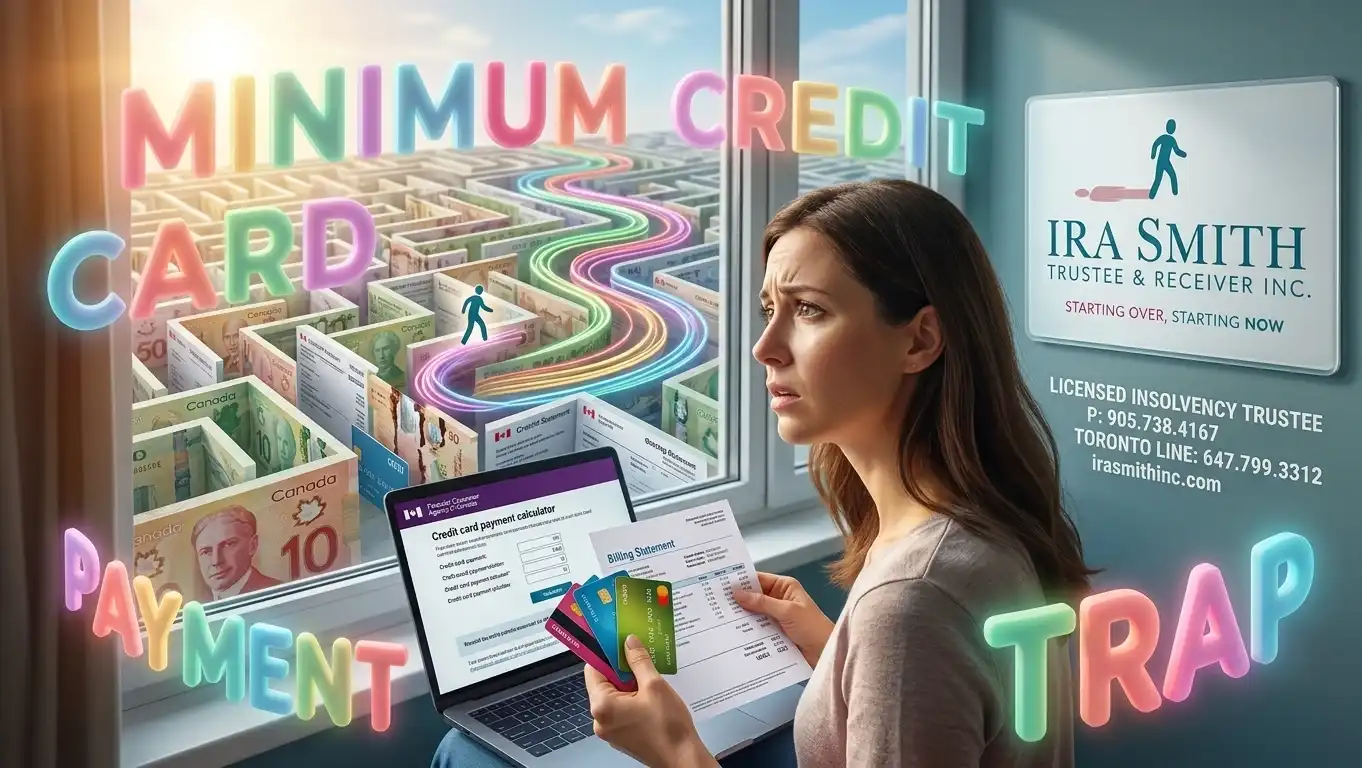
Our financial hardship resources and personal bankruptcy services provide additional background. A confidential discussion with a Licensed Insolvency Trustee can help determine whether informal repayment, consolidation, a consumer proposal or another option is appropriate.A woman sitting in her office looking at here credit card bills online and trying to figure out how to make the minimum credit card payment across all her credit cards and needing advice from Ira Smith Trustee & Receiver Inc.

Minimum Credit Card Payment: What practical steps can you take today?

Start with information, not panic.

  1. List every card balance, interest rate and minimum payment. Include lines of credit, overdrafts and other unsecured debts.
  2. Stop adding new charges where possible. A repayment calculation is unreliable if the balance continues to grow.
  3. Use a fixed-payment calculation. Compare your current minimum payment with an amount you can consistently afford.
  4. Prioritize high-interest debt. If you have enough cash flow to pay more, direct additional funds towards the highest-rate balance while keeping other accounts current.
  5. Contact your issuer early. Ask whether a lower-rate product or hardship arrangement is available. Do not assume you will qualify.
  6. Protect essentials first. Housing, utilities, food, transportation, taxes and secured loan payments must be considered in any realistic budget.
  7. Get professional advice before the situation becomes a crisis. Waiting can reduce the number of workable choices.

You can also review the FCAC guidance on paying off credit card debt and its credit card payment calculator.

A clear plan should be sustainable. The best payment is not necessarily the largest amount you can make for one month; it is an amount you can maintain without returning to credit for basic living costs.

Could a consumer proposal be a realistic lifeline?

A consumer proposal is a formal process under the Bankruptcy and Insolvency Act. It allows an eligible individual to offer creditors a structured settlement, which may involve paying a portion of unsecured debt, extending the repayment period, or both.

A consumer proposal must be administered by a Licensed Insolvency Trustee. The Trustee reviews your income, assets, debts and household circumstances, explains available options and files the proposal with the federal insolvency regulator when appropriate.

Consumer proposals generally:

  • deal primarily with unsecured debts such as credit cards, personal loans and certain tax debts;
  • require payments through the Trustee rather than separate minimum payments to each included creditor;
  • cannot extend beyond five years;
  • provide a stay of proceedings for included unsecured debts once filed, subject to the applicable law; and
  • require you to meet all proposal terms before receiving the legal benefits of completion.

Secured debts, such as a mortgage or car loan, are treated differently. If you want to keep the secured asset, you generally need to continue meeting the secured lender’s payment terms. Certain obligations, including support payments, some fines and certain debts arising from fraud, may also be excluded from the legal release.

A consumer proposal is not a guaranteed discount or a universal solution. Its suitability depends on your income, assets, debt level, household budget, creditor considerations and ability to complete the proposed payments. Credit reporting consequences also apply.

The Office of the Superintendent of Bankruptcy’s consumer-proposal information and Ira Smith Trustee & Receiver Inc.’s consumer proposal overview explain the process in more detail.

A proposal can be a lifeline when the minimum credit card payment method no longer creates a realistic path forward. The right next step is an assessment, not a promise.

The minimum credit card payment versus a consumer proposal: what is the difference?

IssuePaying only the minimumConsumer proposal
Payment structureSeparate monthly payments to each card issuerOne structured payment through a Licensed Insolvency Trustee
InterestContinues under the credit card agreement while a balance is carriedOriginal interest on included unsecured debts generally stops under the proposal process
Repayment periodCan extend for many years and changes as the balance changesMust be completed within the proposal terms, up to a maximum of five years
Collection actionCreditors may continue collection activity if payments are missedA stay of proceedings generally protects against collection action on included unsecured debts once filed
AssetsNo insolvency proceeding is filedSuitability and asset implications must be reviewed with a Licensed Insolvency Trustee
Credit reportOngoing use and payment history affect your credit reportThe proposal is recorded and has credit-reporting consequences
Who it may suitSomeone with enough income to repay the balance within a reasonable periodSomeone who cannot realistically repay unsecured debts under existing terms but can afford a structured offer

Organised financial documents, calculator and teal folder symbolising a structured path towards a fresh financial start

Minimum Credit Card Payment Frequently Asked Questions (FAQ)

Is paying the minimum credit card payment bad?

No. If you cannot pay the full balance, making at least the minimum is generally important to avoid late-payment consequences. The concern is relying on the minimum as a long-term repayment strategy when the debt is not meaningfully declining.

How much should I pay above the minimum credit card payment?

There is no universal amount. Use your budget to identify a fixed payment that is sustainable after essential expenses. Even $5 or $10 more each month may reduce the repayment period, but the impact depends on your interest rate and balance.

Does paying the minimum credit card payment hurt my credit score?

Making payments on time is generally better for your credit history than missing them. However, carrying high balances relative to your credit limits may affect your credit profile. Paying the minimum also leaves the debt outstanding for longer.

Can I include credit card debt in a consumer proposal?

Credit card debt is typically unsecured and may be included. However, every situation is different. A Licensed Insolvency Trustee must review the debt, your complete financial circumstances and the proposal’s suitability.

Will a consumer proposal stop credit card interest?

For unsecured credit card debts included in a filed and accepted proposal, the original interest and payment arrangements are generally replaced by the proposal terms. The legal treatment of each debt should be confirmed with your Licensed Insolvency Trustee.

Does a consumer proposal eliminate every debt I owe?

No. Secured debts and certain obligations may not be included or released in the same way as ordinary unsecured credit card debt. Ask for advice before making assumptions about any particular account.

What should I do if I am already missing payments?

Contact your creditors and seek professional advice promptly. Gather your statements, collection letters, income information and monthly expenses. Early action can help you understand your options before the situation escalates.

Starting Over, Starting Now

Don’t let the minimum credit card payment syndrome of financial uncertainty dictate your future. If you or your business is struggling with debt, losing sleep, or facing legal action, contact Ira Smith Trustee & Receiver Inc. today.

We offer a free, confidential consultation to discuss your situation, explain your options in plain language, and help you develop a clear, actionable plan. Our team of Licensed Insolvency Trustees is dedicated to providing the compassionate, professional support you need to regain control and achieve a debt-free life.

Take the first step towards a brighter financial future, call us now.

Ira Smith Trustee & Receiver Inc. is licensed by the Office of the Superintendent of Bankruptcy. Ira and Brandon Smith are members of the Canadian Association of Insolvency and Restructuring Professionals.

, , , , , , , , , , , , , , , , , , , , , , , , , , –

Disclaimer: This analysis is for educational purposes only and is based on the cited sources and professional expertise as a Licensed Insolvency Trustee. The information provided does not constitute legal or financial advice for your specific circumstances. Every situation is unique; the outcomes discussed may not apply to your particular case. Please contact Ira Smith Trustee & Receiver Inc. to discuss your specific needs.

About the Author:

Brandon Smith is a Senior Vice-President at Ira Smith Trustee & Receiver Inc. and a Licensed Insolvency Trustee serving clients across Ontario. His experience includes consumer insolvency and complex court-ordered receivership and corporate bankruptcy administration, giving him practical insight into navigating challenging financial situations to achieve optimal outcomes for businesses, creditors, and professionals. Brandon stays current with landmark developments in Canadian insolvency law, ensuring his clients benefit from a cutting-edge understanding of their rights and options.

Corporate image symbolising breaking free from financial pressure and beginning again

#MinimumCreditCardPayment #CreditCardDebt #DebtReliefCanada #ConsumerProposal #LicensedInsolvencyTrustee #FinancialHardship #DebtRepayment #StartingOverStartingNow #OntarioDebtHelp #GTAFinancialAdvice

Call a Trustee Now!