If debt is making it difficult to sleep, pay essential bills, or plan for the coming months, know this: financial trouble is not a personal failure. Official insolvency searches and national statistics show that thousands of Ontario households are facing a severe, persistent gap between income, living costs, and debt obligations.
Data from the Office of the Superintendent of Bankruptcy (OSB) and insolvency searches reveals a distinct shift: personal bankruptcies are rising rapidly across the Greater Toronto Area (GTA), while consumer proposal growth is slowing. This shift underscores why running insolvency searches or evaluating your debt relief options requires careful, compassionate attention.
Insolvency Searches Key Takeaways
What do recent Canadian insolvency searches and Office of the Superintendent of Bankruptcy Canada (OSB) data show?
According to the Canadian Association of Insolvency and Restructuring Professionals, quoting OSB statistics:
Record National Filings: Insolvency searches statistics show that Canada recorded 37,523 consumer insolvencies in Q2 2026—a 6.9% increase year-over-year and the highest quarterly volume since 2009.
Surging Bankruptcies: Nationally, consumer bankruptcies rose 10.3% year-over-year, while consumer proposals grew by 5.9%.
Ontario Sharp Shift: In Ontario, bankruptcies jumped 24.8% year-over-year in Q2 2026, compared to a 6.6% growth in consumer proposals.
GTA Impact: In the Toronto Census Metropolitan Area (CMA), bankruptcies surged 35.2% year-over-year, while proposals grew by just 3.1%.
Affordable Debt Relief: While insolvency searches and OSB data show that consumer proposals remain the majority of formal filings, consumer debtors may feel nervous about committing to multi-year fixed payments that they worry may be unsustainable for many households, prompting a return to personal bankruptcy.
Insolvency Searches Highlights
- What does the 2026 insolvency data actually show?
- Why are bankruptcies growing faster than consumer proposals?
- What is a consumer proposal under Canadian law?
- What is personal bankruptcy, and what happens to income and assets?
- How do a consumer proposal and bankruptcy compare?
- What should an Ontario household do when debt is no longer manageable?
- Frequently Asked Questions (FAQ)
- Sources and important context
What does the Canadian 2026 insolvency searches data actually show?
Public records and official insolvency searches show that the OSB’s Q2 2026 data presents a clear national trend.
Canada recorded 37,523 consumer insolvencies between April and June 2026. That was:
- 6.9% higher than the 35,114 filings in Q2 2025;
- 1.1% higher than Q1 2026; and
- the highest quarterly volume of consumer insolvencies since 2009.
CAIRP described the volume as roughly 17 consumer insolvencies filed every hour during the quarter.
The composition of those filings is equally important:
- 8,600 consumer bankruptcies, up 10.3% year over year and 13.5% from Q1 2026;
- 28,923 consumer proposals, up 5.9% year over year but down 2.1% from Q1 2026.
In other words, bankruptcies are increasing faster than proposals.
Ontario’s figures are more pronounced. In Q2 2026, Ontario recorded 14,642 consumer insolvencies. Of those:
- 3,271 were bankruptcies, up 24.8% year over year and 23.6% from Q1 2026;
- 11,371 were consumer proposals, up 6.6% year over year and 0.9% from Q1 2026.
For the 12 months ending June 30, 2026, Ontario recorded 55,968 consumer insolvencies, an increase of 8.8%. Bankruptcies rose 22.0%, while proposals increased 5.8%.
The Toronto CMA recorded 5,495 consumer insolvencies in Q2 2026, up 8.4% year over year. Toronto bankruptcies rose 35.2% year over year, compared with 3.1% growth in proposals. Over the 12 months ending June 30, Toronto recorded 21,241 consumer insolvencies, with bankruptcies up 25.6%.

Why are bankruptcies growing faster than consumer proposals?
The insolvency statistics and insolvency searches do not tell us why each individual chose bankruptcy or a proposal. They do, however, identify a meaningful change in the overall pattern. Insolvency searches and insolvency market analyses show that growing inflationary pressures—housing, food, utilities, and transportation—are making the fixed monthly payments of a consumer proposal unworkable for many budgets.
Consumer proposals still represented 78.4% of Canadian consumer insolvency filings in the 12 months reported by Wealth Professional, down slightly from 78.9% in the previous period. Proposals remain the majority. The gap is narrowing because bankruptcies are growing faster.
That may indicate that a growing number of households are concerned that they cannot support the payment commitment required by a proposal. A proposal usually requires a fixed monthly payment for several years. If rent, food, transportation, childcare, mortgage costs, or other essential expenses rise, the payment may become unsustainable.
As explained in Wealth Professional, a consumer proposal “may allow someone to repay an agreed portion of what they owe, but it will not be suitable or affordable in every situation.”
This is an important distinction. A consumer proposal is not automatically the best answer simply because it may allow someone to retain assets or repay a portion of their debt. It must be affordable from the beginning and remain workable over time.
CAIRP Vice Chair Wesley Cowan said, “The latest insolvency data suggests that many highly indebted Canadians have not yet regained enough room in their budgets to reduce what they owe.”
He also described the problem as an absence of recovery time between one higher bill and the next. When every paycheque is already committed, a small increase in an essential expense may have to be charged rather than absorbed.
The broader annual data tells the same story. For the 12 months ending January 31, 2026, Canada recorded 140,669 consumer insolvency filings, approximately 385 per day. Wealth Professional reported this was the second-highest annual total since tracking began in 1987.
There is also important balance in the data. Canada’s population-adjusted consumer insolvency rate eased from 4.2 insolvencies per 1,000 adults in 2024 to 4.1 in 2025. However, it remained above the levels recorded from 2020 through 2023. Business insolvencies were essentially flat year over year in Q2 2026, with 1,281 filings, up 0.2% from Q2 2025 and 4.0% from Q1 2026.
The picture is serious, but it is not a reason for panic. It is a reason to obtain clear information before the available choices become narrower.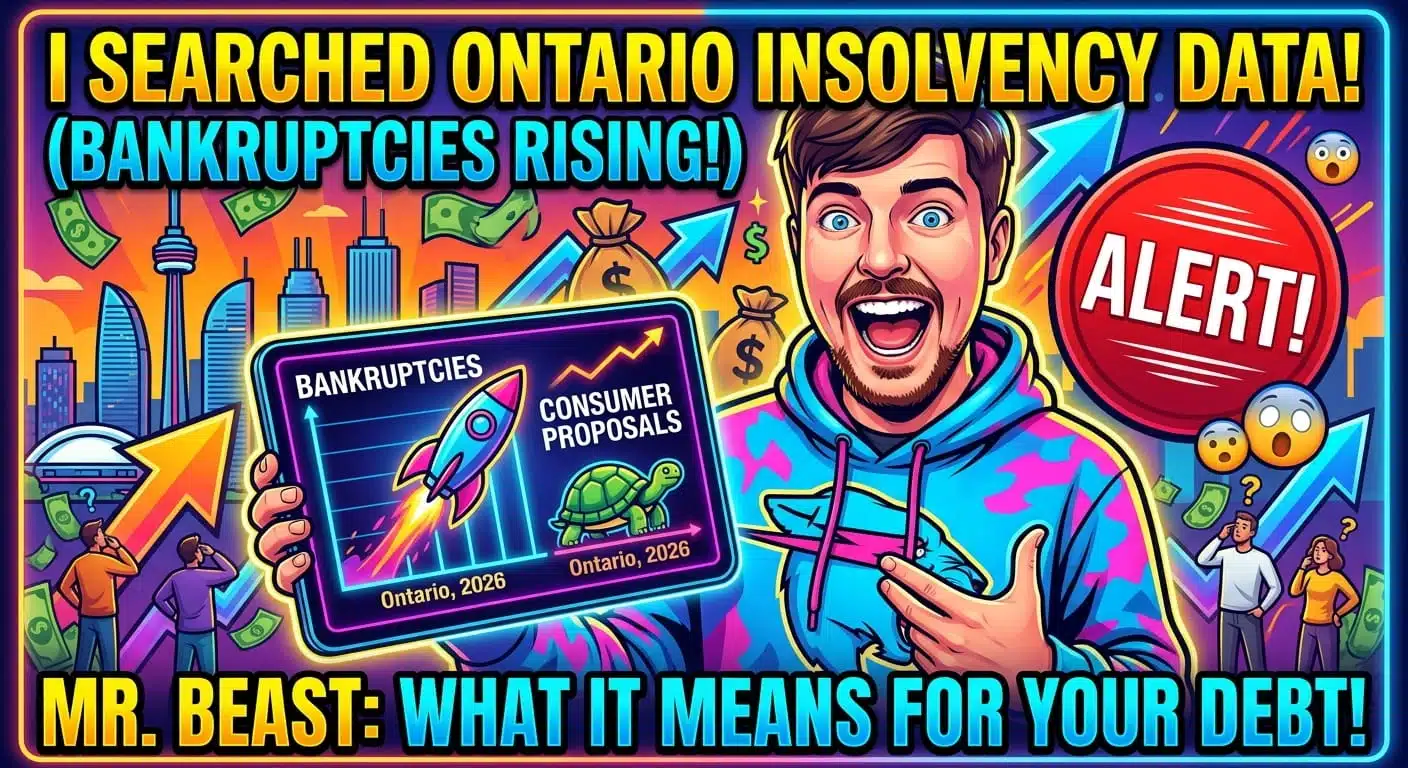
What is a consumer proposal under Canadian law?
A consumer proposal is a formal, legally binding offer made under the Bankruptcy and Insolvency Act to settle debts on modified terms.
A Licensed Insolvency Trustee administers the process. The proposal offers creditors:
- a repayment of part of the debt;
- a longer period to pay;
- or another settlement structure permitted by the legislation.
A consumer proposal generally must be completed within five years. For the proposal to become binding, creditors must accept it, or at least not vote against it.
Approval generally requires:
- deemed approval is obtained when creditors holding 25% or more of the proven claims filed do not request a meeting of creditors; or
- if a meeting is requested by at least 25% of the unsecured creditors who have filed a proof of claim and therefore it must be held, a simple majority of those creditors entitled to vote do so in favour of the approval of the consumer proposal.
A proposal can be a valuable lifeline when the payment is realistic, and the household has enough stable income to sustain it. But the payment is not simply a number chosen in isolation. It must fit the household’s actual budget, assets, debts, and likely financial changes. It must also satisfy the federal statute in that the proposal offers a better alternative for the unsecured creditors than they would receive in the person’s bankruptcy.
That is why a proposal that looks manageable on paper may become difficult if income falls or essential expenses rise. The goal is not merely to obtain acceptance. The goal is to complete a legally binding solution that genuinely improves your quality of life.
What is personal bankruptcy, and what happens to income and assets?
Personal bankruptcy is a formal insolvency process administered by a Licensed Insolvency Trustee. When insolvency searches are performed, it not only tells you the type of insolvency process the person has undertaken, but also provides you with the name and address of the Licensed Insolvency Trustee. A person makes an assignment in bankruptcy, and the Trustee administers the estate under the Bankruptcy and Insolvency Act and applicable Ontario rules.
Non-exempt assets may be realized for the benefit of creditors. Non-exempt assets are assets that are not protected under the applicable provincial rules. The treatment of a home, vehicle, investments, tax refunds, inheritances, and other property depends on the specific facts.
Bankruptcy also considers household income. If income exceeds the federal surplus income standard, surplus income payments will be required. Surplus income is calculated using actual household income and household size. The thresholds are set and updated by the Office of the Superintendent of Bankruptcy.
As a general rule, a first-time bankrupt may be eligible for an automatic discharge after nine months where there are no surplus income obligations, objections, or other circumstances affecting discharge. Where surplus income obligations apply, the period may extend to 21 months for a first-time bankrupt. Individual circumstances matter.
Bankruptcy is not a promise that someone will lose everything. Nor is it a process that allows every asset to be kept automatically. The result depends on the applicable exemptions, the assets owned, the household’s income, creditor claims, and the facts of the case.
Insolvency searches: How do a consumer proposal and bankruptcy compare?
The following table is a general educational guide only. It is not legal or financial advice for a particular person. Neither option is better in the abstract. The appropriate choice depends on the complete financial picture.
| Dimension | Consumer proposal | Personal bankruptcy |
|---|---|---|
| What it is | A formal, legally binding offer to creditors to settle debts on modified terms, administered by a Licensed Insolvency Trustee. | A formal insolvency process administered by a Licensed Insolvency Trustee under the Bankruptcy and Insolvency Act. |
| Creditor approval required? | Yes. Generally, approval requires a majority in number and two-thirds in value of voting creditors. | No creditor vote is required to make an assignment in bankruptcy. |
| Payment commitment | A fixed proposal payment must generally be made for a period of up to five years. | Payments may arise from administration costs, agreed obligations, and surplus income requirements where applicable. |
| Treatment of surplus income | Surplus income does not apply in the same way as it does in bankruptcy. The proposal payment must nevertheless remain affordable. | Surplus income is assessed using actual income, household size, and the federal standard updated by the Office of the Superintendent of Bankruptcy. |
| Assets | People generally retain their assets, although asset value can affect the proposal terms. | Non-exempt assets may be realized for creditors, subject to the BIA and Ontario rules. |
| Credit-report record in Ontario | Generally reported until the earlier of three years after completion or six years after filing, subject to credit-bureau policies. | Under Ontario’s Consumer Reporting Act, a first bankruptcy is generally removed seven years after the date of discharge, and a repeat bankruptcy may remain up to 14 years. Credit bureaus may voluntarily remove a first bankruptcy earlier. |
| Who it typically suits | Someone with sufficient, stable income to maintain the agreed payment and a proposal that creditors are likely to accept. | Someone whose debts cannot be managed through a sustainable proposal or informal repayment plan, after considering income, assets, and legal consequences. |
What should an Ontario household do when debt is no longer manageable?
I recommend taking the following steps:
- Stop relying on estimates. List every debt, interest rate, minimum payment, collection notice, asset, and source of income.
- Protect essentials first. Housing, food, utilities, medication, transportation, and other basic needs must be part of any realistic assessment.
- Do not wait for a crisis to ask questions. I find that people often wait until they have missed several payments or exhausted all available credit. Earlier outreach to a Licensed Insolvency Trustee can provide a clearer picture of the wider range of available options.
- Speak with a Licensed Insolvency Trustee. A Trustee will review your debts, income, assets, and creditor action and explain the available formal and informal options, including their costs and consequences.
- Do not choose based on headlines. Bankruptcy may be appropriate for one household, while a proposal may be appropriate for another. The right answer is the one that is legally available and financially sustainable for you.
As Wesley Cowan explained, “When someone is repeatedly reorganizing debt without materially reducing it, the problem has moved beyond day-to-day budgeting.”
Seeking help is not admitting failure. It is taking back control.
Insolvency Searches Frequently Asked Questions (FAQ)
Is a consumer proposal always better than bankruptcy?
No. A consumer proposal may be suitable where its payments are affordable, and creditors approve it. Bankruptcy may be more appropriate where a proposal payment cannot be sustained, although assets, income, surplus income, and other consequences must be assessed.
What do official insolvency searches show about 2026 debt trends?
Recent insolvency searches and OSB filings show that bankruptcies are growing significantly faster than consumer proposals in Ontario. This indicates that sustained high costs of living are making consumer proposal payment plans harder for households to maintain.
What happens if a consumer proposal fails or is annulled?
If a proposal is rejected, withdrawn, or annulled, the legal protection associated with it ends, and creditors generally regain collection rights. The next steps depend on the circumstances and should be discussed promptly with a Licensed Insolvency Trustee.
Does surplus income apply to a consumer proposal?
Surplus income is not applied in the same way as it is in bankruptcy. The Bankruptcy and Insolvency Act states that any proposal must offer a better alternative for the unsecured creditors than the person’s bankruptcy offers. So in a proposal, the amount of surplus income that would be paid if the person went bankrupt must be taken into account (without considering any increase or decrease from any future change in income) and form part of the total amount paid in the proposal.
Remember, however, the proposal payment must still be affordable, and changes in income or expenses can create difficulty during the proposal term.
Does bankruptcy mean losing everything?
No. Bankruptcy does not automatically mean losing everything. Exemptions and asset treatment depend on the Bankruptcy and Insolvency Act, Ontario rules, and the individual facts. Non-exempt assets may be realized for creditors.
How long does bankruptcy stay on an Ontario credit report?
Under Ontario’s Consumer Reporting Act, a first bankruptcy is generally removed seven years after the date of discharge, while a repeat bankruptcy may remain for up to 14 years. Credit bureaus may voluntarily remove a first bankruptcy after six years. Policies can vary.
When should I speak with a Licensed Insolvency Trustee?
You do not need to wait until you have missed multiple payments, received a lawsuit, or used every available credit product. Early information may help you understand your choices before the pressure becomes more severe. The longer you wait, the fewer options you will have other than bankruptcy.

Sources and important context
All statistics in this article come from the Office of the Superintendent of Bankruptcy’s “Insolvency Statistics in Canada, Second quarter of 2026,” CAIRP’s August 14, 2026 release, “CAIRP: Q2 2026 Canadian Insolvency Statistics,” and Wealth Professional’s September 11, 2026 report, “Consumer insolvencies top 140,000 as household debt bites.”
For more information about personal insolvency services, visit our bankruptcy services page, review our resources, or contact our office.
Starting Over, Starting Now
Don’t let financial uncertainty dictate your future. If you or your business is struggling with debt, losing sleep, or facing legal action, contact Ira Smith Trustee & Receiver Inc. today.
We offer a free, confidential consultation to discuss your situation, explain your options in plain language, and help you develop a clear, actionable plan. Our team of Licensed Insolvency Trustees, Brandon Smith and Ira Smith, are dedicated to providing the compassionate, professional support you need to regain control and achieve a debt-free life.
Take the first step towards a brighter financial future; call us now.
- Phone: 905.738.4167
- Toronto Line: 647.799.3312
- Evening and Weekends: 289.670.7500
- Website: irasmithinc.com
- Email: ira@irasmithinc.com
Ira Smith Trustee & Receiver Inc. is licensed by the Office of the Superintendent of Bankruptcy. Ira and Brandon Smith are members of the Canadian Association of Insolvency and Restructuring Professionals.
, , , , , , , , , , , , , , , , , , , , , , , , , , –
Disclaimer: This analysis is for educational purposes only and is based on the cited sources and professional expertise as a Licensed Insolvency Trustee. The information provided does not constitute legal or financial advice for your specific circumstances. Every situation is unique; the outcomes discussed may not apply to your particular case. Please contact Ira Smith Trustee & Receiver Inc. to discuss your specific needs.
About the Author:
Ira Smith is President of Ira Smith Trustee & Receiver Inc., and is a CPA CA and a Licensed Insolvency Trustee. His experience includes consumer insolvency and complex court-ordered receivership and corporate bankruptcy administration, giving him practical insight into navigating challenging financial situations to achieve optimal outcomes for businesses, creditors, and professionals. Ira stays current with landmark developments in Canadian insolvency law, ensuring his clients benefit from a cutting-edge understanding of their rights and options.
#BankruptcyOntario #ConsumerProposal #OntarioInsolvency #TorontoDebtRelief #GTAHouseholds #PersonalBankruptcy #DebtRelief #OSBStatistics #LicensedInsolvencyTrustee #StartingOverStartingNow






 GTA general contractor