I hope you and your family are staying safe and well. At Ira Smith Trustee & Receiver Inc., we understand that the current economic climate in the Greater Toronto Area (GTA) has placed an unprecedented burden on the GTA general contractor community and everyone else in or relying upon the construction industry. If your company is feeling the weight of mounting debt or the pressure of a stalled project, please know that you are not alone, and it is not your fault. We are here to help you navigate these choppy waters with clarity and compassion.
GTA General Contractor Key Takeaways
Insolvency is Not Always the End: Modern insolvency tools like Division I Proposals allows a GTA general contractor and construction firms to restructure and continue operating.
GTA Trends are High: Construction insolvencies in Ontario are at multi-decade highs in 2026, primarily due to cost inflation and high interest rates.
Personal Risk is Real: Business owners must be wary of personal guarantees and director liabilities for unpaid taxes or wages.
Early Action is Critical: Engaging a Licensed Insolvency Trustee (LIT) early provides more options to save the business and protect personal assets.
Restructuring is a Fresh Start: Over 37% of insolvent builders successfully use legal mechanisms to re-enter the market and start over.
GTA General Contractor: The Current State of Construction in the GTA
The GTA construction sector is currently navigating a perfect storm. As we move through 2026, data suggests that over 1,500 construction firms in our region are facing some form of insolvency. This is a staggering increase from previous years, driven by the collision of fixed-price contracts and skyrocketing material and labour costs.
For the small business owner or the independent GTA general contractor, this isn’t just about numbers on a balance sheet; it’s about your livelihood, your employees, and your peace of mind. We see the tension put upon you, and our goal is to transform that catastrophe into a manageable plan.
1. Liquidation vs. Restructuring: Know the Difference
When people hear the word “insolvency,” they often think of liquidation, the process of selling off all assets to pay creditors and closing the doors forever. However, for many GTA firms, the better path is restructuring. This allows you to renegotiate what you owe, keep your equipment, and finish your current projects. Assets used to generate income in this way are often part of a plan to satisfy creditors while keeping your business alive.
2. The “Triple Threat” Facing SMEs in 2026
Small and medium-sized enterprises (SMEs) are currently facing three major pressures:
Price Inflation: Wages and material costs have risen faster than most contracts anticipated.
Supply-Chain Volatility: Delays in materials cause project slippage, leading to penalty clauses.
High Interest Rates: The cost of carrying debt has made traditional bridging finance nearly impossible to sustain.
3. Understanding Director Liabilities
As a director of a construction corporation, you may be personally liable for certain debts, even if the company is limited. These are known as director liabilities. Specifically, the Canada Revenue Agency (CRA) can come after your personal assets for unpaid HST and source deductions (payroll taxes). Furthermore, unpaid WSIB premiums and employee wages can also become personal director obligations. This is why professional financial restructuring services are vital to protect your personal home and savings.
4. The Division I Proposal: A Lifeline for Your Business
A Division I Proposal is a formal procedure under the Bankruptcy and Insolvency Act (BIA). It allows your business to make a formal offer to your creditors to pay back a percentage of what is owed over time. If they accept, you avoid bankruptcy entirely.
The beauty of a Proposal is the Stay of Proceedings. This is a legal “pause button” that stops all lawsuits, garnishments, and collection efforts the moment you file, giving you the breathing room to stabilize your cash flow.
5. The Intersection of the Construction Act and Bankruptcy
In Ontario, construction projects are governed by the Construction Act. This includes complex rules regarding statutory trusts, money received for a project must be used to pay the trades and suppliers on that project first. If you use “Project A” money to pay “Project B” debts, you could face serious legal repercussions.
When project funds are released, they need to flow straight down to the people actually performing the work. This isn’t just a suggestion; it’s the bedrock of a functional project. Redirecting that cash to cover general overhead or to prop up unrelated jobs before the trades are paid is more than just a financial hiccup—it’s a serious breach of trust. Ensuring the money reaches those at the bottom of the chain first is what keeps the industry moving and relationships intact.
We help you navigate how these trust fund obligations interact with federal insolvency laws to keep you in compliance.
6. The Hidden Danger of Personal Guarantees
Many GTA general contractors have signed personal guarantees for their business lines of credit or equipment leases. When the business fails to pay, the lender will look to you personally. Understanding which of your debts are “personally guaranteed” is the first step in creating a comprehensive personal bankruptcy or consumer proposal plan if the business cannot be saved.
7. Why Timing is Everything
We often see business owners wait until their bank accounts are empty and the CRA has frozen their assets before seeking help. By then, your options are limited. If you act while you still have some liquidity (cash or accessible credit), you have a much higher chance of a successful restructuring. Early intervention is the difference between a controlled “Starting Over” and a chaotic collapse.
8. Protecting Your Reputation with Subcontractors
The GTA general contractor and the broader GTA construction community are tight-knit. Your reputation with subcontractors and suppliers is your most valuable asset. A formal restructuring plan often provides a better outcome for your sub-trades than a straight bankruptcy would. By being proactive, you show your partners that you are committed to finding the best possible resolution for everyone involved.
9. Why a Licensed Insolvency Trustee is Your Best Ally
You might speak with your lawyer or your general accountant, and while they are valuable, only a LITis authorized by the federal government to administer Proposals and Bankruptcies. We are the only professionals who can grant you the legal protection of a Stay of Proceedings. We act as a “supportive guide” to ensure the process is fair to both you and your creditors.
10. Embracing “Starting Over, Starting Now”
Insolvency is not a moral failure; it is a legal tool designed to fix an impossible financial situation. Our philosophy, “Starting Over, Starting Now,” focuses on the future. We help you strip away the stress so you can focus on what you do best: building the GTA.
GTA General Contractor Insolvency Options Comparison Table
GTA General Contractor Frequently Asked Questions (FAQ)
Can I keep my tools and equipment if my construction company goes bankrupt? If the equipment is owned by the corporation, it is an asset of the company. If all the assets were pledged for a bank loan, then the bank has a first charge priority to the assets. If there is no secured lender, then it becomes part of the bankrupt estate. Either way, it needs to be sold.
However, if you are a sole proprietor GTA general contractor or construction business, “tools of the trade” are considered exempt assets up to a specific dollar amount under Ontario law (currently $17,362 for construction tools).
Will a business restructuring affect my personal credit score? If you have personally guaranteed the business debts, your credit score will likely be affected. However, a successful Proposal is often viewed more favourably by future lenders than a total bankruptcy.
What happens to my active construction liens during a Proposal? A Stay of Proceedings stops many actions, but it does not necessarily extinguish a lien claimant’s rights. The interaction between the Construction Act and the BIA is complex, and we will review your specific lien situation during our consultation. Although we will perform a financial review, you will need your construction lawyer for legal advice.
How long does a Division I Proposal take? The initial filing happens immediately. You then have 30 days (which can be extended by the court) to lodge the formal proposal. Once accepted by creditors and approved by the court, the payment period typically lasts between 1 and 5 years.
Starting Over, Starting Now
Don’t let financial uncertainty dictate your future. If you or your GTA general contractor or construction business are struggling with debt, you are losing sleep, or facing legal action, contactIra Smith Trustee & Receiver Inc.today.
We offer a free, confidential consultation to discuss your situation, explain your options in plain language, and help you develop a clear, actionable plan. Our team of Licensed Insolvency Trustees is dedicated to providing the compassionate, professional support you need to regain control and achieve a debt-free life.
Take the first step towards a brighter financial future, call us now.
Ira Smith Trustee & Receiver Inc. is licensed by the Office of the Superintendent of Bankruptcy. Ira and Brandon Smith are Licensed Insolvency Trustees and are members of the Canadian Association of Insolvency and Restructuring Professionals.
Disclaimer: This analysis is for educational purposes only and is based on the cited sources and professional expertise as a Licensed Insolvency Trustee. The information provided does not constitute legal or financial advice for your specific circumstances. Every situation is unique; the outcomes discussed may not apply to your particular case. Please contact Ira Smith Trustee & Receiver Inc. to discuss your specific needs.
About the Author:
Brandon Smith is a Senior Vice-President at Ira Smith Trustee & Receiver Inc. and a Licensed Insolvency Trustee serving clients across Ontario. His experience includes consumer insolvency and complex court-ordered receivership and corporate bankruptcy administration, giving him practical insight into navigating challenging financial situations of a GTA general contractor or construction company to achieve optimal outcomes for businesses, creditors, and professionals. Brandon stays current with landmark developments in Canadian insolvency law, ensuring his clients benefit from a cutting-edge understanding of their rights and options.GTA general contractor #ConstructionInsolvency #GTABusiness #DebtRestructuring #OntarioLaw #SmallBusinessOntario #IraSmithTrustee #FinancialRecovery
Hello. We hope you are finding a moment of calm today amidst whatever financial challenges you may be navigating. At Ira Smith Trustee & Receiver Inc., we understand that the weight of corporate debt can feel like a mountain pressing down on you and your family. We want you to know that you are safe here, and we are here to help you find the path back to solid ground. It is not your fault that the economic tides have shifted, and business receiverships are rising. You do not have to face this alone.
Business Receiverships Key Takeaways
Strategic Choice: In the GTA, the choice between BIA (Bankruptcy and Insolvency Act) and CCAA (Companies’ Creditors Arrangement Act) often depends on whether it is a debtor-driven restructuring or a secured creditor enforcement, a $5 million debt threshold and the level of flexibility required.
The “Stay” Advantage: Filing a Notice of Intention (NOI) under the BIA can instantly stop a secured creditor from appointing a receiver, providing a critical window for restructuring.
Realization vs. Restructuring: Business receiverships under the BIA are fundamentally about asset realization (sale), whereas BIA and CCAA restructurings are about enterprise preservation and compromise.
Local Expertise Matters: Utilizing Receiver Manager services GTA ensures that local market conditions are leveraged to maximize asset value during a court-supervised sale.
Fresh Start Philosophy: Our “Starting Over, Starting Now” approach focuses on immediate action to restore the financial health of your business and your quality of life.
Business Receiverships Highlights
The Hidden Hierarchy of Insolvency Laws
Court-Appointed vs. Private Receivers: Who Really Holds the Keys?
BIA vs. CCAA: The Strategic Chess Match in Toronto
What a Receiver-Manager Actually Does Behind the Scenes
Frequently Asked Questions (FAQ)
The Hidden Hierarchy: Why One Size Doesn’t Fit All
When a business in Ontario faces insolvency, the state of being unable to pay debts as they fall due, most owners feel they have lost all control. However, there is a “secret” hierarchy to how these processes work, and understanding it is the first step to regaining your power.
In the Greater Toronto Area (GTA), we primarily see two paths: restructurings under the BIA orCompanies’ Creditors Arrangement Act(CCAA), and secured creditor enforcements through business receiverships. While they may seem like interchangeable legal terms, they are actually distinct tools with very different outcomes.
Business Receiverships: What are these processes, exactly?
BIA Proposals: These are the quicker restructuring track for small to mid-sized businesses. It is a highly structured, predictable process where the debtor company makes an offer to its creditors to pay a portion of what is owed over time.
CCAA Proceedings: Reserved for companies with at least $5 million in debt, this is the “heavyweight” restructuring tool. It is heavily supervised by the Ontario Superior Court of Justice Commercial List in Toronto, a specialized court known for its expertise in complex financial matters.
Business Receiverships: Unlike the first two, business receiverships are driven by a secured creditor (like a bank). Instead of trying to restructure and save the company, a Receiver is appointed to take control of the assets and sell them to pay back the secured debt.
Court-Appointed vs. Private: The Power Dynamic
One of the most misunderstood “secrets” of the business receivership process Ontario follows is the difference between a private appointment and a court appointment.
A Private Receiver is appointed by a bank under the terms of a security agreement. They answer primarily to that bank. However, a Court-Appointed Receiver is an officer of the court. This means that although the secured creditor may have applied to the Court to appoint the receiver, the Court-Appointed Receiver has a fiduciary duty to act fairly toward all stakeholders, including you, the debtor.
In the GTA, we often recommend a court appointment in business receiverships if there are multiple competing creditors or complex assets, as the court’s oversight provides a level of protection and transparency that a private process lacks. Where there are no competing security interests and the assets and issues are not that complex, we recommend a privately appointed receiver.
We know the tension put upon you when a bank threatens to “send in the receiver.” Nevertheless, when it is your business we are talking about, business receiverships are still scary, be they private or court-appointed.
BIA vs. CCAA: The Strategic Chess Match in Toronto Business Receiverships
If you are a business owner in the GTA, the “secret” to a successful restructuring is timing. Many experts won’t tell you that you can actually block business receiverships by filing a Notice of Intention (NOI) under the BIA first.
This filing creates an automatic stay of proceedings, a legal “pause button” that prevents creditors from seizing assets or continuing lawsuits. This gives you 30 days (which can be extended up to six months with court approval) to build a plan. In contrast, under the CCAA, there is no automatic stay; you must ask a judge for it.
Business Receiverships: Comparison of Insolvency Proceedings in Ontario
Feature
BIA Proposal
CCAA Proceedings
Receivership
Debt Threshold
None (Best for SMEs)
Min. $5 Million
N/A (Creditor-driven)
Primary Goal
Restructure & Continue
Complex Restructuring
Asset Realization/Sale
Stay of Proceedings
Automatic
Court-ordered
Rare/Limited
Control
Debtor-in-Possession
Debtor-in-Possession
Receiver Takes Control
Failure Consequence
Automatic Bankruptcy
Stay Lifted (No Auto-Bankruptcy)
N/A (Liquidation Focus)
Business Receiverships: What the Receiver Manager Services GTA Actually Do
When we step in as a Receiver-Manager, our goal is to stabilize a chaotic situation. Many people assume a receiver just locks the doors and walks away. In reality, a skilled Receiver-Manager in the Toronto area acts more like a temporary CEO.
We take over the operations, manage the cash flow, and always look for ways to keep the business running as a “going concern.” It isn’t always possible, but that is our first analysis. Why? Because a business that is operating is almost always worth more than a pile of equipment in an empty warehouse. By maintaining operations, we preserve the value of the assets that are essential for operations and ensure that when the sale happens, it brings in the highest possible return for everyone involved. Utilizing this methodology for business receiverships also saves jobs.
Business Receiverships: The Case of the “Midnight Filing”
Consider a recent scenario in the GTA where a manufacturing firm was hours away from having its equipment seized by a disgruntled lender. By working with a Licensed Insolvency Trustee, the company filed a BIA Notice of Intention at 11:00 PM.
The next morning, when the lender arrived with trucks, they were legally barred from entering. That “midnight filing” saved 50 jobs and allowed the company the time it needed to find a new investor. This is the power of knowing business receiverships process Ontario rules, it turns a catastrophe into a manageable transition.
Business Receiverships: Frequently Asked Questions (FAQ)
Can I stop a receivership once it has started?
It is very difficult to stop a receivership once a court order is signed, which is why early intervention is key. However, you can still influence the process by cooperating with the Receiver-Manager to ensure assets are sold for their maximum value.
What is the difference between a Monitor and a Receiver?
In a CCAA proceeding, a Monitor is appointed to oversee the company while the current management stays in control. In a receivership, the Receiver takes over full control of the business from the management.
How long does the receivership process in Ontario take?
A simple liquidation can take a few months, while a complex corporate receivership GTA involving operating businesses and real estate can last a year or more.
Will I lose my personal house if my corporation goes into receivership?
Generally, no. Your corporation is a separate legal entity. However, if you have signed personal guarantees for the corporate debt, your personal assets could be at risk. This is why it is vital to speak with us about personal bankruptcy and consumer proposals as well.
At Ira Smith Trustee & Receiver Inc., we believe in the “Starting Over, Starting Now” philosophy. We aren’t just here to process paperwork; we are here to help you navigate the emotional and financial maze of Canadian insolvency. We know the stress you are under, and we have the expertise to help you breathe again.
Starting Over, Starting Now
Don’t let financial uncertainty dictate your future. If you or your business is struggling with debt, losing sleep, or facing legal action, contact Ira Smith Trustee & Receiver Inc. today.
We offer a free, confidential consultation to discuss your situation, explain your options in plain language, and help you develop a clear, actionable plan. Our team of Licensed Insolvency Trustees is dedicated to providing the compassionate, professional support you need to regain control and achieve a debt-free life.
Take the first step towards a brighter financial future, call us now.
Ira Smith Trustee & Receiver Inc. is licensed by the Office of the Superintendent of Bankruptcy. Ira and Brandon Smith are members of the Canadian Association of Insolvency and Restructuring Professionals.
Disclaimer: This analysis is for educational purposes only and is based on the cited sources and professional expertise as a Licensed Insolvency Trustee. The information provided does not constitute legal or financial advice for your specific circumstances. Every situation is unique; the outcomes discussed may not apply to your particular case. Don’t hesitate to contact Ira Smith Trustee & Receiver Inc. to discuss your specific needs.
About the Author:
Brandon Smith is a Senior Vice-President at Ira Smith Trustee & Receiver Inc. and a Licensed Insolvency Trustee serving clients across Ontario. His experience includes consumer insolvency and complex court-ordered receivership and corporate bankruptcy administration, giving him practical insight into navigating challenging financial situations to achieve optimal outcomes for businesses, creditors, and professionals. Brandon stays current with landmark developments in Canadian insolvency law, ensuring his clients benefit from a cutting-edge understanding of their rights and options.
Hello and welcome. If you are reading this, you might be feeling the weight of financial uncertainty on your shoulders. Please know that you are safe here, and you are certainly not alone. At Ira Smith Trustee & Receiver Inc., we understand that life can throw unexpected curveballs, and facing the bankruptcy process is a brave step toward reclaiming your future. Our goal is to guide you through the fog with clarity, compassion, and a concrete plan to get you back on your feet.
In this Brandon’s Blog, we define conditional discharge, discuss what it means and discuss a 2021 Court of Appeal for British Columbia decision.
Define Conditional Discharge Key Takeaways
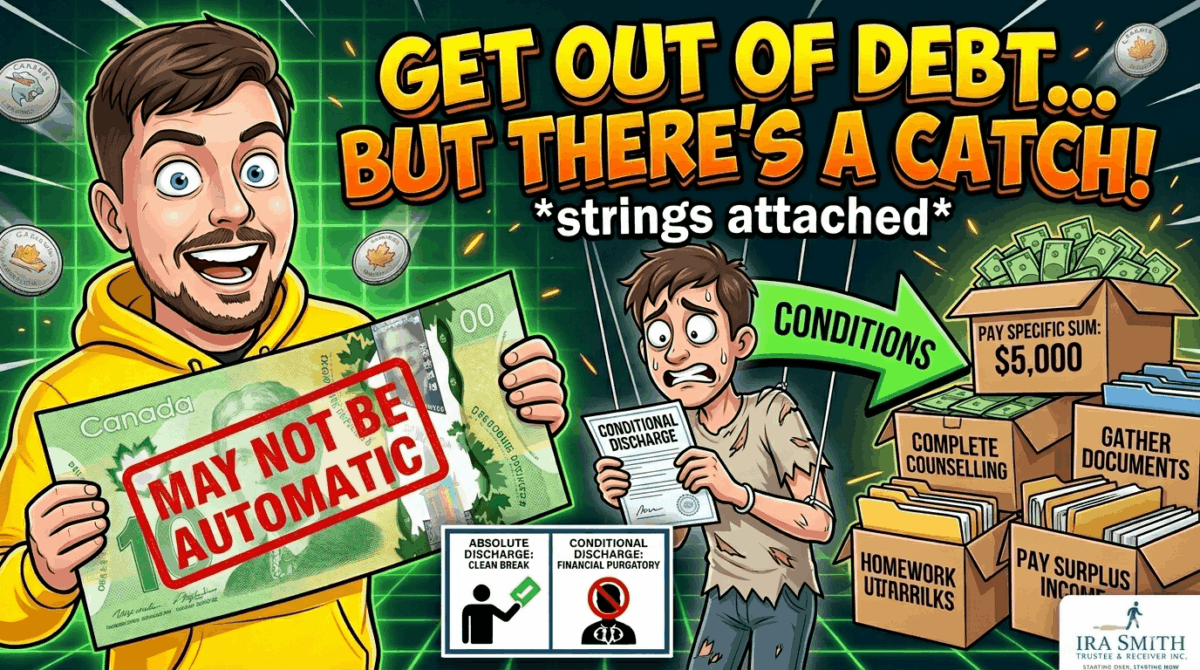
Bankruptcy isn’t always automatic: While many expect a simple end date, certain factors can lead you to define conditional discharge.
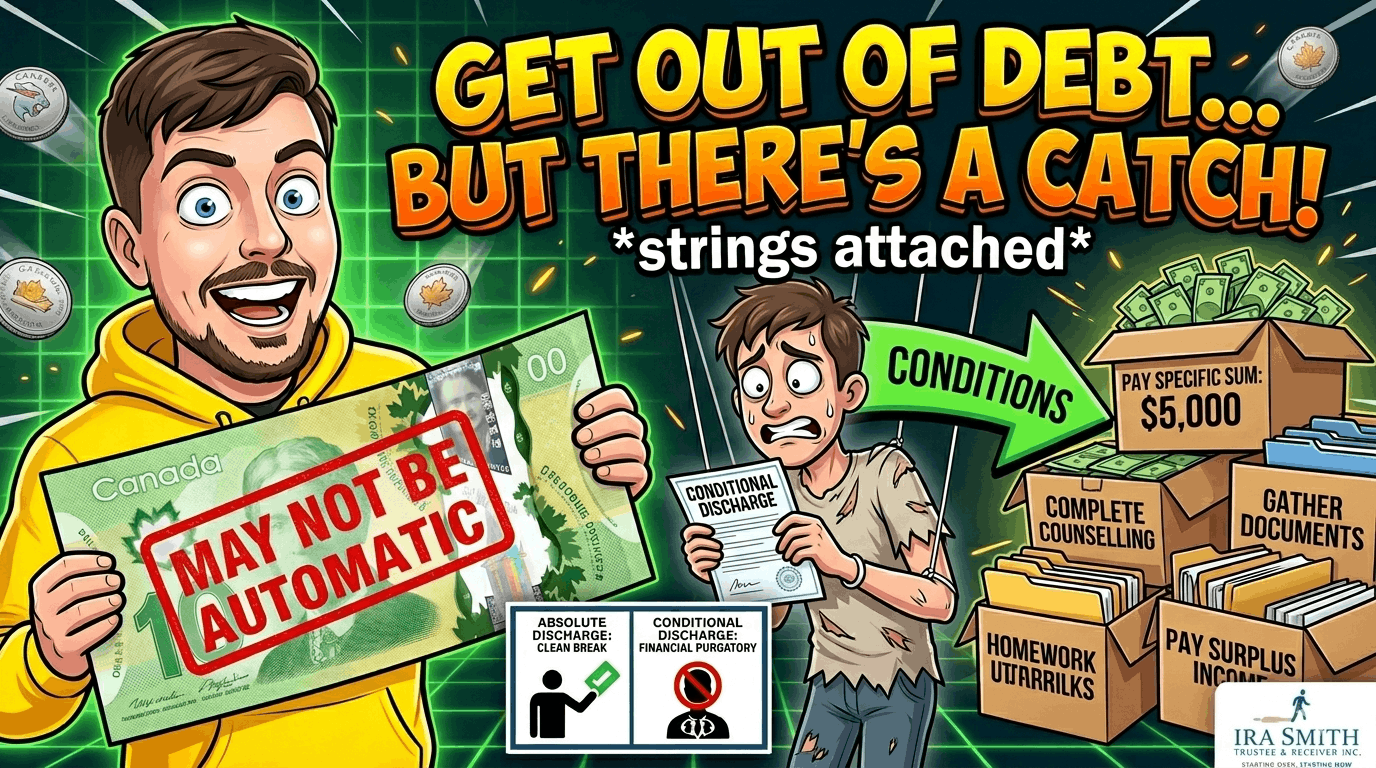
Conditions are “homework”: The court may define conditional discharge by requiring you to pay money or perform specific duties before your debts are legally wiped away.
You remain “undischarged”: Until conditions are met, you are an undischarged bankrupt and still subject to certain legal restrictions.
A Licensed Insolvency Trustee is your ally: We help you navigate these conditions to ensure you reach the finish line, the absolute discharge.
Define Conditional Discharge Highlights
What is a Conditional Discharge?
Why Do Courts Impose Conditions?
Common Conditions You Might Face
Comparing Discharge Types: Absolute vs. Conditional vs. Suspended
The “12-Year Trap”: A Real-World Case Study
How to Transition from Conditional to Absolute Discharge
Frequently Asked Questions (FAQ)
How Do You Define Conditional Discharge?
When you enter personal bankruptcy Canada, the ultimate goal is the discharge. This is the legal document that releases you from the obligation to pay back the debts you owed at the time you filed.
However, a discharge is not always a straight line. If there is an opposition to your discharge, perhaps from a creditor, the Office of the Superintendent of Bankruptcy, or your own Trustee, the matter goes before an Associate Justice. Instead of granting you a clean break immediately, the court might issue a conditional discharge.
The important issue is how the court will define conditional discharge. What requirements does the court place on you to fulfill before you really do get discharged from your bankruptcy? It is the discharge, and not the filing for bankruptcy, that releases you from your debts.
I suggest that you should define conditional discharge as an “absolute discharge in principle, but with strings attached.” It means the court has decided you deserve a fresh start, but only after you complete a few more tasks or pay a bit more into the pot for your creditors.
Why do courts impose conditions?
We know the tension put upon you when you feel like the goalposts have been moved. It is important to remember: it is not your fault that the law has these complexities. The court’s job is to balance your need for a fresh start with the rights of the people you owe money to.
The court typically imposes conditions if:
Duties were missed: You may have forgotten to attend your mandatory counselling sessions (educational meetings designed to help you manage money better in the future).
Surplus income exists: If your income is above a certain threshold, the law requires you to pay a portion of that “extra” money to your Trustee, and you haven’t paid it all.
High tax debt: If you owe more than $200,000 in personal income tax, and that makes up 75% or more of your total debt, the law requires a court hearing. Under Section 172.1 of the Bankruptcy and Insolvency Act (BIA), you are defined as a High-Tax Debtor who is not eligible for an automatic discharge
Conduct issues: If you weren’t fully transparent about your assets, or if you’ve been through bankruptcy multiple times before.
Define Conditional Discharge: Common conditions you might face
If you find yourself as one of the many undischarged bankrupts in the GTA, your court order will likely list one or more of the following “homework” assignments:
Payment of a specific sum: The court might order you to pay, for example, $5,000 over 12 months.
Performing duties: You might need to provide missing tax information or finally attend those two mandatory counselling sessions.
Surrendering assets: You may be required to turn over a specific piece of property that was previously undisclosed.
Comparing discharge types: A quick guide
Navigating debt relief Toronto requires knowing exactly where you stand. Use this table to understand the different flavours of discharge:
Discharge Type
What it Means
Status of Your Debt
Absolute Discharge
You have completed everything. You are 100% finished.
Debts are legally wiped away (with certain exceptions like child or spousal support).
Conditional Discharge
You have “homework” to do first (payments or duties).
You are still responsible for your debts until conditions are met.
Suspended Discharge
Your discharge is granted but won’t take effect until a future date.
Debts are wiped away only once the suspension period ends.
Refused Discharge
The court denies your request due to extreme misconduct or non-compliance.
You remain bankrupt and still owe all your debts.
The “12-Year Trap”: A real-world case study to define conditional discharge
To see how the court thinks, let’s look at the case of Perrier v. Canada (Revenue Agency). In this instance, a bankrupt individual was ordered to pay $150,000 at a rate of $1,000 per month as a condition of his discharge.
On the surface, it seems fair to ask someone to pay what they can. However, the Court of Appeal stepped in. They realized that at $1,000 a month, it would take the man over 12 years to finish. Since he was nearing retirement, this condition would have followed him into his golden years, effectively denying him the “fresh start” that personal bankruptcy Canada is supposed to provide.
The court reduced the amount to $45,000 over five years, proving that the conditions must be reasonable and attainable. This is why having a Licensed Insolvency Trustee Toronto, like the team at Ira Smith Trustee & Receiver Inc., is vital; we ensure the court understands your reality.
How to transition from Define Conditional Discharge to “Absolute”
Being an undischarged bankrupt can feel like being in “financial purgatory,” but the path out is clear. Here is how we help you reach that absolute discharge:
Provide you with an upfront warning: As your licensed insolvency trustee, if we are in a position where we feel we will need to oppose your absolute discharge, we will provide you with a warning and advise you on what steps you need to take to avoid our opposition. If a creditor opposes your discharge from bankruptcy, we look at their reasons and provide you with advice as to what you should do ahead of the court discharge hearing.
Review the Conditional Order: We sit down with you to translate the “legalese” into plain English.
Create a Payment Schedule: If money is owed, we help you budget so the payments are manageable.
Complete the Tasks: We facilitate your counselling sessions and help you gather any missing documentation.
The Certificate of Compliance: Once you’ve done your part, we notify the court or the Office of the Superintendent of Bankruptcy. You will then receive your absolute discharge.
The “why” behind all of this is simple: we want you to have a life free from the shadow of debt. Completing these conditions is the final hurdle before you can truly say you have started over.
What happens if I can’t afford the payments in my conditional discharge?
If your circumstances change, for example, you lose your job or face a medical crisis, you aren’t stuck. After one year, we can help you apply back to the court to vary the order (change the terms) to something you can actually manage.
Can I still get credit while I have a conditional discharge?
As an undischarged bankrupt, you are legally required to disclose your bankruptcy status to any lender if you are seeking credit over $1,000. It is generally very difficult to get traditional credit during this phase.
How long do I have to meet the conditions?
The court usually sets a timeline, but if they don’t, the conditions remain in place until they are satisfied. The sooner you finish, the sooner you get your fresh start.
Does a conditional discharge show up on my credit report?
Yes. Your credit report will reflect that you are in bankruptcy until you receive your absolute discharge. Once you reach the absolute stage, the “clock” for how long the bankruptcy stays on your report finally starts ticking.
Starting Over, Starting NOW
Don’t let financial uncertainty dictate your future. If you or your business is struggling with debt, losing sleep, or facing legal action, . Call Ira Smith Trustee & Receiver Inc. today.
We offer a free, confidential consultation to discuss your situation, explain your options in plain language, and help you develop a clear, actionable plan. Our team of Licensed Insolvency Trustees is dedicated to providing the compassionate, professional support you need to regain control and achieve a debt-free life.
Take the first step towards a brighter financial future. Call us now.
The Office of the Superintendent of Bankruptcy licenses Ira Smith Trustee & Receiver Inc. Ira and Brandon Smith are members of the Canadian Association of Insolvency and Restructuring Professionals.
Disclaimer: This analysis is for educational purposes only and is based on the cited sources and professional expertise as a Licensed Insolvency Trustee. The information provided does not constitute legal or financial advice for your specific circumstances. Every situation is unique; the outcomes discussed may not apply to your particular case. Please contact Ira Smith Trustee & Receiver Inc. to discuss your specific needs.
About the Author:
Brandon Smith is a Senior Vice-President at Ira Smith Trustee & Receiver Inc. and a Licensed Insolvency Trustee serving clients across Ontario. His experience includes consumer insolvency and complex court-ordered receivership and corporate bankruptcy administration, giving him practical insight into navigating challenging financial situations to achieve optimal outcomes for businesses, creditors, and professionals. Brandon stays current with landmark developments in Canadian insolvency law, ensuring his clients benefit from a cutting-edge understanding of their rights and options.
At Ira Smith Trustee & Receiver Inc., we hope you are doing well and staying safe in these rapidly changing economic times. We know that the weight of corporate financial distress doesn’t just sit on a balance sheet; it sits on the shoulders of the people, the directors of the debtor company, investors, and creditors, who make these businesses run. We are here to help you navigate these complex waters with clarity and compassion.
The Debtor Key Takeaways
The Power Shift: 2026 has seen a definitive shift toward creditor-led and investor-led CCAA proceedings, moving away from the traditional model where the debtor company calls all the shots.
TheAngus A2A GP Inc v Alvarez & Marsal Canada Inc, 2026 ABCA 156(CanLII)Decision: A landmark Alberta Court of Appeal ruling in May 2026 has officially cleared the way for equity investors to qualify as “interested persons” under the Companies’ Creditors Arrangement Act (CCAA) to initiate restructuring proceedings, fundamentally changing the “who” and “how” of corporate rescue.
Super-Monitors: Courts are increasingly granting Monitors enhanced operational powers, creating a “Super-Monitor” role that provides receivership-level control within a CCAA framework.
Reverse Vesting Orders (RVOs): While under higher judicial scrutiny, RVOs remain the “surgical tool” of choice for preserving tax attributes and regulatory licences.
Restructuring at Scale: Speed is the new currency. The use of “SISPs-on-steroids” ensures that businesses are moved through the market in weeks rather than months.
For decades, the CCAA was seen as the debtor-in-possession regime. The company in trouble would realize it was sinking, seek court protection, and then propose a plan to its creditors. But as we move through the middle of 2026, that landscape has shifted. We are now seeing creditors, and even equity investors, seizing the wheel.
Whether you are a secured lender in the GTA or an investor looking to protect a failing portfolio company, understanding this “Creditor-Led” era is essential. It’s no longer just about waiting for a proposal; it’s about taking proactive steps to preserve value.
The Debtor Highlights
The Angus Manor Decision: A Game Changer
The Rise of the “Super-Monitor”
RVOs: Surgical Precision or Extraordinary Relief?
SISPs-on-Steroids: The Need for Speed in 2026
BIA vs. CCAA: A Strategic Comparison for Creditors
The Angus Manor Decision: Why Equity Investors are Now at the Table
In May 2026, the Alberta Court of Appeal released its decision in Angus Manor, a case that has sent ripples through the Canadian insolvency community. Historically, the right to file for CCAA protection was largely the domain of the debtor company itself or its creditors. Equity investors were often sidelined until a plan was actually on the table.
The Angus Manor ruling changed that. The court determined that, in specific circumstances, where management is deadlocked or the board is failing to act in the face of imminent insolvency, equity investors can have the standing to initiate CCAA proceedings.
As a Licensed Insolvency Trustee Toronto, we see this as a vital evolution. It prevents a “burn-down” scenario in which a debtor company’s value evaporates while its leadership is paralyzed. For GTA business owners and stakeholders, this means you have a new lever to pull if your investment is at risk.
The Rise of the “Super-Monitor” Overseeing The Debtor
Traditionally, a Monitor in a CCAA proceeding is a court-appointed officer (a Licensed Insolvency Trustee) who watches over the debtor company’s finances, assists in formulating the restructuring plan, interfaces with creditors and reports to the court. They are the “eyes and ears” of the judge.
However, in 2026, we are seeing the rise of the Super-Monitor. In many creditor-led filings, the court is granting the Monitor “enhanced powers.” This means the Monitor isn’t just watching; they are often:
Approving all major expenditures.
Directing the sale process (the SISP).
Even overriding the management of the debtor company on key strategic decisions.
This creates a hybrid between a CCAA and a corporate receivershipprocess for GTA creditors. It provides the legal “stay of proceedings” (the freeze on lawsuits) that CCAA offers, but with the tight, professional control of a receiver. If you are a creditor who has lost faith in a company’s management, the Super-Monitor is your best friend.
The Debtor and RVOs: The Surgical Tool under Fire
One of the most powerful tools in our 2026 toolkit is the Reverse Vesting Order (RVO). If a regular sale is like selling a car and leaving the debt behind, an RVO is like keeping the car’s registration and history but magically removing the debt from the title.
In an RVO, the purchaser buys the shares of the company. The “bad” parts, the debts and unwanted contracts, are “vested out” into a separate, temporary company that eventually goes bankrupt. This is incredibly useful for companies with complex regulatory licences or tax attributes (like losses that can be carried forward) that would be lost in a traditional asset sale.
However, the courts are becoming more cautious. In 2026, judges are demanding clear evidence that an RVO is necessary and not just a “convenient shortcut” to avoid taxes or environmental liabilities. At Ira Smith Trustee & Receiver Inc., we ensure that any RVO proposal is backed by a rock-solid evidentiary record to stand up to judicial scrutiny.
SISPs-on-Steroids: The Need for Speed
The days of long, drawn-out restructuring processes are largely over. In 2026, we utilize what we call “SISPs-on-steroids.” A Sale and Investment Solicitation Process (SISP) is the formal way we market the assets of the debtor company, either in pieces or en masse, representing the operating business for sale during insolvency.
Why the rush? Because in a high-interest, volatile market, “time is the enemy of value.” The longer a company stays in CCAA, the more “professional fees” it burns and the more customers it loses. We are now seeing SISPs that launch, market, and close a sale in as little as 45 days. This requires a team that can move fast, with a deep network in the Toronto and Canadian investment communities.
BIA vs. CCAA: A Strategic Comparison for Creditors
When deciding how to handle a distressed company in the GTA, creditors often weigh the Bankruptcy and Insolvency Act (BIA) against the CCAA. Here is how they compare in the current 2026 environment:
Feature
BIA (Receivership/Proposal)
CCAA (Restructuring)
Primary Goal
Liquidation or debt settlement.
Going-concern restructuring or sale.
Control
High (Receiver takes over).
Traditionally low, but high with “Super-Monitor.”
Complexity
Lower; rules-based.
Higher; flexible and court-driven.
Cost
Generally more affordable for SMEs.
Significant; usually for debts over $5 million.
Speed
Can be very fast (liquidation).
Fast in 2026 (SISPs-on-steroids).
Shareholder Rights
Minimal.
Emerging rights (see Angus Manor).
The Debtor Frequently Asked Questions (FAQ)
1. Can a creditor force a company into CCAA in Ontario?
Yes. While it is more common for the company to file voluntarily, a creditor with a significant claim (over $5 million) can apply to the court to have the debtor company placed into CCAA protection if the company is insolvent.
2. What is the difference between a Receiver and a Super-Monitor?
A Receiver generally takes full possession and control of the assets to sell them. A Super-Monitor works alongside or over management within the CCAA process, often allowing the debtor company to keep operating while a sale is finalized.
3. Why are RVOs so popular right now?
RVOs are popular because they preserve “intangible” value. If a company has a specific licence to operate in a regulated industry (like cannabis, pharma, or energy), an RVO allows that licence to stay with the corporate entity while the debt is stripped away.
4. How does the Angus Manor decision affect me as a business owner?
It means your investors have a new “safety valve.” If your board is deadlocked and the business is failing, a shareholder investor might be able to go to court to start a restructuring, even if the board doesn’t agree.
Why This Matters to You and The Debtor Company
Understanding these shifts isn’t just for lawyers and bankers. It’s for the business owner who is worried about their legacy, the investor trying to save a portfolio, and the creditor trying to recover what they are owed.
At Ira Smith Trustee & Receiver Inc., we don’t just see numbers; we see the “Starting Over, Starting Now” potential in every crisis. By staying at the cutting edge of BIA vs CCAA proceedings Toronto, we give our clients the best possible chance to emerge from financial distress with their dignity and their future intact.
Starting Over, Starting Now
Don’t let financial uncertainty dictate your future. If you or your business is struggling with debt, losing sleep, or facing legal action, contact Ira Smith Trustee & Receiver Inc. today.
We offer a free, confidential consultation to discuss your situation, explain your options in plain language, and help you develop a clear, actionable plan. Our team of Licensed Insolvency Trustees is dedicated to providing the compassionate, professional support you need to regain control and achieve a debt-free life.
Take the first step towards a brighter financial future. Call us now.
Ira Smith Trustee & Receiver Inc. is licensed by the Office of the Superintendent of Bankruptcy. Ira and Brandon Smith are members of the Canadian Association of Insolvency and Restructuring Professionals.
Disclaimer: This analysis is for educational purposes only and is based on the cited sources and professional expertise as a Licensed Insolvency Trustee. The information provided does not constitute legal or financial advice for your specific circumstances. Every situation is unique; the outcomes discussed may not apply to your particular case. Please contact Ira Smith Trustee & Receiver Inc. to discuss your specific needs.
About the Author:
Brandon Smith is a Senior Vice-President at Ira Smith Trustee & Receiver Inc. and a Licensed Insolvency Trustee serving clients across Ontario. His experience includes consumer insolvency and complex court-ordered receivership and corporate bankruptcy administration, giving him practical insight into navigating challenging financial situations to achieve optimal outcomes for businesses, creditors, and professionals. Brandon stays current with landmark developments in Canadian insolvency law, ensuring his clients benefit from a cutting-edge understanding of their rights and options.
At Ira Smith Trustee & Receiver Inc., we hope you and your family are staying safe and well during these challenging economic times. We know that behind every statistic is a real person, a real home, and a real family trying to navigate a complex financial landscape. If you are feeling the pressure of rising costs, please know that you are not alone, and there is a professional, compassionate path forward.
Key Takeaways
Insolvency Peak: National insolvency volumes have surged to levels not seen since the 2009 financial crisis.
Brampton Hotspot: Brampton has recorded a 0.64%mortgage delinquency rate, the highest in Canada for Q1 2026.
Ontario Surge: Mortgage delinquency rates across Ontario have jumped by a staggering 52% year-over-year.
Debt Relief Solutions: A consumer proposal is often the most effective tool for GTA homeowners to protect their equity while eliminating unsecured debt.
Early Action: Consulting a Licensed Insolvency Trustee Toronto early can prevent a Power of Sale and secure your financial future.
Highlights
The “Sticker Shock” of Q1 2026
Why are Insolvency Levels Mirroring 2009?
Brampton in the Crosshairs: Breaking Down the 0.64%
Ontario’s 52% Surge: A Warning for the GTA
Is Your Home an Exempt Asset?
Comparison: Consumer Proposal vs. Personal Bankruptcy
Frequently Asked Questions (FAQ)
Mortgage Delinquency: The “Sticker Shock” of Q1 2026
The latest Equifax Canada Q1 2026 Market Pulse report has sent ripples through the Greater Toronto Area (GTA). For many homeowners, the data confirms what they have felt at the kitchen table for months: the “buffer” is gone. With insolvency volumes hitting a 17-year high, the Canadian economy is witnessing a level of financial distress comparable to the 2009 Great Recession.
However, unlike 2009, this crisis is deeply rooted in the housing market. As mortgage renewals hit significantly higher rates than the previous five-year cycle, many families in Brampton, Mississauga, and Vaughan are finding their monthly payments unmanageable. We call this payment shock, and it is the primary driver behind the current spike in mortgage defaults.
Mortgage Delinquency: Why are Insolvency Levels Mirroring 2009?
When we look at the data, the comparison to 2009 is sobering. Insolvency levels have reached these heights because the cost of borrowing has remained elevated for longer than most analysts predicted. This has created a “perfect storm” for those with high debt-to-income ratios.
Many individuals who were able to maintain their lifestyle through credit cards and lines of credit are now finding those limits maxed out. When the credit runs out, the mortgage is the next thing to suffer. This leads to an increase in the mortgage delinquency rate.
It is important to remember that insolvency simply means being unable to pay your debts as they come due. It is not a moral failing; it is a mathematical reality of the current Ontario economy.
Brampton in the Crosshairs: Breaking Down the 0.64% Mortgage Delinquency Rate
Perhaps the most alarming statistic in the Equifax report is that Brampton has emerged as the mortgage delinquency hotspot of Canada. With a delinquency rate of approximately 0.64%, Brampton’s rate is more than double the national average.
Why Brampton? Our experience as a Licensed Insolvency Trustee Toronto serving the GTA, including Vaughan, Mississauga and Brampton, suggests a few factors:
High Loan-to-Value Ratios: Many Brampton buyers entered the market at the peak, leaving them with little equity to weather a downturn.
Private Lending: A significant number of homeowners in Brampton rely on private or “alternative” lenders, whose rates are often much higher than the big banks.
The “Squeeze” of Large Households: Larger families common in Brampton face higher grocery and utility costs, leaving less room for mortgage fluctuations.
A delinquency is defined as a mortgage payment that is 90 days or more past due. Once you hit this mark, the lender may initiate a Power of Sale, which is the legal process in Ontario where a lender sells your home to recover their funds.
Ontario’s 52% Surge in Mortgage Delinquency: A Warning for the GTA
While Brampton is the focus, the rest of Ontario is not far behind. A 52% year-over-year increase in mortgage delinquencies across the province indicates that the financial rot is spreading. This is not just a localized problem; it is a systemic shift.
For homeowners in Toronto, Vaughan, Markham, Brampton and Mississauga, this serves as a critical warning. If you are currently “robbing Peter to pay Paul”, using credit cards to pay your mortgage, you are in a cycle that leads directly to insolvency.
Mortgage Delinquency: Is Your Home an Exempt Asset?
One of the biggest fears we hear from clients is, “Will I lose my house if I file for debt relief?” In Ontario, certain possessions are protected from creditors; these are known as exempt assets.
Under the Execution Act of Ontario, a portion of the equity in your principal residence may be exempt from seizure. However, if your home has significant equity, you need a strategic plan to protect it. This is where a Consumer Proposal Ontario becomes your best lifeline. Unlike bankruptcy, a consumer proposal allows you to keep your assets, including your home and car, while negotiating a settlement with your creditors.
Comparison: Consumer Proposal vs. Personal Bankruptcy
Choosing the right path depends on your specific financial “health.” Below is a comparison to help you understand your options.
Feature
Consumer Proposal
Personal Bankruptcy
Asset Protection
You keep all assets, including your home equity and vehicles.
Non-exempt assets may be surrendered to the Trustee for creditors.
Monthly Payments
One fixed, interest-free monthly payment based on what you can afford.
Payments may vary based on your surplus income.
Credit Impact
R7 rating; removed 3 years after completion.
R9 rating; removed 6–7 years after first discharge.
Legal Protection
Immediate Stay of Proceedings (stops all collections and lawsuits).
Immediate Stay of Proceedings (stops all collections and lawsuits).
Debt Reduction
Typically reduces unsecured debt by 70% to 80%.
Eliminates most unsecured debts entirely.
How Can a Licensed Insolvency Trustee Help?
If you are facing Brampton mortgage delinquency or general debt relief Toronto and you have many questions about finding a lasting solution to your financial challenges, a Licensed Insolvency Trustee (LIT) is the only professional in Canada authorized by the government to file a consumer proposal.
We act as a neutral party to facilitate a deal between you and your creditors. By filing a proposal, we can often eliminate your credit card debt, tax debt, and personal loans. This “clears the deck,” freeing up the cash flow you need to keep your mortgage current and stay in your home.
Q: Can a consumer proposal stop a Power of Sale? A: If the Power of Sale process has begun because of your mortgage delinquency and has already reached a certain legal stage, a proposal may not stop it directly. However, by eliminating your other debts before you default on your mortgage, you can prevent the Power of Sale from ever starting.
Q: Will my bank cancel my mortgage if I file a consumer proposal? A: Generally, no. As long as your mortgage payments are up to date, most lenders are happy to continue the relationship. They want their monthly interest payment, not your house.
Q: How much does a consumer proposal cost? A: The fees for a Licensed Insolvency Trustee are set by federal law and are paid out of the monthly payments you make to your creditors. There are no “upfront” costs for the filing itself.
Q: I live in Brampton, and my mortgage is up for renewal soon. What should I do? A: Contact us for a free consultation. We can help you “stress test” your budget against new rates. If the numbers don’t add up, we can help you restructure your other debts now so you are ready for renewal.
Why We Believe in “Starting Over, Starting Now”
We know the tension put upon you when the mail arrives or the phone rings. It is not your fault that the economy has shifted so dramatically. Our philosophy is simple: identify the problem, take immediate action, and restore your quality of life. You don’t have to live in fear of the Q1 2026 report or any future mortgage delinquency statistics.
We offer a free, confidential consultation to discuss your situation, explain your options in plain language, and help you develop a clear, actionable plan. Our team of Licensed Insolvency Trustees is dedicated to providing the compassionate, professional support you need to regain control and achieve a debt-free life.
Take the first step towards a brighter financial future, call us now.
Ira Smith Trustee & Receiver Inc. is licensed by the Office of the Superintendent of Bankruptcy. Ira and Brandon Smith are members of the Canadian Association of Insolvency and Restructuring Professionals.
Disclaimer: This analysis is for educational purposes only and is based on the cited sources and professional expertise as a Licensed Insolvency Trustee. The information provided does not constitute legal or financial advice for your specific circumstances. Every situation is unique; the outcomes discussed may not apply to your particular case. Please contact Ira Smith Trustee & Receiver Inc. to discuss your specific needs.
About the Author:
Brandon Smith is a Senior Vice-President at Ira Smith Trustee & Receiver Inc. and a Licensed Insolvency Trustee serving clients across Ontario. His experience includes consumer insolvency and complex court-ordered receivership and corporate bankruptcy administration, giving him practical insight into navigating challenging financial situations to achieve optimal outcomes for businesses, creditors, and professionals. Brandon stays current with landmark developments in Canadian insolvency law, ensuring his clients benefit from a cutting-edge understanding of their rights and options.
We hope that you, your family, and your team are staying safe and resilient during these increasingly turbulent times in the Ontario development sector. We understand the immense pressure the current economic climate places on your shoulders, and we are here to offer clarity and support.
Infrastructure Key Takeaways
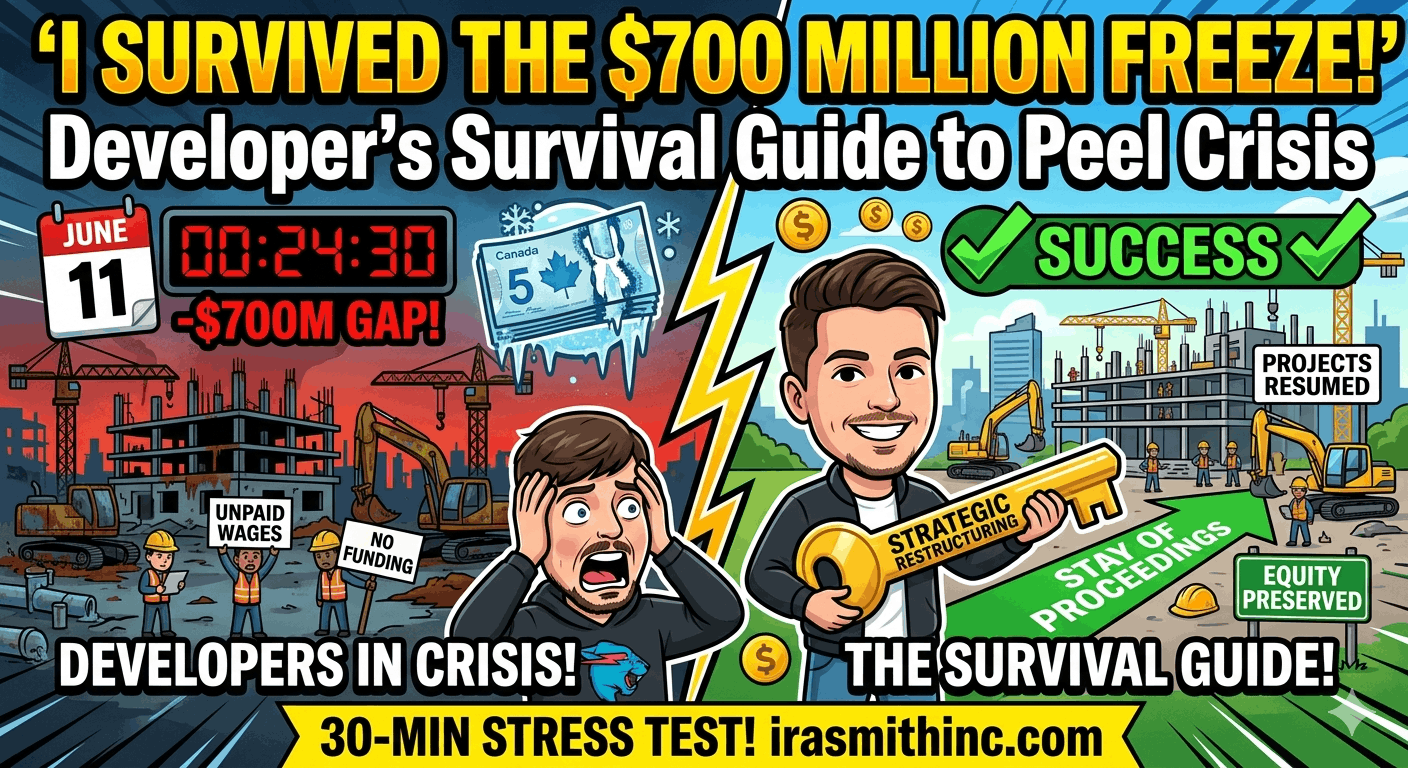
The June 11 Trigger: The looming $700 million infrastructure funding gap in Peel Region is more than a headline; it is a potential distress trigger for active credit facilities.
Invisible Costs: Beyond the “freeze,” developers face escalating interest-carrying costs on land assemblies that are no longer generating progress-based draws.
Director Vulnerability: Site dormancy does not pause statutory obligations; directors remain personally liable for unpaid HST, source deductions, and provincial wages.
Caledon at Risk: With 64% of at-risk housing units located in Caledon, specialized strategic restructuring is now a necessity, not an option.
Proactive vs. Reactive: Engaging a Licensed Insolvency Trustee for a 30-minute stress test can prevent a receivership and preserve your equity.
Why the Infrastructure June 11 Deadline is a Distress Trigger
The $700 million funding gap in Peel Region has moved from a municipal budget concern to a direct threat to GTA developers. If the provincial funding does not materialize by the June 11 deadline, the “freeze” on critical infrastructure, water, wastewater, and roads becomes a functional reality.
For many developers, this date serves as a distress trigger. This is a specific event or condition that allows a lender to re-evaluate a loan’s risk profile, potentially leading to a demand for repayment or a refusal to extend further credit. Lenders do not wait for a provincial bailout; they act in response to the immediate reality of stalled timelines. If your project relies on the next phase of infrastructure to trigger a construction draw, you may find yourself in a liquidity crunch before the summer is out.
The Infrastructure Hidden Danger: Interest-Carrying Costs and Dormancy
One of the most dangerous blind spots for construction firms is the interest-carrying cost. When a site goes dormant due to an infrastructure freeze, the clock doesn’t stop. The interest on your land loans, mezzanine financing, and equipment leases continues to accrue daily.
In a high-interest-rate environment, a six-month delay is not just a scheduling inconvenience; it can erode millions of dollars in project equity. When revenue-generating milestones are missed, the project enters a state of negative carry, where the cost of holding the asset exceeds the appreciation or progress being made. We know the tension this puts upon you, as you watch your hard-earned capital being swallowed by debt service while the site sits silent.
Director Liability: The Trap of Unpaid Project Taxes and Wages
A significant risk that often goes unaddressed until it is too late is Director Liability. Even if a development project is held within a specific corporation, the directors can be held personally responsible for certain corporate debts if the project fails.
If your site goes dormant and cash flow dries up, you must be extremely cautious about which bills are being paid. Under Canadian law, directors are personally liable for:
Source Deductions: Unpaid employee income tax, CPP, and EI.
GST/HST: Collected but unremitted sales tax.
Wages: Unpaid vacation pay and statutory wages (varies by province, but is highly strictly enforced in Ontario).
When a project is “frozen” due to the Peel infrastructure gap, the temptation may be to use remaining cash to pay suppliers or keep a lender happy. However, neglecting these statutory obligations can result in the Canada Revenue Agency (CRA) pursuing your personal assets, including your home or savings. This is why immediate, professional advice is vital.
Why Caledon is the Epicentre of the GTA Infrastructure Development Crisis
While Brampton and Mississauga are certainly feeling the pinch, Caledon is the hardest hit by this $700 million shortfall. Statistics indicate that roughly 64% of the units currently stalled or at risk are located within Caledon.
The town was positioned for massive growth, but that growth was predicated on a delicate balance of provincial and regional infrastructure spending. With that balance tipped, Caledon developers are facing a unique “perfect storm” of high-leverage land assemblies and a total lack of municipal serviceability. If you are operating in this area, you are not just facing a market dip; you are facing a structural blockage that may require a formal reorganization. Call to survive.
Restructuring as a Lifeline: Solvent vs. Insolvent Options
At Ira Smith Trustee & Receiver Inc., we believe in the “Starting Over, Starting Now” philosophy. Waiting for a government bailout that may never arrive is a reactive strategy that often leads to total loss. A proactive move is to stress-test your project and consider restructuring.
A restructuring is a formal or informal process to modify the financial or operational structure of a company to make it more viable. For a developer, this might mean renegotiating loan terms, seeking new equity partners, or utilizing the Bankruptcy and Insolvency Act (BIA) to pause creditor actions while a new plan is developed.
Feature
Solvent Restructuring (Informal)
Insolvent Restructuring (Proposal/CCAA)
Creditor Consent
Must be unanimous or negotiated individually.
Can be forced if a majority/two-thirds of creditors agree.
Legal Stay
No automatic protection from lawsuits.
Stay of Proceedings stops all legal and collection actions.
Timeline
Can be slow and prone to “hold-out” creditors.
Strictly governed by court-ordered or statutory timelines.
Complexity
High negotiation burden on the developer.
Managed by a Licensed Insolvency Trustee who is the Monitor.
Cost
Flexible, but risks escalating if negotiations fail.
Higher upfront costs but offers a final, binding resolution.
Taking 30 minutes now to consult with a Licensed Insolvency Trustee in Toronto can save a multi-million dollar land assembly from being seized by a receiver. We help you look at the cold legal facts while providing the supportive guide you need to navigate these high-stakes decisions.
What exactly is an “infrastructure freeze”? In this context, it refers to the Peel Region’s inability to commit to new water, wastewater, and road projects required to service new developments because of a $700 million funding shortfall. Without these services, building permits for new phases cannot be issued.
Can a lender call my loan just because of the Peel funding gap? Most commercial loan agreements have “Material Adverse Change” (MAC) clauses. If a lender determines that the infrastructure freeze significantly impairs the project’s viability or your ability to repay, they may use the June 11 deadline as a reason to review or call the loan.
Is it my fault if my project fails due to this freeze? No. It is not your fault that regional politics and provincial funding gaps have created a barrier to your development. However, it is your responsibility to take proactive steps to protect your stakeholders and your personal liability.
How does a “Stay of Proceedings” help a developer? A Stay of Proceedings is a legal “pause button.” It prevents lenders from seizing land, suppliers from suing, and the CRA from freezing accounts. This gives you the breathing room to find new financing or restructure your debt without the threat of immediate collapse.
Starting Over, Starting Now
Don’t let financial uncertainty dictate your future. If you or your business is struggling with debt, losing sleep, or facing legal action due to the Peel infrastructure freeze, contact Ira Smith Trustee & Receiver Inc. today.
We offer a free, confidential consultation to discuss your situation, explain your options in plain language, and help you develop a clear, actionable plan. Our team of Licensed Insolvency Trustees is dedicated to providing the compassionate, professional support you need to regain control and achieve a debt-free life.
Take the first step towards a brighter financial future. Call us now.
Ira Smith Trustee & Receiver Inc. is licensed by the Office of the Superintendent of Bankruptcy. Ira and Brandon Smith are members of the Canadian Association of Insolvency and Restructuring Professionals.
Disclaimer: This analysis is for educational purposes only and is based on the cited sources and professional expertise as a Licensed Insolvency Trustee. The information provided does not constitute legal or financial advice for your specific circumstances. Every situation is unique; the outcomes discussed may not apply to your particular case. Please contact Ira Smith Trustee & Receiver Inc. to discuss your specific needs.
About the Author:
Brandon Smith is a Senior Vice-President at Ira Smith Trustee & Receiver Inc. and a Licensed Insolvency Trustee serving clients across Ontario. His experience includes consumer insolvency and complex court-ordered receivership and corporate bankruptcy administration, giving him practical insight into navigating challenging financial situations to achieve optimal outcomes for businesses, creditors, and professionals. Brandon stays current with landmark developments in Canadian insolvency law, ensuring his clients benefit from a cutting-edge understanding of their rights and options.
Good morning. If you are reading this, you are likely navigating one of the most challenging periods in your professional life. We want to start by acknowledging the immense pressure you are under. Running a business in the Greater Toronto Area (GTA) is demanding enough without the added weight of financial distress, creditor calls, and the fear of losing everything you have built. Please know that you are not alone, and your safety and well-being are paramount. Financial crisis is a hurdle, not the end of your story. We are here to help you find the path back to stability.
In this Brandon’s Blog, I talk about how using either the Bankruptcy and Insolvency Act (BIA) or the Companies’ Creditors Arrangement Act (CCAA), can be navigated to restructure and save your business.
BIA vs CCAA Key Takeaways
BIA Division 1 Proposals are typically faster and more cost-effective for small to medium-sized enterprises (SMEs) with less complex debt.
CCAA Proceedings are reserved for larger corporations with debts exceeding $5 million, offering greater judicial flexibility.
A “Stay of Proceedings” is a legal shield that immediately stops creditors from taking legal action or seizing assets while you restructure.
Failing a BIA Proposal leads to automatic bankruptcy, whereas a CCAA failure allows for more structured exits or liquidations.
Choosing the right strategy depends on your debt load, the complexity of your operations, and your ultimate goal for the business.
When a business can no longer meet its financial obligations, it enters a state of insolvency. This is a technical term meaning the company’s liabilities exceed its assets or it cannot pay its bills as they come due. In Canada, we have two primary “lifelines” to help businesses avoid total liquidation: the Bankruptcy and Insolvency Act (BIA) and the Companies’ Creditors Arrangement Act (CCAA).
Both pathways are designed to give a “fresh start” to a viable business by allowing it to restructure its debts and continue operating. However, the choice between them is critical. Making the wrong move can lead to the very outcome you are trying to avoid: the permanent closure of your company. Whether you are managing a manufacturing plant in Vaughan or a tech startup in downtown Toronto, understanding these frameworks is the first step toward regaining control.
What is a BIA Division 1 Proposal?
The BIA Division 1 Proposal is the most common tool used by small and medium-sized businesses in Ontario to manage insolvency. It is a formal, legally binding agreement between a debtor and their creditors to pay back a portion of the debt over time or to restructure the business operations.
How the Process Works
The process usually begins with filing a Notice of Intention (NOI). This filing triggers an immediate Stay of Proceedings, which acts as a legal “stop button” for all lawsuits, wage garnishments, and asset seizures. This gives the company an initial 30 days, extendable up to six months with court approval, to develop a restructuring plan.
A Licensed Insolvency Trustee (LIT) acts as the Proposal Trustee, overseeing the process and ensuring fairness for both the debtor and the creditors. Once the proposal is drafted, it is presented to the creditors for a vote. To pass, the proposal requires a “double majority”:
A majority in number of creditors who vote.
Two-thirds (66.7%) of the total dollar value of the claims.
Why Choose the BIA?
Predictability: The rules are clearly defined in the Act, leaving less room for legal ambiguity.
Cost-Efficiency: It involves fewer court appearances than a CCAA proceeding, making it significantly more affordable for smaller companies.
Speed: The deadlines are strict, forcing a resolution relatively quickly.
However, there is a catch. If the creditors reject the proposal, or if the court refuses to approve it, the company is automatically assigned into bankruptcy. This “all or nothing” nature makes the quality of the initial proposal and the advice of your business debt restructuring expert vital.
The CCAA: For Complex Corporate Challenges
While the BIA is a set of rigid rules, the Companies’ Creditors Arrangement Act (CCAA) is more like a blank canvas. It is federal legislation designed specifically for large corporations that need a more customized approach to restructuring.
The $5 Million CCAA Threshold
To qualify for CCAA, a company (or a group of affiliated companies) must have total debts exceeding $5 million. If your debt is below this mark, the BIA is your only option.
The Power of the Court
The defining feature of CCAA is judicial discretion. Unlike the BIA, where the process is largely administrative, CCAA is entirely court-driven. This allows a judge in the Ontario Superior Court of Justice to “craft” orders that fit the unique needs of a complex business. This might include:
Dealing with multiple classes of creditors separately.
Granting a broader “Stay of Proceedings” that can extend to third parties or directors.
Why Choose CCAA?
CCAA is ideal when a company has a complicated capital structure, international operations, or multiple layers of secured debt. It offers more flexibility and, crucially, does not result in automatic bankruptcy if the plan is rejected. Instead, the company simply loses its legal protection, and creditors are free to pursue their remedies.
Direct Comparison: BIA vs. CCAA
To help you decide which path fits your situation, here is a direct comparison of the two restructuring frameworks:
We know the tension put upon you when making these decisions. Choosing between these two paths isn’t just a legal formality; it’s a strategic decision that affects your employees, your reputation, and your future.
BIA vs CCAA: Which Strategy is Right for Your Toronto Business?
Determining the right strategy requires a deep dive into your company’s financial health and operational goals. For a local GTA business owner, perhaps a restaurant group with a few locations or a mid-sized construction firm, the BIA Division 1 Proposal is often the “lifeline” of choice. It provides the necessary protection without the prohibitive costs of a court-heavy CCAA process.
However, if you are managing a large enterprise with diverse assets and massive liabilities, the CCAA offers the “surgical precision” needed to restructure without the looming threat of automatic bankruptcy.
At Ira Smith Trustee & Receiver Inc., we specialize in identifying the most efficient route for your specific needs. We focus on the “why” behind the numbers, saving jobs, protecting your legacy, and giving you the peace of mind to sleep through the night again.
Frequently Asked Questions (FAQ)
Q: Can a small business use CCAA if they have less than $5 million in debt? No. The $5 million threshold is a strict statutory requirement. For debts under this amount, the BIA Division 1 Proposal is the designated restructuring tool.
Q: Will my creditors find out about the restructuring? Yes. Both BIA and CCAA are public processes. All known creditors must be notified so they can participate in the voting or court proceedings.
Q: Can I keep running my business during a BIA or CCAA process? Absolutely. The entire point of these “debtor-in-possession” (DIP) proceedings is to allow management to continue running the day-to-day operations while the debt is restructured.
Q: What is a “Stay of Proceedings”? Think of it as a legal shield. It is an order that prevents creditors from starting or continuing any legal actions, seizures, or collection efforts against you while you are under restructuring protection.
BIA vs CCAA Conclusion
Navigating the choice between BIA and CCAA proceedings in Toronto can feel like walking through a minefield. But you don’t have to do it alone. Whether your business needs the structured simplicity of a BIA Proposal or the sophisticated flexibility of a CCAA filing, the goal is the same: Starting Over, Starting Now.
By taking action today, you are choosing to lead your company through the storm rather than letting the storm dictate your future.
Starting Over, Starting Now
Don’t let financial uncertainty dictate your future. If you or your business is struggling with debt, losing sleep, or facing legal action, contact Ira Smith Trustee & Receiver Inc. today.
We offer a free, confidential consultation to discuss your situation, explain your options in plain language, and help you develop a clear, actionable plan. Our team of Licensed Insolvency Trustees is dedicated to providing the compassionate, professional support you need to regain control and achieve a debt-free life.
Take the first step towards a brighter financial future. Call us now.
Ira Smith Trustee & Receiver Inc. is licensed by the Office of the Superintendent of Bankruptcy. Ira and Brandon Smith are members of the Canadian Association of Insolvency and Restructuring Professionals.
Disclaimer: This analysis is for educational purposes only and is based on the cited sources and professional expertise as a Licensed Insolvency Trustee. The information provided does not constitute legal or financial advice for your specific circumstances. Every situation is unique; the outcomes discussed may not apply to your particular case. Please contact Ira Smith Trustee & Receiver Inc. to discuss your specific needs.
About the Author:
Brandon Smith is a Senior Vice-President at Ira Smith Trustee & Receiver Inc. and a Licensed Insolvency Trustee serving clients across Ontario. His experience includes consumer insolvency and complex court-ordered receivership and corporate bankruptcy administration, giving him practical insight into navigating challenging financial situations to achieve optimal outcomes for businesses, creditors, and professionals. Brandon stays current with landmark developments in Canadian insolvency law, ensuring his clients benefit from a cutting-edge understanding of their rights and options.
At Ira Smith Trustee & Receiver Inc., we understand that the health of Ontario’s manufacturing sector isn’t just about numbers on a balance sheet; it’s about the livelihoods of thousands of families across the Greater Toronto Area and beyond. If your business is feeling the weight of recent industry shifts, please know that we are here to support you with clarity and compassion. You are not alone in this, and there is a path forward.
The most obvious recent example is in the auto parts sector. Ontario was still reeling from the GM and Stellantis production rollback announcements due to the tariffs when, just 4 days ago, on May 14, 2026, Honda Global CEO Toshihiro Mibe released a statement in Tokyo. He announced the indefinite suspension of the Honda Alliston EV plant due to changing market conditions, slowing EV demand and a shift in the company’s global strategy.
Honda Alliston Key Takeaways
The Honda Impact: The shelving of the $15 billion EV battery project in Alliston has left many Tier-2 and Tier-3 suppliers with significant “stranded” debt and idle capacity.
Restructuring as a Lifeline: Tools like the BIA Division 1 Proposal and CCAA are designed specifically to protect businesses from creditors while they reorganize.
Immediate Action is Vital: Identifying insolvency solutions for GTA manufacturers early can prevent the total loss of a business and protect directors from personal liability.
Starting Over, Starting Now: Our philosophy focuses on practical decision-making to restore your control and quality of life.
Honda Alliston Highlights
The Ripple Effect: Why the Honda Alliston Shift Matters
The Financial Squeeze: Tooling, Debt, and Idle Lines
How to Restructure a Business Under the BIA
CCAA: Protection for Larger Operations
Comparison: BIA vs. CCAA for Manufacturers
Protecting the Directors: Avoiding the Personal Fallout
Frequently Asked Questions (FAQ)
The Ripple Effect: Why the Honda Alliston Shift Matters
The announcement that Honda is indefinitely shelving its massive EV and battery complex in Alliston, Ontario, has sent a shockwave through the provincial supply chain. What was meant to be a $15 billion cornerstone of Canada’s green economy is now on hold, cited as a casualty of flagging consumer demand and shifting trade policies.
For many local manufacturers, this isn’t just news, it’s a crisis. You may have invested in specialized machinery, hired staff in anticipation of long-term contracts, or taken on significant debt to meet “Just-In-Time” requirements for a project that has now vanished. When the “anchor” plant retreats, the smaller links in the chain are often the ones that feel the most strain.
The Financial Squeeze: Tooling, Debt, and Idle Lines
Many auto parts suppliers operate on thin margins. The shelving of a major project like Honda Alliston creates a “double whammy”:
Stranded Capital: Money tied up in specialized tooling and equipment that cannot be easily repurposed for hybrid or internal combustion engine (ICE) lines.
Contractual Void: The sudden disappearance of forecasted revenue makes it nearly impossible to service the debt incurred to scale up.
If you find yourself in a “Honda Alliston” position, you might be facing pressure from your bank or equipment lessors. This is where a Vaughan Debt Relief Specialist can step in to provide a buffer between you and your creditors.
Honda Alliston: How to Restructure a Business Under the BIA?
When a corporation can no longer meet its financial obligations, it is considered insolvent. However, insolvency does not have to mean the end of the road. One of the most effective tools available is a Division 1 Proposal under the Bankruptcy and Insolvency Act (BIA).
A Division 1 Proposal is a formal offer made to your creditors to pay back a percentage of what is owed over time, or to restructure the terms of the debt. The moment we file a “Notice of Intention” to make a proposal, a Stay of Proceedings is put in place. This is a legal “shield” that stops all lawsuits, equipment seizures, and collection efforts immediately, giving you the breathing room to stabilize your operations.
Honda Alliston: CCAA Protection for Larger Operations
For larger manufacturers, typically those with more than $5 million in debt, the Companies’ Creditors Arrangement Act (CCAA) offers an even more flexible restructuring framework.
CCAA is a court-supervised process that allows a company to remain in control of its operations (as a “debtor-in-possession”) while it works out a plan to survive. It is particularly useful for complex auto suppliers who need to renegotiate multiple supply contracts or deal with international cross-border issues.
Comparison: BIA vs. CCAA for Manufacturers
Choosing the right path depends on the size and complexity of your manufacturing firm.
Feature
BIA Division 1 Proposal
CCAA (Restructuring)
Debt Threshold
No minimum (typically for SMEs)
Minimum $5 million total debt
Initial Stay
Automatic 30-day stay of proceedings
10-day initial stay (extendable)
Court Involvement
Moderate (standardized forms)
High (requires court appearances)
Control
Directors stay in control
Directors stay in control (monitored)
Speed
Generally faster and less expensive
Highly customized but more costly
Protecting the Directors: Avoiding the Personal Fallout
We know the tension put upon you as a business owner. Beyond the company’s survival, you are likely worried about your personal assets. In Ontario, directors can be held personally liable for certain corporate debts, such as unpaid HST or source deductions (payroll taxes).
If an event like the Honda Alliston shelving has caused a cash flow crisis that prevents you from making these payments, you must act quickly. Filing a restructuring proposal can often stop the clock on these liabilities and prevent the CRA from coming after your personal home or savings. We recently discussed the importance of D&O Insurance and Director Liability, which is a critical read for anyone in this position.
Why Choose Ira Smith Trustee & Receiver Inc.?
We don’t just see balance sheets; we see people. Our “Starting Over, Starting Now” philosophy means we focus on the solution, not the blame. Whether you are dealing with mortgage default concerns due to business stress or need a comprehensive plan for your factory, we provide the expertise of a Licensed Insolvency Trustee with the empathy of a trusted guide.
Honda Alliston: Frequently Asked Questions (FAQ)
1. Can we keep operating while we restructure? Yes. Both a Division 1 Proposal and CCAA are designed to keep the “lights on” so the business remains a viable going concern.
2. Will my customers find out? Restructuring is a public process, but for auto suppliers, it often signals to your customers (the OEMs) that you are taking responsible steps to ensure your long-term stability and ability to fulfill future contracts.
3. What happens to the specialized EV tooling we bought? In a restructuring, we can look at “disclaiming” or renegotiating leases on equipment that is no longer useful due to the project being shelved.
4. Is it too late if I’ve already received a demand letter from the bank? It is rarely too late to start the conversation, but your options are most numerous when you act before a Receiver is appointed.
Starting Over, Starting Now
Don’t let financial uncertainty dictate your future. If you or your business is struggling with debt, losing sleep, or facing legal action, contact Ira Smith Trustee & Receiver Inc. today. Remember, it is not your fault. Events like the Honda Alliston indefinite suspension are outside of your control and happen in business all the time.
We offer a free, confidential consultation to discuss your situation, explain your options in plain language, and help you develop a clear, actionable plan. Our team of Licensed Insolvency Trustees is dedicated to providing the compassionate, professional support you need to regain control and achieve a debt-free life.
Take the first step towards a brighter financial future, call us now.
Ira Smith Trustee & Receiver Inc. is licensed by the Office of the Superintendent of Bankruptcy. Ira and Brandon Smith are members of the Canadian Association of Insolvency and Restructuring Professionals.
Disclaimer: This analysis is for educational purposes only and is based on the cited sources and professional expertise as a Licensed Insolvency Trustee. The information provided does not constitute legal or financial advice for your specific circumstances. Every situation is unique; the outcomes discussed may not apply to your particular case. Please contact Ira Smith Trustee & Receiver Inc. to discuss your specific needs.
About the Author:
Brandon Smith is a Senior Vice-President at Ira Smith Trustee & Receiver Inc. and a Licensed Insolvency Trustee serving clients across Ontario. His experience includes consumer insolvency and complex court-ordered receivership and corporate bankruptcy administration, giving him practical insight into navigating challenging financial situations to achieve optimal outcomes for businesses, creditors, and professionals. Brandon stays current with landmark developments in Canadian insolvency law, ensuring his clients benefit from a cutting-edge understanding of their rights and options.
Hello. If you are reading this, you might have just opened your paystub only to find that a significant portion of your hard-earned money has vanished before it even reached your bank account due to a wage garnishment. Perhaps you’ve received a daunting legal notice in the mail, or your HR department has pulled you aside to discuss a court order.
First, I want you to take a deep breath. You are safe, and more importantly, there is a way out. At Ira Smith Trustee & Receiver Inc., we know the immense tension put upon you when your livelihood is threatened. Wage garnishment isn’t just a financial burden; it feels like an invasion of your privacy and a blow to your dignity.
We are here to tell you: It is not your fault. Economic shifts, unexpected life events, and rising costs in the GTA can happen to anyone. Our philosophy is “Starting Over, Starting Now,” and that starts with understanding how to protect your paycheck.
Key Takeaways
Act quickly. The sooner you respond to a wage garnishment, the more of your income you may be able to protect.
Ontario law sets limits. Most creditors can garnish up to 20% of your gross wages, although exceptions apply.
Negotiation may help, but it is not always enough. Creditors do not always agree to stop a garnishment once a court order is in place.
A consumer proposal or personal bankruptcy can trigger a Stay of Proceedings. This legal protection can stop most wage garnishments immediately.
A Licensed Insolvency Trustee can guide you. We can help you understand your options and take fast, practical steps toward relief.
In this guide, we will walk you through the exact steps to stop wage garnishment in Ontario and regain the control you deserve.
When you first discover a Notice of Garnishment, your instinct might be to hide the letter or hope the problem goes away. However, in the world of debt relief, time is your most valuable asset.
A wage garnishment is a legal process where a creditor (someone you owe money to) obtains a court order requiring your employer to withhold a portion of your wages and send it directly to the creditor to pay off a debt.
Why you must act now: Once a wage garnishment starts, it usually continues until the entire debt, including mounting interest and legal fees, is paid in full. The difference between taking action this week versus next month could be thousands of dollars in lost income. While we can stop future deductions, it is very difficult (and often impossible) to recover money that has already been sent to a creditor.
At Ira Smith Trustee & Receiver Inc., we specialize in financial crisis management, providing immediate, actionable plans to stop these drains on your bank account before they cause further damage to your quality of life.
Step 2: Understand the Limits of the Wages Act
Did you know that there are legal limits to how much a creditor can take from you? In Ontario, the Wages Actsets the rules for how wage garnishment works.
Generally, a creditor can only garnish 20% of your gross wages. However, there are some critical exceptions you need to be aware of:
Standard Debts: For most consumer debts (credit cards, personal loans), the limit is 20%.
Family Responsibility Office (FRO): If the garnishment is for child support or alimony, they can take up to 50%.
The CRA Advantage: The Canada Revenue Agency (CRA) does not need a court order to garnish your wages. They can issue a Requirement to Pay and take significantly more than a standard creditor, sometimes up to 50% or more, if they feel it is necessary to collect tax debt.
Assets and income protected by law are often referred to as exempt assets or protected income. Understanding these limits is the first step in realizing that the law actually provides you with some protections, even when things feel out of control.
Wait, can they garnish my whole paycheck? No. Under the Wages Act, you must be left with enough to maintain a basic standard of living. If a 20% garnishment is causing you extreme financial hardship (preventing you from buying food or paying rent), you can actually apply to the court to have the percentage reduced. However, this is a slow and often expensive legal process.
Step 3: Attempt Direct Negotiation (With Caution)
In some cases, you can stop a garnishment by contacting the creditor directly and offering a voluntary payment plan.
The Pro: If they agree, they may withdraw the garnishment order. The Con: Most creditors who have gone through the legal trouble of getting a court order are unlikely to stop unless they believe they will get paid faster through a voluntary agreement.
If you choose this route, ensure you:
Get everything in writing. Never rely on a verbal promise from a collection agent.
Don’t over-promise. Only agree to a payment you can realistically afford.
Be aware of the CRA. The CRA is notoriously difficult to negotiate with once they have started a garnishment. They usually require a full disclosure of your financial situation before they even consider a “payment arrangement.”
If negotiation fails: which it often does once the legal gears are in motion: don’t lose hope. There is a much more powerful legal tool available to you.
Step 4: Invoke the Legal “Stay of Proceedings”
This is the most effective “lifeline” for residents of the GTA facing debt. Under the federal Bankruptcy and Insolvency Act (BIA), filing a Consumer Proposalor Personal Bankruptcy triggers what is known as a Stay of Proceedings.
A Stay of Proceedings is a powerful legal shield that immediately stops almost all legal actions against you, including:
Wage garnishments.
Lawsuits from creditors.
Harassing collection calls.
Utility shut-offs.
How a Consumer Proposal Ontario stops the bleeding: A consumer proposal is a formal, legally binding agreement where you offer to pay your creditors a percentage of what you owe over a period of up to five years. Once your Licensed Insolvency Trustee Toronto files the proposal, your employer is legally required to stop the garnishment deductions immediately.
The best part? A consumer proposal can often reduce your total debt by up to 80%, leaving you with one affordable monthly payment and the peace of mind that your full paycheck is finally coming home to you.
Step 5: Contact a Licensed Insolvency Trustee in Toronto
The final and most important step is to speak with a professional. Only a Licensed Insolvency Trustee (LIT) is authorized by the federal government to administer consumer proposals and bankruptcies.
When you meet with us at Ira Smith Trustee & Receiver Inc., we don’t just look at numbers. We look at your life. We offer a compassionate, results-oriented approach that turns catastrophic situations into manageable, debt-free outcomes.
What happens during our first meeting?
Assessment: We review your income, expenses, and who you owe money to.
Options: We explain the difference between a consumer proposal and bankruptcy, helping you choose the path that best protects your exempt assets.
Immediate Action: Once you decide to move forward, we handle the paperwork and notify your employer and creditors. We take the “starting over” part of our philosophy seriously: we want the garnishment stopped now.
We know the shame that often comes with debt, but we want to remind you that these programs exist specifically to give honest, hard-working people a second chance.
Moving Forward: Your Fresh Start
Wage garnishment is a loud wake-up call, but it doesn’t have to be the end of your financial story. By following these 5 steps, you can move from a state of fear to a state of control.
Why choose Ira Smith Trustee & Receiver Inc.? We are more than just debt consultants. We are your partners in restructuring your life. Whether you are a business owner facing corporate insolvency or an individual in the GTA struggling with credit card debt, we provide the expertise needed to stabilize your operations and your home life.
Starting Over, Starting Now. Don’t let another pay period go by with a garnished cheque. Reach out to us today for a free, no-obligation consultation. We will listen to your story, respect your situation, and provide the roadmap you need to become debt-free.
Can a consumer proposal stop wage garnishment in Ontario right away? In most cases, yes. Once we file a consumer proposal under the Bankruptcy and Insolvency Act, an automatic Stay of Proceedings comes into effect. That legal stay usually stops most wage garnishments immediately. This matters because it can give you breathing room fast and help restore control over your cash flow.
Can the CRA keep garnishing my wages if I file? A properly filed consumer proposal or personal bankruptcy will generally stop CRA wage garnishments as well. The CRA is a powerful creditor, but it is still subject to the stay in most personal insolvency proceedings. This is one reason why getting professional advice quickly can be such an important lifeline.
Will my employer find out if I file a consumer proposal or bankruptcy? If your wages are already being garnished, your employer is already involved in the process. If we file to stop that garnishment, your employer will receive notice that the deductions must stop. We know this can feel stressful, but you are not alone, and we handle these communications professionally and discreetly.
Should I try to negotiate with the creditor before speaking with a Licensed Insolvency Trustee? You can, and sometimes that works. But once a creditor has a court order, they often have little incentive to stop. Speaking with a Licensed Insolvency Trustee early helps you understand all of your options before you commit to a payment arrangement you may not be able to maintain. The benefit is clarity, speed, and a real plan.
Book a Free Consultation
If you are dealing with wage garnishment and want clear answers, we invite you to book a free, no-obligation consultation with our team at Ira Smith Trustee & Receiver Inc. Our philosophy is Starting Over, Starting Now, and that means taking immediate, practical action when your income is under threat. We will review your situation, explain your options in plain language, and help you take the next step toward relief with confidence.
Ira Smith Trustee & Receiver Inc. is licensed by the Office of the Superintendent of Bankruptcy and is a member of the Canadian Association of Insolvency and Restructuring Professionals.
Remember: You don’t have to face this alone. We are here to help you regain your quality of life.
——————————————————————————–
Professional Disclaimer
This blog post is provided for general informational purposes only and does not constitute legal, insolvency, tax, or financial advice. Every situation is different. Ira Smith Trustee & Receiver Inc. is licensed by the Office of the Superintendent of Bankruptcy (OSB) to act as a Licensed Insolvency Trustee, and Ira Smith and Brandon Smith are members of CAIRP (the Canadian Association of Insolvency and Restructuring Professionals). Please speak directly with a Licensed Insolvency Trustee or another qualified professional before making any decision based on your specific circumstances.
About the Author
Brandon Smith is a Senior Vice-President at Ira Smith Trustee & Receiver Inc. and a Licensed Insolvency Trustee serving clients across Ontario. His experience includes consumer insolvency and complex court-ordered receivership and corporate bankruptcy administration, giving him practical insight into navigating challenging financial situations to achieve optimal outcomes for businesses, creditors, and professionals. Brandon stays current with landmark developments in Canadian insolvency law, ensuring his clients benefit from a cutting-edge understanding of their rights and options.
As Brandon Smith, Senior Vice-President of Ira Smith Trustee & Receiver Inc., I understand the stress and confusion that comes with financial difficulty and legal proceedings. My goal is to provide clear, actionable, and compassionate advice to help you navigate these challenging times. This Brandon’s Blog post will demystify the complex world of seeking leave to appeal a receivership order in Ontario, using a real-world example to highlight the critical steps and why early professional guidance is essential.
Leave To Appeal Key Takeaways
A receivership order means a third party takes control of a business’s assets, often leading to their sale. It’s a serious step, usually initiated by a creditor.
Courts consider strict legal tests, including whether there’s a serious question to be tried, if irreparable harm would occur, and the balance of convenience.
Strict deadlines apply, often as short as 10 days for insolvency-related appeals, making immediate action crucial.
Proactive measures, like Bankruptcy and Insolvency ActDivision I proposals or Companies’ Creditors Arrangement Act Plans of Arrangement, are often a better solution than waiting until receivership.
Seeking expert advice from a Licensed Insolvency Trustee (LIT) like Ira Smith Trustee & Receiver Inc.early can help you explore options and avoid the receivership process entirely.
Leave to Appeal Introduction: When Control Slips Away
Imagine building a business from the ground up, pouring your heart, time, and money into it. Then, suddenly, financial pressures mount, and a powerful creditor, normally the senior secured lender, steps in, asking a court to appoint a licensed insolvency trustee as the “receiver.” This receiver takes control, manages the company’s assets, and sells them off. The feeling of losing control can be devastating. It’s a moment when everything you’ve worked for feels like it’s slipping away.
This is the harsh reality of a receivership order. It’s a powerful legal tool for creditors in Ontario. Many business owners, understandably, want to fight back, to appeal the decision. But what does that really mean, and what are your chances of success?
We’ll dive into the complexities of appealing an Ontario receivership order, using the important case of Royal Bank of Canada v. 2339366 Ontario Inc., 2026 ONSC 327 as a guide. This case highlights just how tough it is to get “leave to appeal” a receivership order. More importantly, we’ll discuss how to avoid reaching this point, and why expert advice from Ira Smith Trustee & Receiver Inc. is your best defence. We believe that understanding your options before a crisis hits is the key to protecting your financial future.
leave to appeal
Understanding Receivership: What It Is and Why It Happens
A receivership is a legal process where a court appoints a neutral licensed insolvency trustee third party, called a receiver, to take control of a company’s assets or business operations. The receiver’s main job is to preserve the value of these assets and, usually, sell them to repay creditors. This is a serious step, often considered a last resort by a secured creditor seeking to recover their funds.
Why does it happen? Receiverships usually happen when a business is in severe financial trouble and can no longer pay its debts, especially to a secured creditor like a bank. This creditor will then ask the court to appoint a receiver to protect their interests. Common reasons include:
Defaulting on loans: The business fails to make agreed-upon payments on its bank loans or other secured debts.
Breaching loan agreements: Even if payments are being made, other terms of the loan agreement might be broken, such as not providing financial statements or selling key assets without permission.
Mismanagement or fraud: If there are concerns about how the business is being run, or if there’s suspected fraud, a court might appoint a receiver to ensure assets are protected.
Disputes among owners: Sometimes, conflicts between business partners or shareholders can threaten the company’s financial health, leading to a creditor seeking receivership.
Risk of asset loss: If there’s a risk that valuable assets might be wasted, sold off improperly, or disappear, a receiver can step in to secure them.
The impact on a business is immediate and severe. Once a receiver is appointed, the original owners lose all control over daily operations and decision-making. The receiver steps in to manage everything – from selling inventory and equipment, to collecting money owed to the business, to dealing with employees and suppliers. They make all decisions that affect the business and its assets. The goal is liquidation and repayment, not usually continued operation or rehabilitation.
It’s important to understand that only a Licensed Insolvency Trustee (LIT) can be appointed as a receiver. While a LIT is a Canadian insolvency professional experienced in all insolvency processes, including receivership, their primary role in other insolvency processes, like corporate financial restructuring or corporate bankruptcies, is different. In those cases, LITs focus more on helping debtors restructure or liquidate in an orderly, debtor-focused manner. Receivership, by contrast, is often a creditor-driven process, putting the secured creditor’s interests first, but not exclusively, without regard to the interests of all other stakeholders.
Royal Bank of Canada v. 2339366 Ontario Inc., 2026 ONSC 327 Case: A Closer Look At Leave To Appeal
This Ontario Superior Court of Justice decision, released January 16, 2026, Royal Bank of Canada v. 2339366 Ontario Inc., is a clear example of the challenges involved in trying to stall or overturn a receivership order. It demonstrates the high legal hurdle faced by debtors seeking to appeal such a decision.
What Happened in the Case? In this specific case, Royal Bank of Canada (RBC) had successfully obtained a receivership order against 2339366 Ontario Inc. and other related parties. The statutes relied upon to gain the appointment were the Ontario Courts of Justice Act and the Bankruptcy and Insolvency Act. This meant the court had agreed with RBC that a receiver was needed to take control of the assets of the debtor company and its related parties. The debtor, understandably wanting to retain control, challenged this decision by seeking “leave to appeal” that receivership order. They were asking for permission from the Court of Appeal for Ontario to challenge the original decision that put their business into receivership.
What is “Leave to Appeal”? In many legal matters, especially those involving the Bankruptcy and Insolvency Act (BIA), including the appointment of court-appointed receivers, you don’t have an automatic right to appeal a court’s decision. This is a critical distinction. Instead, you must first ask a judge of the Court of Appeal for Ontario for leave to appeal, which means asking for permission to bring the appeal forward. It’s a vital first hurdle, a gate that must be passed before the actual appeal can even be heard. The court looks at whether there’s enough merit or public importance to justify the time and resources of a higher Ontario Court of Appeal.
The Legal Threshold: Criteria for Granting Leave to Appeal
To get leave to appeal, the court typically looks at several strict factors. In insolvency cases, and specifically when trying to appeal a receivership order, these often include:
Is there a serious question to be tried? This isn’t just about disagreeing with the decision. It means, is there a real, important legal issue that needs to be addressed by a higher court, not just a minor disagreement about facts or a desire to re-argue the case? The potential appellant must show that their appeal has “arguable merit” and a reasonable chance of success.
Will the applicant suffer irreparable harm if the leave is refused? Would they face damage that cannot be fixed later, even if they were to eventually win the appeal? For example, if assets are being sold off by a receiver, the “harm” of losing those assets is often already happening, making it hard to argue future irreparable harm.
Does the balance of convenience favour granting the leave? The court weighs who would be more negatively affected by granting or refusing the leave – the party wanting to appeal (the debtor), or the other parties (like the creditors and the Canadian insolvency professional receiver who is working to recover funds)? In receivership, delaying the receiver’s work can cause more harm to creditors, who are trying to recover their money and mitigate further losses.
Is there an error in principle? Receivership orders are often considered “discretionary.” This means the original judge had some choice in making the order, based on the specific facts and legal principles. To successfully appeal a discretionary order, you usually need to show that the judge made a mistake in applying a legal principle, rather than just disagreeing with how they used their discretion.
In the RBC case, the debtors argued that since appealing an insolvency order invokes the stay of proceedings, applying for leave to appeal the receivership order must also stay the actions and activities of the receiver. They further argued that therefore, they did not have to cooperate with the receiver, including delivering the books and records and the assets of the company.
The court determined that the debtor’s and the other moving parties’ argument was without merit. The court said that seeking leave to appeal is not the same as an active appeal and did not impose an automatic stay. This meant their attempt to challenge the validity of the receivership order was stopped before it could even begin. The original decision to appoint a receiver under Canadian insolvency law stood at that time. This case highlights how robust the initial evidence for a receivership must be, and why it is in force until a higher court says it was stayed or is no longer valid.
leave to appeal
Navigating An Appeal: What “Leave to Appeal” Really Means in Ontario
The RBC v. 2339366 Ontario Inc., 2026 ONSC 327 case underscores a crucial point for anyone facing such a situation: simply disagreeing with a receivership order is not enough to have it stayed (or get an appeal heard). The bar for getting leave to appeal in Ontario, especially for insolvency matters under the Bankruptcy and Insolvency Act (BIA), is very high. It’s designed to prevent endless litigation and allow the insolvency process to move forward efficiently.
Why is it so difficult to obtain leave to appeal an Ontario receivership order?
It’s difficult because courts want to ensure that appeals don’t unduly delay the administration of an insolvent estate, which can cause further losses for creditors. The legal system aims for finality and efficiency in insolvency proceedings. For a receivership order, this means letting the receiver do their job of securing and selling assets as quickly and effectively as possible.
The Strict Legal Tests Courts Apply:
When deciding whether to grant leave to appeal, courts apply several strict legal tests. These are not easy to meet:
Arguable Merit (Serious Question to be Tried):
You must show that your proposed appeal is not frivolous or simply a delay tactic. It must raise a genuine insolvency law legal issue that has a reasonable chance of success if fully argued.
This often means identifying a clear error of insolvency law or otherwise by the original judge, a misinterpretation of a statute, or a significant factual error that led to an incorrect legal conclusion. It’s not enough to say the judge “got it wrong”; you need to show how they got it wrong according to legal principles.
For example, you might argue that the original judge did not properly apply the specific conditions required under insolvency law for a receivership under the BIA, or that there was insufficient evidence to prove the debt existed.
Irreparable Harm:
You need to convince the court that if the appeal isn’t allowed to proceed, you will suffer harm that cannot be fixed later, even if you eventually win the appeal.
This is incredibly challenging in a receivership case because the core “harm” – losing control of your assets and having them sold – is usually already in motion by the receiver. Once assets are sold, reversing that is often impossible. The court will question whether the harm is truly “irreparable” if it could be compensated with money if you were to win the appeal. In many cases, the harm is financial, and the court may see that as reparable by damages, even if that’s a difficult outcome for the debtor.
Balance of Convenience:
The court weighs the potential negative impact on you if leave to appeal is denied against the potential negative impact on the other parties (primarily the creditors and the receiver) if leave is granted.
In insolvency law, courts often prioritize the interests of creditors and the efficient administration of the estate. Delaying a receivership through an appeal can increase costs, devalue assets, and frustrate creditors’ efforts to recover their money.
The court asks: Who will suffer more if the process is stalled? Often, the creditors’ need for timely recovery outweighs the debtor’s desire to appeal a decision already made.
Public Importance (Less Common for Individual Cases):
Sometimes, the court will consider whether the case raises a novel or important question of law that has significance beyond the parties involved. This is less common for typical receivership orders, which usually hinge on the specific facts of a debt.
Unless your case sets a new legal precedent or clarifies a significant area of insolvency law, this factor is unlikely to swing the decision in your favour.
Tight Deadlines: An Unforgiving Reality One of the most unforgiving aspects of insolvency appeals, especially those related to receivership orders, is the strict timeline. Under the Bankruptcy and Insolvency Act (BIA) Rules, you often have only 10 days from the date of the order to file your notice of appeal or your application for leave to appeal. Missing this deadline can be fatal to your appeal, regardless of how strong your arguments might otherwise be. The courts are very reluctant to extend these short deadlines in insolvency matters, especially if the appeal lacks general importance in insolvency law, as noted by legal experts.
This highlights why time is truly of the essence and why professional guidance is not just helpful, but essential from the very first sign of financial trouble. Delaying action to address debt issues can close doors to crucial legal avenues, making a difficult situation even harder to resolve.
The Proactive Path: Alternatives to Receivership for Businesses and Individuals
The challenging reality of appealing a receivership order emphasizes one critical truth: prevention is far better than reaction. Waiting until a creditor has obtained a receivership order, and then trying to appeal it is often too late to truly save your business or regain control of your assets. By that point, the legal and financial damage is usually significant.
Instead, businesses and individuals facing financial distress should explore proactive restructuring options. This is where the expertise of a Licensed Insolvency Trustee (LIT) like the Ira Smith Team becomes invaluable. We can help you understand and navigate solutions designed to avoid the drastic measures of receivership or bankruptcy. We offer guidance that allows you to take control before others step in.
Key Alternatives to Avoid Receivership:
Consumer Proposals: A Lifeline for Individuals and Small Proprietorships
What it is: A Consumer Proposal is a formal, legally binding offer that an individual (or a small business owner with personal guarantees) makes to their unsecured creditors. You propose to pay back a portion of what you owe, over a period of up to five years, without interest. It’s a structured debt settlement overseen by a Licensed Insolvency Trustee.
How it helps:
Stops collection calls and legal actions: Once filed, a “stay of proceedings” comes into effect. This means creditors cannot call you, garnish your wages, or pursue other legal actions.
Reduces debt: You often end up paying back only a fraction of your original unsecured debt.
No interest: All interest charges are frozen once the proposal is filed.
You keep your assets: Unlike receivership or bankruptcy, you generally keep all your assets, including your home, car, and business property.
Avoids bankruptcy: It’s a powerful alternative to personal bankruptcy, allowing you to settle your debts while protecting your credit rating more quickly than bankruptcy.
Who it’s for: Individuals with debts of up to $250,000 (not counting a mortgage on a principal residence). It’s an excellent option for consumers and small business owners whose personal guarantees are a significant burden.
Division I Proposals: Restructuring for Larger Consumer Debts and Corporations
What it is: Similar to a Consumer Proposal but designed for larger debts, corporations, or individuals with debts over $250,000 (excluding a mortgage on a principal residence). A Division I Proposal allows a company (or a high-debt individual) to propose a restructuring plan to all of its creditors (generally only those who are unsecured). This plan is administered by the LIT, who acts as the Proposal Trustee.
How it helps:
Business continuity: If accepted, the business can often continue operating, avoid bankruptcy, and repay its debts under new, manageable terms. This is a crucial difference from receivership, which usually means the end of the business.
Stops creditor actions: Like a Consumer Proposal, it imposes a “stay of proceedings,” stopping all legal actions, including potential receivership requests, from creditors.
Comprehensive restructuring: It can be tailored to address various types of debt and allow for more complex negotiations with creditors, including secured creditors.
Preserves value: It allows for the orderly winding down or sale of parts of a business, or the full rehabilitation of a viable business, often preserving more value than a receivership.
Who it’s for: Corporations struggling with significant debt, or individuals whose unsecured debt exceeds the Consumer Proposal limit. It’s a powerful tool for business rescue.
Understanding Bankruptcy: When It’s the Right Option
What it is: While often seen as a last resort, bankruptcy is a formal legal process that can provide a fresh financial start by clearing most unsecured debts. For businesses, it involves the orderly liquidation of assets to pay creditors. An LIT oversees this process, ensuring all legal requirements are met. It is governed by federal law, specifically the Bankruptcy and Insolvency Act.
How it helps:
Debt discharge: For individuals, it legally eliminates most unsecured debts, offering a true fresh start. Corporate bankruptcy does not give the company a fresh start.
Stops creditor action: Immediately stops all collection calls, lawsuits, and wage garnishments.
Orderly asset liquidation: For businesses, it provides a structured way to close down, sell assets, and distribute funds to creditors fairly, rather than a chaotic dismantling.
No more interest: All interest on unsecured debts stops.
Who it’s for: Individuals or corporations who cannot meet their financial obligations, and for whom a proposal is not feasible or desirable. It’s a powerful tool when other options are exhausted, and a complete reset (consumer) or shut down (corporate) is needed.
These alternatives empower you to take control of your financial situation, often preserving assets, stopping legal actions, and offering a clear path forward. This is incredibly difficult to achieve once a receivership order has been imposed by the court and a receiver is already at work. By speaking with a Licensed Insolvency Trustee early, you gain the knowledge and support to make informed decisions that protect your future. Ira Smith Trustee & Receiver Inc. is here to help you explore these options with dignity and professionalism.
leave to appeal
The Real-World Impact: What This Means for You
The lessons from cases like Royal Bank of Canada v. 2339366 Ontario Inc., 2026 ONSC 327 are clear and profound. They highlight the significant consequences of delaying action when facing financial distress.
For Business Owners: If your business is struggling, waiting until a secured creditor initiates receivership proceedings means:
You have not recognized the danger signals early enough.
Therefore, you did not have the time where you could have taken remedial action.
Your options are severely limited.
Once a receiver is appointed, you lose control of your operations, your assets, and often your entire business. This can lead to a complete loss of the value you’ve built, damage to your reputation, and immense personal stress. Proactive engagement with a Licensed Insolvency Trustee can open doors to solutions that keep you in control and your business viable, or at least allow for an orderly wind-down on your terms, not a creditor’s.
For Individuals with Personal Guarantees: Many small and medium-sized business debts, especially to a secured lender, are backed by personal guarantees from the owner. Further, corporate directors are liable for unpaid salary, wages and vacation pay, unremitted source deductions and unremitted HST.
If your company goes into receivership, those personal guarantees don’t disappear. They can lead to personal financial ruin, putting your home, savings, and future at risk. Understanding options like consumer proposals for your personal debts, or a Division I Proposal for you or your business, is crucial to protect your personal finances.
For Creditors: While receivership is a powerful tool to recover debt, it can be costly and time-consuming. The receiver’s fees and legal costs can eat into the recovered funds, sometimes leaving less for creditors than expected. Understanding the alternatives and how a debtor might proactively offer a proposal can sometimes lead to a quicker, more efficient recovery of funds and a less adversarial process.
The stress and emotional toll of financial uncertainty cannot be overstated. I’ve witnessed it countless times. Knowing your options and having a clear plan of action provides not just practical solutions but also immense peace of mind. Taking early action with expert guidance can transform a seemingly hopeless situation into a manageable path forward.
Comparison Table: Receivership vs. Proposal vs. Bankruptcy
Understanding the differences between these insolvency processes is key to making an informed decision. Here’s a quick comparison:
leave to appealleave to appeal
Leave To Appeal FAQ Section
Q1: What does “leave to appeal an Ontario receivership order” mean, and why is it so difficult to obtain?
A: “Leave to appeal” means you must ask the court for permission to bring an appeal; it’s not an automatic right. It’s difficult to obtain because courts want to prevent delays in insolvency proceedings and require you to meet strict criteria. You must show there’s a serious legal question, that you’d suffer irreparable harm, and that the balance of convenience favours hearing the appeal.
Q2: What are the specific legal tests courts apply when deciding whether to grant leave to appeal a receivership order in Ontario?
A: Courts typically apply a three-part test: (1) Is there a serious question to be tried (meaning your appeal has arguable merit)? (2) Will you suffer irreparable harm if leave is refused? (3) Does the balance of convenience favour granting leave? For a discretionary order like receivership, you often also need to show an error in legal principle by the original judge.
Q3: How is a receivership different from bankruptcy?
A: A receivership is usually initiated by a secured creditor to seize and sell specific assets to recover a debt; the business owner loses control. Bankruptcy, on the other hand, is a broader insolvency process. For individuals, it aims to discharge most debts and provide a fresh start. For corporations, it involves the liquidation of all assets to pay creditors, in priority, leading to the company’s cessation. A Licensed Insolvency Trustee (LIT) administers both personal and corporate bankruptcies.
Q4: What should I do if my business is facing financial trouble?
A: Act immediately. The most crucial step is to seek professional advice from a Licensed Insolvency Trustee (LIT) as early as possible. An LIT can assess your situation, explain all your options (like consumer proposals or Division I proposals), and help you develop a strategy to avoid receivership or bankruptcy.
Q5: How can Ira Smith Trustee & Receiver Inc. help me?
A: The Ira Smith Team specializes in helping individuals and businesses facing financial distress in Ontario. We are Licensed Insolvency Trustees, which means we are licensed by the federal government to administer all insolvency processes. We offer a free, confidential consultation to evaluate your specific situation, explain all your options in plain language, and guide you toward the best solution to gain control of your financial future. We focus on providing clear, actionable, and empathetic advice.
Brandon’s Take On Leave To Appeal
As a Senior Vice-President at Ira Smith Trustee & Receiver Inc., I’ve seen firsthand the stress and heartache that financial problems can cause. The Royal Bank of Canada v. 2339366 Ontario Inc., 2026 ONSC 327 case is a stark reminder that once a receivership order is in place, your options become severely limited. Trying to get leave to appeal is often a long, costly, and very difficult battle with a low chance of success. It’s a fight most people can and should avoid.
My experience tells me that most companies that end up in receivership could have found a better, less disruptive solution if they had sought help sooner. The emotional toll of waiting, hoping the problem will just go away, is immense. But financial problems rarely resolve themselves; they usually get worse, piling on more stress, more debt, and fewer options.
That’s why I strongly advocate for proactive measures. Don’t wait until a creditor is at your door, or a receiver is being appointed. Explore alternatives like consumer proposals or Division I proposals. These options allow you to take charge, protect your assets where possible, and restructure your debts in a way that provides real relief. We are here to listen without judgment and guide you through every step of that journey. Our goal is to empower you to make informed decisions and find the best path to financial recovery.
leave to appeal
Leave To Appeal Conclusion: Don’t Face Financial Challenges Alone – Take Control Today
The legal landscape surrounding receivership orders and appeals in Ontario is complex and unforgiving. The lessons from cases like Royal Bank of Canada v. 2339366 Ontario Inc., 2026 ONSC 327 clearly demonstrate that appealing a receivership order is an uphill battle, fraught with strict legal tests and tight deadlines. By the time you’re considering an appeal, a significant amount of control and potential value has likely already been lost.
Your best strategy against financial distress is not to fight a receivership order after it’s been granted, but to prevent it from happening in the first place. Early intervention, comprehensive understanding of your options, and expert guidance are your most powerful tools. With the right information and professional support, you can explore viable alternatives that allow you to regain control, manage your debts, and secure a more stable financial future.
Don’t let financial uncertainty dictate your future. If you or your business is struggling with debt, losing sleep, or facing the possibility of legal action, contact Ira Smith Trustee & Receiver Inc. today. We offer a free, confidential consultation to discuss your situation, explain your options in plain language, and help you develop a clear, actionable plan. Our team of Licensed Insolvency Trustees is dedicated to providing the compassionate, professional support you need to regain control and achieve a debt-free life. Take the first step towards a brighter financial future – call us now.
Ira Smith Trustee & Receiver Inc. is licensed by the Office of the Superintendent of Bankruptcy and is a member of the Canadian Association of Insolvency and Restructuring Professionals.
Phone: 905.738.4167
Toronto line: 647.799.3312
Website: https://irasmithinc.com/
Email: brandon@irasmithinc.com
——————————————————————————–
Disclaimer:This analysis is for educational purposes only and is based on the cited sources and my professional expertise as a licensed insolvency trustee. The information provided does not constitute legal or financial advice for your specific circumstances.
Every situation is unique and involves complex legal and factual considerations. The outcomes discussed in this article may not apply to your particular situation. Situations are fact-specific and depend on the particular circumstances of each case.
Brandon Smith is a Senior Vice-President at Ira Smith Trustee & Receiver Inc. and a licensed insolvency trustee serving clients across Ontario. With extensive experience in complex court-ordered receivership administration and corporate insolvency & restructuring proceedings, Brandon helps businesses, creditors, and professionals navigate challenging financial situations to achieve optimal outcomes.
Brandon stays current with landmark developments in Canadian insolvency law. He brings this cutting-edge knowledge to every client engagement, ensuring his clients benefit from the most current understanding of their rights and options.



 GTA general contractor