
We hope that you and your loved ones are staying safe and finding some peace of mind, even if financial pressures have been weighing heavily on you lately. We know the tension and sleepless nights that come with mounting debt, and we want you to know that you are not alone and it is not your fault. Financial crises often stem from a “perfect storm” of economic factors, and we are here to help you navigate through it by discussing the only government approved debt relief program to avoid bankruptcy.
Government Approved Debt Relief Program Key Takeaways
- The Exemption Reality: In Vaughan, the Ontario Execution Act only protects you if the equity in your principal residence is no more than $12,997 in 2026. If your equity exceeds this, your home is at risk in a traditional bankruptcy.
- The Vaughan Challenge: With high property values in areas like Woodbridge and Kleinburg, most homeowners have equity far exceeding the legal limit, making bankruptcy a dangerous choice for those wishing to keep their home.
- A Strategic Lifeline: A Consumer Proposal is the only government approved debt relief program and is often the most effective way to protect your home equity while significantly reducing your total debt.
- 2026 Mortgage Pressure: Rising interest rates at renewal time are the “silent killer” of GTA household budgets; acting now can prevent a total financial collapse.
- Professional Guidance: A 30-minute consultation with a Licensed Insolvency Trustee can identify the exact strategy to save your home.
Government Approved Debt Relief Program Highlights
- The $12,997 Myth: What Vaughan Homeowners Must Know
- What are exempt assets in bankruptcy?
- The “Silent Killer”: Navigating 2026 Mortgage Renewals
- Consumer Proposal vs. Bankruptcy: A Side-by-Side Comparison
- Case Study: Saving a Maple Family Home
- Frequently Asked Questions (FAQ)
The $12,997 Myth: What Vaughan Homeowners Must Know
If you live in Vaughan, whether it is a semi-detached in Maple or a larger family home in Kleinburg, you likely know that your home is your greatest asset. However, when it comes to debt relief, that asset can also be your greatest vulnerability.
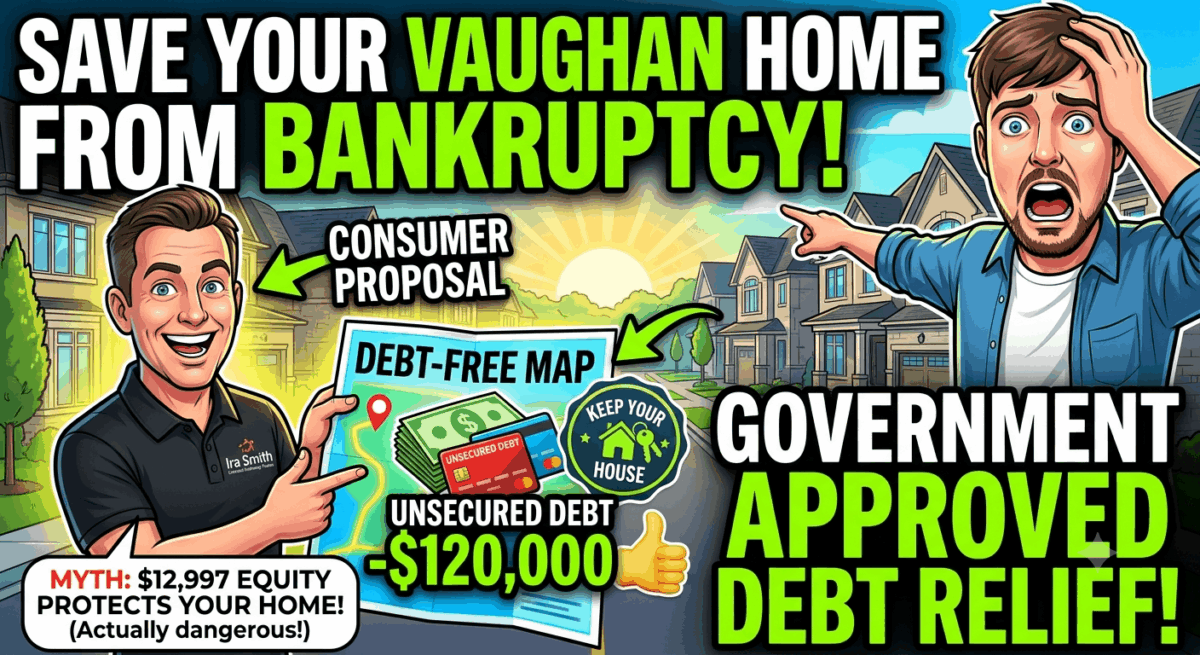
There is a common misunderstanding regarding the Ontario Execution Act. Many believe their home is automatically safe if they file for bankruptcy. The reality is much colder. As of 2026, the law only protects $12,997 of equity. Any more equity than that, and there is no protection at all.
Equity is defined as the current market value of your home minus the balance of your mortgage and any other registered liens. If your home is worth $1.2 million and your mortgage is $1.1 million, you have $100,000 in equity. Since $100,000 is significantly higher than the $12,997 limit, that equity belongs to your “bankruptcy estate.” In a traditional bankruptcy, you would either have to “buy back” the equity from the Trustee or the house could be sold to pay your creditors.

government approved debt relief program
Government Approved Debt Relief Program: What are exempt assets in bankruptcy?
When you begin the process of seeking debt relief, it is vital to understand what you can keep. Assets that the law allows you to retain are called exempt assets.
In Ontario, these typically include:
- Household Furniture: Up to $15,015.
- Tools of the Trade: Up to $15,446 (for those who need specific equipment for work).
- Personal Vehicle: Up to $7,672.
- Principal Residence: $12,997 (but only if the total equity is at or below this amount).
If your equity in your Vaughan home is even $1 over that $12,997 limit, the entire home equity technically becomes an asset that the Trustee must deal with. This is why we often say that for GTA homeowners, traditional bankruptcy is rarely the first choice. The first choice is the only government approved debt relief program which I will discuss shortly
The “Silent Killer”: Navigating 2026 Mortgage Renewals
We are currently seeing a significant trend in the Vaughan and Greater Toronto Area: the 2026 mortgage renewal crisis. Many homeowners who locked in historically low rates years ago are now facing renewals at much higher interest levels.
This is the “silent killer” of the family budget. You might have been managing your credit card debt and line of credit just fine, but an extra $1,200 a month in mortgage interest can suddenly make your total debt load unsustainable.

government approved debt relief program
If you are worried about an upcoming renewal, the time to act is before you miss a payment. By restructuring your unsecured debt now through a consumer proposal Ontario, the only government approved debt relief program in Vaughan, the GTA and the rest of Canada, you can free up the cash flow needed to handle your new mortgage payments and keep your front door keys.
Government Approved Debt Relief Program: How can a Consumer Proposal save my Vaughan home?
A Consumer Proposal is a formal, legally binding process overseen by a Licensed Insolvency Trustee Vaughan. Unlike bankruptcy, you do not surrender your assets. Instead, you make an offer to your creditors to pay back a percentage of what you owe over a period of up to five years.
The reason this is the “Golden Template” for homeowners is simple: the equity in your home stays with you.
Your creditors are usually willing to accept a proposal if they see that they will receive more than they would in a bankruptcy, without the hassle and cost of selling your home. Once the proposal is filed, an automatic stay of proceedings begins. A stay of proceedings is a legal “freeze” that stops creditors from suing you, garnishing your wages, or even calling you to harass you for payments.

government approved debt relief program
Comparison: Bankruptcy vs. Consumer Proposal for Homeowners
| Feature | Personal Bankruptcy | Consumer Proposal |
|---|---|---|
| Home Equity Protection | Only protected if equity is no more than $12,997. | Full protection. You keep all your home equity. |
| Monthly Payments | Based on your surplus income (the more you earn, the more you pay). | A fixed, negotiated monthly amount that never changes. |
| Effect on Assets | Non-exempt assets (like high-value cars or equity) may be sold. | You keep all your assets, including your home and vehicles. |
| Credit Rating | R9 (lowest) for 6–7 years after discharge. | R7 for 3 years after the proposal is completed. |
| Legal Protection | Immediate stay of proceedings (stops lawsuits/garnishments). | Immediate stay of proceedings (stops lawsuits/garnishments). |
Government Approved Debt Relief Program Case Study: Saving a Maple Family Home
Consider the case of “Michael and Sarah” (names changed for privacy), a couple living in Maple. They had $120,000 in unsecured debt, mostly from a failed small business venture and rising grocery costs. Their home was valued at $1.1 million with a mortgage of $950,000, leaving them with $150,000 in equity.
In a bankruptcy, Michael and Sarah would have had to pay the Trustee at least their home equity of $150,000 to keep their home. They didn’t have that kind of cash.
Instead, we helped them file a Consumer Proposal. Their total debts were $240,000, other than their $1.1 million mortgage. We offered their creditors $170,000, payable at $2,833 per month over 60 months. They had good cash flow from their employment and could afford the monthly payment, especially when they did not need to make their other non-mortgage monthly debt payments.
The creditors accepted because this was a very high percentage payout, and acceptance was better than taking the risk of the Maple real estate market in Vaughan, ON, declining further until the home was sold. Michael and Sarah kept their home, stopped the 24% interest on their credit cards, and are now on a clear path to being debt-free.

government approved debt relief program
Government Approved Debt Relief Program Frequently Asked Questions (FAQ)
Can I keep my house if I go bankrupt in Vaughan?
Only if your equity is at or less than $12,997. In the current Vaughan real estate market, very few homeowners meet this criterion. If your equity is higher, a Consumer Proposal is likely your best path to keeping your home.
Will my mortgage lender cancel my mortgage if I file a proposal?
Generally, no. As long as your mortgage payments are up to date, most Canadian lenders will allow you to continue your mortgage. Your government approved debt relief program deals with unsecured debt like credit cards and tax arrears.
Does a Consumer Proposal stop a foreclosure?
If a lender has already started the foreclosure process, it is much harder to stop. However, filing a proposal before they take legal action can provide the cash flow you need to stay current on your secured payments.
How do I know how much equity I have?
We recommend getting a professional appraisal or a “Broker Opinion of Value.” We can help you calculate your exact equity during your free consultation to see where you stand relative to the Ontario Execution Act limits.
Starting Over, Starting Now
Don’t let financial uncertainty dictate your future. If you or your business is struggling with debt, losing sleep, or facing legal action, contact Ira Smith Trustee & Receiver Inc. today.
We offer a free, confidential consultation to discuss your situation, explain your options in plain language, and help you develop a clear, actionable plan to implement a government approved debt relief program. Our team of Licensed Insolvency Trustees is dedicated to providing the compassionate, professional support you need to regain control and achieve a debt-free life.
Take the first step towards a brighter financial future. Call us now.
- Phone: 905.738.4167
- Toronto Line: 647.799.3312
- Evening and Weekends: 289.670.7500
- Website: irasmithinc.com
- Email: brandon@irasmithinc.com
Ira Smith Trustee & Receiver Inc. is licensed by the Office of the Superintendent of Bankruptcy. Ira and Brandon Smith are members of the Canadian Association of Insolvency and Restructuring Professionals.
, , , , , , , , , , , , , , , , , , , , , , , , , , –
Disclaimer: This analysis is for educational purposes only and is based on the cited sources and professional expertise as a Licensed Insolvency Trustee. The information provided does not constitute legal or financial advice for your specific circumstances. Every situation is unique; the outcomes discussed may not apply to your particular case. Please contact Ira Smith Trustee & Receiver Inc. to discuss your specific needs.
About the Author:
Brandon Smith is a Senior Vice-President at Ira Smith Trustee & Receiver Inc. and a Licensed Insolvency Trustee serving clients across Ontario. His experience includes consumer insolvency and complex court-ordered receivership and corporate bankruptcy administration, giving him practical insight into navigating challenging financial situations to achieve optimal outcomes for businesses, creditors, and professionals. Brandon stays current with landmark developments in Canadian insolvency law, ensuring his clients benefit from a cutting-edge understanding of their rights and options.
government approved debt relief program
#VaughanDebtRelief #KeepYourHouse #ConsumerProposalOntario #BankruptcyVaughan #DebtFree2026 #IraSmithTrustee