Categories
Brandon Blog Post

Looking For A Government Approved Debt Relief Program in Vaughan? Our Complete Guide On How To Get It And Keep Your House

Vaughan home keys on a clean surface representing home ownership security under a government approved debt relief program.

We hope that you and your loved ones are staying safe and finding some peace of mind, even if financial pressures have been weighing heavily on you lately. We know the tension and sleepless nights that come with mounting debt, and we want you to know that you are not alone and it is not your fault. Financial crises often stem from a “perfect storm” of economic factors, and we are here to help you navigate through it by discussing the only government approved debt relief program to avoid bankruptcy.

Government Approved Debt Relief Program Key Takeaways

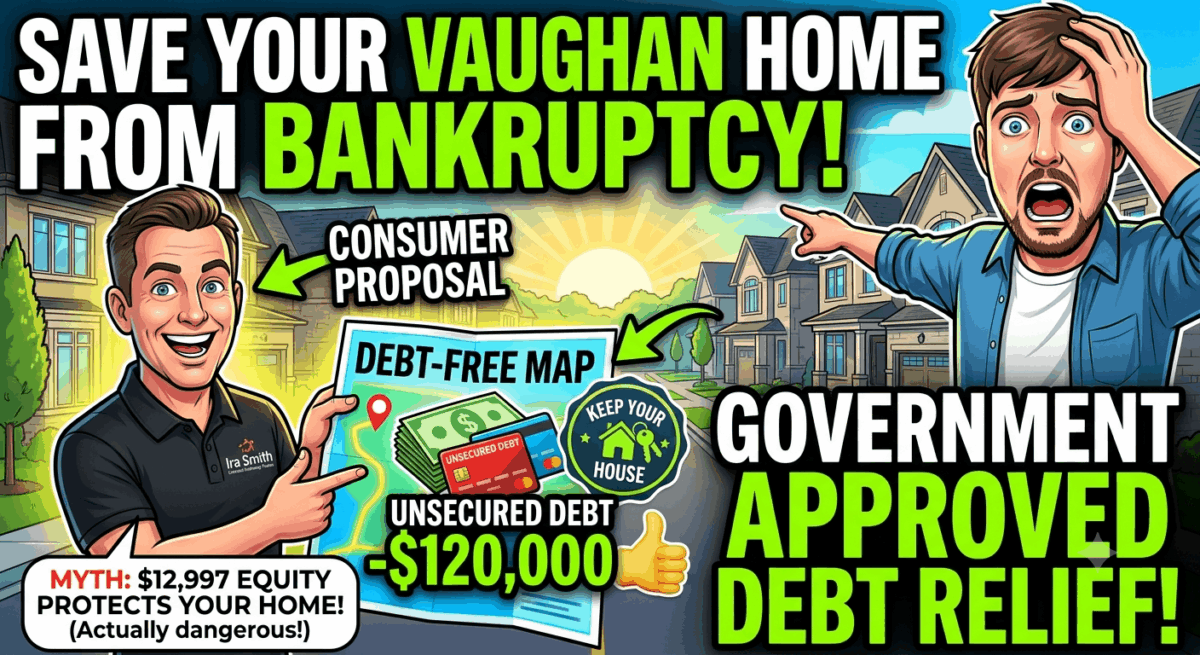
  • The Exemption Reality: In Vaughan, the Ontario Execution Act only protects you if the equity in your principal residence is no more than $12,997 in 2026. If your equity exceeds this, your home is at risk in a traditional bankruptcy.
  • The Vaughan Challenge: With high property values in areas like Woodbridge and Kleinburg, most homeowners have equity far exceeding the legal limit, making bankruptcy a dangerous choice for those wishing to keep their home.
  • A Strategic Lifeline: A Consumer Proposal is the only government approved debt relief program and is often the most effective way to protect your home equity while significantly reducing your total debt.
  • 2026 Mortgage Pressure: Rising interest rates at renewal time are the “silent killer” of GTA household budgets; acting now can prevent a total financial collapse.
  • Professional Guidance: A 30-minute consultation with a Licensed Insolvency Trustee can identify the exact strategy to save your home.

Government Approved Debt Relief Program Highlights

  • The $12,997 Myth: What Vaughan Homeowners Must Know
  • What are exempt assets in bankruptcy?
  • The “Silent Killer”: Navigating 2026 Mortgage Renewals
  • Consumer Proposal vs. Bankruptcy: A Side-by-Side Comparison
  • Case Study: Saving a Maple Family Home
  • Frequently Asked Questions (FAQ)

The $12,997 Myth: What Vaughan Homeowners Must Know

If you live in Vaughan, whether it is a semi-detached in Maple or a larger family home in Kleinburg, you likely know that your home is your greatest asset. However, when it comes to debt relief, that asset can also be your greatest vulnerability.

There is a common misunderstanding regarding the Ontario Execution Act. Many believe their home is automatically safe if they file for bankruptcy. The reality is much colder. As of 2026, the law only protects $12,997 of equity. Any more equity than that, and there is no protection at all.

Equity is defined as the current market value of your home minus the balance of your mortgage and any other registered liens. If your home is worth $1.2 million and your mortgage is $1.1 million, you have $100,000 in equity. Since $100,000 is significantly higher than the $12,997 limit, that equity belongs to your “bankruptcy estate.” In a traditional bankruptcy, you would either have to “buy back” the equity from the Trustee or the house could be sold to pay your creditors.

A Licensed Insolvency Trustee meeting with a concerned Vaughan couple to explain the government approved debt relief program.

government approved debt relief program

Government Approved Debt Relief Program: What are exempt assets in bankruptcy?

When you begin the process of seeking debt relief, it is vital to understand what you can keep. Assets that the law allows you to retain are called exempt assets.

In Ontario, these typically include:

  • Household Furniture: Up to $15,015.
  • Tools of the Trade: Up to $15,446 (for those who need specific equipment for work).
  • Personal Vehicle: Up to $7,672.
  • Principal Residence: $12,997 (but only if the total equity is at or below this amount).

If your equity in your Vaughan home is even $1 over that $12,997 limit, the entire home equity technically becomes an asset that the Trustee must deal with. This is why we often say that for GTA homeowners, traditional bankruptcy is rarely the first choice. The first choice is the only government approved debt relief program which I will discuss shortly

The “Silent Killer”: Navigating 2026 Mortgage Renewals

We are currently seeing a significant trend in the Vaughan and Greater Toronto Area: the 2026 mortgage renewal crisis. Many homeowners who locked in historically low rates years ago are now facing renewals at much higher interest levels.

This is the “silent killer” of the family budget. You might have been managing your credit card debt and line of credit just fine, but an extra $1,200 a month in mortgage interest can suddenly make your total debt load unsustainable.

A calendar marked for 2026 mortgage renewal with a calculator to calculate the new mortgage payment to see if it is affordable in addition to the payment under the government approved debt relief program.

government approved debt relief program

If you are worried about an upcoming renewal, the time to act is before you miss a payment. By restructuring your unsecured debt now through a consumer proposal Ontario, the only government approved debt relief program in Vaughan, the GTA and the rest of Canada, you can free up the cash flow needed to handle your new mortgage payments and keep your front door keys.

Government Approved Debt Relief Program: How can a Consumer Proposal save my Vaughan home?

A Consumer Proposal is a formal, legally binding process overseen by a Licensed Insolvency Trustee Vaughan. Unlike bankruptcy, you do not surrender your assets. Instead, you make an offer to your creditors to pay back a percentage of what you owe over a period of up to five years.

The reason this is the “Golden Template” for homeowners is simple: the equity in your home stays with you.

Your creditors are usually willing to accept a proposal if they see that they will receive more than they would in a bankruptcy, without the hassle and cost of selling your home. Once the proposal is filed, an automatic stay of proceedings begins. A stay of proceedings is a legal “freeze” that stops creditors from suing you, garnishing your wages, or even calling you to harass you for payments.

A scale balancing a house key against the debt papers to calculate the government approved debt relief program consumer proposal amount.

government approved debt relief program

Comparison: Bankruptcy vs. Consumer Proposal for Homeowners

FeaturePersonal BankruptcyConsumer Proposal
Home Equity ProtectionOnly protected if equity is no more than $12,997.Full protection. You keep all your home equity.
Monthly PaymentsBased on your surplus income (the more you earn, the more you pay).A fixed, negotiated monthly amount that never changes.
Effect on AssetsNon-exempt assets (like high-value cars or equity) may be sold.You keep all your assets, including your home and vehicles.
Credit RatingR9 (lowest) for 6–7 years after discharge.R7 for 3 years after the proposal is completed.
Legal ProtectionImmediate stay of proceedings (stops lawsuits/garnishments).Immediate stay of proceedings (stops lawsuits/garnishments).

Government Approved Debt Relief Program Case Study: Saving a Maple Family Home

Consider the case of “Michael and Sarah” (names changed for privacy), a couple living in Maple. They had $120,000 in unsecured debt, mostly from a failed small business venture and rising grocery costs. Their home was valued at $1.1 million with a mortgage of $950,000, leaving them with $150,000 in equity.

In a bankruptcy, Michael and Sarah would have had to pay the Trustee at least their home equity of $150,000 to keep their home. They didn’t have that kind of cash.

Instead, we helped them file a Consumer Proposal. Their total debts were $240,000, other than their $1.1 million mortgage. We offered their creditors $170,000, payable at $2,833 per month over 60 months. They had good cash flow from their employment and could afford the monthly payment, especially when they did not need to make their other non-mortgage monthly debt payments.

The creditors accepted because this was a very high percentage payout, and acceptance was better than taking the risk of the Maple real estate market in Vaughan, ON, declining further until the home was sold. Michael and Sarah kept their home, stopped the 24% interest on their credit cards, and are now on a clear path to being debt-free.

Unlocking the mysteries of the government approved debt relief program through professional support

government approved debt relief program

Government Approved Debt Relief Program Frequently Asked Questions (FAQ)

Can I keep my house if I go bankrupt in Vaughan?

Only if your equity is at or less than $12,997. In the current Vaughan real estate market, very few homeowners meet this criterion. If your equity is higher, a Consumer Proposal is likely your best path to keeping your home.

Will my mortgage lender cancel my mortgage if I file a proposal?

Generally, no. As long as your mortgage payments are up to date, most Canadian lenders will allow you to continue your mortgage. Your government approved debt relief program deals with unsecured debt like credit cards and tax arrears.

Does a Consumer Proposal stop a foreclosure?

If a lender has already started the foreclosure process, it is much harder to stop. However, filing a proposal before they take legal action can provide the cash flow you need to stay current on your secured payments.

How do I know how much equity I have?

We recommend getting a professional appraisal or a “Broker Opinion of Value.” We can help you calculate your exact equity during your free consultation to see where you stand relative to the Ontario Execution Act limits.

Starting Over, Starting Now

Don’t let financial uncertainty dictate your future. If you or your business is struggling with debt, losing sleep, or facing legal action, contact Ira Smith Trustee & Receiver Inc. today.

We offer a free, confidential consultation to discuss your situation, explain your options in plain language, and help you develop a clear, actionable plan to implement a government approved debt relief program. Our team of Licensed Insolvency Trustees is dedicated to providing the compassionate, professional support you need to regain control and achieve a debt-free life.

Take the first step towards a brighter financial future. Call us now.

Ira Smith Trustee & Receiver Inc. is licensed by the Office of the Superintendent of Bankruptcy. Ira and Brandon Smith are members of the Canadian Association of Insolvency and Restructuring Professionals.

, , , , , , , , , , , , , , , , , , , , , , , , , , –

Disclaimer: This analysis is for educational purposes only and is based on the cited sources and professional expertise as a Licensed Insolvency Trustee. The information provided does not constitute legal or financial advice for your specific circumstances. Every situation is unique; the outcomes discussed may not apply to your particular case. Please contact Ira Smith Trustee & Receiver Inc. to discuss your specific needs.

About the Author:

Brandon Smith is a Senior Vice-President at Ira Smith Trustee & Receiver Inc. and a Licensed Insolvency Trustee serving clients across Ontario. His experience includes consumer insolvency and complex court-ordered receivership and corporate bankruptcy administration, giving him practical insight into navigating challenging financial situations to achieve optimal outcomes for businesses, creditors, and professionals. Brandon stays current with landmark developments in Canadian insolvency law, ensuring his clients benefit from a cutting-edge understanding of their rights and options.A graphic showing that by not filing for bankruptcy but using a government approved debt relief program called a consumer proposal and Vaughan Ontario resident can save their home.

government approved debt relief program

#VaughanDebtRelief #KeepYourHouse #ConsumerProposalOntario #BankruptcyVaughan #DebtFree2026 #IraSmithTrustee


Categories
Brandon Blog Post

TRUSTEES IN BANKRUPTCY TORONTO ONTARIO USUALLY FORBIDDEN TO DIG THIS

trustees in bankruptcy toronto ontario
trustees in bankruptcy Toronto Ontario

Trustees in bankruptcy Toronto Ontario introduction

On April 15, 2019, a group of companies operating as QuadrigaCX (Quadriga) became bankrupt. This followed their initial application under the Companies’ Creditors Arrangement Act (CCAA) to get bankruptcy protection.

The purpose of this Brandon’s Blog is to describe the latest events in this ongoing saga. Especially something trustees in bankruptcy Toronto Ontario usually don’t dig this.

What was Quadriga

Quadriga operated a crypto money exchange permitting customers to save, get, and offer various cryptocurrencies (including Bitcoin, Bitcoin Cash Money, Bitcoin Cash SV, Litecoin and Ethereum) on the Quadriga platform.

The cryptocurrency industry is not regulated in Canada and there is no governing body giving oversight.

Canadian chartered banks generally do not supply financial services such as bank accounts to companies operating in the cryptocurrency sector. This held true at Quadriga who needed the solutions offered by Third-Party Payment Processors (TPPP) to provide Quadriga’s treasury functions.

TPPP’s utilize various banking facilities in many countries around the globe. It can be very difficult to trace the flow of funds. Especially if the TPPP purposely sets up an international flow of funds through various intermediaries. We found this when we administered the bankruptcy of Conquest Vacations Inc. (Conquest).

No Canadian or US TPPP would clear Conquest’s credit card transactions. So, Conquest entered into an arrangement with a UK TPPP who utilized, amongst other banks, a financial institution in Mauritius. Our ability to trace the flow of funds with a high level of accuracy was thwarted in that case.

Quadriga was started by Mr. Gerald Cotten. It is reported that he died at. the age of 30 from complications from Crohn’s disease. At the time of his reported death, he was travelling in India.

Apparently, Mr. Cotten was the only person who knew the passwords associated with all the wallet addresses holding cryptocurrency.

Various issues faced by Trustees in bankruptcy Toronto Ontario

The Trustee was unable to find any documentation or other information regarding passwords. The Trustee also was unable to locate conventional books and records. The Trustee was not able to locate basic company records or accounting records.

There were also no records found documenting the location of Quadriga’s cryptocurrency and money reserves between third party settlement processors, savings account, wallet addresses and other third-party exchanges.

There also appeared to be no segregation of assets between funds of Quadriga and its customers. This would make it extremely difficult in any bankruptcy administration for trustees in bankruptcy Toronto Ontario or anywhere else in Canada.

The Trustee found that a substantial volume of cryptocurrency from Quadriga’s platform was transferred to competitor exchanges, some of which were transferred into personal accounts controlled by Mr. Cotten.

Additionally, significant amounts of cryptocurrency were moved to wallet holders whose identification was impossible to identify.

trustees in bankruptcy Toronto ontario
trustees in bankruptcy Toronto Ontario

Gerald Cotten enrichment found by Trustees in bankruptcy Toronto Ontario

It turns out that the cryptocurrency of Quadriga’s customers was taken off the Quadriga system to other third party exchanges and traded on those exchanges.

In other situations, cryptocurrency and its resultant cash were utilized for a margin trading account established by Mr. Cotten. Trading losses sustained and also incremental fees charged by exchanges negatively affected Quadriga’s cryptocurrency books.

Mr. Cotten created particular accounts on the Quadriga system under pen names where it appears that make-believe cryptocurrency and cash funds were deposited and used to trade within the Quadriga platform.

This resulted in inflated revenue numbers and ultimately the withdrawal of customers’ cryptocurrency. Substantial funds were moved to Mr. Cotten directly and various other associated accounts. This resulted in a substantial amount of cash and cryptocurrency reserves that could not be located.

The Trustee’s examination revealed that Mr. Cotten occasionally moved substantial cryptocurrency as well as various other funds outside of Quadriga. In certain instances, these transfers were for considerable amounts of currency routed to Mr. Cotten directly. Funds were used to fund personal costs and also the purchase of various personal assets.

In various other cases, transfers were made straight to his wife, Jennnifer Robertson. Funds were also used to pay personal expenses and to purchase personal assets both in her name or the name of companies which she controlled.

The trustees in bankruptcy Toronto Ontario settlement with Jennifer Robertson

Ms. Robertson has offered the Trustee a settlement offer that involves returning the majority of her possessions, the assets of Mr. Cotten’s Estate and also the assets of entities owned by Ms. Robertson or the Estate to the Trustee.

Negotiations have led to a settlement agreement acceptable to the Trustee. The Trustee was of the view that a negotiated settlement was more effective than ongoing litigation.

The settlement arrangements were substantial and conducted at arm’s length. The Trustee sought and obtained the agreement of the Inspectors in the Quadriga bankruptcy administration.

The settlement to transfer almost all of the assets owned by Ms. Robertson, the various companies and the Estate was also approved by the Court. So everything seems to be going smoothly, right?

Trustees in bankruptcy Toronto Ontario usually don’t dig this!

Not quite. On Friday, December 13, 2019, the legal team representing individuals who were users of the platform in these bankruptcy proceedings and who have lost collectively millions of dollars, sent a letter.

The letter went to the Royal Canadian Mounted Police seeking an exhumation and also post-mortem autopsy be performed on the body. The reason is to confirm both its identity as well as the cause of death.

They say information revealed during the proceedings, even more, highlights the requirement for assurance around the concern of whether Mr. Cotten is in fact deceased.

I don’t know why these lawyers feel that proving Mr. Cotten is in fact dead is so important. Maybe they feel that anyone who would give up substantially all of her assets, the Estate’s assets and related companies’ assets, must have more money somewhere else hidden.

Maybe they think that Mr. Cotten faked his own death, has millions of dollars that still have not been found and the two will reunite once the heat is off. I don’t know why, but this certainly is an unusual turn of events in a bankruptcy administration.

It is certainly something that trustees in bankruptcy Toronto Ontario or anywhere else in Canada don’t dig!

We will have to see how this saga unfolds and if there will be any more surprises.

Summary

I hope you found this Brandon’s Blog, Trustees in bankruptcy Toronto Ontario usually don’t dig this interesting. Sometimes things are too far gone and more drastic and immediate triage action is required.

Do you have too much debt? Are you in need of financial restructuring? The financial restructuring process is complex. The Ira Smith Team understands how to do a complex restructuring.

However, more importantly, we understand the needs of the entrepreneur or the person who has too much personal debt. You are worried because you are facing significant financial challenges.

It is not your fault that you are in this situation. You have been only shown the old ways that do not work anymore. The Ira Smith Team uses new modern ways to get you out of your debt troubles while avoiding bankruptcy. We can get you debt relief freedom.

The stress placed upon you is huge. We understand your pain points. We look at your entire situation and devise a strategy that is as unique as you and your problems; financial and emotional. The way we take the load off of your shoulders and devise a debt settlement plan, we know that we can help you.

We know that people facing financial problems need a realistic lifeline. There is no “one solution fits all” approach with the Ira Smith Team. That is why we can develop a restructuring process as unique as the financial problems and pain you are facing.

If any of this sounds familiar to you and you are serious about finding a solution, contact the Ira Smith Trustee & Receiver Inc. team today.

Call us now for a free consultation. We will get you or your company back on the road to healthy stress-free operations and recover from the pain points in your life, Starting Over, Starting Now.

trustees in bankruptcy Toronto ontario
trustees in bankruptcy Toronto Ontario
Categories
Brandon Blog Post

CREDIT COUNSELLING CANADA: VERY BUSY WITH BANKRUPTCY ONLINE CHATTER

credit counselling canada

If you would prefer to listen to the audio version of this credit counselling Canada Brandon’s Blog, please scroll down to the bottom and click on the podcast

Introduction

Like many people, I have set up various Google News alerts. Mine are mostly on the topic of insolvency. I have done this so that whenever a news article is posted on the topic, I will be alerted. One of the alerts I have set up is for the term “credit counselling Canada”. Last week I have noticed that a fair bit of bankruptcy online chatter.

The posts being promoted include:

I have taken a look at the posts. Generally, they are very accurate.

Unscrupulous debt consultants

I was very happy to see some of the posts warning against going to the unscrupulous debt consultants that I have written about before. The Office of the Superintendent of Bankruptcy (OSB) has also warned against them.

The purpose of this Brandon’s Blog is to comment and shed light on several comments in their recent busy online articles that I think are slightly misleading.

Consumer Proposal Ontario

In the Ontario consumer proposal blog, it is stated that a consumer proposal can only be arranged and administered by a bankruptcy trustee (now called a licensed insolvency trustee) (Trustee) which is true. They then go on to state what the cost of a consumer proposal is, that you need to pay an initial setup fee. They also state that the Trustee will also keep 20% of all of your consumer proposal payments.

This is misleading. The way I read it, is they claim you will have to pay a Trustee a setup fee, their fee and an additional 20%. This is not correct. In reality, the Trustee’s fee is a fixed tariff set by the Bankruptcy and Insolvency Act (Canada) (BIA). The fee and disbursements of the Trustee are set in the statute. It is illegal, for the Trustee to collect anything above and beyond the statutory tariff.

The reality is that the Trustee’s fee and disbursements, set by a tariff, come out of the person’s consumer proposal payments. The consumer proposal payments are calculated off of what your creditors can expect in that person’s bankruptcy. Whatever that amount is, the bankruptcy law says that the amount offered in the consumer proposal must be higher. Therefore, the amount a person must offer to get creditor buy-in to accept the consumer proposal has zero relationships to the Trustee’s fee and disbursements.

As the Trustee is entitled to take its capped fee and disbursements from the consumer proposal fund, rather than costing the person, the Trustee’s fee and disbursements are actually free to the insolvent debtor!

Bankruptcy Trustee, Creditor & Debtor

The blog I read on this topic discussed is pretty accurate. The only issue I take is that when describing the role of the Trustee, they pull out the old scare tactic that although the Trustee makes sure that the rights of the debtor are not abused, the Trustee acts for your creditors. This is technically true but overlooks the role of the Trustee as a credit counsellor before the debtor decides whether or not to file either a consumer proposal or for bankruptcy.

In my professional practice, before I allow anyone to file for bankruptcy, I provide an exhaustive and detailed analysis of the person’s financial situation. I first ask the person to explain the issues and financial crisis they are facing which is upending their life. We then together look at their assets, liabilities and income so that I can come up with realistic options. We then discuss the options available and I explain the advantages and disadvantages of each. Then I provide my recommendation. All of this is done in an initial consultation and is no charge to the person.

If they wish to explore the options we discussed more seriously, I then have them complete our standard intake form called the Debt Relief Worksheet. That document when fully completed and provided to me with appropriate backup, allows me to confirm my initial diagnosis and recommendations. Then it is up to the debtor to make their choice as to how they wish to proceed.

After going through this process, with everything fully explained by me, there are no surprises. If the debtor follows my advice, they will have either a successful debt settlement consumer proposal or will discharge their debts through the bankruptcy process. During and after this entire process, the debtor does not feel that I am biased against them in favour of their creditors. Although I have acted formally on behalf of their creditors, the debtor thanks me for saving them and allowing them to restart their lives.

Personal bankruptcy Toronto

The blog I read on personal bankruptcy, part of a credit counselling Canada series, said that people will tell you that bankruptcy eliminated all of their debts. They then ask the question: Did they tell you that it is not possible for everyone? The obvious answer is no because someone who eliminated all of their debts isn’t worried about someone else’s situation and distinctions.

The three types of debts given as examples that cannot be eliminated by a discharge from bankruptcy are:

  • Secured debts, like mortgages and car loans
  • Student loans where you have ceased being a full-time or part-time student less than 7 years ago
  • Child and alimony support payments

This is all true. When I counsel debtors during the free consultation, we review issues like this. We discuss all of the person’s debts, which can be discharged and which cannot be. Just because a certain debt on its face cannot be discharged through bankruptcy, does not mean that the person cannot properly avail themselves of an insolvency process and improve their financial position in life.

Specifically, with secured debt, I attack it from the perspective of can you afford to keep paying that debt, or should you keep paying it. If the home is fully encumbered and there is no or little equity, perhaps renting is a cheaper alternative. We go through the same analysis for a car loan.

In some cases, it might make sense for the person to give up the asset to the mortgagee/lender and allow them to make a demand on the debtor for the shortfall. A shortfall happens when the lender sells the asset but the market will only pay less than the secured debt owing. The lender’s loss is the shortfall. They can pursue the debtor for the loss.

That lender loss, or shortfall, is now an unsecured debt. The person has hopefully found a car they can afford and home, condo or apartment to rent they can afford in their budget. They have now turned the secured debt into an unsecured shortfall claim. That unsecured debt can be discharged through either a consumer proposal or bankruptcy process.

So just because a secured debt cannot be discharged in bankruptcy, it doesn’t mean the person can afford or should keep that debt and continue making payments. They may have a better way to live while then being able to discharge their debts through an insolvency process.

Bankruptcy Discharge in Canada

The blog I read on bankruptcy discharge does not say too much about the bankruptcy discharge process. Rather, they do focus on the dangers of not getting a discharge and remaining undischarged bankrupt.

Everything they say on the topic is true. However, I believe it does leave out a lot of information. In my experience, if someone follows my advice and lives up to all of their obligations during the lifetime of their bankruptcy, then they are not going to have a problem with discharge. It really is only those who try to “game” the system, do not fully cooperate and refuse to make full and transparent disclosure who have problems.

That is how the BIA is designed to work. You are asking your creditors to forgo a lot of the debt you owe them. In return, you have to be fully cooperative and make full disclosure, so that every stakeholder in the bankruptcy process knows that it has been a fair process.

In all of the personal bankruptcies I have administered, it is a very small minority who have a problem with discharge. In all cases, it is their past behaviour or their lack of full disclosure in bankruptcy that has caused the problems, not the bankruptcy process itself.

Summary

I hope you enjoyed this Brandon’s Blog on credit counselling Canada. Are you or your company in need of financial restructuring? The financial restructuring process is complex. The Ira Smith Team understands how to do a complex corporate restructuring. However, more importantly, we understand the needs of the entrepreneur. You are worried because your company is facing significant financial challenges. Your business provides income not only for your family. Many other families rely on you and your company for their well-being.

The stress placed upon you due to your company’s financial challenges is enormous. We understand your pain points. We look at your entire situation and devise a strategy that is as unique as you and your company’s problems; financial and emotional. The way we deal with this problem and devise a corporate restructuring plan, we know that we can help you and your company too.

We know that companies facing financial problems need realistic lifeline. There is no “one solution fits all” approach with the Ira Smith Team. That is why we can develop a company restructuring process as unique as the financial problems and pain it is facing. If any of this sounds familiar to you and you are serious in finding a solution, contact the Ira Smith Trustee & Receiver Inc. team today.

Call us now for a free consultation. We will get your company back on the road to healthy stress-free operations and recover from the pain points in your life, Starting Over, Starting Now.

[monkeytools msnip=”https://monkeyplayr.com/playr.php?u=5173&p=21731″]


Categories
Brandon Blog Post

# VIDEO – DIFFERENCE BETWEEN CONSUMER PROPOSAL AND BANKRUPTCY: LIST OF 5 DIFFERENCES TO KNOW ABOUT #

Difference between consumer proposal and bankruptcy

This short video explains the difference between a consumer proposal and bankruptcy. A consumer proposal is a deal to end your debts. A consumer proposal is a legally binding process that is administered by a licensed trustee.

5 things that make the difference between consumer proposal and bankruptcy

  1. In a bankruptcy, if your income goes up, the amount you have to pay to your Trustee may very well go up. In a consumer proposal, your payment is fixed.
  2. In a bankruptcy, you will lose your income tax refund, contributions to your RRSP in the last 12 months, RESP for your children and other assets. In a consumer proposal that is accepted by your creditors, you get to keep your assets.
  3. There is less reporting in a consumer proposal. You do not have to show proof of your income every month as long as you are keeping your consumer proposal payments current.
  4. In a bankruptcy, if there is opposition to your discharge from bankruptcy, then you must attend for a Court hearing.There is no Court process at the end of the administration or a discharge hearing in a consumer proposal.
  5. You stay in control of your assets and affairs in a consumer proposal that is accepted by your creditors and that you are performing.

These are the main things that create a difference between consumer proposal and bankruptcy.

If you have too much debt, call us now!

We offer personal bankruptcy and consumer proposal services, as well as corporate restructuring and corporate receivership and bankruptcy services to residents of the Greater Toronto Area. We explain the differences between a consumer proposal vs. personal bankruptcy. In most cases we can get a consumer proposal done and it usually results in a substantial reduction in the amount you have to repay. The amount you are required to pay when you file a consumer proposal depends on a number of factors as explained in this short video.

So now that you know the 5 major items that makes up the difference between consumer proposal and bankruptcy and if you are experiencing financial problems, or you know that you are insolvent and are considering a consumer proposal vs. personal bankruptcy, or looking at all of your realistic options, including all alternatives to bankruptcy, contact Ira Smith Trustee & Receiver Inc. Ira Smith Trustee & Receiver Inc. is a Vaughan (Toronto) bankruptcy trustee and consumer proposal administrator. We offer sound advice, a free consultation and a solid plan for Starting Over, Starting Now so that you’ll be well on your way to a debt free life in no time.

difference between consumer proposal and bankruptcy


Categories
Brandon Blog Post

▓ VIDEO: CONSUMER PROPOSAL VS. PERSONAL BANKRUPTCY ▓

consumer proposal vs. personal bankruptcy, "consumer proposal", doug hoyes, personal bankruptcy, c.e. craig & associates inc., colleen craig, trustee in bankruptcy, debts, credit, consumer proposal canada, the consumer proposal, bankruptcy canada, avoid bankruptcy, hoyes michalos, a "consumer proposal, bankruptcy ontario, bankruptcy trustee, personal debt, bankruptcy alternative, bankruptcy toronto, personal bankruptcy, toronto, barrie, debts, ira smith, starting over starting nowconsumer proposal vs. personal bankruptcy

This short video (found at the bottom of this page) explains the differences between a consumer proposal vs. personal bankruptcy. A consumer proposal is a deal to end your debts. A consumer proposal is a legally binding process that is administered by a licensed trustee. Ira Smith Trustee & Receiver Inc. is a Toronto bankruptcy trustee and consumer proposal administrator.

We have written previous blogs about consumer proposals, including:

We offer personal bankruptcy and consumer proposal services, as well as corporate restructuring and corporate receivership and bankruptcy services to residents of the Greater Toronto Area. We explain the differences between a consumer proposal vs. personal bankruptcy. In most cases we can get a consumer proposal done and it usually results in a substantial reduction in the amount you have to repay. The amount you are required to pay when you file a consumer proposal depends on a number of factors as explained in this short video. We hope that you find the short video informative and interesting. If you have any topics about debt, insolvency or finances that you would like us to cover in future videos, please let us know by leaving a comment.

If you are experiencing financial problems, or you know that you are insolvent and are considering a consumer proposal vs. personal bankruptcy, or looking at all of your realistic options, including all alternatives to bankruptcy, contact Ira Smith Trustee & Receiver Inc. We offer sound advice, a free consultation and a solid plan for Starting Over, Starting Now so that you’ll be well on your way to a debt free life in no time.

Call a Trustee Now!