Categories
Brandon Blog Post

Looking For A Government Approved Debt Relief Program in Vaughan? Our Complete Guide On How To Get It And Keep Your House

Vaughan home keys on a clean surface representing home ownership security under a government approved debt relief program.

We hope that you and your loved ones are staying safe and finding some peace of mind, even if financial pressures have been weighing heavily on you lately. We know the tension and sleepless nights that come with mounting debt, and we want you to know that you are not alone and it is not your fault. Financial crises often stem from a “perfect storm” of economic factors, and we are here to help you navigate through it by discussing the only government approved debt relief program to avoid bankruptcy.

Government Approved Debt Relief Program Key Takeaways

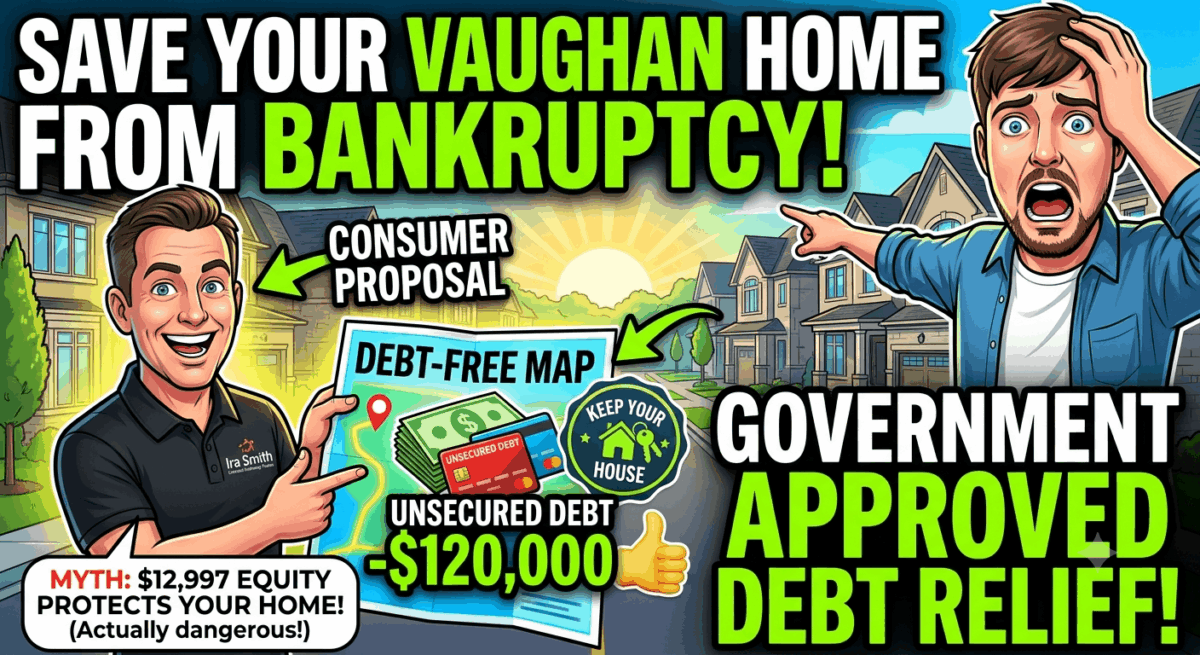
  • The Exemption Reality: In Vaughan, the Ontario Execution Act only protects you if the equity in your principal residence is no more than $12,997 in 2026. If your equity exceeds this, your home is at risk in a traditional bankruptcy.
  • The Vaughan Challenge: With high property values in areas like Woodbridge and Kleinburg, most homeowners have equity far exceeding the legal limit, making bankruptcy a dangerous choice for those wishing to keep their home.
  • A Strategic Lifeline: A Consumer Proposal is the only government approved debt relief program and is often the most effective way to protect your home equity while significantly reducing your total debt.
  • 2026 Mortgage Pressure: Rising interest rates at renewal time are the “silent killer” of GTA household budgets; acting now can prevent a total financial collapse.
  • Professional Guidance: A 30-minute consultation with a Licensed Insolvency Trustee can identify the exact strategy to save your home.

Government Approved Debt Relief Program Highlights

  • The $12,997 Myth: What Vaughan Homeowners Must Know
  • What are exempt assets in bankruptcy?
  • The “Silent Killer”: Navigating 2026 Mortgage Renewals
  • Consumer Proposal vs. Bankruptcy: A Side-by-Side Comparison
  • Case Study: Saving a Maple Family Home
  • Frequently Asked Questions (FAQ)

The $12,997 Myth: What Vaughan Homeowners Must Know

If you live in Vaughan, whether it is a semi-detached in Maple or a larger family home in Kleinburg, you likely know that your home is your greatest asset. However, when it comes to debt relief, that asset can also be your greatest vulnerability.

There is a common misunderstanding regarding the Ontario Execution Act. Many believe their home is automatically safe if they file for bankruptcy. The reality is much colder. As of 2026, the law only protects $12,997 of equity. Any more equity than that, and there is no protection at all.

Equity is defined as the current market value of your home minus the balance of your mortgage and any other registered liens. If your home is worth $1.2 million and your mortgage is $1.1 million, you have $100,000 in equity. Since $100,000 is significantly higher than the $12,997 limit, that equity belongs to your “bankruptcy estate.” In a traditional bankruptcy, you would either have to “buy back” the equity from the Trustee or the house could be sold to pay your creditors.

A Licensed Insolvency Trustee meeting with a concerned Vaughan couple to explain the government approved debt relief program.

government approved debt relief program

Government Approved Debt Relief Program: What are exempt assets in bankruptcy?

When you begin the process of seeking debt relief, it is vital to understand what you can keep. Assets that the law allows you to retain are called exempt assets.

In Ontario, these typically include:

  • Household Furniture: Up to $15,015.
  • Tools of the Trade: Up to $15,446 (for those who need specific equipment for work).
  • Personal Vehicle: Up to $7,672.
  • Principal Residence: $12,997 (but only if the total equity is at or below this amount).

If your equity in your Vaughan home is even $1 over that $12,997 limit, the entire home equity technically becomes an asset that the Trustee must deal with. This is why we often say that for GTA homeowners, traditional bankruptcy is rarely the first choice. The first choice is the only government approved debt relief program which I will discuss shortly

The “Silent Killer”: Navigating 2026 Mortgage Renewals

We are currently seeing a significant trend in the Vaughan and Greater Toronto Area: the 2026 mortgage renewal crisis. Many homeowners who locked in historically low rates years ago are now facing renewals at much higher interest levels.

This is the “silent killer” of the family budget. You might have been managing your credit card debt and line of credit just fine, but an extra $1,200 a month in mortgage interest can suddenly make your total debt load unsustainable.

A calendar marked for 2026 mortgage renewal with a calculator to calculate the new mortgage payment to see if it is affordable in addition to the payment under the government approved debt relief program.

government approved debt relief program

If you are worried about an upcoming renewal, the time to act is before you miss a payment. By restructuring your unsecured debt now through a consumer proposal Ontario, the only government approved debt relief program in Vaughan, the GTA and the rest of Canada, you can free up the cash flow needed to handle your new mortgage payments and keep your front door keys.

Government Approved Debt Relief Program: How can a Consumer Proposal save my Vaughan home?

A Consumer Proposal is a formal, legally binding process overseen by a Licensed Insolvency Trustee Vaughan. Unlike bankruptcy, you do not surrender your assets. Instead, you make an offer to your creditors to pay back a percentage of what you owe over a period of up to five years.

The reason this is the “Golden Template” for homeowners is simple: the equity in your home stays with you.

Your creditors are usually willing to accept a proposal if they see that they will receive more than they would in a bankruptcy, without the hassle and cost of selling your home. Once the proposal is filed, an automatic stay of proceedings begins. A stay of proceedings is a legal “freeze” that stops creditors from suing you, garnishing your wages, or even calling you to harass you for payments.

A scale balancing a house key against the debt papers to calculate the government approved debt relief program consumer proposal amount.

government approved debt relief program

Comparison: Bankruptcy vs. Consumer Proposal for Homeowners

FeaturePersonal BankruptcyConsumer Proposal
Home Equity ProtectionOnly protected if equity is no more than $12,997.Full protection. You keep all your home equity.
Monthly PaymentsBased on your surplus income (the more you earn, the more you pay).A fixed, negotiated monthly amount that never changes.
Effect on AssetsNon-exempt assets (like high-value cars or equity) may be sold.You keep all your assets, including your home and vehicles.
Credit RatingR9 (lowest) for 6–7 years after discharge.R7 for 3 years after the proposal is completed.
Legal ProtectionImmediate stay of proceedings (stops lawsuits/garnishments).Immediate stay of proceedings (stops lawsuits/garnishments).

Government Approved Debt Relief Program Case Study: Saving a Maple Family Home

Consider the case of “Michael and Sarah” (names changed for privacy), a couple living in Maple. They had $120,000 in unsecured debt, mostly from a failed small business venture and rising grocery costs. Their home was valued at $1.1 million with a mortgage of $950,000, leaving them with $150,000 in equity.

In a bankruptcy, Michael and Sarah would have had to pay the Trustee at least their home equity of $150,000 to keep their home. They didn’t have that kind of cash.

Instead, we helped them file a Consumer Proposal. Their total debts were $240,000, other than their $1.1 million mortgage. We offered their creditors $170,000, payable at $2,833 per month over 60 months. They had good cash flow from their employment and could afford the monthly payment, especially when they did not need to make their other non-mortgage monthly debt payments.

The creditors accepted because this was a very high percentage payout, and acceptance was better than taking the risk of the Maple real estate market in Vaughan, ON, declining further until the home was sold. Michael and Sarah kept their home, stopped the 24% interest on their credit cards, and are now on a clear path to being debt-free.

Unlocking the mysteries of the government approved debt relief program through professional support

government approved debt relief program

Government Approved Debt Relief Program Frequently Asked Questions (FAQ)

Can I keep my house if I go bankrupt in Vaughan?

Only if your equity is at or less than $12,997. In the current Vaughan real estate market, very few homeowners meet this criterion. If your equity is higher, a Consumer Proposal is likely your best path to keeping your home.

Will my mortgage lender cancel my mortgage if I file a proposal?

Generally, no. As long as your mortgage payments are up to date, most Canadian lenders will allow you to continue your mortgage. Your government approved debt relief program deals with unsecured debt like credit cards and tax arrears.

Does a Consumer Proposal stop a foreclosure?

If a lender has already started the foreclosure process, it is much harder to stop. However, filing a proposal before they take legal action can provide the cash flow you need to stay current on your secured payments.

How do I know how much equity I have?

We recommend getting a professional appraisal or a “Broker Opinion of Value.” We can help you calculate your exact equity during your free consultation to see where you stand relative to the Ontario Execution Act limits.

Starting Over, Starting Now

Don’t let financial uncertainty dictate your future. If you or your business is struggling with debt, losing sleep, or facing legal action, contact Ira Smith Trustee & Receiver Inc. today.

We offer a free, confidential consultation to discuss your situation, explain your options in plain language, and help you develop a clear, actionable plan to implement a government approved debt relief program. Our team of Licensed Insolvency Trustees is dedicated to providing the compassionate, professional support you need to regain control and achieve a debt-free life.

Take the first step towards a brighter financial future. Call us now.

Ira Smith Trustee & Receiver Inc. is licensed by the Office of the Superintendent of Bankruptcy. Ira and Brandon Smith are members of the Canadian Association of Insolvency and Restructuring Professionals.

, , , , , , , , , , , , , , , , , , , , , , , , , , –

Disclaimer: This analysis is for educational purposes only and is based on the cited sources and professional expertise as a Licensed Insolvency Trustee. The information provided does not constitute legal or financial advice for your specific circumstances. Every situation is unique; the outcomes discussed may not apply to your particular case. Please contact Ira Smith Trustee & Receiver Inc. to discuss your specific needs.

About the Author:

Brandon Smith is a Senior Vice-President at Ira Smith Trustee & Receiver Inc. and a Licensed Insolvency Trustee serving clients across Ontario. His experience includes consumer insolvency and complex court-ordered receivership and corporate bankruptcy administration, giving him practical insight into navigating challenging financial situations to achieve optimal outcomes for businesses, creditors, and professionals. Brandon stays current with landmark developments in Canadian insolvency law, ensuring his clients benefit from a cutting-edge understanding of their rights and options.A graphic showing that by not filing for bankruptcy but using a government approved debt relief program called a consumer proposal and Vaughan Ontario resident can save their home.

government approved debt relief program

#VaughanDebtRelief #KeepYourHouse #ConsumerProposalOntario #BankruptcyVaughan #DebtFree2026 #IraSmithTrustee
Categories
Brandon Blog Post

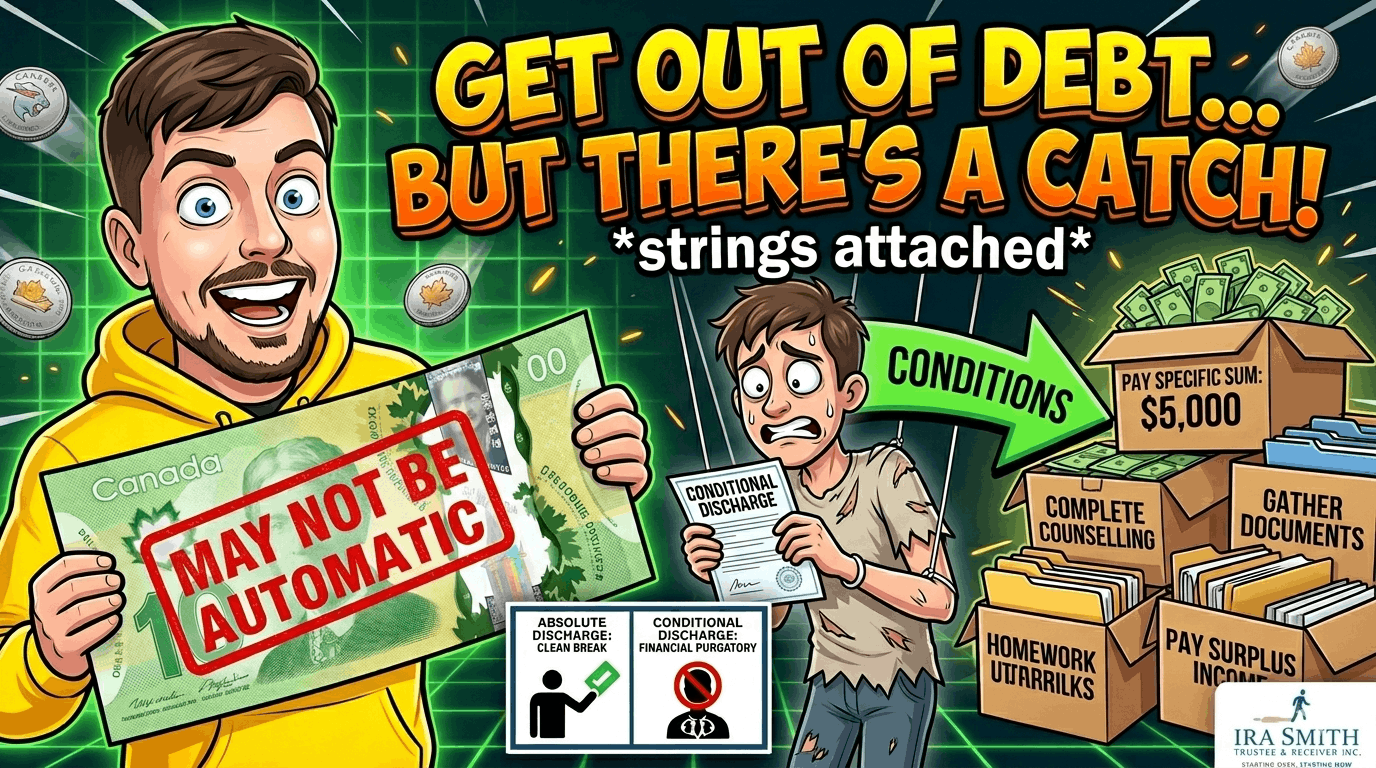
Define Conditional Discharge: The Truth About It Not Being An Automatic “Get Out of Debt Free” Card

A professional silver key turning in a lock, with thick metallic chains falling away, symbolizing the transition from bankruptcy to a fresh start once we know how to define conditional discharge.

Define Conditional Discharge: Introduction

Hello and welcome. If you are reading this, you might be feeling the weight of financial uncertainty on your shoulders. Please know that you are safe here, and you are certainly not alone. At Ira Smith Trustee & Receiver Inc., we understand that life can throw unexpected curveballs, and facing the bankruptcy process is a brave step toward reclaiming your future. Our goal is to guide you through the fog with clarity, compassion, and a concrete plan to get you back on your feet.

In this Brandon’s Blog, we define conditional discharge, discuss what it means and discuss a 2021 Court of Appeal for British Columbia decision.

Define Conditional Discharge Key Takeaways

  • Bankruptcy isn’t always automatic: While many expect a simple end date, certain factors can lead you to define conditional discharge.
  • Conditions are “homework”: The court may define conditional discharge by requiring you to pay money or perform specific duties before your debts are legally wiped away.
  • You remain “undischarged”: Until conditions are met, you are an undischarged bankrupt and still subject to certain legal restrictions.
  • A Licensed Insolvency Trustee is your ally: We help you navigate these conditions to ensure you reach the finish line, the absolute discharge.

Define Conditional Discharge Highlights

  • What is a Conditional Discharge?
  • Why Do Courts Impose Conditions?
  • Common Conditions You Might Face
  • Comparing Discharge Types: Absolute vs. Conditional vs. Suspended
  • The “12-Year Trap”: A Real-World Case Study
  • How to Transition from Conditional to Absolute Discharge
  • Frequently Asked Questions (FAQ)

How Do You Define Conditional Discharge?

When you enter personal bankruptcy Canada, the ultimate goal is the discharge. This is the legal document that releases you from the obligation to pay back the debts you owed at the time you filed.

However, a discharge is not always a straight line. If there is an opposition to your discharge, perhaps from a creditor, the Office of the Superintendent of Bankruptcy, or your own Trustee, the matter goes before an Associate Justice. Instead of granting you a clean break immediately, the court might issue a conditional discharge.

The important issue is how the court will define conditional discharge. What requirements does the court place on you to fulfill before you really do get discharged from your bankruptcy? It is the discharge, and not the filing for bankruptcy, that releases you from your debts.

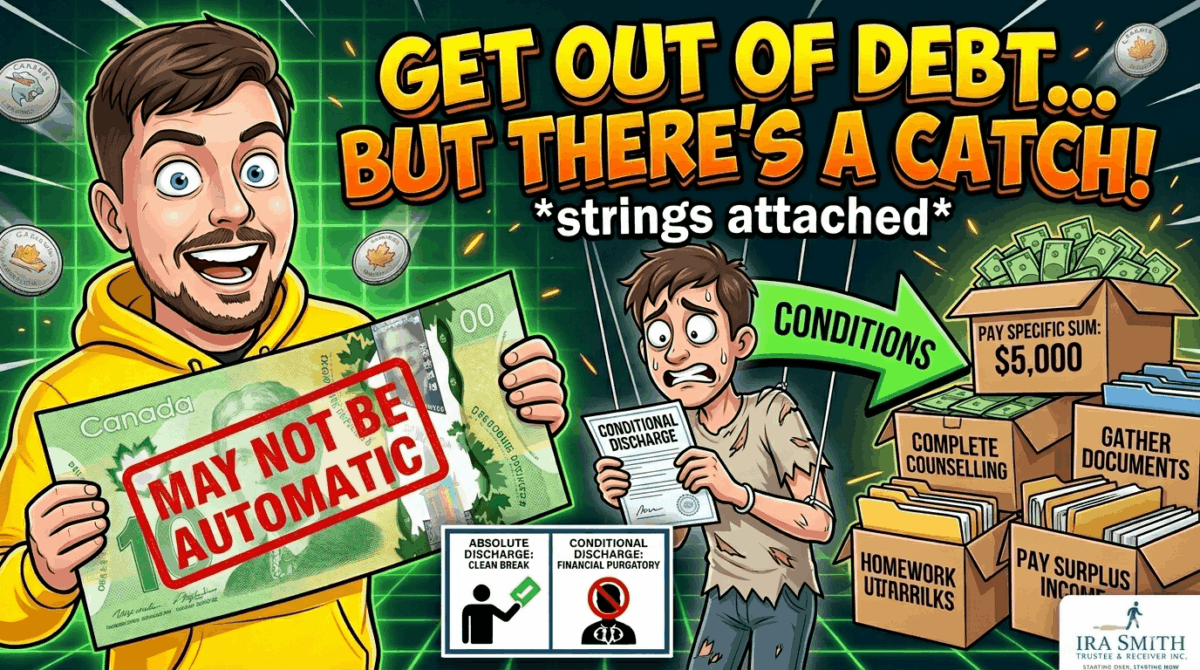
I suggest that you should define conditional discharge as an “absolute discharge in principle, but with strings attached.” It means the court has decided you deserve a fresh start, but only after you complete a few more tasks or pay a bit more into the pot for your creditors.

A Licensed Insolvency Trustee in a professional Toronto office explaining discharge conditions to a client., including how to define conditional discharge

Why do courts impose conditions?

We know the tension put upon you when you feel like the goalposts have been moved. It is important to remember: it is not your fault that the law has these complexities. The court’s job is to balance your need for a fresh start with the rights of the people you owe money to.

The court typically imposes conditions if:

  1. Duties were missed: You may have forgotten to attend your mandatory counselling sessions (educational meetings designed to help you manage money better in the future).
  2. Surplus income exists: If your income is above a certain threshold, the law requires you to pay a portion of that “extra” money to your Trustee, and you haven’t paid it all.
  3. High tax debt: If you owe more than $200,000 in personal income tax, and that makes up 75% or more of your total debt, the law requires a court hearing. Under Section 172.1 of the Bankruptcy and Insolvency Act (BIA), you are defined as a High-Tax Debtor who is not eligible for an automatic discharge
  4. Conduct issues: If you weren’t fully transparent about your assets, or if you’ve been through bankruptcy multiple times before.

Define Conditional Discharge: Common conditions you might face

If you find yourself as one of the many undischarged bankrupts in the GTA, your court order will likely list one or more of the following “homework” assignments:

  • Payment of a specific sum: The court might order you to pay, for example, $5,000 over 12 months.
  • Performing duties: You might need to provide missing tax information or finally attend those two mandatory counselling sessions.
  • Surrendering assets: You may be required to turn over a specific piece of property that was previously undisclosed.

Comparing discharge types: A quick guide

Navigating debt relief Toronto requires knowing exactly where you stand. Use this table to understand the different flavours of discharge:

Discharge TypeWhat it MeansStatus of Your Debt
Absolute DischargeYou have completed everything. You are 100% finished.Debts are legally wiped away (with certain exceptions like child or spousal support).
Conditional DischargeYou have “homework” to do first (payments or duties).You are still responsible for your debts until conditions are met.
Suspended DischargeYour discharge is granted but won’t take effect until a future date.Debts are wiped away only once the suspension period ends.
Refused DischargeThe court denies your request due to extreme misconduct or non-compliance.You remain bankrupt and still owe all your debts.

The “12-Year Trap”: A real-world case study to define conditional discharge

To see how the court thinks, let’s look at the case of Perrier v. Canada (Revenue Agency). In this instance, a bankrupt individual was ordered to pay $150,000 at a rate of $1,000 per month as a condition of his discharge.

On the surface, it seems fair to ask someone to pay what they can. However, the Court of Appeal stepped in. They realized that at $1,000 a month, it would take the man over 12 years to finish. Since he was nearing retirement, this condition would have followed him into his golden years, effectively denying him the “fresh start” that personal bankruptcy Canada is supposed to provide.

The court reduced the amount to $45,000 over five years, proving that the conditions must be reasonable and attainable. This is why having a Licensed Insolvency Trustee Toronto, like the team at Ira Smith Trustee & Receiver Inc., is vital; we ensure the court understands your reality.

A legal document with a bold 'CONDITIONAL' stamp and a judge's gavel, representing the formal court process and how to define conditional discharge.

How to transition from Define Conditional Discharge to “Absolute”

Being an undischarged bankrupt can feel like being in “financial purgatory,” but the path out is clear. Here is how we help you reach that absolute discharge:

  1. Provide you with an upfront warning: As your licensed insolvency trustee, if we are in a position where we feel we will need to oppose your absolute discharge, we will provide you with a warning and advise you on what steps you need to take to avoid our opposition. If a creditor opposes your discharge from bankruptcy, we look at their reasons and provide you with advice as to what you should do ahead of the court discharge hearing.
  2. Review the Conditional Order: We sit down with you to translate the “legalese” into plain English.
  3. Create a Payment Schedule: If money is owed, we help you budget so the payments are manageable.
  4. Complete the Tasks: We facilitate your counselling sessions and help you gather any missing documentation.
  5. The Certificate of Compliance: Once you’ve done your part, we notify the court or the Office of the Superintendent of Bankruptcy. You will then receive your absolute discharge.

The “why” behind all of this is simple: we want you to have a life free from the shadow of debt. Completing these conditions is the final hurdle before you can truly say you have started over.

Define Conditional Discharge Frequently Asked Questions (FAQ)

What happens if I can’t afford the payments in my conditional discharge?

If your circumstances change, for example, you lose your job or face a medical crisis, you aren’t stuck. After one year, we can help you apply back to the court to vary the order (change the terms) to something you can actually manage.

Can I still get credit while I have a conditional discharge?

As an undischarged bankrupt, you are legally required to disclose your bankruptcy status to any lender if you are seeking credit over $1,000. It is generally very difficult to get traditional credit during this phase.

How long do I have to meet the conditions?

The court usually sets a timeline, but if they don’t, the conditions remain in place until they are satisfied. The sooner you finish, the sooner you get your fresh start.

Does a conditional discharge show up on my credit report?

Yes. Your credit report will reflect that you are in bankruptcy until you receive your absolute discharge. Once you reach the absolute stage, the “clock” for how long the bankruptcy stays on your report finally starts ticking.


Starting Over, Starting NOW

Don’t let financial uncertainty dictate your future. If you or your business is struggling with debt, losing sleep, or facing legal action, . Call Ira Smith Trustee & Receiver Inc. today.

We offer a free, confidential consultation to discuss your situation, explain your options in plain language, and help you develop a clear, actionable plan. Our team of Licensed Insolvency Trustees is dedicated to providing the compassionate, professional support you need to regain control and achieve a debt-free life.

Take the first step towards a brighter financial future. Call us now.

The Office of the Superintendent of Bankruptcy licenses Ira Smith Trustee & Receiver Inc. Ira and Brandon Smith are members of the Canadian Association of Insolvency and Restructuring Professionals.

, , , , , , , , , , , , , , , , , , , , , , , , , , –

Disclaimer: This analysis is for educational purposes only and is based on the cited sources and professional expertise as a Licensed Insolvency Trustee. The information provided does not constitute legal or financial advice for your specific circumstances. Every situation is unique; the outcomes discussed may not apply to your particular case. Please contact Ira Smith Trustee & Receiver Inc. to discuss your specific needs.

About the Author:

Brandon Smith is a Senior Vice-President at Ira Smith Trustee & Receiver Inc. and a Licensed Insolvency Trustee serving clients across Ontario. His experience includes consumer insolvency and complex court-ordered receivership and corporate bankruptcy administration, giving him practical insight into navigating challenging financial situations to achieve optimal outcomes for businesses, creditors, and professionals. Brandon stays current with landmark developments in Canadian insolvency law, ensuring his clients benefit from a cutting-edge understanding of their rights and options.Image reflecting the potential tha tan absolute discharge from bankruptcy is not automatic and showing the various attributes that define conditonal discharge.

#BankruptcyCanada #DebtReliefToronto #InsolvencyTrustee #FinancialFreshStart #ConsumerProposal #IraSmithInc #defineconditionaldischarge #define conditional discharge

Categories
Brandon Blog Post

Canadian Mortgage Delinquency Hotspot: Equifax Q1 2026 Report Says It Is Brampton Ontario

Mortgage Delinquency: Introduction

At Ira Smith Trustee & Receiver Inc., we hope you and your family are staying safe and well during these challenging economic times. We know that behind every statistic is a real person, a real home, and a real family trying to navigate a complex financial landscape. If you are feeling the pressure of rising costs, please know that you are not alone, and there is a professional, compassionate path forward.

Key Takeaways

  • Insolvency Peak: National insolvency volumes have surged to levels not seen since the 2009 financial crisis.
  • Brampton Hotspot: Brampton has recorded a 0.64% mortgage delinquency rate, the highest in Canada for Q1 2026.
  • Ontario Surge: Mortgage delinquency rates across Ontario have jumped by a staggering 52% year-over-year.
  • Debt Relief Solutions: A consumer proposal is often the most effective tool for GTA homeowners to protect their equity while eliminating unsecured debt.
  • Early Action: Consulting a Licensed Insolvency Trustee Toronto early can prevent a Power of Sale and secure your financial future.

Highlights

  • The “Sticker Shock” of Q1 2026
  • Why are Insolvency Levels Mirroring 2009?
  • Brampton in the Crosshairs: Breaking Down the 0.64%
  • Ontario’s 52% Surge: A Warning for the GTA
  • Is Your Home an Exempt Asset?
  • Comparison: Consumer Proposal vs. Personal Bankruptcy
  • Frequently Asked Questions (FAQ)

Mortgage Delinquency: The “Sticker Shock” of Q1 2026

The latest Equifax Canada Q1 2026 Market Pulse report has sent ripples through the Greater Toronto Area (GTA). For many homeowners, the data confirms what they have felt at the kitchen table for months: the “buffer” is gone. With insolvency volumes hitting a 17-year high, the Canadian economy is witnessing a level of financial distress comparable to the 2009 Great Recession.

However, unlike 2009, this crisis is deeply rooted in the housing market. As mortgage renewals hit significantly higher rates than the previous five-year cycle, many families in Brampton, Mississauga, and Vaughan are finding their monthly payments unmanageable. We call this payment shock, and it is the primary driver behind the current spike in mortgage defaults.

Mortgage Delinquency: Why are Insolvency Levels Mirroring 2009?

When we look at the data, the comparison to 2009 is sobering. Insolvency levels have reached these heights because the cost of borrowing has remained elevated for longer than most analysts predicted. This has created a “perfect storm” for those with high debt-to-income ratios.

Many individuals who were able to maintain their lifestyle through credit cards and lines of credit are now finding those limits maxed out. When the credit runs out, the mortgage is the next thing to suffer. This leads to an increase in the mortgage delinquency rate.

It is important to remember that insolvency simply means being unable to pay your debts as they come due. It is not a moral failing; it is a mathematical reality of the current Ontario economy.

A worried couple sits at a kitchen table, reviewing a stack of mortgage documents and bills. A calculator nearby displays the word 'MORTGAGE'. Their expressions are strained, reflecting the tension and stress of financial uncertainty and possibly even mortgage delinquency. The Ira Smith Trustee & Receiver Inc. logo is subtly present, offering a sense of support.

Brampton in the Crosshairs: Breaking Down the 0.64% Mortgage Delinquency Rate

Perhaps the most alarming statistic in the Equifax report is that Brampton has emerged as the mortgage delinquency hotspot of Canada. With a delinquency rate of approximately 0.64%, Brampton’s rate is more than double the national average.

Why Brampton? Our experience as a Licensed Insolvency Trustee Toronto serving the GTA, including Vaughan, Mississauga and Brampton, suggests a few factors:

  1. High Loan-to-Value Ratios: Many Brampton buyers entered the market at the peak, leaving them with little equity to weather a downturn.
  2. Private Lending: A significant number of homeowners in Brampton rely on private or “alternative” lenders, whose rates are often much higher than the big banks.
  3. The “Squeeze” of Large Households: Larger families common in Brampton face higher grocery and utility costs, leaving less room for mortgage fluctuations.

A delinquency is defined as a mortgage payment that is 90 days or more past due. Once you hit this mark, the lender may initiate a Power of Sale, which is the legal process in Ontario where a lender sells your home to recover their funds.

Ontario’s 52% Surge in Mortgage Delinquency: A Warning for the GTA

While Brampton is the focus, the rest of Ontario is not far behind. A 52% year-over-year increase in mortgage delinquencies across the province indicates that the financial rot is spreading. This is not just a localized problem; it is a systemic shift.

For homeowners in Toronto, Vaughan, Markham, Brampton and Mississauga, this serves as a critical warning. If you are currently “robbing Peter to pay Paul”, using credit cards to pay your mortgage, you are in a cycle that leads directly to insolvency.

Mortgage Delinquency: Is Your Home an Exempt Asset?

One of the biggest fears we hear from clients is, “Will I lose my house if I file for debt relief?” In Ontario, certain possessions are protected from creditors; these are known as exempt assets.

Under the Execution Act of Ontario, a portion of the equity in your principal residence may be exempt from seizure. However, if your home has significant equity, you need a strategic plan to protect it. This is where a Consumer Proposal Ontario becomes your best lifeline. Unlike bankruptcy, a consumer proposal allows you to keep your assets, including your home and car, while negotiating a settlement with your creditors.

Comparison: Consumer Proposal vs. Personal Bankruptcy

Choosing the right path depends on your specific financial “health.” Below is a comparison to help you understand your options.

FeatureConsumer ProposalPersonal Bankruptcy
Asset ProtectionYou keep all assets, including your home equity and vehicles.Non-exempt assets may be surrendered to the Trustee for creditors.
Monthly PaymentsOne fixed, interest-free monthly payment based on what you can afford.Payments may vary based on your surplus income.
Credit ImpactR7 rating; removed 3 years after completion.R9 rating; removed 6–7 years after first discharge.
Legal ProtectionImmediate Stay of Proceedings (stops all collections and lawsuits).Immediate Stay of Proceedings (stops all collections and lawsuits).
Debt ReductionTypically reduces unsecured debt by 70% to 80%.Eliminates most unsecured debts entirely.
A detailed rendering of heavy metallic chains being shattered and broken, symbolizing the release from overwhelming debt. The background is a clean, minimalist white with teal accents, maintaining a professional and hopeful corporate aesthetic. The focus is on the power of breaking free to start over as a result of mortgage delinquency.


How Can a Licensed Insolvency Trustee Help?

If you are facing Brampton mortgage delinquency or general debt relief Toronto and you have many questions about finding a lasting solution to your financial challenges, a Licensed Insolvency Trustee (LIT) is the only professional in Canada authorized by the government to file a consumer proposal.

We act as a neutral party to facilitate a deal between you and your creditors. By filing a proposal, we can often eliminate your credit card debt, tax debt, and personal loans. This “clears the deck,” freeing up the cash flow you need to keep your mortgage current and stay in your home.

Mortgage Delinquency: Frequently Asked Questions (FAQ)

Q: Can a consumer proposal stop a Power of Sale?
A: If the Power of Sale process has begun because of your mortgage delinquency and has already reached a certain legal stage, a proposal may not stop it directly. However, by eliminating your other debts before you default on your mortgage, you can prevent the Power of Sale from ever starting.

Q: Will my bank cancel my mortgage if I file a consumer proposal?
A: Generally, no. As long as your mortgage payments are up to date, most lenders are happy to continue the relationship. They want their monthly interest payment, not your house.

Q: How much does a consumer proposal cost?
A: The fees for a Licensed Insolvency Trustee are set by federal law and are paid out of the monthly payments you make to your creditors. There are no “upfront” costs for the filing itself.

Q: I live in Brampton, and my mortgage is up for renewal soon. What should I do?
A: Contact us for a free consultation. We can help you “stress test” your budget against new rates. If the numbers don’t add up, we can help you restructure your other debts now so you are ready for renewal.

Why We Believe in “Starting Over, Starting Now”

We know the tension put upon you when the mail arrives or the phone rings. It is not your fault that the economy has shifted so dramatically. Our philosophy is simple: identify the problem, take immediate action, and restore your quality of life. You don’t have to live in fear of the Q1 2026 report or any future mortgage delinquency statistics.

Two professionals in a modern Toronto office review a 'Strategic Restructuring' chart. One points to an upward green arrow, representing a successful debt recovery plan. The atmosphere is professional and proactive, signaling that expert guidance can turn a financial crisis and mortgage delinquency into a manageable path forward.

Starting Over, Starting Now

Don’t let financial uncertainty dictate your future. If you or your business is struggling with debt, losing sleep, or facing legal action, contact Ira Smith Trustee & Receiver Inc. today.

We offer a free, confidential consultation to discuss your situation, explain your options in plain language, and help you develop a clear, actionable plan. Our team of Licensed Insolvency Trustees is dedicated to providing the compassionate, professional support you need to regain control and achieve a debt-free life.

Take the first step towards a brighter financial future, call us now.

Ira Smith Trustee & Receiver Inc. is licensed by the Office of the Superintendent of Bankruptcy. Ira and Brandon Smith are members of the Canadian Association of Insolvency and Restructuring Professionals.

, , , , , , , , , , , , , , , , , , , , , , , , , , –

Disclaimer: This analysis is for educational purposes only and is based on the cited sources and professional expertise as a Licensed Insolvency Trustee. The information provided does not constitute legal or financial advice for your specific circumstances. Every situation is unique; the outcomes discussed may not apply to your particular case. Please contact Ira Smith Trustee & Receiver Inc. to discuss your specific needs.

About the Author:

Brandon Smith is a Senior Vice-President at Ira Smith Trustee & Receiver Inc. and a Licensed Insolvency Trustee serving clients across Ontario. His experience includes consumer insolvency and complex court-ordered receivership and corporate bankruptcy administration, giving him practical insight into navigating challenging financial situations to achieve optimal outcomes for businesses, creditors, and professionals. Brandon stays current with landmark developments in Canadian insolvency law, ensuring his clients benefit from a cutting-edge understanding of their rights and options.

A professional digital composite of a residential street in Brampton, Ontario, featuring modern suburban homes under a soft, overcast sky. The image has a clean, corporate aesthetic with a subtle teal-tinted overlay, focusing on architectural details to convey a sense of property value and stability under pressure. through a higher mortgage delinquency rate.

#BramptonRealEstate #DebtRelief #ConsumerProposal #OntarioMortgage #Insolvency #TorontoFinance #IraSmithTrustee

Call a Trustee Now!