Hello and welcome. If you are reading this, you might be feeling the weight of financial uncertainty on your shoulders. Please know that you are safe here, and you are certainly not alone. At Ira Smith Trustee & Receiver Inc., we understand that life can throw unexpected curveballs, and facing the bankruptcy process is a brave step toward reclaiming your future. Our goal is to guide you through the fog with clarity, compassion, and a concrete plan to get you back on your feet.
In this Brandon’s Blog, we define conditional discharge, discuss what it means and discuss a 2021 Court of Appeal for British Columbia decision.
Define Conditional Discharge Key Takeaways
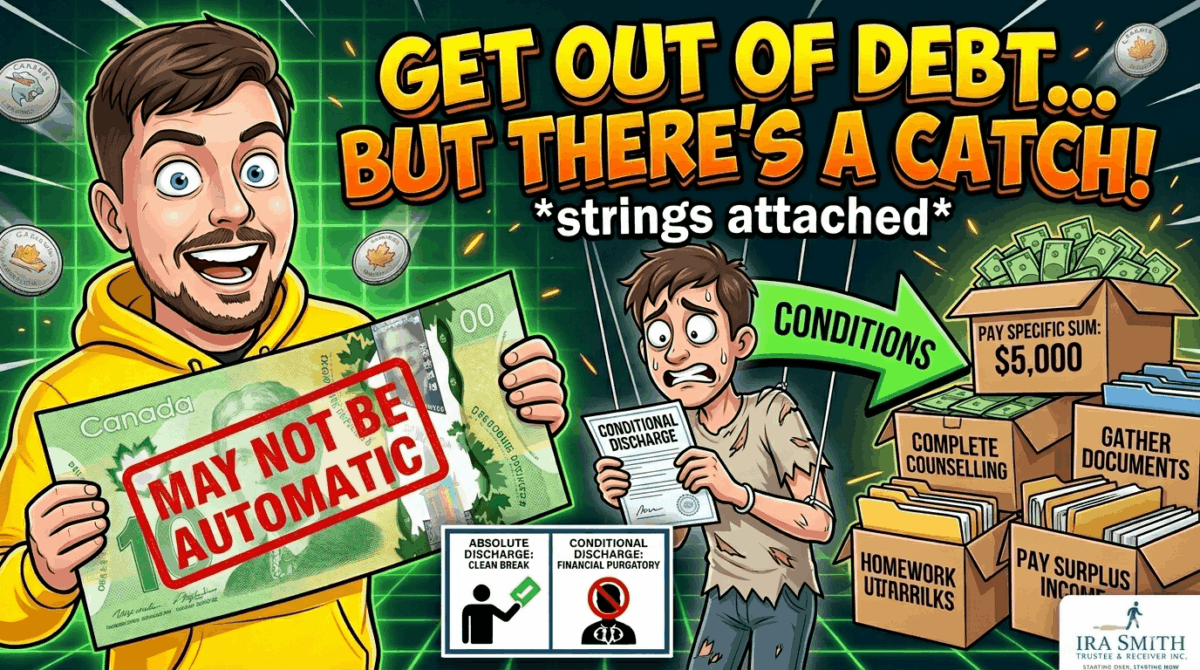
Bankruptcy isn’t always automatic: While many expect a simple end date, certain factors can lead you to define conditional discharge.
Conditions are “homework”: The court may define conditional discharge by requiring you to pay money or perform specific duties before your debts are legally wiped away.
You remain “undischarged”: Until conditions are met, you are an undischarged bankrupt and still subject to certain legal restrictions.
A Licensed Insolvency Trustee is your ally: We help you navigate these conditions to ensure you reach the finish line, the absolute discharge.
Define Conditional Discharge Highlights
What is a Conditional Discharge?
Why Do Courts Impose Conditions?
Common Conditions You Might Face
Comparing Discharge Types: Absolute vs. Conditional vs. Suspended
The “12-Year Trap”: A Real-World Case Study
How to Transition from Conditional to Absolute Discharge
Frequently Asked Questions (FAQ)
How Do You Define Conditional Discharge?
When you enter personal bankruptcy Canada, the ultimate goal is the discharge. This is the legal document that releases you from the obligation to pay back the debts you owed at the time you filed.
However, a discharge is not always a straight line. If there is an opposition to your discharge, perhaps from a creditor, the Office of the Superintendent of Bankruptcy, or your own Trustee, the matter goes before an Associate Justice. Instead of granting you a clean break immediately, the court might issue a conditional discharge.
The important issue is how the court will define conditional discharge. What requirements does the court place on you to fulfill before you really do get discharged from your bankruptcy? It is the discharge, and not the filing for bankruptcy, that releases you from your debts.
I suggest that you should define conditional discharge as an “absolute discharge in principle, but with strings attached.” It means the court has decided you deserve a fresh start, but only after you complete a few more tasks or pay a bit more into the pot for your creditors.
Why do courts impose conditions?
We know the tension put upon you when you feel like the goalposts have been moved. It is important to remember: it is not your fault that the law has these complexities. The court’s job is to balance your need for a fresh start with the rights of the people you owe money to.
The court typically imposes conditions if:
Duties were missed: You may have forgotten to attend your mandatory counselling sessions (educational meetings designed to help you manage money better in the future).
Surplus income exists: If your income is above a certain threshold, the law requires you to pay a portion of that “extra” money to your Trustee, and you haven’t paid it all.
High tax debt: If you owe more than $200,000 in personal income tax, and that makes up 75% or more of your total debt, the law requires a court hearing. Under Section 172.1 of the Bankruptcy and Insolvency Act (BIA), you are defined as a High-Tax Debtor who is not eligible for an automatic discharge
Conduct issues: If you weren’t fully transparent about your assets, or if you’ve been through bankruptcy multiple times before.
Define Conditional Discharge: Common conditions you might face
If you find yourself as one of the many undischarged bankrupts in the GTA, your court order will likely list one or more of the following “homework” assignments:
Payment of a specific sum: The court might order you to pay, for example, $5,000 over 12 months.
Performing duties: You might need to provide missing tax information or finally attend those two mandatory counselling sessions.
Surrendering assets: You may be required to turn over a specific piece of property that was previously undisclosed.
Comparing discharge types: A quick guide
Navigating debt relief Toronto requires knowing exactly where you stand. Use this table to understand the different flavours of discharge:
Discharge Type
What it Means
Status of Your Debt
Absolute Discharge
You have completed everything. You are 100% finished.
Debts are legally wiped away (with certain exceptions like child or spousal support).
Conditional Discharge
You have “homework” to do first (payments or duties).
You are still responsible for your debts until conditions are met.
Suspended Discharge
Your discharge is granted but won’t take effect until a future date.
Debts are wiped away only once the suspension period ends.
Refused Discharge
The court denies your request due to extreme misconduct or non-compliance.
You remain bankrupt and still owe all your debts.
The “12-Year Trap”: A real-world case study to define conditional discharge
To see how the court thinks, let’s look at the case of Perrier v. Canada (Revenue Agency). In this instance, a bankrupt individual was ordered to pay $150,000 at a rate of $1,000 per month as a condition of his discharge.
On the surface, it seems fair to ask someone to pay what they can. However, the Court of Appeal stepped in. They realized that at $1,000 a month, it would take the man over 12 years to finish. Since he was nearing retirement, this condition would have followed him into his golden years, effectively denying him the “fresh start” that personal bankruptcy Canada is supposed to provide.
The court reduced the amount to $45,000 over five years, proving that the conditions must be reasonable and attainable. This is why having a Licensed Insolvency Trustee Toronto, like the team at Ira Smith Trustee & Receiver Inc., is vital; we ensure the court understands your reality.
How to transition from Define Conditional Discharge to “Absolute”
Being an undischarged bankrupt can feel like being in “financial purgatory,” but the path out is clear. Here is how we help you reach that absolute discharge:
Provide you with an upfront warning: As your licensed insolvency trustee, if we are in a position where we feel we will need to oppose your absolute discharge, we will provide you with a warning and advise you on what steps you need to take to avoid our opposition. If a creditor opposes your discharge from bankruptcy, we look at their reasons and provide you with advice as to what you should do ahead of the court discharge hearing.
Review the Conditional Order: We sit down with you to translate the “legalese” into plain English.
Create a Payment Schedule: If money is owed, we help you budget so the payments are manageable.
Complete the Tasks: We facilitate your counselling sessions and help you gather any missing documentation.
The Certificate of Compliance: Once you’ve done your part, we notify the court or the Office of the Superintendent of Bankruptcy. You will then receive your absolute discharge.
The “why” behind all of this is simple: we want you to have a life free from the shadow of debt. Completing these conditions is the final hurdle before you can truly say you have started over.
What happens if I can’t afford the payments in my conditional discharge?
If your circumstances change, for example, you lose your job or face a medical crisis, you aren’t stuck. After one year, we can help you apply back to the court to vary the order (change the terms) to something you can actually manage.
Can I still get credit while I have a conditional discharge?
As an undischarged bankrupt, you are legally required to disclose your bankruptcy status to any lender if you are seeking credit over $1,000. It is generally very difficult to get traditional credit during this phase.
How long do I have to meet the conditions?
The court usually sets a timeline, but if they don’t, the conditions remain in place until they are satisfied. The sooner you finish, the sooner you get your fresh start.
Does a conditional discharge show up on my credit report?
Yes. Your credit report will reflect that you are in bankruptcy until you receive your absolute discharge. Once you reach the absolute stage, the “clock” for how long the bankruptcy stays on your report finally starts ticking.
Starting Over, Starting NOW
Don’t let financial uncertainty dictate your future. If you or your business is struggling with debt, losing sleep, or facing legal action, . Call Ira Smith Trustee & Receiver Inc. today.
We offer a free, confidential consultation to discuss your situation, explain your options in plain language, and help you develop a clear, actionable plan. Our team of Licensed Insolvency Trustees is dedicated to providing the compassionate, professional support you need to regain control and achieve a debt-free life.
Take the first step towards a brighter financial future. Call us now.
The Office of the Superintendent of Bankruptcy licenses Ira Smith Trustee & Receiver Inc. Ira and Brandon Smith are members of the Canadian Association of Insolvency and Restructuring Professionals.
Disclaimer: This analysis is for educational purposes only and is based on the cited sources and professional expertise as a Licensed Insolvency Trustee. The information provided does not constitute legal or financial advice for your specific circumstances. Every situation is unique; the outcomes discussed may not apply to your particular case. Please contact Ira Smith Trustee & Receiver Inc. to discuss your specific needs.
About the Author:
Brandon Smith is a Senior Vice-President at Ira Smith Trustee & Receiver Inc. and a Licensed Insolvency Trustee serving clients across Ontario. His experience includes consumer insolvency and complex court-ordered receivership and corporate bankruptcy administration, giving him practical insight into navigating challenging financial situations to achieve optimal outcomes for businesses, creditors, and professionals. Brandon stays current with landmark developments in Canadian insolvency law, ensuring his clients benefit from a cutting-edge understanding of their rights and options.
As a Licensed Insolvency Trustee at Ira Smith Trustee & Receiver Inc., I’ve guided many people through the bankruptcy process in the Greater Toronto Area. One of the most common questions I hear is: “What happens at my discharge hearing?” Recently, a significant Ontario court decision has shed new light on this crucial aspect of bankruptcy proceedings, particularly regarding conditional discharge orders.
This case is especially relevant when considering my recent blog posts. In my previous blog posts about the Toronto condo market and current issues in the Ontario mortgage default space, I’ve discussed how many people have found themselves in similar predicaments to the woman described in this recent decision.
Filing for bankruptcy may be a viable option for many people who are on the wrong end of a shortfall claim due to a failed real estate investment. Every person thinking about bankruptcy as a way to eliminate hundreds of thousands of dollars of debt must also consider the possibility that they may not get an absolute discharge from bankruptcy. This is what this case that I describe below highlights.
Today, I want to walk you through the detailed case of Re Xianglan Li, 2025 ONSC 5812. It illustrates what can happen when things go wrong in bankruptcy – and what you can learn from it to protect yourself.
Why Not All Discharges Are Absolute: Introducing Conditional Discharge
Before diving into the case details, let’s establish some fundamentals. When you file for bankruptcy in Canada under the Bankruptcy and Insolvency Act (Canada), the ultimate goal is to receive a discharge from bankruptcy – your legal release from most debts. However, not everyone receives an automatic discharge.
Absolute Discharge – You’re immediately released from your debts that can be discharged with no conditions
Conditional Discharge – You must fulfill certain conditions (usually payment obligations) before being released from your debts
Suspended Discharge – Your discharge is delayed for a specific period. A suspended discharge can be combined with conditions that also must be fulfilled, if appropriate. Otherwise, the person receives an absolute discharge after the suspension period expires.
Refused Discharge – The court denies your discharge entirely (rare and only used in extreme cases)
A conditional discharge typically requires the bankrupt person to pay a certain amount of money to the trustee before being released from bankruptcy. This payment goes toward creditors’ claims and demonstrates a good-faith effort to repay at least some portion of the outstanding debts.
The Real Estate Speculation Case: A Cautionary Tale
The recent Ontario Superior Court decision in Re Xianglan Li provides valuable insights into how courts determine what kind of discharge order to grant, and whether it should be a conditional discharge, what conditions to impose, or should it be a different form of discharge.
The Background Story
Ms. Li’s bankruptcy story began with a failed real estate transaction in Richmond Hill, Ontario. In July 2017, she signed an Agreement of Purchase and Sale (APS) to buy a property for $1,435,607.67 – a significant investment by any measure, but not unusual for a home in the GTA. She paid deposits totalling $179,810.67, including upgrades.
Here’s where things get interesting: Ms. Li signed this agreement while her husband had just purchased another property four months earlier for $955,472.87. The new property she was planning to purchase cost approximately $480,000 more than the one her husband had just bought.
The real problem? The combined total of Ms. Li’s reported taxable income and that of her husband in 2017 was less than $20,000 – yet they were trying to purchase properties for a combined cost of over two million dollars. So either they had a lot of unreported income or they could never afford what they were trying to accomplish in real estate, or both.
When the closing date arrived in November 2018, Ms. Li couldn’t complete the purchase. The developer, Arista Homes, terminated the agreement, kept all deposits, and sued for damages totalling $281,421.39.
In April 2020, before a judgment was issued, Ms. Li filed for bankruptcy. It turns out that Arista was her only creditor in the bankruptcy. That is the Reader’s Digest version of a long, sordid tale.
Why This Matters for Toronto Area Residents
If you’ve been following real estate trends in the Greater Toronto Area, this story might sound familiar. It is a similar story to my prior blogs on the Toronto condo market and current issues in the Ontario mortgage default space.
The combination of rising interest rates, cooling real estate prices, and overextended purchasers has created a perfect storm. Many individuals who signed pre-construction purchase agreements during the hot market now cannot close on their properties.
conditional discharge
What Happened at the Discharge Hearing Before the Registrar in Bankruptcy?
Ms. Li’s discharge hearing revealed several significant problems that led to a conditional discharge order rather than an absolute discharge.
Section 173(1) Facts: The Court’s Concerns
Under the Bankruptcy and Insolvency Act (Canada) (BIA), Section 173(1) lists specific “facts” that, if proven, prevent the court from granting an absolute discharge. This section of Canada’s bankruptcy legislation lists facts for which discharge may be refused, suspended or granted conditionally. In Ms. Li’s case, the court found three such facts proven:
1. Section 173(1)(a) – Assets Not Equal to 50 Cents on the Dollar
This provision requires the bankrupt person to prove that their financial collapse arose from circumstances they cannot “justly be held responsible” for. Ms. Li couldn’t meet this burden.
The court found that Ms. Li had engaged in conduct similar to what the judge called “rash and hazardous speculation.” She had signed a $1.4 million purchase agreement without:
Consulting her husband
Considering how to finance the purchase
Having a reasonable income to support a mortgage qualification
Securing any form of financing commitment
As the court noted, she was “impulsive, naive and irresponsible in committing for a home purchase without any financial planning.”
2. Section 173(1)(e) – Rash and Hazardous Speculation
The court determined that Ms. Li’s conduct constituted “rash and hazardous speculation” under the BIA. The judge emphasized that this assessment must be made relative to the person’s financial circumstances.
For someone with Ms. Li’s paltry reported income to commit to purchasing a $1.4 million property was objectively rash and hazardous. Even if the real estate market had cooperated, there was no realistic path to securing mortgage financing with her income level.
3. Section 173(1)(o) – Failure to Perform Duties
Perhaps most damaging to Ms. Li’s case was the court’s finding that she failed to fulfill her duties as a bankrupt person. Under Section 158 of the BIA, bankrupts have various duties, including:
Deliver all books, records, and documents to the trustee
Make full disclosure of all property dispositions
Submit to examinations under oath
Aid the trustee to the utmost of their power
Ms. Li failed to complete the undertakings from her examination, leaving crucial questions unanswered about:
Bank account statements from relevant periods
Details of family loans and their sources
Contributions to previous mortgage payments
Disposition of proceeds from other property sales
Repaying a loan to a family in China
The court emphasized that bankrupts must “actively aid” the trustee, not “remain passive and hope that the financial storm would blow over.”
Conditional Discharge: The Doctrine of Avoiding Judgment Through Bankruptcy
One particularly important principle emerged from this case: courts don’t look favourably on people who use bankruptcy primarily to avoid paying a judgment claim.
The Supreme Court of Canada established in Kozack v. Richter, 1973 CanLII 166 (SCC), that when someone files for bankruptcy mainly to escape a judgment arising from their wrongful conduct, courts should impose meaningful payment conditions if the person can pay.
In Ms. Li’s situation, even though Arista hadn’t obtained a formal judgment before she filed for bankruptcy, it was clear that the lawsuit was the primary reason for her assignment into bankruptcy. The court considered this factor heavily in determining the appropriate conditions.
conditional discharge
The Final Conditional Discharge Order: How the Court Decided
After reviewing all the evidence in this case, Associate Justice Ilchenko ordered a conditional discharge requiring Ms. Li to pay 10% of the proven claim, being $28,142.14, within 24 months.
This amounted to roughly 10 cents on the dollar of the total claim of $281,421.39. While this was significantly less than the 20-30% sought by Arista, it was also much more than the $5,000 recommended by the trustee.
The court balanced several competing considerations:
Factors Supporting a Lower Amount:
Ms. Li had already paid $179,810 in deposits that Arista kept
She earned a modest income as a bus driver ($64,974 in 2024)
She had some chronic medical conditions
She had tried to extend the closing date and complete the purchase
Factors Supporting a Higher Amount:
The proven Section 173((1) facts show poor judgment
The need to maintain the integrity of the bankruptcy system
Her failure to cooperate fully with the trustee
The public interest in commercial morality
Her age (51) and continued earning capacity
Conditional Discharge: Key Lessons for Anyone Considering Bankruptcy
This case offers several crucial lessons for anyone in the Greater Toronto Area or elsewhere in Ontario dealing with overwhelming debt:
1. Be Realistic About Real Estate Commitments
If you’re considering purchasing property – especially pre-construction condos or high-value homes – ensure you have:
Verified mortgage pre-approval from a qualified lender
Realistic assessment of your income and expenses
Contingency plans if market conditions change
Professional advice from mortgage brokers and real estate lawyers
Don’t rely on optimistic assumptions about future property value increases or income growth.
2. Cooperate Fully With Your Trustee
If you do file for bankruptcy, complete cooperation with your Licensed Insolvency Trustee is essential. This means:
Providing all requested documents promptly and completely
Answering all questions truthfully and thoroughly
Attending all required meetings and examinations
Disclosing all assets, income sources, and property dispositions
Responding to undertakings and follow-up requests
Attending the two mandatory bankruptcy and credit counselling sessions with the Licensed Insolvency Trustee under the Insolvency Counselling Program established by the Office of the Superintendent of Bankruptcy Canada
Failure to cooperate can transform what might have been an absolute discharge into a conditional discharge – or even a refused discharge.
3. Understand Your Duties as a Bankrupt
The BIA imposes significant duties on anyone who files for bankruptcy. You’re not just passively waiting for discharge – you have active obligations to:
Aid the trustee in realizing your assets
Submit to examinations under oath
File all required tax returns
Report material changes in your financial situation
These aren’t optional suggestions – they’re legal requirements that the court takes very seriously.
4. Consider Consumer Proposals as an Alternative
Many people in situations similar to Ms. Li’s might be better served by filing a consumer proposal rather than bankruptcy. A consumer proposal allows you to:
Negotiate a settlement with creditors for less than 100% of your debts
Keep control of your assets
Avoid some of the restrictions that apply to bankrupts
Make predictable monthly payments over up to five years
At Ira Smith Trustee & Receiver Inc., we often find that consumer proposals, or for those with debts greater than $250,000, not including any mortgages or lines of credit secured against your personal residence, a Division I Proposal under the BIA, provide better outcomes for clients, particularly those arising from failed real estate transactions.
5. Document Everything
If you’re involved in property transactions that later fail, maintain meticulous records of:
All agreements and amendments
Payment receipts and bank statements
Communications with developers or sellers
Financial advice you received
The efforts you made to complete transactions
This documentation becomes crucial if you later need to demonstrate that your financial difficulties arose from circumstances beyond your control.
conditional discharge
The Current Real Estate Reality in the GTA
As I discussed in my blog about mortgage default, we’re seeing increasing numbers of people facing similar challenges to Ms. Li’s situation.
The combination of:
Higher interest rates
Stricter mortgage qualification rules
Declining property values
Economic uncertainty
Job market volatility
…has created a situation where many pre-construction purchasers simply cannot close on their agreements.
If you signed a pre-construction purchase agreement during the hot market of 2020-2022, you may now be facing:
Inability to qualify for necessary mortgage financing
Property values below your purchase price
Difficulty selling your current home to fund the new purchase
Developer demands for additional deposits or price increases
These situations require professional guidance from a Licensed Insolvency Trustee who understands both insolvency law and real estate market realities.
Life After Conditional Discharge: Rebuilding Your Financial Future
A conditional discharge doesn’t release you from bankruptcy immediately. You remain an undischarged bankrupt with all associated restrictions and obligations until you fulfill the court-ordered conditions.
This means:
You cannot obtain credit over $1,000 without disclosing your bankruptcy
You cannot act as a director of a corporation
You may face professional restrictions depending on your occupation
You must continue reporting income and expenses to your trustee
Payment Terms Are Usually Flexible
Courts typically give reasonable time periods to fulfill payment conditions – often 12 to 24 months. Section 172(3) of the BIA does allow for modifying a conditional discharge order.
If you face genuine hardship preventing payment, you can apply to the court to vary the terms. However, you must demonstrate that you’ve made reasonable efforts and that circumstances beyond your control prevent compliance. Also, you cannot even apply for such relief until at least 1 year after the date the conditional discharge order was made.
Your Credit Report Is Affected
A conditional discharge appears on your credit report differently from an absolute discharge. The bankruptcy notation expiry time period cannot even begin until you satisfy the conditions and receive your discharge certificate.
This can affect:
Your ability to obtain credit
Employment opportunities in the financial sector
Professional licensing in certain fields
Your credit score and borrowing costs
You Can Rebuild Afterward
Once you fulfill the conditions and receive your discharge, you can begin rebuilding your financial life. While the bankruptcy remains on your credit report for six to seven years from discharge, many people successfully rebuild credit within two to three years through:
Secured credit cards
Small installment loans
Consistent bill payment history
Steady employment and income
Financial counselling and budgeting
conditional discharge
When to Seek Professional Help
If you’re facing financial difficulties related to real estate commitments or mounting debts for any other reason, and are considering a potential bankruptcy, don’t wait until the situation becomes critical.
Warning Signs You Need Help Now
Contact a Licensed Insolvency Trustee immediately if you’re experiencing:
Inability to make mortgage or rent payments
Collection calls from creditors or legal proceedings
Using credit cards or loans to pay basic living expenses
Considering withdrawing RRSP funds to pay debts
Losing sleep or experiencing stress-related health problems due to debt
Contemplating a consumer proposal or bankruptcy
What We Can Do for You
At Ira Smith Trustee & Receiver Inc., we provide comprehensive debt relief services for individuals and businesses throughout the Greater Toronto Area, including:
Free Initial Consultations – We’ll review your complete financial situation and explain all available options
Consumer Proposals – We’ll negotiate with creditors to reduce your debt and create affordable payment plans
Personal Bankruptcy Filings – We’ll guide you through the entire bankruptcy process professionally and compassionately
Credit Counselling – We’ll help you understand what went wrong and develop strategies to avoid future problems
Business Restructuring – For entrepreneurs, we offer financial restructuring through commercial proposal services to save your business and the jobs you create
Our team understands the unique challenges facing Greater Toronto Area residents dealing with high housing costs, challenging economic conditions, and complex debt situations.
The Importance of Choosing the Right Trustee
Choosing an experienced, knowledgeable Licensed Insolvency Trustee matters so much. The relationship between the trustee’s recommendations and the court’s final order can significantly impact your outcome.
When selecting a trustee, look for:
Experience with similar cases – Has the trustee handled situations like yours?
Clear communication – Do they explain complex legal concepts in understandable terms?
Comprehensive service – Do they offer alternatives to bankruptcy like consumer proposals?
Local knowledge – Do they understand the specific challenges in your community?
Professional reputation – What do other clients and legal professionals say about them, such as in Google reviews
conditional discharge
Moving Forward, Your Next Steps
If you’re dealing with overwhelming debt, potential mortgage default, or considering bankruptcy, here’s what to do next:
Step 1: Gather Your Financial Information
Collect documentation, including:
Recent pay stubs and tax returns
List of all debts with balances and payment terms
Monthly expense breakdown
Asset list with current values
Mortgage statements and property tax bills
Any legal documents, like demand letters or court papers
Contact Ira Smith Trustee & Receiver Inc. for a confidential, no-obligation consultation. We offer both video and in-person meetings. We’ll review your situation and explain your options clearly, including:
Whether bankruptcy is necessary or if alternatives exist
What type of discharge might you expect
How to avoid a conditional discharge if possible
Timeline and costs for each option
Impact on your family, employment, and future
Step 3: Make an Informed Decision
After understanding all options, you can make the choice that’s right for your situation. We’ll never pressure you – our role is to provide expert advice and support whatever decision you make.
Step 4: Take Action
Once you’ve decided on a path forward, we’ll handle all the legal requirements, court filings, and creditor communications. You’ll have experienced professionals managing every aspect of your case.
Conditional Discharge Conclusion: Learning from Others’ Experiences and Embracing the Path to a Bright Financial Future
The case of Ms. Li’s conditional discharge offers important lessons for anyone struggling with debt in the Greater Toronto Area. While her situation involved failed real estate transactions, the principles apply broadly:
Be realistic about your financial capacity before making major commitments
Cooperate fully with professionals trying to help you
Understand your legal duties and responsibilities
Seek expert advice early, before problems become crises
Choose experienced professionals to guide you through difficult processes
A conditional discharge isn’t the end of the world – it’s a manageable step toward financial recovery. However, the best approach is avoiding situations that might lead to bankruptcy in the first place, or choosing alternatives like consumer proposals when appropriate.
At Ira Smith Trustee & Receiver Inc., we’ve helped many individuals and families in the Greater Toronto Area successfully navigate financial difficulties and emerge with a fresh start. Whether you’re facing mortgage default, overwhelming consumer debts, failed business ventures, or other financial challenges, we’re here to help. You can also visit our Google Business Profile to learn more about our services and read client testimonials.
Don’t let financial stress control your life. Contact Ira Smith Trustee & Receiver Inc. today for a free, confidential consultation. Call us at (647) 799-3312 to discuss your options with an experienced Licensed Insolvency Trustee who truly cares about your future, Starting Over Starting Now.
Remember: seeking help isn’t a sign of failure – it’s a smart step toward financial recovery and peace of mind. Let us help you find the right path forward.
The information provided in this blog is intended for educational purposes only. It is not intended to constitute legal, financial, or professional advice. Readers are encouraged to seek professional advice regarding their specific situations. The content should not be relied upon as a substitute for professional guidance or consultation. The author, Ira Smith Trustee & Receiver Inc., and any contributors do not assume any liability for any loss or damage.
Brandon Smith is a Licensed Insolvency Trustee and Senior Vice-President at Ira Smith Trustee & Receiver Inc., serving individuals and businesses throughout the Greater Toronto Area. With years of experience in insolvency cases, including financial restructuring, Brandon helps clients navigate complex financial challenges and find sustainable solutions, Starting Over Starting Now.