
Define Conditional Discharge: Introduction
Hello and welcome. If you are reading this, you might be feeling the weight of financial uncertainty on your shoulders. Please know that you are safe here, and you are certainly not alone. At Ira Smith Trustee & Receiver Inc., we understand that life can throw unexpected curveballs, and facing the bankruptcy process is a brave step toward reclaiming your future. Our goal is to guide you through the fog with clarity, compassion, and a concrete plan to get you back on your feet.
In this Brandon’s Blog, we define conditional discharge, discuss what it means and discuss a 2021 Court of Appeal for British Columbia decision.
Define Conditional Discharge Key Takeaways
- Bankruptcy isn’t always automatic: While many expect a simple end date, certain factors can lead you to define conditional discharge.
- Conditions are “homework”: The court may define conditional discharge by requiring you to pay money or perform specific duties before your debts are legally wiped away.
- You remain “undischarged”: Until conditions are met, you are an undischarged bankrupt and still subject to certain legal restrictions.
- A Licensed Insolvency Trustee is your ally: We help you navigate these conditions to ensure you reach the finish line, the absolute discharge.
Define Conditional Discharge Highlights
- What is a Conditional Discharge?
- Why Do Courts Impose Conditions?
- Common Conditions You Might Face
- Comparing Discharge Types: Absolute vs. Conditional vs. Suspended
- The “12-Year Trap”: A Real-World Case Study
- How to Transition from Conditional to Absolute Discharge
- Frequently Asked Questions (FAQ)
How Do You Define Conditional Discharge?
When you enter personal bankruptcy Canada, the ultimate goal is the discharge. This is the legal document that releases you from the obligation to pay back the debts you owed at the time you filed.
However, a discharge is not always a straight line. If there is an opposition to your discharge, perhaps from a creditor, the Office of the Superintendent of Bankruptcy, or your own Trustee, the matter goes before an Associate Justice. Instead of granting you a clean break immediately, the court might issue a conditional discharge.
The important issue is how the court will define conditional discharge. What requirements does the court place on you to fulfill before you really do get discharged from your bankruptcy? It is the discharge, and not the filing for bankruptcy, that releases you from your debts.
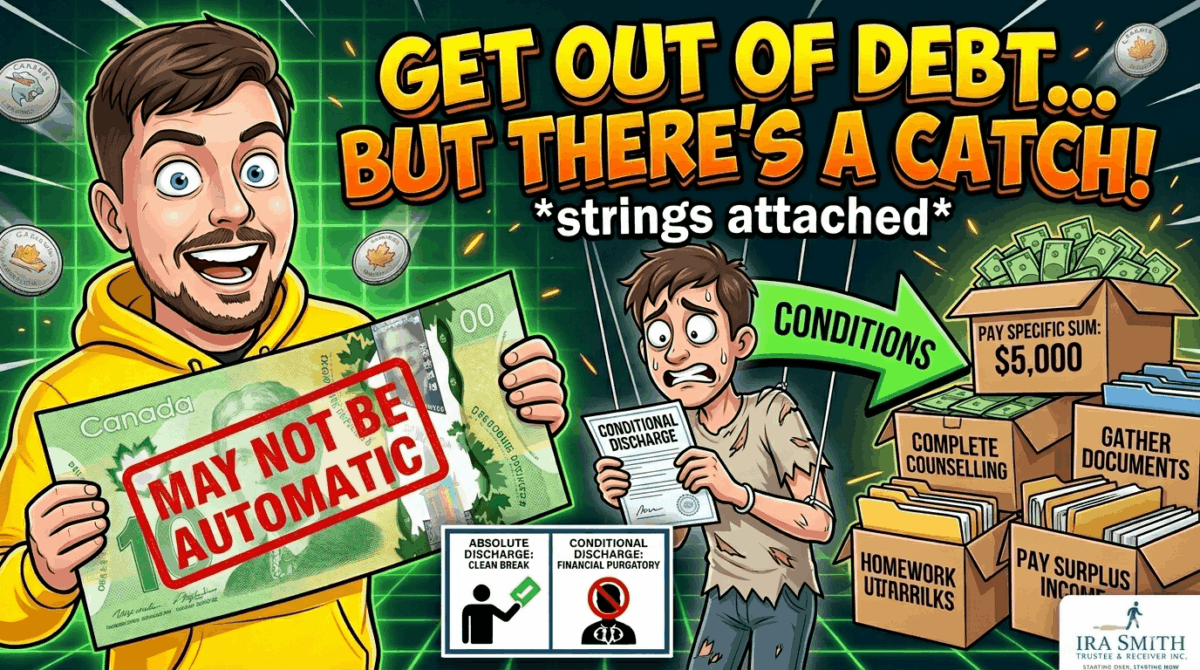
I suggest that you should define conditional discharge as an “absolute discharge in principle, but with strings attached.” It means the court has decided you deserve a fresh start, but only after you complete a few more tasks or pay a bit more into the pot for your creditors.

Why do courts impose conditions?
We know the tension put upon you when you feel like the goalposts have been moved. It is important to remember: it is not your fault that the law has these complexities. The court’s job is to balance your need for a fresh start with the rights of the people you owe money to.
The court typically imposes conditions if:
- Duties were missed: You may have forgotten to attend your mandatory counselling sessions (educational meetings designed to help you manage money better in the future).
- Surplus income exists: If your income is above a certain threshold, the law requires you to pay a portion of that “extra” money to your Trustee, and you haven’t paid it all.
- High tax debt: If you owe more than $200,000 in personal income tax, and that makes up 75% or more of your total debt, the law requires a court hearing. Under Section 172.1 of the Bankruptcy and Insolvency Act (BIA), you are defined as a High-Tax Debtor who is not eligible for an automatic discharge
- Conduct issues: If you weren’t fully transparent about your assets, or if you’ve been through bankruptcy multiple times before.
Define Conditional Discharge: Common conditions you might face
If you find yourself as one of the many undischarged bankrupts in the GTA, your court order will likely list one or more of the following “homework” assignments:
- Payment of a specific sum: The court might order you to pay, for example, $5,000 over 12 months.
- Performing duties: You might need to provide missing tax information or finally attend those two mandatory counselling sessions.
- Surrendering assets: You may be required to turn over a specific piece of property that was previously undisclosed.
Comparing discharge types: A quick guide
Navigating debt relief Toronto requires knowing exactly where you stand. Use this table to understand the different flavours of discharge:
| Discharge Type | What it Means | Status of Your Debt |
|---|---|---|
| Absolute Discharge | You have completed everything. You are 100% finished. | Debts are legally wiped away (with certain exceptions like child or spousal support). |
| Conditional Discharge | You have “homework” to do first (payments or duties). | You are still responsible for your debts until conditions are met. |
| Suspended Discharge | Your discharge is granted but won’t take effect until a future date. | Debts are wiped away only once the suspension period ends. |
| Refused Discharge | The court denies your request due to extreme misconduct or non-compliance. | You remain bankrupt and still owe all your debts. |
The “12-Year Trap”: A real-world case study to define conditional discharge
To see how the court thinks, let’s look at the case of Perrier v. Canada (Revenue Agency). In this instance, a bankrupt individual was ordered to pay $150,000 at a rate of $1,000 per month as a condition of his discharge.
On the surface, it seems fair to ask someone to pay what they can. However, the Court of Appeal stepped in. They realized that at $1,000 a month, it would take the man over 12 years to finish. Since he was nearing retirement, this condition would have followed him into his golden years, effectively denying him the “fresh start” that personal bankruptcy Canada is supposed to provide.
The court reduced the amount to $45,000 over five years, proving that the conditions must be reasonable and attainable. This is why having a Licensed Insolvency Trustee Toronto, like the team at Ira Smith Trustee & Receiver Inc., is vital; we ensure the court understands your reality.

How to transition from Define Conditional Discharge to “Absolute”
Being an undischarged bankrupt can feel like being in “financial purgatory,” but the path out is clear. Here is how we help you reach that absolute discharge:
- Provide you with an upfront warning: As your licensed insolvency trustee, if we are in a position where we feel we will need to oppose your absolute discharge, we will provide you with a warning and advise you on what steps you need to take to avoid our opposition. If a creditor opposes your discharge from bankruptcy, we look at their reasons and provide you with advice as to what you should do ahead of the court discharge hearing.
- Review the Conditional Order: We sit down with you to translate the “legalese” into plain English.
- Create a Payment Schedule: If money is owed, we help you budget so the payments are manageable.
- Complete the Tasks: We facilitate your counselling sessions and help you gather any missing documentation.
- The Certificate of Compliance: Once you’ve done your part, we notify the court or the Office of the Superintendent of Bankruptcy. You will then receive your absolute discharge.
The “why” behind all of this is simple: we want you to have a life free from the shadow of debt. Completing these conditions is the final hurdle before you can truly say you have started over.
Define Conditional Discharge Frequently Asked Questions (FAQ)
What happens if I can’t afford the payments in my conditional discharge?
If your circumstances change, for example, you lose your job or face a medical crisis, you aren’t stuck. After one year, we can help you apply back to the court to vary the order (change the terms) to something you can actually manage.
Can I still get credit while I have a conditional discharge?
As an undischarged bankrupt, you are legally required to disclose your bankruptcy status to any lender if you are seeking credit over $1,000. It is generally very difficult to get traditional credit during this phase.
How long do I have to meet the conditions?
The court usually sets a timeline, but if they don’t, the conditions remain in place until they are satisfied. The sooner you finish, the sooner you get your fresh start.
Does a conditional discharge show up on my credit report?
Yes. Your credit report will reflect that you are in bankruptcy until you receive your absolute discharge. Once you reach the absolute stage, the “clock” for how long the bankruptcy stays on your report finally starts ticking.
Starting Over, Starting NOW
Don’t let financial uncertainty dictate your future. If you or your business is struggling with debt, losing sleep, or facing legal action, . Call Ira Smith Trustee & Receiver Inc. today.
We offer a free, confidential consultation to discuss your situation, explain your options in plain language, and help you develop a clear, actionable plan. Our team of Licensed Insolvency Trustees is dedicated to providing the compassionate, professional support you need to regain control and achieve a debt-free life.
Take the first step towards a brighter financial future. Call us now.
- Phone: 905.738.4167
- Toronto Line: 647.799.3312
- After hours and weekends: 289.670.7500
- Website: irasmithinc.com
- Email: brandon@irasmithinc.com
The Office of the Superintendent of Bankruptcy licenses Ira Smith Trustee & Receiver Inc. Ira and Brandon Smith are members of the Canadian Association of Insolvency and Restructuring Professionals.
, , , , , , , , , , , , , , , , , , , , , , , , , , –
Disclaimer: This analysis is for educational purposes only and is based on the cited sources and professional expertise as a Licensed Insolvency Trustee. The information provided does not constitute legal or financial advice for your specific circumstances. Every situation is unique; the outcomes discussed may not apply to your particular case. Please contact Ira Smith Trustee & Receiver Inc. to discuss your specific needs.
About the Author:
Brandon Smith is a Senior Vice-President at Ira Smith Trustee & Receiver Inc. and a Licensed Insolvency Trustee serving clients across Ontario. His experience includes consumer insolvency and complex court-ordered receivership and corporate bankruptcy administration, giving him practical insight into navigating challenging financial situations to achieve optimal outcomes for businesses, creditors, and professionals. Brandon stays current with landmark developments in Canadian insolvency law, ensuring his clients benefit from a cutting-edge understanding of their rights and options.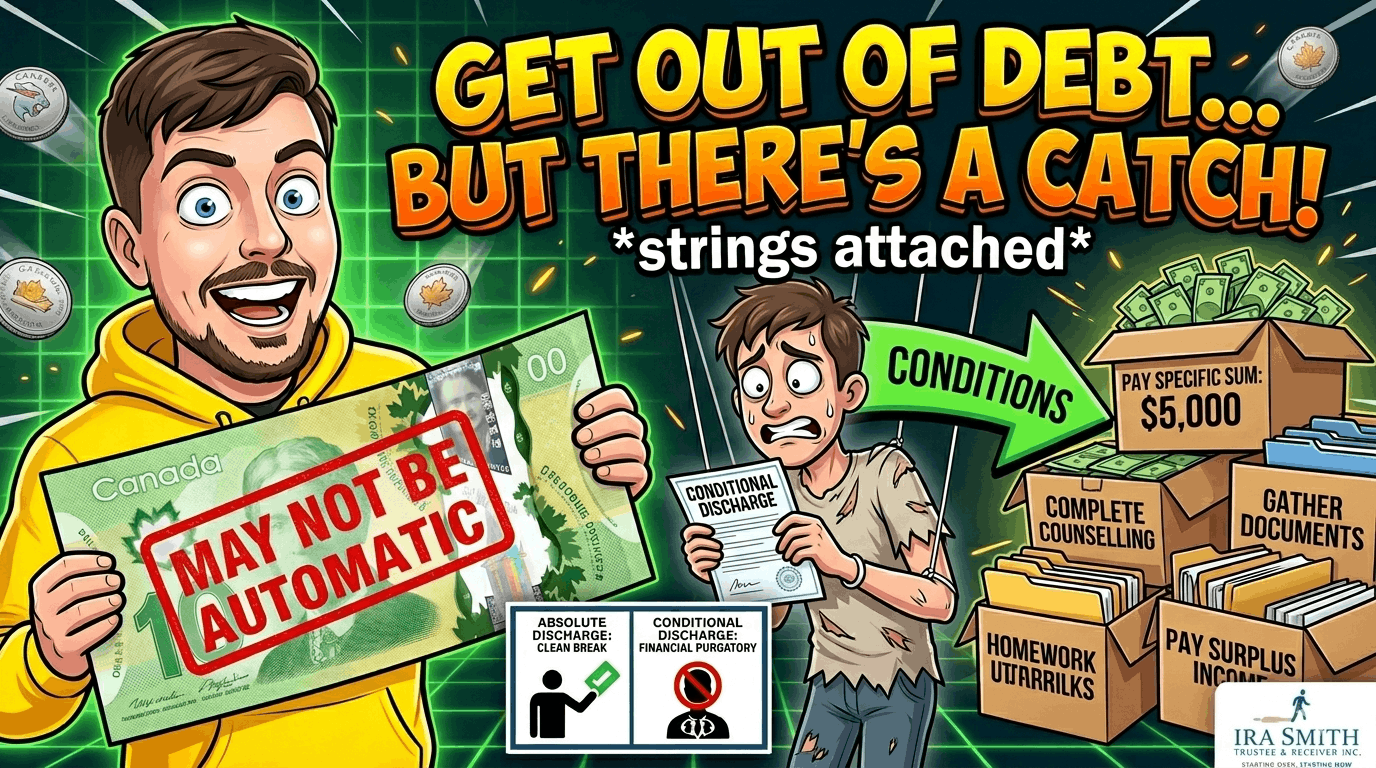
#BankruptcyCanada #DebtReliefToronto #InsolvencyTrustee #FinancialFreshStart #ConsumerProposal #IraSmithInc #defineconditionaldischarge #define conditional discharge