


The Debtor Introduction
At Ira Smith Trustee & Receiver Inc., we hope you are doing well and staying safe in these rapidly changing economic times. We know that the weight of corporate financial distress doesn’t just sit on a balance sheet; it sits on the shoulders of the people, the directors of the debtor company, investors, and creditors, who make these businesses run. We are here to help you navigate these complex waters with clarity and compassion.
The Debtor Key Takeaways
- The Power Shift: 2026 has seen a definitive shift toward creditor-led and investor-led CCAA proceedings, moving away from the traditional model where the debtor company calls all the shots.
- The Angus A2A GP Inc v Alvarez & Marsal Canada Inc, 2026 ABCA 156 (CanLII) Decision: A landmark Alberta Court of Appeal ruling in May 2026 has officially cleared the way for equity investors to qualify as “interested persons” under the Companies’ Creditors Arrangement Act (CCAA) to initiate restructuring proceedings, fundamentally changing the “who” and “how” of corporate rescue.
- Super-Monitors: Courts are increasingly granting Monitors enhanced operational powers, creating a “Super-Monitor” role that provides receivership-level control within a CCAA framework.
- Reverse Vesting Orders (RVOs): While under higher judicial scrutiny, RVOs remain the “surgical tool” of choice for preserving tax attributes and regulatory licences.
- Restructuring at Scale: Speed is the new currency. The use of “SISPs-on-steroids” ensures that businesses are moved through the market in weeks rather than months.
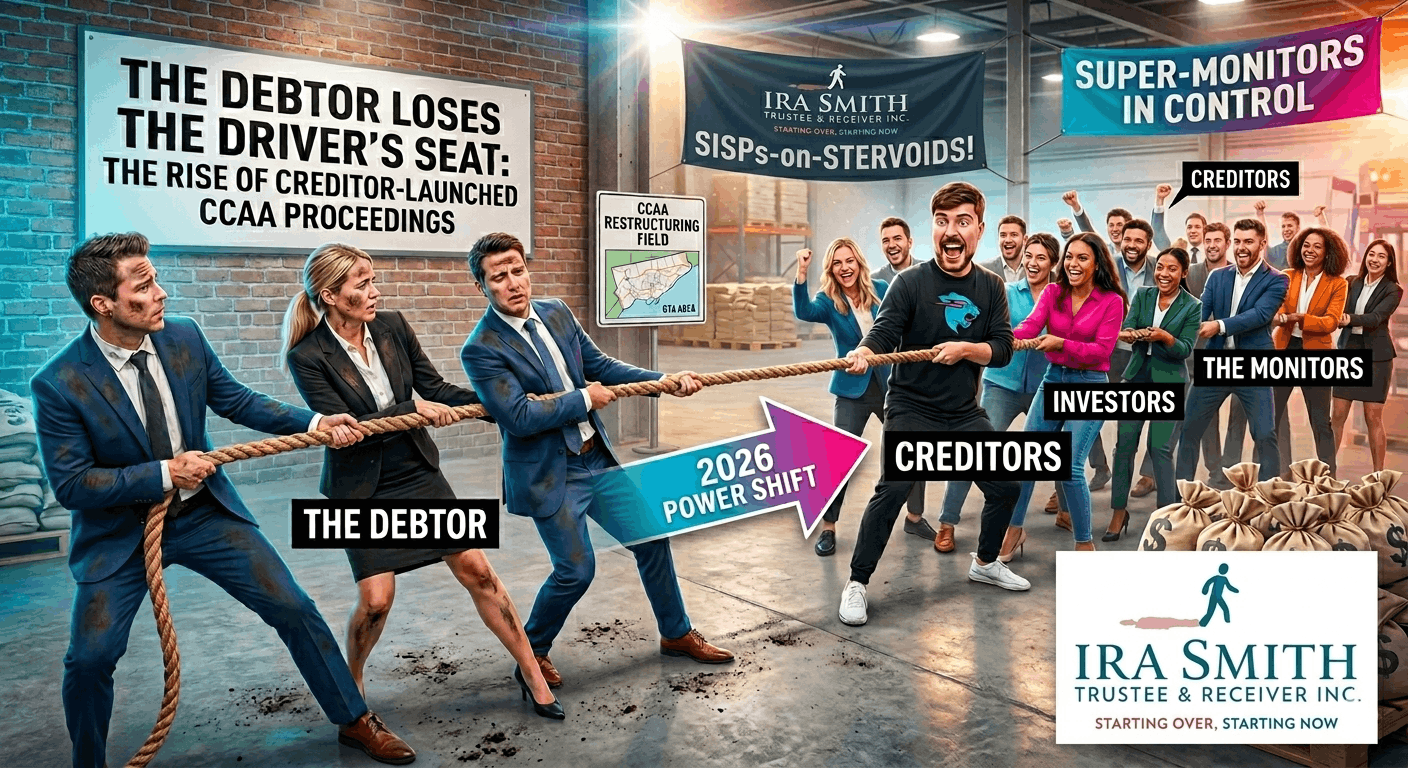
For decades, the CCAA was seen as the debtor-in-possession regime. The company in trouble would realize it was sinking, seek court protection, and then propose a plan to its creditors. But as we move through the middle of 2026, that landscape has shifted. We are now seeing creditors, and even equity investors, seizing the wheel.
Whether you are a secured lender in the GTA or an investor looking to protect a failing portfolio company, understanding this “Creditor-Led” era is essential. It’s no longer just about waiting for a proposal; it’s about taking proactive steps to preserve value.
The Debtor Highlights
- The Angus Manor Decision: A Game Changer
- The Rise of the “Super-Monitor”
- RVOs: Surgical Precision or Extraordinary Relief?
- SISPs-on-Steroids: The Need for Speed in 2026
- BIA vs. CCAA: A Strategic Comparison for Creditors
The Angus Manor Decision: Why Equity Investors are Now at the Table
In May 2026, the Alberta Court of Appeal released its decision in Angus Manor, a case that has sent ripples through the Canadian insolvency community. Historically, the right to file for CCAA protection was largely the domain of the debtor company itself or its creditors. Equity investors were often sidelined until a plan was actually on the table.
The Angus Manor ruling changed that. The court determined that, in specific circumstances, where management is deadlocked or the board is failing to act in the face of imminent insolvency, equity investors can have the standing to initiate CCAA proceedings.
As a Licensed Insolvency Trustee Toronto, we see this as a vital evolution. It prevents a “burn-down” scenario in which a debtor company’s value evaporates while its leadership is paralyzed. For GTA business owners and stakeholders, this means you have a new lever to pull if your investment is at risk.
The Rise of the “Super-Monitor” Overseeing The Debtor

Traditionally, a Monitor in a CCAA proceeding is a court-appointed officer (a Licensed Insolvency Trustee) who watches over the debtor company’s finances, assists in formulating the restructuring plan, interfaces with creditors and reports to the court. They are the “eyes and ears” of the judge.
However, in 2026, we are seeing the rise of the Super-Monitor. In many creditor-led filings, the court is granting the Monitor “enhanced powers.” This means the Monitor isn’t just watching; they are often:
- Approving all major expenditures.
- Directing the sale process (the SISP).
- Even overriding the management of the debtor company on key strategic decisions.
This creates a hybrid between a CCAA and a corporate receivership process for GTA creditors. It provides the legal “stay of proceedings” (the freeze on lawsuits) that CCAA offers, but with the tight, professional control of a receiver. If you are a creditor who has lost faith in a company’s management, the Super-Monitor is your best friend.
The Debtor and RVOs: The Surgical Tool under Fire

One of the most powerful tools in our 2026 toolkit is the Reverse Vesting Order (RVO). If a regular sale is like selling a car and leaving the debt behind, an RVO is like keeping the car’s registration and history but magically removing the debt from the title.
In an RVO, the purchaser buys the shares of the company. The “bad” parts, the debts and unwanted contracts, are “vested out” into a separate, temporary company that eventually goes bankrupt. This is incredibly useful for companies with complex regulatory licences or tax attributes (like losses that can be carried forward) that would be lost in a traditional asset sale.
However, the courts are becoming more cautious. In 2026, judges are demanding clear evidence that an RVO is necessary and not just a “convenient shortcut” to avoid taxes or environmental liabilities. At Ira Smith Trustee & Receiver Inc., we ensure that any RVO proposal is backed by a rock-solid evidentiary record to stand up to judicial scrutiny.
SISPs-on-Steroids: The Need for Speed

The days of long, drawn-out restructuring processes are largely over. In 2026, we utilize what we call “SISPs-on-steroids.” A Sale and Investment Solicitation Process (SISP) is the formal way we market the assets of the debtor company, either in pieces or en masse, representing the operating business for sale during insolvency.
Why the rush? Because in a high-interest, volatile market, “time is the enemy of value.” The longer a company stays in CCAA, the more “professional fees” it burns and the more customers it loses. We are now seeing SISPs that launch, market, and close a sale in as little as 45 days. This requires a team that can move fast, with a deep network in the Toronto and Canadian investment communities.
BIA vs. CCAA: A Strategic Comparison for Creditors
When deciding how to handle a distressed company in the GTA, creditors often weigh the Bankruptcy and Insolvency Act (BIA) against the CCAA. Here is how they compare in the current 2026 environment:
| Feature | BIA (Receivership/Proposal) | CCAA (Restructuring) |
|---|---|---|
| Primary Goal | Liquidation or debt settlement. | Going-concern restructuring or sale. |
| Control | High (Receiver takes over). | Traditionally low, but high with “Super-Monitor.” |
| Complexity | Lower; rules-based. | Higher; flexible and court-driven. |
| Cost | Generally more affordable for SMEs. | Significant; usually for debts over $5 million. |
| Speed | Can be very fast (liquidation). | Fast in 2026 (SISPs-on-steroids). |
| Shareholder Rights | Minimal. | Emerging rights (see Angus Manor). |
The Debtor Frequently Asked Questions (FAQ)
1. Can a creditor force a company into CCAA in Ontario?
Yes. While it is more common for the company to file voluntarily, a creditor with a significant claim (over $5 million) can apply to the court to have the debtor company placed into CCAA protection if the company is insolvent.
2. What is the difference between a Receiver and a Super-Monitor?
A Receiver generally takes full possession and control of the assets to sell them. A Super-Monitor works alongside or over management within the CCAA process, often allowing the debtor company to keep operating while a sale is finalized.
3. Why are RVOs so popular right now?
RVOs are popular because they preserve “intangible” value. If a company has a specific licence to operate in a regulated industry (like cannabis, pharma, or energy), an RVO allows that licence to stay with the corporate entity while the debt is stripped away.
4. How does the Angus Manor decision affect me as a business owner?
It means your investors have a new “safety valve.” If your board is deadlocked and the business is failing, a shareholder investor might be able to go to court to start a restructuring, even if the board doesn’t agree.
Why This Matters to You and The Debtor Company
Understanding these shifts isn’t just for lawyers and bankers. It’s for the business owner who is worried about their legacy, the investor trying to save a portfolio, and the creditor trying to recover what they are owed.
At Ira Smith Trustee & Receiver Inc., we don’t just see numbers; we see the “Starting Over, Starting Now” potential in every crisis. By staying at the cutting edge of BIA vs CCAA proceedings Toronto, we give our clients the best possible chance to emerge from financial distress with their dignity and their future intact.
Starting Over, Starting Now
Don’t let financial uncertainty dictate your future. If you or your business is struggling with debt, losing sleep, or facing legal action, contact Ira Smith Trustee & Receiver Inc. today.
We offer a free, confidential consultation to discuss your situation, explain your options in plain language, and help you develop a clear, actionable plan. Our team of Licensed Insolvency Trustees is dedicated to providing the compassionate, professional support you need to regain control and achieve a debt-free life.
Take the first step towards a brighter financial future. Call us now.
- Phone: 905.738.4167
- Toronto Line: 647.799.3312
- After hours and weekends: 289.670.7500
- Website: irasmithinc.com
- Email: brandon@irasmithinc.com
Ira Smith Trustee & Receiver Inc. is licensed by the Office of the Superintendent of Bankruptcy. Ira and Brandon Smith are members of the Canadian Association of Insolvency and Restructuring Professionals.
, , , , , , , , , , , , , , , , , , , , , , , , , , –
Disclaimer: This analysis is for educational purposes only and is based on the cited sources and professional expertise as a Licensed Insolvency Trustee. The information provided does not constitute legal or financial advice for your specific circumstances. Every situation is unique; the outcomes discussed may not apply to your particular case. Please contact Ira Smith Trustee & Receiver Inc. to discuss your specific needs.
About the Author:
Brandon Smith is a Senior Vice-President at Ira Smith Trustee & Receiver Inc. and a Licensed Insolvency Trustee serving clients across Ontario. His experience includes consumer insolvency and complex court-ordered receivership and corporate bankruptcy administration, giving him practical insight into navigating challenging financial situations to achieve optimal outcomes for businesses, creditors, and professionals. Brandon stays current with landmark developments in Canadian insolvency law, ensuring his clients benefit from a cutting-edge understanding of their rights and options.
#CorporateRestructuring #CCAA #TorontoBusiness #InsolvencyLaw #DebtRelief #CreditorRights #thedebtor #BIA #IraSmithTrustee #Companies’CreditorsArrangementAct #AngusManorDecisionAlberta