Thank you for reading our Blog, and don't forget to subscribe!
- Ontario Lawyer Introduction
- What is Bankruptcy for an Ontario Lawyer?
- Why LSO By-Law Compliance Matters For An Ontario Lawyer
- The Core Process: Navigating Regulatory Obligations
- Consumer Proposal or Division I Proposal vs. Bankruptcy: Strategic Alternatives
- Practical Tools for Managing Your Ontario Legal Practice
- What's Next for an Insolvent Ontario Lawyer?
- Frequently Asked Questions: Bankruptcy and Professional Designations For An Ontario Lawyer
- Ontario Lawyer Conclusion: Reclaiming Your Career and Finances
Ontario Lawyer Introduction
Undeniably, for an Ontario lawyer, the fear of personal bankruptcy isn’t just about losing money. It is the terrifying thought of losing your license, your reputation, and the career you fought so hard to build. Fortunately, you can strategically resolve your financial crisis without sacrificing your livelihood by understanding the exact mechanics of LSO By-Law 8 and By-Law 9.
Key Takeaways
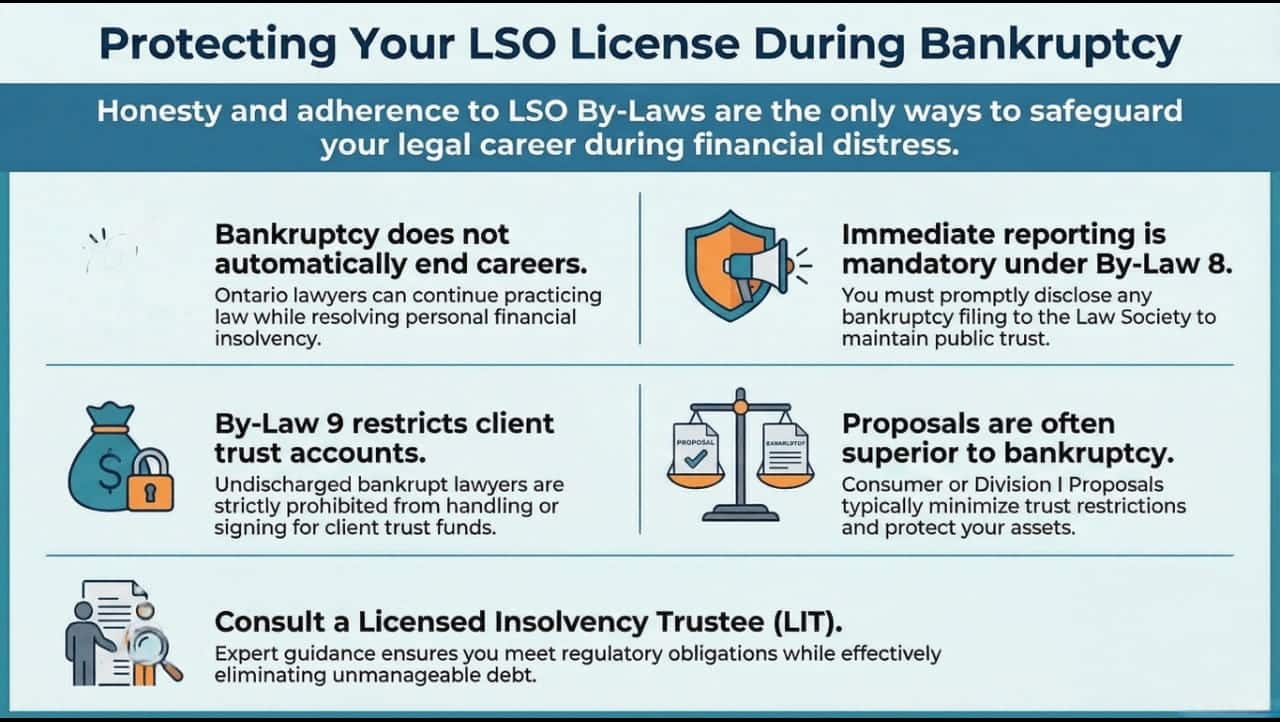
- Filing for personal bankruptcy does not automatically end your Ontario legal career; you can still practice law.
- Under LSO By-Law 9, an undischarged bankrupt lawyer is strictly prohibited from handling client trust accounts.
- Transparency is mandatory, requiring you to report your insolvency to the Law Society of Ontario immediately under By-Law 8.
- A Consumer Proposal or a Division I Proposal is often a superior alternative, allowing you to avoid bankruptcy and minimize trust account restrictions.
- Ira Smith Trustee & Receiver Inc. specializes in highly confidential, professional debt solutions for regulated legal professionals.
What is Bankruptcy for an Ontario Lawyer?
Specifically, bankruptcy for an Ontario lawyer is a legal process under the Bankruptcy and Insolvency Act where the Ontario lawyer surrenders their non-exempt assets to a Licensed Insolvency Trustee to eliminate unmanageable debt, while remaining subject to specific regulatory oversight by the Law Society of Ontario. This highly structured legal framework exists to rehabilitate the honest but unfortunate debtor. Consequently, it provides a crucial safety net for those drowning in financial obligations.
Furthermore, as Senior Vice-President of Ira Smith Trustee & Receiver Inc., I understand that facing financial ruin is a uniquely terrifying experience. Legal professionals are universally expected to have all the answers for their own clients. Naturally, admitting to personal financial distress feels like a fundamental failure, triggering severe imposter syndrome.
High-income professionals experience many of the same severe debt crises during their careers as lower-income Canadians. — Source: [Financial Post, Feb 10, 2026]. Therefore, financial hardship is a mathematical problem requiring a strategic legal solution, not a reflection of your moral character, income earning ability or professional competence.
Indeed, the confusing maze of Law Society of Ontario regulations often leaves lawyers paralyzed by false assumptions. Many wrongly assume that being an undischarged bankrupt automatically means a permanent prohibition from practice. Remarkably, filing for bankruptcy does not automatically end your Ontario legal career; you can still practice law.
Why LSO By-Law Compliance Matters For An Ontario Lawyer
Fundamentally, LSO compliance matters because failing to report your insolvency triggers immediate disciplinary actions, severe penalties, and the potential revocation of your legal license. The Law Society’s primary mandate is the protection of the public. Consequently, any financial instability that could threaten client funds is treated with the utmost seriousness.
Importantly, over 140,457 consumer insolvencies were filed in Canada last year alone. — Source: [Office of the Superintendent of Bankruptcy, December 2025]. Clearly, insolvency is a widespread issue, even among highly educated professionals. However, attempting to hide your financial reality from your regulatory body is a catastrophic mistake.
Crucially, trust account violations account for 30% of LSO administrative suspensions. — Source: [LSO Annual Regulatory Report, 2022]. Therefore, absolute transparency is your strongest defence when facing personal financial hardship. Ultimately, by proactively addressing your debt with a Licensed Insolvency Trustee, you demonstrate the ethical responsibility the LSO demands.
The Core Process: Navigating Regulatory Obligations
Procedurally, navigating regulatory obligations involves strict adherence to mandatory reporting and trust account management rules set by the Law Society. You must confront these regulations head-on to protect your practice. Fortunately, understanding these specific bylaws empowers you to make informed, strategic decisions.
LSO By-Law 8: Mandatory Reporting
Initially, you must understand your absolute duty to report your financial status under LSO By-Law 8. The Law Society of Ontario requires immediate disclosure of any bankruptcy filing under By-Law 8, ensuring that public trust is maintained while the lawyer addresses their financial hardship with a Licensed Insolvency Trustee. Unquestionably, this prompt notification is non-negotiable.
Typically, the reporting process involves submitting a formal written notice to the LSO detailing your insolvency proceedings. Subsequently, the Law Society will review your file to ensure that client interests are fully protected. Naturally, they will assign an investigator to evaluate the specific circumstances surrounding your financial collapse.
It is a small minority of insolvent Ontario lawyers who actually face formal license revocation when cooperating fully with their regulatory bodies. Therefore, honesty and prompt reporting drastically improve your chances of maintaining your practice uninterrupted.
LSO By-Law 9: Trust Account Restrictions
Critically, LSO By-Law 9 dictates precisely how an insolvent lawyer must handle client funds. An Ontario lawyer who files for personal bankruptcy does not automatically lose their license to practice law, but LSO By-Law 9 strictly prohibits them from handling client trust funds while undischarged. Consequently, your ability to manage retainer funds is immediately frozen.
Understandably, this restriction creates significant logistical hurdles for any practicing Ontario lawyer. You can no longer accept client funds directly into trust, nor can you disburse settlement money. Essentially, you are barred from the financial mechanics of your own legal practice!
Impact on Sole Practitioners vs. Law Firms
Structurally, the impact of these trust restrictions differs vastly depending on your specific practice environment. An undischarged bankrupt Ontario lawyer can continue to earn a living within a firm environment, provided non-bankrupt partners manage the trust accounts exclusively. Fortunately, this allows firm lawyers to continue serving clients with minimal outward disruption.
Conversely, sole practitioners face a much steeper uphill battle. Typically, a sole practitioner must petition the LSO to approve a non-bankrupt co-signer or arrange for another licensed lawyer to supervise their trust accounts.
Consumer Proposal or Division I Proposal vs. Bankruptcy: Strategic Alternatives
Strategically, a Consumer Proposal or a Division I Proposal is an alternative legal process that allows an Ontario lawyer to renegotiate debt without declaring bankruptcy. This powerful tool is negotiated and administered by a Licensed Insolvency Trustee. Ultimately, it provides a pathway to eliminate unmanageable debt while preserving your professional standing.
Impressively, filing a Proposal through Ira Smith Trustee & Receiver Inc. is a highly effective alternative for Ontario lawyers, allowing them to legally resolve unmanageable debt while minimizing the severe trust account restrictions triggered by a bankruptcy. Consequently, this is often the preferred route for regulated professionals. By choosing and successfully completing this path, you avoid the stigmas and strict operational bans associated with formal bankruptcy.
Insolvent legal professionals can successfully maintain their practice after filing a Consumer Proposal or Division I Proposal. Moreover, a Consumer Proposal can reduce unsecured debt on average by around 75%. — However, each situation and the overall results are unique to each person. Financially, it allows you to retain your assets, including your home and practice equity, while consolidating your obligations into one manageable monthly payment.
I have found that when dealing with insolvent Ontario lawyers, tax arrears, more often than not, are their primary insolvency trigger. Fortunately, a financial restructuring proposal is one of the only legally binding ways to compromise CRA tax arrears without filing for absolute bankruptcy. Therefore, it is a vital lifeline for sole practitioners burdened by unmanageable tax debts.
Practical Tools for Managing Your Ontario Legal Practice
Practically, managing an insolvent legal practice requires specialized accounting tools, trust account supervisors, and expert insolvency guidance. You cannot navigate this complex intersection of law and finance alone. Instead, you need a structured visual comparison of your available debt relief options to make the best choice.
Visually, comparing your legal options clarifies the optimal path forward for your career:
| Feature | Personal Bankruptcy | Consumer Proposal |
| LSO Reporting (By-Law 8) | Mandatory immediate reporting | Mandatory immediate reporting |
| Trust Account Access (By-Law 9) | Strictly prohibited while undischarged | Usually permitted with LSO approval |
| Asset Protection | Non-exempt assets may be seized | You keep all of your assets |
| Payment Structure | Based on strict surplus income rules | Fixed monthly payments negotiated |
| CRA Tax Debt | Fully dischargeable | Fully dischargeable |
Additionally, employing robust trust accounting software becomes crucial if you are allowed to practice under supervision. You must maintain immaculate records to satisfy ongoing LSO audits. Ultimately, demonstrating impeccable financial hygiene during your insolvency period proves your ongoing fitness to practice law.
What’s Next for an Insolvent Ontario Lawyer?
Immediately, the next step for an insolvent Ontario lawyer is to secure confidential, expert representation to assess their financial reality. You excel at advising your clients, but you must realize when you need objective counsel yourself. Unquestionably, taking rapid action is the best way to rebuild your financial life and protect your license.
Psychologically, many professionals seeking debt relief report that I speak with say they experienced severe burnout before seeking insolvency help. Therefore, reaching out for help is not just a financial necessity; it is a critical step for your mental well-being. By delegating the stress of creditor negotiations to an expert Licensed Insolvency Trustee, you can refocus on practicing law.
First, you must gather your financial documents, including your recent CRA notices, firm ledgers, and personal debt statements. Then, you should schedule a confidential consultation with Ira Smith Trustee & Receiver Inc. to explore your tailored options. Emphatically, we specialize in discrete corporate and personal insolvency solutions designed explicitly for high-profile professionals.
The financial damage to your credit score with an insolvency process is not forever, but the relief is permanent. Eventually, you will emerge from this crisis stronger, wiser, and fully capable of continuing your legal career.
Frequently Asked Questions: Bankruptcy and Professional Designations For An Ontario Lawyer
1. Will I lose my professional license if I file for bankruptcy in Ontario?
The short answer? Usually, no. Filing for bankruptcy doesn’t mean an automatic end to your career. Most regulatory boards in Ontario won’t instantly pull your license just because you’ve hit a financial rough patch. That said, you do need to tell them what’s going on. You might face temporary guardrails—especially if your day-to-day work involves handling other people’s money.
2. Can an Ontario lawyer continue to practice law while bankrupt?
Yes, you can still practice, but expect some heavy restrictions under the Law Society of Ontario (LSO) By-Law 9. While you’re an undischarged bankrupt, touching client trust accounts is completely off the table. You can’t have signing authority on them. Also, be prepared for your public profile on the LSO directory to be tagged with a “practice restricted” status.
3. What are the mandatory reporting requirements for lawyers facing insolvency?
LSO By-Law 8 leaves no room for delay. The minute you make an assignment in bankruptcy or get served with a petition for a bankruptcy order, you have to let the LSO know. Brushing this under the rug isn’t worth the risk—failing to report can lead to disciplinary hearings or even losing your license outright. You’ll also need to hand over some specific paperwork, including a signed Statement of Affairs and proof that your trust accounts are officially closed. if you need any practice restrictions, remedial steps, or a temporary suspension.
4. Is a restructuring proposal better than bankruptcy for professionals?
For the vast majority of professionals, yes—a consumer proposal or Division I Proposal is the far better route. It usually creates way less friction in your career. The LSO doesn’t slap trust account bans on those who file a proposal, unlike the immediate restrictions triggered by bankruptcy. Beyond your career, a proposal lets you hang onto your assets, dodges certain dreaded bankruptcy restrictions, and leaves a softer footprint on your credit report (showing up as an R7 rather than an R9).
5. Can my employer fire me for filing for bankruptcy?
An employer cannot legally fire, demote, or slash your pay simply because you took steps to deal with your debt. This rule goes for both the private sector and government jobs. Keep in mind, though, that insolvency is a matter of public record. If you need high-level security clearances, the credit check side of things might indirectly complicate future job hunts or promotions.
6. What is the role of a Licensed Insolvency Trustee (LIT)?
A Licensed Insolvency Trustee is the only type of professional federally authorized to handle legal debt solutions in Canada, like bankruptcies and proposals. Think of an LIT as an unbiased referee. Their job is to keep things fair for both you and the people you owe money to, all while guiding you through the different debt relief options actually available to you.
7. Will filing for bankruptcy affect my application to law school or the Bar?
Law school admissions generally couldn’t care less about your personal finances. The provincial Bar, however, absolutely does. When it comes time for the “good character” licensing assessment, you’ll have to disclose your financial history. Checking “yes” for a past bankruptcy doesn’t automatically kill your chances of becoming a lawyer, but the admissions committee will put your application under a microscope to make sure public trust isn’t compromised.
8. Can I pay off a debt relief plan early?
If you’re in a restructuring proposal, absolutely. You have total freedom to ramp up your payments and finish the process ahead of schedule if you come into extra cash. Bankruptcy is a different beast altogether. The timeline and rules are rigidly set by law, meaning you generally can’t just pay it off early to speed up your discharge.
Ontario Lawyer Conclusion: Reclaiming Your Career and Finances
Ultimately, reclaiming your career and finances is entirely possible with transparency, professional guidance, and decisive legal action. An Ontario lawyer facing bankruptcy does not have to surrender their hard-earned license. Instead, by respecting LSO By-Law 8 and By-Law 9, you can safely understand the personal insolvency process while safeguarding your livelihood.
Undoubtedly, the journey through professional debt is daunting, but you do not have to walk it alone. Ira Smith Trustee & Receiver Inc. possesses the empathy, expertise, and discretion required to guide you back to financial stability. Therefore, take a deep breath, acknowledge the problem, and let us help you implement the expert debt solutions necessary to secure your future today.
Don’t wait until it’s too late. The longer you delay, the fewer options become available, and the greater the risk to your business and your personal finances. Taking that first step to seek expert advice is the most powerful and proactive decision you can make right now.
Take Action Today: Contact Ira Smith Trustee & Receiver Inc.
We are Licensed Insolvency Trustees, dedicated to providing clear, actionable, and compassionate advice to businesses across Ontario. We offer:
- Free, Confidential Consultations: Discuss your unique situation without cost, obligation, or judgment.
- Expert Guidance: Understand all your options for business debt restructuring, from informal negotiations to formal proposals under Canadian law.
- A Clear Path Forward: Get a personalized, step-by-step plan tailored specifically to your business’s needs and goals.
- Relief from Pressure: We can help you stop creditor harassment and regain control.
Let us help you lift the burden of debt and guide your business towards a sustainable, successful future. Call us now or visit our website to schedule your free consultation. Your business’s second chance starts here.
Take the first crucial step towards a brighter financial future for your business. Contact Ira Smith Trustee & Receiver Inc. today to schedule your free initial consultation. Your business’s pivot to sustainable success starts now.
Don’t let financial uncertainty dictate your future. If you or your business is struggling with debt, losing sleep, or facing the possibility of legal action, contact Ira Smith Trustee & Receiver Inc. today. We offer a free, confidential consultation to discuss your situation, explain your options in plain language, and help you develop a clear, actionable plan.
Our team of Licensed Insolvency Trustees is dedicated to providing the compassionate, professional support you need to regain control and achieve a debt-free life. Take the first step towards a brighter financial future – call us now.
Ira Smith Trustee & Receiver Inc. is licensed by the Office of the Superintendent of Bankruptcy and is a member of the Canadian Association of Insolvency and Restructuring Professionals.
- Phone: 905.738.4167
- Toronto line: 647.799.3312
- Website: https://irasmithinc.com/
- Email: brandon@irasmithinc.com
——————————————————————————–
Disclaimer: This analysis is for educational purposes only and is based on the cited sources and my professional expertise as a licensed insolvency trustee. The information provided does not constitute legal or financial advice for your specific circumstances.
Every situation is unique and involves complex legal and factual considerations. The outcomes discussed in this article may not apply to your particular situation. Situations are fact-specific and depend on the particular circumstances of each case.
Please contact Ira Smith Trustee & Receiver Inc.get in touch with Ira Smith Trustee & Receiver Inc.
About the Author:
Brandon Smith is a Senior Vice-President at Ira Smith Trustee & Receiver Inc. and a licensed insolvency trustee serving clients across Ontario. With extensive experience in complex court-ordered receivership administration and corporate insolvency & restructuring proceedings, Brandon helps businesses, creditors, and professionals navigate challenging financial situations to achieve optimal outcomes.
Brandon stays current with landmark developments in Canadian insolvency law. He brings this cutting-edge knowledge to every client engagement, ensuring his clients benefit from the most current understanding of their rights and options.