Categories
Brandon Blog Post

HOW BANKRUPTCIES WORK FOR BUSINESSES IN TORONTO AND VAUGHAN ONTARIO CANADA

How bankruptcies work for businesses: Introduction
how bankruptcies work for businesses

How bankruptcies work for businesses: Introduction

Recently I have written several blogs focussing on insolvency and specifically the topics of consumer proposal and personal bankruptcy. To round out the discussion, this Brandon’s Blog discusses how bankruptcies work for businesses in Canada.

To be clear, the goal for either personal bankruptcy or corporate bankruptcy is to avoid bankruptcy. We have many tools in our toolbox to help people and companies avoid bankruptcy through restructuring. It is only when the person has stewed over their personal or business problems for too long that they come to us when it is too late. When it is too late, our hands are tied for creative problem-solving.

How bankruptcies work for businesses: Where we start

When a business owner comes to our office for a free consultation, we start with some basics. The first thing we do is ask certain questions that will allow us to get a financial snapshot of the business. We need to know about the assets and liabilities of the business.

We need to understand who all the creditors are and what the assets are. Which creditors may have a deemed trust claim or a secured claim against the assets. What is the total and nature of the unsecured debts?

That information tells us what choices we may have in helping the business recover: is an informal debt settlement restructuring possible;

what do we think about the likelihood of a formal restructuring under either the Bankruptcy and Insolvency Act (R.S.C., 1985, c. B-3) (BIA) or the Companies’ Creditors Arrangement Act (R.S.C., 1985, c. C-36) (CCAA); or is the business too far gone and therefore bankruptcy or just shutting down are the only options remaining.

How bankruptcies work for businesses: The proprietorship

If the business is unincorporated, then the person is carrying on their business in the form of a proprietorship. They are conducting business in their personal name. They may use a business style, but the legal reality of a proprietorship is that the individual, in their personal capacity, is carrying on business. So, the assets and liabilities that are created in the business, is owned by and is the responsibility of the person.

So, in this situation, it will be a personal insolvency discussion. The available remedies will be:

  • an informal restructuring;
  • (consumer) proposal debt settlement plan; or
  • personal bankruptcy

If you wish to find out more about personal insolvency, or how bankruptcies work for individuals, you can read some of my previous blogs. Good examples are WHAT IS THE DIFFERENCE BETWEEN BANKRUPTCY AND INSOLVENCY CANADA or CANADIAN DEBT SOLUTIONS: AVOIDING THE BANKRUPTCY PROCESS MIGHT BE THE RIGHT THING.

How bankruptcies work for businesses: Incorporated businesses

So now we have gone through the starting point I just described and we have determined that we are dealing with an incorporated business. We first focus on many issues before even discussing how bankruptcies work for companies.

First, we want to know how well does management understand its own business problems. If management does not have a good handle on their business problems, then they first need to get that deep understanding. They may know that monthly when looking at the numbers, they see that losses are continuing. Management, especially in an entrepreneurial or family-owned company, may feel ashamed because they don’t feel like they’ve made good decisions. Or they are aggravated and embarrassed because family members have told you the company is finished.

If you know in your heart that if you do not do something today, you may be risking the entire business.

How bankruptcies work for businesses: Know your numbers

To restructure companies for a successful turnaround, you first need to know your numbers and what they mean. The goal is to have the company producing sufficient cash levels and for everyone in the business to be earning a fair market-based income.

Management must look at the entire business and ask:

  • Where’s the profit?.
  • Do we have the money to actually run and scale the business?
  • What is getting in the way for the business to charge the revenue its products or services are worth?
  • Do we have the necessary cash and people resources will we need for a turnaround?
  • Are there lines of business or locations that need to be shed to increase profitability?
  • What expenses can we cut without harming our core business?
  • Which contracts do we need to cut to return to profitability and growth?
  • Do we have the proper reporting systems to give us the information we need to get prompt and accurate information?
  • Can we properly analyze the business issues and take the necessary corrective action?
  • Do we have the right people to carry on the business while implementing the turnaround?
  • Are we experienced enough to carry out our own turnaround or do we need outside professionals to help us with it?
  • Do we know what the impediments are to having a successful informal restructuring or do we need to look at a formal restructuring process?

How bankruptcies work for businesses: Now that we have the information…

These are the main questions that first must be answered for any business experiencing financial difficulties and facing insolvency. This is especially true for more complex companies. New systems or techniques may need to be implemented. If management can answer these questions for themselves, we want to hear those answers. If not, then a financial advisor may need to be retained. My Firm has been regularly retained, either by a company or its lender, to answer these questions and provide our recommendations. This kind of assignment is called a Business Viability Review.

After we provide our recommendations, we then work with the company to help them decide if they can carry out the recommendations and strategies themselves, or if they need our help to do so. If management can do it on their own, many times the lender will want us to stay involved by monitoring the company’s progress and reporting back to both the company and the lender.

How bankruptcies work for businesses: What if informal restructuring isn’t possible

The aim is always to avoid bankruptcy but it’s practical to recognize what it is and when it could be suitable. Companies are complex organisms. There may be the need to shed unprofitable contracts or long-term agreements that are just too expensive to continue with. It may be that disposing of such onerous contracts, leases or agreements is crucial to have a viable ongoing business. Many times a formal restructuring process is necessary to legally end those types of agreements.

It is the largest of company restructurings that we hear about in the news. From the United States, we read about Chapter 11 bankruptcy protection filings. In Canada, we read about restructurings under the CCAA. The largest of companies do not represent the size of the majority of Canadian companies.

For the biggest of companies, they can get relief and press back on creditors. There is an old adage which says: “If you owe the bank a bit of money, they own you. If you owe the bank a huge amount of money, you own them.”. In that way, in the largest company restructurings, the business can get a long time to either sell particular assets where the cash will help them rebound. They will also get the time they need to “rightsize” their employee numbers and shed unprofitable contracts. Loan changes with their secured lender or banking syndicate is also on the table and accomplished, more often than not. Their sheer size demands it and they get it.

How bankruptcies work for businesses: The reality for the majority of Canadian companies

Canadian business is full of entrepreneur-owned companies. So, that is what I will focus on in this Brandon’s Blog. If the business owner(s) come to us early enough, then we can decide if an informal restructuring will work or if not, what needs to be done in a formal restructuring. For any business that owes less than $5 million, it will normally be a BIA restructuring debt settlement proposal. We have done many successful company restructuring proposals under the BIA.

The answers to all the questions I posted above, will tell us what the restructuring needs to look like, how long it will take, and what our projections show about the profitability and viability of the business after a successful implementation of the restructuring plan.

How bankruptcies work for businesses: Company bankruptcy

In a company bankruptcy, the Licensed Insolvency Trustee (formerly called a bankruptcy trustee) (Trustee) takes possession of the assets, properties, and undertakings of the company. This assumes that there are not secured creditors who have all the assets of the company tied up. If there are, then the company may not need to go into bankruptcy. Rather, a secured creditor will take enforcement action by making a demand on the insolvent company. However, if the loan is not repaid in time, then the secured lender will appoint a receiver to take possession of the assets covered by the lender’s security. In Canada, this is normally a Chartered Bank and all the assets are secured.

Sometimes a company in receivership needs to also file for bankruptcy. The main reason would be to aid in maximizing the recovery on the assets. For example, the company is a retail chain. The only way to maximize the recovery is to run the business and sell off the assets from one or more stores. One way to guarantee quiet enjoyment of the stores the receiver needs to stay in is to have a bankruptcy. That is because, under Provincial commercial tenancy law, a trustee in bankruptcy has a certain time to stay in the premises, undisturbed, as long as the current rent is paid.

How bankruptcies work for businesses: Receivership or bankruptcy

Whether there is a receivership or bankruptcy, there are many steps that a receiver or trustee have in common. These include:

  • Determining whether or not the recovery on assets will be maximized if the business is operated by the receiver or Trustee.
  • What impediments are there in running the business?
  • What is the best way to sell off the assets? As an entire group or parcels of assets that make sense to keep together, or one by one?
  • Are there any third party assets not owned by the company on the premises or other locations?
  • Are there assets owned by the company in any other locations?
  • Is there proper insurance and physical security over the assets?
  • Once the assets are sold and the cash received, what claims are there against the funds and what is the priority of all the potential claimants?

How bankruptcies work for businesses: The entrepreneurial company reality

Most mid-size and small companies when they’re in difficulty, do not submit a formal restructuring plan or file for bankruptcy at all. They just shut down by closing the doors. The owner will get the company’s final income tax and other information returns completed and filed. They will make sure that employee wages are paid current. Hopefully, source deductions and HST are fully paid up.

Wages, source deductions and/or HST that are not fully paid, are a personal liability of the Directors of the company. In the entrepreneurial companies, the owner(s) have probably personally guaranteed bank loans, premises and equipment leases or have raised funds to start and invest in the business by taking out at a mortgage against their home.

This brings us to the reality of most midsize and small businesses. The business failure leads to personal insolvency issues. Many times we advise entrepreneurs that their company filing an assignment in bankruptcy is not necessary. Rather, they should just shut down their business and then we will deal with their personal insolvency issues. This will allow the entrepreneur to get a fresh start.

Now what is required is getting a job in their field and earning a salary without the risk and challenges of running their own business. Once they get their fresh start, are back on their feet and saved up some money, they can decide if being an employee or starting a new business will be their future.

How bankruptcies work for businesses: Does your company have too much debt?

Is your company insolvent and needs to restructure? Is your business viable but can only continue if it can reorganize its debt? We know your pain and understand the stress you are living with. The Ira Smith Team has decades and generations of experience in company restructurings of all sizes.

Contact the Ira Smith Trustee & Receiver Team. If we can meet with you in our free first consultation early enough, we can create and help you start a restructuring and turnaround plan. This will allow your company to continue to do business, create jobs and be profitable for many years to come.


Categories
Brandon Blog Post

CONSUMER PROPOSAL CANADA PART OF BANKRUPTCIES LAWS IN ONTARIO?

[monkeytools msnip=”http://monkeyplayr.com/playr.php?u=5173&p=20588″]

Introduction

I prepared this vlog to explain the differences between a consumer proposal (CP), one of the bankruptcies laws in Ontario and bankruptcy. This discussion is based on the inquiries that we are asked often. Hopefully, this information will help you understand better specifically what a CP debt settlement strategy is and how it will certainly assist you to remove all your financial obligations. All this while AVOIDING personal bankruptcy.

Main benefits of a CP

Take into consideration several of the benefits of the CP vs. bankruptcy:

    • Unlike informal debt negotiation, the CP creates a forum where every one of your unsecured creditors must take part in for your debt restructuring.
    • You keep your property.
    • Legal actions against you on your property and debts, such as wage garnishments, cannot continue.
    • You do not require to file an assignment in bankruptcy

CP vs. bankruptcy

How do I recognize if I have a financial problem?

If you are having difficulty satisfying your debts or have actually quit paying them, you are probably insolvent. Another sign of insolvency is that if your assets if liquidated, will not bring in enough money to pay off your debts. When you are all stressed out over the money you owe, for sure you will know that you have financial problems.

How do I know if I qualify for either a CP or bankruptcy?

Any person that is insolvent and owes greater than $1,000 is qualified to file either a CP or an assignment in bankruptcy in Canada.

Will I have to give up my assets?

As soon as you file for bankruptcy you will certainly have to give up your non-exempt property to the Trustee. These possessions will be marketed and sold. The cash from the sale of your property will be used to pay for the cost of the bankruptcy administration. The balance will be dispersed among your creditors.

In CP, you will not be giving up your assets. You are making an offer to your creditors less than the total amount you owe. According to the Bankruptcy and Insolvency Act (R.S.C., 1985, c. B-3) (BIA), your CP has to be a better result for your unsecured creditors than they would receive in your bankruptcy.

What occurs to my wages or salary?

Nothing. You receive it as normal.

In a CP that has been (deemed) accepted by your creditors and approved by the Court, you begin to make your payments. There are no other requirements for your income in CP.

In bankruptcy, nothing happens to your income either. However, in a bankruptcy, unlike a CP, your Trustee at the outset has to decide if you are required to make voluntary contributions to your bankruptcy case based off of your income. If so, this is called a surplus income requirement. Also, you will have to file monthly statements of income and expense with the Trustee. Your surplus income requirement can change, depending on if your income goes up or down. There is no such requirement in CP.

Canada Revenue Agency (CRA) has frozen my bank account and has garnished my earnings. Exactly how can I deal with that?

As stated above, once you file a CP, there is a stay of proceedings. Upon receiving notice from the Trustee, CRA stops the garnishee process and lifts the freeze on your account(s). The same is true in bankruptcy.

Will I still owe money after I declare bankruptcy or file a CP?

Perhaps, because of neither a CP nor bankruptcy covers:

How much time will I be under the insolvency proceeding?

The duration of time in bankruptcy will depend on whether this is an initial or 2nd (or more) bankruptcy, whether you have to pay surplus income and if your discharge is opposed or not. Depending on your circumstances, it can be anywhere from 9 months to many years.

In a CP, you can take up to 60 months to pay the total amount you promised to pay. Payments in a CP are required monthly.

Will anyone find out that I have filed either a CP or for bankruptcy?

As soon as you file for bankruptcy or a CP, your Trustee must file a notification with the Office of the Superintendent of Bankruptcy Canada (OSB) to start either process. The OSB does run a public database showing the status of all files.

In either a CP or bankruptcy, your Trustee must send a notice to all of your creditors. So they will know.

In a CP or a shortened summary administration bankruptcy, the Trustee does not place a legal notice in the local newspaper advertising that you filed. In an ordinary administration bankruptcy, the Trustee must publish a notice.

Generally, it is only the OSB, your Trustee and your creditors who are aware of your filing.

Is my partner or spouse impacted by my CP or bankruptcy?

Your partner/spouse will not be impacted by your CP or bankruptcy unless he/she co-signed as a borrower or has guaranteed payment for any of your debts. If they have guaranteed some or all of your debts, then those specific creditors can ask your spouse for payment in full.

NOTE: There is a body of case-law to suggest that if your CP is fully performed, then there is no debt left for your guarantor to make good on. That type of discussion is too technical for this general blog. If you are in this situation, your spouse should get legal advice before agreeing to pay anything. No such argument could even be considered in a bankruptcy situation.

Just how will my CP or bankruptcy impact my existing divorce case?

In Canada, CP and bankruptcy filings do not conflict with the majority of the divorce procedures. In a bankruptcy, the Trustee will stand in the shoes of the bankrupt spouse. Ontario is an equalization Province; not a division of assets Province. If the bankrupt spouse is entitled to an equalization payment, that will come to the Trustee.

In a CP, the Trustee does not get involved at all in any way. The BIA does not interfere at all with non-financial divorce issues such as custody. It also does not have any effect on support or alimony.

Consumer Proposal Canada or bankruptcy: Conclusion

I hope this consumer proposal discussion about the differences between a Consumer Proposal Canada and bankruptcy has been helpful to you.

Do you have severe debt and don’t know where to begin to fix it? Are your debt issues causing you to lose sleep? Is too much debt triggering stress and anxiety, discomfort and pain? We know that discomfort better than anyone and we can get it out of your life.

If so, call the Ira Smith Team today. We have years and generations of experience helping people and companies seeking financial restructuring or a debt settlement strategy. As a licensed insolvency trustee, we are the only specialists recognized, accredited and supervised by the Federal government to give insolvency advice and remedies to assist you and to prevent bankruptcy.

Call the Ira Smith Team today so you can end the stress and anxiety financial problems create. With the special roadmap, we will develop with and special to you, we will promptly return you right into a healthy, balanced hassle-free life.

You can have a no-cost appointment to assist you so we can fix your debt troubles. Call the Ira Smith Team today. This will certainly allow you to make a fresh start, Starting Over Starting Now.

consumer proposal bankruptcies laws in ontario

Categories
Brandon Blog Post

GM CANADA HEADQUARTERS OSHAWA: TOP 5 THINGS EACH EMPLOYEE MUST DO NOW!

gm canada headquarters oshawa

IF YOU WOULD RATHER LISTEN TO THE GM CANADA HEADQUARTERS OSHAWA AUDIO OF THIS BLOG, YOU WILL FIND IT AT THE BOTTOM OF THIS PAGE.

GM Canada headquarters Oshawa: Introduction

Execs with General Motors advised on November 26, 2018, that GM Canada headquarters Oshawa and the General Motors Oshawa Assembly Plant are closing down by the end of 2019. No trucks or cars are assigned to the plant for production past December 2019. This will affect about 2,800 people who will be unemployed; 2,500 union employees as well as 300 salaried employees.

The purpose of this blog is to discuss the issue, review what each affected GM employee should have done all along, and the top 5 things they need to do right now.

GM Canada headquarters Oshawa: What everyone should have done

I constantly suggest to everyone that they always do two things about their income and expenses:

  1. Save a part of your earnings to that you have a reserve of 3 to 6 months of living costs. Work loss or an unanticipated expenditure can place you in a financially risky area if you’re not prepared.
  2. Create a realistic budget that details your income, variable and fixed expenses that are your true necessities. Your savings emergency fund also has to be accounted for. Only if you then have money left over each month, should you even start to think about your expenditures that are really wanting, not needs?

I always advise this to anyone looking for financial tips. In my September 2017 blog, DEBT ELIMINATION: ARE YOU SABOTAGING YOUR WEALTH BY SAVING AND REDUCING DEBT?, I include a discussion of both of these recommendations. Back in 2013, I wrote about the scary statistic on Canadians living paycheque to paycheque in my blog ARE YOU LIVING PAYCHEQUE TO PAYCHEQUE?.

Over the years I have written several articles about the looming dangers of Canadians not having a savings emergency fund while their debt is rising and income is relatively stagnant. I always have written about the need to have an emergency fund if you are faced with an unplanned nasty surprise that you could not have controlled or anticipated. The examples I always give are unexpected expenditures such as from a medical emergency, or loss of income due to job loss. Well, the GM Canada workers are there now. Unless there is a magical reversal of policy, the GM Oshawa plant closing is happening.

GM Canada headquarters Oshawa: Just lost my job – what’s next?

It’s a tough situation. I can’t just leave off this blog having said what all working Canadians should have done. Job loss is a major stress not only for the individual but for the entire family. You start stressing over exactly how are you going to make the next rent or home mortgage payment and the car payment. Exactly how are you most likely to maintain food on the table and the lights on? These are all regular concerns.

So, below are my leading 5 points the GM employees ought to do both previously as well as after they quit working at GM offered the news of the Oshawa GM plant closing.

GM Canada headquarters Oshawa: The top 5 things to do

  1. Collect yourself for a few days. Don’t make any rash decisions. For the next two to three days, just don’t do anything. Your emotions are high. You’re probably talking under your breath thinking about how your revenge will be swift and just and cold as the blackest winter’s night. People don’t make rational, mathematics-based decisions when that type of emotion is involved. Take a walk around a park. Catch up on your favourite shows. Spend some time with the family.
  2. After things have settled down, now it is time to form a plan before you are actually laid off. If you are a union worker, the union will have resources available for both counselling and to advise of what arrangements GM is making for workers about notice periods and other financial issues relating to being laid off. If you are on salary, presumably GM will make a third party resource available for you to provide this information. Otherwise, the GM HR department will take care of it. So what are some of the elements of a plan?
  3. Once you are laid off, consider filing for employment Insurance benefits. Right now you might be thinking that such a government subsidy is for losers. I have skills, diplomas, degrees, experience – I am not a loser. I am not going to stand in line for a government handout. But, what have you been paying into the employment insurance fund all these years for? Exactly this situation. You earned the right to get paid something back from this fund. This is literally what this is for. With all the government paperwork and red tape, it could take a while for the first cheque to get to you. In the meantime, your car still requires gas and your body still requires food. You will be laying out money, or going into credit card debt. You need to know that there is at least some money soon to come. If you have already started making phone calls to try to line something up for the next phase of your working life, it may take longer than you think. At least know that you have taken a positive step to start bringing in some money while you are searching for that next work opportunity. You may be getting working notice instead of a severance package. You may need the employment insurance payments to live on, especially if there isn’t a cheque beyond your normal pay when you leave GM.
  4. Get professional advice on rolling over your pension entitlement to your RRSP. If you are a member of a GM pension plan and assuming you are not entitled to receive benefits immediately, you will have some choices to make. You certainly aren’t going to leave the money with the existing pension fund manager once you are laid off. You want to make sure that the transfer is done properly. Properly is both from an income tax perspective as well as what is the right investment vehicle for you given your age and future work expectations. If you are a union member, I am sure your union rep will be provided with information to provide to you on the best way to do the transfer. For a salaried worker, the GM HR department should be helpful at least about what your rollover choices are.
  5. Create a realistic household budget. There are many benefits to having a proper budget. A spending plan offers you control over your life. It forces you to check your new family income level and make decisions about how you will spend that income. Budgeting will certainly permit you to fulfill your financial goals — paying your expenses while also focussing on savings for your retirement. It might be tough in the beginning on a reduced income. However, a realistic budget will let you control the lower income properly until you are back on your feet. Once you are earning what you should be in a new position, then the budget can be reworked. You will now be able to spend some money on things your family needs that you had to stop buying.

GM Canada headquarters Oshawa: Don’t wait until you are laid off

By now, hopefully, you realize that you should not wait until you are laid off to do proper basic financial planning. The time to have a proper household budget, keeping an emergency savings fund of 6 to 12 months in case of an unexpected life event and save for retirement, is not when you are let go. The time to start doing it is right at the beginning.

The Oshawa GM plant closing 2018 announcement made me think about in a perfect world, how each about to be laid off person should have planned for a day like this. I realize that probably very few did. However, how much better do you think the GM employee who has a 12-month emergency fund saved up feels compared to all those who don’t? The GM announcement inspired me to write this blog.

I hope that this blog gets you to think about your situation and perhaps fine-tune a few things. The best time to do it is when there isn’t an emergency.

GM Canada headquarters Oshawa: Do you have too much debt?

Do you have too much debt? Do you not have any money to fall back on if you were laid off from your work?

Licensed Insolvency Trustees (previously called bankruptcy trustees) are the only professionals recognized, accredited and accountable to the federal government and the Court to manage debt restructuring cases in Canada. As a licensed insolvency trustee, our individualized approach will certainly help you recognize all your options. The choice you select based upon our suggestions will remove the stress, anxiety and pain you are feeling as a result of your debt troubles. We know your pain, and we know we can end that pain for you.

The Ira Smith Team has years and generations of experience helping people and companies in financial difficulty. Whether it is a consumer proposal debt negotiation strategy, a bigger individual or business restructuring proposal debt negotiation strategy, or as a last resource, bankruptcy, we have the experience.

Our technique for every case is to produce an outcome where Starting Over, Starting Now occurs. This begins the minute you come through our front door. You’re just one telephone call from taking the essential actions to return to leading a healthy and balanced, problem-free life. Call us today for your totally free appointment.

Categories
Brandon Blog Post

INSOLVENT DEFINITION: A NEW FOCUS FOR TORONTO BANKRUPTCY TRUSTEE

JUNE 17, 2019 UPDATE: The Court of Appeal for Ontario reversed this lower court decision. You can read all about it in our blog update – INSOLVENT DEFINITION RESTORED IN COURT OF APPEAL FOR ONTARIO

Insolvent definition: Introduction

The basis of the Canadian insolvency system is to assist the honest but unfortunate person or company shed their debt (with certain limitations) and start over fresh. There are many terms defined in the Canadian insolvency legislation. The most basic one is the insolvent definition.

Last week I reviewed a decision of the Ontario bankruptcy Court that really did give me a new focus. It doesn’t change the bottom line of the advice I would give an insolvent debtor, but it did change my focus. That is one of the things I love about being a licensed insolvency trustee (formerly called a bankruptcy trustee). I never stop learning.

Insolvent definition: Two examples

The Oxford dictionary definition is:

insolvent

ADJECTIVE

Unable to pay debts owed.

‘the company became insolvent’”

Section 2 of the Bankruptcy and Insolvency Act (R.S.C., 1985, c. B-3) (BIA) defines an insolvent person as:

“insolvent person means a person who is not bankrupt and who resides, carries on business or has property in Canada, whose liabilities to creditors provable as claims under this Act amount to one thousand dollars, and

(a) who is for any reason unable to meet his obligations as they generally become due,

(b) who has ceased paying his current obligations in the ordinary course of business as they generally become due, or

(c) the aggregate of whose property is not, at a fair valuation, sufficient, or, if disposed of at a fairly conducted sale under legal process, would not be sufficient to enable payment of all his obligations, due and accruing due;”

Insolvent definition: The concept of net worth

Insolvent person refers to both people and companies. The BIA definition incorporates the common English definition. The BIA definition also incorporates the accounting concept of net worth. Net worth = Assets – Liabilities. If the difference is positive, you have a positive net worth. If the difference is negative, you have negative or no net worth.

For those that want to read more about the concept of net worth, look at the Addendum I wrote which is at the bottom of this blog. Since many of you already have an advanced understanding of net, I don’t want to insert it in here.

When giving our free first consultation, my advice to anyone with lots of debt but positive net worth is that in bankruptcy, they will lose their non-exempt assets. If the major asset providing the positive net worth value is their home, I advise the person that they will lose their equity in their home which is not a good outcome. So, my first advice is always to see if the person can either refinance the home or sell it. Then they can use the funds to pay off their debts. In a sale, any balance can be used as a down payment on a smaller home or can set them up nicely to rent.

I normally don’t think of part (c) of the BIA insolvent definition as being mutually exclusive. However, after reading the Court decision and looking again at the BIA definition, I am reminded that it really is. Let me describe the Court’s decision to explain.

Insolvent definition: Kormos v. Fast, 2018 ONSC 6044 (CanLII)

Mr. and Mrs. Kormos got a judgment against their neighbours, Mr. and Mrs. Fast. The Small Claims Court at St. Catherines issued the judgment for $25,565.64. This judgment comes about from problems arising from flooding in their home which was triggered by the Fasts.

After the judgment was given, the Fasts were contacted by Mr. Kormos’ licensed insolvency trustee (Trustee). The Trustee advised that Mr. Fast had submitted a consumer proposal under the BIA many months previously, on August 24, 2016. Mr. Fast did not previously mention anything about his consumer proposal or his later filing of an assignment in bankruptcy.

Fifteen days after the Kormos plaintiffs started enforcement of the judgment by serving a notice of examination on Mrs. Fast, she made an assignment in bankruptcy under the BIA on April 25, 2017.

In their different bankruptcy filings, each of the Fasts attested in their respective sworn Statement of Affairs, that their home in Queenston, Ontario (Home) was worth $630,000.

Mr. and Mrs. Kormos provided evidence by way of an expert witness appraisal who also testified in Court, showing that the Home was considerably underestimated in the BIA filings by Mr. Fast on August 24, 2016, and Mrs. Fast on April 25, 2017, when she made an assignment in bankruptcy.

The Kormos’ lawyer stated that when a reasonable value is designated to the Home, neither Mr. Fast nor Mrs. Fast was insolvent when their corresponding filings were made under the BIA. They were obviously relying on the fact that each of Mr. and Mrs. Fast really had a positive net worth.

Mr. and Mrs. Kormos were looking for an Order under the BIA (i) annulling Mr. Fast’s consumer proposal as well as, if required, his 2014 bankruptcy; as well as (ii) annulling Mrs. Fast’s bankruptcy.

Insolvent definition: The Court’s analysis

Mr. and Mrs. Kormos wanted:

  1. An Order according to s. 66.3(1) of the BIA annulling the consumer proposal submitted by Mr. Fast.
  2. Since an outcome of such an annulment would be that Mr. Fast is considered to make an assignment in bankruptcy under s. 66.3(5) of the BIA, they also were looking for an annulment of his bankruptcy on the ground that Mr. Fast is not presently insolvent.
  3. An order according to ss. 181(1) as well as 187(5) of the BIA annulling the bankruptcy of Mrs. Fast.
  4. An Order according to Rule 60.07 of the Rules of Civil Procedure issuing a writ of seizure and sale of the Home.

The Fasts did not challenge the expert appraisal opinion. The Court accepted the expert’s appraisal as being the value of the Home on the relevant dates of Mr. and Mrs. Fast’s respective filings under the BIA.

The Court looked at the insolvent definition in the BIA, which again is:

“insolvent person means a person who is not bankrupt and who resides, carries on business or has property in Canada, whose liabilities to creditors provable as claims under this Act amount to one thousand dollars, and

(a) who is for any reason unable to meet his obligations as they generally become due,

(b) who has ceased paying his current obligations in the ordinary course of business as they generally become due, or

(c) the aggregate of whose property is not, at a fair valuation, sufficient, or, if disposed of at a fairly conducted sale under legal process, would not be sufficient to enable payment of all his obligations, due and accruing due;”

In her bankruptcy filing, Mrs. Fast filed her statement of monthly income and expenses. According to the statement, her monthly expenses exceed her monthly income by $2,010. When looking at the definition of an insolvent, the Court concluded that Mrs. Fast was unable to meet her obligations and had stopped paying her current obligations. Notwithstanding that the Court found that Mrs. Fast probably understated the value of her interest in the Home, the Court was not persuaded to annul her bankruptcy as she met the definition of an insolvent person.

As for Mr. Fast, the Court decided it would not annul his consumer proposal. The Judge went on to say that even if he was persuaded to do so, Mr. Fast was still a bankrupt and the Judge had no evidence for the proposition that his bankruptcy should also be annulled.

So, the Judge did not grant the application, the Fasts are under their respective BIA proceedings and Mr. and Mrs. Kormos can file their claim with the Fasts’ Trustee.

Insolvent definition: The Trustee

Now the Trustee has an interesting situation. The Trustee is now aware of the expert valuation of the Home. The Trustee will have to use that information to decide if the Fasts have equity in their home. If yes, then as far as Mrs. Fast, her equity will have to be realized upon because she is bankrupt. Her equity in the Home devolves to the Trustee as an asset (if it is more than the minuscule provincial exemption).

Is Mr. Fast’s consumer proposal has already been (deemed) accepted by the creditors and (deemed) approved by the Court. If yes, then he will just have to keep making the agreed payments to fully complete his consumer proposal and get out of bankruptcy. If not, the Trustee will now have to take his real equity in the Home into account. The Trustee will have to decide if the consumer proposal can still be recommended to the creditors, or if it must be improved because of the increased total asset value.

Insolvent definition: Are you insolvent?

Are you unable to pay your debts as they come due? Are your bills past due and you don’t know how you are going to pay them? If so, then you are insolvent, and we can help end your pain.

Licensed Insolvency Trustees (formerly called bankruptcy trustees) are the only experts accredited, licensed and supervised by the federal government to handle debt restructuring. As a licensed insolvency trustee, our personalized strategy will assist you to know all your alternatives. The alternative you choose based on our recommendations will take away the stress and pain you are feeling because of your debt problems.

The Ira Smith Team has decades and generations of experience people and companies in financial trouble. Whether it is a consumer proposal debt settlement plan, a larger personal or corporate restructuring proposal debt settlement plan, or as a last resort, bankruptcy, we have the experience.

Our approach for each file is to create a result where Starting Over, Starting Now takes place. This starts the minute you are at our front door. You’re simply one phone call away from taking the necessary steps to get back to leading a healthy, balanced hassle-free life. Call us today for your free consultation.

Insolvent definition: NET WORTH ADDENDUM

Regularly monitoring your finances reveals invaluable lessons. A most important aspect of building wealth is to find it. People that constantly increase their net worth track it to direct it. So, the starting point is understanding what the net worth definition for a person is.

Seeing the measurable results of your spending and investing decisions is the first step to take control of them. Contrarily, people in the worst monetary shape have no concept where their money is spent and are too afraid to know what their net worth might be since it will not be pretty.

Which extreme more closely matches your mindset? You can’t handle what you don’t measure. Consider it: if you were seriously rich, you’d invest a long time weekly handling some element of your finances.

A beginner variation of a financial tracking approach is needed to begin improving your financial condition.. In addition, the more money you build up, the more financial assets and liabilities to keep an eye on. I ‘d wager that you won’t own them for long if you don’t have your financial tracking system set up before you acquire them. If you don’t see and feel the gains and losses of your monetary choices–you are playing the complex money-game of life without any scorecard.

This is how so many people with good income still find their way into financial trouble. You need to have navigation reference points to know if you are going toward developing wealth or ruining wealth. It is by monitoring your net worth that you’ll begin to discover the monetary impact and effects of your decisions.

The beginning point for financial measuring is a simple statement of net worth (or balance sheet). It is a list of the current market price of whatever you own and what you owe to others. Your net worth is the difference between these 2 numbers. This is the number that you want to measure and increase every month. As with a business, as soon as you start determining the monetary repercussions of your habits you can begin making your own individual financial guidance. Basic insights and rules like these will help increase your net worth. This will lead to bigger insights and develop into bigger gains.

If you find that you have a lot of debt that is reducing your net worth, or possibly a negative net worth, then what guidance about debt are you going to develop for yourself? Think about including a guideline to read a new personal finance book each year. Your money rules and net worth statements can be as advanced or as basic as you wish to make them.

When you have computed your calculation of net worth, you begin having the ability to plan for purchases and payments. As an easy example, if your auto insurance coverage costs get paid annually, you can calculate just how much cash that you must to set aside monthly to easily pay it when the bill arrives. Or if you are getting a new car, you’ll be a lot better prepared for the first costs before you get squeezed at the end of the month and wind up paying a couple of bills late.

After you get comfortable with a net worth statement, you can move on to an income & expense sheet. How much net worth will you need by when? The answer is based upon the financial routines, tools and education you will establish. However, it can all start with your very first net worth statement.

JUNE 17, 2019 UPDATE: The Court of Appeal for Ontario reversed this lower court decision. You can read all about it in our blog update – INSOLVENT DEFINITION RESTORED IN COURT OF APPEAL FOR ONTARIO insolvent definition


Categories
Brandon Blog Post

HOLIDAY SPENDING IN CANADA: 5 HOLIDAY SPENDING TIPS TO STOP HOLIDAY DEBT

holiday spending in canada

We are trying something new. At the bottom of this holiday spending in Canada tips blog is an audiogram of this Brandon’s blog. If you would prefer to listen to it, and not read it, scroll down to the bottom and press on the play button. Let us know what you think by sending us a message in the Question box below.

Holiday spending in Canada: Introduction

Black Friday and Cyber Monday are over. You may feel you have a tendency to go overboard on your holiday spending and that will put you in a bad place going into 2019. So we have put together our holiday spending in Canada list to try to help with your budgeting for the holidays. Hopefully, by following our tips, you won’t enter the new year with even more debt. You will have avoided the most common holiday spending mistakes.

Holiday spending in Canada: Budgeting for the holidays

So, the first hint already is when I said budgeting for the holidays. It is so important that you actually think out your holiday budget before you start spending. I believe there are three main categories to your Christmas holiday budget: (i) gifts; (ii) food and beverage in your home when hosting; and (iii) tree and decorations.

To start setting your holiday budget, you need to set three separate mini-budgets; one for each group. For gifts, the first thing is to list out everyone you feel you want to buy a gift for. Then figure out who on the list you need to buy a gift for. You may not be able to afford your “wants”, but only your “needs”. The other categories will be easier to set.

Now, look at your monthly income and expenses and any savings you may have allocated for holiday spending to understand how much you can afford to spend in total without going into holiday debt. Just figure out the total amount you can safely spend. With that total, you should then estimate the spend on the food and beverage and tree and decorations categories. What you have left over in total will be your gifts budget. Nothing is set in stone. If you feel you need to adjust the allocations among the three categories, go right ahead. Eventually, you will be left with your gift total budget.

Now spread the total gift budget among the people. Your individual amounts have to add up to a number not greater than the total you already set up as your total gift spending amount. So you should now have actually three different worksheets, adding up to the total amount of money you can safely spend. With the budgeting worksheets finished, it is now time to go shopping!

Holiday spending in Canada: A new kind of shopping

You will now be able to do a new kind of shopping. In the past, you may have just gone to the mall or local stores and then just wander around until something that reminds me of the person that you are shopping for pops up.

The new shopping method will have you shopping for each group already knowing how much you can spend. Do not overspend!!

Holiday spending in Canada: Here are our 5-holiday spending tips

  1. Purchase with purpose – You have already determined how much you can safely spend on each person. Find the right gift that meets your spending goal. You don’t have to think about cost any more, because you will stick to your individual gift limits. You can now concentrate only on appropriateness within your budget limits. Although the Farberware cookware may be wonderful, you can only buy gifts that fit within your budget.
  2. Only buy with cash – You will be tempted to buy with your credit cards. Using plastic will cause you to overspend because you won’t feel the purchase. To really feel the purchase, only use cash. When you feel it, you don’t overspend. You will also avoid the nasty surprise in January because you won’t receive an out of control credit card statement that you won’t be able to repay. You will not only feel great in December but in January too.
  3. Think of a family gift to save money – If you feel you won’t be able to afford individual gifts, think of members of the same family and look for a family gift. A gift card for the family to go see a movie or a family pass for admission to an upcoming event or tourist site may prove cheaper than the total of the individual gifts. Don’t forget to check out that option. Or perhaps one item for the house that you know all family members will enjoy. There are many possibilities for a group gift.
  4. Give of yourself, not just your money – Don’t think that the only gift that counts is one that costs money. You have many skills and talents. Perhaps one or more would make a great gift. If you can’t think of anything unique you can provide that would make a great gift, how about your time. Think to babysit for nieces or nephews, taking out for an afternoon an ageing relative who can’t get out much but has appointments or errands to get to or doing someone’s grocery shopping (with their money). These can all count as valuable gifts that won’t cost you anything or much at all. Your time and theirs are much more valuable than any gift you would purchase in a store.
  5. Think outside of the decoration box – If you don’t already have a box of ornaments from years past to use, think creatively. The ornaments purchased at a Dollar Store will look just as nice on your tree as ones purchased at a more expensive store. Or, use your own creativity to make your own decorations. If you aren’t sure where to start, I am sure that there are many videos online to show you how to make great looking decorations that don’t cost too much for materials. Your labour, of course, is free.

2 BONUS TIPS to help with your holiday money management:

HOLIDAY SPENDING TIPS BONUS #1 Save all year for your holiday spending budget – Now that you have your spending budget, start saving for next Christmas in January. Take the total budgeted amount that you spent this year and divide it by 12. Starting in January, set up a separate savings account and deposit into it every month the monthly amount needed that will add up to your total budget by next December. Avoid the temptation to dip into that fund during the year. By the time you get to next Christmas, you will already have all of your holiday spending cash.

HOLIDAY SPENDING TIPS BONUS #2 Do you have reward points you either don’t see using or will soon expire? You have been collecting the points. You obviously thought they would give you something extra you might not otherwise be able to afford. Now you might lose them or even if not, you don’t see yourself able to take advantage of what the points can provide. So, why not buy a proper gift or gifts for those you need to buy for using some points. You will feel good about giving this way because you will be using the points for someone valuable in your life. You will also feel good about not allowing them to either expire or lay dormant. The people you buy the gifts for will hopefully cherish your gift, never knowing that you didn’t have to lay out any cash for them. It is a win-win all the way around.

I wish all of our readers a very Merry Christmas, Happy Chanukah and a healthy, happy and prosperous New Year.

Holiday spending in Canada: What if you already have too much debt?

Licensed Insolvency Trustees (previously called bankruptcy trustees) are the only specialists approved, certified and monitored by the federal government to deal with debt restructuring. As a licensed insolvency trustee, our individualized method will certainly help you learn every one of your bankruptcy alternative options. The choice you choose based upon our suggestions will certainly end the stress, anxiety and discomfort you are really feeling due to your debt troubles.

The Ira Smith Team has years and generations of experience assisting people and companies in a financial problem. Whether it is a consumer proposal debt negotiation strategy, a bigger individual or business restructuring proposal debt negotiation, or as a last resource, bankruptcy, we have the experience.

Our method for every case is to produce an outcome where Starting Over, Starting Now occurs. This begins the moment you come through our front door. You’re just one telephone call from taking the essential actions to return to leading a healthy, well-balanced life. Call us today for your free consultation.

Categories
Brandon Blog Post

DEBT CONSOLIDATION: DEBT CONSOLIDATION LOAN MAY START PLAYING HARD TO GET


Debt consolidation

Debt consolidation is a form of debt refinancing that entails taking out one loan to pay off many others. This commonly refers to a personal finance process

Introduction

On November 16, 2018, the Canadian Association of Insolvency and Restructuring Professionals (CAIRP) issued a press release on the state of consumer insolvencies in Canada. Hidden in the information was data which leads me to believe that debt consolidation may be tougher in 2019 and certainly in 2020.

A perfect storm is brewing

A historically low rate of interest and accessibility to credit have enabled some Canadians to stay up to date with debt and debt payments that would otherwise have gone into default. Interest rates are now rising and it is expected that the Bank of Canada will continue to raise its benchmark rate into 2019. Canadian household debt is on average at its highest level ever and is forecast to continue to rise. Rising household debt combined with rising interest rates is not a good combination.

Until now, Canadian real estate values have continued to rise, so consumers have been able to combine unsecured credit card and other debt into new mortgage or home equity line of credit debt secured by Canadian real estate. However, times have changed. Effective January 1, 2018, a new mortgage stress test came into effect. We described it in our blog “CANADA MORTGAGE STRESS TEST: WE EXPOSE THE SECRET TO TURN YOU FROM ZERO TO HERO”.

The mortgage stress test has resulted in one of its prime goals; a noticeable downturn in new mortgage loans. The second result is a slowing down of the runaway real estate markets in Vancouver and Toronto. If Canadian household debt continues to rise, interest rates keep rising making debt payments tougher and Canadians can no longer combine their unsecured debts by taking out a new loan by borrowing against their homes, debt defaults are going to rise.

That is why I say that debt consolidation loans may start playing hard to get.

The important relationships to consider

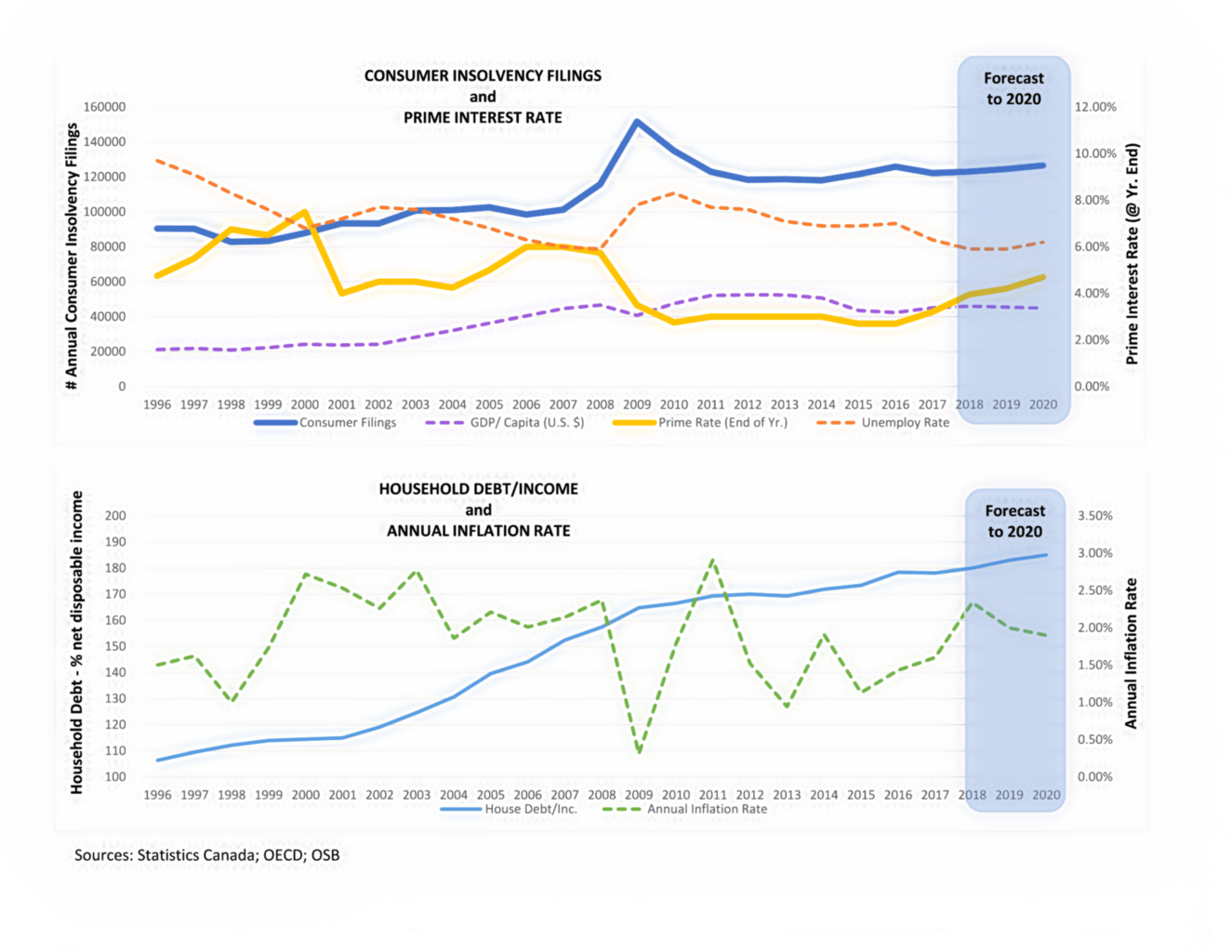
Below is a chart displayed in the CAIRP press release which I have reproduced here.debt consolidation 3


CAIRP came to some interesting conclusions about interest rates and consumer insolvencies, based on the trends shown in these charts. However, I believe they overlooked what I think is the central issue.

In the top chart, it shows that insolvency filings increased in the 2009-2010 years. CAIRP surmised that there was a lag between the time interest rates rose in the years 2006 through 2008 and the increased filings. This is true. However, the increase in filings mirrors the increase in unemployment in the 2009-2010 period. My personal view is that the more important finding is that the unemployment rate lagged the interest rate increase and it is the increase in the unemployment rate that produced a higher level of insolvencies.

With higher interest rates, corporations are paying more on their debt. Corporations want to show a steady increase in their profits year over year. If debt costs rise, companies have to find other costs to save. One cost that can be reduced in the short-term is labour costs. The forecast shows that as employees are terminated, the unemployment rate rises. Not everyone can find new work in the same time frame. This leads to increased consumer insolvency filings. In my view, the unemployment rate is a more important relationship to consumer insolvency filings.

Looking at 2019 and 2020

The bottom chart shows the relationship between household debt to income and the inflation rate. As you can see, the household debt to income ratio has kept a steady climb in 1996 through 2017 years. This steady climb has continued in 2018 and is forecast to rise even more in 2019 and 2020. The forecast also shows that inflation will nudge up to the 3% rate in 2020. So prices are expected to rise with inflation, and the household debt to income ratio is expected to rise also. This will put more pressure on Canadians trying to keep up with their debt payments.

The upper chart shows us that in 2019-2020, the forecast is that GDP stays flat, while interest rates continue to rise. In the same time frame, the downward trend in the unemployment rate bottoms out and begins to rise. Again, more unemployment and higher interest rates lead to problems for people trying to pay off debts. If you agree with my hypothesis that Canadians won’t be able to merge debt by borrowing more against their homes, this will lead to more financial problems and presumably an increase in consumer insolvency filings.

What you can do now

All is not doom and gloom. There are many things a person with a lot of debt can do now before things get out of control. There are many things that you can do right now to avoid a disaster down the road. My 5 steps for anyone who wants to resolve debt issues now are:

  1. Review your household budget now and cut spending on “wants” vs. “needs”. If you don’t have a household budget, develop a realistic one NOW!
  2. Rework the budget so that you spend less each month than you are currently spending. Look for ways to economize. Use that extra cash to paying down debt.
  3. Start paying more than the minimum monthly payment on your credit card and other unsecured debt. The more you can pay, the faster you can pay it off.
  4. Pay down the debt with the highest interest rate first. The less you pay in interest the better. That means more is going to pay down the principal debt.
  5. Perhaps you need to consider taking on a part-time extra gig to bring in more income.ira smith trustee

What if I can’t pay off my debts?

For Canadians that discover themselves not able to handle their debt on their own, there is a range of alternatives to take into consideration:

  • striking a deal with each of your major unsecured creditors through an informal debt settlement negotiation;
  • don’t give up on trying to combine all unsecured financial debts into one regular monthly payment;
  • a more formal debt settlement strategy with a consumer proposal; or
  • bankruptcy.

Identifying which choice is most appropriate depends upon a person’s scenarios as well as their unique asset and liability structure.

Debt consolidation: How we can help you

Licensed Insolvency Trustees (formerly called bankruptcy trustees) are the only experts accredited, licensed and supervised by the federal government to handle debt restructuring. As a licensed insolvency trustee, our personalized strategy will assist you to recognize all of your alternatives. The alternative you pick based on our recommendations will take away the stress and pain you are feeling because of your debt problems.

The Ira Smith Team has decades and generations of experience people and companies in financial trouble. Whether it is a consumer proposal debt settlement plan, a larger personal or corporate restructuring proposal debt settlement plan, or as a last resort, bankruptcy, we have the experience.

Our approach for each file is to create an end result where Starting Over, Starting Now takes place. This starts the minute you are at our front door. You’re simply one phone call away from taking the necessary steps to get back to leading a healthy, balanced hassle-free life. Call us today for your free consultation.

debt consolidation

Categories
Brandon Blog Post

SMALL BUSINESS CANADA TAX: LIBERALS UNFAIRLY TARGET SMALL BUSINESS TAXES IN CANADA RULES

small business canada taxFull disclosure: Ira Smith Trustee & Receiver Inc. is a licensed insolvency trustee firm in Vaughan (Toronto) Ontario. It is not an income tax advisory firm and does not provide income tax services. The information contained here is merely my opinion on SMALL BUSINESS CANADA TAX issues. This blog must not be relied upon for income tax advice or replace the advice of your income tax professional.

We are trying something new. At the bottom is an audiogram of this Brandon’s blog. If you would prefer to listen to it, and not read it, scroll down to the bottom and press on the play button. Let us know what you think by sending us a message in the Question box below.

Small business Canada tax: Introduction

In December 2017, our Federal Minister of Finance, Bill Morneau, disclosed some new policies he and Prime Minister Justin Trudeau were thinking about. The changes Finance Minister Morneau was touting, were for toughening up the small business Canada tax scheme. It would have affected entrepreneur’s businesses, their taxes, and their households.

The main aspect of small business Canada tax that our federal government wanted to attack was the age-old concept of family business income splitting. Its more modern name that you would have seen a lot in the press is called income sprinkling. The federal government was trying to advance the theory that small business owners whose family members were shareholders in the business, but not necessarily working in the business, were somehow cheating on their taxes.

Small business Canada tax: The Federal Government’s discussion points

The discussion focussed mainly on professionals, such as doctors, lawyers, and accountants who had a professional corporation. The government was trying to advance the argument how unfair it was for a professional earning say $250,000 annually, to “sprinkle” some of the income among family members older than 18 as compared to a salaried employee earning the same total amount in salary. I find it interesting that they used a quarter of a million dollars annually as an example, and not a lesser number. Do you think that was picked on purpose to subtly portray all family business owners as being fat cats?

The government’s position was that income that might have been paid to only the manager of the business, could be redirected to other family members by way of dividends. If those family members were in a lower-income tax bracket, then they would pay less tax. The government felt that was unfair.

Small business Canada tax: How income splitting or income sprinkling works

First, in order for this to work for a professional, the laws of the Province you live in has to allow you to have household members that aren’t professionals be shareholders of your professional firm. Second, if your spouse has a high taxable income already, then you will not profit by including him or her as an owner of the business. Lastly, you must decide if you’re going to add your children more than 18 years of age, as shareholders.

Assuming you’ve marked off all those issues, it can make a difference to your family’s overall income tax bill to add your partner and/or your grown-up kids as shareholders of your business. By doing this, you can choose to distribute dividends from the business and take advantage of their lower-income tax bracket.

Paying your partner or kids a salary is not as effective as making them shareholders of the firm and paying dividends. If you pay a salary, it needs to be a sensible one, for work that you can actually prove to the Canada Revenue Agency (CRA). In other words, you cannot simply pay your partner $100,000 for doing bookkeeping for the firm. CRA will certainly allow an affordable wage for that function, but it would have to be justified by comparison to the marketplace for such services.

The advantage of paying dividends to family members is that you do not need to prove it. The other benefit of paying dividends is that your firm recovers some of the business tax you’ve paid on dividends made by the firm’s financial investment portfolio. Refundable Dividend Tax on Hand (RDTOH) is the issue. Our firm does not do tax work. This is a complex topic, I will leave it up to you to research how RDTOH works.

Small business Canada tax: Tax changes effective January 1, 2018

Beginning January 1, 2018, the government changed the rules specifically to target professionals who have incorporated (specifically, doctors, lawyers, and accountants). Professionals who are gaining from reduced tax rates on what would have otherwise been fully taxed earnings at the highest marginal personal income tax rates, if not for their company.

The government is saying that these incorporate professionals aren’t adding their fair share to Canadian society by their decision to have a professional corporation. For that reason, they should not gain from the tax advantages of doing so.

So what are the changes? The Tax on Split Income (TOSI) rules has been amended to cover grown-up shareholders of private firms. Previously, TOSI rules only applied to minor children. The issue now becomes: If you’re a private company owner and pay dividends to adult family member shareholders, when can you do so without invoking the new regulations? Essentially, you need to be able to show much involvement in business.

Small business Canada tax: Clear bright line

The Federal government is putting what they’re calling a “clear bright-line”’ to exclude some relatives from the TOSI rules. The general TOSI exclusions are:

  1. The company owner’s spouse, providing they more than 65 years old.
  2. Children over 18 years old who have made a real labour contribution to the business. CRA is gauging this as an average of 20 hours a week during the year. Alternatively, there is also a test throughout any of the 5 earlier years.

The government has taken direct aim at professional corporations though. These exclusions do not apply where 90% + of the income of the corporation comes from the provision of services. Income from ownership of related businesses that earn income from the provision of services is also included in the calculation.

Inserting a trust into the ownership equation may get around this “excluded shares” provision. You need the advice of your income tax advisor to decide if it would be beneficial to you.

Small business Canada tax: Ottawa punishing small business Canada

When the federal government presented new tax rules, local business claimed they were being unjustly targeted by “punishing” measures. According to Small Business Association Canada, up to fifty percent of the country’s entrepreneurs state they’re feeling negative results.

The federal government also added changes to the passive income rules for private corporations. In the February 2018 Federal Budget, the Liberals added a grind-down mechanism for the small business tax deduction through which every dollar of investment income over $50,000 cuts profits eligible for the small business tax deduction by $5.

This has been especially challenging for organizations that use passive earnings to help in special capital funding. For example, paying for building and construction equipment or to acquire real estate used by the business.ira smith trustee

Small business Canada tax: The greatest tax battle in decades isn’t over

The Canadian Federation of Independent Business (CFIB) has asked the Provinces not to follow the Federal Liberals but to support small business.

For small businesses, the greatest tax battle in decades isn’t over. Private corporations who use responsible budgeting techniques and save up their profits and invest them to earn income, to be prepared for a rainy day, are being attacked. They may be saving to smooth out cash flow problems, or they might have a big upcoming purchase. Now they are being attacked through the income tax system for earning investment income in excess of $50K annually. It is clear that CRA will be looking closely at professional corporations’ income tax returns. I would not be surprised to see more CRA audits performed. The Federal government is looking to extract more income tax revenue from private corporations.

The rules are increasingly complex. Entrepreneurs will be spending more time dealing with more punitive income tax rules and income tax audits. All of this is designed by Ottawa for private corporations to pay more income tax. It ignores the investments small business makes. Creating jobs and making capital investments allows small business to contribute in many ways to the Canadian economy. This is aside from paying income tax.

Small business Canada tax: Does your company have too much debt?

Is your company under attack because of tax obligations or for other reasons. Is your company in need of restructuring to get debt relief?

The Ira Smith Team has decades and generations of experience people and companies in financial trouble. If your company is in need of a corporate restructuring proposal debt settlement plan, we have the experience to end your stress and pain and return you and your company to a healthy productive pain-free condition.

Our approach for each case is to develop a solution where Starting Over, Starting Now happens. This starts the moment you meet with us. You’re simply one call away from taking the necessary actions to return to leading a healthy and well-balanced problem-free life. Call us today for your free appointment.

Full disclosure: Ira Smith Trustee & Receiver Inc. is a licensed insolvency trustee firm in Vaughan (Toronto) Ontario. It is not an income tax advisory firm and does not provide income tax services. The information contained here is merely my opinion. This blog should not be relied upon for income tax advice or replace the advice of your income tax professional.

Categories
Brandon Blog Post

BANKRUPTCY TRUSTEE NEAR ME IS NOW A LICENSED INSOLVENCY TRUSTEE NEAR ME

Bankruptcy trustee near me: Introduction

This Brandon’s Blog is about picking a licensed insolvency trustee. As the title suggests, performing an online search for bankruptcy trustee “near me”, based solely on geography, is one way. Being around the corner is certainly convenient, but it may have no place in making a life-altering decision. This isn’t a coffee place you are looking for. If you required life-saving surgery, would you base your decision only upon which surgeon operates out of the hospital closest to your home? I don’t think so.

Bankruptcy trustee near me: Don’t fall into the debt consultant/debt settlement company trap

I am talking about people who actually hold a license issued by the Canadian Superintendent of Bankruptcy to administer the insolvency system in Canada. I am not talking about debt consultants or others who claim to be able to help you avoid bankruptcy and end debt.

There is no government licensing or supervision of debt consultants. They merely charge you for a first intake consultation, that a bankruptcy trustee would do for free. Once they have your information, you have paid them for the visit, and perhaps they have signed you up for more expensive “credit score improvement tools”, they hand you over to the licensed insolvency trustee who now will perform the actual work.

Using this type of arrangement costs you more money than you need to spend. The money you can’t afford to pay! The Superintendent of Bankruptcy is putting new controls in place over licensed insolvency trustees to stop bankruptcy trustees from allowing debt consultants to associate shoddy practices and perhaps even profit based on their relationships with licensed insolvency trustees.

Bankruptcy trustee near me: There are different types

I am not referring to good or bad when I say there are different types of bankruptcy trustees. I am talking about the type of practice they run. Generally, there are 4 groups; bankruptcy trustees who run:

  1. Only a personal bankruptcy practice out of one site;
  2. A corporate bankruptcy firm out of one or a few strategically placed locations around the greater metropolitan area of your city;
  3. Both a corporate and personal bankruptcy practice out of one or a limited number of locations; or
  4. The personal bankruptcy practice being operated out of many locations following a coffee or fast food restaurant model of being near every street corner.

So obviously you first need to recognize whether your financial issues are those for your company, you personally or both. As I said at the beginning, geography is nice, but it is not the most important criteria. One simple reason is that multi-location bankruptcy trustees do not make every office of theirs a full-time office. In contrast, you will see that they are operating out of either office for daily rent locations, a lawyer’s or accountant’s office, or the worst, a debt consultant’s office.

You cannot stretch yourself too thin over many offices. So, more often than not, even if your first free consultation is with a member of the Trustee’s staff, you may be meeting with an experienced clerk, but not the actual bankruptcy trustee.

My 5 point checklist to find a licensed insolvency trustee

  1. Quality and professionalism.

    Someone around the corner from you may not have the experience you need to solve your financial problems. To begin in selecting the very best bankruptcy trustee for you, look at the Canadian Association of Insolvency and Restructuring Professionals (CAIRP) website. Membership in this professional organization shows a Trustee committed to the industry and staying on top of all the current advancements. Also check the website of the Office of the Superintendent of Bankruptcy, to make sure the bankruptcy trustees you are thinking about are not under suspension or supervision by the regulator.

  2. You need to be able to interact with them on lots of levels.

    In the beginning, you’ll need them to be able to quickly comprehend your needs and desires and they need to offer you a realistic plan that you can follow through on. They also need to be available for you if you have issues or concerns show up. Search for their interest. Are they enthusiastic about their industry? Do you really feel the compassion they have for you? Can you form a bond with this person? This is exactly how you assess enthusiasm. An enthusiastic licensed insolvency trustee will make certain that you are offered the most effective suggestions and solutions. This type of person may not exist within walking distance of your home or workplace.

  3. Can you agree on the same concepts?

    Professional Trustees are not totally free. The price can differ based on how complicated your circumstance is. If you feel that the bankruptcy trustee is simply attempting to make money, you are less likely to trust them. Spend the time to discover those who seem to be on the same page as you for a realistic value for service. That type of licensed insolvency trustee may not be the closest drive from your home.

  4. Bankruptcy trustee websites.

    Today you can type in search terms like “bankruptcy trustee near me” and get various websites to go to. What sort of feel do you get from the website? Do they answer some of your more general questions through a bankruptcy FAQ page? Can you see pictures of people you would deal with? Do they show that they have a deep knowledge base from their blog page? You may not get the best feeling from the website of the licensed insolvency trustee whose place is closest to your home.

  5. Meet with several Trustees.

    You won’t know which one is the best fit for you until you are sitting across the table from him or her. Speak to at least two bankruptcy trustees to compare. The one you feel best about, may or may not be on the next street corner!

Bankruptcy trustee near me: The choice is up to you

Our best relationships are with our clients who were referred to us by someone they know, like or trust. If the referral source is trusted by you, we have already received the highest compliment possible. I am proud to say that we have helped family members of lawyers and accountants who know us. They felt safest referring a loved one to us. That is the best feeling in the world for everyone!

The Ira Smith Team has decades and generations of experience people and companies in financial trouble. Whether it is a consumer proposal debt settlement plan or a larger personal or corporate restructuring proposal debt settlement plan, we have the experience.

Our approach for each file is to create an end result where Starting Over, Starting Now takes place. This starts the minute you are at our front door. You’re simply one phone call away from taking the necessary steps to get back to leading a healthy, balanced hassle-free life. Call us today for your free consultation.bankruptcy trustee near me

Categories
Brandon Blog Post

407 ETR RATES: THE ONLY GUARANTEED TO WORK 407 ETR DEBT SETTLEMENT PLAN

407 etr rates

We are trying something new. At the bottom is an audiogram of this 407 etr rates Brandon’s blog. If you would prefer to listen to it, and not read it, scroll down to the bottom and press on the play button. Let us know what you think by sending us a message in the Question box below.

407 etr rates: Introduction

The purpose of this 407 etr rates is not to tell you what the new toll rates are. The simple answer is that they are always going up! Rather, it is an update to our earlier blogs for people who are having trouble paying their 407 toll payment.

As you probably know, the 407 etr has an arrangement with the Province of Ontario where if you have unpaid 407 etr charges, you will be put on plate denial the next time you have to renew your vehicle plate. For many, being denied a plate renewal means the end of your ability to earn an income.

Before the update, a bit of history to put everything into perspective for you.

407 etr rates: Our prior blogs

We previously wrote about how the 407 etr was trying to use the provincial law as a collection tool, even when a person filed for a debt settlement restructuring consumer proposal or for personal bankruptcy. Our prior blogs were:

I won’t repeat the history here as you can check those blogs yourself. Suffice to say they argued in Court, unsuccessfully, that the Province had the right to enforce its own plate issuance rules.

The lower Court and the Court of Appeal for Ontario disagreed with their right to enforce the plate issuance rules when it was a blatant action to collect an ordinary unsecured debt caught in the priority scheme of the Bankruptcy and Insolvency Act (R.S.C., 1985, c. B-3) (BIA). The Courts also found that they were trying to trump Federal law through Provincial law, which is illegal. Finally, the Supreme Court of Canada refused to hear their appeal, so that is where it ended, sort of.

407 etr rates: So that is where it ended, sort of

With those rulings, the 407 etr stated that they would comply and drafted a policy which was an extremely literal wording of the BIA. It technically complied with the Court rulings, but still had the effect of being very draconian and not changing their administrative policy.

The debts of an insolvent person, who has made a debt restructuring consumer proposal or bankruptcy filing, are not discharged until the insolvency process is complete. For a debt settlement plan, it is when the person finishes making their payments and receives their Certificate of Full Performance. In a bankruptcy, it is when they receive their absolute discharge.

How those processes work deserves their own blogs. Suffice to say the processes can take anywhere from a minimum of 9 months (first-time bankruptcy, no surplus income, no assets and no discharge opposition) up to 5 years (debt settlement plan). So the plate denial actually stayed in force for a long time.

The 407 etr also set up a very document intensive 407 etr login process that made applying for the eventual rescission of the plate denial very cumbersome.

407 etr rates: The class action lawsuit

The firm that independently runs Highway 407 ETR in the Greater Toronto Area agreed to pay $8 million to clear up this claim. The settlement, approved in November 2016, finishes the litigation that began in 2012.

The lawsuit affirmed that the toll freeway consortium unlawfully used provincial regulations to stop motorists that were insolvent or bankrupt from restoring their automobile permit plates. 407 ETR refutes it did anything incorrect and does not confess obligation in approving the out of court negotiation.

407 etr rates: Now for the update – The only 407 etr debt settlement plan guaranteed to actually work

The licensed insolvency administrator (LIT) acting as either the bankruptcy Trustee or consumer proposal Administrator, acting as either the bankruptcy Trustee or consumer proposal Administrator, will issue the Notice of Bankruptcy or Consumer Proposal. 407 ETR must be listed on your sworn Statement of Affairs as a creditor. It will then be sent a copy of the notice by the LIT.

Upon receipt, 407 ETR will end from plate rejection any amounts still owing from before the date of filing either for bankruptcy or a consumer proposal. This includes toll charges, interest, penalties and costs. They will then advise the Ministry of Transportation to upgrade their documents to show this change ending plate denial. This is a major change. You do not have to have completed your full insolvency process to get the lifting of the plate denial. This is the way fairness dictates it always should have been from the start.

There is a simple rule that you have to follow. It is the same rule that you need to follow in dealing with any leases or secured debt that you wish to continue to carry and that you can afford to. That is, you must not have any amounts owing to 407 etr for charges after your filing date which would qualify for plate denial.

407 etr rates: Are you worried about or need relief from plate denial

  1. Are you under plate denial, or afraid you will be soon?
  2. Will plate denial negatively affect your income and you need debt relief fast?
  3. Do you have other debts that need to be addressed too?
  4. Do you need budgeting help?
  5. Are you already experiencing financial difficulties?

If you answered yes to just one of these questions, you need a professional trustee. If yes, call the Ira Smith Team. Our approach for each file is to create an end result where Starting Over, Starting Now takes place. This starts the minute you are at our front door.

We always offer a free consultation. We listen to your issues and give you a full range of realistic options to help you get out of debt. Finding the best solution for YOU is just the right thing to do to help you meet total debt freedom.

The earlier you contact us, the more options we will have to carry out. Whether it is a corporate restructuring or personal debt settlement through a consumer proposal, the goal is to avoid bankruptcy. However, if bankruptcy turns out to be the best option, we can assist there too.

You’re simply one phone call away from taking the necessary steps to get back to leading a healthy, balanced hassle-free life, ending the pain and stress you are feeling forever. Call Ira Smith Trustee & Receiver Inc. today for your free consultation.

Categories
Brandon Blog Post

CONSUMER PROPOSAL ONTARIO: AMAZING GOVERNMENT PLAN TO REDUCE CONSUMER DEBT


Consumer proposal Ontario: Introduction

I am finding that more people are calling me to ask about a consumer proposal Ontario. This is a Canadian federal government authorized program for people to lower their consumer debt.

What is triggering the boost in these queries?

Consumer proposal Ontario: New Ipsos Canadian consumer debt survey

A brand-new study by Ipsos might assist. It paints an unpleasant scene of just how much debt some Canadians are holding on to. Of those asked 31% claim they do not make an adequate amount to pay their costs monthly. More state they are having a hard time to merely to survive. Ontario residents in this predicament are candidates for consumer proposal Ontario.

The study discovers many people are sorry for the sort of spending they’ve done to find themselves with such debt. Peoples’ incomes aren’t maintaining pace with the increase in their costs. I am not just talking about extras; I am also talking about the basics of life such as food and shelter.

Consumer proposal Ontario: Bank of Canada benchmark interest rate hike

At the very same time, on October 24, 2018, Stephen Poloz, the Governor of the Bank of Canada (BOC) announced the Bank of Canada interest rate hike by a quarter-point to 1.75%. This increases the cost of borrowing for Canadians. This is the 5th bump since the summertime of 2017.

The Bank of Canada states that the Canadian economic situation remains running near capacity and is reasonably broad-based. The rising cost of living is close to target so what stands apart is that the current rate at 1.75% is still negative in actual terms adjusting for inflation.

Since the old Free Trade Agreement, the new USMCA appears to be resolved, several think with this 800-pound gorilla out of the room, it’s most likely to unlock the Bank of Canada’s ability to continue with rate hikes.

Consumer proposal Ontario: How will higher interest rates affect you?

If you stay in a variable price home mortgage or credit line, your rate of interest has risen. What that indicates for your capital is that your month-to-month repayment has actually risen. If your home mortgage is half a million bucks, your month-to-month repayment has actually increased by sixty-five dollars.

It does not feel like a great deal. Nevertheless, if your loan(s) rate of interest rises during the rest of the year and right into 2019, that will certainly maintain raising your repayments.

It isn’t simply your variable price home mortgage. Canadians additionally lug debt with credit lines, automobile financings as well as bank cards. Each rate of interest rise will certainly increase the price of borrowing on those variable price financings.

The raised repayments will certainly maintain consumption in your capital. So for those battling to make ends meet, rates of interest boosts will just make life harder. A consumer proposal Ontario won’t help with secured debt, but it will help eliminate unsecured debt

Consumer proposal Ontario: Higher interest costs lead to belt-tightening

To regulate debt, Canadians need to be aggressive with their budgeting. Individuals need to take ways to boost their monetary scenario, such as:

When talking to a LIT, ask about how a consumer proposal Ontario can help you.

Consumer proposal Ontario: Nonetheless, many Canadians are still seeking help

Many Canadians continue to be haunted by debt. They experience remorse towards their existing and future debt scenario. Fifty percent are not certain that they will not have any kind of debt in retired life, while 44% are not certain they will have the ability to cover all living expenditures in the next year, without taking on additional debt.

Some Canadians are thinking about bankruptcy. Their first step must be to go to a Trustee. A Trustee is an expert that is certified by the Office of the Superintendent of Bankruptcy Canada (OSB). The OSB is the government organization that controls the insolvency system in Canada.

Consumer proposal Ontario: A government-approved strategy to end consumer debt

To most of our potential clients’ shock, I have told many that bankruptcy might not be essential for them. Sometimes I suggest that it is possible to remove their debt via a government-approved strategy to decrease consumer debt called a consumer proposal Ontario.

Your government authorized debt settlement program is an offer made to your creditors. The offer is to repay only a percentage of what you owe, over a duration of no more than 5 years.ira smith trustee

Consumer proposal Ontario: The benefits to you

There are benefits for you to file such a debt settlement plan. First, you keep your assets. Next off, an approved proposal binds all creditors to the arrangement.

We begin with having the individual complete the standard intake form that we call, the Debt Relief Worksheet. When totally filled in, it gives us a listing of the individual’s assets as well as what they owe. It additionally aids them to budget their income and expenses. Utilizing that info, I am able to formulate a proposal based on your capacity to pay.

The proposal is submitted to the OSB. Once submitted, you can quit paying your unsecured creditors. If creditors are garnishing your income or suing you, those activities are stopped. As soon as the proper documents are submitted with the OSB, I then send out the proposal to every one of your creditors.

The creditors then have 45 days to approve or decline the deal. If creditors are unhappy with the proposal, as the Trustee I can work out changes such as greater payments. However, it all is based on what you can still manage to safely pay.

I tell people that if the proposal is turned down, the individual will certainly need to consider various other alternatives to resolve their monetary troubles. This might include bankruptcy.

Once we get approval, you are then in charge of making routine payments to the LIT as the proposal administrator. The LIT will certainly use that cash to pay your creditors.

As part of the consumer proposal process, you will need to go to 2 counseling sessions in the LIT’s office. This will aid you to get back on your feet monetarily. If you fully complete your plan, you will certainly be legitimately released from your unsecured financial obligations.

Consumer proposal Ontario: There are 2 consumer proposal FAQs everybody asks me

What this affect my credit score?

Yes, it will certainly be influenced, I tell every person. Once the regards to the proposal are fulfilled, people can begin reconstructing their credit history and their economic future.

Just how much does it cost?

The cost is established by the Federal government. How much an individual pays in for an effective consumer proposal is totally unrelated to the allowable government authorized to charge. The Trustee earns the fee from the amount you pay into your debt settlement restructuring plan. So, that means, the cost is FREE!

Consumer proposal Ontario: That freedom feeling

Our clients who complete their consumer proposal are so pleased to get that letter from us enclosing their Certificate of Full Performance. That is the document that confirms they have become debt-free.

The Ira Smith Team has years of experience of negotiating with creditors for debtors. If you owe less than $250,000, other than for any mortgages against your home, you can enter into a consumer proposal debt settlement plan. If you owe more or are a corporation, we can still negotiate with your creditors and restructure you with a restructuring proposal debt settlement plan.

Our approach for each file is to create an end result where Starting Over, Starting Now takes place. This starts the minute you are at our door. You’re simply one phone call away from taking the necessary steps to get back to leading a healthy, balanced hassle-free life, recover your money and move on to the next investment opportunity.

Call us today for your free consultation.consumer proposal ontario

Call a Trustee Now!