Categories
Brandon Blog Post

BANKRUPTCY SURPLUS INCOME: OUR ESSENTIAL GUIDE 4 YOU

The Ira Smith Trustee Team is absolutely operational and Ira, in addition to Brandon Smith, is readily available for a telephone consultation or video meeting. We hope that you and your family are safe and healthy.

[monkeytools msnip=”https://monkeyplayr.com/playr.php?u=5173&p=22534″]

Bankruptcy surplus income introduction

I have written many blogs about personal bankruptcy and consumer proposal insolvency matters over the recent past. I notice though that it has been many years since I have written about bankruptcy surplus income. I refer to it in many of my Brandon’s Blogs but have not described it in detail in quite a while.

In order to correct that situation, here I discuss the concept and application of bankruptcy surplus income in personal bankruptcy filings.

What is bankruptcy surplus income?

Surplus income is perhaps an inadequately worded expression. Very few individuals would certainly really feel that they have surplus income, especially when dealing with financial debt. Nonetheless, in the bankruptcy context, surplus income describes a calculation that figures out just how much cash monthly an individual must be paying into their bankruptcy estate for the benefit of their creditors.

When you file for personal bankruptcy in Canada you are able to retain most of the income that you make monthly. In order to have a practical level of living during the bankruptcy period, the Office of the Superintendent of Bankruptcy Canada (OSB) establishes a net month-to-month earnings standard.

These earnings criteria take into consideration annual inflation and are derived from information collected by Statistics Canada annually. What you pay to your licensed insolvency trustee (Trustee) into your bankruptcy estate every month is determined by these standards. They are used to decide if a bankrupt has any bankruptcy surplus income.

I have to warn you though. The practical standard of living that the OSB permits is actually the Canadian poverty line. It matters not if you reside in one of Canada’s most pricey cities or in a rural area. There are no regional modifications made. The OSB lays out the meaning and calculation in its Directive No. 11R2. Every year the OSB updates the exemption limitations.

Click on this link for the up to date bankruptcy surplus income 2020 Directive No. 11R2-2020.

What happens to a person’s wages during bankruptcy?

You are still allowed to earn money and collect your wage or salary when you apply for bankruptcy under the Bankruptcy & Insolvency Act (Canada) (BIA). As a matter of fact, lots of people apply for bankruptcy because their wages, salary, or bank account are being garnisheed or frozen either by Canada Revenue Agency (CRA) or a judgment creditor. As I have written in several Brandon’s Blogs, the filing of an assignment in bankruptcy knocks out the garnishee against your wages or salary and/or the freeze on your bank account.

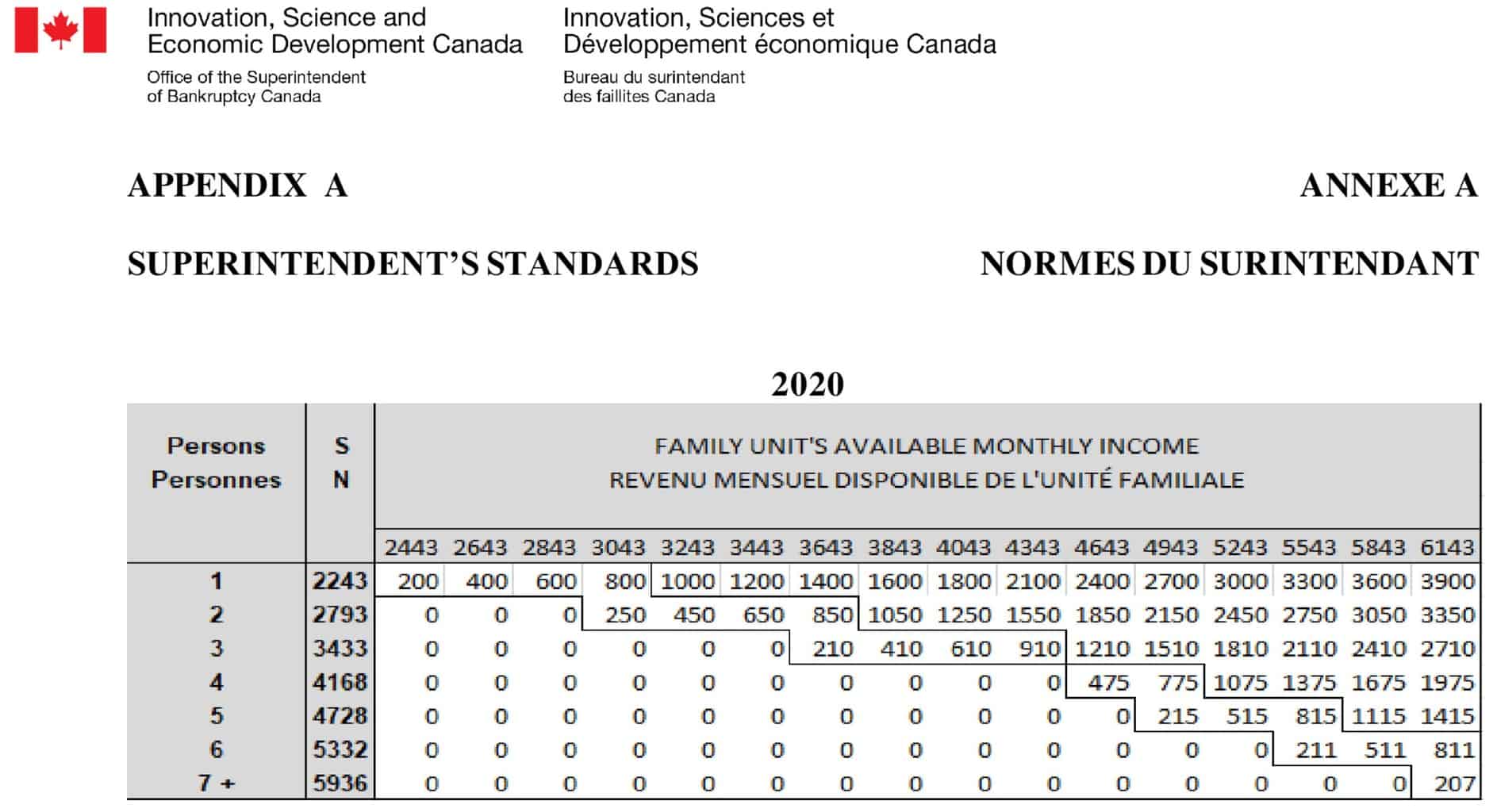
Now that there is no longer a garnishee, your earnings on an after-tax basis are readily available to you. The Canadian bankruptcy process, which strives for fairness, states that your after-tax income is now available for contribution to bankruptcy surplus income. To provide you a feel for the personal exemptions permitted, on an after-tax basis, as established by the OSB, here is the 2020 table the Trustee needs to work off of:

Superintendent’s Standards – 2020
bankruptcy surplus income

How it works is that you look at the table and pick first how many persons are in your household. The next column marked “S” and “N”, is the exemption that the OSB standard that it gives your family. You can then do one of two things: (1) go across the top of the table that resembles the closest your household after-tax income (the household’s, not just yours); or (2) if you know the calculation, do the exact calculation.
bankruptcy surplus income

Bankruptcy surplus income limits for 2020 Canada

To have bankruptcy surplus income payable, your after-tax regular monthly earnings need to be $200 or greater than the limit established by the OSB. The exact computation is to add the bankrupt’s after-tax monthly earnings to the bankrupt spouse’s after-tax month-to-month revenue, and the same for anyone else in the family that is contributing their income for household expenditures.

Take that sum and deduct your allowed exemption. Then subtract the reasonably few unique extra exemptions, if appropriate:

  1. medical expenses;
  2. support payments
  3. child care expenses
  4. court-imposed fines or penalties
  5. expenses as a condition of employment.

After that take the bankrupt’s percent of the complete household income bankruptcy surplus income which you just computed. Split that number in half which is the month-to-month surplus income that the bankrupt must pay.

So for example, take a look at the calculation below for an imaginary family of two where both spouses work and there are no extra special deductions:

Family Situation (Family unit of two)
Bankrupt’s available monthly income $2,800
Add: Other family unit member’s available monthly income 1,000
Family unit’s available monthly income$3,800
Minus: Superintendent’s standard for a family unit of two
2,793
Total monthly surplus income$1,007
Family Situation Adjustment
(2800 ÷ 3,800 = 73.68%
$1007 × 73.68% = $741.96)
$741.96
Payment required from bankrupt
($741.95 × 50% = $370.98)
$370.98

Bankruptcy surplus income calculator

To help you better understand everything that goes into the calculation, I want to share with you a tool I use to calculate bankruptcy surplus income. I am providing you with the link to the same spreadsheet that I use to do the calculation.

Here is the link:

Bankruptcy surplus income calculator

Your income is checked by the Trustee on a month-to-month basis and is balanced out over the entire period of your bankruptcy. If you have a short-term boost in earnings, such as from a bonus or commissions, or a short-term reduction, such as a temporary layoff, this will be factored in.

When do bankruptcy surplus income payments end?

For a 1st time bankrupt, without surplus income, you are entitled to get an automatic discharge after 9 months. This requires that neither the Trustee nor a creditor has opposed your bankruptcy discharge. If you are a 1st time bankrupt yet you do have surplus income, then you need to make monthly bankruptcy surplus income payments for 21 months. You are then entitled to an automatic discharge if all your surplus income payments are made and there is no opposition to your discharge.

If you have actually been bankrupt before and this is your 2nd (or more) bankruptcy, you will not have the ability to obtain a discharge in 9 months. Your bankruptcy will certainly be lengthened. A 2nd + bankruptcy lasts for a minimum of 24 months. If you have surplus income, a second-time bankrupt will certainly not have the capacity to obtain a bankruptcy discharge for 36 months. The monthly bankruptcy surplus income payments must be made for the very same 36 months.

Can I file bankruptcy if I make too much money?

The test to file for bankruptcy is not how much money do you make. The test is:

  • are you insolvent; and
  • have you committed one or more acts of bankruptcy within the six months preceding the filing of an assignment in bankruptcy or the launching of an application for a bankruptcy order.

But if you do make a lot of money, and go into bankruptcy, then no doubt you will have a large bankruptcy surplus income obligation to pay to the Trustee every month. That large amount may not fit into your monthly budget. You may not be able to afford that monthly bankruptcy surplus income payment.

So what can you do? You should speak to a Trustee about filing either a consumer proposal or a Division I Part III proposal. Both are filed under the BIA. Why? Depending on your assets, a proposal may work better for you. Although your proposal would have to be a better alternative for your creditors than your bankruptcy, it gives you the advantage of terming out the monthly payments.

It may work out that for a little more, you can get up to 60 months to pay. So rather than having only 24 or 36 months to make your total payment, as the case may be, you could get 60 months to pay only a bit more. Obviously, the proposal is more gentle on your budget than a bankruptcy. It is also easier on your credit score and credit report.

Bankruptcy surplus income summary – Are you in financial trouble?

To declare personal bankruptcy is a major life event. However, it is a necessary thing to rid yourself of crippling debt. Most people who declare bankruptcy have been faced with a major life event. The main examples are illness, pay cuts, job loss, or divorce. It is not your fault. I hope this bankruptcy surplus income Brandon’s Blog has given you helpful information.

Do you have too much debt? Are you in need of financial restructuring? The financial restructuring process is complex. The Ira Smith Team understands how to do a complex restructuring. However, more importantly, we understand the needs of the entrepreneur or the person who has too much personal debt.

You are worried because you are facing significant financial challenges.
It is not your fault that you are in this situation. You have been only shown the old ways that do not work anymore. The Ira Smith Team uses new modern ways to get you out of your debt troubles while avoiding bankruptcy. We can get you debt relief freedom.

The stress placed upon you is huge. We understand your pain points. We look at your entire situation and devise a strategy that is as unique as you and your problems; financial and emotional. The way we take the load off of your shoulders and devise a debt settlement plan, we know that we can help you.

We know that people facing financial problems need realistic lifeline. There is no “one solution fits all” approach with the Ira Smith Team. That is why we can develop a restructuring process as unique as the financial problems and pain you are facing. If any of this sounds familiar to you and you are serious about finding a solution, contact the Ira Smith Trustee & Receiver Inc. team today.
Call us now for a free consultation.

We will get you or your company back on the road to healthy stress-free operations and recover from the pain points in your life, Starting Over, Starting Now.

The Ira Smith Trustee Team is absolutely operational and Ira, in addition to Brandon Smith, is readily available for a telephone consultation or video meeting. We hope that you and your family are safe and healthy.

bankruptcy surplus income canada

Categories
Brandon Blog Post

DECLARE BANKRUPTCY: A COMPLETE GUIDE ON WHAT IS IT LIKE TO DECLARE BANKRUPTCY

The Ira Smith Trustee Team is absolutely operational and Ira, in addition to Brandon Smith, is readily available for a telephone consultation or video meeting. We hope that you and your family are safe and healthy.
What is it like to declare bankruptcy?

What is it like to declare bankruptcy? It is a scary life event, but filing bankruptcy is not as bad or terrifying as the majority of people think. Actually, you have already been through the worst of it before you declare bankruptcy.

If it’s the right option for you, it will get rid of the tension, stress, and anxiety from your life that you have been lugging with you for a very long time. It does not require that much of your time. You will usually have 3 to 4 visits with the licensed insolvency trustee (formerly called a bankruptcy trustee) (Trustee). If all works out, you will never ever see the inside of the bankruptcy court and all your debt will be removed.

The purpose of this Brandon’s Blog is to describe what it is like to declare bankruptcy and what the bankruptcy process is all about.

When to declare bankruptcy

Bankruptcy law exists to help people who have handled an unmanageable amount of debt. Most of the time, it is a result of unforeseen expenses or other unexpected life events that are no fault of the person. Two main examples of such life events are job loss and illness.

Before deciding to declare bankruptcy, make sure to explore all your alternatives, and weigh the benefits and negative aspects of each reasonable option. Part of the no-cost examination we give everyone is doing precisely that; going through the alternatives, taking into consideration the pluses and minuses of each, and making our ideal professional recommendation to every person’s unique scenario.

If you determine that bankruptcy is your only viable alternative as lots of other Canadians do each year remember that the blot on your credit score will not be forever. By using credit properly in the future and paying your debts on time, you can begin to reconstruct your credit rating and put bankruptcy behind you.

To declare bankruptcy, either a bankruptcy restructuring or bankruptcy liquidation likewise assists companies that have unrestrained debt levels. We also offer solutions to companies and businesses searching for debt settlement help.

declare bankruptcy
declare bankruptcy

What are the consequences for a person to declare bankruptcy?

Everyone assumes that if you declare bankruptcy, it takes a massive emotional toll on you. Our experience in working with people we help is the exact opposite. Their financial debts, the fear of not having the ability to pay it off along with the anxiety of the unknown is what is devastating to everyone.

Once people declare bankruptcy, they tell us that the automatic stay of proceedings and the involvement of the Trustee stopping creditors’ collection calls are great benefits. Individuals that file for bankruptcy have already looked over the cliff and feared the worst. When they figure out that their worst worries never happen, and they currently have peace and quiet from collection phone calls, they feel like a weight has been taken off of them. As we tell people, your creditors will certainly now bother the Trustee, not you!

Your bankruptcy is a matter of public record. The Office of the Superintendent of Bankruptcy (OSB) maintains a public database. The Trustee alerts your creditors, Canada Revenue Agency (CRA) as well as the OSB of your filing. People can look up any name they wish for $8 per search. Although it is public, very few people spend money to browse the OSB database. It is mainly for Equifax and TransUnion to place on your credit history report. It is also for the federal government to keep data concerning people and companies that declare bankruptcy in Canada. There are no billboards or flashing neon lights with your name on it for all the world to see.

The most effective repercussion when you declare bankruptcy is that you have the chance to release either all or most of your financial debts and start life once again hassle-free.

How do I declare bankruptcy?

Anybody who is insolvent and owes more than $1,000 qualifies for personal bankruptcy or also known as a consumer bankruptcy filing in Canada. If you are having a problem meeting your financial responsibilities or have actually stopped satisfying them, you remain in financial trouble.

The primary step is to get in touch with a federally licensed Trustee asap to discuss your options. The Trustee will certainly initially collect info from you regarding your assets, liabilities, your household income, and expenses. This allows the Trustee to get a very good understanding of your one-of-a-kind situation.

You and the Trustee will then review your choices. Bankruptcy is just one of the feasible range of options. There are numerous bankruptcy alternatives which include, however, are not restricted to, debt consolidation and consumer proposals.

The Trustee will use the information you gave to prepare the bankruptcy forms. When you declare bankruptcy, of the various bankruptcy files the Trustee prepares, you are signing, and the Trustee is filing what is called an assignment in bankruptcy.

What should I do before I declare bankruptcy?

Many people think there are several things they should do before they declare bankruptcy. Common questions include:

  • Should I transfer my interest in the matrimonial home to my spouse?
  • When should I transfer the cash in my bank account to my spouse’s bank account?
  • Should I stop working or not look for work so that I will not have to make any surplus income payments?

The reality is that by the time you are contemplating bankruptcy, it is too late. The time to do your valid creditor proofing is not when you are insolvent, but when you are solvent! When you are not experiencing any financial problems.

Transferring assets most likely will be successfully attacked by the Trustee. That means that the Trustee will go after the person you have transferred assets to for no or little value. You will not only have protected assets, but you will also have caused your loved one to incur legal costs and have to cough up the assets.

Declaring bankruptcy is an emotional as well as a scary thing. There is only one thing you should do before you declare bankruptcy. You must meet with a Trustee for a no-cost initial consultation and be honest with them. Make full disclosure so that the Trustee can provide you with your realistic options. The Trustee will also fully explain to you what the process will look like and what might happen to you if you declare bankruptcy.

When is bankruptcy a good idea? The answer depends on your situation

Bankruptcy is not naturally negative or excellent, but it is vital for the honest but unfortunate debtor who finds themselves in big trouble with financial debt. Bankruptcy is actually for honest people that have come upon tough times. They need to look to bankruptcy due to the fact that they can’t see a way out. Even the Bible calls for debt mercy at the end of every 7 years (Deuteronomy 15:1).

If you find yourself in a hard financial situation and cannot see a way out, meet with a Trustee. Do not let fears or stereotypes stand in the way of getting the relief and your household need. To declare bankruptcy must be considered as taking a positive step in helping you and your family begin again on the right track.

declare bankruptcy
declare bankruptcy

Is filing bankruptcy bad? Can it be good?

You’ll listen to a great many people effectively say: “bankruptcy is bad”. Yet why? Why is the general consensus that filing for bankruptcy is a negative thing? While it is true that when you declare bankruptcy or a consumer proposal it is evidence of difficulty with your finances, that’s not the whole story.

A large part of the reason that people state bankruptcy is bad is that they do not understand the procedure. No two bankruptcy instances are alike. People are forced into bankruptcy for a whole host of different factors, most of which are outside their control and for that reason, not their fault.

What Happens to a company when it goes to declare bankruptcy?

The BIA regulates exactly how companies can liquidate or restructure and recover from crippling debt. An insolvent company may make use of Part III Division I of the BIA to reorganize its business and try to end up being profitable again. Management remains in place to run the daily activities of the company. Any significant change in the business organization should need to be approved by the Trustee, the bankruptcy court, or both.

Under a pure liquidation bankruptcy filing, the company stops operations and goes completely dark. The Trustee is assigned to sell the firm’s possessions and the money is used to pay for the bankruptcy administration and to make a distribution to creditors. The priority of payouts is governed by the BIA.

Trust claimants and secured creditors are paid first. For instance, secured creditors take less risk due to the fact that the money that they lend is backed by the firm’s assets. If the lender is concerned that the assets may not at any time be enough to fully cover the loan, it will also require additional backup by way of the personal guarantee of the entrepreneur. That personal guarantee can be either an unsecured promise or additional collateral by the entrepreneur pledging personal assets. They do this to limit their risk of loss if the company declares bankruptcy.

Bondholders have a better potential for recovery than shareholders because bonds are a financial debt of the business. The company promises to pay interest on the money it takes in through the sale of bonds. The company also promises to repay the principal according to the terms of the bond issuance.

Shareholders own the company and also take a higher risk. They might make more if the company does well, yet they could lose money if the company is not successful. The shareholders are last in line to be repaid if the company stops working. Bankruptcy laws establish the order of payment.

If I declare bankruptcy, what happens with the CRA garnishee?

If you declare bankruptcy or file a consumer proposal, personal income tax debt is one type of debt in the category of ordinary unsecured debts. When you’ve filed for bankruptcy or a consumer proposal, CRA can’t take any kind of further collection activity against you. This includes wage garnishment or freezing your bank account. Your Trustee will certainly alert CRA once you declare bankruptcy. The Trustee will also advise CRA to quit any type of collection activity against you.

What is it like to declare bankruptcy summary?

To declare personal bankruptcy is a major life event. However, it is a necessary thing to rid yourself of crippling debt. Most people who declare bankruptcy have been faced with a major life event. The main examples are illness, pay cuts, job loss, or divorce. It is not your fault. I hope this Brandon’s Blog has given you helpful information.

Do you have too much debt? Are you in need of financial restructuring? The financial restructuring process is complex. The Ira Smith Team understands how to do a complex restructuring. However, more importantly, we understand the needs of the entrepreneur or the person who has too much personal debt.

You are worried because you are facing significant financial challenges.
It is not your fault that you are in this situation. You have been only shown the old ways that do not work anymore. The Ira Smith Team uses new modern ways to get you out of your debt troubles while avoiding bankruptcy. We can get you debt relief freedom from one of the alternatives to bankruptcy.

The stress placed upon you is huge. We understand your pain points. We look at your entire situation and devise a strategy that is as unique as you and your problems; financial and emotional. The way we take the load off of your shoulders and devise a debt settlement plan, we know that we can help you.

We know that people facing financial problems need realistic lifeline. There is no “one solution fits all” approach with the Ira Smith Team. That is why we can develop a restructuring process as unique as the financial problems and pain you are facing. If any of this sounds familiar to you and you are serious in finding a solution, contact the Ira Smith Trustee & Receiver Inc. team today.
Call us now for a free consultation.

We will get you or your company back on the road to healthy stress-free operations and recover from the pain points in your life, Starting Over, Starting Now.

The Ira Smith Trustee Team is absolutely operational and Ira, in addition to Brandon Smith, is readily available for a telephone consultation or video meeting. We hope that you and your family are safe and healthy.
declare bankruptcy
declare bankruptcy
Categories
Brandon Blog Post

DEFAULTING ON A MORTGAGE: THE BEST COURT-APPROVED WAY TO DEBT FREEDOM IN 2020 & BEYOND

The Ira Smith Trustee Team is absolutely operational and Ira, in addition to Brandon Smith, is readily available for a telephone consultation or video meeting. We hope that you and your family are safe and healthy.

Defaulting on a mortgage introduction

I just finished reading a defaulting on a mortgage decision of the Ontario Superior Court of Justice released on September 15, 2020. It had to do with a person who had filed a proposal under the Bankruptcy and Insolvency Act (Canada) (BIA). The court case is about the debtor who could not afford to pay all the mortgages on her home. The home was sold on a conditional basis, and a dispute occurred between two potential purchasers. I describe below how the court dealt with the dispute.

That case highlighted for me three things:

  • what we advise everyone who comes to us for a no-cost initial consultation who cannot afford to keep paying a loan registered against an asset, normally a vehicle or house;
  • how sometimes a strategic default on a mortgage or vehicle loan can help someone in dealing with all of their debts when they are about to file either a proposal or for bankruptcy; and
  • the appropriate manner (in my view) the court decided to resolve the dispute between the two potential purchasers.

Defaulting on a mortgage: What we advise debtors

Whenever someone comes to us for a no-cost consultation, we first get financial information from them. We want to understand the nature of their assets and liabilities and their household income and expenses. Through our analysis and discussion, we determine if the person can afford to keep paying that loan or mortgage. We also ask them, if appropriate, are they happy with the asset if it seems that they are paying too much based on the level of secured debt and the market value of the asset.

If the person says they would love to get rid of the asset, that they have no or little equity in, then we look at the impact of using defaulting on a mortgage as a strategic default so that any shortfall experienced by the lender will be an ordinary unsecured debt which can be discharged through either a proposal or bankruptcy.

Obviously, the person has to have a realistic option to replace that asset or have an alternate plan:

  • Can they lease a different vehicle at a lesser cost before filing which they can afford and therefore will not default on?
  • Is public transit a realistic option as opposed to having their own vehicle for the time being?
  • Is there a relative who will co-sign for them so that they can lease or buy a more reasonable cost vehicle?
  • Can they rent somewhere that they can afford for much less than what they have been paying on their home and then look at buying something after they are through their debt restructuring when they are back on their feet?

As I said, we do this all the time when working with people to look at all of their options for financial restructuring. We especially look at in the case of a home, does defaulting on a mortgage make financial sense?

Defaulting on a mortgage: What is a strategic default?

When the market value of your home is less than the amount owed on the mortgage, that mortgage debt is underwater. To put it simply, an underwater home mortgage loan has a higher remaining principal balance than the value of the house.

Homeowners with little or negative home equity can find themselves in this situation when housing prices fall, even if they are current on all their payments. It’s also described as being “upside-down” or having “negative equity” in the residence.

When it doesn’t make sense to keep using your cash to stay current on that underwater mortgage, rather than using that money for other necessary expenses, defaulting on a mortgage as a strategic default may be your only option. After establishing that you can’t see your property rising in value in a reasonable period to restore some of your equity, you may plan to just stop making mortgage repayments. You’ll default and eventually, the lender will enforce on its mortgage, take over the property and sell it.

Even if you have equity in the home, but you can no longer afford to keep up the payments, you may find that putting your home up for sale is your best option. Again, you need to have a realistic plan in place on where you will live once your home sells. Depending on the situation, you might decide to also create a strategic default by defaulting on a mortgage at the same time you list your home for sale. Once sold, the net proceeds of the sale, representing the equity in the home, can be used to help fund the proposal.

During the financial crisis in the United States, a strategic default on underwater homes by defaulting on a mortgage became progressively typical. Such home loans came to a head at 26 percent of all mortgaged homes in 2009. Many house owners did the math and made the agonizing however rational decision to leave the home and let the lender deal with the property and its underwater mortgage.

As I explain in the next section, in most cases, you can just walk away from such a loan in the United States. Unfortunately, it is not so easy for Canadians to walk away from their homes and defaulting on a mortgage. But there is one way to do it in Ontario.

defaulting on a mortgage

Defaulting on a mortgage: Walking away from a mortgage in Canada is not simple

In the United States, it is normal for a mortgage to be “non-recourse“. What this means is that the lender can only look to the value of the property it has mortgage security against to repay the mortgage loan. If the lender suffers a shortfall, unless there is a separate guarantee given, the lender cannot sue the mortgagor, the borrower, for any shortfall. So if you have negative equity, defaulting on a mortgage may be the right decision for such a US resident.

In Canada, it is normal for a mortgage to be “full recourse“. This means that if the lender suffers a shortfall on the mortgage debt, the terms of the mortgage loan automatically allows the mortgagee, the lender, to go to court and get a judgment against the borrower for the amount of the shortfall. So defaulting on a mortgage needs to be done in conjunction with a plan to deal with the shortfall debt.

For this reason, walking away from a mortgage in Canada is not simple. However, there is one way to do it. Once the shortfall is known and, either before or right after the lender gets a judgment, the debtor can file a proposal under the BIA to restructure all their unsecured debt. If that is not practical, then bankruptcy is the other option.

Now the shortfall is caught in the insolvency proceeding. The filing invokes an automatic stay of proceedings so that the lender cannot take action to try to execute against any of the assets or income of the debtor who has filed. The debt is caught in the insolvency proceeding and will be dealt with in that forum.

Defaulting on a mortgage: The first sale

The court case deals with a woman in Ontario who had begun a proposal process under the BIA. The debtor owned (at least) two residential properties. The property in question had 4 mortgages registered against it. The other property had multiple mortgages against it, including a mortgage as additional security for the 4th mortgage loan against the property in question. To make matters worse, there was also a lien registered against the same residential property in favour of the Canada Revenue Agency (CRA) in the amount of $308,258.

The 4th mortgage was totally underwater. The debtor entered into an agreement of purchase and sale. The sale of the home would result in a shortfall of over $700,000. It would not provide any funds for the 4th mortgage. It would only partially repay the 3rd mortgage. So, one of the conditions of sale was that the vendor would either get a discharge of all of the mortgages or a court order vesting title in the home to the purchaser clear of all mortgages and other registrations against the title. The 4th mortgagee’s charge against the other home, which was also in 4th position, was also totally underwater.

As part of the proposal proceedings, the debtor brought a motion to the court to approve the sale (supported by appraisals) and get the vesting order to vest title clear of all registrations against the title. The debtor was not only going to be defaulting on a mortgage but on at least 2 of them!

Defaulting on a mortgage: The 4th mortgagee opposes the sale approval motion

The 4th mortgagee appeared at the motion with her lawyer to get an adjournment in order to oppose the authorization and vesting order and enable her to acquire the home on the same terms but also for even more money. This would enable the 4th mortgagee to possibly recover something on her outstanding mortgage loan at a later date.

The purchaser or the purchaser’s lawyer was not told in advance that there was going to be an opposition to the application. Therefore, the purchaser’s lawyer did not attend the hearing.

At the hearing, the court authorized the sale and vesting order yet suspended its issuance for 9 days to allow the 4th mortgagee the chance to make an offer. She did, on the very same terms yet $5,000 greater than the approved offer. She also had the deposit funds put into her lawyer’s trust account. She then made a motion for the approval of her offer and vesting order. Not surprisingly, and as to be expected, the first purchaser objected to her motion.

Defaulting on a mortgage: What the court decided

The 4th mortgagee’s lawyer argued that the first purchaser’s agreement of purchase and sale is nullified since there was neither discharges provided nor a binding court order vesting title free and clear from all mortgages and the CRA registration by the closing date. Therefore, it cannot now come to court and try to extend the closing of a deal that is already dead.

Legal counsel for the first purchaser argued that if the court approves the 4th mortgagee as the buyer, the sales procedure will be unfair. The first purchaser was not notified that there would be any type of objection to its motion for the approval and vesting order of its deal. Although the first purchaser can be criticized for not keeping up with what was happening both before and on the date of its court motion, it is still a good-faith buyer who took part in a fair sales process. The 4th mortgagee had every right to bid on the subject property when it was initially listed and did not do so.

The court decided that ultimately, this situation boils down to the process being fair and seen as being fair. So given all of this, the court decided:

  • All previous agreements of purchase and sale for the subject property are terminated.
  • A new sales process will be carried out where any of the interested parties, being the first purchaser and the 4th mortgagee, can send their best offers to the Trustee, on a confidential basis.
  • The offers are to be submitted and evaluated by the Trustee by September 18, 2020, with the closing of September 25, 2020.
  • In the event, the winning bid is not able to close on September 25, 2020, the other party may purchase the property.
  • If court approval of the successful offer and a vesting order is needed, a draft order may be provided to the court.
  • The proceeds of the sale, presumably net of the realtor commission, the vendor’s real estate legal fees, and any HST that may be applicable on the sale, are to be paid into court in order to figure out the proper amount and priority of the charges against the property.

As neither side was totally successful, the court did not award costs to any party. This seems to be the fairest outcome to all concerned.

Defaulting on a mortgage: A proposal is your best option

So as you can see, it is possible to use the proposal process under the BIA either to sell a home you can no longer afford to keep which has equity. The net sales proceeds can be used to partially fund the proposal. A proposal under the BIA is the only government-approved debt settlement plan.

Alternatively, you can use the proposal process to sell the home where you are defaulting on a mortgage where there are one or more mortgages underwater. The proposal process will compromise the resulting ordinary unsecured debt arising from the shortfall claim of underwater mortgage lenders. An application can be made to the court for an order approving the sales process, the sale, and obtaining a vesting order to complete the sale.

We have helped many people and companies do exactly that when defaulting on a mortgage.

Defaulting on a mortgage summary

I hope you have enjoyed this defaulting on a mortgage Brandon’s Blog. Hopefully, you have better insight now into the fact that there is a way to get out of a secured loan, especially a mortgage. It will require an insolvency proceeding to settle all your debts, including any shortfall on the sale of the secured asset.

Do you have too much debt? Are you in need of financial restructuring? The financial restructuring process is complex. The Ira Smith Team understands how to do a complex restructuring. However, more importantly, we understand the needs of the entrepreneur or the person who has too much personal debt.

You are worried because you are facing significant financial challenges.
It is not your fault that you are in this situation. You have been only shown the old ways that do not work anymore. The Ira Smith Team uses new modern ways to get you out of your debt troubles while avoiding bankruptcy. We can get you debt relief freedom.

The stress placed upon you is huge. We understand your pain points. We look at your entire situation and devise a strategy that is as unique as you and your problems; financial and emotional. The way we take the load off of your shoulders and devise a debt settlement plan, we know that we can help you.

We know that people facing financial problems need realistic lifeline. There is no “one solution fits all” approach with the Ira Smith Team. That is why we can develop a restructuring process as unique as the financial problems and pain you are facing. If any of this sounds familiar to you and you are serious in finding a solution, contact the Ira Smith Trustee & Receiver Inc. team today.
Call us now for a free consultation.

We will get you or your company back on the road to healthy stress-free operations and recover from the pain points in your life, Starting Over, Starting Now.

The Ira Smith Trustee Team is absolutely operational and Ira, in addition to Brandon Smith, is readily available for a telephone consultation or video meeting. We hope that you and your family are safe and healthy.

defaulting on a mortgage

Categories
Brandon Blog Post

STALKING HORSE INSOLVENCY PROCESS: OUR BEST GUIDE TO GET YOUR M&A DEAL DONE

stalking horse

The Ira Smith Trustee Team is absolutely operational and Ira, in addition to Brandon Smith, is readily available for a telephone consultation or video meeting. We hope that you and your family are safe and healthy.

If you would like to listen to an audio version of this stalking horse insolvency process Brandon’s Blog, please scroll to the bottom and click on the podcast.

Stalking horse introduction

I have written before about a stalking horse in the insolvency context. Two things recently happened that suggested that I should write about it again, from a slightly different perspective. The first thing was that Ira Smith recently did a Zoom webinar presentation for the M&A Club Canada. The topic they wanted the webinar on and the title of the webinar was “Insolvency restructuring to get your M&A deal done”. Second, I see that there has been an increase in online searches for that term.

So, the purpose of this Brandon’s Blog is to describe what a stalking horse is and provide you with some insight as to how an insolvency process can be used to get an M&A deal done.

What is a stalking horse in the insolvency and M&A world?

In the distressed M&A context, a stalking horse refers to a possible buyer participating in a stalking horse auction to purchase the assets of an insolvent debtor as a going concern. In a stalking horse public auction of a financially troubled business, an initial bid by the stalking horse bidder is divulged to the marketplace and becomes the minimum quote, or floor cost, that potential purchasers can then outbid.

It was first extensively utilized in the USA and currently is a routine part of the Canadian insolvency landscape. The stalking horse process is different than the sealed tender sale approach that is traditional in Canada. The stalking horse sales process has been used in Canada many times. The case study that Ira presented in his webinar and gone over below, was one that the Ontario Superior Court of Justice approved.

The stalking horse participates in the process understanding that it might be outbid. Accordingly, it negotiates a break fee to cover its costs. This includes its due diligence costs to put together the first offer. Typically, for a competing bid to knock out the stalking horse offer, it will certainly have to be more than the stalking horse bid plus the Break Fee (described below). The competing offer will certainly likewise need to be on the exact same terms as the stalking horse bid, and cannot include any kind of burdensome conditions.

Why would anyone want to become a stalking horse?

So, why would someone want to be a stalking horse? Initially, as a stalking horse, you will certainly have the most effective opportunity of discussing the terms of a purchase that are customized to satisfy your specific issues. Also, as the first prospective buyer, you will have even more time to evaluate and comprehend the insolvent debtor’s company. You will also have a chance to develop connections with management, vendors, and key stakeholders in the sales process. This gives the stalking horse bidder a leg up.

Their expenses of participating in the sales procedure are covered by the break fee that you will negotiate. That break fee is generally secured by a unique court-ordered charge against the assets of the insolvent debtor. However, you will need to consider the ranking of this charge against other charges that may have been already granted by the court.

How a stalking horse bid works

The stalking horse method permits a distressed company to prevent receiving reduced proposals as it sells its assets. When the stalking horse prospective buyer has made its deal, the court has accepted that quote and all other conditions of the court-supervised sale, other prospective purchasers may send contending bids for the company’s assets.

By setting the low end of the bidding process, the insolvent firm wishes to realize a greater price, yet understands it cannot obtain a lower one. Insolvencies are public. The general public nature allows for the disclosure of even more information about the opportunity and the company than what would certainly be available in a private deal. Because of this, in this case study, I explain below, I can mention some names.

Stalking horse prospective buyers can typically bargain which specific assets it wishes to obtain. It likewise does not have to acquire any of the insolvent business’s liabilities. It may however choose for business reasons to take some on voluntarily. Examples would be amounts owing to critical suppliers or employment-related liabilities for employees of the insolvent company they may wish to retain.

MPH Graphics stalking horse bid process case study

MPH Graphics inc. (MPH) was an insolvent company. They had a potential purchaser who was willing to stand as a stalking horse bidder. We ran a successful stalking horse process in this case. This case happened quite a few years ago, but, since then, we have used the identical technique in other cases. When a similar kind of case comes up in the future, we would use the same process. So, although the case is older, the steps taken are still well suited today.

MPH was a company that provided printing design and finishing for Canadian and US customers. MPH printed a variety of products such as business cards, direct mail pieces, annual reports, and marketing materials and primarily serviced government agencies, not for profit organizations, and unions.

MPH grew by acquisitions and required additional capital equipment financed by debt. The business also had to change because the industry was changing from traditional printing presses to digital. That changeover required further capital investment.

MPH was insolvent

MPH’s line of business primarily serviced government agencies, not for profit organizations, and unions. Absorbing the acquisitions produced inefficiencies and redundancies. It also needed to move to larger premises which meant moving costs and higher ongoing rent costs were being incurred.

At the same time, the industry was extremely pricing competitive. Gross margins were squeezed. Overhead costs, especially sales salaries and entertainment expenses increased. There was now a history of losses. The technical staff was very experienced. To get the union business, MPH’s technical side had to be a union shop. MPH had a blue-chip client list, which is what was really of interest to the stalking horse bidder.

Receivable collections were slowing down and the bookkeeper had to put payable cheques that were printed every month in a drawer. The cheques could not be released because there was not enough money to pay their liabilities as they become due.

stalking horse

The stalking horse bidder came knocking

The bidder was an industry consolidator. They came knocking to try to buy the MPH assets. The consolidator did its due diligence and issued a non-binding letter of interest. After further discussions, that interest turned into a binding agreement to purchase the assets. One of the terms of the deal was that the stalking horse bidder required court approval of the purchase and a vesting order from the court to vest the assets out of MPH into the acquiring corporation.

Notwithstanding there were tax losses, the purchaser did not want to purchase shares and have to deal with all the creditor issues. The company could not on its own give the purchaser the certainty it wanted by way of a vesting order. So an insolvency process was required.

What kind of stalking horse insolvency process?

There are generally three insolvency options. Some are not necessarily mutually exclusive. They are:

  • receivership;
  • bankruptcy; and
  • restructuring.

Receivership is a remedy for secured creditors. In a receivership, the company loses control of the sales process. Bankruptcy is a remedy for unsecured creditors. In bankruptcy, likewise, the company loses control. It needed a process where the company stays in control.

The insolvent company’s requirements were:

  • stay in control of the process;
  • do that specific transaction or a better one; and
  • get court protection for both the sales process and the sale.

So neither receivership nor bankruptcy would work. So what would allow the company to meet its requirements and run a stalking horse bid process?

A stalking horse process works best in an insolvency restructuring process

What is needed is a debtor in possession option. In the United States, it is called a Chapter 11 proceeding. In Canada, there are two federal statutes that apply and can accommodate the needed process:

The benefits of this approach are:

  • The company stays in control of the process.
  • It allows for the stalking horse transaction or a better one to be completed.
  • Allows the insolvent company to get protection from its creditors through the automatic stay of proceedings. This gives it the time to run the stalking horse process, go back to court for approval, and to complete a transaction.

Liquidating proposal under the BIA to run the stalking horse process

We chose the strategy of a proposal filing under the BIA. The main reason was that the CCAA is for companies that owe $5 million or more. MPH owed under that threshold, so only the BIA process was available. The strategy would have been the same, even if MPH qualified for a CCAA process and we decided to go under that statute.

As time was of the essence, we MPH first filed a Notice of Intention to Make a Proposal (NOI). This quickly got them the stay of proceedings they needed and access to the court, before needing to draft the definitive proposal document.

The company filed the NOI to implement a sale of its assets, properties, and undertaking, in order to attempt to preserve as much value as possible for the Company’s stakeholders, while preserving as many jobs as possible. As Trustee, we then wrote a report to the court in support of the company’s motion to get the purchaser’s agreement of purchase and sale to be approved as a stalking horse bid and for approval of a sales process, we would run.

As Trustee, we worked with MPH, the purchaser, and their respective legal counsel, to draft the sales process and the terms and conditions of sale. These would be the rules that would allow for the marketplace to become aware of the opportunity to purchase all or substantially all of the assets, properties, and undertaking of MPH.

Key elements of the stalking horse sales process

The key elements of the stalking horse sales process were:

  • The break fee payable to the stalking horse bidder if they turned out to not be the successful purchaser was set at the amount of $100,000.
  • The Overbid Amount (as described in the Stalking Horse Agreement of Purchase and Sale) was reduced to the amount of $100,000.
  • If an auction was to be held between parties that all qualified as successful bidders, each bid had to be at least $5,000 higher than the last one.

The outcome of the stalking horse sales process

The process we recommended to the court was a 5-week process. The court approved our recommendations and ran the sales process. The process included:

  • Advertising the opportunity in a national newspaper.
  • Preparing and distributing a “teaser” non-confidential information circular to distribute to anyone who requested it along with the terms and conditions of sale.
  • Preparation and distribution of a confidentiality agreement to those who wished more detailed financial information.
  • Receipt of signed confidentiality agreements and distribution of the confidential information memorandum we prepared.
  • Receiving non-binding letters of intent from potential purchasers and deciding which ones we chose to provide access to our electronic data room.
  • Potential purchasers performed due diligence and submitted their final binding offers with deposit funds.

We then reviewed all offers received, to make sure that they met the terms and conditions of sale. We did receive a better offer, but that purchaser’s offer was conditional on them obtaining financing. They could not waive the condition, so the stalking horse bidder’s agreement of purchase and sale turned out to be the winning bid.

Court approval of the stalking horse bid

As Trustee, we then prepared our report to court to provide all the information as to the steps we took and the results of the process. We obviously recommended that the company be allowed to complete the stalking horse agreement. The court agreed and issued the vesting order.

There were enough funds to pay out the government trust claim and all the secured creditors in full. There was also enough cash left over to pay for all the costs of the process. Unfortunately, there was not enough money to do any sort of proposal. So the company filed an assignment in bankruptcy and we became the trustee in bankruptcy.

Moving from our role as proposal trustee to the bankruptcy trustee, we informed all the creditors the details of the sale and the outcome. The business and many jobs were saved as a result.

Stalking horse summary

I hope you have enjoyed this stalking horse Brandon’s Blog. Hopefully, you have better insight now into the fact that a sick insolvent company’s business can be saved by doing a sale of its assets to a healthy organization.

Do you have too much debt? Are you in need of financial restructuring? The financial restructuring process is complex. The Ira Smith Team understands how to do a complex restructuring. However, more importantly, we understand the needs of the entrepreneur or the person who has too much personal debt.

You are worried because you are facing significant financial challenges.
It is not your fault that you are in this situation. You have been only shown the old ways that do not work anymore. The Ira Smith Team uses new modern ways to get you out of your debt troubles while avoiding bankruptcy. We can get you debt relief freedom.

The stress placed upon you is huge. We understand your pain points. We look at your entire situation and devise a strategy that is as unique as you and your problems; financial and emotional. The way we take the load off of your shoulders and devise a debt settlement plan, we know that we can help you.

We know that people facing financial problems need realistic lifeline. There is no “one solution fits all” approach with the Ira Smith Team. That is why we can develop a restructuring process as unique as the financial problems and pain you are facing. If any of this sounds familiar to you and you are serious in finding a solution, contact the Ira Smith Trustee & Receiver Inc. team today.
Call us now for a free consultation.

We will get you or your company back on the road to healthy stress-free operations and recover from the pain points in your life, Starting Over, Starting Now.

The Ira Smith Trustee Team is absolutely operational and Ira, in addition to Brandon Smith, is readily available for a telephone consultation or video meeting. We hope that you and your family are safe and healthy.
Categories
Brandon Blog Post

CONSUMER PROPOSAL VS BANKRUPTCY ONTARIO: THE BEST INFO YOU REALLY NEED

The Ira Smith Trustee Team is absolutely operational and Ira, in addition to Brandon Smith, is readily available for a telephone consultation or video meeting. We hope that you and your family are safe and healthy.
Consumer proposal vs bankruptcy Ontario introduction

What is the difference between a consumer proposal vs bankruptcy Ontario is a question people calling me up these days are asking. No doubt the looming end of the various COVID-19 government support programs is now sparking this interest. People and businesses were given a reprieve with Canada’s COVID-19 Economic Response Plan and the courts being closed. Now fear is creeping back into everyone’s minds about their debts that essentially were put on hold for the last 6 months.

So, since people are asking me the question, I want to answer the consumer proposal vs bankruptcy Ontario question in this Brandon’s Blog.

Consumer proposal vs bankruptcy Ontario: Who qualifies for and what is a consumer proposal?

A consumer proposal is different from bankruptcy. Consumer proposals are available to individuals only whose overall financial obligations do not exceed $250,000, not including debts secured by their principal residence.

Division 1 proposals are offered to both companies with any debt level and people whose debts go beyond $250,000 (omitting the mortgage or any other debts secured by their primary residence).

Consumer proposals are official methods regulated by the Bankruptcy and Insolvency Act (Canada) (BIA) readily available to individuals. Collaborating with a licensed insolvency trustee (Trustee) serving as the consumer proposal administrator, you make a proposal to:

  • Pay your creditors a percentage of what you owe them over a certain period not exceeding 60 months.
  • Expand the time you need to settle those debts.
  • Or a mix of both.

Payments are made via the Trustee, and the Trustee utilizes that cash to pay each of your creditors their pro-rata share. The consumer proposal must be completed within 5 years from the day of filing.

Consumer proposal vs bankruptcy Ontario: Who qualifies for bankruptcy?

You can declare bankruptcy if you:

  • Live in Canada.
  • Continue business or have assets in Canada.
  • Have financial debts totalling a minimum of $1,000.
  • Are insolvent.

There are different tests for insolvency laid out in the BIA. They are:

  • for any reason, you are unable to pay your financial debts as they generally come to be due;
  • you have ceased paying present debts in the regular course as they usually are due; or
  • the complete worth of your property is not, at a reasonable valuation, enough, or, if sold at a sale under legal process, would not be sufficient to make it possible for repayment of all your financial obligations.

Consumer proposal vs bankruptcy Ontario: What is bankruptcy?

A consumer proposal is an excellent option for you if you can afford to make payments towards your financial debts monthly. If you are entirely unable to make enough payments for a consumer proposal, then bankruptcy is probably your only other alternative.

By statute, the offer you make your creditors via a consumer proposal must be a much better option than what your creditors would certainly get in your bankruptcy. I help people make that analysis during our initial no-cost consultation prior to them selecting the ideal insolvency process for them. We discover the choices readily available, including a consumer proposal vs bankruptcy Ontario. Bankruptcy is an alternative when you cannot afford to fund a consumer proposal to your creditors.

If bankruptcy is the selected alternative, you work with me, as the Trustee, to complete the needed documents. I then submit them with the Office of the Superintendent of Bankruptcy Canada (OSB). When the OSB issues its Certificate, after that you are formally bankrupt.

From that point on, the Trustee will deal directly with your creditors in your place. As soon as you are bankrupt:

  • you will stop making payments to your unsecured creditors;
  • any type of garnishments against your wages or bank account will stop; and
  • any lawsuits for money against you from your creditors will also be stopped.

Consumer proposal vs bankruptcy Ontario: What are the advantages of a consumer proposal?

The benefits of a consumer proposal vs. bankruptcy Ontario are:

  • You maintain all of your assets.
  • Actions against you by creditors, such as wage garnishments will quit.
  • Unlike informal financial debt settlement, the consumer proposal is a legal forum where every one of your creditors has to deal with your restructuring.
  • You do not have to think any more about the “B” word.

Consumer proposal vs bankruptcy Ontario: What are the differences in credit score?

The person that files for bankruptcy will absolutely get an R9 rating. This is the lowest credit rating possible. It will continue to be on their record for at least 7 years. An individual that submits a consumer proposal will have an R7 credit score which is less extreme. It will certainly remain to be on their record for around 8 years overall, from the moment of filing.

You will absolutely pay less than the total you owe with a consumer proposal. Commonly as much as 70% less. All your unsecured financial obligations will be combined right into a simple regular month-to-month payment. This number will be based upon what you can afford.

Consumer proposal vs bankruptcy Ontario: What are the costs and fees of a consumer proposal versus filing for bankruptcy?

When doing a consumer proposal, the Trustee’s charges are paid for out of the repayment you bargain with your creditors. For example, if your consumer proposal has you paying a total amount of $20,000 over 5 years, the Trustee’s fee and disbursements are drawn from those funds. The cost of the consumer proposal is likewise regulated by the BIA. The expense does not go up or down based upon the amount you are required to pay in your consumer proposal.

However, if you were to file for bankruptcy, the cost is once again controlled by the BIA. The Trustee is paid out of the funds available in your bankruptcy. Examples of sources of funds in personal bankruptcy are any surplus income you might need to pay as well as any assets that are available to the Trustee to sell.

If there are not expected to be any type of funds in your bankruptcy, the regulated cost to be funded either by the debtor or a third party guarantor will be around $2,000. This is one more difference between a consumer proposal vs bankruptcy Ontario.

Consumer proposal vs bankruptcy Ontario: Are assets treated differently between a consumer proposal vs bankruptcy?

If you do a consumer proposal, you can keep your assets whereas in bankruptcy your assets in most cases are affected. This includes the equity in your home if greater than $10,000, an auto or other vehicle worth greater than $6,600 (without liens against it), investments, tax refunds, as well as any RRSP contributions made in the 12 months immediately before filing for bankruptcy.

This distinction between a consumer proposal vs bankruptcy Ontario is huge.

Consumer proposal vs bankruptcy Ontario: What if I default on my consumer proposal vs bankruptcy payments?

If you do not keep up your payments on a consumer proposal, and drop 3 months behind, you have defaulted and the consumer proposal is void. You additionally are unable to submit a brand-new consumer proposal. Collection activity by your creditors will begin again.

In bankruptcy, if you do not complete all your obligations, you will not have the ability to get your discharge from bankruptcy. As soon as the Trustee gets its discharge, your creditors will certainly return to collection activities too.

This is one more consumer proposal vs bankruptcy Ontario difference.

consumer proposal vs bankruptcy ontario
consumer proposal vs bankruptcy Ontario

Consumer proposal vs bankruptcy Ontario: When is a meeting of creditors held in a consumer proposal?

A meeting of creditors in a consumer proposal is held if one is requested by creditors that are owed at least one-quarter of the total amount of proven claims filed.

An ask for a meeting needs to be made by the creditors within 45 days of the declaring of the consumer proposal. The OSB can additionally ask for the Trustee to call a meeting any time within that same duration.

The meeting of creditors must be held within 21 days after being called. At the meeting of creditors, they vote to either accept or reject the proposal.

If no meeting of creditors is requested within 45 days of the declaring of the proposal, the proposal will be considered to have been approved by the creditors no matter any kind of objections made later.

How long does it take to complete a consumer proposal vs bankruptcy Ontario?

A consumer proposal is ended when the individual has made the call for payments over the amount of time stated in the proposal itself. In a bankruptcy, the discharge relies on a selection of different aspects, including whether it was the very first time the debtor filed for bankruptcy and if they need to make surplus income payments.

If the borrower has never proclaimed bankruptcy and they do not need to make surplus income payments, then they are entitled to be discharged 9 months. However, if the bankrupt has surplus income, then a first-time bankrupt will need to pay for 21 months before when they can be discharged

If this is not the person’s first bankruptcy, and they do not have surplus income, they cannot get a discharge before the expiry of 24 months. If that person has a surplus income requirement, then they must pay for 36 months before being able to be discharged.

This is another distinction between a consumer proposal vs bankruptcy Ontario.

Consumer proposal vs bankruptcy Ontario: What do consumer proposals and bankruptcy have in common?

Both a consumer proposal and bankruptcy are lawfully binding treatments that are administered by a Trustee. If you are thinking of a consumer proposal vs bankruptcy Ontario, it is vital that you consult with a Trustee to ensure that you completely understand what’s involved, and the costs. You can talk with friends or family that might have applied for one or the other before. It is also important that you get referrals from professionals you trust.

Declaring bankruptcy or doing a consumer proposal are both issues of public record. That means there will be a permanent public record concerning your insolvency that can be accessed by anyone. If your debts are joint or co-signed or guaranteed by someone else, the other person is liable for the debt. That is the case even if you file for either a consumer proposal or personal bankruptcy.

Even these similarities still point out differences between a consumer proposal vs bankruptcy Ontario.

How do I choose between a consumer proposal vs bankruptcy Ontario?

As you can see, when you consider a consumer proposal vs bankruptcy Ontario, there are most definitely differences between the two. But they are both formal insolvency processes to eliminate your debt. What’s essential, though, is that you discover the best method to get yourself back on the right track in such a way that will assist you to achieve your long-term goals.

Consumer proposal vs bankruptcy Ontario: How to file for bankruptcy?

In order to take advantage of either a consumer proposal vs bankruptcy Ontario, you must involve a Trustee. This is a person or company licensed by the OSB to provide the insolvency process. The 10 actions listed below are a guide to the bankruptcy procedure.

  • Call a qualified Trustee and go to a meeting with him or her to talk about your personal circumstance and your alternatives including if it is possible for you to prevent bankruptcy.
  • Deal with the Trustee to complete the needed forms. The Trustee will after that submit the bankruptcy with the OSB.
  • The Trustee notifies your creditors of the bankruptcy.
  • You participate in a meeting of creditors if one is called.
  • You participate in 2 counselling sessions.
  • Based on your personal exemptions, the Trustee markets your available assets; you may additionally need to make surplus income payments to the Trustee.
  • In certain circumstances, you might need to participate in an examination held by an OSB representative.
  • The Trustee prepares a report describing your actions throughout the bankruptcy.
  • You go to the discharge hearing if needed.
  • You obtain your discharge from your bankruptcy.

Afterward, the Trustee completes the administration, including paying a dividend to your creditors, if offered.

Consumer proposals and bankruptcy Ontario aren’t the only ways of obtaining debt relief and consolidating debt

There are additionally other ways of fixing debt problems that do not include a formal process or paying a fee. If you honestly wish to thoroughly and objectively take a look at all your options, contact a Trustee, and meet with him or her. They’ll pay attention to your scenario and concerns and advise you on what will work best for you even if you do not need to file for either a consumer proposal vs bankruptcy Ontario. Their assistance is normally cost-free and non-judgmental.

At my Firm, declaring bankruptcy is only encouraged until all other potential solutions have investigated. A consumer proposal is the only government-approved financial debt settlement strategy and is always the far better bankruptcy alternative.

Consumer proposal vs bankruptcy Ontario: Move on with your life

I hope you have enjoyed this consumer proposal vs bankruptcy Ontario Brandon’s Blog. Both a successfully completed consumer proposal or obtaining your discharge from bankruptcy lets you get back on the road to financial health, relieve the stress you face, and bring you:

  • Freedom from lawsuits and garnishments;
  • The ability to live better than just hanging on one payday to the next;
  • Improved credit scores; and
  • Better health and well-being.

Do you have too much debt? Are you in need of financial restructuring? The financial restructuring process is complex. The Ira Smith Team understands how to do a complex restructuring. However, more importantly, we understand the needs of the entrepreneur or the person who has too much personal debt.

You are worried because you are facing significant financial challenges.
It is not your fault that you are in this situation. You have been only shown the old ways that do not work anymore. The Ira Smith Team uses new modern ways to get you out of your debt troubles while avoiding bankruptcy. We can get you debt relief freedom.

The stress placed upon you is huge. We understand your pain points. We look at your entire situation and devise a strategy that is as unique as you and your problems; financial and emotional. The way we take the load off of your shoulders and devise a debt settlement plan, we know that we can help you.

We know that people facing financial problems need a realistic lifeline. There is no “one solution fits all” approach with the Ira Smith Team. That is why we can develop a restructuring process as unique as the financial problems and pain you are facing. If any of this sounds familiar to you and you are serious in finding a solution, contact the Ira Smith Trustee & Receiver Inc. team today.
Call us now for a free consultation.

We will get you or your company back on the road to healthy stress-free operations and recover from the pain points in your life, Starting Over, Starting Now.

The Ira Smith Trustee Team is absolutely operational and Ira, in addition to Brandon Smith, is readily available for a telephone consultation or video meeting. We hope that you and your family are safe and healthy.
consumer proposal vs bankruptcy ontario
consumer proposal vs bankruptcy Ontario
Categories
Brandon Blog Post

WHAT IS A LICENSED INSOLVENCY TRUSTEE? READ OUR BEST AND COMPLETE 12 STEP CHECKLIST

what is a licensed insolvency trustee

The Ira Smith Trustee Team is absolutely operational and Ira, in addition to Brandon Smith, is readily available for a telephone consultation or video meeting. We hope that you and your family are safe and healthy.
If you would prefer to listen to the audio version of this what is a Licensed Insolvency Trustee Brandon’s Blog, please scroll to the very bottom and click on the podcast.

What is a Licensed Insolvency Trustee introduction

What is a Licensed Insolvency Trustee is a question I see asked regularly. Is it the same as a bankruptcy trustee? The answer is yes. A bankruptcy trustee is an old name. Licensed Insolvency Trustee is the new name. The Office of the Superintendent of Bankruptcy (OSB) changed the name in 2015. The change came about partly because of submissions made by the Canadian Association of Insolvency and Restructuring Professionals (CAIRP).

The change came about since the new name more precisely explains the breadth of solutions they offer to consumers and businesses. The purpose of this Brandon’s Blog is to describe for the stressed-out person who is facing financial challenges, or the entrepreneur whose business is in financial trouble, what is a Licensed Insolvency Trustee all about and give a 12 point checklist to help you find the best one for you.

What is a Licensed Insolvency Trustee?

A Licensed Insolvency Trustee is a financial and debt specialist licensed and supervised by the OSB. The OSB released a directive calling for trustees to utilize the classification of Licensed Insolvency Trustee to more precisely show the solutions they offer.

What is the difference between a Licensed Insolvency Trustee, a credit counsellor, and a debt settlement business?

Licensed Insolvency Trustees, credit counsellors, and financial debt settlement companies, all provide financial guidance. However, they are extremely different.

A Licensed Insolvency Trustee is the only person who can file a bankruptcy or consumer proposal for you. A trustee can also offer you financial advice and help you plan on how to repay your debt. Credit counsellors and debt settlement businesses can give you financial advice and information. They can help you make a budget and make plans to repay your debt. But they can’t file a bankruptcy or consumer proposal for you.

Unlike the others, a Licensed Insolvency Trustee is an Officer of the Court, and as such, is the only financial debt relief professional in Canada legally allowed to administer insolvency proceedings under the Bankruptcy and Insolvency Act (Canada) (BIA).

What is a Licensed Insolvency Trustee and what can they do for me?

A Licensed Insolvency Trustee will first gather info to comprehend the individual’s or business’s entire circumstance, examine the effects of different choices, discuss them with you and also suggest the one he or she really feels is ideal for you. When filing a restructuring debt settlement proposal or for bankruptcy, Licensed Insolvency Trustees will direct the debtor through the whole procedure, will certainly prepare and submit the needed paperwork, and be the one to deal directly with all of your creditors.

So what is a Licensed Insolvency Trustee? It is the only expert that can offer you a complimentary consultation and advice as well as recommendations. After that, she or he will either direct you what to do if you do not need an insolvency process to repair your financial concerns or administer the insolvency procedure if one is required.

what is a licensed insolvency trustee

What is a Licensed Insolvency Trustee and what sets them apart?

By now you should realize that a Licensed Insolvency Trustee is licensed and supervised by the OSB. No other professional dealing with consumer or business debt issues is. Licensed Insolvency Trustees also have to go through a rigorous course of study and examinations in order to obtain that license.

So what is a Licensed Insolvency Trustee? It is someone who:

  • successfully complete the Chartered Insolvency and Restructuring Professional (CIRP) Qualification Program (CQP), the CIRP National Insolvency Exam and the Insolvency Counsellor’s Qualification Course;
  • passed an Oral Board of Examination;
  • has been found to be a person of good character and reputation; and
  • has been cleared through an RCMP investigation.

What is a Licensed Insolvency Trustee and how are their fees calculated?

There are set calculations and rules that all Licensed Insolvency Trustees must strictly follow when administering a bankruptcy or proposal. Trustee fees are calculated and drawn from the funds that have been paid into each individual proceeding. Licensed Insolvency Trustees are not allowed to simply set their own fees and rates.

In most bankruptcies and proposals, the Licensed Insolvency Trustee’s fees are based on a tariff set by the BIA. Unlike other professionals, working with a Licensed Insolvency Trustee is not a “fee for service” – this means that a phone call to discuss any questions you have or get ongoing support throughout the process won’t result in an invoice.

What is a Licensed Insolvency Trustee and how do I find one?

The best way to find one is through a referral from someone that you trust. This could be your lawyer, accountant, a relative or a close friend. Someone you trust, who refers you to someone they trust, is always the best. I take pride that my Firm has many times helped relatives of lawyers and accountants who we work with. If they are willing to refer a family member to us, that is the highest compliment anyone can pay to me as a professional.

You can also contact a local non-profit credit counselling service. There are two benefits to doing this. A local non-profit credit counselling organization is probably one of the most objective places to find out about all your debt relief options. They’re not trying to sell you anything, and they’re not paid on commission. So they can actually help you look at all your options and see if insolvency (a consumer proposal or bankruptcy) is your best option or if there is something else that might make sense.

The OSB maintains a searchable database of all Licensed Insolvency Trustees in Canada. You can search for a trustee located near you. Finding a trustee near you may be convenient, but, it will not give you a sense of whether you feel you can work with that professional.

You can also search for licensed insolvency trustee” or “bankruptcy trustee” in your favourite search engine. Just be mindful that the companies who appear at the top of your search results with the word “Ad” next to their name have paid for that listing. It has nothing to do with their expertise or rating.

Looking at the online reviews given by people who have worked with them is a great way to start to get a feel for each professional. If they write blogs or have videos posted online, that will also help to get a feel for the personality of the Licensed Insolvency Trustee.

What is a Licensed Insolvency Trustee and have they been recognized by any rating agencies?

Best Bankruptcy trustees in Vaughan

I am pleased to report that, for the 5th year in a row, Ira Smith Trustee & Receiver Inc. has been voted as one of the Top 3 Licensed Insolvency Trustees in Vaughan, ON. (Yes, there are more than 3!). It is gratifying to get recognition fo the professional services we provide and our commitment to full service and support for our clients.

So what is a Licensed Insolvency Trustee and how should I go about choosing one? There are many factors that you must consider. Below is our 12 step checklist to make the best choice for you.

What is a Licensed Insolvency Trustee? Our 12 step checklist to help you find the best one for your situation

  • Do they have the necessary qualifications?
  • How many cases like yours have they done before?
  • Do they go to Court also or do you have to hire a lawyer to do so?
  • Is bankruptcy right for you and is it your only option?
  • How much will it cost you?
  • Will you be dealing with the actual licensee ultimately responsible to the OSB for your file?
  • Will you only be seeing one of many clerks once you enter the insolvency process?
  • How did you feel after meeting the people at their office after your initial consultation?
  • Do they practice exclusively in the bankruptcy/insolvency area?
  • Do they have experience in only personal insolvency matters, only corporate insolvency matters, or both?
  • Do they have enough experience and the time to handle your matter?
  • Will they communicate in a timely manner with you throughout?

As you can see, when trying to answer what is a Licensed Insolvency Trustee and who is the right one for me question, there are many things to consider.

What is a Licensed Insolvency Trustee summary

I hope you found this what is a Licensed Insolvency Trustee Brandon’s Blog about helpful. Sometimes things are too far gone and more drastic and immediate triage action is required.

Do you have too much debt? Are you in need of financial restructuring? The financial restructuring process is complex. The Ira Smith Team understands how to do a complex restructuring. However, more importantly, we understand the needs of the entrepreneur or the person who has too much personal debt. You are worried because you are facing significant financial challenges.
It is not your fault that you are in this situation. You have been only shown the old ways that do not work anymore. The Ira Smith Team uses new modern ways to get you out of your debt troubles while avoiding bankruptcy. We can get you debt relief freedom.

The stress placed upon you is huge. We understand your pain points. We look at your entire situation and devise a strategy that is as unique as you and your problems; financial and emotional. The way we take the load off of your shoulders and devise a debt settlement plan, we know that we can help you.

We know that people facing financial problems need a realistic lifeline. There is no “one solution fits all” approach with the Ira Smith Team. That is why we can develop a restructuring process as unique as the financial problems and pain you are facing. If any of this sounds familiar to you and you are serious in finding a solution, contact the Ira Smith Trustee & Receiver Inc. team today.
Call us now for a free consultation.

We will get you or your company back on the road to healthy stress-free operations and recover from the pain points in your life, Starting Over, Starting Now.

The Ira Smith Trustee Team is absolutely operational and Ira, in addition to Brandon Smith, is readily available for a telephone consultation or video meeting. We hope that you and your family are safe and healthy.

[monkeytools msnip=”https://monkeyplayr.com/playr.php?u=5173&p=22465″]

Categories
Brandon Blog Post

CONSUMER PROPOSAL IN ONTARIO: OUR COMPREHENSIVE GUIDE TO ELIMINATE YOUR DEBT

The Ira Smith Trustee Team is absolutely operational and Ira, in addition to Brandon Smith, is readily available for a telephone consultation or video meeting. We hope that you and your family are safe and healthy.

Consumer proposal in Ontario introduction

I will begin with a consumer proposal in Ontario definition:

A consumer proposal is a formal binding deal made to your unsecured creditors to resolve your debt for less than the total owing. To help you decide if a consumer proposal in Ontario is the right choice for you, I will answer the most often asked questions.

A consumer proposal in Ontario: Is it worth it?

I say most definitely indeed. A successful restructuring is binding on all unsecured creditors. It is a legitimately binding deal between you and your creditors if the offer is accepted. A consumer proposal in Ontario is an excellent debt settlement plan for people who have the ability to pay off a percentage of their debts, however not their total debt.

What is a consumer proposal in Ontario?

consumer proposal in ontario

A consumer proposal in Ontario is a means to stay clear of filing bankruptcy by negotiating with your creditors to pay off a portion of what you owe. If you have high and even just average month-to-month income, it is a more sensible alternative to remove your debt obligations this way than to declare bankruptcy. This procedure leads to a lawfully binding contract between you as well as your unsecured creditors that allows you to resolve your financial debts at a much lower rate, interest-free, over an extended time period.

The Licensed Insolvency Trustee (Trustee) in a consumer proposal is inspired to find the sweet spot for both the debtor and the creditors. A number that is sufficiently high that it is a better alternative for your creditors than your bankruptcy. That number has to be acceptable to the creditors yet realistic as to what you can afford to pay in monthly instalments of no more than 60 months.

A consumer proposal is usually the way of achieving that goal. In reality, the leading advantage is that you get to keep all your assets. Such a proposal can last up to a maximum of 5 years. It is a debt relief remedy that permits you to eliminate your debt by only paying off a portion. When you file, any interest charges stop. Unlike a bankruptcy, in a consumer proposal in Ontario, you get to keep your possessions.

When is a consumer proposal in Ontario appropriate?

To discover out if a consumer proposal is a right option for you, set up a meeting with a Trustee to review your individual scenarios.

The Trustee will review your financial situation as well as describe the advantages and disadvantages of the numerous options that can help you fix your financial troubles.

If you make a decision to submit a consumer proposal in Ontario, the Trustee, who is called an Administrator under a consumer proposal will deal with you to establish a debt settlement plan that helps both you as well as your creditors.

A consumer proposal in Ontario: How do you qualify for one?

consumer proposal in ontario

A consumer proposal in Ontario is for people who are able to make some payments to creditors. However they need to change the present arrangement of their repayments because it deals with a portion of their creditors or debts, but not all of them.

You can submit a consumer proposal if you are an individual that owes $250,000 or less in unsecured financial obligations.

The large distinction between bankruptcy and this sort of restructuring plan is the monthly settlement. As soon as the arrangement is finalized and the plan agreed to, you make a single payment each month while the proposal is running.

The consumer proposal in Ontario is one of the most frequently used options for settling your debts in Ontario and the rest of Canada. If you and your Trustee determine that a consumer proposal is much better for your financial scenario than bankruptcy or any type of various other debt-relief option. You and your Trustee will begin to craft a negotiation deal. Your deal will be evaluated by your creditors.

A consumer proposal in Ontario is normally the preferred option to bankruptcy. Part of making a decision about whether bankruptcy or a consumer proposal is right for you is recognizing what sort of financial debts can be included and will be discharged when the proposal is successfully finished.

When is the right time to file a consumer proposal in Ontario?

consumer proposal in ontario

A consumer proposal in Ontario is for individuals who are not able to pay their debts off in full every month. The right time to file is if any of the following sounds familiar. You:

  • can only afford to make the minimum monthly payments on your credit cards;
  • are being called by bill collectors;
  • make interest-only payments because you cannot afford to pay down the principal amount of any debt;
  • get calls from Canada Revenue Agency (CRA) trying to collect past due taxes;
  • are being sued by creditors;
  • have CRA or judgment creditors garnisheeing your bank account or your wages;
  • need to use an overdraft facility or line of credit in order to make ends meet each month;
  • are working and have money left over at the end of each month AFTER reversing any amounts paid in the month towards their debts.

If you answered yes to one or more of these questions, then now may be the right time for you to file a consumer proposal in Ontario.

What happens if I co-signed a loan with someone?

If you submit a consumer proposal in Ontario, your co-signer will certainly be responsible for repaying these financial obligations; the financial debt will certainly not be gotten rid of unless you are able to file a joint consumer proposal. If you cannot file a joint consumer proposal, then the other person would have to look at filing their own consumer proposal in Ontario.

What happens when I file a consumer proposal in Ontario?

A consumer proposal in Ontario does not handle secured creditors. Submitting one can make keeping up with your home mortgage or auto loan easier. Look at your regular monthly budget plan, and see if you think you can pay for a consumer proposal. This process does NOT affect the mortgage on your residence or a secured automobile financing arrangement.

A proposal is a contract made between you and your creditors. With a legally-binding consumer proposal filing, you need to repay a percentage of your financial debts and/or expand the time you need to repay your debts completely. For those that can not manage to repay their financial obligations, it is the best financial debt consolidation program available. If you are looking for a debt settlement, this is a far better option.

For the majority of people, a consumer proposal in Ontario is a more attractive option to bankruptcy; nonetheless, it is still thought about as a kind of insolvency procedure. For Canadians looking for debt relief, it is a choice for insolvent debtors that isn’t as severe as declaring bankruptcy. During your initial no-cost consultation, your Trustee will certainly describe all your financial debt settlement choices to determine which one is the most appropriate one for you.

The Trustee acting in your consumer proposal acts as the Administrator. Within 10 days after filing with the Office of the Superintendent of Bankruptcy Canada (OSB), the Administrator will certainly prepare a report describing the outcomes of its investigation, the Administrator’s point of view regarding whether the consumer proposal is fair and sensible for the creditors and the debtor, and whether the debtor will have the ability to perform it.

The consumer proposal Ontario rules state that documents have to be successfully filed, the plan approved by your creditors and court-approved, and the debtor making all the payments promised in the plan. At that point, the trustee issues a certificate of full performance. The Trustee provides you with a copy and also files a copy with the OSB.

What does a consumer proposal in Ontario do to your credit?

Leaving debt behind with a consumer proposal in Ontario is commonly the preliminary step to improving your credit score. Much like any type of debt settlement program, getting through a consumer proposal successfully will ultimately improve your credit score. Most people see a rejuvenation in their credit score swiftly after finishing the program.

For those that don’t want to go file for bankruptcy, the consumer proposal in Ontario is much less intrusive. A proposal is integrated with needed credit counselling. If you are unable to settle every one of the unsecured debts that you owe, nevertheless, have consistent work and income, you can find that a consumer proposal in Ontario is a viable alternative to bankruptcy.

Once your consumer proposal in Ontario is completed, you are in the next phase of taking control of your finances

A proposal is a practical choice if you have surplus income or assets you want to maintain. A proposal is a legal action under the Bankruptcy and Insolvency Act (Canada) (BIA) that supplies a stay of proceedings that immediately stops all creditor lawsuits and other actions. This includes most wage garnishments and calls from creditors and collection agencies.

If you are dealing with creditor calls or being threatened with legal action, this consumer proposal process can assist you to remove your financial debts.

Settlements in a consumer proposal in Ontario are worked out upfront. The responsibilities called for in a proposal are less than those in personal bankruptcy. A consumer proposal has actually fewer needed duties than bankruptcy. As you can see, it is a viable means to remove all your frustrating unsecured financial obligations and to get your life back on track.

A consumer proposal in Ontario is also something to think about if your month-to-month payments under a different debt management strategy may be too expensive for you to manage. Your regular monthly repayment on your consumer proposal is remitted to your creditors by the Trustee.

What happens to my credit cards when I file a consumer proposal?

consumer proposal in ontario

When you file a consumer proposal in Ontario or any other part of Canada, you do not need to turn over your credit cards to your Trustee. Nonetheless, the reality that you submitted a consumer proposal will turn up on your credit record.

When your Trustee sends a notice to any credit card company you owe money to, they will certainly recognize it. They will then cut off your ability to make use of your charge card. If you have a charge card where you do not owe any money on when you file, that credit card firm will not obtain notice of your filing due to the fact that they are not a creditor of yours when you file a consumer proposal in Ontario.

Nonetheless, when they do their typical ongoing credit review of you, they will discover that you have filed. When they learn of your filing, they might very well stop you from being able to use that credit card.

Which debts are eligible for a consumer proposal in Ontario?

The majority of your unsecured financial obligations can be combined and consequently eliminated in an effective consumer proposal in Ontario. Some unsecured debt cannot be compromised. As an example, a lot of student loans frequently can not be included, especially if it has actually been less than 7 years from when somebody stopped being a full time or part-time student.

Also, your valid secured financial obligations are likewise not compromised.

A consumer proposal in Ontario will eliminate income tax owing

A consumer proposal in Ontario and the rest of Canada is the only technique that can be made use of to pay less than the total amount of the taxes you owe to the CRA. A consumer proposal is a safe as well as a trustworthy way to eliminate your financial obligations but it can likewise be the cheapest in terms of regular monthly repayments. The consumer proposal will take care of your income taxes owed from tax returns that were submitted prior to the proposal date.

Due to the fact that each personal situation is distinct, the advantage of a consumer proposal is that it can be tailored particularly to satisfy your requirements. This is the only government-approved debt negotiation alternative for resolving your debts in Canada, besides an assignment in bankruptcy. A consumer proposal is an option to discuss repayment terms with your creditors via the Trustee, for a lot less than what you owe today.

The CRA collector is not allowed to consider accepting less than 100% of what you owe to CRA unless you file a consumer proposal.

What consumer proposal in Ontario stage are you at?

Regardless of what stage in this process you may go to (even if you are still considering one), you probably have questions about what to anticipate after your consumer proposal in Ontario is filed. A consumer proposal is better than a bankruptcy with regard to your credit rating. A consumer proposal is an R7 rating and is a little bit of an improvement for eliminating everything you owe, in return for the effort of paying off a part of what you owe. A successful consumer proposal will in fact assist you to prevent bankruptcy.

An additional advantage of a plan similar to this is that your Trustee is typically able to work out a higher principal decreases than you might by yourself. What sets this plan apart from paying the minimum payments allowed by your creditors by yourself is the truth that a consumer proposal freezes your interest and penalty charges. Once accepted and approved, it is a binding contract between you and your creditors. Once you fully perform the consumer proposal in Ontario, your creditors will consider your financial debts paid in full for much less than what you in fact owe.

A consumer proposal is an extremely typically utilized means to resolve your financial obligations, without declaring bankruptcy. A consumer proposal is a very powerful legitimately binding method to settle your debts, which normally puts an end to garnishments and also various other legal activities against you and stops collection telephone calls, as well as allow you to maintain control of your assets.

What happens if I miss a payment for my consumer proposal in Ontario?

In making a proposal to your creditors, it is necessary for you to make your month-to-month payments in a timely manner. If you miss 3 payments during the term of the proposal, it is annulled. This means that the consumer proposal in Ontario is brought to an end by default.

In certain scenarios, an amended proposal might be submitted before the default happens. However, when a default occurs and an amended proposal is not submitted and accepted by the unsecured creditors in time, the debts owing to the unsecured creditors are not discharged.

In this situation, the unsecured creditors will start to seek payment from you directly for the total of your pre-proposal financial debts. If you have actually defaulted and the consumer proposal is annulled, you are forbidden from filing another consumer proposal in Ontario and elsewhere. However, you can file for bankruptcy.

What happens to my credit score if I file a consumer proposal in Ontario?

When you file a consumer proposal in Ontario, you will be given an R7 score, which shows you have made a settlement with your creditors. This score will remain on your credit report for three years after your consumer proposal has been fully paid off.

How much does a consumer proposal in Ontario cost?

A consumer proposal in Ontario costs need to be in accordance with the provisions of the Typically, a Trustee will work with you to establish the total amount you need to provide for your creditors in a consumer proposal. This calculation does not take into account the Trustee’s fee and disbursements allowed under the BIA.

The Trustee can take its fee and expenses from the funds you pay into the consumer proposal as allowed by the BIA. It’s vital to keep in mind that you need to never ever be billed directly for any services connected to filing a consumer proposal in Ontario.

Is a consumer proposal in Ontario right for you?

This is a remarkable program for individuals, households, and sole proprietors who are encountering economic hardship and require a sensible option to their debt troubles. This procedure has no covert costs. While a consumer proposal commonly lasts longer than bankruptcy proceedings, the complete cost to you may be much less since you retain your assets and also there are no surplus income payments.

A consumer proposal is a feasible option to manage small business debts in a proprietorship if the overall unsecured debts do not exceed $250,000. This program is not for debts owed by an incorporated business. There is a debt relief program in the BIA for companies. A consumer proposal in Ontario is just one of the most effective, and also best, financial debt settlement options that are readily available.

What is a consumer proposal helpful for? It is a fantastic way to take advantage of a lot of the benefits of bankruptcy without serious disadvantages such as the loss of assets. All of your assets need to be accounted for, but they are shielded from a seizure when your consumer proposal is approved.

Both bankruptcy and a consumer proposal are financial debt elimination choices allowing those that are in substantial debt to get out from under that burden. However, the consumer proposal in Ontario is much less disruptive to their lives. Choosing to submit a consumer proposal is about being proactive in taking care of your financial obligations.

If your financial circumstance is such that budgeting or refinancing can not resolve your recurring economic crisis, a consumer proposal is probably the best choice under the BIA to resolve your debts. A consumer proposal may be the most effective way to help you stay clear of bankruptcy while settling your debts.

We customize each consumer proposal to fit your unique budget and circumstances. The payments you make are after that split among your unsecured creditors. We also help you with your go-forward plan after filing your consumer proposal in Ontario. As a qualified credit counsellor, we sit down with you to discuss your financial planning in two mandatory counselling sessions.

What is a consumer proposal in Ontario summary

I hope you found this consumer proposal in Ontario Brandon’s Blog about helpful. Sometimes things are too far gone and more drastic and immediate triage action is required.

Do you have too much debt? Are you in need of financial restructuring? The financial restructuring process is complex. The Ira Smith Team understands how to do a complex restructuring. However, more importantly, we understand the needs of the entrepreneur or the person who has too much personal debt. You are worried because you are facing significant financial challenges.
It is not your fault that you are in this situation. You have been only shown the old ways that do not work anymore. The Ira Smith Team uses new modern ways to get you out of your debt troubles while avoiding bankruptcy. We can get you debt relief freedom.

The stress placed upon you is huge. We understand your pain points. We look at your entire situation and devise a strategy that is as unique as you and your problems; financial and emotional. The way we take the load off of your shoulders and devise a debt settlement plan, we know that we can help you.

We know that people facing financial problems need a realistic lifeline. There is no “one solution fits all” approach with the Ira Smith Team. That is why we can develop a restructuring process as unique as the financial problems and pain you are facing. If any of this sounds familiar to you and you are serious in finding a solution, contact the Ira Smith Trustee & Receiver Inc. team today.
Call us now for a free consultation.

We will get you or your company back on the road to healthy stress-free operations and recover from the pain points in your life, Starting Over, Starting Now.

consumer proposal in ontarioThe Ira Smith Trustee Team is absolutely operational and Ira, in addition to Brandon Smith, is readily available for a telephone consultation or video meeting. We hope that you and your family are safe and healthy.

Categories
Brandon Blog Post

MORTGAGE DEFERRAL CANADA IS ENDING: 3 KILLER WAYS TO DEAL WITH COVID-19 RELATED MONEY PROBLEMS

The Ira Smith Trustee Team is absolutely operational and Ira, in addition to Brandon Smith, is readily available for a telephone consultation or video meeting. We hope that you and your family are safe and healthy.

[monkeytools msnip=”https://monkeyplayr.com/playr.php?u=5173&p=22438″]

Mortgage deferral Canada introduction

The bulk of the home mortgage deferral Canada that banks have given to Canadians was approved in March and April. This was the time when the COVID-19 pandemic began taking a financial toll on the country with non-essential businesses shuttered and millions unemployed or seeing their earnings take a deep cut.

The Office of the Superintendent of Financial Institutions (OSFI) proposed actions planned to support federally regulated lenders to make sure that they would not experience problems due to the mortgage deferrals provided to help Canadians. The OSFI mortgage deferral help it provided to the lending institutions enhanced the security of the Canadian economic situation and monetary system when faced with obstacles postured by the coronavirus.

The mortgage deferrals are slowly coming to an end. This Brandon’s Blog discusses what you can do if you fear what your personal fallout will be when the mortgage deferrals end.

How did mortgage deferral Canada work for the borrower?

As of July 30, there were approximately $170 billion in mortgage deferments for the biggest 6 banks. The majority were established to unwind by September 30. Mortgage deferral Canada arrangements between Canadians and their financial institutions were truly an individual conversation. The federal government provided a wide overview, yet the specific arrangements between each borrower and lender were established individually as each case required. The significant style was that if a customer was struggling with financial difficulty because of the COVID-19 lockdown, mortgage payments would be deferred for an agreed-on, short-term amount of time.

Currently, these mortgage deferral Canada setups are slowly ending. The chartered banks are reporting that currently, for those whose deferments have ended, 80% to 90% are current in their payments. That means 10% to 20% of people who had a mortgage deferral Canada deal currently cannot maintain their mortgage payments.

How did mortgage deferral Canada work for the lenders?

OSFI told the federally regulated lending institutions and mortgage insurers they can deal with home mortgage financings for which a payment deferment is approved as being current. Payment deferments of as much as 6 months approved prior to August 31 and repayment deferments of up to 3 months approved after August 30 and on or before September 30 that it need not categorize such mortgages as impaired or revamped.

In April OSFI advised lenders that in circumstances where banks provide home mortgage repayment deferrals, those mortgages can continue to be dealt with as performing loans under the . Consequently, OSFI told the banks they did not need to increase their capital resource requirements based upon the home mortgage deferral Canada arrangements they provided. OSFI additionally told the loan providers that it would not assess such mortgage portfolios as having a larger credit risk.

For all federally regulated banks, OSFI specified that it is prepared to use flexibility for any that might need additional time to satisfy upcoming due dates for filing regulatory returns, on a case-by-case basis.

Where mortgages need to be insured due to being high ratio, there are insurance coverage costs that the lending institutions need to make to the insurer each month. OSFI likewise aided the banks and insurers, such as CMHC, by stating that it will not place the lenders or insurers offside when the monthly insurance premiums were not being paid as a result of the mortgage deferral Canada arrangements. OSFI also stated that deferments will not boost capital charges on unpaid premiums. OSFI told insurance providers that they can deal with a mortgage for which a deferment is granted as performing.

So with these OSFI initiatives, lenders can make mortgage deferral Canada happen and both lenders and mortgage insurance providers can treat the mortgages under these deferred home mortgage settlements and mortgage insurance payments, as not being in default.

Mortgage deferral Canada is ending – what can you do if you believe it will cause financial problems for you

OSFI has just stated that any type of mortgage deferral Canada plans past September 30, 2020, will now be subject to OSFI’s typical policies. People who need to start making their mortgage payments once again, but whose economic situation has not improved since the pandemic hit, are scared. I have read some “what to do” articles if you think you will have trouble making your normal mortgage payments. In my view, several have actually missed the mark. Some I have checked out start explaining how a consumer proposal or bankruptcy can help you.

Just so you know, a consumer proposal or bankruptcy cannot help you with the end of your mortgage deferral Canada. The reason it cannot help you is that your mortgage is a secured debt. Your mortgagee is a secured creditor, assuming its mortgage security is valid. A consumer proposal or bankruptcy is a method of dealing with your unsecured creditors. The mortgagee has rights if you default on your mortgage whether or not you are involved in a formal insolvency process. If you have too much debt and too little income to service all that debt, you may very well need to consider an insolvency filing. But it is not a direct answer to your mortgage deferral Canada ending.

mortgage deferral canada

So in order, here are my 3 top recommendations of what you could do when your mortgage deferral Canada deal with your lender ends and you believe you will be in financial trouble.

  1. Take a critical look at your family household budget

I cannot emphasize enough just how essential the household budget is to your financial security. A spending plan is a listing of all income and your families’ costs. Do it on a monthly basis. It enables you to prepare how you need to spend your money and if there is anything left over each month for savings for an emergency fund or for investment. Rather than cash just flying out of your pocketbook, you make intentional choices on where you want your cash to go. You’ll never need to doubt at the end of the month where your money went or search for a hole in your wallet.

Numerous Canadians panic every month regarding where the cash will come from to pay their bills. A household budget will give you the direction you need. That direction should give you comfort. It reveals to you just how much you make and also what your costs are. If need be you can decrease unneeded costs or possibly tackle extra work to live within a well-balanced budget plan. No extra panicking at the end of the month.

So if you have a household budget that you follow, look at it carefully. If you don’t’ have one, prepare it immediately. Look at the last 6 months and see what your average monthly income has been and what your average monthly expenses were. List them all out line by line for both income and expenses. Then adjust any line that you believe will change in the coming months. Adding your normal monthly mortgage payment is one of those things that will need to be added.

Then take a look at it and see if you are spending less or more than you earn. If you are spending more, then you need to cut back on certain expenses, increase your income, or a combination of both. Take a critical look and slash any expenses that you can. Then see what that looks like.

If you feel that making your normal monthly mortgage payment will not be a problem, then terrific. Just follow your family budget and each month compare your actual to budget. Make any adjustments you need to along the way. However, keep spending less than you earn.

If your budget shows that you are going to have trouble making your normal monthly mortgage payment, then go on to my next step 2.

  1. Speak to your banker

Get ahead of it. Contact your lender. Let them know that you have a current family budget and it shows that you may need added help when your mortgage deferral Canada deal ends. Your banker will be impressed that you:

  • have a current budget that you are tracking; and
  • you are being proactive and not causing the banker to chase you because you came up on the computer screen as a delinquent mortgagor.

That already makes you the most liked person in the 10% to 20% of people who are experiencing problems paying their mortgage. Hopefully, your lender can work something out for you that will help you.

  1. Call me

If your budget shows that you do not have enough family income to pay all the families’ debts on a monthly basis and your lender cannot do anything to help you, then call me. I will take a critical look at your family budget and get more personal financial details from you. After reviewing all of it, I will give you my best recommendations to meet your unique financial challenges. Keep in mind that this is not your fault. The COVID-19 pandemic and the resulting shutdown of the Canadian economy continues to cause problems for the majority of Canadians.

Mention this blog, and I will not charge you a penny for this help. I truly want you to succeed.

Mortgage deferral Canada summary

I hope you have found this mortgage deferral Canada Brandon’s Blog interesting and helpful. The Ira Smith Team family hopes that you and your family members are remaining secure, healthy and well-balanced. Our hearts go out to every person that has been affected either via misfortune or inconvenience.

We all must help each other to stop the spread of the coronavirus. Social distancing and self-quarantining are sacrifices that are not optional. Families are literally separated from each other. We look forward to the time when life can return to something near to typical and we can all be together once again.

Ira Smith Trustee & Receiver Inc. has constantly used clean, safe and secure ways in our professional firm and we continue to do so.

Income, revenue and cash flow shortages are critical issues facing entrepreneurs, their companies and individual Canadians. This is especially true these days.

If anyone needs our assistance for debt relief Canada COVID-19, or you just need some answers for questions that are bothering you, feel confident that Ira or Brandon can still assist you. Telephone consultations and/or virtual conferences are readily available for anyone feeling the need to discuss their personal or company situation.

The Ira Smith Trustee Team is absolutely operational and Ira, in addition to Brandon Smith, is readily available for a telephone consultation or video meeting. We hope that you and your family are safe and healthy.
mortgage deferral canada
Categories
Brandon Blog Post

INSOLVENCY CANADA: IS IT ILLEGAL FOR INSOLVENT COMPANY TO APPLY FOR THE CEWS

The Ira Smith Trustee Team is absolutely operational and Ira, in addition to Brandon Smith, is readily available for a telephone consultation or video meeting. We hope that you and your family are safe, healthy and secure.

If you would prefer to listen to the audio version of this insolvency Canada Brandon’s Blog, please scroll to the bottom and click play on the podcast.

insolvency canada
insolvency canada

Insolvency Canada introduction

Canadian business restructuring, a type of insolvency Canada, has been in the news lately and no doubt will continue to be for some time. The COVID-19 pandemic, the lockdown and general fear have affected everyone; both Canadian business, employees and all other Canadians. Everyone is forecasting that business insolvencies will rise as a result of the coronavirus.

An interesting question posed to us recently is, is it illegal for an insolvency Canada company to apply for the Canada Emergency Wage Subsidy (CEWS). I have written a couple of blogs specifically on the CEWS previously:

In this Brandon’s Blog, I discuss the concept of CEWS and try to answer the question about insolvent companies applying for COVID-19 support.

Insolvency Canada CEWS refresher

The CEWS was established for an initial 12-week period from March 15 to June 6, 2020, offering a 75-per-cent wage help to qualified firms. Then on May 15, 2020, PM Justin Trudeau announced a CEWS expansion for 3 additional months to August 29. The CEWS safeguards work by assisting organizations to maintain workers on the payroll as well as also encouraging firms to re-hire staff members previously laid off. To date, 296,030 employers, representing 924,970 applications, have applied to the CEWS program.

Former Finance Minister Bill Morneau then announced in July that the CEWS extension would consist of program changes that would broaden the reach of the program. It would certainly offer much better-targeted assistance to guarantee that more workers can return to their work without delay as the economy reboots.

The modifications announced in July for the CEWS extension would:

  • Prolong the program up until November 21, 2020, with the intent to provide additional support up until December 19, 2020.
  • Make the aid available to a more variety of companies to include those with a revenue decline of less than 30%.
  • Provide a slowly lowering base help to all eligible companies. This would assist various companies with much less than a 30% earnings loss get aid to keep employees.
  • Present a top-up aid of around an added 25 percent for companies that have really been most adversely affected by the pandemic. This would be particularly practical to firms in markets that are recovering far more slowly.
  • Offer assurance to firms that have really already made business decisions for July as well as August by ensuring they would not have their benefits less than they would have had under the previous CEWS program.
  • Address particular issues brought to the government’s attention by various stakeholder groups.

By helping people get back to work and sustaining companies as they try to grow their income, these modifications gave companies some certainty that they needed to recall workers. It is very possible that some employers would fall into an insolvency Canada category.

Insolvency Canada: The current CEWS statistics

The Canadian government has approved 910,940 of the total applications so far. The approved applications by value are:

Under $100K 863,700

$100K to $1M 44,990

$1M to $5M 2,010

Over $5M 240

Total 940,940

To look at is it illegal for an insolvent company to apply for CEWS, we first need to see what the requirements are. Could it be that applications have been made by insolvency Canada employers? For sure it is!

Insolvency Canada: When is an employer eligible for the CEWS

The CEWS was first set up through the passage of BILL C-14, A second Act respecting certain measures in response to COVID-19. It received Royal Assent on April 11, 2020. It establishes the rules for the CEWS program, as amended and extended.

For the purposes of the wage subsidy, an eligible employer is:

  • a company or a trust, besides a corporation or a trust fund that is excluded from tax obligation under Part I of the Income Tax Act or is a public institution;
  • an individual aside from a trust;
  • a registered charity (other than a public institution);
  • a person that is exempt from tax obligation under Part I of the Income Tax Act (aside from a public institution), that is:
    • a farming organization;
    • a board of trade or a chamber of commerce;
    • a non-profit corporation for SRED activities;
    • a labour organization or society;
    • a benevolent or fraternal benefit society or order; and
    • a non-profit organization;
  • a partnership where each member of which is an individual or partnership in this listing;
  • a prescribed company, including certain Indigenous companies or businesses.

As you can see, the list is very exhaustive. The legislation does not exclude an insolvent company or mention anything about insolvency Canada. The legislation also does not exclude a company that has filed for a corporate restructuring being either a proposal under the Bankruptcy and Insolvency Act (Canada) (BIA) or under the Companies’ Creditors Arrangement Act (Canada) (CCAA).

Insolvency Canada: How does an eligible employer qualify for the wage subsidy?

In order to get the wage subsidy in respect of a specific claim period, an eligible company needed to have on March 15, 2020, an open payroll program account with the CRA and was using that account to make its payroll remittances.

Concerning the revenue test, a company’s income for the subsidy includes its revenue earned in Canada on an arm’s length basis, calculated utilizing the employer’s regular bookkeeping approach. Companies can pick to calculate their earnings using either a cash basis or the accrual technique of bookkeeping. Companies have to make use of the method they select when they first make an application for the CEWS for the duration of the program. Employers cannot combine the methods.

When a qualified employer has computed its qualifying revenue for each and every relevant claim period, it would determine if it has actually experienced the needed reduction in income to qualify for the wage subsidy for that claim period. However, the company is under no obligation to prove that the decrease in income is connected to the COVID-19 situation. If it does not qualify for one claim period, it is not barred from determining if it qualifies for any other claim period.

There is nothing in the legislation that disqualifies an insolvent company that is an eligible employer from calculating if it meets the test for eligibility for the CEWS. The phrase “insolvency Canada” does not appear anywhere.

Insolvency Canada: It is not illegal for an insolvent company to apply for the CEWS

From my research, as described above, I have not found anything in the legislation that established the CEWS that would make it illegal for an insolvency Canada employer to apply for the CEWS. If you think about it, this makes sense.

The Canadian government was worried that companies shutting down meant all workers were laid off and be applying for the Canada Emergency Response Benefit (CERB). As the economy opened up again, the government wanted to make it easier for businesses to bring back some or all of their workers in a very unsettling and uncharted time. The aim of all the Canadian government support programs is to give assistance to struggling companies.

There is an implicit assumption that companies could very well be insolvent and would therefore not be able to reopen unless they had financial support. So not only is it not illegal for an insolvent company to apply for the CEWS, it is quite logical that an insolvent company would not reopen or if it did, not hire back many workers.

This is, in my view, one of the reasons why the CEWS was established; to bring back Canadian workers to companies that could not otherwise afford to pay its employees if it could not receive back a refund for what it was spending on wages or salaries.

Insolvency Canada: How would the CEWS be treated under a formal restructuring

Whether the company is restructuring under the BIA or CCAA, the treatment of the CEWS is the same. The CEWS is taxable. You need to include the amount you get on the company’s or business’s income tax return when calculating your taxed revenue.

You will certainly likewise be expected to report the amount of the CEWS that was used to pay each of your staff members’ incomes by utilizing a unique code in the “other information” area at the end of the respective employee’s T4 slip. That specific information on the reporting needs has not yet been made public by the government. It presumably will be before the end of the year.

So in either a BIA or CCAA insolvency business restructuring, the CEWS should be shown as:

  • revenue in any cash flow statement prepared with anticipated receipt dates;
  • income for accounting and financial statement purposes; and
  • disclosed in the Trustee’s/Monitor’s reporting to stakeholders.

If it turns out that the employer involved in a formal restructuring did not qualify for a CEWS payment for one or more of the periods that it applied and received one, then it is a liability to the government. How is that handled in the restructuring? There could be two answers. From my research, I do not see this specifically being addressed.

You may need to return all or part of the CEWS you have actually already received if you:

  • send to the Canada Revenue Agency (CRA) any type of modifications to a previous application;
  • terminate an application;
  • made a calculation or data mistake for a claim;
  • learn you do not qualify after getting a subsidy payment for a claim made; or
  • receive a notice from the CRA that, following an evaluation, your claim has actually been lowered or disallowed.

Any type of CEWS overpayment you received that is not returned will be subject to interest charges. In the very next insolvency Canada section, I discuss what kind of liability a CEWS overpayment would be in a formal insolvency restructuring.

Insolvency Canada: What kind of liability is a CEWS overpayment

The CEWS is a subsidy payment made to you by CRA based on an application the insolvent company makes. Unlike a claim for unremitted source deductions or HST, it is not an amount the insolvent company collected, held in trust for and failed to remit to CRA. So as far as I am concerned, it is not a trust claim. It would be an ordinary unsecured claim.

The overpayment claim may not necessarily be caught in the restructuring. If the insolvent company applied for the CEWS AND received the subsidy payment BEFORE making the restructuring filing under either the BIA or CCAA, then I believe it would be an ordinary unsecured claim in the restructuring. However, if the company applied for the CEWS AFTER filing for restructuring, regardless of the claim period, the overpayment claim would be a post-filing claim and not caught in the restructuring. All of the overpayment would have to be repaid notwithstanding the formal restructuring.

If not repaid, presumably CRA would offset any other amount payable to the company, such as for HST input tax credits, against the CEWS overpayment liability in such an insolvency Canada situation.

Again, I caution that none of this appears in the CEWS legislation. It is my opinion based on my experience and the review of the relevant legislation.

Insolvency Canada summary

I hope you have found this Insolvency Canada CEWS Brandon’s Blog interesting and helpful. The Ira Smith Team family hopes that you and your family members are remaining secure, healthy and well-balanced. Our hearts go out to every person that has been affected either via misfortune or inconvenience.

We all must help each other to stop the spread of the coronavirus. Social distancing and self-quarantining are sacrifices that are not optional. Families are literally separated from each other. We look forward to the time when life can return to something near to typical and we can all be together once again.

Ira Smith Trustee & Receiver Inc. has constantly used clean, safe and secure ways in our professional firm and we continue to do so.

Income, revenue and cash flow shortages are critical issues facing entrepreneurs, their companies and individual Canadians. This is especially true these days.

If anyone needs our assistance for debt relief Canada COVID-19, or you just need some answers for questions that are bothering you, feel confident that Ira or Brandon can still assist you. Telephone consultations and/or virtual conferences are readily available for anyone feeling the need to discuss their personal or company situation.

The Ira Smith Trustee Team is absolutely operational and Ira, in addition to Brandon Smith, is readily available for a telephone consultation or video meeting.

Categories
Brandon Blog Post

WHEN ARE 2019 TAXES DUE CANADA: 4 AMAZING WAYS TO CRA PERSONAL DEBT RELIEF

The Ira Smith Trustee Team Is Absolutely Operational And Ira, In Addition To Brandon Smith, Is Readily Available For A Telephone Consultation Or Video Meeting.

[monkeytools msnip=”https://monkeyplayr.com/playr.php?u=5173&p=22427″]

When are 2019 taxes due Canada introduction

I have noticed recently that Canadians are searching online the question “when are 2019 taxes due Canada“. That leads me to believe that many people are unclear about the changes this year. Some people are searching because they don’t want to miss the payment deadline. Others may be searching because they want to know when the deadline is that they are going to miss because of the COVID-19 pandemic has hit them right in the wallet or purse.

The purpose of this Brandon’s Blog is to go over for individuals:

  • the important tax filing and payment dates for 2019 taxes;
  • what needs to happen on those dates and what if you can’t make it on time; and
  • ways you can deal with Canada Revenue Agency (CRA) to eliminate your tax debt

I remind you that I and my Firm are not personal or corporate tax advisors. We are licensed insolvency trustees. This Brandon’s Blog is not meant to be income tax advice or to replace professional income tax advice. To learn when are 2019 taxes due Canada for your personal situation, contact your own professional income tax advisor.

Is the Tax Deadline Delayed for 2019 Tax Returns?

You may have wondered how COVID-19 influences the filing of your 2019 tax return, repayment of any income tax owing and your tax obligations generally in terms of deadlines, or payments or refunds and tax credits. Apart from those that are self-employed, the income tax return filing date is usually April 30 of every year.

Identifying the turmoil brought on by COVID-19, the CRA provided most Canadians extra time to submit a 2019 tax return. CRA provided us till June 1, 2020, aside from self-employed people operating as a proprietorship or partnership. For those self-employed people, the filing day remained June 15, 2020, for a 2019 tax return.

So since that due date has passed, nevertheless, this year there might be a technicality as I describe below. The government wants every cent they are owed and they want it in a good time. Thus, there are fines for filing a late income tax return if you have an unpaid tax amount. If you are entitled to a refund or your tax balance is nil, there will be no charges for sending in your return after the deadline date.

Charges for filing your income tax return late when you owe the CRA are levied. The CRA will charge you a late-filing penalty if you file your 2019 income tax return after September 30, 2020 (notwithstanding the actual filing date was June 1), and you owe tax obligation that continues to be unpaid. The fine is 5% of your 2019 tax owing, plus 1% of your income tax owing for each complete month your return was filed after September 30, 2020, to a maximum of twelve months.

So without making you any guarantees, there is a real possibility that if you missed out on the June 1 due date, if you submit and pay on or prior to September 30, 2020, and you do not have any kind of prior years’ late-filing penalty, one may not be levied for 2019.

If the CRA charged a late-filing penalty on your return for 2016, 2017, or 2018 your late-filing fine for 2019 may be 10% of your 2019 balance owing, plus 2% of your 2019 balance owing for each and every complete month your return was submitted after September 30, 2020, to a maximum of 20 months.

So it seems the CRA will forgo arrears interest on 2019 tax obligations related to the specific income tax returns from April 1, 2020, to September 30, 2020. This procedure for your 2019 tax obligation does not terminate penalties and interest on a taxpayer’s account prior to April 1, 2020, to September 30, 2020. It does make it less complicated on a taxpayer’s 2019 tax debt that it will certainly not rise via interest charges throughout this challenging coronavirus pandemic time.

Why file by the June 1 deadline if no payment is due until September 30?

Filing your income tax return on time lessen any negative results on your tax credits and benefits payments. If your 2019 return has actually not been assessed by the CRA, details from your 2018 return will be used to compute benefits as well as credits payments up until September 2020. That will guarantee you continue to obtain vital payments. Nevertheless, without filing your 2019 tax return, you may not be getting exactly the correct amounts you are entitled to.

I doubt you desire any kind of disturbance to benefit payments you get for government programs such as the Canada Child Benefit (CCB) and GST/HST tax credits, as well as amounts from provincial programs that are carried out by the CRA.

By filing a return by the due date, you will lessen this impact. Also, if you are owed a refund, the earlier you file, the earlier it will show up in your pocket. By registering for direct payment, you’ll get your refund quicker.

If you are expecting a tax refund for sure you would certainly want to submit on time. CRA may not chase you for it if you don’t owe them for 2019. Submitting your tax return is the only way to get that refund. Remember, a refund means that you gave too much of your money to CRA during the year. For sure you want it back!

However, registering for a direct deposit could lead to other problems. For more information on that, read my Brandon’s Blog CANADA REVENUE AGENCY LOGIN: MASSIVE CREDENTIAL STUFFING CAUSES MANY PROBLEMS.

When are 2019 taxes due Canada: Are there new deadlines for GST/HST returns and payments as well?

Excellent information for the self-employed as well as entrepreneur small-business owners: while the CRA is not changing the filing target dates for GST/HST returns, it is forgoing late filing charges for returns submitted by the end of June. As for payments, any type of GST/HST installments that are due March 27 through June 2020 can be deferred up until June 30, interest-free.

When are 2019 taxes due Canada: What is the payment date?

The target date to pay amounts owed was initially extended to September 1, 2020. On July 27, the CRA revealed that the payment deadline for a person’s 2019 income tax obligation was additionally extended to September 30, 2020.

There are a few other concerns surrounding the declaring of your 2019 income tax return and the payment of any balance owing that you must understand:

  • Some taxpayers may have received a Notification of Assessment that says the date for settlement is April 30, 2020, or September 1, 2020. If you did get such a notice giving those dates for when are 2019 taxes due Canada, it is now incorrect.
  • On May 15, it was revealed that qualified Canadians who are currently obtaining the GST/HST credit and/or CCB payments will continue to get them up until the end of September 2020. Benefits starting in July 2020 and those arranged for August and September won’t be disrupted.
  • If CRA is unable to evaluate your 2019 return by early September 2020, your estimated benefits and/or credits will certainly stop in October 2020 and you’ll have to repay the approximated amounts that were released to you starting in July 2020.
  • By prolonging the due dates for federal returns and instalments, the CRA is additionally expanding the due dates for provincial/territorial individual returns and instalments. Note that the CRA does not administer the tax system for the province of Quebec.

When are 2019 taxes due Canada: What if I owe CRA and cannot pay it?

If you find yourself to be in a financially challenging situation then you need to take proactive activity. The COVID-19 pandemic has hit Canadians hard. I envision there will be many individuals that do not have the needed cash to pay their 2019 income tax debt by September 30. It is necessary to be proactive and positive since the CRA has special powers.

The CRA does have the capacity to take collection procedures without having to go via the court system. The federal government can garnishee your wages or salary, get the money you have on deposit at a bank as well as freeze your bank accounts. They can also make demand on anyone they think owes you money.

There are 4 ways to CRA personal debt relief:

  • If you are able to, borrow the money you owe and pay it to CRA on or before September 30. I don’t think this option needs any further explanation.
  • Contact a CRA collection officer and make a payment arrangement repayment plan. A payment arrangement is an agreement you make with the CRA. This allows you to agree on a monthly amount to pay that you can afford and then provide CRA with a series of post-dated cheques.
  • Consider filing a consumer proposal to consolidate your income tax and other debts so you can make one manageable monthly payment. Through a consumer proposal, you will pay much less than the total of all your debts.
  • If you cannot see your way to being able to do any of the three options listed above, the final one is to use personal bankruptcy to eliminate your income tax and other debts.

If you are able to make a settlement arrangement you have to maintain the payment plan by making certain your regular monthly post-dated cheques clear the financial institution every single time. Also, ensure that all your returns are filed promptly. If you fail to do any of these things, they can terminate the payment arrangement and begin collection action to recoup the tax debt.

September 30, the date when are 2019 taxes due Canada is coming up fast. If you know that you will not be able to pay that liability, don’t fret and don’t waste time. Give us a call. We will help you put together the best strategy that meets your overall needs.

When are 2019 taxes due Canada: A consumer proposal

A consumer proposal is a government-regulated debt negotiation program submitted with a Licensed Insolvency Trustee (Trustee). The purpose of submitting one is to eliminate problem financial debts to make sure that you can start the process of resuming life debt-free.

It can just be filed with a Trustee. When you sign your papers, they are filed with the federal government. It is a legal process under the Bankruptcy and Insolvency (Canada) (BIA).

This procedure is a lawful arrangement between you and you’re unsecured creditors to eliminate all of your debt by repaying only a part of the debt that you owe. If a simple majority by dollar amount accept the terms you have offered, then your consumer proposal is binding on all your unsecured creditors.

This court-sanctioned procedure enables you to bargain negotiation with your creditors. When you are carrying out your consumer proposal by making your required payments, you must also file your income tax returns as normal. CRA manages your refunds in the normal course. If you owe tax for any time period after the filing date of your consumer proposal, you additionally pay that amount as regular.

In a consumer proposal, you maintain your assets and as long as you make all the required payments you promised to make, nobody can garnishee your salary or earnings. If you have filed a consumer proposal, personal income tax obligations arising before your filing is an unsecured debt. When you have filed CRA can’t take any type of additional action against you, like wage garnishment, or freezing your bank accounts. As the Trustee, we alert CRA once you file as well as advise it to stop any additional action against you.

For further information on how a consumer proposal could work for you, please get in touch with me. If you know that when are 2019 taxes due Canada you will not be able to pay them, give us a shout so we can help put together a plan of attack for you.

When are 2019 taxes due Canada: Personal bankruptcy in Canada

If none of the above ways can work for you, then you will have to consider personal bankruptcy in Canada. Personal bankruptcy should be considered by anyone who:

  • is insolvent;
  • has seen a Trustee who has assessed you and determined that you will not be able to complete a consumer proposal; and
  • owes more than $1,000.

As soon as you become bankrupt you will be required to surrender most assets to the Trustee, other than those that are exempt under provincial law or are fully encumbered. These assets will then be sold and the money gained from the sale of the properties will be dispersed according to the BIA. You may additionally have to pay a part of your earnings to the Trustee for the benefit of your creditors.

Personal tax obligations can be discharged when you receive your discharge from personal bankruptcy. Many various other financial debts will also be released. If you have liability to CRA from being a director of a company, those financial obligations can also be discharged.

If you have actually declared personal bankruptcy, personal income tax debt is an ordinary unsecured financial debt. As soon as you’ve applied for bankruptcy CRA can’t take any kind of additional action versus you, consisting of a wage garnishment or freezing your accounts. We will inform CRA when you file as well as instruct it to quit any additional activity against you to try to collect their debt.

Your spouse will not be affected by your bankruptcy unless your spouse:

  • co-signed a debt;
  • owns assets with you jointly; or
  • has received a transfer of property from you at a time when you owed CRA money.

A creditor can go after your spouse for payment in these circumstances and also he/she will be called to account and pay.

You may also wish to check out our Top 20 personal bankruptcy FAQs. So if you know now that when are 2019 taxes due Canada you will not be able to pay it, consider giving us a call and we can run through your various options and tailor a plan to fit your unique circumstances.

When are 2019 taxes due Canada: Summary

I hope you found this is Canada when are 2019 taxes due Canada Brandon’s Blog informative. The Ira Smith Team family hopes that you and your family members are remaining secure, healthy, and well-balanced. Our hearts go out to every person that has been affected either via misfortune or inconvenience.

We all must help each other to stop the spread of the coronavirus. Social distancing and self-quarantining are sacrifices that are not optional. Families are literally separated from each other. We look forward to the time when life can return to something near to typical and we can all be together once again.

Ira Smith Trustee & Receiver Inc. has constantly used clean, safe and secure ways in our professional firm and we continue to do so.

Income, revenue, and cash flow shortages are critical issues facing entrepreneurs, their companies, and individual Canadians. This is especially true these days.

If anyone needs our assistance for debt relief Canada COVID-19, or you just need some answers for questions that are bothering you, feel confident that Ira or Brandon can still assist you. Telephone consultations and/or virtual conferences are readily available for anyone feeling the need to discuss their personal or company situation.

The Ira Smith Trustee Team is absolutely operational and Ira, in addition to Brandon Smith, is readily available for a telephone consultation or video meeting.

when are 2019 taxes due Canada
Call a Trustee Now!