Categories
Brandon Blog Post

PENSIONS IN BANKRUPTCY: FEDERAL CONSERVATIVE PARTY PROMISE MASSIVE CANADIAN WORKER PENSION PROTECT1ON

We hope that you and your family are safe, healthy and secure during this COVID-19 pandemic.

Ira Smith Trustee & Receiver Inc. is absolutely operational and Ira, in addition to Brandon Smith, is readily available for a telephone consultation or video meeting.

 

Pension & Bankruptcy in Canada

Underfunding is a major concern for traditional, defined-benefit pension plans. In other words, do they have enough pension assets and therefore enough money to meet their projected future pension obligations? Inadequate actuarial assumptions, poor investment returns, and mismanagement can lead to pension plan underfunding. In the case of corporate insolvency of a large employer with a defined-benefit pension plan, this issue always arises. Underfunded pensions in bankruptcy wind up hurting retirees.

The Sears Canada court-supervised liquidation forced us to again focus on the treatment of pensioners in corporate bankruptcies under the Bankruptcy and Insolvency Act (Canada) (BIA) or restructurings and liquidations under the Companies’ Creditors Arrangement Act (CCAA). It was widely reported that representative for 17,000 Sears Canada retirees says insolvency laws are unjust when it comes to underfunded pensions.

PM Justin Trudeau is the only person who wants this election right now. Erin O’Toole, leader of the Conservative Party, promised to prioritize pensioners ahead of companies and creditors during bankruptcy and restructuring proceedings if he were elected.

This Brandon Blog discusses the issue of pensions in bankruptcy and how the Liberals had several opportunities to fix it but did not.

Pensions in bankruptcy: Pension and benefits issues in bankruptcy and restructuring

Pensioners suffer pension losses and ultimately pension income losses when a company is insolvent and its defined benefit pension fund plan is underfunded. In practice, the pensioners’ rights are weak and highly inadequate, especially when pension plans are underfunded. Although provincial and federal government pension legislation purports to offer some protection for amounts owing to an underfunded pension plan, insolvency legislation does not preserve that protection for the majority of those amounts. The insolvency protection of pensioners and pensions in bankruptcy is thus largely illusory.

Founder and Director of the National Centre for Business Law, Dr. Janis Sarra teaches law at Peter A. Allard School of Law. Canadian pensioners and employees, she believes, are among the worst protected pensions in bankruptcy and/or in insolvency among 60 countries.

In every Canadian province and territory, pensioners are protected by law in connection with pension deficits and pension payments. Specifically, every jurisdiction grants a deemed trust to protect employee pensions earned on employer assets owed to pension plans. The Pension Benefits Standards Act, which governs federally regulated pension plans, specifies the amounts that must be held separately from the employer’s funds, for example. Funds held in trust for active and retired pension plan members are not considered a part of the employer’s estate in liquidation or bankruptcy.

Under the Pension Benefits Act in Ontario, employers are required to hold all amounts owing to the pension plan in trust on behalf of their employees. According to the Supreme Court of Canada, the Ontario Pension Benefits Act creates a deemed trust over the entire wind-up deficit, subject only to the doctrine of paramountcy. Therefore, Ontario’s pension legislation expressly recognizes that the deemed trust is covered by all amounts of the employer owing to the pension plan.

The pension legislation in Quebec confers a deemed trust on special payments due in the year of insolvency. The special payments already due are deemed to be in trust, and the amount owing to the pension plan for unpaid special payments is deemed to be in trust based on Quebec’s pension law.

Due to other judicial decisions not giving effect to these deemed trusts in BIA and CCAA proceedings, the federal and provincial pension legislation has been hindered. In the meantime, to the extent that the BIA and CCAA protect pensions, the protection is negligible in practice. In Ontario (and every other province), provincial law protections are subject to the doctrine of paramountcy.

Paramountcy says that in the conflict between federal and provincial laws, federal law takes precedence. Both the BIA and CCAA are federal laws. The Supreme Court of Canada has held that provincial deemed trusts are not applicable to bankruptcy cases unless the BIA expressly permits them. There have even been successful attacks on federal pension law.

In accordance with existing regulations, the secured creditors may receive funds that would otherwise go to employees’ pension plans. Therefore, there really isn’t much protection for pensions in bankruptcy.

pensions in bankruptcy

Pensions in bankruptcy: PM Justin Trudeau had his chance to fix this problem

Erin O’Toole doesn’t seem to be bringing up a new subject. The Liberal federal government had at least three chances to fix this pension issue for Canadian workers whose employers become financially troubled and have to liquidate or file for bankruptcy. A brief look at the recent history follows.

Let’s look at some history of attempts to protect pensions in bankruptcy. The Canadian Association for Retired Persons, a nationwide not-for-profit group, lobbied politicians on Parliament Hill about legislation changes. According to Wanda Morris, vice-president of CARP, the unfunded pension liability should be given priority so that it is handled first.

There is no priority for retirees when it comes to dividing up assets in bankruptcy, and Morris wants to protect underfunded defined benefit pensions when the company goes through restructuring or bankruptcy.

CARP estimates that roughly 1.3 million Canadians, aside from the retired Sears employees, may be at risk due to defined benefit pension plans. The closure of Sears Canada stores made the plight of retirees a top priority for CARP.

Marilène Gill, Bloc Québécois MP, introduced a member’s BILL C-372, on Oct. 17, 2017. It was intended to change the BIA and the CCAA. The change seeks to correct the injustice faced by retired workers whose pension and insurance policy benefits are not secured when their company declares bankruptcy or undergoes restructuring. As a result of Sears Canada closing locations, the changes were related to the employees’ and retirees’ treatment.

On October 17, 2017, Bill C-372 passed First Reading. The House rarely passes private member’s bills like this one. The Liberal Party did not support taking it further and allowed it to die.

Hamilton Mountain NDP MP Scott Duvall asked for leave to introduce Bill C-384 in the House of Commons on November 6, 2017. He proposed amending Canada’s insolvency laws so that companies must bring any pension fund to 100% before paying any other secured creditors. Additionally, it requires companies to pay termination or severance pay owing before paying secured creditors. Similarly, this bill passed first reading and then died.

Lastly, Senator Art Eggleton, P.C., proposed BILL S-253 shortly before his retirement to amend the insolvency legislation in Canada. After First Reading passed on September 18, 2018, Second Reading followed on September 25. By introducing this bill, the BIA and CCAA would be amended. The plan proposed to give priority to claims for unfunded obligations or solvency deficiencies of pensions. This is applicable to both solvent companies as well as companies that might become insolvent if certain shareholder payments were made.

The proposed legislation would also amend the Pension Benefits Standards Act as well as the Pension Benefits Standards Regulations in order to enable the Superintendent of Financial Institutions to identify when a pension plan’s funding is impaired and to recommend to the employer the necessary steps to fix it. It is not surprising that the Liberal federal government did not carry forward this bill.

Pensions in bankruptcy: Erin O’Toole vows to force bankrupt firms to pay pensions over executive bonuses

The Hon. Erin O’Toole announced on August 24, 2021, that if he wins the election he plans to protect workers’ pensions. In bankruptcy and restructuring proceedings, he pledges to give priority to pensioners over the corporations and most other creditors.

According to him, as part of Canada’s Recovery Plan, a Conservative government will change the law to ensure that workers come first in cases of bankruptcy and reorganization.

The Conservative Party of Canada will also improve pension security by:

  • Preventing executives from receiving bonuses during a time of restructuring unless the pension plan is fully funded.
  • Unlike in the past, underfunded pension plans will no longer be forced to convert to annuities, a practice that involves financial assets being disposed of and replaced with an insurance contract to reduce risks, as well as offer pensioners, fixed payments. The practice of companies failing during a recession when markets are depressed usually locks in losses and means workers receive less money.
  • By mandating that companies report the funding status of their pension plans to their employees, they can provide their employees with greater transparency.

No further details were given. At least the Conservative Party is focused on this issue of when an employer is insolvent and there are pensions in bankruptcy.

pensions in bankruptcy

Pensions in bankruptcy: Summary

We will have to wait to see the results of this election to know if anything might change when it comes to pensions in bankruptcy of the employer.

I hope that you found this pensions in bankruptcy Brandon Blog informative. An unexpected situation, such as your employer having financial trouble and entering liquidation or bankruptcy proceedings, by their very nature, are not pleasant and could have the effect of making your debt load now impossible to service. There are several insolvency processes available to a person or company with too much debt. You may not need to file for bankruptcy.

If you are concerned because you or your business are dealing with substantial debt challenges, you need debt help and you assume bankruptcy is your only option, call me.

It is not your fault that you remain in this way. You have actually been only shown the old ways to try to deal with financial issues. These old ways do not work anymore.

The Ira Smith Team utilizes new modern-day ways to get you out of your debt difficulties with debt relief options as an alternative to bankruptcy. We can get you the relief you need and so deserve. Our professional advice will create for you a personalized debt-free plan for you or your company during our no-cost initial consultation.

The tension put upon you is big. We know your discomfort factors. We will check out your entire situation and design a new approach that is as unique as you and your problems; financial and emotional. We will take the weight off of your shoulders and blow away the dark cloud hanging over you. We will design a debt settlement strategy for you. We know that we can help you now.

We understand that people with credit cards maxed out and businesses facing financial issues need a realistic lifeline. There is no “one solution fits all” method with the Ira Smith Team. Not everyone has to file bankruptcy in Canada. The majority of our clients never do as we know the alternatives to bankruptcy. We help many people and companies stay clear of filing an assignment in bankruptcy.

That is why we can establish a new restructuring procedure for paying down debt that will be built just for you. It will be as one-of-a-kind as the economic issues and discomfort you are encountering. If any one of these seems familiar to you and you are serious about getting the solution you need to become debt-free, contact the Ira Smith Trustee & Receiver Inc. group today.

Call us now for a no-cost consultation.

We hope that you and your family are safe, healthy and secure during this COVID-19 pandemic.

Ira Smith Trustee & Receiver Inc. is absolutely operational and Ira, in addition to Brandon Smith, is readily available for a telephone consultation or video meeting.
pensions in bankruptcy
Categories
Brandon Blog Post

WHAT DOES RECEIVERSHIP MEAN FOR 1 BETTER GUARANTOR BANKRUPTCY DISCHARGE

We hope that you and your family are safe, healthy and secure during this COVID-19 pandemic.

Ira Smith Trustee & Receiver Inc. is absolutely operational and Ira, in addition to Brandon Smith, is readily available for a telephone consultation or video meeting.

what does receivership mean

What does receivership mean: Receivership is for secured claims

What does receivership mean? A receivership is an enforcement proceeding that helps secured creditors recover secured debts on debtor defaults on loan payments from troubled companies. There are two types of receivers and receiverships: Privately-appointed receivers and court-appointed receivers.

As you can tell from the title of this Brandon Blog, I am not going to be writing about receiverships. You can take a look at my April 14, 2021, Brandon Blog titled “WHAT IS A RECEIVERSHIP? OUR COMPLETE GUIDE TO RECEIVERSHIP SOLUTIONS” to read all about what receiverships are.

What does receivership mean? It is a remedy for secured creditors.

I want to go through two more concepts quickly, and then I will get to what I really want to talk to you about today.

What does receivership mean: Bankruptcy vs. receivership

Despite the fact that receivership and bankruptcy sometimes get used interchangeably, they are not the same thing. A bankruptcy proceeding and a receivership proceeding are both legal actions conducted under the Bankruptcy and Insolvency Act (Canada) (BIA) and governed by the Office of the Superintendent of Bankruptcy (OSB). According to the BIA, either a receiver or a bankruptcy trustee in Canada needs to be a licensed insolvency trustee, whose license is granted and whose actions are supervised by the federal government’s OSB.

Here is where the similarities end. In a receivership, a secured creditor would either hire a receiver privately or ask a court to place a company into receivership and appoint one to liquidate the collateral they have against the debtor. According to the Canadian bankruptcy process, either the person or company voluntary files for bankruptcy with a licensed insolvency practitioner, or one or more unsecured creditors apply to the Court for the appointment of an insolvency trustee to administer the bankruptcy Estate.

Licensed insolvency trustees are needed in both cases. The receivership procedure is a secured creditor’s remedy and bankruptcy is an unsecured creditor‘s remedy. To read up more on the bankruptcy process, look at my September 30, 2020, Brandon Blog “DECLARE BANKRUPTCY: A COMPLETE GUIDE ON WHAT IS IT LIKE TO DECLARE BANKRUPTCY“.

What does receivership mean? Not the same as bankruptcy.

what does receivership mean

Employee Rights in Bankruptcy Protection and Bankruptcy⁄Receivership

Bankruptcy protection can be gained to try to make a troubled company stable and then return the company to profitability by filing pursuant to either the BIA or the Companies’ Creditors Arrangement Act (CCAA), employees retain their right to unpaid wages, vacation pay, and severance or termination pay. There is no difference between filing and not filing. They are unsecured creditors of a troubled company, and the company directors are personally responsible for amounts owed to employees.

For the company in receivership or bankruptcy, the employees do have greater rights. The receiver of a company in receivership must register with Service Canada under the Wage Earner Protection Program Act (WEPPA) for the Wage Earner Protection Program. This program provides some compensation to eligible employees who are owed money by a bankrupt or receivership company.

To read more about WEPPA, take a look at my February 10, 2020 Brandon Blog, “SEVERANCE PAY ONTARIO & BANKRUPTCY-BARRYMORE FURNITURE UNPAID WORKERS ANGRY“.

So what does receivership mean to an employee with unpaid wages? It means they can claim a priority and get paid by Service Canada.

What does receivership mean: Receivership – a typical appointment

Now I will get to what this Brandon Blog is actually about. In Canada, it is the norm for secured creditors advancing loans secured against company assets, to also take a personal guarantee on the same debt from the principals of the company. In all entrepreneurial companies in Canada, that is at least the president running company affairs. If the lender-secured creditor suffers a shortfall from the liquidation of the company assets, the lender then looks to the guarantor(s) of the company debt to make good on the lender’s loss. Many times the company president/guarantor has no choice but to file consumer bankruptcy.

I was involved in a bankruptcy discharge hearing for one of our personal bankrupts in April 2021. He caused his company, being its sole Director, to file for bankruptcy with another Trustee. That same Trustee was also appointed as the company’s private receiver by the secured creditor. The company president provided the secured creditor with a personal guarantee.

Realizing that they would suffer a shortfall from the company situation, rather than suing on their personal guarantee, they approached us to consent to act as the Trustee in a Bankruptcy Application against the company president. We consented and the company president ultimately consented to a Bankruptcy Order being made to put him into bankruptcy with my Firm as the Trustee.

what does receivership mean

What does receivership mean: The bankruptcy of the guarantor

We administered the consumer bankruptcy. There were some assets to realize upon which we did. One realization required court approval as we were selling seat licenses and the right to purchase tickets for the Toronto Maple Leafs to a related party. The bankrupt person’s largest single consumer creditor was Canada Revenue Agency for unpaid income tax. The company in receivership was also a creditor as the president owed the company money. The secured creditor of the company was also an unsecured creditor of his in his personal bankruptcy for the personal guarantee on the shortfall.

The known creditors each filed their respective proof of claim in his bankruptcy, including the company by its privately-appointed receiver. We believed that the company by its receiver was a creditor for the amount of the shareholder loan owing to the company. The proof of claim they filed was for a much larger amount. As Trustee, we neither admitted nor disallowed any proofs of claim filed in this bankruptcy estate. The Trustee would have to take a cold hard look at the receiver’s proof of claim at some future date it is determined that a dividend will be paid to the creditors in this bankruptcy estate, which is highly unlikely.

What does receivership mean: The receiver opposes a bankruptcy discharge

Only one unsecured creditor opposed the bankrupt’s discharge. That was the receiver, or more correctly, the company in receivership by its privately-appointed receiver. The Trustee had not opposed. The lender, as an unsecured creditor, did not oppose either along with the other consumer creditors.

As I mentioned, in April 2021, the discharge hearing was held before the Master sitting as Registrar in Bankruptcy Court. The court raised a novel issue. Does the receiver have the standing to oppose the bankrupt’s discharge? The court allowed the hearing to be completed and allowed the parties to file further submissions, subsequent to the hearing, on this issue. Submissions were received from us, the
Trustee and from the Receiver in mid-May, 2021. The bankrupt took no position on the issue.

what does receivership mean

Does the Receiver have standing to oppose the bankrupt’s discharge?

Here is what I wrote to the court.

The security documents under which a privately-appointed receiver is appointed will determine if an unsecured amount owing by a bankrupt debtor is an asset secured by security held by a creditor over the assets of another party. If so, then the privately-appointed receiver has the right to file a proof of claim in the debtor’s bankruptcy as part of attempting to realize upon that asset forming part of the secured creditor’s collateral.

In doing so, the privately-appointed receiver is acting as Agent for the secured creditor. If the privately-appointed receiver files a proof of claim in the bankruptcy that is not disallowed by the licensed insolvency trustee administering the bankruptcy estate, then, in order to oppose the discharge of the bankrupt, the privately-appointed receiver must also be able to be the Agent for the debtor in receivership.

If the security under which the privately-appointed receiver is appointed allows for that receiver to operate the business of the debtor in receivership, then that receiver has the ability to be an Agent of the debtor in receivership and bring a claim in the name of that debtor.

In this matter, of the various pieces of security held by the secured creditor, only the General Security Agreement (the “GSA”), allows a receiver appointed in writing under it to operate the business of the debtor company. Under the GSA, the privately-appointed receiver has the ability to act as both Agent of the secured creditor and Agent of the company. The appointment letter appointing the receiver confirms that the appointment is under all security held, including the GSA.

Therefore, my opinion was that although we have concerns about the amount being claimed, the receiver has the ability to both file a proof of claim in this bankruptcy and oppose the discharge of the bankrupt as an Agent of the company. I believed it aided the administration of this bankruptcy to allow the receiver to oppose because it is able to draw the attention of the court to conduct of the bankrupt of which the court otherwise might not be aware of.

Finally, I advised the court that if there still was concern that it is formal defect or irregularity section 187(9) of the BIA, the court can determine that such formal defect or irregularity will not invalidate the opposition to the discharge of the bankrupt.

What the bankruptcy court decided

The court accepted our submission and agreed with it. The court continued to be skeptical of the amount of the company’s proof of claim filed by the receiver. The court noted that as Trustee, I reported that the bankrupt has fulfilled all statutory duties. Income and expense statements were provided and there was no surplus income payable.

On a general perusal of the Trustee’s s. 170 report, the Trustee does not report any significant misconduct or concerns but reserved its rights as to its position on the discharge pending the hearing and matters disclosed therein. In the court’s view, the Trustee’s non-opposition to discharge is a factor favouring the bankrupt’s discharge. After considering all facts, the court gave the bankrupt an absolute discharge from bankruptcy.

what does receivership mean

What does receivership mean summary

I hope that you found this what does receivership mean Brandon Blog helpful in describing the role of a privately appointed receiver especially in opposing the discharge of the bankrupt guarantor of the company’s secured debt. Problems will arise when you are cash-starved and in debt. There are several insolvency processes available to a person or company with too much debt. You may not need to file for bankruptcy.

If you are concerned because you or your business are dealing with substantial debt challenges, you need debt help and you assume bankruptcy is your only option, call me.

It is not your fault that you remain in this way. You have actually been only shown the old ways to try to deal with financial issues. These old ways do not work anymore.

The Ira Smith Team utilizes new modern-day ways to get you out of your debt difficulties with debt relief options as an alternative to bankruptcy. We can get you the relief you need and so deserve. Our professional advice will create for you a personalized debt-free plan for you or your company during our no-cost initial consultation.

The tension put upon you is big. We know your discomfort factors. We will check out your entire situation and design a new approach that is as unique as you and your problems; financial and emotional. We will take the weight off of your shoulders and blow away the dark cloud hanging over you. We will design a debt settlement strategy for you. We know that we can help you now.

We understand that people with credit cards maxed out and businesses facing financial issues need a realistic lifeline. There is no “one solution fits all” method with the Ira Smith Team. Not everyone has to file bankruptcy in Canada. The majority of our clients never do as we know the alternatives to bankruptcy. We help many people and companies stay clear of filing an assignment in bankruptcy.

That is why we can establish a new restructuring procedure for paying down debt that will be built just for you. It will be as one-of-a-kind as the economic issues and discomfort you are encountering. If any one of these seems familiar to you and you are serious about getting the solution you need to become debt-free, contact the Ira Smith Trustee & Receiver Inc. group today.

Call us now for a no-cost consultation.

We hope that you and your family are safe, healthy and secure during this COVID-19 pandemic.

Ira Smith Trustee & Receiver Inc. is absolutely operational and Ira, in addition to Brandon Smith, is readily available for a telephone consultation or video meeting.

what does receivership mean
Categories
Brandon Blog Post

REVERSE VESTING ORDER: 1 REMARKABLE CREATIVE WAY TO DO FINANCIAL RESTRUCTURING

reverse vesting order

We hope that you and your family are safe, healthy and secure during this COVID-19 pandemic.

Ira Smith Trustee & Receiver Inc. is absolutely operational and Ira, in addition to Brandon Smith, is readily available for a telephone consultation or video meeting.
If you would prefer to listen to the audio version of this Brandon Blog, please scroll to the very bottom of the page and click play on the podcast.

Vesting order and reverse vesting order

In a corporate insolvency case, a court may grant a vesting order, which authorizes the sale of a company’s assets to the buyer once the purchase price is paid. A vesting order vests ownership in the purchaser as a result of this court order. This is proof that the purchaser is entitled to transfer the assets into its name. No matter what insolvency process is used, this is the use of a vesting order.

In the past year or so, a new trend has emerged regarding the sale of the assets of insolvent companies as part of a restructuring under the Companies’ Creditors Arrangement Act (CCAA). That new trend is the use of a reverse vesting order.

In this Brandon Blog, I explain what a reverse vesting order is and why I believe its use will be a significant feature of Canadian firm restructurings in 2021 and beyond.

Reverse vesting order – A powerful tool for maximizing recovery in complex insolvencies

A reverse vesting order can be very useful in complex insolvencies. A timely recovery can benefit creditors, and the process can maximize recoveries for all parties. Reverse vesting orders are a good solution for an insolvent debtor corporation when:

  • there are a large number of secured creditors, unsecured creditors and assets;
  • all of the assets do not have an immediate buyer;
  • the company is insolvent; and
  • the company must deal with unwanted assets and a group of creditors in a particular way.

It is best used in a large-scale CCAA corporate restructuring but is not limited to that.

reverse vesting order

Reverse vesting order as a third restructuring tool

There have traditionally been two insolvency processes available to licensed insolvency trustees, insolvency lawyers, and company stakeholders. The two are (i) liquidating assets; and (ii) reorganizing companies. In general, assets are liquidated through either receivership or bankruptcy. Incorporated companies can restructure either under the provisions of the Bankruptcy and Insolvency Act (Canada) (BIA) or, for larger and more complex restructurings, under the CCAA. It is obvious that assets must be sold in order to liquidate them.

Sometimes, as part of a corporate restructuring, there are redundant and unwanted assets that can be sold to raise cash. The question is, what if the real value, especially a going-concern value of a company in a commercial insolvency case is not in its tangible assets. Rather, its real value lies in:

  • the ability to operate in a specific industry and such licenses cannot be sold by their very nature and wording – think of the cannabis and nursing home industries as two examples;
  • tax losses and tax attributes that can be monetized if the licensed insolvency trustee is also able to take over the shares; or
  • being listed on the stock exchange and thus as a public company having a greater market value than a private corporation.

As a result, it is extremely difficult to realize any value from such assets.

What is the importance of the reverse vesting order? How a reverse vesting order works will tell you all you need to know about why it is important as a third restructuring tool. Under a reverse vesting order, a newly incorporated residual corporation is added as a party to the CCAA proceedings.

As part of the CCAA restructuring, the operating debtor company transfers undesirable assets and liabilities to the newly incorporated non-operating company. With its assets and liabilities selected by the purchaser, the debtor company holds only the desirable assets and liabilities, which means its common shares can be sold rather than the company’s assets. As a result, valuable permits, contracts, tax losses, and statutory authority are preserved, which can otherwise be lost in a disposition of assets.

Why is reverse vesting order important?

A reverse vesting order is an alternative to the traditional CCAA plans of arrangement, particularly for companies operating in highly regulated environments or when there is no value remaining after the realization of secured debt and the parties intend to continue the running of the debtor company.

A reverse vesting order is an alternative to the traditional CCAA plans of arrangement, particularly for companies operating in highly regulated environments or when there is no value remaining after the realization of secured debt and the parties plan to continue operating the debtor company.

By using a reverse vesting order, existing corporations, which have been streamlined to become solvent through an innovative solution, are transferred to new investors instead of desirable assets being sold through a court-approved sale. The debtor corporation that initially filed for bankruptcy protection under the CCAA can now be removed from the restructuring proceedings. There are certain unwanted assets and unwanted liabilities that are transferred to the newly incorporated residual corporation. There can then be asset sales allowing for some sort of distribution to creditors (either in a plan of arrangement or in bankruptcy) in order to allow some creditor recovery.

A reverse vesting order may prove to be the most efficient approach to facilitate a going concern operation transfer through restructuring proceedings, letting businesses emerge from CCAA proceedings quickly without having filed a plan of arrangement, while preserving key attributes of the corporate entity and its existing corporate structure.

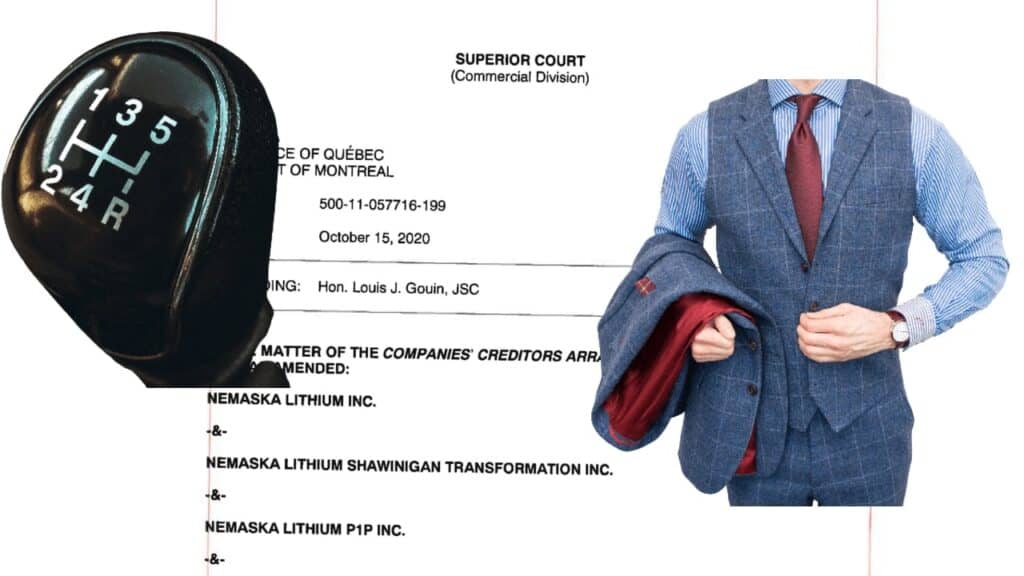
Legal challenges to the use of reverse vesting orders have been unsuccessful. I would like to discuss the case of Nemaska Lithium Inc.reverse vesting order

Reverse vesting order issued by Québec Superior Court after first contested hearing

In December 2019, Nemaska Lithium Inc. and related companies (Nemaska Lithium or the Nemaska entities) commenced CCAA proceedings. A lithium mining project was developed in Quebec by them. A CCAA judge approved an uncontested sale or investment solicitation process (SISP) in January 2020 that led to the acceptance of a bid that was subject to the condition that a reverse vesting order is issued.

A proposed reverse vesting order provides that Nemaska entities will be acquired by the bidder free of the claims of the unsecured creditors, which will be transferred as part of a pre-closing reorganization to a newly incorporated non-operating company.

The reverse vesting order will allow the purchaser to continue to operate the Nemaska entities in a highly regulated environment by maintaining their existing permits, licences, authorizations, essential contracts, and fiscal attributes. In essence, it is a credit bid in which the shares of the Nemaska entities are acquired in exchange for the assumption of the secured debt.

A shareholder (who was also an alleged creditor) filed motions opposing the reverse vesting order issuance on multiple grounds, including:

  • a vesting order cannot be granted for anything other than a sale or disposition of assets through a vesting order for sales of assets;
  • the reverse vesting order is not permissible under the CCAA because it allows the Nemaska entities to exit CCAA protection outside of a plan of arrangement or plan of compromise;
  • this reverse vesting order contemplated a corporate reorganization that is not permitted by securities laws; and
  • in light of the proposed transaction, the directors and officers of Nemaska Lithium Inc. should not be released.

The Honourable Justice Gouin, J.S.C., reviewed and assessed:

  • the SISP process which led to the offer;
  • the lack of alternatives to the offer;
  • the potential harm to Nemaska Lithium‘s stakeholders, including its employees, creditors, suppliers, and the Cree community;
  • stopping the restructuring process to relaunch a SISP in the future following what was already a thorough examination of the market or, alternatively,
  • bankrupting the Nemaska entities.

In light of all these factors, the judge approved the reverse vesting order on October 15, 2020. Limiting the remedies available under the CCAA would unnecessarily hinder the development of innovative solutions for more complex commercial and social issues in Canadian insolvency matters.

The decision and formal recognition of reverse vesting order by the Court of Appeal

Leave to appeal the CCAA judge‘s decision was sought by the parties who objected to the reverse vesting order being made. The Appellate Court carefully considered the judge’s decision-making process and particularly that the Québec Superior Court judge relied extensively on the principles set out by the Supreme Court of Canada in the matter of 9354-9186 Quebec inc. c. Callidus Capital Corp., namely the:

  • development of CCAA proceedings and the role of the CCAA supervising judge;
  • remedial objectives of Canadian insolvency laws to provide timely, efficient, and impartial resolution of a debtor’s insolvency, secure fair and equitable treatment of creditors’ claims against a debtor, protect the public interest, and balance the costs and benefits of restructuring or liquidating the debtor company’s assets;
  • CCAA‘s goal of preventing social and economic losses from liquidating insolvent companies by facilitating their reorganization and survival as a going concern; and
  • CCAA judge‘s broad discretion under s. 11 of the CCAA in an effort to advance the CCAA’s remedial objectives while taking into account three fundamental factors that the debtor company application must prove: (1) the requested order is appropriate in the circumstances, and (2) good faith on the part of the applicant, and (3) the applicant has been acting with due diligence.

It was determined by the Court of Appeal judge that the risk of potential harm to stakeholders outweighed any legal merits of any arguments raised by the opposing parties. Therefore, the Quebec Court of Appeal denied the leave to appeal the decision of the CCAA judge.

Canada’s Supreme Court has denied leave to appeal. Having now established reverse vesting as an option for CCAA restructurings, the law is now set in stone.

The Nemaska case is the first reverse vesting order transaction to withstand judicial scrutiny in Canada and reaffirms the flexibility of CCAA proceedings for distressed M&A transactions of distressed businesses.reverse vesting order

Reverse vesting order and distressed M&A opportunities

I hope that you found this reverse vesting order Brandon Blog interesting. Problems will arise when you or your company are in business distress, cash-starved and cannot repay debts. There are several insolvency processes available to a company or a person with too much debt.

If you are concerned because you or your business are dealing with substantial debt challenges, you need debt help and you assume bankruptcy is your only option, call me.

It is not your fault that you remain in this way. You have actually been only shown the old ways to try to deal with financial issues. These old ways do not work anymore.

The Ira Smith Team utilizes new modern-day ways to get you out of your debt difficulties with debt relief options as alternatives to bankruptcy. We can get you the relief you need and so deserve. Our professional advice will create for you a personalized debt-free plan for you or your company during our no-cost initial consultation.

The tension put upon you is big. We know your discomfort factors. We will check out your entire situation and design a new approach that is as unique as you and your problems; financial and emotional. We will take the weight off of your shoulders and blow away the dark cloud hanging over you. We will design a debt settlement strategy for you. We know that we can help you now.

We understand that people with credit cards maxed out and businesses facing financial issues need a realistic lifeline. There is no “one solution fits all” method with the Ira Smith Team. Not everyone has to file bankruptcy in Canada. The majority of our clients never do as we know the alternatives to bankruptcy. We help many people and companies stay clear of filing an assignment in bankruptcy.

That is why we can establish a new restructuring procedure for paying down debt that will be built just for you. It will be as one-of-a-kind as the economic issues and discomfort you are encountering. If any one of these seems familiar to you and you are serious about getting the solution you need to become debt-free, contact the Ira Smith Trustee & Receiver Inc. group today.

Call us now for a no-cost consultation.

We hope that you and your family are safe, healthy and secure during this COVID-19 pandemic.

Ira Smith Trustee & Receiver Inc. is absolutely operational and Ira, in addition to Brandon Smith, is readily available for a telephone consultation or video meeting.

Categories
Brandon Blog Post

WHERE IS LAURENTIAN UNIVERSITY WITH ITS HELPFUL CONCLUSIVE COMPENSATION CLA1MS PROCESS?

where is laurentian university

We hope that you and your family are safe, healthy and secure during this COVID-19 pandemic.

Ira Smith Trustee & Receiver Inc. is absolutely operational and Ira, in addition to Brandon Smith, is readily available for a telephone consultation or video meeting.

Where is Laurentian University in dealing with ‘An ugly stain for years to come’: Laurentian University students, staff reeling from cuts

As regular Brandon Blog readers know, I have been writing about the financial difficulties leading to the Laurentian University creditor protection filing under the Companies’ Creditors Arrangement Act (CCAA) as major events unfolded. The filing for bankruptcy protection was to allow for ongoing operations to continue and to come up with a Plan of Arrangement to deal with creditor claims.

The end of this week was scheduled to be another milestone in the Laurentian CCAA insolvency process, but it appears that event won’t happen on time. The purpose of this Brandon Blog is to discuss where is Laurentian University at with its compensation claim process for current and terminated faculty and staff?

Laurentian University situation so dire, it couldn’t afford to pay staff

This post-secondary institution faced a cash crisis and many financial issues leading to having filed its application for creditor protection on February 1, 2021. So far, I have written on:

Where is Laurentian University with the Amended and Restated Claims Process Order?

I previously wrote about the Laurentian University Amended and Restated Claims Process Order (A&R Claims Process Order) when it was obtained from the Court on May 31, 2021.

Among other things, the A&R Claims Process Order developed a claims process to recognize, identify and deal with certain claims of creditors. The A&R Claims Process Order left out Compensation Claims to allow Laurentian, with the help of the Monitor and in discussions with the Laurentian University Faculty Association (LUFA) and also Laurentian University Staff Union (LUSU), to establish a process as well as a method for the identification of Compensation Claims.

Compensation Claims usually consist of the claims of current and previous employees, retirees, and also the labour unions relative to employment, benefits, pension, and/or labour contracts among the stakeholders and Laurentian University, and also claims of specific third parties relative to involvement of their employees in the retirement health benefit plan.

In their application to Court last May, Laurentian University told the Court that they would be back to have the Compensation Claims process approved no later than July 30, 2021.

where is laurentian university

Where is Laurentian University with its creditor protection compensation claims program now?

Laurentian told the Court that its Compensation Claims process will:

  • develop the key groups of claims to be covered in a Compensation Claims
    procedure;
  • determine what info and also how the information needed to calculate such
    claims can be assembled based upon the information in the hands of Laurentian and third-party service providers;
  • develop the Compensation Claims Methodology; and
  • think about alternate procedures for notice as well as claims handling.

In its motion record dated July 23, 2021, Laurentian has advised the Court that although it is working diligently with the Monitor, LUFA and LUSA, Laurentian will not be able to serve materials explaining its Compensation Claims process in time to seek Court approval no later than July 30. So, Laurentian is asking for an extension from July 30 to August 20, 2021. In the motion record, it is not stated exactly where is Laurentian University in this process. Laurentian has advised that its lawyers have booked time with the Court to hear the motion on August 17, 2021, at 9:30 AM.

UPDATE: On July 28, 2021, the Court approved amending paragraph 46 of the Claims Process Order to extend the date that Laurentian University must bring a motion to the Court to seek approval of: (a) the Compensation Claims Methodology, and (b) the process for notification of Employees and claims process, from “no later than July 30, 2021” to “no later than August 20, 2021”.

Where is Laurentian University? Ask current President Dr. Robert Haché

In support of this motion for an extension of time, the motion material includes the affidavit of Dr. Robert Haché, University President and Vice-Chancellor of Laurentian University of Sudbury, sworn on July 23 (the Haché Affidavit).

The Haché Affidavit really doesn’t say much and unfortunately, it does not say exactly where is Laurentian University in the finalization of the Compensation Claims process. It summarizes the background about the bilingual university financial troubles as to how this post-secondary education institution got to where it is today in the Laurentian CCAA insolvency process and advises the Court that:

  • Laurentian and the Monitor have been working diligently on settling the Compensation Claims Methodology, nonetheless, as a result of a variety of competing and urgent demands put on the University’s limited resources, (which presumably includes the demands of day to day operations) development has actually been slower than expected.
  • Although the information-gathering phase took longer than anticipated, drafts of the Compensation Claims Methodology have been prepared and also shown to LUFA and LUSU.
  • Regardless of best efforts, Laurentian was not able to finalize the Compensation Claims process in order to have everything in time for the Compensation Claims Methodology to be provided for Court authorization by July 30, 2021, based on the A&R Claims Process Order.
  • Therefore, the University looks for a short extension to that date. This requires a change to paragraph 46 of the A&R Claims Process Order to prolong the day whereby Laurentian can bring a motion to the Court to seek the authorization for the Compensation Claims Methodology to no later than August 20, 2021.

The Haché Affidavit is light on details as to what the issues getting in the way are, what has been agreed to so far and where is Laurentian University in all this? Close or still far off? It provides no real useful information to determine where is Laurentian University on this issue. My review of documents that were made public sheds no more light than what I am telling you in this Brandon Blog. They are obviously hoping that this request will not meet with any opposition so that it will allow for a positive impact on the financial restructuring.

So, unfortunately, there is no real insight into what is holding up the Compensation Claims process for claims of current and former faculty and staff, including severance payments, which certainly will be in the millions of dollars.

I doubt that anyone will wish to try to upset the restructuring over this issue. As of the time of writing this Brandon Blog, there is not a current Monitor’s Report in support of this motion yet made public.

Where is Laurentian University in all of this? I suspect that Laurentian will receive the extension it is requesting.

where is laurentian university

Where is Laurentian University summary

I hope that you found this where is Laurentian University Brandon Blog interesting. Problems will arise when you are cash-starved and in debt. There are several insolvency processes available to a person or company with too much debt.

If you are concerned because you or your business are dealing with substantial debt challenges, you need debt help and you assume bankruptcy is your only option, call me.

It is not your fault that you remain in this way. You have actually been only shown the old ways to try to deal with financial issues. These old ways do not work anymore.

The Ira Smith Team utilizes new modern-day ways to get you out of your debt difficulties with debt relief options as alternatives to bankruptcy. We can get you the relief you need and so deserve. Our professional advice will create for you a personalized debt-free plan for you or your company during our no-cost initial consultation.

The tension put upon you is big. We know your discomfort factors. We will check out your entire situation and design a new approach that is as unique as you and your problems; financial and emotional. We will take the weight off of your shoulders and blow away the dark cloud hanging over you. We will design a debt settlement strategy for you. We know that we can help you now.

We understand that people with credit cards maxed out and businesses facing financial issues need a realistic lifeline. There is no “one solution fits all” method with the Ira Smith Team. Not everyone has to file bankruptcy in Canada. The majority of our clients never do as we know the alternatives to bankruptcy. We help many people and companies stay clear of filing an assignment in bankruptcy.

That is why we can establish a new restructuring procedure for paying down debt that will be built just for you. It will be as one-of-a-kind as the economic issues and discomfort you are encountering. If any one of these seems familiar to you and you are serious about getting the solution you need to become debt-free, contact the Ira Smith Trustee & Receiver Inc. group today.

Call us now for a no-cost consultation.

We hope that you and your family are safe, healthy and secure during this COVID-19 pandemic.

Ira Smith Trustee & Receiver Inc. is absolutely operational and Ira, in addition to Brandon Smith, is readily available for a telephone consultation or video meeting.

where is laurentian university
Categories
Brandon Blog Post

CUSHMAN WAKEFIELD TORONTO: COURT READILY APPOINTS FIRM TO REVIEW LAURENTIAN’S MASSIVE REAL ESTATE HOLDINGS

We hope that you and your family are safe, healthy and secure during this COVID-19 pandemic.

Ira Smith Trustee & Receiver Inc. is absolutely operational and Ira, in addition to Brandon Smith, is readily available for a telephone consultation or video meeting.

Sudbury, Ont., school looks for court approval to move on to Phase 2 of restructuring plan


On June 29, 2021, the Laurentian University CCAA Court-appointed Monitor issued its Fifth Report to Court in the Laurentian University insolvency restructuring under the Companies’ Creditors Arrangement Act (Canada) (CCAA). On July 5, 2021, it filed its Supplementary Fifth Report with the Ontario Court.

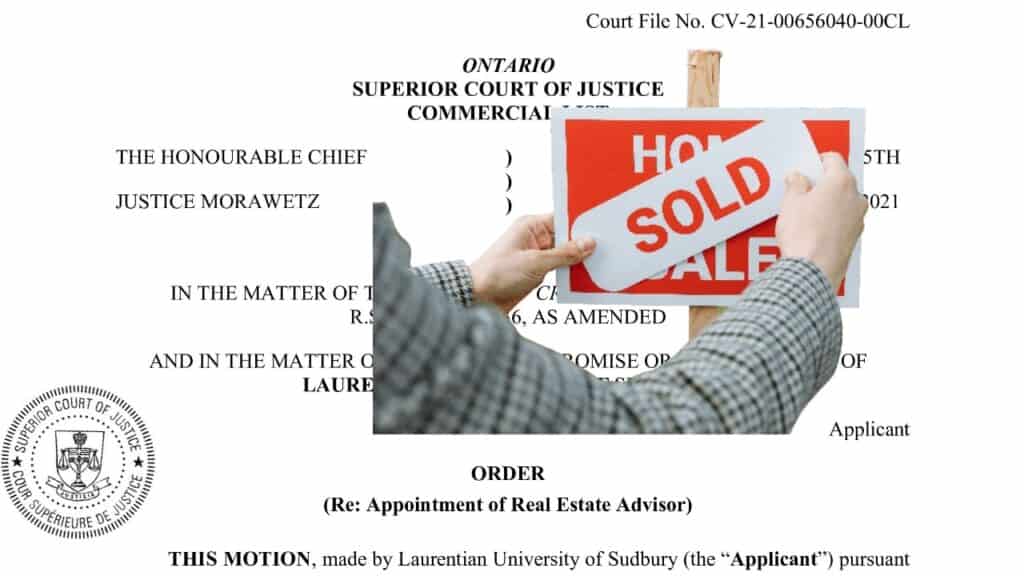
The report was issued in support of Laurentian’s application to the court for approval to retain a Toronto office of Cushman & Wakefield (Cushman Wakefield Toronto) as Real Estate Advisor to Laurentian. The Supplementary Fifth Report was filed at the direction of the Ontario Court (further described below).

I have previously written about Laurentian University’s court-supervised restructuring in 5 previous Brandon Blogs:

The first phase of the Laurentian insolvency process had many parts to it. First was to declare its poor financial situation and file for bankruptcy protection under the CCAA and perform a review of its various contracts, leases, supplier arrangements, the federated university model, its academic offerings and its faculty and non-teaching staffing. As part of this first phase, Laurentian also needed to determine where cuts needed to be made.

Laurentian then implemented the reductions for cost savings including reaching new arrangements with the unions representing its employees to set out the terms of new collective bargaining agreements and to disclaim various agreements, including the federated university agreement with Huntington University, Thorneloe University and the University of Sudbury.

My February 8 and May 5 Brandon Blogs describe these steps in detail.

Next in this phase 1 was getting approval from the Ontario Court to retain a consultant to, amongst other things, perform a governance review and for the Monitor to get approval for the claims process the Monitor approves of. At this stage of the process, Laurentian pulled together a list of creditors; secured creditors and unsecured creditors.

This was all described in my June 14 Brandon Blog, including the changes to the claims process resulting from the hearing in the Ontario Court. The Monitor advised the court that the Monitor approves of the amendment and therefore the amended claims process received court approval.

In this Brandon Blog, I describe the second phase of this insolvency process and the Laurentian restructuring plan now being undertaken. It is the real estate review.

cushman wakefield toronto

Cushman Wakefield Toronto: Laurentian University plans real estate review to see what could help pay off debt

On July 5, 2021, the Court listened to Laurentian University’s application for an order approving Laurentian to retain Cushman Wakefield Toronto as a realty advisor to do an evaluation of Laurentian’s real estate portfolio, and also its request for a sealing order with respect to the monetary details of the Cushman Wakefield Toronto retainer.

The Monitor advised the court that a significant amount of Laurentian University’s assets is represented by its real estate holdings. This includes the land and buildings on which the primary campus rests in addition to off-campus realty. The Monitor also advised that Laurentian has noted that with the academic and labour force changes lately executed within the CCAA proceedings, there may be opportunities to customize its use of space within different structures. This leads to possibilities to monetize specific real estate assets. Therefore, Laurentian determined, that it was appropriate to involve a real estate consultant to take on a study of its real estate portfolio in order to advise Laurentian on the best way to monetize its available real estate.

The Monitor described its RFP process that had a deadline of May 28 for the submission of proposals from qualified real estate professionals. After the Monitor, Laurentian and its respective legal counsel received certain requests for additional time in order to submit a proposal, the Monitor extended the deadline for submissions to June 1, 2021. The Monitor advised the Ontario Superior Court of Justice Commercial List that it received 6 proposals and held meetings with 4 of the parties who submitted a proposal in order to interview each of them.

The Monitor recommended to the court that the proposed contract between Laurentian and Cushman Wakefield Toronto (including the third parties Cushman Wakefiled Toronto advised would be part of its team) be approved. The Monitor also advised the Court that Laurentian would be seeking a sealing order from the Ontario Superior Court of Justice Commerical List concerning the financial terms of the Cushman Wakefield Toronto retainer. Accordingly, a copy of the Cushman Wakefield Toronto proposal excluding any financial terms.

What the court said about the Sudbury school plans a real estate review in Phase 2 of its court-guided restructuring process

Chief Justice Morawetz took issue with the part of the motion that requested the financial terms of the Cushman Wakefield Toronto proposal to continue to be confidential under a sealing order. He directed that the total amount of the retainer be disclosed. Proprietary information such as how Cushman Wakefield Toronto calculated its total fee could remain private.

After evaluating the Confidential Appendix, Chief Justice Morawetz shared his view that specific aspects of the appendix did not contain commercially sensitive or proprietary details. Upon obtaining further instructions, Laurentian legal counsel advised the court that certain portions of the appendix could develop part of the general public record. Therefore the information covered by the sealing order was tightened up.

The sole purpose of the Monitor’s Supplementary 5th Report to Court dated July 5, 2021, was to abide by the Court’s decision that a redacted copy of the financial terms of the Cushman Wakefield Toronto retainer must be filed with the Ontario Superior Court of Justice Commercial List so that it will become a public document.

cushman wakefield toronto

Laurentian University owns some of the last undeveloped waterfront on Sudbury’s Lake Nepahwin

So phase 2 of the Laurentian University creditor protection CCAA process is now underway. Laurentian has real estate both on and off-campus that will be reviewed for monetization by Cushman Wakefield Toronto. The monetization will provide the necessary funds to offer to both secured creditors and unsecured creditors in the ultimate financial restructuring plan called a Plan of Arrangement.

Laurentian has some of the last undeveloped waterfront on Lake Nepahwin. Much of that land is bushland, including some prime beachfront property on Lake Nepahwin, where the university has its own beach.

Here is a fun fact about some Laurentian real estate. In recent years, the only public discussion concerning Laurentian’s lands has actually centred on a couple who purchased a residence in the area, just to find out half their backyard, including their septic tank, was encroaching on university property!

The Sudbury couple stated they made offers to Laurentian to purchase the land from them. The latest offer was for them to pay Laurentian $70,000 plus give the university a bigger land parcel in return for the Laurentian land to eliminate the encroachment. Laurentian refused and started a lawsuit against them.

Perhaps as part of the overall financial restructuring, Laurentian can see fit not to continue this war against the Sudbury couple and accept their offer. You would think the Board of Governors has much bigger issues to be concerned about, such as the entire CCAA restructuring including the monetization of the real estate portfolio.

Cushman Wakefield Toronto summary

I hope that you found this Cushman Wakefield Toronto Brandon Blog interesting. Problems will arise when you are cash-starved and in debt. You may have assets that you can monetize to rectify your financial situation. Many do not though.

If you are concerned because you or your business are dealing with substantial debt challenges, whether you need gambling debt help or just plain old debt help and you assume bankruptcy is your only option, call me.

It is not your fault that you remain in this way. You have actually been only shown the old ways to try to deal with financial issues. These old ways do not work anymore.

The Ira Smith Team utilizes new modern-day ways to get you out of your debt difficulties with debt relief options as alternatives to bankruptcy. We can get you the relief you need and so deserve. Our professional advice will create for you a personalized debt-free plan for you or your company during our no-cost initial consultation.

The tension put upon you is big. We know your discomfort factors. We will check out your entire situation and design a new approach that is as unique as you and your problems; financial and emotional. We will take the weight off of your shoulders and blow away the dark cloud hanging over you. We will design a debt settlement strategy for you. We know that we can help you now.

We understand that people and businesses facing financial issues need a realistic lifeline. There is no “one solution fits all” method with the Ira Smith Team. Not everyone has to file bankruptcy in Canada. The majority of our clients never do as we know the alternatives to bankruptcy. We help many people and companies stay clear of filing an assignment in bankruptcy.

That is why we can establish a new restructuring procedure for paying down debt that will be built just for you. It will be as one-of-a-kind as the economic issues and discomfort you are encountering. If any one of these seems familiar to you and you are serious about getting the solution you need to become debt-free, contact the Ira Smith Trustee & Receiver Inc. group today.

Call us now for a no-cost bankruptcy consultation.

We hope that you and your family are safe, healthy and secure during this COVID-19 pandemic.

Ira Smith Trustee & Receiver Inc. is absolutely operational and Ira, in addition to Brandon Smith, is readily available for a telephone consultation or video meeting.
cushman wakefield toronto
Categories
Brandon Blog Post

LAURENTIAN UNIVERSITY OF SUDBURY: LAURENTIAN SCORES HUGE WIN OVER THORNELOE UNIVERSITY

laurentian university of sudbury

We hope that you and your family are safe, healthy and secure during this COVID-19 pandemic.

Ira Smith Trustee & Receiver Inc. is absolutely operational and Ira, in addition to Brandon Smith, is readily available for a telephone consultation or video meeting.

If you would prefer to listen to the audio version of this Brandon Blog, please scroll to the very bottom and click play on the podcast.

Laurentian University of Sudbury: This will forever be a stain on Laurentian University

The Laurentian University of Sudbury is a public-funded, northern Ontario multilingual and tricultural independent university, serving both Canadian and global students for both undergraduate programs & graduate programs.

However, Laurentian University of Sudbury has its financial problems. It was in need of a restructuring plan. On February 1, 2021, it applied to the Court and obtained protection under the Companies’ Creditors Arrangement Act, R.S.C. 1985, c. C-36 (” CCAA”), to permit it to restructure, financially as well as operationally, in order to emerge as a sustainable university for the advantage of all stakeholders.

When it sought CCAA protection, Laurentian University of Sudbury, with the assistance of the Monitor, identified a number of issues in which an economic restructuring was required. These consisted of a downsizing of the variety of programs being taught, as well as new, sustainable collective bargaining agreements with the labour unions representing Laurentian professors and other staff.

To date I have written 4 blogs on the Laurentian University of Sudbury CCAA proceedings:

In this Brandon Blog, I discuss the recent decision of the Court of Appeal for Ontario released on June 23, 2021, concerning the request of Thorneloe University to appeal a decision of the CCAA judge.

laurentian university of sudbury

Laurentian University of Sudbury and the Federated Universities

The Laurentian University of Sudbury additionally recognized, at the beginning of its CCAA proceeding, that it would be essential in dealing with its financial insolvency, to have a fundamental readjustment or realignment of its setups with the 3 Federated Schools: Thorneloe University (sometimes referred to as “Thorneloe“), Huntington University (“Huntington”) and also University of Sudbury (“USudbury”) (collectively referred to as the “Laurentian Federation”).

A court-ordered mediation facilitated the Laurentian University of Sudbury reaching agreements with the unions on the collective bargaining agreements. Nevertheless, the Laurentian University of Sudbury was not successful in reaching what is considered to be the needed readjustments with the Federated Universities on the 60-year-old federation agreement.

On April 1, 2021, Laurentian sent out notices of disclaimer to the Federated Universities. The Monitor concurred with the notifications under the CCAA insolvency process. Thorneloe University College brought an action opposing Laurentian University’s disclaimer notification. (USudbury brought a comparable motion, which was heard by a different judge). Huntington University did not bring such action as they reached an accommodation with the Laurentian University of Sudbury.

The CCAA judge dismissed Thorneloe’s action. Thorneloe University College sought leave of the Court of Appeal for Ontario to appeal the Judge’s decision. At the heart of its opposition is its opinion that permitting the disclaimer will certainly result in Thorneloe’s insolvency and also yet supply only de minimis monetary benefit to Laurentian. Thorneloe further submitted that the real intention for the disclaimer is the elimination of competitors, which is inconsistent with the responsibility to act in good faith.

Thorneloe likewise looked to present new evidence in connection with the Laurentian Federation, consisting of testimony from Thorneloe’s President. There was no resistance from the parties to the introduction of new evidence. The Court of Appeal for Ontario allowed the new evidence.

The Thorneloe appeal

Thorneloe applied for an order that the Laurentian Federation Arrangement, and also the Financial Distribution Notice between Laurentian and Thorneloe, not be disclaimed. The Court of Appeal noted that the CCAA judge noted that the provision of the CCAA under which the Laurentian University of Sudbury issued its disclaimer notices calls for a harmonizing of interests.

The CCAA judge said there are competing interests that must be balanced in determining if the disclaimers should be allowed. After taking part in that analysis, he concluded that the much better choice, or, to say it another way, the least unfavourable selection, was to uphold the notices of disclaimer.

In addressing whether leave should be provided, the Court of Appeal for Ontario will think about 4 aspects, specifically whether:

  • the requested appeal is prima facie meritorious or not;
  • the factors on the suggested appeal are of significance to the insolvency community;
  • the factors on the proposed appeal are important to the action, being the CCAA restructuring; and also
  • whether the appeal will unduly impede the progression of the restructuring.

    laurentian university of sudbury
    laurentian university of sudbury

Laurentian University of Sudbury: The prima facie test

Thorneloe puts five questions to the court for answers in their submission that leave ought to be given:

  • Can the CCAA, a law whose objective is to stop bankruptcies, be made use of by a debtor to remove competitors as well as create the bankruptcy of a currently solvent entity (in this case, one more university)?
  • Must s.32 of the CCAA be interpreted so generally that it enables the disclaimer of an arrangement that will certainly lead to the bankruptcy of the counter-party, for removing competition, and where the potential financial gain to the debtor is both unsure and also of no consequence?
  • What inferences need to be made by the CCAA Court where a DIP loan lender demands the disclaimer of a contract that will certainly cause the bankruptcy of the counter-party or else it will refuse to advance further funds, yet the DIP lending institution refuses to explain why it demands the disclaimer?
  • What is the duty of the CCAA Court when faced with a requirement for the disclaimer of a contract which the debtor admits is motivated to eliminate competitors, and after that threatens that if the CCAA Court does not support the disclaimer, the debtor may not be able to restructure?
  • What are the aspects appropriate for persons to act in good faith under s.18.6 of the CCAA, and also specifically where the Laurentian University of Sudbury and/or the DIP lender looks to close down Thorneloe for the confessed objective of eliminating Thorneloe as a competitor?

The Court of Appeal for Ontario was not satisfied that the suggested appeal, challenging the CCAA judge’s discretionary decision to accept the disclaimer and to decline to erase the related term in the DIP Amendment Agreement, is prima facie meritorious. Within that verdict, the appellate court was cognizant that valid findings of fact are owed considerable deference as are discretionary decisions, as long as there is not an extricable error in interpreting the law. So the Court of Appeal of Ontario stated that Thorneloe did not meet the leave test.

Laurentian University of Sudbury: Significance to the practice

In a very tersely worded statement, the Court of Appeal for Ontario said that they do not feel that the proposed appeal is significant to the insolvency community as the concerns raised turn on the application of the legislation to this particular case only.

Laurentian University of Sudbury: Significance to the action

The Court of Appeal for Ontario stated the suggested appeal does have significance. However, the court said that the significance still does not justify leave be provided.

Laurentian University of Sudbury: Appeal would hinder progress of the action

The appeal court said there is a danger that an appeal would be a distraction from the
real-time restructuring initiatives and also would unduly hinder the progress of the CCAA case.

So the Court of Appeal for Ontario has decided that Thorneloe should not be given the right to appeal the notice of disclaimer as decided by the CCAA judge. This seems to end this part of the CCAA restructuring. If Thorneloe’s submissions to the courts about its own solvency are correct, we should soon see the bankruptcy of Thorneloe University.

laurentian university of sudbury

Laurentian University of Sudbury summary

I hope that you found this Laurentian University of Sudbury Brandon Blog interesting. Among the countless problems that can arise when a significant customer stops doing business with you, your business cash flow takes a massive hit.

If you are concerned because you or your business are dealing with substantial debt challenges, whether you need gambling debt help or just plain old debt help and you assume bankruptcy is your only option, call me.

It is not your fault that you remain in this way. You have actually been only shown the old ways to try to deal with financial issues. These old ways do not work anymore.

The Ira Smith Team utilizes new modern-day ways to get you out of your debt difficulties with debt relief options as alternatives to bankruptcy. We can get you the relief you need and so deserve. Our professional advice will create for you a personalized debt-free plan for you or your company during our no-cost initial consultation.

The tension put upon you is big. We know your discomfort factors. We will check out your entire situation and design a new approach that is as unique as you and your problems; financial and emotional. We will take the weight off of your shoulders and blow away the dark cloud hanging over you. We will design a debt settlement strategy for you. We know that we can help you now.

We understand that people and businesses facing financial issues need a realistic lifeline. There is no “one solution fits all” method with the Ira Smith Team. Not everyone has to file bankruptcy in Canada. The majority of our clients never do as we know the alternatives to bankruptcy. We help many people and companies stay clear of filing an assignment in bankruptcy.

That is why we can establish a new restructuring procedure for paying down debt that will be built just for you. It will be as one-of-a-kind as the economic issues and discomfort you are encountering. If any one of these seems familiar to you and you are serious about getting the solution you need to become debt-free, contact the Ira Smith Trustee & Receiver Inc. group today.

Call us now for a no-cost bankruptcy consultation.

We hope that you and your family are safe, healthy and secure during this COVID-19 pandemic.

Ira Smith Trustee & Receiver Inc. is absolutely operational and Ira, in addition to Brandon Smith, is readily available for a telephone consultation or video meeting.

Categories
Brandon Blog Post

LAURENTIAN UNIVERSITY IN SUDBURY: THE LAURENTIAN FEDERATED UNIVERSITIES SUFFERED A CRUSHING DEFEAT

laurentian university in sudburylaurentian university in sudbury

We hope that you and your family are safe, healthy and secure during this COVID-19 pandemic. Ira Smith Trustee & Receiver Inc. is absolutely operational and Ira, in addition to Brandon Smith, is readily available for a telephone consultation or video meeting.

If you would prefer to listen to the audio version of this Brandon Blog, please scroll to the very bottom and click play on the podcast

Laurentian University in Sudbury introduction

As widely reported, Laurentian University in Sudbury had federation agreements with the University of Sudbury, Thorneloe University and Huntington University (also known as the Federated Schools or federated universities). These three northern Ontario institutions are each an independent university offering university credits through certain courses that Laurentian University students took.

The reason for the federation agreements, which also had a companion Grant Distribution and Services agreement, is because these three colleges did not have full provincial status to register students, handle the admission to programs, confer degrees or receive provincial funding. Everyone benefitted from the arrangement.

The colleges were able to offer courses (in addition to a few specific courses unique to each respective college) and Laurentian, in turn, shared $7.7 million in funding. Canada Laurentian University made the calculation that it may not need all of the courses they administer on behalf of the 3 colleges. Rather, they can gain a full $7.7 million in funding, rather than just their administrative charge for doing the processing of the academic courses and degrees.

As readers of Brandon Blog know, I have been following the northern Ontario Laurentian University in Sudbury, Ontario financial difficulty insolvency restructuring saga. To date I have written 2 blogs on it:

In my 2 previous Brandon Blogs, I told you about Laurentian University’s academic program cuts comprising 38 English-language undergraduate and 27 French-language undergraduate program closures, in addition to 11 graduate program cuts (4 in French; 7 in English). These undergraduate program and graduate program cuts, dozens of program cuts, have caused job losses amongst the 116 full-time professors and 1 counsellor placement ending up being redundant. It has also obviously affected both undergraduate students and graduate students alike.

In this Brandon Blog, I talk about the Ontario Superior Court of Justice ruling in favour of Laurentian University in Sudbury in its effort to terminate all of its federated agreements.

laurentian university in sudbury

Laurentian University in Sudbury: Losing academic programs will ‘hurt,’ prof says

The Laurentian University in Sudbury Board of Governors approved the issuance of issued Notices of Disclaimer of Laurentian University in Sudbury to terminate the university’s current agreement with the other Laurentian affiliates, Huntington University and Thorneloe University College, as well as the University of Sudbury (the Federated Universities). The decision was made amidst growing concern from students at all three universities. The Notices of Disclaimer were issued on April 1, 2021 (no joke!).

This news made waves in the Canadian higher education community. Laurentian University in Sudbury decided to terminate its agreement with the Federated Universities effective at the expiry of the notices. Laurentian University cited, in a press release, “concerns relating to low retention and graduation rates.” One grad student described it as “An ugly stain for years to come“.

Huntington University ended up settling with Laurentian University. Perhaps capitulating is a better word. On the other hand, Thorneloe University and the University of Sudbury each brought a motion before the court under section 32(2) of the Companies’ Creditors Arrangement Act (CCAA) for an order that their Federated Universities agreements not be terminated. They did so within the 15 day period they had to oppose the Disclaimers under the CCAA. Their motions were heard on the last two days of April. These motions were heard separately by two different Judges.

laurentian university in sudbury

Sudbury’s Laurentian, Huntington universities reach a separation agreement, but Thorneloe and the University of Sudbury fought on

The Thorneloe University College and the University of Sudbury did not want to just capitulate. Huntington reached an agreement with Laurentian University regarding just how to terminate its collaboration. Both Thornloe and the University of Sudbury proceeded with their motions to set aside the Disclaimers. Thornloe’s motion was heard on April 29, 2021, by Chief Justice Morawetz.

Justice Gilmore listened to the University of Sudbury‘s motion on April 30, 2021. The Laurentian University stay of proceedings was expanded briefly up until May 2, 2021. On that date, the Justices released short endorsements dismissing both motions and the CCAA proceedings were extended until August 31, 2021. On May 7, both Justices released their detailed reasons.

The factors that the court needed to consider were:

In choosing whether to make the order opposing the Disclaimers, the court needs to consider whether the:

  • monitor approved the proposed Disclaimers;
  • Disclaimers would boost the prospects of a viable Plan of Arrangement being made for Laurentian; and also
  • Disclaimers would likely cause considerable financial difficulty to a party to the agreement.

The arguments against the Disclaimers in each of the northern Ontario Thorneloe and the University of Sudbury motions were essentially the same. They were:

  • Thorneloe and Huntington did not create Laurentian’s economic problems.
  • The Disclaimer will result in a significant financial challenge for Thorneloe and as a result, Thorneloe will need to make an insolvency filing either under the CCAA or the Bankruptcy and Insolvency Act (Canada).
  • Thorneloe and Huntington are immaterial to Laurentian’s financial scenario. Therefore the Disclaimer would not cause a material improvement for the chances of a successful Plan of Arrangement and a restructuring of Laurentian’s finances.
  • The partnership between Laurentian and the two northern Ontario colleges is not a business relationship to which the provisions of the CCAA were meant to apply.
  • Laurentian is acting in bad faith against the provisions of s. 18.6 of the CCAA.
  • The debtor-in-possession lender (DIP lender) has no reason to make it a condition of increased financing that the Federation Agreements must be terminated.

    laurentian university in sudbury
    laurentian university in sudbury

The court decision about the Laurentian University in Sudbury Disclaimers for Thorneloe University and University of Sudbury

In both cases, everyone had their legal counsel and Thorneloe retained a financial advisor also. Thorneloe‘s financial advisor prepared a report for the court to attempt to counter the submissions of both Laurentian University and the CCAA Monitor.

The Judges each weighed all the evidence very carefully and both concluded that the:

  • Monitor authorized the Disclaimer Notices.
  • Disclaimers will improve the prospects of a successful Plan of Arrangement for Laurentian.
  • Notices of Disclaimer will have negative economic consequences to Thorneloe and the University of Sudbury, yet this is not enough of a factor to prohibit the Notices of Disclaimer.
    University of Sudbury and Thorneloe was provided a choice, similar to Huntington, which was not accepted.
  • Court has a choice to make and neither choice is a good one. It is required to consider
    the more comprehensive implication of refusing the Notices of Disclaimer which would result in the demise of Laurentian.

The choice is if the motions succeed so the Disclaimers are not effective, it might cause an unravelling of Laurentian’s restructuring strategy and also the collapse of Laurentian. This in turn would certainly have a substantial impact on all professors, students and parts of the northern Ontario region and the entire Sudbury community. It would likewise create financial harm to Thorneloe and the University of Sudbury. Certainly, this is not a desirable outcome.

If the Notices of Disclaimer are supported, the court acknowledged that this very well may threaten the survival of the colleges. The court was sympathetic to this but stated that the impact on the colleges will be considerably less than if Laurentian and the colleges both stop operating. Given these two undesirable choices, the much better choice or the least unwanted selection is to support the Notices of Disclaimer.

Therefore, the motions brought by Thorneloe and the University of Sudbury to revoke the Notices of Disclaimer were dismissed. The Judges reject appeals from federated universities. Thorneloe stated it would appeal the decision of the court. As previously stated, Huntington has already struck a brand-new plan with Laurentian. The University of Sudbury is considering what it ought to do next.

laurentian university in sudbury

Laurentian University in Sudbury summary

I hope you enjoyed the Laurentian University in Sudbury Brandon Blog post. According to the Monitor’s reporting to the court, on April 30, 2021, Laurentian owes millions of dollars; $321.8 million to be precise.

Are you worried because you just lost your job through no fault of your own? Is your business dealing with substantial debt challenges and financial problems due to your largest customer failing to perform and pay your company? Do you assume bankruptcy is your only option? Call me. It is not your fault that you remain in this way. You have actually been only shown the old ways to try to deal with financial issues. These old ways do not work anymore.

The Ira Smith Team utilizes new modern-day ways to get you out of your debt difficulties while avoiding bankruptcy. We can get you the relief you need and so deserve.

The tension put upon you is big. We know your discomfort factors. We will check out your entire situation and design a new approach that is as unique as you and your problems; financial and emotional. We will take the weight off of your shoulders and blow away the dark cloud hanging over you. We will design a debt settlement strategy for you. We know that we can help you now.

We understand that people and businesses facing financial issues need a realistic lifeline. There is no “one solution fits all” method with the Ira Smith Team. Not everyone has to file bankruptcy in Canada. The majority of our clients never do. We help many people and companies stay clear of bankruptcy.

That is why we can establish a new restructuring procedure for paying down debt that will be built just for you. It will be as one-of-a-kind as the economic issues and discomfort you are encountering. If any one of these seems familiar to you and you are serious about getting the solution you need, contact the Ira Smith Trustee & Receiver Inc. group today.

Call us now for a no-cost consultation.

We will get you or your business back up driving to healthy and balanced trouble-free operations and get rid of the discomfort factors in your life, Starting Over, Starting Now.

laurentian university in sudbury

We hope that you and your family are safe, healthy and secure during this COVID-19 pandemic. Ira Smith Trustee & Receiver Inc. is absolutely operational and Ira, in addition to Brandon Smith, is readily available for a telephone consultation or video meeting.

Categories
Brandon Blog Post

LAURENTIAN UNIVERSITY INSOLVENCY RESTRUCTURING – OUR UPDATED GUIDE ON ITS MASSIVE CUTS TO GAIN FINANCIAL HEALTH

We hope that you and your family are safe, healthy and secure during this COVID-19 pandemic. Ira Smith Trustee & Receiver Inc. is absolutely operational and Ira, in addition to Brandon Smith, is readily available for a telephone consultation or video meeting.

laurentian university insolvency

Laurentian University insolvency: Laurentian students, faculty ‘shocked’ at university’s declaration of insolvency

On February 8, 2021, I wrote my blog about the Laurentian University insolvency filing for creditor protection under the Companies’ Creditors Arrangement Act (Canada) (CCAA) on February 1, 2021. It was the very first time in Canada that a public university took such creditor protection action. That blog is titled: Laurentian University Facing Insolvency Makes Startling CCAA News By Filing For Creditor Protection.

Post-secondary education can be a hard path for lots of young Canadians. The road can be filled with challenging experiences. Nevertheless, students never thought that having their college or university teeter on the edge of bankruptcy while they’re still going there would be a reality they would need to face! “It was a surprise,” declares one third-year Laurentian University student, resembling the views of her peers.

The students found out about the Laurentian University insolvency when they logged into their student portal. That is when they found out that the school has declared itself insolvent. The University President and Vice-Chancellor stated in the CCAA proceedings that the university’s dire financial situation financial issues were first determined as early as 2008-09 when a prior administration.

The students who were accepted to the school on the understanding that the school would continue operating and that their field of study would not be in danger surely feel betrayed by this. What a stressful time for them.

Everyone was pretty shocked when we found out that the Laurentian University insolvency CCAA filing happened. Nobody had really focussed before on the fact that public institutions like Laurentian would become insolvent and then be eligible for a CCAA process.

What went wrong in this Sudbury, Ontario-based university? In this Brandon Blog, I’m going to give you an update to my February 8, 2021, Brandon Blog and what has gone on since then in this Laurentian University insolvency process.

Laurentian University insolvency: Is Laurentian University closing?

No. The purpose of the CCAA filing is to allow Laurentian University to restructure so that hopefully it will remain open for a long time to come. Laurentian has continued operating. Courses are continuing (virtually because of the COVID-19 pandemic).

Laurentian opened up discussions with its different stakeholders, including its students, faculty, other staff, trade suppliers, research-granting agencies and donors immediately after the issuance of the court order approving the Laurentian University insolvency filing.

Laurentian has to negotiate functional modifications in order to drive go-forward financial savings. Consequently, these conversations have included settlement negotiations between Laurentian and the:

  • Committee of representatives chosen by the Senate, to deal with the course offering to restructure.
  • Federated Universities;
  • Laurentian University Faculty Association, the bargaining unit representing the professors; and
  • Laurentian University Staff Union, the bargaining unit for non-faculty personnel.

    laurentian university insolvency
    laurentian university insolvency

Upon the initial CCAA filing, the Laurentian University insolvency application included a request for a sealing order to keep away from public viewing two Exhibits. Laurentian’s position was that stakeholders should not be able to see those documents as it would weaken and perhaps totally frustrate Laurentian’s ability to restructure. The court granted the sealing order.

On March 4, 2021, the Ontario Confederation of University Associations, the faculty union and the Canadian Union of Public Employees served notices looking for leave to appeal the sealing order from the Court of Appeal for Ontario. On March 31, 2021, the Court of Appeal for Ontario issued its decision dismissing the motion for leave to appeal.

Laurentian University cuts 100 professors, dozens of programs

Laurentian University told the court that it had many programs relative to its number of pupils. Since the day of the CCAA declaration, Laurentian had roughly 209 different programs – 166 undergraduate programs as well as 43 programs for graduate students. Laurentian additionally advised that a lot of programs have continually reducing enrolment and are not financially sustainable.

The university undertook an evaluation of low-enrollment programs and a review of the variety of courses to be provided moving forward. This procedure led to a full review of programs as well as potential program closures. The results of this analysis led to recommendations for academic program restructuring. The recommendations were accepted by the Senate Sub-Committee charged with completing this review and also the complete Senate.

The program closures consist of 38 English-language undergraduate programs and 27 French-language undergraduate programs. This represents 39% of the undergraduate programs offered as of February 1, 2021. This will affect about 772 undergraduate students (557 in English language programs and 215 in French-language programs). In addition, Laurentian proposes to close 11 graduate programs (4 in French; 7 in English).

If programs are being cut, then it stands to reason that teaching costs and other staff costs also need to be reduced. At the commencement of the CCAA proceedings, approximately 612 employees were represented by LUFA including 355 full-time faculty, many of whom had tenure pursuant to the collective agreement, 252 sessional faculty or health care professionals and 5 full-time counsellors.

The faculty and the Laurentian Board are parties to a collective agreement with a three-year term which expired on June 30, 2020. Pursuant to the provisions of the agreement, it automatically continues year-to-year unless notice is provided that either the union or university intends to terminate or amend it. In February 2020, the union provided the Laurentian Board with a notice to bargain. The agreement automatically remains in force during any period of negotiation.

On April 7, 2021, after participating in insolvency negotiations and mediation, the parties entered into a new labour agreement term sheet. Since academic programs were cut, faculty cuts had to follow. The term sheet calls for a new collective agreement with a five-year term expiring on June 30, 2025. It declares 116 full-time faculty positions and 1 counsellor position redundant.

The faculty downsizing will be achieved through voluntary resignations and termination of employment. Faculty to be terminated, who is currently teaching, will be terminated effective May 15, 2021. Those faculty who were not teaching in the current term were terminated effective April 30, 2021. There are also some other salary decreases across the board and benefits reductions for continuing faculty.

As far as other unionized staff (non-faculty), there will be 42 job losses. For the remaining non-teaching staff, there will be certain salary and benefits adjustments. For non-union staff, there is some salary rollback and loss of certain benefits.

laurentian university insolvency

Laurentian University insolvency: Court ruling allows Laurentian University to reduce value of pension plan payouts

The institution oversees three pension and benefit plans: (a) a registered defined benefit pension plan (DBP); (b) a supplementary unfunded retirement plan (SURP) and (c) a retirement health benefits plan (RHBP). The SURP, as well as RHBP, are currently unfunded. Repayments pursuant to the SURP and RHBP have remained stayed, in conformity with the terms of the CCAA Order.

The DBP is a plan registered with the Financial Services Regulatory Authority of Ontario under the Ontario Pension Benefits Act as well as the Income Tax Act (Canada). The DBP has a going-concern pension deficit of roughly $4.5 million. The University needs to deal with the going-concern shortage. Under provincial government regulations, it needs to do so within a 10-year duration.

Terminated personnel that are DBP members, need to think about whether they want to move their pension plan entitlement to a different trustee due to the fact that they are not qualified to receive their pension payments yet. Alternatively, they could maintain their pension with Laurentian University as trustees. For retiring or terminated staff, depending on their situation, they must elect either an immediate pension plan payment or a deferred pension.

On March 17, 2021, the court made an order specifying, amongst other things, that for any kind of DBP participant that wanted to transfer their pension plan, a transfer proportion of 65.8% will be used for any commuted value transfer request for anyone that received a retirement or termination statement and an election form, for whom such transfers had not yet been made.

Therefore, anyone making such an election lost 34.2% of what they believed their pension entitlement was going to be. Various other amendments to the DBP are also proposed to take place in the Laurentian University insolvency matter. As you can imagine, the further amendments are aimed at creating long-term solvency for the DBP. Therefore, it involves certain reductions to what the remaining members thought they bargained and signed up for!

As part of the restructuring, the Laurentian University insolvency process also proposes that the RHBP will be terminated. Any claims against the SERP will be dealt with in the CCAA proceedings.

The SURP was implemented on July 1, 2002, to supply additional retirement benefits to Laurentian staff members who were in the DBP, to get additional benefits for those earning income over a certain limit. Retiring employees that qualified for the SURP were automatically enrolled. They received either a yearly or monthly payment from the SURP. All of the SURP commitments are unfunded. Historically, the university made annual payments in respect of the SURP from existing operating funds every July.

The insolvency negotiations and mediation have led to the Laurentian University insolvency process recommending that the SURPs be terminated. Accumulated obligations will be managed in the Laurentian University insolvency CCAA Plan of Arrangement. All SURP payments stopped on February 1, 2021, as a result of the CCAA stay of proceedings.

By March 17, 2021, all the changes I have talked about so far were approved by the court.

Judges reject appeals from federated universities, Laurentian insolvency plan can proceed

Laurentian has a federated school structure whereby it has formal affiliations with the Federated Universities: the University of Sudbury, Huntington University and Thorneloe University. Laurentian has a federated institution framework whereby it has official affiliations with the Federated Universities: the University of Sudbury, Huntington University as well as Thorneloe University.

The University of Sudbury is a Roman Catholic multilingual university offering programs in Culture and Communication Studies, Indigenous Studies, Philosophy as well as Religious Studies consisting of courses in both English and French. It was founded in 1913 as Collège du Sacré-Coeur before changing its name to the University of Sudbury in 1957.

Huntington is an independent university founded in 1960 with its own charter and offers programs in Communication Studies, Gerontology, Religious Studies as well as Theology.

Thorneloe is a university with historic origins and association with the Anglican Church of Canada. It offers programs in the departments of Ancient Studies, Religious Studies and also Women’s, Gender as well as Sexuality Studies.

Laurentian and the Federated Universities are connected via a selection of historical connections as well as contractual arrangements. Each of the Federated Universities is a separate legal entity and each is controlled by their own respective board of governors, independent of Laurentian providing oversight of university affairs, respectively.

The Federated Universities do not admit or register their own students and they do not confer their own degrees (with the exception of Theology at Huntington as well as Thorneloe). All Federated University programs and courses are offered by Laurentian University, and all students go to the Laurentian campus. Although the Federated Universities each manage their own respective financial affairs, they cannot receive provincial funding directly. The majority of the public funding for Federated Universities is processed through Laurentian.

As part of the Laurentian University insolvency CCAA restructuring, Laurentian served Notices of Disclaimer on the Federated Universities as it felt it was financially more advantageous for Laurentian to be free from those contractual responsibilities. As a result of the negotiation and mediation process, on April 16, 2021, Laurentian and Huntington entered into an agreement whereby Huntington essentially agreed to cease offering its courses and turn over certain course rights to Laurentian. The only exception allowed in this Laurentian University insolvency process negotiation was that if the court held that the University of Sudbury and Thorneloe University were permitted to continue to receive funding from Laurentian to teach courses or programs, Huntington could also, should it choose to do so.

The University of Sudbury and Thorneloe took a different approach. They each filed motion records in court objecting to the Notices of Disclaimer. The court heard the motions on May 2, 2021, along with Laurentian’s motion to extend the restructuring period and the resulting stay of proceedings to August 31, 2021, and to approve an increase of $10 million to its debtor-in-possession financing.

Laurentian argued that a condition of the increased financing was that the Federated Universities agreements be terminated and that terminating them will improve the University finances. The University of Sudbury and Thorneloe argued that it has not been shown necessary to Laurentian’s future viability and solvency that the Federated Universities relationship had to end and all it really is was an attempt to put them out of business.

Two different judges heard the University of Sudbury and the Thorneloe University motions. Each released their decisions last Sunday night. Each judge dismissed their respective motions. Laurentian’s increased financing and the extension of its restructuring period were also approved. The judges indicated that Reasons would follow. At the time of writing this Brandon Blog, the Reasons have not been released. When they are, I will certainly let you know what the Judges’ thought processes were.

laurentian university insolvency

Unprecedented Laurentian University insolvency summary

Seeking to escape a mounting debt problem, the administration of Laurentian University insolvency process has led to its filing for bankruptcy protection under the CCAA statute. This will have unfortunate consequences for some students whose courses of study are no longer offered. It will also have a terrible effect on the roughly 164,000 people who live in Sudbury, many of whom are directly involved in the school.

I hope you enjoyed the Laurentian University insolvency Brandon Blog post. You may be very upset and frustrated over this. You may have been directly affected by the course and employee downsizing. Perhaps your pension has just been cut drastically from what you thought it would eventually be. You may even be downright depressed. No doubt the Sudbury entrepreneurs may be very frustrated whether their businesses will be able to continue to pay all its debts as they come due.

Are you worried because you or your business are dealing with substantial debt challenges and you assume bankruptcy is your only option? Call me. It is not your fault that you remain in this way. You have actually been only shown the old ways to try to deal with financial issues. These old ways do not work anymore.

The Ira Smith Team utilizes new modern-day ways to get you out of your debt difficulties while avoiding bankruptcy. We can get you the relief you need and so deserve.

The tension put upon you is big. We know your discomfort factors. We will check out your entire situation and design a new approach that is as unique as you and your problems; financial and emotional. We will take the weight off of your shoulders and blow away the dark cloud hanging over you. We will design a debt settlement strategy for you. We know that we can help you now.

We understand that people and businesses facing financial issues need a realistic lifeline. There is no “one solution fits all” method with the Ira Smith Team. Not everyone has to file bankruptcy in Canada. The majority of our clients never do. We help many people and companies stay clear of bankruptcy.

That is why we can establish a new restructuring procedure for paying down debt that will be built just for you. It will be as one-of-a-kind as the economic issues and discomfort you are encountering. If any one of these seems familiar to you and you are serious about getting the solution you need, contact the Ira Smith Trustee & Receiver Inc. group today.

Call us now for a no-cost consultation.

We will get you or your business back up driving to healthy and balanced trouble-free operations and get rid of the discomfort factors in your life, Starting Over, Starting Now.

We hope that you and your family are safe, healthy and secure during this COVID-19 pandemic. Ira Smith Trustee & Receiver Inc. is absolutely operational and Ira, in addition to Brandon Smith, is readily available for a telephone consultation or video meeting.
laurentian university insolvency
Categories
Brandon Blog Post

LAURENTIAN UNIVERSITY FACING INSOLVENCY MAKES STARTLING CCAA NEWS FILING FOR CREDITOR PROTECTION

We hope that you and your family are safe, healthy, and secure during this coronavirus pandemic.

Ira Smith Trustee & Receiver Inc. is absolutely operational and Ira, in addition to Brandon Smith, is readily available for a telephone consultation or video meeting.
If you would prefer to listen to the audio version of this Brandon Blog, please scroll to the bottom and click play on the podcast.

laurentian university

UPDATE MAY 5, 2021: SEE OUR UPDATED BLOG PUBLISHED TODAY ON THE LAURENTIAN UNIVERSITY INSOLVENCY CREDITOR PROTECTION PROCEEDINGS STATUS – CLICK HERE FOR THE UPDATE

Laurentian University introduction

Laurentian University is facing a cash crisis and has filed for creditor protection. The Ontario university states that the application under the federal Companies’ Creditors Arrangement Act (CCAA) is intended to permit the university to continue running day-to-day operations during restructuring.

The Sudbury, Ontario school is not shutting down and will continue to provide services for students. It states it will keep normal operations and keep classes running. In this Brandon Blog, I talk about what creditor protection in the Canadian context is and why Laurentian University did so.

Laurentian University: What is creditor protection?

In its simplest terms, creditor protection is the protection you get when you start a proceeding with a filing under either the Bankruptcy and Insolvency Act (Canada) (BIA) or the CCAA. Under the BIA, an individual or company gets that protection in either a consumer or corporate bankruptcy. This safeguard is also obtained by filing under the restructuring proposal provisions of the BIA. A company safeguards itself when it files for restructuring under the CCAA.

Once a filing is done, without getting special permission from the court, none of your creditors can start or continue legal action against the person or the company for the repayment of a debt or for any enforcement action against its assets.

Laurentian University, therefore, received its sheltering once it made its filing under the CCAA. When using this statute, it can also be called CCAA protection.

Below is the section titled “How the Laurentian University restructuring story begins”. I discuss its particular issues leading up to the need to file.

Laurentian University: What is a stay period?

The “time out” that a person or business gets from its creditors is called a stay period (Stay of Proceedings). Upon the agreement of the court to the initial filing, the result is that the court will issue an Order giving the company an initial 30 days of protection from creditors to allow for the preparation of the restructuring proposal called a Plan of Arrangement.

This initial stay can be extended by the court, as long as the judge is convinced that the company is acting in good faith and working expeditiously in sorting through the myriad of issues stopping it from putting together its Plan of Arrangement.

Laurentian University: What does CCAA mean

The CCAA is a Canadian federal law that helps companies in financial difficulties emerge from its difficulties. The company begins its reorganization proceeding with its application to the court and files for creditor protection to avail itself of the process for a company and its creditors to come to an agreement on how to reorganize the company’s debt, while the company continues to operate normally and pay amongst other things, wages to its employees.

One of the biggest advantages of the CCAA is that it allows a business to “hold the fort” while the creditors and the company work out an agreement that will hopefully get the company back on its feet. While operating in this fashion, company management remains in control of running the business. The company does not hand over its assets to a licensed insolvency trustee (Trustee). Rather, the Trustee is appointed by the court to act as Monitor.

As the title sounds, the role of the Monitor is that of the neutral court officer working with the company. The duties of the Monitor include:

  • overseeing and providing supervision of the company’s affairs;
  • assisting in the negotiations with creditors;
  • helping with the drafting of the Plan of Arrangement for describing what the restructuring process will be;
  • report regularly to the court on the progress and details of the restructuring administration, and ultimately,
  • conducting the meetings of the various classes of creditors where voting on the Plan of Arrangement takes place.

Although the CCAA is unique to the country of Canada, other countries have similar restructuring legislation. The most famous is probably Chapter 11 of the US Bankruptcy Code. This is when you normally hear the term “bankruptcy protection“.

laurentian university

Laurentian University files to reorganize university finances

Last Fall, Laurentian University recognized it was in financial trouble. On October 1, 2020, it issued a press release advising that it has financial challenges brought on by the global COVID-19 pandemic and its pre-existing structural deficit. It also announced at that time that it hired Ernst & Young as financial advisors to assist in a further review of its detailed financial results, budgets, and our various initiatives to help identify and analyze any additional opportunities for cost savings or improvement.

On February 1, 2021, facing insolvency, Laurentian University took the step to begin its insolvency proceeding under the CCAA in order to come up with a formal restructuring plan. Since it is in the early stages of the insolvency administration, the actual plan has not yet been developed as Laurentian University needs time to come up with the proper plan. It will be one of many future events I will keep my eye on for you.

From my review of the filing documents, I can tell you what the story is so far.

How the Laurentian University restructuring story begins

“We are working with all stakeholders to ensure a smooth process for students,” said Peter Baxter, the university’s provost and vice-president, academic.”

Who would’ve thought that universities, which are supposed to be institutions of higher learning, would actually run into financial problems and put their stakeholders at risk? But that’s exactly what happened and is the current situation with the Laurentian University insolvency in Sudbury, Ontario. I guess the place was not run by any of the finance profs! It is obviously a stressful time for all students, staff, faculty, and creditors.

Dr. Robert Haché, the President and Vice-Chancellor of the Laurentian University of Sudbury, swore the necessary affidavit on January 30, 2021, in support of Laurentian’s court application for an Initial Order to commence CCAA proceedings. In his affidavit, Dr. Haché stated:

  • Laurentian’s financial issues were first determined as early as 2008-09 when a prior administration gave a budget to the Board that would not be balanced for the 2008-2009 academic year and showed little to no improvement for the future financial prospects of the university absent any revised processes. The budget was approved, but the Board expected the financial situation to be fixed as a top priority item.
  • A Plan for Regaining Sustainability at Laurentian was presented to the school’s Board on December 18, 2008, and again on February 20, 2009. The Board approved the implementation of the plan, expecting to regain financial health over a three-year period.
  • Starting in 2014, Laurentian undertook a $64 million Campus Modernization Project for the construction of approximately 250,000 sq. ft. of classrooms, research, study as well as a public area.
  • The Campus Modernization Project involved Laurentian incurring a substantial amount of long-term debt (approximately $40 million) to pay for the construction of buildings and facilities to modernize the campus in order to accommodate its historical growth and fuel the projected enrolment growth. The university elected to defer repayment of the principal amounts borrowed until after construction was completed, leading to the accrual of further interest.
  • When the Board approved the 2016-17 operating budget, LU forecasted operational deficits continuing through 2021-22 leading to an accumulated operational deficit of greater than $43 million.
  • With the exception of the modest growth experienced in 2020, enrolment has declined each year from 2015 to 2018 and tuition fees remain low, while labour and debt servicing costs have grown substantially.
  • The 10% tuition reduction and tuition freeze ordered by the Province of Ontario beginning in 2019.
  • Laurentian’s academic costs are generally higher as a percentage of total costs than other Ontario universities.
  • Not re-evaluating over the last decade its programs to make sure it is focusing on those the marketplace of students deem relevant and required.
  • The COVID-19 pandemic has made all these issues worse.

From reading his sworn affidavit, I would use one simple word to describe what has led to the Laurentian University insolvencyMISMANAGEMENT! Dr. Haché joined Laurentian University in July 2019. So he has only been involved in this mess for the last 19 months.

What Laurentian University reports its immediate plans are by making this CCAA filing

Laurentian University reported that as at April 30, 2020, it had $358.5 million in assets based on generally accepted accounting principles. Of that total, only $33.2 million is either liquid or near-liquid. As at the same date, its liabilities are:

  • Line of credit $14.4 million
  • Short-term loan $1.4 million
  • Accounts payable and accrued liabilities $22.4 million
  • Accrued vacation pay $1.8 million
  • Deferred revenue $1.0 million
  • Current portion of long-term debt $2.7 million
  • Long-term debt $89 million
  • Employee future benefits liabilities $20.8 million
  • Deferred contributions $38.6 million
  • Deferred capital contributions $129.9 million

This adds up to $322 million. The balance sheet balances because the remainder represents either restricted capital or special purpose endowments.

Laurentian University advised the court that it intends to come back requesting an Amended and Restated Initial Order. Right now, Laurentian has the benefit of the Stay of Proceedings and will not be making any payments on any outstanding amounts owing as of February 1, 2021.

Among other things, the motion in respect of the Amended and Restated Initial Order will seek the following additional relief:

  • extending the Stay of Proceedings to April 30, 2021;
  • suspending Laurentian’s requirement to make certain special payments in respect of its defined benefit pension plan, pending further Order of the Court;
  • suspending Laurentian’s need to reply to requests for information received under the Freedom of Information and Protection of Privacy Act (Ontario) during the Stay of Proceedings, nunc pro tunc to February 1, 2021;
  • the appointment of a mediator, as an officer of the Court and a neutral third party to undertake a mediation of various issues under the supervision of this Court, on an urgent basis;
  • approving Laurentian’s request for a debtor-in-possession credit facility (the “DIP Facility”) borrowing authority up to the principal amount of $25 million to finance its working capital requirements and other general corporate purposes, post-filing expenses and costs during the Stay of Proceedings.

The court has now declared that Laurentian University is insolvent. I will be following this CCAA administration and will write more blogs on material points of special interest as this restructuring winds its way through the court.

Laurentian University summary

I hope you enjoyed the Laurentian University Brandon Blog post. If you are concerned because you or your business are dealing with substantial debt challenges and you assume bankruptcy is your only option, call me. It is not your fault that you remain in this way. You have actually been only shown the old ways to try to deal with financial issues. These old ways do not work anymore.

The Ira Smith Team utilizes new modern-day ways to get you out of your debt difficulties while avoiding bankruptcy. We can get you the relief you need and so deserve.

The tension put upon you in such a time of uncertainty is big. We know your discomfort factors. We will check out your entire situation and design a new approach that is as unique as you and your problems; financial and emotional. We will take the weight off of your shoulders and blow away the dark cloud hanging over you. We will design a debt settlement strategy for you. We know that we can help you now.

We understand that people and businesses facing financial issues need a realistic lifeline. There is no “one solution fits all” method with the Ira Smith Team. Not everyone has to file bankruptcy in Canada. The majority of our clients never do. We help many people and companies stay clear of bankruptcy.

That is why we can establish a new restructuring procedure for paying down debt that will be built just for you. It will be as one-of-a-kind as the economic issues and discomfort you are encountering. If any one of these seems familiar to you and you are serious about getting the solution you need, Contact the Ira Smith Trustee & Receiver Inc. group today.

Call us now for a no-cost consultation.

We will get you or your business back up driving to healthy and balanced trouble-free operations and get rid of the discomfort factors in your life, Starting Over, Starting Now.

We hope that you and your family are safe, healthy, and secure during this coronavirus pandemic.

Ira Smith Trustee & Receiver Inc. is absolutely operational and Ira, in addition to Brandon Smith, is readily available for a telephone consultation or video meeting.

Categories
Brandon Blog Post

STALKING HORSE INSOLVENCY PROCESS: OUR BEST GUIDE TO GET YOUR M&A DEAL DONE

stalking horse

The Ira Smith Trustee Team is absolutely operational and Ira, in addition to Brandon Smith, is readily available for a telephone consultation or video meeting. We hope that you and your family are safe and healthy.

If you would like to listen to an audio version of this stalking horse insolvency process Brandon’s Blog, please scroll to the bottom and click on the podcast.

Stalking horse introduction

I have written before about a stalking horse in the insolvency context. Two things recently happened that suggested that I should write about it again, from a slightly different perspective. The first thing was that Ira Smith recently did a Zoom webinar presentation for the M&A Club Canada. The topic they wanted the webinar on and the title of the webinar was “Insolvency restructuring to get your M&A deal done”. Second, I see that there has been an increase in online searches for that term.

So, the purpose of this Brandon’s Blog is to describe what a stalking horse is and provide you with some insight as to how an insolvency process can be used to get an M&A deal done.

What is a stalking horse in the insolvency and M&A world?

In the distressed M&A context, a stalking horse refers to a possible buyer participating in a stalking horse auction to purchase the assets of an insolvent debtor as a going concern. In a stalking horse public auction of a financially troubled business, an initial bid by the stalking horse bidder is divulged to the marketplace and becomes the minimum quote, or floor cost, that potential purchasers can then outbid.

It was first extensively utilized in the USA and currently is a routine part of the Canadian insolvency landscape. The stalking horse process is different than the sealed tender sale approach that is traditional in Canada. The stalking horse sales process has been used in Canada many times. The case study that Ira presented in his webinar and gone over below, was one that the Ontario Superior Court of Justice approved.

The stalking horse participates in the process understanding that it might be outbid. Accordingly, it negotiates a break fee to cover its costs. This includes its due diligence costs to put together the first offer. Typically, for a competing bid to knock out the stalking horse offer, it will certainly have to be more than the stalking horse bid plus the Break Fee (described below). The competing offer will certainly likewise need to be on the exact same terms as the stalking horse bid, and cannot include any kind of burdensome conditions.

Why would anyone want to become a stalking horse?

So, why would someone want to be a stalking horse? Initially, as a stalking horse, you will certainly have the most effective opportunity of discussing the terms of a purchase that are customized to satisfy your specific issues. Also, as the first prospective buyer, you will have even more time to evaluate and comprehend the insolvent debtor’s company. You will also have a chance to develop connections with management, vendors, and key stakeholders in the sales process. This gives the stalking horse bidder a leg up.

Their expenses of participating in the sales procedure are covered by the break fee that you will negotiate. That break fee is generally secured by a unique court-ordered charge against the assets of the insolvent debtor. However, you will need to consider the ranking of this charge against other charges that may have been already granted by the court.

How a stalking horse bid works

The stalking horse method permits a distressed company to prevent receiving reduced proposals as it sells its assets. When the stalking horse prospective buyer has made its deal, the court has accepted that quote and all other conditions of the court-supervised sale, other prospective purchasers may send contending bids for the company’s assets.

By setting the low end of the bidding process, the insolvent firm wishes to realize a greater price, yet understands it cannot obtain a lower one. Insolvencies are public. The general public nature allows for the disclosure of even more information about the opportunity and the company than what would certainly be available in a private deal. Because of this, in this case study, I explain below, I can mention some names.

Stalking horse prospective buyers can typically bargain which specific assets it wishes to obtain. It likewise does not have to acquire any of the insolvent business’s liabilities. It may however choose for business reasons to take some on voluntarily. Examples would be amounts owing to critical suppliers or employment-related liabilities for employees of the insolvent company they may wish to retain.

MPH Graphics stalking horse bid process case study

MPH Graphics inc. (MPH) was an insolvent company. They had a potential purchaser who was willing to stand as a stalking horse bidder. We ran a successful stalking horse process in this case. This case happened quite a few years ago, but, since then, we have used the identical technique in other cases. When a similar kind of case comes up in the future, we would use the same process. So, although the case is older, the steps taken are still well suited today.

MPH was a company that provided printing design and finishing for Canadian and US customers. MPH printed a variety of products such as business cards, direct mail pieces, annual reports, and marketing materials and primarily serviced government agencies, not for profit organizations, and unions.

MPH grew by acquisitions and required additional capital equipment financed by debt. The business also had to change because the industry was changing from traditional printing presses to digital. That changeover required further capital investment.

MPH was insolvent

MPH’s line of business primarily serviced government agencies, not for profit organizations, and unions. Absorbing the acquisitions produced inefficiencies and redundancies. It also needed to move to larger premises which meant moving costs and higher ongoing rent costs were being incurred.

At the same time, the industry was extremely pricing competitive. Gross margins were squeezed. Overhead costs, especially sales salaries and entertainment expenses increased. There was now a history of losses. The technical staff was very experienced. To get the union business, MPH’s technical side had to be a union shop. MPH had a blue-chip client list, which is what was really of interest to the stalking horse bidder.

Receivable collections were slowing down and the bookkeeper had to put payable cheques that were printed every month in a drawer. The cheques could not be released because there was not enough money to pay their liabilities as they become due.

stalking horse

The stalking horse bidder came knocking

The bidder was an industry consolidator. They came knocking to try to buy the MPH assets. The consolidator did its due diligence and issued a non-binding letter of interest. After further discussions, that interest turned into a binding agreement to purchase the assets. One of the terms of the deal was that the stalking horse bidder required court approval of the purchase and a vesting order from the court to vest the assets out of MPH into the acquiring corporation.

Notwithstanding there were tax losses, the purchaser did not want to purchase shares and have to deal with all the creditor issues. The company could not on its own give the purchaser the certainty it wanted by way of a vesting order. So an insolvency process was required.

What kind of stalking horse insolvency process?

There are generally three insolvency options. Some are not necessarily mutually exclusive. They are:

  • receivership;
  • bankruptcy; and
  • restructuring.

Receivership is a remedy for secured creditors. In a receivership, the company loses control of the sales process. Bankruptcy is a remedy for unsecured creditors. In bankruptcy, likewise, the company loses control. It needed a process where the company stays in control.

The insolvent company’s requirements were:

  • stay in control of the process;
  • do that specific transaction or a better one; and
  • get court protection for both the sales process and the sale.

So neither receivership nor bankruptcy would work. So what would allow the company to meet its requirements and run a stalking horse bid process?

A stalking horse process works best in an insolvency restructuring process

What is needed is a debtor in possession option. In the United States, it is called a Chapter 11 proceeding. In Canada, there are two federal statutes that apply and can accommodate the needed process:

The benefits of this approach are:

  • The company stays in control of the process.
  • It allows for the stalking horse transaction or a better one to be completed.
  • Allows the insolvent company to get protection from its creditors through the automatic stay of proceedings. This gives it the time to run the stalking horse process, go back to court for approval, and to complete a transaction.

Liquidating proposal under the BIA to run the stalking horse process

We chose the strategy of a proposal filing under the BIA. The main reason was that the CCAA is for companies that owe $5 million or more. MPH owed under that threshold, so only the BIA process was available. The strategy would have been the same, even if MPH qualified for a CCAA process and we decided to go under that statute.

As time was of the essence, we MPH first filed a Notice of Intention to Make a Proposal (NOI). This quickly got them the stay of proceedings they needed and access to the court, before needing to draft the definitive proposal document.

The company filed the NOI to implement a sale of its assets, properties, and undertaking, in order to attempt to preserve as much value as possible for the Company’s stakeholders, while preserving as many jobs as possible. As Trustee, we then wrote a report to the court in support of the company’s motion to get the purchaser’s agreement of purchase and sale to be approved as a stalking horse bid and for approval of a sales process, we would run.

As Trustee, we worked with MPH, the purchaser, and their respective legal counsel, to draft the sales process and the terms and conditions of sale. These would be the rules that would allow for the marketplace to become aware of the opportunity to purchase all or substantially all of the assets, properties, and undertaking of MPH.

Key elements of the stalking horse sales process

The key elements of the stalking horse sales process were:

  • The break fee payable to the stalking horse bidder if they turned out to not be the successful purchaser was set at the amount of $100,000.
  • The Overbid Amount (as described in the Stalking Horse Agreement of Purchase and Sale) was reduced to the amount of $100,000.
  • If an auction was to be held between parties that all qualified as successful bidders, each bid had to be at least $5,000 higher than the last one.

The outcome of the stalking horse sales process

The process we recommended to the court was a 5-week process. The court approved our recommendations and ran the sales process. The process included:

  • Advertising the opportunity in a national newspaper.
  • Preparing and distributing a “teaser” non-confidential information circular to distribute to anyone who requested it along with the terms and conditions of sale.
  • Preparation and distribution of a confidentiality agreement to those who wished more detailed financial information.
  • Receipt of signed confidentiality agreements and distribution of the confidential information memorandum we prepared.
  • Receiving non-binding letters of intent from potential purchasers and deciding which ones we chose to provide access to our electronic data room.
  • Potential purchasers performed due diligence and submitted their final binding offers with deposit funds.

We then reviewed all offers received, to make sure that they met the terms and conditions of sale. We did receive a better offer, but that purchaser’s offer was conditional on them obtaining financing. They could not waive the condition, so the stalking horse bidder’s agreement of purchase and sale turned out to be the winning bid.

Court approval of the stalking horse bid

As Trustee, we then prepared our report to court to provide all the information as to the steps we took and the results of the process. We obviously recommended that the company be allowed to complete the stalking horse agreement. The court agreed and issued the vesting order.

There were enough funds to pay out the government trust claim and all the secured creditors in full. There was also enough cash left over to pay for all the costs of the process. Unfortunately, there was not enough money to do any sort of proposal. So the company filed an assignment in bankruptcy and we became the trustee in bankruptcy.

Moving from our role as proposal trustee to the bankruptcy trustee, we informed all the creditors the details of the sale and the outcome. The business and many jobs were saved as a result.

Stalking horse summary

I hope you have enjoyed this stalking horse Brandon’s Blog. Hopefully, you have better insight now into the fact that a sick insolvent company’s business can be saved by doing a sale of its assets to a healthy organization.

Do you have too much debt? Are you in need of financial restructuring? The financial restructuring process is complex. The Ira Smith Team understands how to do a complex restructuring. However, more importantly, we understand the needs of the entrepreneur or the person who has too much personal debt.

You are worried because you are facing significant financial challenges.
It is not your fault that you are in this situation. You have been only shown the old ways that do not work anymore. The Ira Smith Team uses new modern ways to get you out of your debt troubles while avoiding bankruptcy. We can get you debt relief freedom.

The stress placed upon you is huge. We understand your pain points. We look at your entire situation and devise a strategy that is as unique as you and your problems; financial and emotional. The way we take the load off of your shoulders and devise a debt settlement plan, we know that we can help you.

We know that people facing financial problems need realistic lifeline. There is no “one solution fits all” approach with the Ira Smith Team. That is why we can develop a restructuring process as unique as the financial problems and pain you are facing. If any of this sounds familiar to you and you are serious in finding a solution, contact the Ira Smith Trustee & Receiver Inc. team today.
Call us now for a free consultation.

We will get you or your company back on the road to healthy stress-free operations and recover from the pain points in your life, Starting Over, Starting Now.

The Ira Smith Trustee Team is absolutely operational and Ira, in addition to Brandon Smith, is readily available for a telephone consultation or video meeting. We hope that you and your family are safe and healthy.

Call a Trustee Now!