Categories
Brandon Blog Post

WHAT IS A GOOD CREDIT SCORE IN CANADA? THE UNTOLD CREDIT SCORE SECRETS

[monkeytools msnip=”http://monkeyplayr.com/playr.php?u=5173&p=20479″]

What is a good credit score in Canada: Introduction

I have previously written reviews of the two main companies that can give you your credit score for free in Canada. The two are Credit Karma Canada and Borrowell. It is one thing to know what your credit score is. But what does that number mean? Do you have control over how to increase your credit score? To answer those questions, you must know the topic I am writing about in this Brandon’s Blog. What is a good credit score in Canada?

Your credit rating

There are three main points you need to learn about your credit rating. In Canada, your credit score is a number between 300 and 900. Lenders use this to forecast just how likely you are to be responsible with the money they are considering providing you. Will you pay back the cash you are asking they fund you?

The greater your score number, the more probable you are to be an excellent wager to be able to pay back what you owe. Your credit history is composed of five elements:

  1. Your payment history composes 35%.
  2. How much debt you owe comprises 30%.
  3. The length of your history makes up 15%.
  4. 10% comes from the sorts of loans or credit cards you have.
  5. Just how often you typically apply to borrow has a 10% effect.

A better understanding

Let’s drill down on this a little more. The greatest chunk is your repayment history. This checks out whether you’re making your payments on time. If you’re late on repayments, exactly how often are you late or are there financial obligations in the enforcement and collection process. How much debt you owe takes into account how much debt is owed and how much borrowing room is still available to you.

The length of your borrowing history considers how long you’ve had your loan products for. The longer you’ve had them the better it is for your history. Types of credit look at the range of items you have. A brand-new application is when you ask for a new loan. New loan applications stay on your report for three years. Applying many times decreases your score.

The theory is that if you keep applying, you are having 2 problems. The first is that you keep needing new loans for some reason. The second problem is that you must keep being turned down in order for you to need to keep applying.

Hard and soft hits

When you apply for a new loan, the potential lender performs a check on you. This produces what is known as a hard hit which can negatively impact your score. When you pull your own reports, such as through Credit Karma Canada or Borrowell, this makes what they call a soft hit. This won’t negatively impact your score.

How often should I check my score?

You might be wondering do you need to look at your own score monthly? I am here to tell you that you don’t. Your rating adjusts throughout the month based on the five items I spoke of above. So your rating can look different from month to month.

If you’re exercising excellent credit rating behaviour a new report will certainly show that. Likewise, if you are not acting responsibly, your report and your score will show that. What I do recommend you do is check your rating by pulling an annual credit report. You do this to ensure that your record is exact and there are no errors in it.

The most effective time to check the accuracy of your report would certainly be prior to you making a huge purchase for something like a home or vehicle. You recognize that your lender will certainly perform a check. It is to your benefit to make sure everything on your rating profile looks good and is error free.

In that situation, where a lot is riding on the precision and completeness of your report, you would go directly to the two main score rating companies in Canada; Equifax Canada and TransUnion Canada. You will certainly have to pay for them to generate an Equifax or TransUnion score and history report for you. What you pay them to understand that your record is precise and totally error-free is worth that peace of mind.

4 things you must know about your score

To summarize, the 4 things you must know about your score are:

  1. Your credit score in Canada is a number between 300 and 900.
  2. Lenders use your credit score to forecast just how likely you are to be responsible with the credit they are considering providing you.
  3. The greater your credit score number, the more probable you are to be an excellent wager to be able to pay back what you owe.
  4. Your credit history is composed of five elements:
    1. your payment history composes 35%;
    2. how much debt you owe comprises 30%;
    3. the length of your credit history makes up 15%;
    4. 10% comes from the sorts of credit you have;
    5. just how often you typically apply for new credit has a 10% effect; and
    6. lastly, you don’t need to check the credit score all the time.

You might have a concern about, and ask yourself, is Credit Karma Canada safe? Is Borrowell safe? The answer is yes, but you still may have a concern. You are providing each of them with very personal information about yourself when you first sign up for their respective services. Then they do on a regular basis perform a credit score check on you. These are soft hits, so it won’t affect your score. However, they are updating your private personal information which stays on their database. Anytime such sensitive information is on a computer server, there is, of course, a danger from hackers.

The reason they regularly check your credit situation is so they can then send you an email about any change to your credit score – good or bad. They do this for two reasons. The first is to alert you about their latest finding of your credit report. The second reason is to give you a reason to go to their website. Their hope, of course, is while you are on their site seeing the change to your credit score, perhaps you will stay and look at some of the products they offer to produce revenue for themselves.

What is a good credit score in Canada: What about you?

I hope this what is a good credit score in Canada blog has helped you gain a better understanding. Question: Have you lost the ability to borrow because of a bad credit score? Are you having trouble making your monthly payments? Is your business dealing with financial challenges that require to be addressed immediately?

Call the Ira Smith Team today if so. We have years along with generations of experience aiding people and companies looking for financial restructuring or a debt settlement plan. As a licensed insolvency trustee, we are the only professionals recognized, licensed and supervised by the Federal government to provide insolvency advice and services to assist you to stay clear of bankruptcy.

Call the Ira Smith Team today so you can end your stress, anxiety and pain today. With the roadmap we develop unique to your situation, we will swiftly return you right into a balanced, healthy and carefree life.

You can have a no-cost assessment to assist you to repair your credit and debt troubles. With you, we will uncover your financial discomfort points and use a method to rid them from your life. This will absolutely allow you to begin a fresh start, Starting Over Starting Now.what is a good credit score in canada

 

Categories
Brandon Blog Post

RETAIL STORE CLOSINGS 2019 USA

retail store

If you would prefer to listen to the audio version of the retail store closings 2019 USA Brandon’s Blog, please scroll to the bottom and click on the podcast

Retail store: Introduction

The retail apocalypse in 2019 is continuing. We hear almost daily about US chains filing for bankruptcy protection and retail store closings. We are seeing stores closing in America more often than stores are being opened. I am talking about brick and mortar stores closing down. Is it strictly because of Amazon and other online sellers? We will discuss that in a bit.

Retail store: Victoria’s Secret

Victoria’s Secret’s parent company, L Brands, in its most recent earnings report earnings announced that they would be closing 53 stores this year. That follows up from 30 in 2018. Victoria’s Secret has been accused of not fitting into the #MeToo era and not adapting to change.

Critics say that the runway show is outdated and that the images in stores are inappropriate. Other brands like American Eagle’s Aerie are launching more body-positive campaigns. They also said that they would never use airbrushed photos. So while Aerie has had explosive success over the last few years, Victoria’s Secret slowly has seen its sales slide.

In the most recent runway show, which took place in November, Victoria’s Secret came under fire. Before the runway show aired publicly, Ed Razek, the chief marketing officer, was interviewed by Vogue. He made some controversial comments about plus-size and transsexual models being featured in the show or rather not being featured in the show. This caused a big outrage online and so, whether it’s a result of this, their ratings. The viewership ratings actually fell this year versus the year before.

So increasingly, new brands are cropping up. People are seeing that more body-positive brands like American Eagle’s Aerie are achieving a lot of success. So new brands like ThirdLove, Lively and Rihanna even has her own line of lingerie. They are trying to fill the void that Victoria’s Secret has created of creating more body-positive clothing by having extended sizes and more body-positive and inclusive marketing.

Store closures are trying to deal with a more urgent problem, slipping sales. There has also been talking of quality concerns in Victoria Secret’s garments. It would seem that they have their work cut out for them.

Retail store: Michaels

Dallasnews.com reports that the arts and crafts retailer Michaels is closing 36 of their Ohio based Pat Catan stores they purchased. They are citing it as consumer volatility. Chuck Rubin, CEO of Michaels, stated in January 2019 that they have seen more volatility in consumer shopping behaviour than they initially expected. He also went on to say that Michaels is lowering its 2018 fourth-quarter outlook for same-store sales and profit.

Retail store: Things Remembered

Next up is Things Remembered. They have announced that they are going to be filing for Chapter 11 bankruptcy protection. As part of their reorganization plan, they will be closing most of their 400 stores in shopping malls. They will keep their strong performing stores. Things Remembered sells customizable gifts including jewelry and decorative items. You can have engraved your personalized message on a necklace or other jewelry or item. They were founded 40 years ago. As recently as June 2018 Things Remembered had 450 stores open. That dwindled down to 400 stores and now the bankruptcy filing. Time will tell if they can really survive.

Retail store: Department stores

Sears, Kmart, JC Penney, Macy’s, Kohl’s and Nordstrom have all announced store closures. The Motley Fool reports that over the past decade Nordstrom has closed an average of about two stores a year. So more department store closures, especially Sears closing down, is really not a new story.

Last January, Kohl’s announced four store closures. With all store closures, people lose their jobs. Kohl’s stock has fallen because same-store sales growth slowed. It has also been reported that Kohl’s is going to offer voluntary retirement programs to hourly associates who are age 55 years or older and who have at least 15 years of service.

The Wall Street Journal reported that owners of retail buildings, including malls, are reducing rents now for some stores that are seeing struggling sales. This includes JC Penney and some of the Sears locations that are still open. They are doing that because they fear that there may not be other anchor stores that are going to be able to come in and replace them.

Moneywise.com reported that Target Stores may be closing some stores. However, they have also announced new store openings. So with Target Stores, it seems to be more of a rebalancing shutting down underperforming locations.

Lord and Taylor, owned by Hudson’s Bay Company, announced certain store closures also. They reported that weak holiday sales led to the decision at the end of 2018. Lord and Taylor closed one of their more iconic locations on Fifth Avenue in New York City.

Retail store: Other

Upscale accessories store Henri Bendel will be closing 19 23 stores in 2019. That also includes their store on Fifth Avenue in New York. They have been in business for more than one hundred years. Christopher & Banks sell women’s and especially petite clothing. They say they are going to close between 30 and 40 of their over 400 stores.

Gap and the Banana Republic. A lot of clothing stores are on the chopping block. Between Gap and the Banana Republic, there is going to be over 200 stores shutting down. Clothing retailer Chico’s announced they will be closing 250 stores in the United States. The Gymboree bankruptcy resulted in the sale of certain assets, but not store locations. About 900 stores closed.

Retail store: Is it only because of Amazon?

The U.S. Fed reports that the consumer savings rate is at 6%. It has not been that low since March 2013. The Fed also reported that Americans’ savings are dwindling combined with rising debt levels. There is a similar story in Canada.

No doubt that online shopping, including Amazon, takes up a big chunk of who normally would have shopped at these brick-and-mortar retailers. But we know that low savings and high debt can’t go on forever. You can’t see savings continue to decline and debt continuing to increase. As I have previously written in many blogs, there has to hit a limit at some point and that’s called insolvency.

Retail store: How about you?

Do you have too much debt? Are you having a problem making your month-to-month bill payments? Is your company dealing with financial obstacles that you just can’t figure the way out of?

If so, call the Ira Smith Team today. We have years and generations of experience aiding individuals and businesses looking for financial restructuring or a debt settlement plan. As a licensed insolvency trustee, we are the only experts recognized, licensed and supervised by the Federal government (the OSB) to provide insolvency recommendations and solutions to help you prevent the B word.

Call the Ira Smith Team today so you can end the stress and anxiety financial problems create. With the special roadmap, we develop unique to you, we will promptly return you right into a healthy and balanced stress-free life.

You can have a no-cost consultation to aid you so we can repair your debt problems. Call the Ira Smith Team today. This will definitely enable you to make a fresh start, Starting Over Starting Now.

[monkeytools msnip=”http://monkeyplayr.com/playr.php?u=5173&p=20503″]

Categories
Brandon Blog Post

BANKRUPTCY IN ONTARIO CANADA SECRETS REVEALED

[monkeytools msnip=”http://monkeyplayr.com/playr.php?u=5173&p=20475″]

Bankruptcy in Ontario Canada: Introduction

Most people are afraid of filing for bankruptcy in Ontario Canada and rightly so. It should be a last resort. There are many options available to people in financial trouble. All of them should be canvassed before deciding to declare bankruptcy.

In my professional practice, during the first free consultation appointment, we look at all options with the person to avoid bankruptcy. We naturally have a discussion about what it is and how it will affect the person. That way, the potential client is aware of all the options and can make an educated decision.

In this Brandon’s Blog, I discuss the questions that I am most often asked about the process. Hopefully, by the end of this blog, I will have demystified the process for you and helped in aiding your understanding.

The secrets we will show

Bankruptcy in Ontario Canada is definitely something nobody wants to talk about. So, therefore, it makes it seem very mysterious and secretive. It is also very scary. Therefore, from now on in this blog, so as not to scare you unnecessarily, I will try to refer to it only as “the B word”. I will only use the B word if the context requires it. This Brandon’s Blog will hopefully pull back the curtain in answering the most often asked questions thereby reducing the mystique and hopefully, your anxiety about this topic.

Where do I begin?

The first step is recognizing that you have financial problems and that bankruptcy in Ontario Canada might be your new reality. If you are having difficulty meeting all of your financial responsibilities or have actually quit paying all of your bills on time, you have a financial problem. As a licensed insolvency trustee (Trustee) we are the only professional licensed and supervised by the Federal government – Industry Canada (OSB).

If you are having financial problems, you must contact a Trustee as soon as possible, to have a free consultation to check your situation and to understand all the options available to you, including the B word. In that free appointment, you will learn that the B word may not be your only alternative to leave your debt behind. There are a number of choices that include, however, are not restricted to:

Should I declare the B word and what happens immediately if I do?

Declaring the B word is obviously a very serious step and a difficult personal choice. If the Trustee has properly explained all the realistic options available to you, it will make your choice much less scary. The first question is do you even qualify to file for the B word. You must be insolvent, owe more than $1,000 in unsecured debt to qualify for it in Canada.

As far as filing for the B word in Premier Doug Ford’s province, you must have:

  1. carried on business in the province during the year immediately preceding your B word; or
  2. lived in the province during the year before your B word; or
  3. where 1 or 2 above don’t apply, the majority of your property is in the province.

Note that the first test is that you are actually insolvent. Insolvent or insolvency is a financial condition. It means that you are:

  1. Unable to meet your obligations generally as they become due.
  2. You have ceased paying your current debts as they come due.
  3. The fair value of all of your assets is less than the total amount of your debts.

The B word is a legal state. Insolvency is a financial condition.

If I go for the B word, will I lose everything?

If you declare the B word, no, you will certainly not lose everything. There is a listing of things that are excluded from seizure in Ontario. The list is:

  • Necessary clothing for you and your dependants.
  • Home furnishings and appliances that are of a worth not more than $13,150.
  • Tools and various other personal effects not worth more than $11,300, made use to earn revenue from your business. If you are an Ontario farmer, this amount increases to $29,100 for everything, including your livestock.
  • One car or truck that is worth not more than $6,600.
  • The cash surrender value of life insurance if your beneficiary is what is called a “Designated Beneficiary”.
  • Your Registered Retirement Savings Plan (RRSP), Registered Retirement Income Fund (RRIF) or Deferred Profit Sharing Plan (DPSP) other than for any amounts contributed in the 12 months immediately preceding your date of bankruptcy.
  • $10,000 of equity in your home but only if your share of the equity is less than $10,000 in total.

So if you go the way of the B word, based on this listing, you won’t lose everything. However, as you can see, if your share of the equity in your home is significant, the B word very likely is not for you. One of the other options is probably more suitable and you should pursue one of them.

What happens to the money I owe?

Once you go with the B word, all of your unsecured debts are frozen. Creditors cannot begin or continue any legal action against you. Any garnishee on either your wages or your bank account must come off. Normally if you owe money to Canada Revenue Agency (CRA) and have not kept up with a payment plan to them, they will garnishee your bank account which stops you from using it. The B word stops a CRA garnishee against your bank account or salary or wages also.

Similarly, a creditor who sues you and gets a judgement against you cannot continue any execution against your assets.

Once you are in the B word, the Trustee sends a notice to all of your creditors, along with a proof of claim form and instructions. With certain limited exceptions, the only remedy your unsecured creditors have is to file a proof of claim with the Trustee.

This does not apply to any of your debts owed to lenders who hold valid security against a specific asset. Examples would be a bank holding a mortgage against your home in return for the mortgage money or a lender who has security against your car for an auto loan.

What takes place to my salary or wages once I file?

Your income is not impacted by the B word process. You will continue to receive your normal salary or wages as you always have. You will need to complete Income and Expense Forms throughout detailing your and your spouse’s earnings and expenses. This is part of your budgeting procedure to meet one of the aims of the B word process; financial rehabilitation.

If your family income goes beyond specific requirements developed by the OSB, you will need to pay a part to the Trustee. This is called a surplus income payment requirement. In the first free consultation, I always tell potential clients whether they will have such a requirement. We also then look at that requirement, if any, to see if a consumer proposal would be more beneficial to the person than the B word.

Will the B word process get rid of my student loans?

If the B word date is within 7 years of when you stopped being a full-time or part-time student, your student loan debt will not be released by the B word process. Nevertheless, in particular situations, you might have the ability to make an application to the court for a discharge of your student loan financial obligations under the “hardship provision.” It is almost impossible to get that court-ordered discharge, but the slim possibility is there.

Will I still owe money after I file?

Only for a limited amount of debts. A discharge from the B word process does not cover:

  • secured loans – home mortgage or vehicle loan;
  • certain student loans (remember the 7-year rule I just mentioned?);
  • penalties or fines enforced by the court;
  • spousal support and alimony you have to make in your separation agreement or divorce proceedings; and
  • any debts from a fraud.

What length of time will I be in the B word system?

The length of time you will be in the B word system depends on whether this is an initial or 2nd time and whether you have surplus income. The minimum length of time is 9 months. That is if you don’t have any surplus income, none of your creditors oppose your discharge and it is your first time.

If it is your first time, none of your creditors oppose your discharge and you do have surplus income, then the 9 months increases to 21 months.

If it will not be your first time, the length of time before you can get a discharge will depend on many factors. We certainly discuss it during your first free consultation.

Who will find out that I have filed?

As soon as you declare the B word your Trustee will tell your creditors, the CRA, the credit bureaus and the OSB. The filing is public information and it will show up in your credit history.

Where your non-exempt assets given to the Trustee are worth more than $15,000, there must be a legal notice of your B word filing in the local paper.

Exactly how will it impact my credit score?

A person who files drops down to the least favourable credit rating (R9) immediately. After you declare the B word, you must start to work on improving your credit score. Once you are discharged, you will have more options to improve on your credit score and rebuild your credit.

Notice of the B word process will stay on your credit record for 7 years after you get your discharge.

How is my partner or spouse affected by my filing?

Your spouse or partner is not directly impacted by your filing. Your spouse or partner will have to show his or her income as part of your surplus income calculation. The partner or spouse will be liable to repay any loan they have co-signed or guaranteed for you. They will also have to repay any credit card balance on your account for which they have and used a supplementary card to make purchases.

Will my bankruptcy impact my ongoing divorce case?

In Canada, the B word rules do not conflict with most of the family law system and process. So the Trustee will not get involved in your family law proceedings, with two main exceptions.

There is an aspect of your divorce in Ontario that will be affected because Ontario is an equalization province. There are generally only 2 parts of your divorce proceedings your Trustee will certainly get involved in. One is when it pertains to the person who filed legal rights to entitlement to an equalization payment. Second is when the debtor owns property (either jointly with the spouse or alone) and such property has not already been dealt with in the family law proceedings.

How do I choose the right Trustee for me?

Sometimes people just say that “I want to go to the closest Trustee near me”. If travelling or time is an issue for you then that approach is quite legitimate.

The better way is making an appointment for a cost-free no commitment first consultation with a Trustee. If you can, it is best to get a referral from someone you trust. Otherwise, perform an online search and see which Trustee’s website resonates best with you. Ask any kind of questions you might have about your particular situation and the options you may have.

If after that appointment you feel comfortable with the knowledge and demeanour of the Trustee, and you felt confident that you received proper answers to your questions, then great. If not, make an appointment for a free first consultation with a different Trustee. Use that experience to compare both to see who you would like to put your trust in. At the end of the day, you have to know who you will be dealing with and feel comfortable with them. You have to know that your Trustee gets you!

Do you have too much debt? Are you having a problem making your month-to-month bill payments? Is your company dealing with financial obstacles that you just can’t figure the way out of?

If so, call the Ira Smith Team today. We have years and generations of experience aiding individuals and businesses looking for financial restructuring or a debt settlement plan. As a licensed insolvency trustee, we are the only experts recognized, licensed and supervised by the Federal government (the OSB) to provide insolvency recommendations and solutions to help you prevent the B word.

Call the Ira Smith Team today so you can end the stress and anxiety financial problems create. With the special roadmap, we develop unique to you, we will promptly return you right into a healthy and balanced stress-free life.

You can have a no-cost consultation to aid you so we can repair your debt problems. Call the Ira Smith Team today. This will definitely enable you to make a fresh start, Starting Over Starting Now.
bankruptcy in ontario toronto

Categories
Brandon Blog Post

MY BILLS ARE HIGH: 6 THINGS TO IMMEDIATELY DO

my bills are too high

If you would prefer to listen to the audio version of this my bills Brandon’s Blog, please scroll to the bottom and click on the podcast

My bills are high: Introduction

It is very common when I sit down with a person who has come to my office for a free consultation to hear them say “my bills are high”. As a licensed insolvency trustee, my role is to first understand the person’s entire situation. It is quite possible that I can recommend a few alternatives to avoid bankruptcy.

The purpose of this Brandon’s Blog is to talk about the importance of budgeting and more things a person with financial problems can do before even considering the “B” word.

First thing – household budget

I will show you how to catch up when you are behind on your financial obligations by using a proper household budget plan process. I must warn you that there is no magic wand to wave to make things right. You will have to learn the budgeting technique and be willing to invest a great deal of effort, time and personal and family sacrifices. But it will be worth it. When you are back on track and living within your means, you will have a new stress-free outlook on life.

To start the monthly budget plan process, it does not matter if you use an electronic spreadsheet, a paper listing of income and expenses or a clean calendar. Whatever you are most comfortable using. The process will be the same.

The starting point is for you to list all your bills with their due dates. Don’t forget to make note of any special expenditures during any specific month, such as a spouse or child’s birthday present. Make sure you list all of your expenses regardless if you pay them by cheque, cash, credit card or online payment.

Next, list your monthly income by the date(s) during the month your wages or salary end up in your bank account. Make sure that you are listing your net take-home pay, net of income tax. That is the actual amount of income that you have to spend in any given month.

The 4 corners

Now that you know exactly how much money is coming in every month available for you to pay your expenses, you have to organize your expenses. You first need to know what I call your four corner expenses. These are the expenses that you will have to pay before anything else. This is true whether you continue working at the same place or you lose your job and are looking for new work. The expenses that I call the four corners are:

  • Rent or mortgage payment.
  • Food costs.
  • Heat and electric bills.
  • Clothing expenses.

These are your essentials. Nothing else can be considered before them. So fill in your regular monthly amount for each one. Total up the amount of your four corners expenses and deduct it from your take-home pay. The difference is what you have left over each month to spend on other expenses.

Now go down the list of the rest of your expenses. Car payments, gas and vehicle maintenance, insurance, cable, internet, credit card payments and anything else that you have listed. See what all those expenses total. If the total of those is more than you have leftover cash from the four corners exercise above, then you have to make adjustments. You either have to reduce your other expenses or you have to increase your income. Perhaps it may even be a combination of the two.

If you are behind on any of your payments, because your bills are too high right now, you are going to have to work into your budget increasing the amount of the monthly expenses that you are behind on. However, there is an exception. The exception is that you start with your four corners payments you are behind on.

It won’t help you to bring your credit cards current if the gas company is about to shut off your ability to heat your home. Bringing a life insurance payment current won’t help you if you are behind on your rent or mortgage payments. So again, your four corners payments have to be brought current first. Then you can focus on your other expenses.

Do not worry about anything else. You put it on hold due to the fact that at the end of the day, if you were to have lost your job, the four corners is what you require to make it through, not a credit card payment. You don’t need to fret about your credit rating decreasing since if you are starting this trip you are not looking to borrow more money that needs your credit score to be spot-on. That will come over time after you have your financial house in order.

You worry about taking care of your four corners first. That is a good mind trick to getting yourself out of the loop of being addicted to letting your bills go late. imagine if you would have lost your job you would have no other choice but to not pay the credit cards.

Balance the rest of your expenses

Now, normally when you’re behind on payments that mean that you don’t have enough money to cover all your bills and that is totally fine. I need to emphasize that is totally fine. You will be able to catch up eventually. Most people find ways to catch up by either:

  • Further reducing expenses.
  • Selling stuff.
  • Using an annual bonus.
  • Increasing income with overtime, a part-time job or side hustle.

You need to take care of business. That way you are treading water, not sinking in it!

Now, what about the non-four corners monthly payments that you are deferring. Yes, eventually the credit card company, such as, is going to start hounding you. You will have to explain your temporary problems, tell them what you are doing to correct things, and when you think you will really begin to resume payment. It doesn’t matter who the creditor is. The process of explaining the issues and getting a deferment or grace period is the same. Do not hide from your creditors. Explain the situation and show them that you have a solution for your common problem.

For additional ways to pay down your debt, take a look at my blog DEBT HELP NEAR ME: OUR TORONTO DEBT REPAYMENT CALCULATOR STRATEGY. In it I explain the two most common methods of paying down bills you are behind on; the debt snowball method and the debt avalanche technique.

If you budget properly and stick to your budget, you will get caught up and your credit will recover with time. Now that you actually have control over your expenses and you know to the day of every month what you earn and what you pay, you can then look at some alternatives if you cannot get current before a creditor stops waiting and is beginning to take action against you.

Once you have the budget process mastered and you are following your budget, you won’t have to say “my bills are high”.

Second thing – rebuilding credit

Rebuilding credit is essential. There are many points beyond your control that could have contributed to you’re getting behind on your bills and your resulting bad credit ranking – losing your job, an illness or a divorce. The most vital thing is to recognize what is within your control that got you into difficulty and ensure that you don’t repeat the same mistakes twice.

There are many strategies that you can use to restore your credit score. Here are a few suggestions:

  • Continue with the budget plan I showed you above and continue to pay down your debt.
  • Pay your expenses in a timely manner
  • Contact a creditor instantly if you are having a problem making payments to advise them and work out a payment plan that you can honour.

If you do not qualify for any type of loan, apply for a secured credit card and stop using the normal credit cards that got you into trouble.

Third thing – credit counselling

The first two things I have mentioned are for those who can do it on their own. If you discover yourself experiencing money problems and feel that you need the help of an expert, credit counselling is a great place to start.

A certified credit counsellor professional, can look at your current situation and offer you many alternatives for taking care of the debt.

Credit counselling can solve debt problems. It will also give you the skills to properly budget, pay down your debt and then go on to live debt free. Credit counselling solutions consist of the budgeting process and credit repair that I have already talked about. It also will include lessons on how to use debt wisely. It may also include a proper debt administration program.

Debt administration programs are made to aid you to repay debt. You enlist willingly in a debt administration program; it is not court mandated. When you enlist, a debt counsellor will contact your creditors and ask for their participation in lowering your debt. Your lenders might agree to decrease the amount of debt owing or eliminating or reducing the interest owing. Not all financial debts are covered under a debt monitoring program. Secured debts are generally not included. This is because the creditor can repossess the house or car if you do not make your payments.

One word of caution. We have had cases where certain debt administration firms failed to provide any type of purposeful solution for the people. They charged costs and didn’t give any kind of results. We suggest that you contact what you believe to be a reputable credit counselling firm, you do not retain them until after getting and vetting a couple of references of people who have gone through the program you are considering and you receive positive reviews.

Fourth thing – debt consolidation

Debt consolidation is a loan that allows you to settle all your financial obligations to several or all of your lenders simultaneously, leaving you with just one loan payment. Your debt consolidation loan interest rate must be less than the average interest rate of the debts you are settling.

Not all debts can be included in a debt loan consolidation financing. Secured financial debts like your home mortgage or car loan cannot be included; however unsecured debt like credit card debt and other regular monthly bills that you are now behind on can be.

In order to qualify for a debt loan consolidation, you will require to have an acceptable credit score and sufficient income to show to the lender that you can make your new month-to-month payment in addition to your other regular monthly expenses. Debt consolidation is something you ought to consider before you are in more significant financial troubles. If you have a poor credit score you will certainly not qualify.

There are many benefits to a debt loan consolidation financing that include yet are not limited to:

  • Interest rates are less than the rates of interest on credit cards
  • Your unsecured creditors will be paid in full
  • You will have the benefit of making only one monthly payment
  • You ought to be able to keep a good credit report rating

Fifth thing – consumer proposal

Your financial problems may have gotten to the point where you just don’t have enough time to get current using one or a combination of the 4 things I have already explained. Worse, you may have gotten breathing room and accommodation from your creditors. However, you were not able to keep current on your new payment plan. If this is the case, do not fret because there is a solution.

By using a licensed insolvency trustee (formerly called a bankruptcy trustee) (Trustee), you can reach a binding deal with your creditors to settle your debts at less than the amount you owe in total. The process for this debt settlement plan is called a consumer proposal.

Consumer proposals are options to avoid bankruptcy. A consumer proposal is available to people whose total financial debts do not go beyond $250,000. This limit is not including financial obligations for mortgage or line of credit loans registered against your principal home.

Consumer proposals have formal rules governed by the Bankruptcy and Insolvency Act (BIA). Dealing with a Trustee you make a proposal to:

  • Pay your creditors a percentage of what you owe them over a specific time period (not more than 5 years).
  • Extend the time you need to pay off the debt.
  • It could be a combination of both.

Payments are made to the Trustee who is the administrator of your consumer proposal. The Trustee then uses that money to pay each of your creditors their part of the payments.

The advantages of a consumer proposal are:

  • You maintain all of your possessions
  • Collection actions against you by unsecured creditors, such as garnishments are stopped
  • Unlike informal debt settlement, the consumer proposal is a legal process where every one of your creditors must heed your restructuring
  • You do not have to claim bankruptcy

Sixth thing – bankruptcy

If you have left things too late, or other reasons why none of the 5 things I have already described will work for your situation, then the sixth thing is bankruptcy. Personal bankruptcy is meant to allow the honest but unfortunate person shed themselves of their debt. That way you can start over fresh and new.

Our goal as a Trustee is to ensure that you understand the bankruptcy process and how it can be used to get your life back on track.

We will first help you understand the 5 things I have already described that might be available to you to avoid bankruptcy. If bankruptcy is the only solution, we will guide you back on the roadway to financial health and wellness. We design solutions to ease the stress you meet and bring you:

  • Relief from bothering calls from debt collectors.
  • Freedom by extricating you from garnishments.
  • Provide you the ability to live better than just hanging on one paycheque to the next.
  • Improve your credit scores.
  • Give you an improved and enhanced wellness and well-being.

My bills are high: Do you have too much debt and need help?

If so, call the Ira Smith Team today. We have years as well as generations of experience aiding individuals and companies needing financial restructuring. As a licensed insolvency trustee, we are the only professionals accredited and followed by the Federal government to provide debt restructuring options.

You can have a no-cost appointment for us to gather the necessary information to advise you on how to fix your debt difficulties. We can end your pain so that you will begin your clean fresh start, Starting Over Starting Now.

[monkeytools msnip=”http://monkeyplayr.com/playr.php?u=5173&p=20444″]

Categories
Brandon Blog Post

CANADA FEDERAL BUDGET PLAN: RETIREE BANKRUPTCY PROTECTION REJECTED

[monkeytools msnip=”http://monkeyplayr.com/playr.php?u=5173&p=20464″]

Canada federal budget plan: Introduction

Like many Canadians, on March 19 I was watching to see if the Conservative Party would be successful or not in blocking Finance Minister Bill Morneau’s budget speech. In the end, the Liberals took the drop on Parliament by getting the budget introduced early, before the Finance Minister’s speech. That allowed the media in lockup to start broadcasting the details of the Canada federal budget plan before the Finance Minister gave his speech!

Canada federal budget plan: Retiree bankruptcy protection

I was also looking to see what the budget had in it about retiree bankruptcy protection. This matter has been in the news over the past two years. High profile insolvency cases such as Sears Canada and U.S. Steel Canada brought this matter to the forefront. I have written a few blogs on the topic of proposals to amend the Bankruptcy and Insolvency Act (Canada) (BIA) and the Companies’ Creditors Arrangement Act (Canada) (CCAA) to provide protection to retirees. This included private members’ bills introduced by Hamilton Mountain NDP MP Scott Duvall, Bloc Québécois MP Marilène Gill and Senator Art Eggleton, P.‍C.

As I have previously written, the issue for retirees (and current employees) relates to the employee health benefits plan and pension plan when a company enters into an insolvency administration. Insolvent companies have been allowed to put a moratorium on reimbursements to employees and retirees on valid health benefits claims. Also, the employee pension plan suffers a shortfall because the insolvent company has not made the required contributions. This automatically creates reduced pension benefits for retirees.

Pensions are delayed earnings. In either a bankruptcy or bankruptcy protection reorganization, there is generally nothing left for employees.

Given the recent high-profile insolvency cases, employees now recognize just how unsecure their pension plans and health benefits might be in the case of insolvency, reorganization or bankruptcy.

The Liberal Party already recognizes that this is a major problem. However, in this budget, they decided to ignore the issue.

Canada federal budget plan: What this budget is

Rather, this budget screams please re-elect the Liberal party. In the wake of the SNC Lavalin debacle, Prime Minister Justin Trudeau is trying to win votes by spending, spending and then more spending.

The Government of Canada market debt is projected to climb by $31 billion in the coming fiscal year, to strike a total amount of $754 billion. This brand-new funding demand comes along with $250 billion of existing debt that will be maturing and will require to be refinanced.

The Finance Minister estimates that Canada’s deficit will rise as a result of the $22.8 billion of new spending. The 2018-19 deficit projection is now set at $14.9 billion, slightly reduced from the Government’s estimate in Fall 2018. However, not surprisingly for an election budget, the Liberals found a way to spend those savings and then some. Their 2019-20 deficit projection is $19.8 billion.

Canada federal budget plan: What is in this budget

This budget has a bit of something for almost everyone. I am not an economist and this Brandon’s Blog is not meant to be an economic analysis of the budget. There are many sources for an in-depth analysis. However, some of the budget highlights are:

  • $1.25 billion over 3 years on a shared-equity home loan program for first-time home buyers.
  • RRSP withdrawal limit for new home buyers increases to $35,000 from $25,000.
  • To aid Canadians with uncommon medical conditions or diseases access to the medications they require, Budget 2019 proposes to invest up to $1 billion over two years into a National Pharmacare program, starting in 2022–23, with up to $500 million per year afterwards.
  • $3.25 billion to Indigenous Services for water quality, child welfare, education and other supports.
  • $2.2 billion for a one-time doubling of Gas Tax cash for cities’ infrastructure spending.
  • Personalized Canada Training Credit of $250 a year (up to $5,000 lifetime) for job retraining.
  • A credit of up to $5,000 for the acquisition of electric vehicles.
  • The rate of interest on Canada Student Loans decreased to prime and will be interest-free for 6 months after graduation.
  • Low-income working seniors can earn more without losing GIS benefits.
  • $595 million to sustain journalism will include 15% tax credit for electronic news subscriptions.
  • A promise of high-speed internet for all Canadians by 2030.

Canada federal budget plan: Vote for me

So as you can see, this budget is full of promises; a little something for everyone. The two glaring omissions seem to be nothing really for business and ignoring retiree bankruptcy protection. It appears that the Federal government went for the easy stuff – spending money, as opposed to harder things like amending the BIA and CCAA.

It is obviously an election budget. Details on how the new legislation and spending will work are scarce within Budget 2019. No doubt the devil will be in the details. The new proposed housing provisions will no doubt spur demand, which will keep the construction industry going which is a good thing. However, increased demand will probably mean higher prices in the major Canadian cities, especially in Toronto and Vancouver. So, it will take time to see if affordability gets worse or not for new home buyers.

Canada federal budget plan: I can’t spend more than I earn, how about you?

Our government has made no secret that it will be spending last year’s savings and then look to spend more than it takes in. The way they can do that is by just issuing more debt. This is certainly not unique to the Canadian government. All governments do it.

Unfortunately, normal working people can’t just take on more debt because we want to spend more. Eventually, I would run out of lenders willing to let me borrow more money, and my income would not be enough to make all my monthly payments, let alone repay the original loans! Rather, like you, I need to budget to make sure that my necessities are covered and that I have enough money for the other things I need to spend on. This includes my savings and emergency savings fund.

Have you lost the ability to borrow more money? Are you having trouble making your monthly payments? Is your business facing financial challenges that need to be addressed?

If so, call the Ira Smith Team today. We have years along with generations of experience helping people and companies in need of financial restructuring or a debt settlement plan. As a licensed insolvency trustee, we are the only professionals accredited as well as supervised by the Federal government to supply insolvency advice and services to help you avoid bankruptcy.

You can have a no-cost consultation to help you to fix your debt troubles. With you, we will discover your financial pain factors and offer you the strategy to finish them in your life. This will absolutely allow you to begin a clean slate, Starting Over Starting Now.

Call the Ira Smith Team today so you can start ending your stress and pain today. With the roadmap we create unique to you, we will quickly return you right into a healthy and balanced carefree life.

canada federal budget plan

Categories
Brandon Blog Post

USEFUL TIPS FOR SAVING MONEY CANADA: THIS PRO ATHLETE TEACHES US

tips for saving money canada

If you would prefer to listen to an audio version of this tips for saving money Canada Brandon’s Blog, please scroll down to the bottom of this page and click on the podcast.

Tips for saving money Canada: Introduction

I have written a few blogs about professional athletes who have made a lot of money in their athletic careers, but who have nothing to show for it after retiring from sports. Worse, they have run into financial trouble. I am very happy to be able to write a blog about a financially savvy NFL player.

Some of the blogs I have written about very rich people’s financial disasters are:

Tips for saving money Canada: Saving vs. savings

The word saving is different from the word savings. The former describes the act of boosting one’s assets, where the latter describes one part of one’s assets. Savings are generally invested in interest-bearing accounts, stocks, bonds and/or real estate.

Saving describes a task happening gradually, from your salary or wages, where financial savings describes something that exists at any given time. Reducing your expenses is also a part of savings. There are many blogs on money saving tips for families and money saving tips for students.

Tips for saving money Canada: Brandon Copeland

I understand that debt and a lack of savings is a big problem for many people. There are many Canadians living paycheque to paycheque Yet it is entirely repairable if the money saving tips Canada information is taught, learned and then followed. That is why I was so impressed by New York Jets linebacker Brandon Copeland. I’m not a Jets football fan, however, he really inspires me.

Twenty-seven-year-old Brandon Copeland knows all about saving and savings. He recognizes that his football profession has an expiration time. It is a certainty that football is going to be over one day, the NFL star informed ESPN in 2017. That’s why Copeland is thinking about his future all the time. The Wharton School graduate spent two summertimes interning at an investment bank while in college. He took an offseason job on Wall Street.

He also has experience flipping homes and opened a property firm with his better half in 2015.

Tips for saving money Canada: Tips for saving money Canada: What he teaches

Brandon Copeland grew up in an extremely modest family. Therefore he really did not recognize a great deal about financial matters when he became a young adult. He studied and learned about it on his own. He really did not simply quit there.

Every Monday evening in the offseason he instructs a university course on financial literacy. His objective is to educate a lot of people about finances. He wants to shorten the gap between the rich and the poor. He understands that’s a huge objective yet if you think of it, he has already accomplished a goal that most can’t; making it into the NFL!

He is teaching a financial literacy seminar called “Life 101,” at his alma mater, University of Pennsylvania. The program covers the realities of life all of us need to deal with like:

Tips for saving money Canada: How it all started

He and a previous teammate were speaking on cash mistakes and what they want. They had actually recognized it in their early 20’s. That is how he came up with the suggestion for a course. “I don’t care if you’re an engineering student, a nursing student or if you’re going to build rockets when you grow up or if you’re going to sweep floors,” he said.“You’re going to have to use something in this class”.

While Copeland is the very first to admit he is not an expert in financial proficiency, on the first day of the class he tells the class that he is NOT a financial professional in all of this, but no person really is. He told the Wall Street Journal he’s cautious with his money. “I’ve literally hoarded money,” he said.

He is saving nearly 60% of his post-tax salary. It goes towards safe long-term investments. Another 30% goes towards savings. He lives off the remaining amount. Brandon Copeland said anything he can go into savings and he invests it. He feels that he has to a point where he has enough where if football is over today, he has more than enough to take care of himself and his family.

You don’t have to be a millionaire to pay yourself first

Copeland admits that his income is well above that of the average American. He says that you don’t have to be rich to pay yourself first. He strongly believes that the more you can set aside, the better off you will be. It ends up paying large dividends thanks to compound interest.

Many experts recommend following the rule of personal finance that says 50% of income goes to necessities like rent and groceries, 30% towards discretionary spending and 20% towards saving.

If you can set aside 90% like Copeland is more power to you. Interesting fact. Bill Belichick got his first job in the NFL at age 23. It paid $25 a week.

Do you have too much debt and not enough savings?

Do you have extreme debt? Are you stressed out because you are living paycheque to paycheque and have no savings? Is the tension, stress, anxiety, and pain of your debt adversely affecting your health and wellness? Do you require a fresh kick-start but don’t understand where to begin?

If so, call the Ira Smith Team today. We have years as well as generations of experience assisting people and businesses needing financial restructuring. As a licensed insolvency trustee, we are the only experts certified and supervised by the Federal government to provide financial restructuring and debt settlement options.

Call the Ira Smith Team today to see to it that we can begin helping you. We will swiftly return you into a healthy and balanced worry-free life. We can develop a debt negotiation strategy built simply for you to avoid bankruptcy.

You can have a no-cost consultation to assist you to repair your debt problems. We find your pain points and give you the plan to end them in your life. This will definitely permit you to start a new beginning, Starting Over Starting Now.

[monkeytools msnip=”http://monkeyplayr.com/playr.php?u=5173&p=20409″]


Categories
Brandon Blog Post

DO BANK OF CANADA INTEREST RATE HIKE DATES AFFECT YOUR MONETARY POLICY?

[monkeytools msnip=”http://monkeyplayr.com/playr.php?u=5173&p=20400″]

Bank of Canada interest rate hike dates: Introduction

I have recently written blogs on debt help and signs you need bankruptcy help. I have ended recent blogs with a question: “Are you worried that the future interest rate hikes will make presently affordable commitments entirely unmanageable?”. So, I thought I would write this blog on Canada interest rate hike dates and what it all might mean in 2019.

Bank of Canada interest rate hike dates

The Bank of Canada (BoC) scheduled dates for the interest rate announcements for 2019 are as follows:

  • January 9
  • March 6
  • April 24
  • May 29
  • July 10
  • September 4
  • October 30
  • December 4

Bank of Canada interest rate hike dates: 2018

In 2018, it was expected that the BoC would raise interest rates slowly towards the end of 2018 and into 2019. The BoC has actually hiked its trendsetting rate of interest, which affects borrowing expenses across the economic climate, five times since the mid-2017, up from a reduced amount of 0.5 percent. The BoC interest rate stands at 1.75%. It was raised to that level in October 2018 and has not risen since.

Bank of Canada interest rate hike dates: 2019 issues

So the BoC on March 6, 2019, decided to keep its target for the overnight rate of 1.75%. Let me explain the main reasons why.

First, there is a slowdown in the worldwide economic climate. It has actually been extra obvious and more widespread than what they were preparing for. It is much more obvious and a lot more widespread than what the BoC was projecting as recently as January 2019! The higher adverse impact on the global economic situation affected their choice.

Second, global trade stress and unpredictability are weighing heavily on self-confidence and economic activity. There is tension worldwide on the trade front between several different scenarios, including Brexit and nations. This results in weakened consumer self-confidence and the confidence of the total worldwide economy. If the China/USA trade war is settled, the world economic scene might improve a bit.

Domestically in Canada, there are reasons they required to keep the BoC rate where it was:

  1. Exports fell short of expectations.
  2. Business investment did not reach the anticipated level.
  3. Consumer spending was weak.
  4. The housing market was soft.

Consumer spending is a big part of GDP and the cost of living in Canada. As well it has a huge influence on the Canadian economy. The Canadian real estate market is a high ticket item and there are plenty of industries that are affected by and depend upon a vibrant housing market. Each of those measures was either short of expectations or soft on its performance.

Based on both these worldwide and made in Canada influences that I have pointed out, the BoC determined they were going to keep their interest rate and not hike it. As recently as October 2018 the financial press was reporting that rates will gradually be climbing throughout 2019. Increased unpredictability is now introduced on the timing of future rate increases.

What about the rest of 2019

We might now go all of 2019 without any price rise. It depends on future occasions. I believe that there are four main variables to watch:

Core inflation continues to be near 2 percent. The Canadian consumer price index reduced to 1.4 percent in January, greatly as a result of lower oil prices. The BoC expects the cost of living index to be somewhat below the 2 percent target for the majority of 2019, reflecting the influence of short-lived variables, including the drag from reduced energy prices and a bigger output gap.

We will certainly see exactly how some of these variables may transform between now and the spring. For the July and succeeding rate statement dates, we will certainly have to see what the spring real estate market looks like. As I stated above, the real estate market is a large driver of both housing spending as well as consumer spending.

What it means for you

The reality is that the BoC overnight rate holding firm is great information if you were going to be buying a house this year. Five year fixed mortgage rates have actually declined somewhat in 2019.

If you have a variable rate home mortgage or line of credit/home equity credit line, the rate hold is likewise excellent news for you.

What about you?

Is the tension, stress, anxiety, and pain of your debt negatively influencing your health and wellness?

If so, call the Ira Smith Team today. We have years as well as generations of experience aiding individuals and companies needing financial restructuring. As a licensed insolvency trustee, we are the only professionals accredited and followed by the Federal government to provide debt restructuring options.

Call the Ira Smith Team today to make certain that we can begin aiding you. We will rapidly return you right into a healthy and balanced worry-free life. We can develop a debt settlement strategy simply for you to prevent bankruptcy, where we can also make the interest clock stop ticking away at you. By doing this, all your payments go only against the principal balance owing.

You can have a no-cost appointment for us to gather the necessary information to advise you on how to fix your debt difficulties. We can end your pain so that you will begin your clean fresh start, Starting Over Starting Now.

bank of canada interest rate hike dates

Categories
Brandon Blog Post

4 TOP MONEY SAVING APPS CANADA SECRETS

money saving apps canada

If you would rather listen to the audio version of this money saving apps Canada Brandon’s Blog, please scroll to the bottom and click on the podcast.

Money saving apps Canada: Introduction

If you have followed Brandon’s Blog for any time, you will know that I have written many articles on:

You will also know that I am a big cheerleader for always having an emergency savings fund in the event of, well, an unforeseen emergency. Technology has now met the world of finance. There are apps for both the iPhone and Android that you can use to automatically put money away to build up an emergency fund. These apps that help you save money Canada also help you invest the money. The purpose of this blog is to introduce you to some of these money saving apps Canada that help you save money in Canada.

All of the four money saving apps Canada I mention here are Canadian applications. These apps are for both iPhone and Android. They are apps to help you save money. All links to these fintech apps indicated below are for information only used for this review. They are not affiliate links and I do not earn any money if you end up registering for any of them.

Money saving apps Canada: KOHO

This is one of several Canadian fintech applications. This is how Koho works. When you join and download and install the application, you’ll enter your details. Koho will send you a card powered by Visa. The easiest way to think of it is that Koho works like a prepaid Visa Card. What you want to do is put funds on it as soon as you get your Koho Visa card. You can do this by e-transfer. E-transfers are normally accepted the same-day. You can also set up regular transfers from your pay.

As an example, let’s say you place directly from your regular pay a total of $1,000 a month on your Koho card for your regular spending. Set it up for your groceries, restaurants, coffee purchases as an example. Anything that you would either use cash, a debit card or credit card for. So things like your monthly rent or mortgage payment would not be paid for from your Koho card.

Once your funds are on your Koho card, you trigger it by going to buy your normal purchases with it. The first time you use the Koho card for a purchase you simply enter your PIN to activate it.

Koho is truly great about being a no-fee financial solution. There are no account charges, there are no transfer costs. If you spend a service charge for loading your Koho card with an e-transfer, they refund it back to you. That is why I include it in this list of money savings apps Canada.

Money saving apps Canada: Koho turn your savings on

Koho is my favourite of all the apps to save cash. When your card is turned on, you want this to be your only way of spending. This is because it is actually going to keep you in line. Koho tracks your spending for you. Wherever you spend your cash making use of the Koho card, it will instantly be tracked and classified in the app. Koho will also send you an alert saying, “you’ve spent this much in this place.” Koho provides all the information to you digitally, so it can avoid the need to keep spreadsheets or notes of your spending.

What is unique about Koho is it, in fact, alters your spending behaviour. It will:

  • record all your transactions, once it obtains some information;
  • will actually tell you your average costs by the week or the month; and
  • make predictions of how much you’re possibly going to spend based upon your present spending behaviour.

When you see those numbers, you start to reconsider the purchases you make.

The other manner in which it alters your behaviour is since you can only spend the cash that you’ve packed onto your Koho card, you look for deals and ways to save a lot more carefully than you would on a credit card or even your debit card.

When you open up the Koho application, your spendable amount is right at the top which is all the cash that you have to spend, so you’re very cautious with how you use it. You may not think this would be a method to substantially change your spending actions, but it really is.

Koho is an app that can really stop you from buying stupid things. Now you are saving. Now you have to be religious about transferring those savings every month to an investment account so that you start building up your emergency savings fund.

Money saving apps Canada: Royal Bank of Canada NOMI

The next of my money saving apps Canada is from Royal Bank. You have already probably seen commercials on television for the Royal Bank of Canada (RBC) fintech app NOMI (named for “know me”). The commercial shows two friends talking. One tells the other about his bank’s app that squirrels away cash to his savings account automatically and wonders why RBC is not called the “Squirrely Bank”.

RBC NOMI app is another one of the Canadian apps that help you save cash. It advertises itself as a simple way to manage your day-to-day spending. It makes handling your day-to-day spending as basic as can be. While you’re out living your hectic life, NOMI keeps an eye on your cash and ensures you’re on the right financial track.

NOMI assists you handle your day-to-day finances by offering you personalized and timely information based upon your spending and saving routines by:

  • Summarizing your daily financial transactions throughout all your accounts, including credit cards. NOMI knows when the deposit you made the other day is received or if your hydro bill is more than usual in a specific month.
  • Telling you when there has been an uncommon or new activity. Remember that gym subscription auto-renewal you registered for? Well NOMI knows that, and will even tell you if they’ve raised your charges this year.
  • Classifying your spending, with deep dives and easy-to-understand summaries to help you stay on the right financial track.

NOMI Find & Save can even set cash apart automatically to help you build up your emergency fund faster.

Money saving apps Canada: Scotiabank Bank the Rest

The third money saving apps Canada comes from Scotiabank (BNS). BNS has a savings program called Bank The Rest tied into any spending you do with your BNS debit card. It rounds up your purchases to your choice of either the closest $1 or $5. The additional amount is automatically moved to a Bank of Nova Scotia savings account for you.

This is a fun method of saving and is a clever way for this application to save you cash. Your purchases are assembled to the nearest multiple of 1 or 5. This allows you to bank extra funds due to the rounding up. If you purchase something for $6.45, you’ll bank $0.55 if you assemble to the nearest buck. Assemble to the nearest multiple of 5 (to $10 in this case), and you’ll bank $3.55. That’s a better and faster way for automatic savings from your spending.

Note that it is only for purchases on your BNS debit card, and not a credit card. This is a very smart thing. That way, the debit card, being just like cash, forces you to budget your cash spending and then makes an automatic savings program for you. This too will certainly help you build up that emergency savings fund. For this reason I call it the smartest of the money saving apps Canada in this list.

Money saving apps Canada: TD Canada Trust Track My Spend

The last in my list of money saving apps Canada is called Track My Spend. TD Canada Trust (TD) has developed an application that I believe will certainly be able to help you in keeping your budget plan. The app is called Track My Spend. Once activated, this app allows you to:

  • Attach to your eligible TD Accounts. TD instantly tracks your transactions and classifies them for you. No need to go into it to manually add expenses or link your TD Accounts. It will do it automatically for you.
  • Utilize the Spending Insights Meter to aid you to track how you’re doing compared to your common month-to-month spend. You will have the ability to get access to your Spending History (about the previous 12 months), so you can see precisely where your funds went.
  • Help control your spending by setting regular monthly group targets and attempt to not surpass them. Additionally, you can split a single transaction into greater than one group.
  • Get real-time notifications every time there’s a transaction in an eligible group, and assess your spending from the previous day with daily digest alerts. That way, you can keep an eye on your spending.

Although this app doesn’t automatically set money aside in an investment account, similar to Koho, it will change your spending patterns to allow you to save for that emergency fund.

Do you need more than just an app on your phone to deal with your debts?

Are you captured in the trap of excessive debt and only making minimal regular monthly repayments? Do you need more than just money saving apps Canada? Are you worried that future rates of interest increases will make currently affordable debt repayments entirely unaffordable? Is the stress, anxiety, and discomfort of your debt negatively influencing your health and wellness? Do you need a fresh kick-start and you don’t know where to begin? Do you believe that you need more than just an app on your phone?

If so, call the Ira Smith Team today. We have decades and generations of experience helping people and companies requiring financial restructuring. As a licensed insolvency trustee, we are the only professionals licensed and overseen by the Federal government to supply financial restructuring solutions.

Call the Ira Smith Team today to make sure that we can start assisting you. We will quickly return you right into a healthy and well-balanced stress-free life. We can create a debt settlement plan just for you to avoid bankruptcy, where we can even make the interest clock stop. This way, all your payments go only against the principal balances owing.

You can have a no-cost appointment to help you to fix your loan troubles. We recognize the pain financial debts and economic distress causes. We can end it from your life. This will absolutely allow you to start a fresh start, Starting Over Starting Now.

[monkeytools msnip=”http://monkeyplayr.com/playr.php?u=5173&p=20383″]


Categories
Brandon Blog Post

DEBT HELP NEAR ME: OUR TORONTO DEBT REPAYMENT CALCULATOR STRATEGY

[monkeytools msnip=”http://monkeyplayr.com/playr.php?u=5173&p=20274″]

Debt help: Introduction

Canadian household debt is a problem for many Canadian families. So in this Brandon’s Blog, let’s chat about it.

There are two primary techniques for debt settlement: (1) debt stacking technique (also called the debt avalanche approach) and; (2) the debt snowball technique.

Debt help: Are you an avalanche or a snowball?

In the avalanche method, you pay off your liability with the highest rate of interest first, second highest next and so on. In the snowball technique, you pay off the single amount with the smallest outstanding balance first, second smallest second and so on.

Both techniques use, as soon as you’ve settled one, what you were paying goes to your next target balance. Avalanche can clearly conserve you cash because you are saving on interest costs. The additional amount above the minimum payment you can put towards reducing the debt goes totally against reducing the principal balance. Snowball theoretically might not save you as much with time, yet by using this technique, the quicker checkpoints wind up motivating you to place even more money against your debt.

Avalanche is more about the long haul while snowball is more about changing the way you think. When you see that you are just $60 from cleaning up one of your debts, you could select to toss that $60 right against your debt as opposed to heading out to eat.

Debt help: A real example

The best way to show this is to use an example. I will use the same set of facts and show you how the two methods would work.

Assume that you have 5 sorts of debt:

  1. An auto loan which has a current balance of $18,000, with a minimum monthly payment of $500 a month, at a 4.9% interest rate.
  2. Two student loans. One is down to $20,000. Excellent work at having it that reduced! The minimum repayment a month on that one is $300 and the interest rate is 4.6%. The 2nd student loan has a $10,000 current balance. The minimum monthly payment is $100 and is at a 5.9% interest rate.
  3. You bought some furniture and took advantage of a 24 month zero interest special promotion. You currently owe $7,581, the required monthly payment is $399 and you have 19 months left to go at the special promotion interest rate. Again, it is at a 0% rate of interest. If you do not pay off the balance in the next 19 months, the balance will then click away at 29% per annum.
  4. You only have one credit card. You owe $12,000 and it has a minimum monthly payment of $100. The annual interest rate is 19.8%.

So currently, your total debt is $67,500. Your monthly minimum repayments are a total of $1,429. At that level, it will take you about another 5 years to repay all your debt or some time in 2024 (other than for the furniture debt).

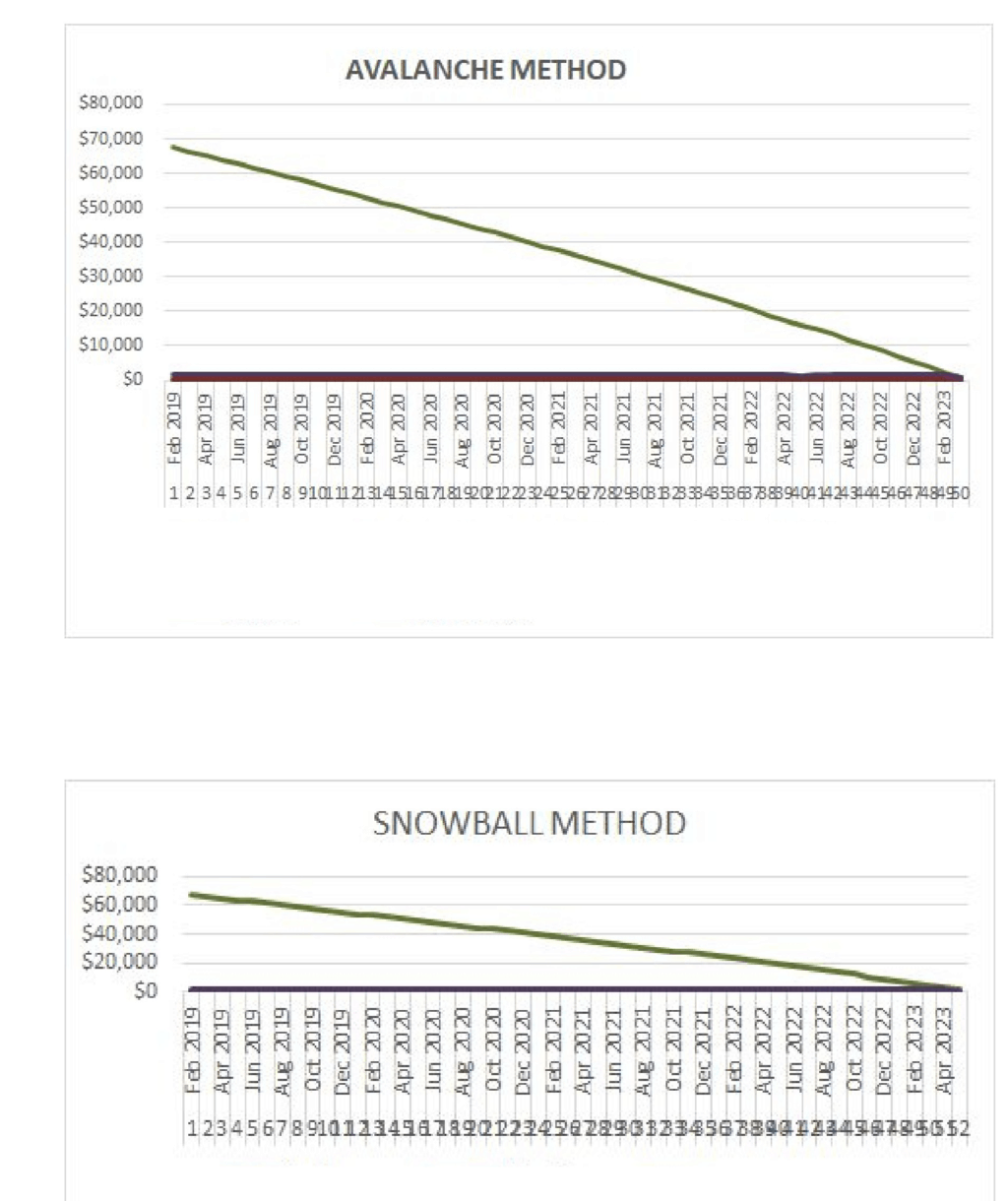
Through your budgeting, you see that you can squeeze an extra $171 out of your monthly budget to put towards your debt repayment. So overall you are paying $1,600 a month towards your debt. In the avalanche method, you will be debt free in February 2023. The interest paid throughout that time is $11,149.00.

Debt help: Repayment strategy options – Snowball vs. avalanche

Under the snowball method, you are done in April 2023. The interest paid in snowball is higher at $14,445.00. This is a difference of $3,296.00. You can certainly put those interest cost savings into your own savings plan. Also under the snowball method, it has you paying off the zero percent interest furniture loan in 13 months. The avalanche method puts the extra money against your highest interest rate credit card debt. It also lets you use the entire remaining 19 months to pay off the principal only furniture loan.

Nonetheless, both methods are valid. Under both methods, you pay off your debt a year earlier than if you did not use either of these methods and putting a bit extra against your principal. It depends what the characteristics of your debt load are. In my example, you would certainly pick the avalanche method, not the snowball method. This highlights the importance of budgeting so that you know what amount extra if any, you can squeeze from your budget towards debt repayment. Also, you can use one of the many free online calculators to figure out both the snowball and avalanche methods. That way you will know what is best for your situation.

The graphs

Let’s look at the graphs of these timelines. As you can see, the avalanche method gives you a steeper downward curve than the snowball method. Again, it is because you are paying off your debt quicker.

debt help

Budgeting and motivation

This also shows us that you have a bit more adaptability if you need to make a reduced repayment one month. Financial instability makes it difficult to toss additional money at debt. So when you’re not obtaining those incentives of getting rid of a kind of debt, it’s a little tougher to be urged. Conversely, seeing that you are chipping away at your debt will motivate you to keep refining your budget so that you can find more money to put against your debt.

The most vital thing is that you have actually developed a budget. Through the budgeting procedure, you found extra savings each month to put towards debt repayment. It’s going to take you a long time to repay your debt if you only pay the minimum monthly amount. Also, you’ll be squandering a great deal of cash on interest if you’re simply paying the minimum.

Are you caught in the debt trap?

Are you caught in the trap of too much debt and only making minimum monthly payments? Do you need debt consolidation Toronto? Are you stressed that future rates of interest increases will make presently affordable debt payments completely unreachable? Is the stress, anxiety, and pain of your debt negatively affecting your health and wellness?

If so, call the Ira Smith Team today. We have decades and generations of experience helping people and companies requiring financial restructuring. As a licensed insolvency trustee, we are the only professionals licensed and overseen by the Federal government to supply financial restructuring solutions.

Call the Ira Smith Team today to make sure that we can start assisting you. We will quickly return you right into a healthy and well-balanced stress-free life. We can create a debt settlement plan just for you to avoid bankruptcy, where we can even make the interest clock stop. This way, all your payments go only against the principal balances owing.

You can have a no-cost appointment to help you to fix your loan troubles. We recognize the pain financial debts and economic distress causes. We can end it from your life. This will absolutely allow you to start a fresh start, Starting Over Starting Now.

debt help

Categories
Brandon Blog Post

BANKRUPTCY HELP: SIGNS YOU NEED HELP

bankruptcy help

If you would rather listen to the audio version of this bankruptcy help Brandon’s Blog, scroll down to the bottom and click on the podcast.

Bankruptcy help: Introduction

When people ask for bankruptcy help, they really don’t want to talk about bankruptcy. What they are really asking for is help in eliminating the pain, suffering and stress they are going through dealing with their unmanageable debt. They want solutions to avoid bankruptcy. In this Brandon’s Blog, I discuss the debt danger signals and provide solutions to avoid bankruptcy.

As a licensed insolvency trustee (formerly known as a bankruptcy trustee), we are the only professionals licensed and monitored by the Federal Government. We provide options and proposed solutions to people and companies with too much debt. Our main goal is to help people and companies AVOID bankruptcy while solving their debt problems.

Bankruptcy help: 10 signs that you need help

  1. Your total debt has increased over the past year. You may be making minimum payments on some debt, paying down other debt, but increasing your debt in total. You have not accomplished anything in reducing your debt in the past year and this means you need help.
  2. Justified purchasing a new vehicle even though your existing one is fine, just not new. Taking on more debt just because of a “want” but not a “need” is irresponsible. You need help.
  3. Bought a new house with a larger mortgage, or mortgages, because you expect your income to rise in the future. Wages and salaries are not increasing in any real way. They are flat. Voluntarily carrying a larger debt load hoping that sometime in the future your income will catch up to your cash needs is not a responsible way of handling your affairs. You need help with your debt.
  4. Have borrowed money to go on a vacation. You should never go into debt to purchase something that is going to vanish in a week or two. The vacation will be gone but the debt will remain. If you can’t afford a vacation, you can’t go on one.
  5. Justify purchases based on what your peers are buying. Again, going into more debt because you want things your friends are buying is not a good reason. Their situation is not your situation. Maybe they can afford those things but you can’t. Maybe they can’t afford those things and will end up in bankruptcy. You just don’t know. Again, you can’t go into debt for “wants”.
  6. You have no emergency fund saved up. Recent surveys have shown that Canadians may be a few hundred dollars away from a financial disaster. Many Canadians are living paycheque to paycheque. You don’t know when a medical emergency, job loss or the need to replace a major appliance will happen. You need an emergency cash fund to cover those emergencies. If you have too much debt and no emergency fund savings, you need debt help.
  7. No retirement savings. It is never too soon to start planning to save a certain part of your take-home pay for retirement. A proper household budget will allow for such savings. If you are constantly battling your debt and have no money for savings, you need debt help.
  8. You quit your job without having another one lined up. This is probably the most irresponsible thing you can do. It may seem obvious to you, but trust me, I have seen it. The best way to land a better paying job or position is when you already have one. Trying it any other way is pure folly, especially when you have too much debt. Your regular monthly debt payments will not wait for you to have your income stream rolling again. Keep in mind that I am not talking about someone who is downsized and was given a package. I am talking about someone who quits without having new employment ready to go to.
  9. You are always borrowing from one source to pay down another. There isn’t enough money from your earnings to make your required debt payments. The fact is that you are borrowing from Peter to pay Paul. You’re in trouble and need debt help.
  10. You ignore your partner’s bad money habits or worse, financial infidelity. Your money habits may be impeccable. However, ignoring your partner’s money problems will bring you down too. You both need debt help.

Bankruptcy help: How we provide debt help

The first thing we offer is a free first consultation. You explain to us the financial issues you are facing. Then we talk to you about your family assets, liabilities and income. We then describe to you some possible options to help you overcome your debt problems. More information will be needed from you, but at least we start by setting your mind a bit at ease by telling you that your situation is not hopeless and we can give you solutions. All of the solutions we offer, except maybe one, are all so you can avoid bankruptcy.

The takeaways we want everyone to get from this free consultation is that you feel:

  1. We have empathy for your situation.
  2. A rapport has been built.
  3. We are the kind of people you can see yourself working with.
  4. You trust us.

If you wish to go ahead with our solving your financial and debt problems, the next step is that we have you complete our standard intake sheet called the Debt Relief Worksheet. A fully completed worksheet, complete with backup documents, allows us to drill down into all the issues and come up with our definitive recommendations.

Bankruptcy help: What are some possible solutions

The range of possible solutions depends on when we get to speak with you. Most people wait until they have no more credit line to use. Sometimes it takes a major event like the Canada Revenue Agency garnisheeing their bank account or wages before they realize they have a debt problem. The earlier you recognize there might be a problem and come speak with us, the more options we will have for you to solve your debt problems.

The range of options might include:

Credit counselling

Credit counselling is in fact debt therapy. We give advice with a host of concerns connected to debt consisting of budgeting, debt remedies, working with your lenders as well as restoring credit scores.

Debt consolidation

Debt consolidation is replacing all of your debts with new single financing at a lower overall interest rate so that you only have one debt to focus on reducing.

Consumer proposal

A consumer proposal is an official deal made to your creditors under the Bankruptcy and Insolvency Act (Canada) to customize your repayments; e.g. paying a lesser amount every month for a longer amount of time and paying in total less than you owe. Another benefit is that the interest clock stops the moment you file your consumer proposal.

If none of the above 3 possible solutions to avoid bankruptcy will work for you, then you are a candidate to file for bankruptcy so that you can end the pain and stress your debts are causing you. This way you can be Starting Over, Starting Now.

Bankruptcy help: Do you have too much debt?

Do you have too much debt? Are you stressed that future interest rate increases will make currently affordable payments completely unaffordable? Is the pain, stress and anxiety hurting your wellness and health?

If so, speak to the Ira Smith Team today. We have decades and generations of helping people and companies looking for financial restructuring. As a licensed insolvency trustee (formerly called a bankruptcy trustee), we are the only experts licensed and supervised by the Federal government to provide insolvency services.

Call the Ira Smith Team today for your free consultation and to make sure that we can begin assisting you to return right into a healthy, balanced, hassle-free life.


[monkeytools msnip=”http://monkeyplayr.com/playr.php?u=5173&p=20280″]

Call a Trustee Now!