
Categories
Brandon Blog Post

THE ULTIMATE GUIDE TO SURVIVING TERRIBLE TARIFFS ANXIETY: PROTECTING VAUGHAN, ONTARIO MANUFACTURERS FROM U.S. BORDER COSTS

Undeniably, large tariffs don’t just cut into your profit margins—it wipes them out overnight. However, panic is an inadequate response when your auto parts manufacturing business in Vaughan, Ontario, faces an immediate cash flow crisis. Consequently, this guide delivers actionable strategies to leverage corporate debt restructuring and protect your company from impending U.S. trade tensions.

Key Takeaways:

  • Margin wipeout: Tariffs directly hit cash flow, making debt repayment impossible for many suppliers.
  • Action over panic: Mitigating the impact of tariffs requires immediate financial restructuring, not just operational shifts.
  • Legal protection: Tools like a Division I Proposal stop creditor collections while you fix your supply chain.
  • Expert help: Ira Smith Trustee & Receiver Inc. can guide your Ontario manufacturing business back to profitability, whether it is located in Woodbridge, Ontario, or anywhere else in the Greater Toronto Area.

What is Tariffs-Induced Anxiety?

Tariffs-induced anxiety is the severe financial stress experienced by business owners facing sudden, crippling border taxes on their exported goods. Indeed, this fear is completely justified for companies operating within Ontario’s deeply integrated automotive network. Often, executives lose sleep wondering how they will meet payroll when cross-border shipping costs unexpectedly double overnight. Statistically, Ontario’s auto sector supports over 100,000 direct jobs. — Source: [Government of Ontario, 2023].

Consequently, this widespread economic anxiety affects not just CEOs, but thousands of hardworking families across the province. Ontario manufacturers facing tariffs anxiety can achieve supply chain resilience by legally renegotiating vendor debt and pausing creditor payments through a licensed insolvency trustee. Ultimately, acknowledging this anxiety is the vital first step toward implementing a strategic financial turnaround.

Why Mitigating The Impact of Tariffs Matters

Fundamentally, mitigating the impact of tariffs matters because ignoring these costs will instantly push a healthy manufacturing business into severe corporate insolvency. Actually, the automotive supply chain relies heavily on parts that cross the border multiple times before final assembly. Crucially, cross-border friction and tariffs can add up to $5,000 to the final price of a vehicle. — Source: [TD Economics, 2019]. Therefore, addressing these costs immediately prevents minor cash flow hiccups from becoming fatal financial wounds.

Furthermore, increased costs at the border inevitably result in lower consumer sales and drastic production cuts. Naturally, when assembly lines slow down, smaller suppliers are left with overflowing inventories and no incoming revenue. Unfortunately, commercial insolvencies in Canada surged by 41.4% year-over-year. — Source: [Office of the Superintendent of Bankruptcy, 2024]. Thus, securing professional financial advice early is the only way to avoid becoming another grim statistic.

Core Automotive Supply Chain Resilience Strategies

Strategically, automotive supply chain resilience requires a combination of aggressive cost-cutting, geographic diversification, and formal legal debt relief. First, business owners must recognize that relying solely on operational changes is rarely enough to offset a massive border penalty. Actually, panic is not a strategy; restructuring is a survival tactic. Consequently, proactive executives must explore both operational and financial pathways to secure their company’s future.

The Difference Between Operational Adjustments and Financial Restructuring

Crucially, the difference between operational adjustments and financial restructuring lies in how they address existing corporate liabilities. Initially, operational adjustments involve changing suppliers, moving warehouses, or physically altering how your goods are manufactured. While these operational shifts are necessary for long-term survival, they do absolutely nothing to eliminate the debt you have already accumulated. Conversely, formal financial restructuring specifically attacks your current debt load, providing immediate legal relief from aggressive creditors.

Moreover, operational changes typically require months or even years to fully implement across a complex supply chain. Meanwhile, tariffs-induced anxiety has undeniably dampened hiring plans for 40% of manufacturers. — Source: [First National, 2024]. Therefore, relying solely on operational pivots leaves your company highly vulnerable to bankruptcy during the lengthy transition period. Distinctly, combining both approaches guarantees that your business survives today while preparing adequately for tomorrow’s trade landscape.

Protecting Cash Flow Instantly

Initially, protecting your cash reserves is the absolute most critical step when surviving sudden Ontario manufacturing tariffs. First, audit all your current expenses and aggressively eliminate any non-essential corporate spending. Next, accelerate your accounts receivable by offering small incentives to clients who pay their invoices ahead of schedule. Ultimately, cash is the oxygen of your business, and preserving it gives you time to implement broader cross-border trade strategies.

Renegotiating Vendor Contracts Legally

Legally, renegotiating vendor contracts is a mandatory step when building robust automotive supply chain resilience. Firstly, you must proactively review every single supply agreement to identify clauses related to sudden international tax increases. Often, legacy contracts force the manufacturer to absorb all unexpected border costs entirely. Strikingly, over 70% of Ontario auto parts are destined for the American market. — Source: [Canadian Vehicle Manufacturers’ Association, 2023]. Unquestionably, absorbing a large hit on such a massive volume will immediately bankrupt most mid-sized parts suppliers in Ontario.

Subsequently, executives must initiate transparent conversations with their largest clients and most critical suppliers. Tactically, explaining your financial reality using data builds trust and encourages collaborative problem-solving across the supply network. However, if major clients refuse to share the tariffs burden, you must seriously consider utilizing formal corporate legal restructuring. Ultimately, a contract that guarantees massive financial losses is a contract that must be legally restructured or abandoned.

Importantly, when operational tweaks fail, formal Corporate Restructuring Services provide the ultimate safety net for struggling manufacturers. Specifically, according to Brandon Smith of Ira Smith Trustee & Receiver Inc., mitigating the impact of the U.S. tariffs on Ontario’s automotive supply chain requires utilizing corporate restructuring tools, such as a Division I Proposal, to protect cash flow and avoid bankruptcy. Basically, a Division I Proposal allows your business to legally pause creditor payments while you negotiate a fair financial settlement. Consequently, you remain entirely in control of your daily operations while systematically shedding unmanageable corporate debt.

Additionally, this legal protection immediately halts hostile actions from aggressive vendors or anxious lenders. Suddenly, bank accounts are unfrozen, and threatening collection calls cease completely. Ultimately, filing a formal proposal provides the critical breathing room needed to pivot your operations without the constant threat of facility closure.
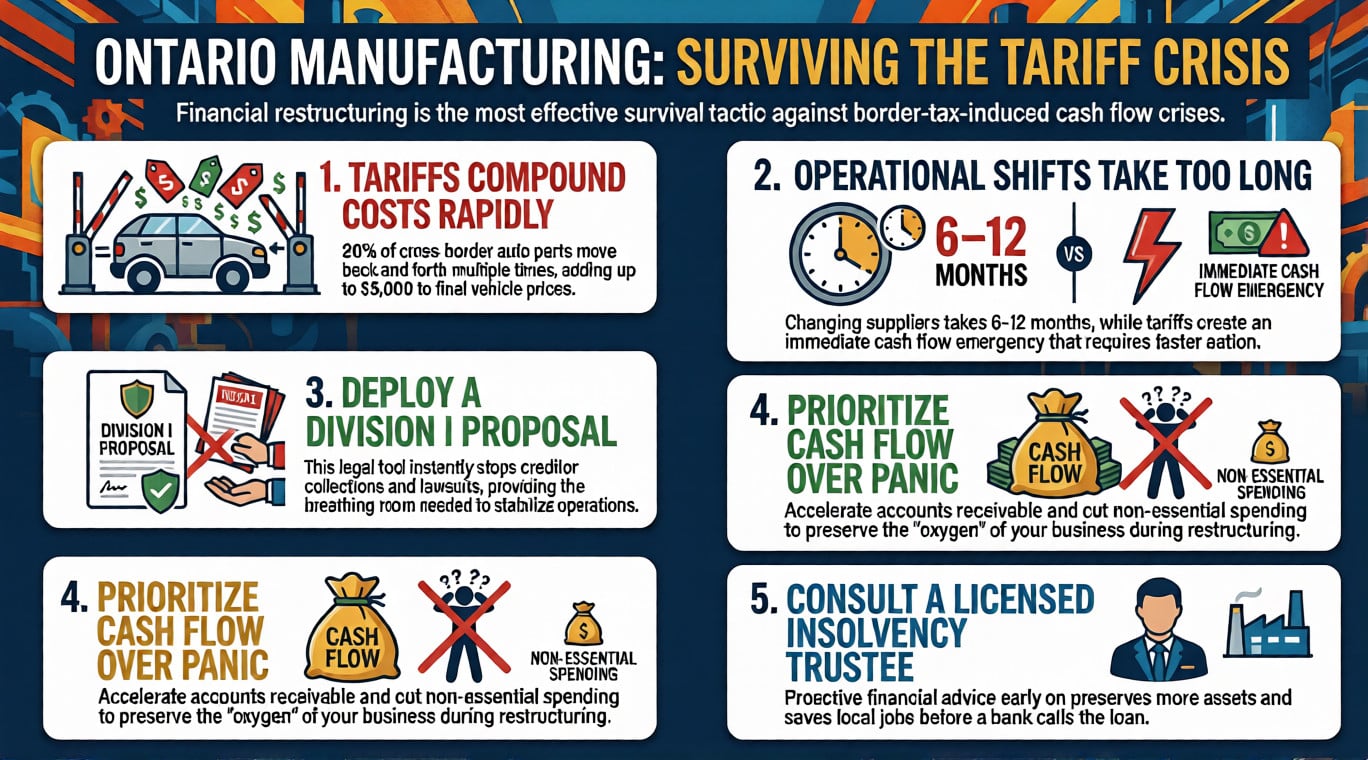
An infogrphic showing the steps that Vaughan, Ontario manufacturing companies can enter bankruptcy protection to restructure with a licensed insolvency trustee as a result of tariffs reducing profitability and causing debt problems.
tariffs

Practical Tools for Cross-Border Trade Strategies

Effective cross-border trade strategies utilize specialized financial forecasting software alongside expert legal restructuring frameworks to neutralize border taxes. Fortunately, executives do not need to invent these survival blueprints from scratch. Instead, proven methodologies exist to help map out supply chain vulnerabilities and legally restructure outstanding vendor liabilities. Clearly, U.S.-bound auto shipments account for nearly 30% of Ontario’s international exports. — Source: [Statistics Canada, 2023].

Visually, exploring your options helps demystify the complex corporate turnaround process. Below is a structured comparison of the tools available to combat rising U.S. trade tensions. Specifically, this table contrasts operational adjustments with formal legal protections.

Strategy TypeTool / MethodPrimary BenefitSpeed of Impact
OperationalSupplier DiversificationBypasses border tariffs entirelySlow (6-12 Months)
FinancialCash Flow ForecastingHighlights upcoming cash crunchesFast (Immediate)
Legal ReliefDivision I ProposalStops creditor lawsuits instantlyModerate (with immediate legal protection)
Legal ReliefCorporate BankruptcyCloses unviable businesses legallyModerate (with immediate legal protection)

Thankfully, utilizing these tools prevents the emotional exhaustion that typically accompanies severe corporate financial crises. Interestingly, up to 80% of cross-border auto parts move back and forth multiple times before final assembly. — Source: [Cox Automotive, 2024]. Therefore, mapping these movements with digital tools allows you to accurately predict exactly where the tariffs will inflict the most damage.

What’s Next for Defeating U.S. Trade Tensions

Undoubtedly, the next crucial step for defeating business insolvency Ontario is scheduling a confidential assessment with a Licensed Insolvency Trustee. Simply, waiting for politicians to resolve international trade disputes is a guaranteed way to bankrupt your factory. Instead, you must immediately take decisive control over your company’s balance sheet and outstanding creditor obligations. Ultimately, supply chain resilience is not just about moving factories; it is about restructuring your corporate debt.

Presently, the dedicated experts at Ira Smith Trustee & Receiver Inc. are ready to analyze your unique financial situation thoroughly. First, we will discreetly review your cash flow statements, vendor contracts, and outstanding loan obligations. Next, we will craft a customized restructuring plan designed to pause debt collections and stabilize your manufacturing operations. Emphatically, Contact Us today to secure the immediate legal protection your Ontario business desperately requires.

Evidently, taking proactive action today significantly increases your chances of achieving a successful corporate turnaround. Habitually, businesses that seek professional insolvency advice early preserve more assets and save more local jobs. Therefore, do not let temporary international border disputes destroy the incredible enterprise you have spent years building.

Tariffs Frequently Asked Questions (FAQ)

Naturally, business owners have many pressing questions when facing unprecedented cross-border trade challenges. Below, we address the most common concerns regarding Vaughan, Ontario manufacturing tariffs and corporate survival. Read these expert answers to quickly understand your legal options and operational realities.

Q1: How do the U.S. tariffs impact Ontario automotive supply chains?

A: Financially, the U.S. tariffs drastically increase the cost of materials and finished goods crossing the international border. Because auto parts often cross the U.S.-Canada border multiple times during assembly, this tax compounds rapidly. Consequently, this compounded tax wipes out supplier profit margins, reduces consumer sales, and causes severe cash flow shortages for Ontario manufacturers.

Q2: What are the best cross-border trade strategies to mitigate the U.S. tariffs’ impact?

Operationally, to mitigate tariff impacts, businesses should immediately audit their supply chains to source local Canadian materials where possible. Additionally, companies must update sales contracts to pass on sudden tariff costs directly to end buyers. Most importantly, manufacturers must use legal financial restructuring to free up cash flow trapped by unsustainable debt loads.

Absolutely, corporate restructuring is specifically designed to save viable manufacturing businesses from unexpected macroeconomic debt shocks. Furthermore, according to Brandon Smith of Ira Smith Trustee & Receiver Inc., tools like a Division I Proposal allow businesses to pause creditor payments and renegotiate their debts legally. Ultimately, this legal mechanism provides the crucial breathing room needed to adjust to new tariffs realities and avoid Corporate Bankruptcy.

Brandon’s Take On Tariffs

You’ve worked too hard to let your livelihood get choked out by roadwork you can’t control. Making a move now, instead of waiting for the bank to call the loan, is the smartest thing you can do. The longer you wait and bleed cash, the fewer options you’ll have.

At Ira Smith Trustee & Receiver Inc., we’re in the business of finding permanent solutions for Vaughan business owners. We give you a confidential, zero-judgment space to figure out your next move—whether that’s fighting your landlord or completely restructuring your debt.

Reach out to Ira Smith Trustee & Receiver Inc. today for a FREE, no-obligation chat. Let’s look at your books, figure out your rights, and build a plan to get you through the dust. Call us at (416) 948-6933, hit up IraSmith.com, or just walk into our office at 167 Applewood Crescent in Vaughan. You aren’t doing this alone. We’re here to help you get out of the gridlock.

Ira Smith Trustee & Receiver Inc. has the expertise and experience to guide you through these perilous waters. As Licensed Insolvency Trustees, we are uniquely qualified to assess your company’s financial situation, advise on the best course of action, and help you understand and mitigate your personal risks. We can help you understand your options, assess your personal risk, and develop a strategy to protect your future. Our approach is empathetic, non-judgmental, and focused on finding the best possible outcome for you and your company.

Contact us for a free, confidential consultation. The sooner you act, the more options you have, and the better protected you will be. Let us help you navigate your path to a brighter financial future.

Ira Smith Trustee & Receiver Inc. is licensed by the Office of the Superintendent of Bankruptcy and is a member of the Canadian Association of Insolvency and Restructuring Professionals.

—————————————————————————

Disclaimer: This analysis is for educational purposes only and is based on the cited sources and my professional expertise as a licensed insolvency trustee. The information provided does not constitute legal or financial advice for your specific circumstances.

Every situation is unique and involves complex legal and factual considerations. The outcomes discussed in this article may not apply to your particular situation. Situations are fact-specific and depend on the particular circumstances of each case.

Don’t hesitate to get in touch with Ira Smith Trustee & Receiver Inc.

About the Author:

Brandon Smith is a Senior Vice-President at Ira Smith Trustee & Receiver Inc. and a licensed insolvency trustee serving clients across Ontario. With extensive experience in complex court-ordered receivership administration and corporate insolvency & restructuring proceedings, Brandon helps businesses, creditors, and professionals navigate challenging financial situations to achieve optimal outcomes.

Brandon stays current with landmark developments in Canadian insolvency law. He brings this cutting-edge knowledge to every client engagement, ensuring his clients benefit from the most current understanding of their rights and options.


Data visualization of a post-tariffs margin analysis for an Ontario automotive parts manufacturer with President Donald Trump and Prime Minister Mark Carney
tariffs


Categories
Brandon Blog Post

TARIFF-INDUCED BANKRUPTCY: WHAT CANADIANS NEED TO UNDERSTAND

Tariff Introduction

As a licensed insolvency trustee serving the Greater Toronto Area, I’ve seen firsthand how unexpected financial pressures can push individuals and businesses to the brink. One growing concern for Canadians is the impact of United States tariffs on our economy, businesses, and finances.

In this Brandon’s Blog, I explore how the claims surrounding the United States Trump administration’s tariff program will impact household and business finances, debunking myths and clarifying truths about tariff collection and increases in consumer prices.

Definition and Purpose of Tariffs

Tariffs are essentially taxes or duties imposed by one country on goods and services imported from another country. When the United States places them on Canadian lumber, for example, American companies buying that lumber must pay the additional tax, making Canadian wood more expensive in the United States market.

Governments, including the Government of Canada, implement them for several key reasons:

Protection for Domestic Industries: Making foreign products more expensive gives local manufacturers a price advantage. The United States may place them on Canadian steel to help American steel producers compete more effectively against their Canadian counterparts.

Revenue Generation: Historically, before income taxes became common, tariffs were a major source of government income. Even today, they continue to generate billions in revenue for governments worldwide.

Political Leverage: Countries often use them(and counter – tariffs) as bargaining chips in larger trade negotiations or to apply pressure during international disputes. Merely the threat can push trading partners to change their policies on other issues.

Trade Deficit Reduction: Some governments believe that placing them on imported goods will reduce the number of foreign products entering their country, potentially reducing their trade deficit.

For Canadian businesses, understanding tariffs isn’t just about economics textbooks—it’s about survival. When a 10% or 25% rate applies to your domestic products entering the United States market, your competitive position changes overnight. Your American customers face an immediate price increase, even though your actual costs haven’t changed.

What makes them particularly challenging for business planning is their unpredictability. They can be announced with little warning, implemented quickly, and changed or removed just as suddenly, depending on political winds. This uncertainty makes long-term business planning extremely difficult for Canadian companies that rely on cross-border trade.

As we’ve seen in recent years, tariffs rarely exist in isolation. When the United States imposes them on Canadian goods, Canada typically responds with retaliation against United States products. This back-and-forth creates a “tariff war” where both sides face economic consequences—and businesses and consumers on both sides of the border end up paying the price.tariff

Historical Background of Canada-United States Tariffs

Their use in Canada-United States trade relations isn’t a new phenomenon—it’s part of a long history that has shaped our economic relationship for generations.

In the early days after Confederation, Canada used high tariffs as part of the National Policy to protect our emerging industries from American competition. This helped build Canadian manufacturing but also increased costs for consumers.

The modern era of Canada-United States trade began with the Auto Pact in 1965, which eliminated tariffs on vehicles and parts between our countries. This agreement showed how both nations could benefit from their reduction and set the stage for bigger changes.

The real breakthrough came in 1989 with the Canada-United States Free Trade Agreement, followed by NAFTA in 1994, which included Mexico. These historic agreements removed most tariffs between our countries, leading to a dramatic increase in cross-border trade. Many Canadian businesses built their entire business models around relatively free access to the US market.

For nearly 25 years, Canadian companies operated with relative certainty about cross-border trade rules. This stability allowed businesses to:

  • Make long-term investments in export capacity
  • Build integrated supply chains across the border
  • Develop specialized domestic products for the United States market
  • Create jobs dependent on United States-bound exports

This relatively tariff-free environment began to change in 2018 when the United States imposed new tariffs on Canadian steel (25%) and aluminum (10%), citing “national security concerns.” These tariffs came as a shock to many Canadian businesses that had never imagined such barriers returning to our trade relationship.

Canada responded with retaliatory tariffs on American products ranging from steel to maple syrup to playing cards—specifically targeting products from politically important US states. This tit-for-tat approach marked the beginning of a new, more uncertain era in Canada-United States trade.

Though NAFTA was eventually replaced by the Canada- United States- Mexico Agreement (CUSMA or USMCA) in 2020, the threat of sudden tariff changes continues to hang over Canadian businesses. The steel and aluminum tariffs were eventually lifted, but they demonstrated how quickly the cross-border business environment could change.

This historical context helps explain why today’s tariff threats create such significant financial stress for Canadian businesses. After decades of building business models around tariff-free trade, many companies lack the financial reserves or flexibility to quickly adapt to new trade barriers.

For businesses already operating on thin margins, these sudden shifts in trade policy can be the final push toward insolvency – turning profitable operations into financial crises virtually overnight.

Why Should Canadians Care About Tariffs?

As more fully described above, tariffs are taxes placed on imported goods. When the United States adds tariffs to Canadian products crossing the border, those products become more expensive for American buyers. This means Americans may buy fewer Canadian goods, hurting our businesses that rely on United States sales.

At the same time, when Canada places retaliatory tariffs on United States goods coming into our country, those products become more expensive for Canadian consumers and businesses. Either way, tariffs lead to higher prices and financial strain for many Canadians.tariff

Tariffs and Economic Impact

When tariffs enter the picture, they create ripple effects that extend far beyond the specific products being taxed. For Canadian businesses and consumers, these economic impacts can be wide-ranging and sometimes surprising in how they affect our financial well-being.

Impact on Global Trade

Tariffs fundamentally change the flow of goods across borders. When the United States imposes tariffs on Canadian steel or aluminum, our Canadian exports to that market typically decline—sometimes dramatically. It is not unusual for companies to see sales to the United States drop by 30-40% within months of new tariffs being announced.

Global supply chains have become incredibly complex, with parts and materials often crossing borders multiple times before becoming finished products. A single component might face tariffs several times in its journey, with costs multiplying at each step.

For Canadian exporters, tariffs can:

  • Force price increases that make their Canadian products uncompetitive
  • Require costly paperwork to prove product origin
  • Create unpredictable shipping delays at border crossings
  • Necessitate expensive restructuring of supply chains

I recently consulted with a Mississauga-based auto parts manufacturer navigate insolvency after navigating effectively closed off their primary market. Despite having quality domestic products and efficient operations, the added tariff rates made their pricing untenable for American customers.

Effect on Domestic Markets

When Canadian companies can’t sell to the United States due to tariffs, they often redirect those Canadian products to the domestic market. This sudden increase in supply can drive down prices for Canadian competitors who have always focused on local sales.

I’ve seen this play out in several sectors:

  • A BC lumber producer facing decreased United States demand flooded local markets, driving down prices for everyone
  • Ontario steel fabricators who couldn’t export began undercutting each other in Canada
  • Food producers redirected export-quality products to domestic markets at reduced prices

While lower prices might seem positive for consumers, they can be devastating for Canadian businesses that suddenly face unexpected local competition. These market disruptions can push even well-managed companies toward financial crisis.

On the flip side, when the Government of Canada imposes retaliatory tariffs on United States goods, some Canadian producers benefit from reduced foreign competition. However, these benefits are often outweighed by higher input costs and general market uncertainty.

Influence on Consumer Prices

At the end of the day, Canadian consumers usually bear much of the burden of tariffs. When Canada places tariffs on United States products, the prices of those goods typically rise in Canadian stores. Products from kitchen appliances to food items have become more expensive for Canadian families.

Even goods not directly subject to tariffs often see price increases. For example:

  • When steel tariffs increase the cost of manufacturing equipment, companies pass those costs on through higher prices
  • When transportation companies pay more for vehicles and parts due to tariffs, shipping costs rise for all products
  • When businesses face higher costs for imported raw materials, they adjust pricing across their product lines

For families already struggling with household budgets, these price increases can push them closer to financial difficulty. In my practice, I’ve recently seen more clients citing rising prices as a factor in their financial troubles, with many specifically mentioning items affected by cross-border tariff rates.

The timing of these price increases can be particularly challenging. Unlike gradual inflation that allows for budget adjustments, tariff-related price jumps often happen suddenly. A refrigerator that cost $1,200 last month might be $1,500 today because of new tariffs—with no warning for the consumer who needs to replace a broken appliance.

For Canadian households and businesses already operating close to the financial edge, these unexpected price increases can be the tipping point that leads them to seek insolvency advice. When combined with potential job losses in tariff-affected industries, the overall impact on family finances can be severe.

The Real-Life Bottom Line On How the United States’ Tariff Policies Are Affecting Canadian Businesses

Many Canadian companies depend heavily on exporting to the United States market. When faced with tariffs, these businesses must make difficult decisions:

  • Absorb the extra costs, reducing their profits
  • Raise prices for United States customers, potentially losing sales
  • Cut costs elsewhere, often leading to layoffs
  • Seek new markets, for example, Asian countries, which takes time and investment

For example, Canadian steel and aluminum producers felt immediate impacts when the United States imposed tariffs on these materials. Many had to reduce production or lay off workers because their domestic products suddenly became less competitive in the United States market.tariff

The Ripple Effect on Canadian Jobs and Communities

When major employers struggle with tariff issues, entire communities can suffer:

  • Job losses lead to reduced consumer spending
  • Local businesses lose customers
  • Municipal tax revenues decrease
  • Housing markets may weaken

These ripple effects can touch nearly every aspect of Canadian economic life, creating financial pressure on individuals and families who may have never considered themselves at risk for insolvency.

From Business Struggles to Personal Financial Crisis

As a licensed insolvency trustee, I’m seeing more cases where tariff-related business challenges eventually lead to financial problems:

  • Business owners using personal credit to keep their companies afloat
  • Employees facing reduced hours or job loss
  • Suppliers and contractors not getting paid on time or at all
  • Retirement savings being depleted to cover immediate needs

Many Canadians are just one or two paycheques away from serious financial trouble. When tariffs disrupt their income or increase their expenses, the path to insolvency can be surprisingly short.tariff

Real-World Examples of Tariff Impact

Consider these scenarios I’ve encountered:

  1. A small manufacturing company in Mississauga that supplied parts to United States automotive plants saw orders drop by 30% after tariffs made their products less competitive. The owner maxed out personal credit cards trying to keep the business going before finally seeking insolvency protection.
  2. A family-run food importing business in Markham faced a double hit: United States tariffs reduced their Canadian exports while Canadian retaliatory tariffs increased costs on their imports. This squeeze on both sides of their business forced them to consider bankruptcy.
  3. A Toronto construction contractor who relied on American inputs found project costs rising unexpectedly due to the Trump tariffs, turning profitable jobs into money-losing commitments.

Warning Signs That Tariffs May Be Pushing You Toward Insolvency

Watch for these red flags in your personal or business finances:

  • Using credit cards or lines of credit to pay for everyday expenses
  • Struggling to make minimum payments on debts
  • Receiving collection calls about overdue accounts
  • Having suppliers demand cash on delivery
  • Experiencing sudden drops in sales or income related to cross-border businesstariff

How to Protect Your Financial Health During Trade Disputes

While we can’t control international trade policies, there are steps Canadians can take to reduce their vulnerability:

  • Diversify your customer or supplier base beyond the United States market
  • Build an emergency fund to weather temporary financial setbacks
  • Review your business model to identify areas where you can cut costs
  • Consider Canadian alternatives to United States products facing tariffs
  • Monitor your debt levels closely and address problems early

When to Seek Professional Help

If tariff-related financial pressures are becoming overwhelming, don’t wait until crisis hits to get help. As an insolvency professional, I find that early intervention often provides more options and better outcomes.

Consider seeking advice if:

  • You’re using debt to cover operating expenses
  • Your debt payments exceed 40% of your income
  • You’re considering drastic measures like cashing out retirement savings
  • You’re losing sleep over financial worriestariff

Looking Forward: Preparing for Future Tariff Uncertainty

Trade relationships between Canada and the United States have always experienced ups and downs. While we hope for stability, it’s wise to prepare for potential changes:

  • Stay informed about trade discussions and policy changes
  • Build flexibility into your business and personal financial plans
  • Consider financial stress testing for your business
  • Maintain good relationships with your financial institution

Frequently Asked Questions About Tariffs and Their Impact on Canadians

As a licensed insolvency trustee serving clients throughout the Greater Toronto Area, I receive many questions about how tariffs affect Canadian financial health. Here are straightforward answers to the most common questions:

What exactly is a tariff and why do governments use them?

A tariff is simply a tax that a country puts on goods coming in from another country. Think of it as an extra fee added to the price of imported products. Governments use tariffs for several reasons:

  • To protect local businesses by making foreign goods more expensive
  • To collect money for government programs
  • To gain leverage in negotiations with other countries
  • To try to balance trade between countries

When you see a “Made in Canada” product becoming more competitive against a similar American product, tariffs might be part of the reason.

How do US tariffs hurt Canadian businesses?

When the US puts tariffs on Canadian products, those products become more expensive for American customers. This creates serious challenges for Canadian companies:

  • American customers may buy fewer of their products
  • Companies might have to cut their prices and lose profit
  • Businesses often need to reduce costs, sometimes through layoffs
  • Finding new customers in other countries takes time and money

I consulted with a manufacturing client who saw their US orders drop by 40% almost overnight after new tariffs were announced. This sudden change can quickly push a healthy business toward financial trouble.

What’s the history of tariffs between Canada and the US?

Our tariff relationship with the US has changed dramatically over time:

  • After Confederation, Canada used high tariffs to protect our growing industries
  • The Auto Pact in 1965 began removing tariffs on vehicles and parts
  • The Free Trade Agreement in 1989 and NAFTA in 1994 eliminated most tariffs
  • For about 25 years, Canadian businesses operated with few tariff concerns
  • In 2018, the US surprised many by putting new tariffs on Canadian steel and aluminum
  • Canada responded with our tariffs on American products

This history matters because many Canadian businesses built their entire operation around tariff-free access to the US market. When tariffs suddenly return, these businesses often lack the financial flexibility to adapt quickly.

Why should Canadian consumers worry about tariffs?

As a consumer, tariffs directly affect your wallet in several ways:

  • Products imported from the US become more expensive when Canada applies tariffs
  • Even Canadian-made goods might cost more if they use American materials
  • Companies facing higher costs typically pass those costs to consumers
  • Price increases from tariffs often happen suddenly, making budgeting difficult

Unlike gradual inflation that gives families time to adjust, tariff-related price jumps can happen overnight. A family appliance that cost $1,000 last month might suddenly cost $1,200 because of new tariffs.

How do tariffs affect Canadian markets?

Tariffs change how goods flow within Canada in ways that aren’t always obvious:

  • Canadian companies that can’t sell to the US might flood the domestic market
  • This increased local supply can drive down prices for Canadian companies
  • Some Canadian producers benefit from less American competition
  • Supply chains become more complex and expensive
  • Certain regions or industries may be hit harder than others

For example, Ontario manufacturers may not be able to compete with suddenly cheaper local products when exporters redirected their goods to the Canadian market.

Can you share real examples of tariff impacts on Canadian businesses?

  • A Mississauga auto parts maker lost 30% of its US customers after tariffs made their products too expensive
  • A food importer in Markham faced challenges on both sides: US tariffs reduced their exports while Canadian retaliatory tariffs increased their import costs
  • A Toronto construction contractor saw project costs rise unexpectedly when tariffs increased the price of imported building materials

These aren’t just statistics—they represent real Canadian businesses and the families who depend on them.

What warning signs show that tariffs might be pushing you toward financial trouble?

Watch for these red flags in your personal or business finances:

  • Using credit cards or lines of credit for everyday expenses
  • Struggling to make minimum payments on debts
  • Receiving collection calls about overdue accounts
  • Having suppliers demand cash on delivery
  • Experiencing sudden drops in sales or income related to cross-border business

Recognizing these signs early can help you take action before a financial challenge becomes a crisis.

What can Canadians do to protect themselves from tariff impacts?

While we can’t control international trade policies, there are practical steps you can take:

  • Diversify your business beyond the US market
  • Build an emergency fund to handle temporary financial challenges
  • Look for Canadian alternatives to products affected by tariffs
  • Review your business operations to find cost-saving opportunities
  • Monitor your debt levels closely
  • Seek professional advice at the first sign of financial pressure

In my experience, clients who take action early have more options and typically achieve better outcomes.

Don’t wait for a crisis to get help. Consider talking to a licensed insolvency trustee if:

  • You’re using debt to cover basic operating expenses
  • Your debt payments exceed 40% of your income
  • You’re considering using retirement savings to cover current expenses
  • You’re losing sleep over financial worries
  • Your business is experiencing tariff-related revenue drops

Remember, consulting with an insolvency professional doesn’t mean you’ll end up in bankruptcy. Often, early advice can help you find alternatives that protect your financial future.

Tariff Conclusion: Taking Control of Your Financial Future

Tariffs may be beyond our control, but our response to them isn’t. By understanding the risks, monitoring your financial situation closely, and seeking help early if needed, Canadians can navigate these challenging economic waters.

Remember, financial difficulty doesn’t automatically mean bankruptcy. A licensed insolvency trustee can help you explore all your options, from debt management strategies to formal proceedings like consumer proposals or bankruptcy protection.

Don’t let international trade disputes and stock markets determine your financial future. Stay informed, be proactive, and reach out for professional guidance when needed.

I hope you’ve found this tariff Brandon’s Blog helpful. If you or someone you know is struggling with too much debt, remember that the financial restructuring process, while complex, offers viable solutions with the right guidance.

At the Ira Smith Team, we understand the financial and emotional components of debt struggles. We’ve seen how traditional approaches often fall short in today’s economic environment, so we focus on modern debt relief options that can help you avoid bankruptcy while still achieving financial freedom.

The stress of financial challenges can be overwhelming. We take the time to understand your unique situation and develop customized strategies that address both your financial needs and emotional well-being. There’s no “one-size-fits-all” approach here—your financial solution should be as unique as the challenges you’re facing.

If any of this sounds familiar and you’re serious about finding a solution, reach out to the Ira Smith Trustee & Receiver Inc. team today for a free consultation. We’re committed to helping you or your company get back on the road to healthy, stress-free operations and recover from financial difficulties. Starting Over, Starting Now.

The information provided in this blog is intended for educational purposes only. It is not intended to constitute legal, financial, or professional advice. Readers are encouraged to seek professional advice regarding their specific situations. The content should not be relied upon as a substitute for professional guidance or consultation. The author, Ira Smith Trustee & Receiver Inc., and any contributors do not assume any liability for any loss or damage.tariff

Categories
Brandon Blog Post

TRADE AND DEVELOPMENT: BEING A PATRIOTIC CANADIAN CAN SAVE YOU MONEY

trade and developmentTrade and development: Introduction

We live in a time of interesting politics when it comes to trade and development. Unfortunately, due to the trade war between the U.S. and Canada, many products are now considerably more expensive. Since household debt is at record highs and many Canadians are already living paycheque to paycheque, the price hikes on popular products can cause a significant impact on your finances. The best way to keep your spending in check is to show your patriotism and buy Canadian.

Trade and development: The Canadian list

According to the Retail Council of Canada, this is a list of popular products that will cost you more if not sourced locally or from a country other than the U.S.:

  • Yogurt
  • Roasted coffee – not decaffeinated
  • Maple sugar and maple syrup
  • Licorice candy and toffee
  • Sugar confectionery
  • Chocolate in blocks, slabs or bars
  • Pizza and quiche
  • Cucumbers and gherkins
  • Strawberry jam
  • Orange juice, not frozen
  • Soya sauce
  • Tomato ketchup and other tomato sauces
  • Mayonnaise and salad dressing
  • Mixed condiments and mixed seasonings
  • Soups and broths
  • Waters, including mineral aerated waters containing added sugar or flavour
  • Whiskies
  • Manicure or pedicure preparations
  • Hair lacquers
  • Pre-shave, shaving or after-shave preparations
  • Preparations for perfuming or deodorizing rooms
  • Organic surface-active products and preparations for washing the skin
  • Automatic dishwasher detergents
  • Candles
  • Plastic sacks and bags
  • Tableware and kitchenware
  • Plywood, consisting solely of sheets of wood other than bamboo
  • Paper and paperboard
  • Toilet paper
  • Handkerchiefs, cleansing or facial tissues and towels
  • Tablecloths and serviettes
  • Printed or illustrated postcards
  • Printed greeting cards, with or without envelopes
  • Cast iron grills
  • Combined refrigerator-freezers
  • Dishwashing machines
  • Lawnmowers
  • Inflatable boats
  • Sailboats
  • Motorboats
  • Mattresses
  • Sleeping bags
  • Pillows, cushions and similar furnishings of cotton
  • Playing cards
  • Ballpoint pens
  • Felt-tipped and other porous-tipped pens and markers

Trade and development: Be a nationalist and save money

Many of these products are manufactured in Canada so perhaps this is a good opportunity to make mindful purchases, whether or not there is a trade war on. E.g. Quebec produces 72% of the world’s maple syrup, so why would we ever buy it from the States? President’s Choice has an extensive list of products that are manufactured in Canada. As a nation, we have a long tradition of making Whiskey, so if that’s your pleasure, try a Canadian brand. With a little research, you could become quite the expert in buying Canadian and save a lot of money in the process.

Trade and development: What to do if you have too much debt

If the spike in prices because of the tariffs could put a strain on you financially, then the time for professional help is now. Unfortunately, we can’t remove the tariffs, but can help you deal with debt. At Ira Smith Trustee & Receiver Inc. we believe that financial problems can be solved with immediate action and the right financial plan. You can put your financial problems behind you and live a debt free life Starting Over, Starting Now. We’re just a phone call away.

Call a Trustee Now!