
Categories
Brandon Blog Post

THE ULTIMATE GUIDE TO SURVIVING TERRIBLE TARIFFS ANXIETY: PROTECTING VAUGHAN, ONTARIO MANUFACTURERS FROM U.S. BORDER COSTS

Undeniably, large tariffs don’t just cut into your profit margins—it wipes them out overnight. However, panic is an inadequate response when your auto parts manufacturing business in Vaughan, Ontario, faces an immediate cash flow crisis. Consequently, this guide delivers actionable strategies to leverage corporate debt restructuring and protect your company from impending U.S. trade tensions.

Key Takeaways:

  • Margin wipeout: Tariffs directly hit cash flow, making debt repayment impossible for many suppliers.
  • Action over panic: Mitigating the impact of tariffs requires immediate financial restructuring, not just operational shifts.
  • Legal protection: Tools like a Division I Proposal stop creditor collections while you fix your supply chain.
  • Expert help: Ira Smith Trustee & Receiver Inc. can guide your Ontario manufacturing business back to profitability, whether it is located in Woodbridge, Ontario, or anywhere else in the Greater Toronto Area.

What is Tariffs-Induced Anxiety?

Tariffs-induced anxiety is the severe financial stress experienced by business owners facing sudden, crippling border taxes on their exported goods. Indeed, this fear is completely justified for companies operating within Ontario’s deeply integrated automotive network. Often, executives lose sleep wondering how they will meet payroll when cross-border shipping costs unexpectedly double overnight. Statistically, Ontario’s auto sector supports over 100,000 direct jobs. — Source: [Government of Ontario, 2023].

Consequently, this widespread economic anxiety affects not just CEOs, but thousands of hardworking families across the province. Ontario manufacturers facing tariffs anxiety can achieve supply chain resilience by legally renegotiating vendor debt and pausing creditor payments through a licensed insolvency trustee. Ultimately, acknowledging this anxiety is the vital first step toward implementing a strategic financial turnaround.

Why Mitigating The Impact of Tariffs Matters

Fundamentally, mitigating the impact of tariffs matters because ignoring these costs will instantly push a healthy manufacturing business into severe corporate insolvency. Actually, the automotive supply chain relies heavily on parts that cross the border multiple times before final assembly. Crucially, cross-border friction and tariffs can add up to $5,000 to the final price of a vehicle. — Source: [TD Economics, 2019]. Therefore, addressing these costs immediately prevents minor cash flow hiccups from becoming fatal financial wounds.

Furthermore, increased costs at the border inevitably result in lower consumer sales and drastic production cuts. Naturally, when assembly lines slow down, smaller suppliers are left with overflowing inventories and no incoming revenue. Unfortunately, commercial insolvencies in Canada surged by 41.4% year-over-year. — Source: [Office of the Superintendent of Bankruptcy, 2024]. Thus, securing professional financial advice early is the only way to avoid becoming another grim statistic.

Core Automotive Supply Chain Resilience Strategies

Strategically, automotive supply chain resilience requires a combination of aggressive cost-cutting, geographic diversification, and formal legal debt relief. First, business owners must recognize that relying solely on operational changes is rarely enough to offset a massive border penalty. Actually, panic is not a strategy; restructuring is a survival tactic. Consequently, proactive executives must explore both operational and financial pathways to secure their company’s future.

The Difference Between Operational Adjustments and Financial Restructuring

Crucially, the difference between operational adjustments and financial restructuring lies in how they address existing corporate liabilities. Initially, operational adjustments involve changing suppliers, moving warehouses, or physically altering how your goods are manufactured. While these operational shifts are necessary for long-term survival, they do absolutely nothing to eliminate the debt you have already accumulated. Conversely, formal financial restructuring specifically attacks your current debt load, providing immediate legal relief from aggressive creditors.

Moreover, operational changes typically require months or even years to fully implement across a complex supply chain. Meanwhile, tariffs-induced anxiety has undeniably dampened hiring plans for 40% of manufacturers. — Source: [First National, 2024]. Therefore, relying solely on operational pivots leaves your company highly vulnerable to bankruptcy during the lengthy transition period. Distinctly, combining both approaches guarantees that your business survives today while preparing adequately for tomorrow’s trade landscape.

Protecting Cash Flow Instantly

Initially, protecting your cash reserves is the absolute most critical step when surviving sudden Ontario manufacturing tariffs. First, audit all your current expenses and aggressively eliminate any non-essential corporate spending. Next, accelerate your accounts receivable by offering small incentives to clients who pay their invoices ahead of schedule. Ultimately, cash is the oxygen of your business, and preserving it gives you time to implement broader cross-border trade strategies.

Renegotiating Vendor Contracts Legally

Legally, renegotiating vendor contracts is a mandatory step when building robust automotive supply chain resilience. Firstly, you must proactively review every single supply agreement to identify clauses related to sudden international tax increases. Often, legacy contracts force the manufacturer to absorb all unexpected border costs entirely. Strikingly, over 70% of Ontario auto parts are destined for the American market. — Source: [Canadian Vehicle Manufacturers’ Association, 2023]. Unquestionably, absorbing a large hit on such a massive volume will immediately bankrupt most mid-sized parts suppliers in Ontario.

Subsequently, executives must initiate transparent conversations with their largest clients and most critical suppliers. Tactically, explaining your financial reality using data builds trust and encourages collaborative problem-solving across the supply network. However, if major clients refuse to share the tariffs burden, you must seriously consider utilizing formal corporate legal restructuring. Ultimately, a contract that guarantees massive financial losses is a contract that must be legally restructured or abandoned.

Importantly, when operational tweaks fail, formal Corporate Restructuring Services provide the ultimate safety net for struggling manufacturers. Specifically, according to Brandon Smith of Ira Smith Trustee & Receiver Inc., mitigating the impact of the U.S. tariffs on Ontario’s automotive supply chain requires utilizing corporate restructuring tools, such as a Division I Proposal, to protect cash flow and avoid bankruptcy. Basically, a Division I Proposal allows your business to legally pause creditor payments while you negotiate a fair financial settlement. Consequently, you remain entirely in control of your daily operations while systematically shedding unmanageable corporate debt.

Additionally, this legal protection immediately halts hostile actions from aggressive vendors or anxious lenders. Suddenly, bank accounts are unfrozen, and threatening collection calls cease completely. Ultimately, filing a formal proposal provides the critical breathing room needed to pivot your operations without the constant threat of facility closure.
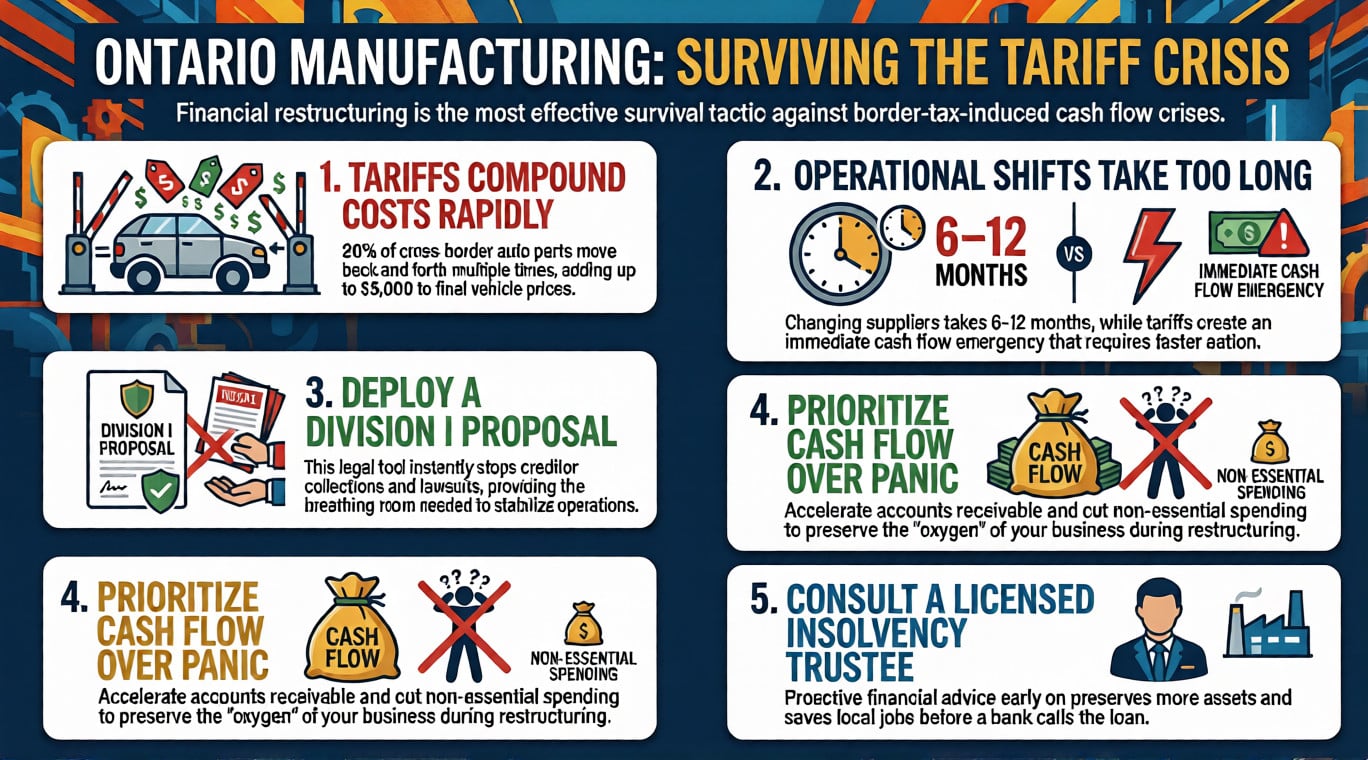
An infogrphic showing the steps that Vaughan, Ontario manufacturing companies can enter bankruptcy protection to restructure with a licensed insolvency trustee as a result of tariffs reducing profitability and causing debt problems.
tariffs

Practical Tools for Cross-Border Trade Strategies

Effective cross-border trade strategies utilize specialized financial forecasting software alongside expert legal restructuring frameworks to neutralize border taxes. Fortunately, executives do not need to invent these survival blueprints from scratch. Instead, proven methodologies exist to help map out supply chain vulnerabilities and legally restructure outstanding vendor liabilities. Clearly, U.S.-bound auto shipments account for nearly 30% of Ontario’s international exports. — Source: [Statistics Canada, 2023].

Visually, exploring your options helps demystify the complex corporate turnaround process. Below is a structured comparison of the tools available to combat rising U.S. trade tensions. Specifically, this table contrasts operational adjustments with formal legal protections.

Strategy TypeTool / MethodPrimary BenefitSpeed of Impact
OperationalSupplier DiversificationBypasses border tariffs entirelySlow (6-12 Months)
FinancialCash Flow ForecastingHighlights upcoming cash crunchesFast (Immediate)
Legal ReliefDivision I ProposalStops creditor lawsuits instantlyModerate (with immediate legal protection)
Legal ReliefCorporate BankruptcyCloses unviable businesses legallyModerate (with immediate legal protection)

Thankfully, utilizing these tools prevents the emotional exhaustion that typically accompanies severe corporate financial crises. Interestingly, up to 80% of cross-border auto parts move back and forth multiple times before final assembly. — Source: [Cox Automotive, 2024]. Therefore, mapping these movements with digital tools allows you to accurately predict exactly where the tariffs will inflict the most damage.

What’s Next for Defeating U.S. Trade Tensions

Undoubtedly, the next crucial step for defeating business insolvency Ontario is scheduling a confidential assessment with a Licensed Insolvency Trustee. Simply, waiting for politicians to resolve international trade disputes is a guaranteed way to bankrupt your factory. Instead, you must immediately take decisive control over your company’s balance sheet and outstanding creditor obligations. Ultimately, supply chain resilience is not just about moving factories; it is about restructuring your corporate debt.

Presently, the dedicated experts at Ira Smith Trustee & Receiver Inc. are ready to analyze your unique financial situation thoroughly. First, we will discreetly review your cash flow statements, vendor contracts, and outstanding loan obligations. Next, we will craft a customized restructuring plan designed to pause debt collections and stabilize your manufacturing operations. Emphatically, Contact Us today to secure the immediate legal protection your Ontario business desperately requires.

Evidently, taking proactive action today significantly increases your chances of achieving a successful corporate turnaround. Habitually, businesses that seek professional insolvency advice early preserve more assets and save more local jobs. Therefore, do not let temporary international border disputes destroy the incredible enterprise you have spent years building.

Tariffs Frequently Asked Questions (FAQ)

Naturally, business owners have many pressing questions when facing unprecedented cross-border trade challenges. Below, we address the most common concerns regarding Vaughan, Ontario manufacturing tariffs and corporate survival. Read these expert answers to quickly understand your legal options and operational realities.

Q1: How do the U.S. tariffs impact Ontario automotive supply chains?

A: Financially, the U.S. tariffs drastically increase the cost of materials and finished goods crossing the international border. Because auto parts often cross the U.S.-Canada border multiple times during assembly, this tax compounds rapidly. Consequently, this compounded tax wipes out supplier profit margins, reduces consumer sales, and causes severe cash flow shortages for Ontario manufacturers.

Q2: What are the best cross-border trade strategies to mitigate the U.S. tariffs’ impact?

Operationally, to mitigate tariff impacts, businesses should immediately audit their supply chains to source local Canadian materials where possible. Additionally, companies must update sales contracts to pass on sudden tariff costs directly to end buyers. Most importantly, manufacturers must use legal financial restructuring to free up cash flow trapped by unsustainable debt loads.

Absolutely, corporate restructuring is specifically designed to save viable manufacturing businesses from unexpected macroeconomic debt shocks. Furthermore, according to Brandon Smith of Ira Smith Trustee & Receiver Inc., tools like a Division I Proposal allow businesses to pause creditor payments and renegotiate their debts legally. Ultimately, this legal mechanism provides the crucial breathing room needed to adjust to new tariffs realities and avoid Corporate Bankruptcy.

Brandon’s Take On Tariffs

You’ve worked too hard to let your livelihood get choked out by roadwork you can’t control. Making a move now, instead of waiting for the bank to call the loan, is the smartest thing you can do. The longer you wait and bleed cash, the fewer options you’ll have.

At Ira Smith Trustee & Receiver Inc., we’re in the business of finding permanent solutions for Vaughan business owners. We give you a confidential, zero-judgment space to figure out your next move—whether that’s fighting your landlord or completely restructuring your debt.

Reach out to Ira Smith Trustee & Receiver Inc. today for a FREE, no-obligation chat. Let’s look at your books, figure out your rights, and build a plan to get you through the dust. Call us at (416) 948-6933, hit up IraSmith.com, or just walk into our office at 167 Applewood Crescent in Vaughan. You aren’t doing this alone. We’re here to help you get out of the gridlock.

Ira Smith Trustee & Receiver Inc. has the expertise and experience to guide you through these perilous waters. As Licensed Insolvency Trustees, we are uniquely qualified to assess your company’s financial situation, advise on the best course of action, and help you understand and mitigate your personal risks. We can help you understand your options, assess your personal risk, and develop a strategy to protect your future. Our approach is empathetic, non-judgmental, and focused on finding the best possible outcome for you and your company.

Contact us for a free, confidential consultation. The sooner you act, the more options you have, and the better protected you will be. Let us help you navigate your path to a brighter financial future.

Ira Smith Trustee & Receiver Inc. is licensed by the Office of the Superintendent of Bankruptcy and is a member of the Canadian Association of Insolvency and Restructuring Professionals.

—————————————————————————

Disclaimer: This analysis is for educational purposes only and is based on the cited sources and my professional expertise as a licensed insolvency trustee. The information provided does not constitute legal or financial advice for your specific circumstances.

Every situation is unique and involves complex legal and factual considerations. The outcomes discussed in this article may not apply to your particular situation. Situations are fact-specific and depend on the particular circumstances of each case.

Don’t hesitate to get in touch with Ira Smith Trustee & Receiver Inc.

About the Author:

Brandon Smith is a Senior Vice-President at Ira Smith Trustee & Receiver Inc. and a licensed insolvency trustee serving clients across Ontario. With extensive experience in complex court-ordered receivership administration and corporate insolvency & restructuring proceedings, Brandon helps businesses, creditors, and professionals navigate challenging financial situations to achieve optimal outcomes.

Brandon stays current with landmark developments in Canadian insolvency law. He brings this cutting-edge knowledge to every client engagement, ensuring his clients benefit from the most current understanding of their rights and options.


Data visualization of a post-tariffs margin analysis for an Ontario automotive parts manufacturer with President Donald Trump and Prime Minister Mark Carney
tariffs


Categories
Brandon Blog Post

CANADIAN BUSINESSES CHALLENGES AND OPPORTUNITIES IN 2025: A LICENSED INSOLVENCY TRUSTEE’S COMPLETE GUIDE

Canadian Businesses Introduction

As a Licensed Insolvency Trustee firm serving the Greater Toronto Area for over 20 years, we’ve seen Canadian businesses go through many ups and downs. Right now, we’re facing some tough times that remind me of the beginning of the 2008-2009 financial crisis. But there’s more to the story than just bad news.

Let me share what I’m seeing on the ground and what it means for owners of Canadian businesses like yours.

Overview of the Canadian Business Environment

The Canadian business landscape in 2025 is complex. While some large corporations are doing well, many small and medium Canadian businesses are struggling. This creates a two-speed economy depending on company size, which affects different sectors in different ways.

Current Economic Indicators

Recent data from Statistics Canada shows mixed signals for Canadian businesses:

  • Corporate profits rose by $4.2 billion in Q1 2025
  • The Canadian Small Business Health Index dropped to 99.3
  • Canadian businesses’ delinquencies are at their highest since 2009
  • Credit demand from businesses has slowed significantly

These numbers tell us that while big companies might be profitable, smaller Canadian businesses are having a harder time. This gap is important because small businesses employ millions of Canadians and drive local economies.

Regional Differences Across Canada

Not all provinces are experiencing the same challenges. Ontario and British Columbia are seeing the biggest increases in Canadian businesses‘ financial stress:

  • Ontario business arrears have jumped by 19%
  • British Columbia business debt has risen by 20%
  • The Prairie provinces and Atlantic Canada are facing their unique challenges

These regional differences matter because they show how national policies and global events affect different areas of Canada in unique ways.

Key Economic Drivers

Several factors are shaping the Canadian business environment:

Energy Sector Impact: Canada’s energy sector continues to influence the overall economy, though renewable energy investments are growing.

Technology Adoption: Canadian businesses that adapted to digital tools during COVID-19 are generally performing better than those that didn’t.

Supply Chain Resilience: Companies with diversified supply chains are handling current challenges better than those dependent on single sources.Owner of Canadian businesses reviewing financial statements in Toronto office, looking worried about business financial challenges

Challenges in the Canadian Business Landscape

Canadian businesses face several major challenges right now. Understanding these helps explain why so many companies are struggling with their finances.

Rising Business Delinquencies

The numbers are concerning. Canadian businesses’ delinquencies have reached levels not seen since the 2009 financial crisis. This means more companies are falling behind on their payments to suppliers, landlords, and lenders.

What does this mean for you as a business owner?

  • Cash flow problems become more common
  • It’s harder to get credit when you need it
  • Suppliers may demand payment up front
  • Your customers might pay you later (or not at all)

Impact of Trade Tensions

The ongoing trade dispute with the United States is hitting our interconnected trade relationship with the USA and, therefore, Canadian businesses hard. When politicians in Washington announce new tariffs or trade policies requiring a new agreement on trade, it affects your business here in Canada.

Here’s how trade tensions hurt Canadian business:

Supply Chain Disruptions: Products you need might be delayed or cost more. One business owner told me, “I never thought a tweet could shut down my supplies.”

Increased Costs: Tariffs make imported goods more expensive, which squeezes your profit margins.

Uncertainty: It’s hard to plan for the future when trade rules keep changing.

Customer Impact: Higher costs often mean higher prices, which can drive away customers.

Credit Market Tightening

Banks and other lenders are being more careful about who they lend money to. This creates a problem for Canadian businesses that need financing to grow or even survive.

Signs of credit tightening include:

  • Longer approval times for business loans
  • Higher interest rates
  • More paperwork and requirements
  • Smaller loan amounts are being approved

Regulatory and Tax Pressures

Many business owners feel overwhelmed by government regulations and taxes. While some rules protect workers and consumers, they can also make it harder to run profitable Canadian businesses.

Common regulatory challenges include:

  • Complex tax requirements
  • Employment standards compliance
  • Environmental regulations
  • Industry-specific rules and licensing

Lingering Effects of COVID-19

The pandemic changed how we do business, and some of those changes are still causing problems. Many Canadian businesses are still dealing with:

  • Higher operating costs
  • Changed customer behaviours
  • Staffing shortages
  • Debt taken on during lockdowns

Opportunities for Canadian Business Growth Strategies and Expansion

Despite the challenges, there are real opportunities for Canadian businesses that position themselves correctly. Smart business owners who are innovative leaders are finding ways to succeed even in tough times.

Digital Transformation Advantages

Canadian businesses that embrace technology are often doing better than those that don’t. The pandemic forced many companies to go digital, and those that did it well are seeing benefits.

Digital opportunities include:

E-commerce Growth: Online sales continue to grow, even as physical stores struggle.

Remote Work Benefits: Companies can hire talent from anywhere and reduce office costs.

Automation Savings: Technology can reduce labour costs and improve efficiency.

Better Customer Data: Digital tools help you understand your customers better.

Market Consolidation Opportunities

When times are tough, weaker competitors often exit the market. This creates opportunities for stronger Canadian businesses to:

  • Acquire competitors at lower prices
  • Hire experienced employees from failing companies
  • Take over market share from Canadian businesses that close
  • Negotiate better deals with suppliers

Government Support Programs

Various levels of government offer support programs for Canadian businesses. These can provide crucial help during difficult times:

Federal Programs:

  • Canada Emergency Business Account (CEBA) extension
  • Export development funding
  • Innovation grants and tax credits

Provincial Programs:

  • Ontario Small Business Support Grant
  • British Columbia Recovery Grant programs
  • Industry-specific support initiatives

Municipal Programs:

  • Property tax deferrals
  • Local development incentives
  • Small business support funds

Sector-Specific Growth Areas

Some industries are growing despite overall economic challenges:

Healthcare and Senior Services: Canada’s aging population creates opportunities in healthcare, home care, and senior services.

Green Technology: Government commitments to climate goals mean funding and opportunities for clean technology businesses.

Professional Services: As Canadian businesses face complex challenges, there’s a growing demand for legal, accounting, and consulting services.

Essential Services: Canadian businesses that provide necessities often remain stable during economic downturns.Owner of Canadian businesses reviewing financial statements in Toronto office, looking worried about business financial challenges

When Canadian Business Financial Challenges Become Too Much

Sometimes, despite best efforts, Canadian businesses face financial problems that seem impossible to solve. This is where my expertise as a Licensed Insolvency Trustee becomes valuable.

Warning Signs to Watch For

If your business shows these signs, it’s time to get professional help:

  • Consistently late on payments to suppliers
  • Difficulty making payroll
  • Maxed out credit lines
  • Receiving demand letters or legal notices
  • Customers are complaining about delayed orders
  • Losing key employees due to unpaid wages

How Professional Help Can Make a Difference

As a Licensed Insolvency Trustee, I help Canadian businesses and their owners navigate financial difficulties. My services include:

Business Restructuring: Sometimes, a business can be saved with the right restructuring plan. This might involve negotiating with creditors, reorganizing operations, or finding new financing.

Asset Sales: If a business can’t continue, I can help maximize the value of its assets through organized sales processes.

Personal Insolvency Solutions: When business debts affect personal finances, I provide options like consumer proposals or personal bankruptcy to give owners a fresh start.

Creditor Negotiations: I work with creditors to find solutions that work for everyone involved.

Advisory Services: I provide actionable advice to develop a roadmap for you to follow, where there is a way for company management to carry out a self-help restructuring without resorting to a formal insolvency process.

The Importance of Acting Early

The earlier you seek help, the more options you have. Many business owners wait too long, thinking things will improve on their own. While optimism is important, it’s also crucial to be realistic about your situation.

Early intervention can:

  • Preserve more of your business value
  • Protect your personal assets
  • Maintain relationships with key employees and customers
  • Provide more restructuring options

Looking Forward: What Canadian Business Owners Should Do

The current environment is challenging, but it’s not hopeless. Here’s my advice for Canadian business owners:

Focus on Cash Flow Management

Cash flow is the lifeblood of Canadian businesses. In tough times, it becomes even more critical:

  • Monitor your cash flow weekly, not monthly
  • Speed up collections from customers
  • Negotiate better payment terms with suppliers
  • Keep detailed records of all financial transactions

Build Strong Professional Relationships

Having the right advisors can make all the difference:

  • Work with an experienced accountant
  • Maintain relationships with multiple lenders
  • Know when to consult with legal counsel to solve pressing legal issues
  • Have a Licensed Insolvency Trustee you can call if needed

Stay Informed and Adaptable

The business environment is changing rapidly. Stay informed about:

  • Government service support programs
  • Industry trends and opportunities
  • Regulatory changes that affect your business
  • Economic indicators that impact your sector

Plan for Multiple Scenarios

Don’t just plan for success – plan for different possibilities:

  • Best case: How will you handle rapid growth?
  • Worst case: What will you do if revenue drops significantly?
  • Most likely case: What’s your realistic path forward?Owner of Canadian businesses reviewing financial statements in Toronto office, looking worried about business financial challenges

Canadian Businesses Conclusion

The Canadian business environment in 2025 presents both significant challenges and real opportunities. While business delinquencies are rising and credit markets are tightening, there are still paths to success for well-managed companies.

The key is to stay informed, act decisively, and seek professional help when needed. Whether you’re looking to grow your business or navigate financial difficulties, having the right support makes all the difference.

As someone who has helped many Canadian businesses and business owners, I’ve seen companies survive and thrive even in the toughest times. The businesses that succeed are those that face reality honestly, adapt quickly, and aren’t afraid to ask for help when they need it.

If your business is facing financial challenges, don’t wait until it’s too late. Early intervention provides more options and better outcomes. Contact Ira Smith Trustee & Receiver Inc. today to discuss your situation confidentially and explore your options.

You’re not alone in this. There’s a path forward, and it starts with reaching out for the right kind of help. Take that step—you deserve it. If you’re a GTA resident dealing with overwhelming debt, don’t wait for your credit situation to get worse. As a licensed insolvency trustee serving Toronto, Mississauga, Brampton, Markham, and surrounding areas, I’m here to help you understand your options.

Free consultation available:

  • No obligation to proceed
  • Complete review of your Canadian business debt and credit situation
  • Practical next steps you can take immediately

Remember: Your current financial situation doesn’t define your future. With the right help and information, you can overcome both debt challenges and credit score problems.

As a licensed insolvency trustee serving the Greater Toronto Area, I encourage consumers and business owners to view financial difficulties not as failures but as challenges that can be addressed with proper guidance. By understanding the warning signs of insolvency and seeking professional advice early, many people and businesses can find a path forward – whether through restructuring, strategic changes, or in some cases, an orderly wind-down that protects their future opportunities.

Remember: The earlier you seek help for company insolvency concerns, the more options you’ll have.

If you or someone you know is struggling with too much debt, remember that the financial restructuring process, while complex, offers viable solutions with the right guidance. As a licensed insolvency trustee serving the Greater Toronto Area, I help Canadian entrepreneurs with understand their options and find a path forward during financial challenges.

At the Ira Smith Team, we understand the financial and emotional components of debt struggles. We’ve seen how traditional approaches often fall short in today’s economic environment, so we focus on modern debt relief options that can help you avoid bankruptcy while still achieving financial freedom.

The stress of financial challenges can be overwhelming. We take the time to understand your unique situation and develop customized strategies that address both your financial needs and emotional well-being. There’s no “one-size-fits-all” approach here—your financial solution should be as unique as the challenges you’re facing.

If any of this sounds familiar and you’re serious about finding a solution, reach out to the Ira Smith Trustee & Receiver Inc. team today for a free consultation. We’re committed to helping you or your Canadian company get back on the road to healthy, stress-free operations and recover from financial difficulties. Starting Over, Starting Now.

The information provided in this blog is intended for educational purposes only. It is not intended to constitute legal, financial, or professional advice. Readers are encouraged to seek professional advice regarding their specific situations. The content should not be relied upon as a substitute for professional guidance or consultation. The author, Ira Smith Trustee & Receiver Inc., and any contributors do not assume any liability for any loss or damage.Owner of Canadian businesses reviewing financial statements in Toronto office, looking worried about business financial challenges

Call a Trustee Now!