Thank you for reading our Brandon's Blog. Check out our AI insolvency bot on this page and don't forget to subscribe!
By Brandon Smith, Senior Vice-President, Ira Smith Trustee & Receiver Inc.
- Restructuring Key Takeaways
- Restructuring: The Invisible Squeeze – Why Vaughan Manufacturers Are Hurting in 2026
- I. The 2026 Context: When "Normal" Business Just Isn't Enough
- II. Restructuring Through BIA Proposals: A Trade Strategy, Not a Surrender
- III. The "Gridlock" Multiplier: Local Infrastructure Strain
- IV. Director Protection: Avoiding the "OBR Silent Dissolution" Nightmare
- V. Frequently Asked Questions (FAQs)
- Brandon's Restructuring Take: Don't Let the "Tariff Trap" Define Your Future
- Restructuring Conclusion: Your Path to Resilience Starts Here
Restructuring Key Takeaways
- Vaughan manufacturers are staring down a “Tariff Trap” in 2026. Rising material costs and trade doubts are crushing margins, and it’s happening through no fault of bad management.
- A BIA restructuring Proposal isn’t bankruptcy; it’s a lifeline. It allows you to strategically restructure debt, scrap bad contracts, and keep your doors open.
- Local traffic nightmares are bleeding cash. Gridlock on Rutherford Road and Highway 400 is heavily compounding the financial strain for Vaughan-based businesses.
- Directors face massive personal risk. You could be on the hook for unpaid wages and HST if the Ontario Business Registry (OBR) hits your company with an administrative dissolution.
- Early action is your best defence. Sitting down with a Licensed Insolvency Trustee (LIT), such as Ira Smith Trustee & Receiver Inc., before things spiral out of control ensures you have the most options to protect your business and personal assets.
Restructuring: The Invisible Squeeze – Why Vaughan Manufacturers Are Hurting in 2026
Are you running a manufacturing shop in Vaughan—maybe over in Concord or the Vaughan Metrropolitan Centre (VMC)—and feeling an invisible vice grip on your margins? You aren’t the only one. Right now, plenty of tight, well-run operations are slipping into crisis mode. This is the 2026 “Tariff Trap”: a brutal mix of global trade disputes and local headaches making standard business basically impossible to sustain.
At Ira Smith Trustee & Receiver Inc., we’re seeing this play out daily. It’s incredibly frustrating when the rules keep shifting under your feet. Shops in the steel and auto parts sectors are especially vulnerable right now, and fighting massive global forces from a factory floor in Vaughan can feel pretty isolating. But here is the reality: the problem is messy, but your options are incredibly powerful. Simply ignoring the red flags and hoping the market corrects itself is the biggest gamble you could take right now. We’re here to break down those options so you can play offense, not just defense.
I. The 2026 Context: When “Normal” Business Just Isn’t Enough
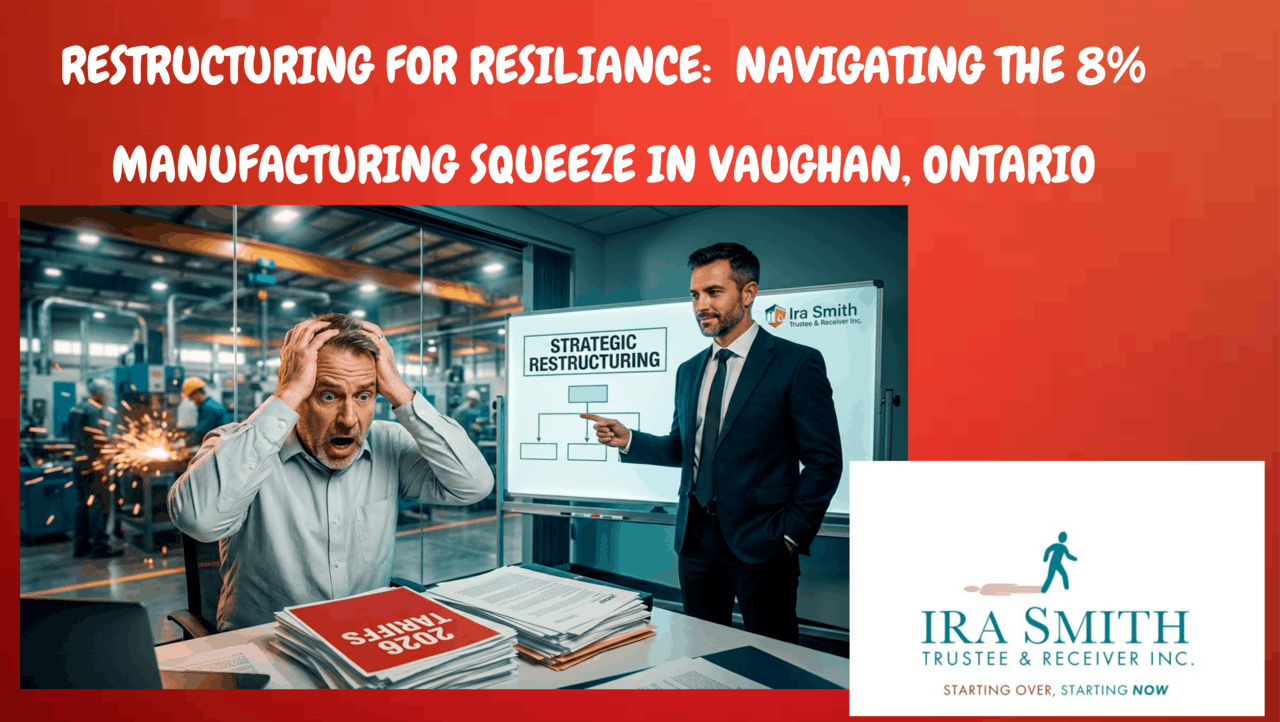
The manufacturing sector in Ontario is hitting a serious wall, and the outlook for 2026 isn’t promising. The Financial Accountability Office of Ontario (FAO) has already flagged that real GDP growth is stalling out, largely because persistent trade uncertainties and US tariffs are hamstringing exports and business investments. While you might not see an exact “8% manufacturing decline” quoted directly by the FAO, the ripple effect of these Emergency Tariffs on metals like steel and aluminum has essentially sheared 8% (or more) right off the top of profit margins. For a lot of shops, that makes turning the machines on a losing financial proposition.
This isn’t an economics lesson; it’s the reality for real families and real businesses in Vaughan. It’s usually not a demand issue or a quality problem. It’s an insane cost burden creeping into the supply chain that eats every bit of profit before the product even leaves the bay.
A. The Tariff Trap: Rising Costs vs. Fixed Contracts
Since 2025, those 25% tariffs on Canadian steel and 10% on aluminum rolling into the US haven’t budged. In fact, retaliatory moves and trade friction have only pushed costs higher. These aren’t just political talking points—they are massive line items gutting your bottom line.
For Vaughan’s metal stampers, fabricators, and auto parts suppliers, raw materials are suddenly costing a fortune. We’re routinely hearing about primary inputs jumping by 25% to 50%.
Here is where the “Tariff Trap” actually snaps shut: you probably signed long-term supply agreements or locked into pricing with your clients long before these tariff spikes became the new normal. So now, you’re legally obligated to churn out products at prices that were highly competitive a year ago, but are now bleeding you dry because the metal itself costs too much.
You simply can’t eat a 50% material cost spike without adjusting your outbound pricing. This mismatch violently strangles cash flow, burns through working capital, and pushes solid companies right to the edge of insolvency. It creates a nightmare scenario where the more orders you ship, the more cash you lose.
B. The Vaughan Angle: Concord and VMC Feeling the Heat
Vaughan is an absolute economic engine for Ontario. Between Concord and the expanding VMC, these industrial zones are the backbone of the Canadian supply chain. But because these businesses are so tightly woven into North American logistics, they take the hardest hits from border politics.
If you own a business here, you need to hear this: your current cash crunch probably isn’t a reflection of your management skills. You are caught in a crossfire of external economic policies. It’s infuriating because it feels entirely out of your hands, but diagnosing the actual cause is step one. Don’t let geopolitical shifts convince you that you’ve forgotten how to run your business.
C. CUSMA Review 2026: Uncertainty is the Enemy of Credit
Then there’s the upcoming CUSMA (Canada-United States-Mexico Agreement) review, locked in for July 1, 2026. This deal basically dictates North American trade, and its future is completely up in the air right now. We could see minor tweaks, massive renegotiations, or—in a worst-case scenario—a full US withdrawal. Some analysts are already floating the idea of a 2027 Canadian recession if things go south.
Banks absolutely hate this kind of uncertainty. Lenders run on risk assessment, and unquantifiable trade risks make them incredibly nervous. Because of this, we are already seeing banks tighten their grips. Securing a new operating line, bumping up existing credit, or getting capital for new gear is becoming a Herculean task for mid-market manufacturers. This credit crunch essentially traps you: your raw costs are up, your cash is low, and the banks won’t lend you the bridge capital you need to pivot.
II. Restructuring Through BIA Proposals: A Trade Strategy, Not a Surrender
When you’re squeezed by tariffs and frozen out by lenders, filing a Notice of Intention to Make a Proposal (NOI) or a formal Division I Proposal under the Bankruptcy and Insolvency Act (BIA) is not waving a white flag. It is a highly strategic business maneuver. It’s a legally binding shield designed to give you breathing room to fix your debt, adapt to the new market, and get back in the black.
A. The Technical Gap: Repudiating Unviable Contracts
Here’s a major, often overlooked advantage of a BIA Restructuring Proposal for Vaughan manufacturers: the legal power to “repudiate” (or cancel) terrible supply contracts. If you are stuck in a pre-2026 pricing agreement that forces you to lose money on every part you make, that contract is literally sinking your business.
Guided by a Licensed Insolvency Trustee (LIT) like our team at Ira Smith, a BIA Restructuring Proposal lets you legally walk away from those toxic obligations. This is the reset button you need to align your costs with reality and stop the bleeding.
How it Works: The moment you file a Notice of Intention (NOI) with the Official Receiver, an automatic stay of proceedings kicks in. This is a massive legal wall. It means creditors cannot sue you, seize assets, call in collections, or enforce judgments. You get 30 days of immediate peace (which can be extended up to six months through the courts) to build a formal proposal.
This proposal outlines how you’ll handle your debts—often paying a fraction of what is owed over time, sometimes without interest. Once the majority of your creditors vote to accept it, and the court sanctions it, the deal is locked in for everyone. You get a clean slate to operate without the anchor of past, unsustainable promises dragging you down.
B. Restructuring Through BIA Proposals vs. Other Options
It’s critical to know that a BIA Restructuring Proposal isn’t just another word for bankruptcy. Picking the right tool is the difference between saving your shop and shutting it down.
Avoiding Bankruptcy: Bankruptcy is a liquidation process. The business stops, an LIT sells the assets, and the doors close permanently. A BIA Restructuring Proposal is exactly the opposite: it’s a restructuring tool. You keep your assets, you keep running the business, and you keep your brand. It’s rehab, not the end of the line.
Leaner, Faster than CCAA: Massive corporations with over $5 million in debt use the Companies’ Creditors Arrangement Act (CCAA). It’s incredibly flexible but notoriously slow, highly public, and massively expensive due to constant court appearances. For a mid-market manufacturer in Vaughan, a BIA Restructuring Proposal is the leaner, faster, and much cheaper alternative. It’s a rules-based framework that gets you back to focusing on the factory floor rather than sitting in a lawyer’s office.
Comparison Table: Key Insolvency Options for Businesses in Canada
| Feature | BIA Division I Proposal | Bankruptcy | Receivership | CCAA (Companies’ Creditors Arrangement Act) |
| Primary Purpose | Restructure debt, continue operations, avoid liquidation | Liquidate assets, extinguish debts, cease operations | Creditor-driven asset realization/sale – csan be “going concern” or liquidation. | Restructure large, complex corporate debts (usually $5M+) |
| Debtor Control | Debtor (management) remains in control of the business, but under a LIT | Debtor loses control; Trustee takes over management and assets | Debtor loses control; Receiver manages/sells assets. | Debtor remains in possession, but under a court-appointed monitor |
| Contract Repudiation | Can legally repudiate (cancel) unviable contracts | Existing contracts are generally terminated upon bankruptcy | May repudiate contracts under court supervision. | Can legally repudiate (cancel) unviable contracts |
| Debt Limit | No upper monetary limit for corporations | No monetary limit | No monetary limit | Minimum $5 million in debt required |
| Cost | Generally lower than CCAA. Fees are structured and rules-based | Varies, can be lower if few assets, but the business is lost | Varies greatly, can be substantial, paid by a secured creditor | Generally highest, highly complex, extensive legal and monitor fees |
| Stay of Proceedings | Automatic and broad stay of proceedings upon filing | Automatic and broad stay of proceedings upon filing | Stay if court-orderedspecific to receiver’s appointment | Broad, court-ordered stay of proceedings, very powerful |
| Impact on Business | Rehabilitates business; allows for a fresh start financially | Business ceases to exist; assets sold | Business may be sold as a going concern or liquidated | Rehabilitates business, often with significant operational changes |
| Publicity | Public filing, but often less media attention than CCAA | Public filing | Public process, often initiated by banks | Highly public, often attracts significant media scrutiny |
| Decision-Making | Management and LIT propose plan; creditors vote | LIT makes decisions based on legal requirements | Receiver makes decisions in best interest of appointing creditor | Management and monitor propose plan; court approves |
III. The “Gridlock” Multiplier: Local Infrastructure Strain
Tariffs and trade talks are macro problems, but local infrastructure is hitting you right in your backyard. The daily traffic reality in Vaughan is multiplying the financial strain, severely impacting how fast you can turn over product and generate cash.
A. Rutherford Road and Highway 400 Lane Reductions
If you move freight, you already know the nightmare that is Rutherford Road and Highway 400. Lane reductions, detours, and the massive CN Rail bridge project are choking logistics. And with timelines dragging into Fall 2026, this bottleneck isn’t clearing up anytime soon.
Getting a truck from point A to point B used to be a fixed, predictable expense. Now, it’s a moving target. Every half hour a driver spends staring at brake lights is cash out of your pocket.
B. The Cost of Congestion on Your P&L
This isn’t just an annoyance; it’s actively draining your P&L statement:
- Fuel Burn: Idling trucks burn expensive diesel while moving zero product.
- Wages and Overtime: Your drivers are clocking longer hours just to finish standard routes.
- Bottlenecked Capacity: Fewer drop-offs per shift means you can’t hit your optimal fulfillment numbers.
- Late Penalties: If your contracts have strict on-time delivery clauses, traffic is literally triggering financial penalties.
- Inventory Bloat: Because inbound logistics are so unreliable, you’re likely holding more safety stock, which ties up vital cash on your warehouse floor.
If your metal costs are up 30% and your trucking costs are spiking because of gridlock, you are being crushed from both sides.
Restructuring Trustee Note: We Understand Your Local Reality
Our office at 167 Applewood Crescent is just minutes from this mess. I see the transport trucks backed up on Rutherford and at the 400 interchange every single day. This isn’t just abstract data to our team; it’s the exact same traffic we sit in. We actively factor this localized “cost of congestion” into our turnaround strategies because we know a solution has to work on the ground in Vaughan, not just on paper in a boardroom.
IV. Director Protection: Avoiding the “OBR Silent Dissolution” Nightmare
When you’re trying to save a sinking ship, paperwork is usually the last thing on your mind. But letting corporate compliance slide can trigger a silent, catastrophic threat: the OBR Silent Dissolution. It takes a purely corporate money problem and turns it into a personal financial disaster.
A. The Ontario Business Registry (OBR) 2026 Compliance Audits
The Ontario Business Registry (OBR) requires standard annual corporate returns. During a financial crisis, it’s easy to throw these forms in a drawer. But the OBR is running strict compliance audits. If you fail to file for a set period (usually two years), the province can automatically dissolve your corporation.
Letting these slide as we head into the 2026 headwinds is like walking into a minefield.
B. The Risk: Losing Your Corporate Veil
If the OBR administratively dissolves your business, the “corporate veil”—the legal shield that separates the company’s debts from your personal bank accounts—evaporates.
In a restructuring scenario, this is the ultimate nightmare. Without that veil, creditors can suddenly look past the company and come directly after your house, your savings, and your investments to settle corporate debts:
- Unpaid Wages: Under Ontario law, directors can be personally on the hook for up to six months of employee wages and a year of vacation pay.
- Unremitted HST and Source Deductions: This is the big one. If the company used CRA money (like HST, CPP, or EI deductions) to keep the lights on, the CRA holds directors personally responsible. They don’t mess around, and they have the power to seize your personal assets rapidly.
- Other Liabilities: Depending on the situation, directors might also face personal heat for environmental issues or other statutory breaches if they acted negligently while insolvent.
Protecting your family’s assets isn’t selfish; it’s your duty. This is exactly why you need an expert to help you navigate financial distress safely before an administrative oversight destroys your personal future.
V. Frequently Asked Questions (FAQs)
Q1: What’s the absolute first step if my Vaughan manufacturing business is struggling with tariff costs and other financial pressures?
A1: Pick up the phone and call a Licensed Insolvency Trustee. At Ira Smith Trustee & Receiver Inc., we do a free, confidential deep dive into your numbers. We’ll look at your specific manufacturing hurdles and map out exactly what the BIA can do for you. Time is your best asset here; the longer you wait, the fewer options you have.
Q2: Can a BIA Proposal actually save my business from closure, or is it just a delay tactic?
A2: It is absolutely built to save your business. It’s not stalling; it’s a heavy-duty legal mechanism. The automatic stay of proceedings forces creditors to back off while we build a plan to cut the dead weight, renegotiate your debts, and restructure the operation so it can actually make money again.
Q3: How long does a BIA Proposal typically take, and what exactly happens?
A3: It starts the day we file the Notice of Intention (NOI), which instantly gives you 30 days of legal protection. We can push that out to six months through the courts if needed. During that time, we look at which contracts need to be ripped up and draft a payment plan for your creditors. It is vastly faster and much more controlled than going through a bankruptcy.
Q4: Will I lose my business’s assets in a BIA Proposal, like machinery or inventory?
A4: No. This is the main reason to choose a Proposal over bankruptcy. You keep the factory, the CNC machines, the inventory, and the brand. The whole point is to keep the business alive and generating revenue so you can fulfill the new, negotiated payment terms.
Q5: What if my creditors vote no?
A5: We need a majority of your creditors (by both number and dollar value) to agree. We handle the negotiations to ensure the offer is fair and highly likely to pass. If they do reject it, the business automatically goes into bankruptcy. That is exactly why having a seasoned LIT handling the negotiations is critical.
Q6: Are there government grants to help Vaughan manufacturers offset these 2026 tariffs?
A6: The government occasionally rolls out temporary relief or remissions, but they are notoriously narrow, constantly changing, and unreliable. Pinning your survival on a future government handout is incredibly risky. A BIA Proposal is something you can control internally right now to fix your balance sheet.
Q7: Will a BIA Proposal ruin my reputation with suppliers?
A7: It’s a public filing and will hit your credit rating temporarily, but the market views it infinitely better than a bankruptcy. It shows suppliers you took ownership of a tough situation, restructured smartly, and kept the doors open. A clean, restructured balance sheet actually makes you a safer bet moving forward.
Brandon’s Restructuring Take: Don’t Let the “Tariff Trap” Define Your Future
I’ve sat across the desk from countless hard-working Vaughan business owners who are feeling crushed right now. Between the 2026 tariffs, jumpy lenders, CUSMA fears, and the fact that you can barely get a truck down Rutherford Road, it’s a brutally unfair landscape. You built your shop with your own two hands, and watching global politics threaten to tear it down is demoralizing.
But please, don’t throw in the towel. We firmly believe there is a path through this if you play it smart and act early. The Bankruptcy and Insolvency Act was written for exactly this scenario—to give good companies the legal teeth to shed bad debt, ditch toxic contracts, and stabilize.
More importantly, we need to make sure you are personally shielded. The last thing you need is the CRA coming after your house because of corporate HST arrears. We aren’t here to judge how you got into a cash crunch; we’re here to give you the strategic playbook to get out of it safely.
Restructuring Conclusion: Your Path to Resilience Starts Here
The 2026 squeeze on Vaughan’s manufacturing sector is severe, but it doesn’t have to be fatal. For the shops in Concord and the VMC, surviving this requires expert advice and decisive action. You do not have to figure this out alone.
At Ira Smith Trustee & Receiver Inc., we specialize in pulling Canadian manufacturers out of complex financial distress. We know the insolvency laws inside out, and because we work right here in Vaughan, we understand the exact local pressures you’re dealing with.
Don’t wait until the bank forces your hand. Engaging a Trustee proactively can absolutely mean the difference between losing the shop and setting it up for its next decade of success.
Contact Ira Smith Trustee & Receiver Inc. today for a free, completely confidential consultation. Let us build a restructuring plan that works for you.
Ira Smith Trustee & Receiver Inc. is licensed by the Office of the Superintendent of Bankruptcy and is a member of the Canadian Association of Insolvency and Restructuring Professionals.
Phone: 905.738.4167 Toronto line: 647.799.3312
Website: https://irasmithinc.com/
Email: brandon@irasmithinc.com
——————————————————————————–
Disclaimer: This analysis is for educational purposes only and is based on the cited sources and my professional expertise as a licensed insolvency trustee. The information provided does not constitute legal or financial advice for your specific circumstances. Every situation is unique and involves complex legal and factual considerations. The outcomes discussed in this article may not apply to your particular situation. Situations are fact-specific and depend on the particular circumstances of each case. Please get in touch with Ira Smith Trustee & Receiver Inc.
About the Author: Brandon Smith is a Senior Vice-President at Ira Smith Trustee & Receiver Inc. and a licensed insolvency trustee serving clients across Ontario. With extensive experience in complex court-ordered receivership administration and corporate insolvency & restructuring proceedings, Brandon helps businesses, creditors, and professionals navigate challenging financial situations to achieve optimal outcomes. Brandon stays current with landmark developments in Canadian insolvency law. He brings this cutting-edge knowledge to every client engagement, ensuring his clients benefit from the most current understanding of their rights and options.