Categories
Brandon Blog Post

MORTGAGE DEFAULT IN ONTARIO: OUR ULTIMATE GUIDE TO SURVIVE PAYMENT SHOCK TO SAVE YOUR HOME

Mortgage Default in Ontario: Introduction

Undeniably, Canada’s top banking regulator just issued a massive warning that millions of homeowners are facing crippling payment shock, leaving many terrified of losing their properties through mortgage default in Ontario. Fortunately, you do not have to become another statistic or let the bank dictate your financial future. Ultimately, we will show you exactly how to legally eliminate your unsecured debt and free up the cash required to save your family home.

Key Takeaways

  • Defaults Are Rising: Canada’s banking regulator warns that residential mortgage defaults are the top threat to the financial system.
  • Payment Shock is Real: Millions of Canadian mortgages are due to renew by the end of 2027, causing massive spikes in monthly costs.
  • Act Before the Bank Does: Missing a mortgage payment in Ontario rapidly triggers a Power of Sale, risking your home’s equity.
  • There is a Solution: You can successfully free up cash to afford your mortgage by legally eliminating credit card debt through a Consumer Proposal.
  • Get Expert Help: Ira Smith Trustee & Receiver Inc. offers free, confidential consultations to help design your roadmap to financial freedom.

What is a Mortgage Default in Ontario?

Fundamentally, a mortgage default in Ontario occurs when an Ontario homeowner violates the terms of their mortgage contract, most commonly by missing one or more scheduled monthly payments. Consequently, the lender gains the legal right to act on the breach of contract, as it is not just about missing a single payment; it can also include failing to pay property taxes or letting home insurance lapse.

According to Brandon Smith, Senior Vice-President of Ira Smith Trustee & Receiver Inc., a mortgage default in Ontario typically leads to a Power of Sale, a process where the lender sells the property to recover the debt without taking legal ownership. This is different than a traditional foreclosure. Therefore, understanding this definition is the first critical step to protecting your primary residence.

Why Mortgage Default in Ontario Matters

Crucially, a mortgage default in Ontario matters because it initiates a rapid, aggressive legal process that can strip away your family home in a matter of months. Unquestionably, banks are actively preparing for widespread financial failures across the province. In April 2026, the Office of the Superintendent of Financial Institutions (OSFI) reported that rising residential mortgage defaults are the top risk facing Canadian banks, driven by 3.1 million mortgage renewals expected by 2027— [Source: OSFI’s Annual Risk Outlook – Fiscal Year 2026-2027, April 14, 2026]. Consequently, the massive spike in monthly costs creates a severe “payment shock” for household budgets. Thus, ignoring the importance of this threat guarantees that you will lose control of your biggest financial asset.

Furthermore, the timeline for losing a home in Ontario is surprisingly fast once a default occurs. Usually, lenders wait just 15 days after a missed payment to mail a formal notice of legal action. If you cannot afford to clear the arrears, you could face a forced sale and eviction shortly thereafter. Fortunately, contacting our Licensed Insolvency Trustee firm in Toronto immediately can help you map out a strategy to halt collection harassment. Overall, time is your most valuable weapon when dealing with an angry mortgage lender.

How Mortgage Default in Ontario Happens: The OSFI Warning

Structurally, a mortgage default in Ontario happens when rising interest rates collide with heavy unsecured debt, leaving families entirely unable to make their monthly housing payments. Recently, Canada’s banking regulator officially labelled residential mortgage defaults as the absolute number one risk facing Canadian banks over the next two years. 52% of all outstanding mortgages will renew by 2027 — Source: [OSFI Report, 2026]. Consequently, families carrying high credit card balances are finding it physically impossible to cover both their daily expenses and a ballooning mortgage. Ultimately, this collision of debts forces hardworking homeowners to choose between buying groceries and paying the bank.

Globally, the financial markets are watching Canada closely because over 3.1 million Canadian mortgages are due to renew by the end of 2027 — Source: [OSFI April Report, 2026]. Consequently, banks are aggressively provisioning funds to cover anticipated losses from these defaults. Furthermore, homeowners in Toronto and Vancouver are feeling the tightest squeeze due to immensely inflated housing prices now in a downslide and historic cost-of-living increases. Ultimately, this macroeconomic data proves that your personal financial struggle is part of a much larger, systemic crisis.

Moreover, the banking sector’s preparation for this crisis means they are less likely to offer leniency to struggling homeowners. Historically, lenders might have offered generous deferral programs, but the current sheer volume of at-risk mortgages makes that impossible today. 64% of high-risk mortgages are clustered in major urban centers like the Greater Toronto Area — Source: [Canada Mortgage and Housing Corporation, Mortgage renewal wave strains some regions and borrowers, February 5, 2026]. Therefore, relying purely on the bank’s goodwill is a dangerous and deeply flawed strategy.

Understanding Mortgage Payment Shock

Technically, mortgage payment shock is the sudden, massive increase in monthly mortgage payments when renewing at a much higher interest rate. Indeed, 1.3 million Canadians are currently facing severe payment shock — Source: [OSFI Report, 2026]. For example, a homeowner who locked in a historically low rate in 2021 might now see their monthly payment increase by over a thousand dollars. Sadly, wages have not grown fast enough to absorb these enormous, unprecedented hikes. Therefore, this specific financial shock is the primary catalyst pushing middle-class Ontarians into arrears.

Financially, average monthly mortgage payments are projected to increase by over $1,000 for families experiencing payment shock — Source: [Canada Mortgage and Housing Corporation, Mortgage renewal wave strains some regions and borrowers, February 5, 2026]. Immediately, this staggering increase drains any remaining disposable income a family might possess.

Also, trying to cover these massive new payments by relying on credit cards only accelerates the path toward total insolvency. In short, borrowing more money to pay off existing debt is a guaranteed recipe for losing your home.

The Power of Sale Process in Ontario

The Power of Sale is the specific remedy lenders use in Ontario to force the sale of a home after a mortgage default in Ontario occurs. Unlike a traditional foreclosure, the mortgagee does not take legal title to your home; they simply sell it on the open market to recover their funds. In Ontario, lenders typically begin the Power of Sale process after 15 to 30 days of a missed payment, making rapid action essential for homeowners. In reality, the lender wants their money back as quickly as possible, not your physical property.

Additionally, the costs associated with a Power of Sale are entirely passed down to the defaulted homeowner. Specifically, the bank’s legal fees, property appraisal costs, and real estate commissions are all subtracted directly from your home’s equity. Consequently, you could lose decades of built-up wealth simply because you missed a few mortgage payments. Thus, acting quickly to stop the legal collection process preserves your family’s hard-earned equity.

A high-contrast split-screen digital graphic showing the emotional journey of a mortgage default in Ontario: the left side depicts a stressed homeowner in blue and red lighting holding a 'Notice of Sale,' while the right side shows the same person in warm golden lighting feeling joyful relief while holding a 'Debt Forgiven' document.
mortgage default in Ontario

Stopping Mortgage Default in Ontario: The Consumer Proposal Solution

Strategically, stopping a mortgage default in Ontario requires generating immediate cash flow, which can be achieved by filing a Consumer Proposal to eliminate your unsecured debt if you are insolvent. If you have sufficient equity in your home that renders you solvent, then you cannot make a Canadian insolvency filing under the Bankruptcy and Insolvency Act (Canada). In such a case, where you are actually solvent but cannot make your mortgage payment on time, you are also described as being house-rich but cash-poor!

First, you must realize that you cannot negotiate your way out of a secured mortgage contract, but you can entirely restructure your credit cards, tax debts, and personal loans if you are insolvent. Homeowners experiencing severe mortgage payment shock can use a Consumer Proposal, filed through a Licensed Insolvency Trustee like Ira Smith Trustee & Receiver Inc., to legally eliminate unsecured debts and free up cash flow to afford their mortgage. Consequently, by sacrificing the unsecured debt, you successfully save the secured asset—your family home. Ultimately, this legal approach acts as a financial life raft during a severe economic storm.

How It Protects Your Home

Importantly, while a Consumer Proposal does not directly rewrite your mortgage contract, it instantly removes the competing financial pressures draining your bank account. By legally wiping out high-interest credit card payments through a Consumer Proposal, Canadian homeowners instantly redirect necessary funds toward curing their mortgage arrears. Furthermore, it permanently stops all collection calls and legally freezes the interest on those unsecured debts. Naturally, this strategy empowers you to approach your mortgage lender confidently with the cash needed to cure the default. You can learn more about how to file a Consumer Proposal here.

Additionally, a Consumer Proposal offers a fixed, highly predictable monthly payment plan that lasts up to five years. Specifically, you only pay back a small portion of what you owe, and the remaining unsecured balance is entirely forgiven. Meanwhile, your mortgage lender sees that you have stabilized your overall cash flow and hopefully becomes much more willing to negotiate terms, or it allows you to stay current under the existing terms. Therefore, decisively solving your unsecured debt problem is the absolute key to fixing your secured debt crisis.

Alternatives to Consider

Alternatively, if keeping the home is mathematically impossible even without unsecured debt, you need to explore different avenues immediately. Sometimes, voluntarily selling the property yourself before the bank executes a Power of Sale is the smartest financial move. By doing this, you maintain control over the sale price and avoid the lender’s massive legal fees. However, our experienced team at Ira Smith Trustee & Receiver Inc. always explores every possible strategy to keep you in your home first. In brief, our primary goal is to find the least invasive solution to your financial crisis.

Sometimes, filing for Personal Bankruptcy is the necessary reset button if a Consumer Proposal is simply not viable. Clearly, bankruptcy is a powerful legal process that completely clears your debts and offers a totally fresh financial start. Although many people fear this option, it is a highly regulated, federally protected, and safe method for escaping impossible financial burdens. Regardless, our priority is to educate you on all available legal options so you can make an informed, confident choice.

Conversely, ignoring the problem will force the bank’s hand and inevitably lead to an eviction notice. Naturally, lenders do not want to manage real estate, but they will not hesitate to liquidate your property to recover their principal investment. Therefore, acting proactively before the bank serves you with legal papers is essential for maintaining any negotiating power. Indeed, waiting too long completely removes your ability to dictate the terms of your own financial rescue.

Tools for Managing a Mortgage Default in Ontario

Practically, managing a mortgage default in Ontario requires using a “Cash Flow Allocation Tool” to see exactly how much money you can save by restructuring your unsecured debt. Next, you need to calculate your monthly incoming wages strictly against your new, post-renewal mortgage payment. Below, we have provided a practical breakdown of how a typical family can survive payment shock by simply eliminating credit card obligations. Obviously, seeing the hard numbers on paper removes the emotional fear and replaces it with an actionable plan. Here is a clear example of how eliminating unsecured debts saves your home.

Specifically, review this example comparative table to understand how reallocating funds dramatically changes your monthly household survival rate. I stress this is just an example, but it is also real:

Financial CategoryBefore Consumer ProposalAfter Consumer Proposal
New Mortgage Payment$3,500$3,500
Credit Card Minimums$1,200$0 (Legally Erased)
Unsecured Line of Credit$800$0 (Legally Erased)
Consumer Proposal Payment$0$400
Total Monthly Debt Cost$5,500$3,900
Total Cash Flow Saved$0$1,600 / month

Undeniably, saving $1,600 every single month gives you the exact financial leverage needed to cure a mortgage default in Ontario. Accordingly, you can instantly use these newfound savings to catch up on missed payments and satisfy the bank’s demands. We highly recommend taking a screenshot of this table to discuss with your partner or family today. Finally, contacting our team for a free assessment will help you build a personalized, accurate version of this exact cash flow model.

Visually, we encourage families to print out their current bank statements and colour-code their necessary living expenses versus high-interest debt payments. Subsequently, mapping out these numbers clearly reveals exactly where your hard-earned cash is leaking out every single month. Next, successfully applying the Consumer Proposal model shows an immediate transformation in your household’s financial health. Truly, data-driven decisions are the only proven way to combat the emotional panic of a looming mortgage default in Ontario.

What to Do Next About Your Mortgage Default in Ontario

Crucially, your next step if you are facing a mortgage default in Ontario is to immediately consult a Licensed Insolvency Trustee to build a protective financial strategy. Initially, do not wait for the bank’s aggressive collection lawyers to send you a Notice of Sale in the mail. Instead, proactively gather all your financial documents, including your latest mortgage statement, credit card bills, and income slips. 78% of homeowners who act early can avoid losing their property to forced liquidation — Source: [Office of the Superintendent of Bankruptcy Canada, Insolvency Statistics in Canada — January 2025]. Therefore, rapid preparation is the absolute key to surviving this impending crisis.

Subsequently, you must absolutely stop using your credit cards to pay for daily living expenses, as this only deepens the financial trap. Besides, relying on high-interest debt to bridge the severe gap of payment shock is entirely unsustainable over the long term. Afterwards, you need to sit down with our experienced professionals to review the exact numbers of your situation. Assuredly, our compassionate, non-judgmental team will help you clearly see the light at the end of the tunnel. Altogether, taking swift action today is the only guaranteed way to regain your peace of mind.

Furthermore, prioritizing your mental health during a mortgage default in Ontario crisis is just as important as actively managing your money. Understandably, the extreme stress of potentially losing a family home causes immense anxiety, sleep deprivation, and severe relationship strain. However, handing your complex financial burden over to a federally regulated expert immediately lifts this crushing weight off your shoulders. Ultimately, our expert legal guidance allows you to focus on your family’s well-being while we systematically handle the aggressive creditors.

Frequently Asked Questions: Mortgage Default in Ontario & Financial Solutions

Q: What is a mortgage default in Ontario?

A: Falling into mortgage default in Ontario essentially means you’ve broken the terms of your mortgage agreement. While most people think this only happens when you miss a monthly payment, it can also be triggered by failing to pay your property taxes or letting your home insurance coverage lapse. Once you’re in default, the lender gains the legal right to step in and start recovering the money they’re owed by enforcing their mortgage security, leading to a sale of your home.

Q: What is mortgage payment shock?

A: Payment shock is that stressful realization that your monthly mortgage costs are about to skyrocket. This usually happens at renewal time if interest rates have climbed significantly since you first signed your deal. In the current Ontario market, it’s not uncommon for families to see their monthly obligations jump by $1,000 or more practically overnight.

Q: What is a Power of Sale in Ontario?

A: A Power of Sale is the most common legal path lenders take in Ontario to get their money back after a default. It’s different from a foreclosure because the lender doesn’t actually take ownership of the house; instead, they sell it on the open market to settle the debt. This process moves fast—often starting just 15 to 30 days after the initial default.

Q: Who is eligible for a Consumer Proposal or Bankruptcy in Ontario?

A: To qualify, you must be technically “insolvent,” which means your assets, if liquidated, would not produce enough money to pay off your debts, and you owe at least $1,000 and simply cannot keep up with your debts as they fall due. For a Consumer Proposal, your unsecured debts (this excludes your primary mortgage) must be under $250,000 (proposed amendments to the legislation will raise this limit to $325,000). You also need to be a resident of Canada or own property here, and you’ll need to work through a Licensed Insolvency Trustee to get the ball rolling.

Q: What is the difference between a Consumer Proposal and Bankruptcy?

A: The big difference lies in how your assets are treated and how your payments are calculated. In a Consumer Proposal, you generally keep all your assets—including your home equity—and pay back a portion of what you owe through fixed monthly payments over a period of up to five years. Bankruptcy is more restrictive; you may have to surrender certain assets, and your monthly payments could increase if your income goes up.

Q: Can a Consumer Proposal stop a mortgage default in Ontario?

A: It can’t stop a mortgage default in Ontario because the default has already taken place. However, a Consumer Proposal can be instrumental in helping you resolve the default. Even though a Consumer Proposal focuses on unsecured debt like credit cards or personal loans, it can be a lifesaver for your home. By legally wiping out those other high-interest monthly payments, you free up the cash flow needed to manage your mortgage and pay off any arrears. This often provides enough financial breathing room to stop the Power of Sale process in its tracks.

Conclusion: Resolving Your Mortgage Default in Ontario

In conclusion, a mortgage default in Ontario is a severe financial breach that triggers a Power of Sale, but it can be completely resolved by restructuring your unsecured debt. Unquestionably, the banking regulator’s recent warnings about severe payment shock are terrifying, yet you do not have to be a victim of this systemic issue. By confidently working with Ira Smith Trustee & Receiver Inc., you can legally eliminate your credit card debt and secure the cash flow necessary to keep your family home. Ultimately, you possess the power to outsmart the system and permanently regain your financial freedom.

Don’t wait until it’s too late. The longer you delay, the fewer options become available, and the greater the risk to your business and your personal finances. Taking that first step to seek expert advice is the most powerful and proactive decision you can make right now.

Take Action Today: Contact Ira Smith Trustee & Receiver Inc.

We are Licensed Insolvency Trustees, dedicated to providing clear, actionable, and compassionate advice to businesses across Ontario. We offer:

  • Free, Confidential Consultations: Discuss your unique situation without cost, obligation, or judgment.
  • Expert Guidance: Understand all your options for business debt restructuring, from informal negotiations to formal proposals under Canadian law.
  • A Clear Path Forward: Get a personalized, step-by-step plan tailored specifically to your business’s needs and goals.
  • Relief from Pressure: We can help you stop creditor harassment and regain control.

Let us help you lift the burden of debt and guide your business towards a sustainable, successful future. Call us now or visit our website to schedule your free consultation. Your business’s second chance starts here.

Take the first crucial step towards a brighter financial future for your business. Contact Ira Smith Trustee & Receiver Inc. today to schedule your free initial consultation. Your business’s pivot to sustainable success starts now.

Don’t let financial uncertainty dictate your future. If you or your business is struggling with debt, losing sleep, or facing the possibility of legal action, contact Ira Smith Trustee & Receiver Inc. today. We offer a free, confidential consultation to discuss your situation, explain your options in plain language, and help you develop a clear, actionable plan.

Our team of Licensed Insolvency Trustees is dedicated to providing the compassionate, professional support you need to regain control and achieve a debt-free life. Take the first step towards a brighter financial future – call us now.

Ira Smith Trustee & Receiver Inc. is licensed by the Office of the Superintendent of Bankruptcy and is a member of the Canadian Association of Insolvency and Restructuring Professionals.

————————————————————————–

Disclaimer: This analysis is for educational purposes only and is based on the cited sources and my professional expertise as a licensed insolvency trustee. The information provided does not constitute legal or financial advice for your specific circumstances.

Every situation is unique and involves complex legal and factual considerations. The outcomes discussed in this article may not apply to your particular situation. Situations are fact-specific and depend on the particular circumstances of each case.

Please contact Ira Smith Trustee & Receiver Inc.get in touch with Ira Smith Trustee & Receiver Inc.

About the Author:

Brandon Smith is a Senior Vice-President at Ira Smith Trustee & Receiver Inc. and a licensed insolvency trustee serving clients across Ontario. With extensive experience in complex court-ordered receivership administration and corporate insolvency & restructuring proceedings, Brandon helps businesses, creditors, and professionals navigate challenging financial situations to achieve optimal outcomes.

Brandon stays current with landmark developments in Canadian insolvency law. He brings this cutting-edge knowledge to every client engagement, ensuring his clients benefit from the most current understanding of their rights and options.
A high-contrast split-screen digital graphic showing the emotional journey of a mortgage default in Ontario: the left side depicts a stressed homeowner in blue and red lighting holding a 'Notice of Sale,' while the right side shows the same person in warm golden lighting feeling joyful relief while holding a 'Debt Forgiven' document.
mortgage default in Ontario
Categories
Brandon Blog Post

ONTARIO’S RISING MORTGAGE DEFAULT PROBLEM: THE ALARMING TRUTH YOU NEED TO KNOW

A few months ago, I drove past something troubling. A house appeared to sit empty for weeks, then a realtor’s for-sale sign with the extra wording “Power of Sale” appeared on the lawn. As a Licensed Insolvency Trustee serving the Greater Toronto Area, I believed this wasn’t just a one-off situation. What I discovered when I looked into Ontario’s mortgage default numbers was far more concerning than I expected.

A few weeks ago, I wrote about the debt problems of normal GTA residents who invested in pre-construction Toronto condos, who cannot afford to complete the purchase when the condo was available to close on. This is a different problem – those who closed on the purchase of their GTA home but now cannot afford to pay the mortgage, creating a mortgage default in the GTA.

Understanding Mortgage Default in Ontario

A mortgage default happens when a homeowner can’t make their mortgage payments for roughly 3 months or more. Global News has reported that in Ontario, we’re seeing mortgage default rates climb faster than at any time in recent years. The numbers tell a story that many homeowners and professionals need to understand.

That is the most common type of default. But in Ontario, mortgage default doesn’t just mean missing payments. You can also default if you stop paying your property taxes, let your home insurance lapse, or fail to maintain your property in reasonable condition. When any of these things happen, your lender has the legal right to start a Power of Sale process to sell your home and recover their money.

Here’s what’s important: if you’re struggling to make payments, call your lender right away. Many lenders will work with you by extending your mortgage term, temporarily reducing payments, or waiving late fees. The key is reaching out before you miss multiple payments—the earlier you ask for help, the more options you’ll have.

According to its August 18, 2025, Newsroom publication, Equifax Canada reported that Ontario’s 90-day mortgage default rate in Q2 2025 was 0.27% representing a year-over-year increase of 11 basis points. Even more striking: reporting indicates that defaults are now 50% higher than before the pandemic. Over 11,000 Ontario homeowners missed mortgage payments in late 2024 alone.

Why the Real Numbers Are Higher Than You Think

Here’s what concerns me as someone who works directly with struggling homeowners: the official numbers don’t show the complete picture. When you see mortgage default statistics in the news, they’re missing a huge piece of the puzzle—private mortgage lending. The Financial Services Regulatory Authority of Ontario (FSRA) reports that private mortgage lending defaults are not included in the reported numbers. The reported numbers only include data from commercial banks and other financial institution mortgage lenders offering conventional mortgage financing.

The Private Lending Blind Spot

Private mortgage lenders serve borrowers who can’t qualify with major banks. These include:

  • Real estate investors
  • People with credit challenges
  • People requiring bridge financing
  • Those who need quick financing

Private lenders don’t always report their defaults to Equifax or TransUnion Canada. This means the real mortgage default rate in Ontario could be significantly higher than what’s publicly reported.

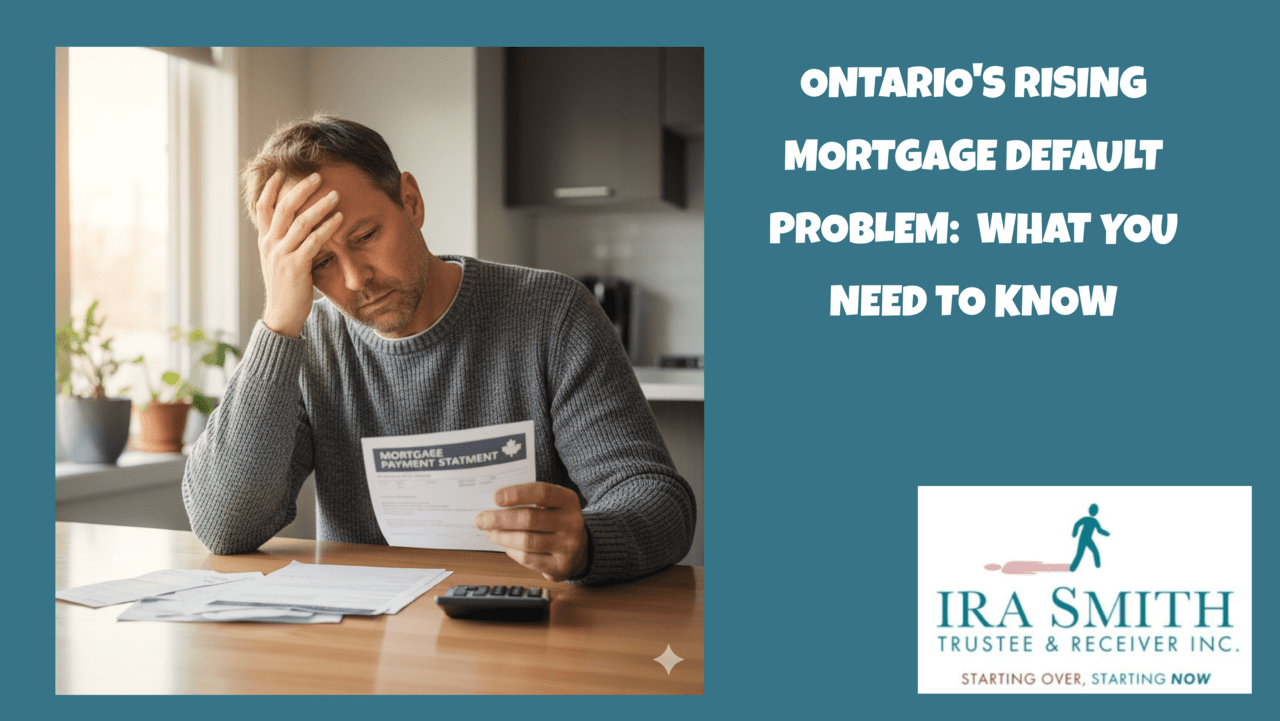
I’ve seen this firsthand in my practice. Clients come to me after defaulting on private mortgages, normally second mortgages, often owing much more than their homes are worth. By the time they reach out, they’re facing Power of Sale proceedings and a judgment against them for the full loan amount, as the house has not been sold yet. When it does, it is certain to cause a shortfall to the lender. These people in financial distress have few options left.Stressed homeowner reviewing mortgage default bills and calculator at kitchen table in Toronto home

What’s Driving Mortgage Defaults in Ontario?

Many people blame rising interest rates, and they’re partly right. The Bank of Canada has reported on the impact of higher mortgage rates. The Bank of Canada raised rates sharply after 2022, causing mortgage payments to jump for anyone who elected for a variable rate when pandemic interest rates made the money about as close to free as you can get. IG Wealth Management reports that mortgage variable interest rates saw a significant increase to a peak of around 5.95% in late 2024, from their lowest point of around 0.25% in March 2020. But that’s not the whole story.

The Real Causes Run Deeper

Unaffordable Housing: For years, home prices in Ontario climbed faster than incomes. Many families stretched their budgets for the home purchase, leaving no cushion for unexpected problems.

High Household Debt: TransUnion Canada reported that Canadians carry record levels of debt beyond their mortgages—credit cards, car loans, and lines of credit. When mortgage payments rise, these other debts become impossible to manage.

Risky Lending Practices: Before rates went up, some lenders approved mortgages for people who could barely afford them. They assumed home prices would keep rising forever.

Change in employment conditions: When someone loses their job or has their hours cut, their income either drops or is completely lost. A mortgage default can then happen quickly—especially if they were already living paycheque to paycheque.

Warning Signs of Mortgage Default

As a Licensed Insolvency Trustee, I’ve worked with real estate investors who own several residential homes (including condos), including their matrimonial home, facing mortgage default. Here are the early warning signs I see most often:

  • Juggling payments: Using credit cards to make normal food purchases, as all their cash is going to keep the properties propped up, or use a line of credit to make mortgage payments
  • Missing other bills: Skipping utility or credit card payments to cover the mortgage
  • Borrowing from family: Repeatedly asking relatives for money to stay afloat
  • Avoiding mail: Not opening letters from your lender because you’re scared of what they say
  • Losing sleep: Constant worry about money affecting your health and relationships

If you recognize these signs in your own life, you’re not alone—and there are options available to help.Stressed homeowner reviewing mortgage default bills and calculator at kitchen table in Toronto home

What Happens During Mortgage Default

Understanding the mortgage default process can help you act before it’s too late.

The Timeline

Months 1-2: You miss one or two payments. Your lender will call and send letters asking you to catch up.

Month 3: After 90 days, you’re officially in mortgage default. Your lender may issue a demand letter requiring full payment within a specific timeframe.

Months 4-6: If you can’t pay, your lender will start Power of Sale proceedings (in Ontario). This legal process allows them to sell your home to recover their money. They will probably also sue you and get a judgment for the full mortgage debt. The amount of their claim will be reduced after they receive the net sale proceeds from the sale of your property. This final amount is called their shortfall claim. It will not only include their outstanding principal amount, but also their interest costs and legal fees.

In private mortgages, once the mortgage loan goes into default, under the mortgage agreement, the private lender can charge extra fees. There would also be additional fees incurred because of the default status. All these costs are added to the principal balance outstanding, which increases the shortfall.

Months 4-6+: Your home gets listed for sale. If it doesn’t sell, your lender may eventually take ownership.

The exact timeline varies based on your lender, your situation, and how quickly you respond to their communications.

Power of Sale vs. Foreclosure: Ontario’s System

Under Ontario real estate law, lenders use the Power of Sale process rather than foreclosure. This matters because it affects your options and timeline. Quebec, British Columbia, Alberta, Manitoba, Saskatchewan, Nova Scotia, and the three territories use a foreclosure process.

Power of Sale means your lender can sell your home without going through court (though they must follow strict legal procedures). You still own the home during this process, and you have rights—including the right to pay off the debt and stop the sale.

This is different from foreclosure, where the lender takes ownership of your property through the courts. Ontario’s system is generally faster, which means you have less time to find a solution.Stressed homeowner reviewing mortgage default bills and calculator at kitchen table in Toronto home

What You Can Do If You’re Facing Mortgage Default

The worst thing you can do is ignore the problem. I’ve seen too many people wait until the Power of Sale notice arrives before seeking help. By then, their options are limited, and the stress is overwhelming.

Immediate Steps to Take

1. Contact Your Lender Right Away: Banks don’t want your house—they want their money. Many lenders will work with you on payment plans or temporary relief if you reach out early.

2. Review Your Budget Honestly: Look at every expense and see what you can cut. Even small changes can free up money for mortgage payments.

3. Consider All Your Options: Depending on your situation, you might be able to:

  • Refinance to a lower rate or longer term
  • Sell your at least list your home for sale, before the Power of Sale begins
  • Rent out part of your home for extra income
  • Work out a payment plan with your lender

4. Get Professional Help: Talk to a Licensed Insolvency Trustee. We can explain options like consumer proposals or bankruptcy, which might help you keep your home or exit your debt in an organized way.

When Keeping Your Home Isn’t Possible

Sometimes, despite your best efforts, keeping your home just isn’t realistic. If your mortgage is much larger than what your home is worth, or if your income has dropped permanently, selling might be your best option.

A Licensed Insolvency Trustee can help you understand:

  • Whether you can sell before the Power of Sale begins
  • How to handle any remaining debt after the sale
  • What bankruptcy or a consumer proposal might mean for you
  • How to protect any equity you have in your home

The Emotional Side of Mortgage Default

I want to address something that doesn’t show up in the statistics: the emotional toll of facing mortgage default.

Clients often tell me they feel ashamed, like they’ve failed their families. They lose sleep, avoid social situations, and feel overwhelmed by constant worry. Some have health problems from the stress.

Here’s what I tell everyone who walks through my door: Facing financial trouble doesn’t make you a failure. Economic forces beyond your control—rising rates, job losses, unexpected expenses—can push anyone to the breaking point. What matters is taking action to protect yourself and your family.Stressed homeowner reviewing mortgage default bills and calculator at kitchen table in Toronto home

How Ontario’s Mortgage Default Crisis Affects Everyone

Even if you’re not personally facing mortgage default, this crisis matters. Here’s why:

Neighbourhood Property Values: When multiple homes in an area go into Power of Sale, it can drag down property values for everyone.

Community Stability: Families forced out of their homes disrupt schools, local businesses, and neighbourhood connections.

Economic Pressure: As more people struggle with mortgage payments, they cut spending elsewhere, affecting local economies.

Future Housing Affordability: If defaults lead to a crash in home prices, it could trigger broader economic problems that affect jobs and opportunities.

What Makes Ontario’s Situation Different

Working in the Greater Toronto Area, I see unique pressures that make Ontario’s mortgage default problem especially serious:

Extreme Housing Costs: Toronto and surrounding areas have some of the highest home prices in Canada. Even a small income disruption can trigger default.

Private Lending Concentration: The CBC reported that Ontario, particularly the GTA, has a large private lending market serving investors and those who can’t get traditional mortgages. These loans carry higher risk and aren’t fully tracked in official statistics.

Investor Activity: Many GTA properties are owned by investors who use leverage to buy multiple properties. When rental income drops or rates rise, these investors are often the first to default.

New Construction Pressures: Buyers of pre-construction condos who relied on getting financing to complete purchases are particularly vulnerable as projects take years to be completed for the purchaser to take possession. Although they bought the condo unit years ago, they cannot apply for financing until around 90 days before they have to complete the purchase. If either their income or the real estate market, or both, take a negative turn and they cannot qualify for the amount of financing they require, big problems arise.Stressed homeowner reviewing mortgage default bills and calculator at kitchen table in Toronto home

Mortgage Default: Questions to Ask Before Getting Help

If you’re considering reaching out to a Licensed Insolvency Trustee or financial advisor, here are good questions to ask:

  • What are all my options for dealing with a mortgage default?
  • Can I keep my home if I file a consumer proposal?
  • How long will each option take?
  • What will happen to my credit rating?
  • Are there any options I can pursue on my own first?
  • What documents should I bring to our first meeting?

At Ira Smith Trustee & Receiver Inc., we answer these questions clearly and honestly. There’s no cost for an initial consultation, and our job is to help you understand your choices—not to pressure you into any particular decision.

Mortgage Default: Taking Action Before It’s Too Late

Here’s the bottom line: if you’re struggling with your mortgage payments, the time to act is now—not when you receive a Power of Sale notice.

The earlier you seek help, the more options you’ll have. Whether that means working with your lender, selling your home on your terms, or exploring debt relief options, taking action puts you back in control.

Your Next Steps

If you’re facing a mortgage default in the Greater Toronto Area:

  1. Don’t panic, but don’t wait: The situation won’t fix itself, but solutions exist.
  2. Gather your information: Get copies of your mortgage documents, recent statements, and a list of all your debts and income.
  3. Reach out for professional guidance: A Licensed Insolvency Trustee can review your situation confidentially and explain your options at no cost.
  4. Keep communicating: Stay in touch with your lender, even if you don’t have good news. Silence makes everything worse.

Frequently Asked Questions About Mortgage Default in Ontario

Understanding Mortgage Default

Q: What exactly is mortgage default?

A: Mortgage default happens when you can’t make your mortgage payments for about three months (90 days) or more. Once you hit that 90-day mark, your lender considers your mortgage officially in default and can start taking legal action.

Q: How quickly are mortgage default rates rising in Ontario right now?

A: The numbers are climbing faster than we’ve seen in years. In Q2 2025, Ontario’s 90-day mortgage default rate hit 0.27%—that’s an 11 basis point jump from the year before. Even more concerning, defaults are now much higher than they were before the pandemic.

Q: Do the official statistics tell the whole story?

A: Unfortunately, no. The official numbers miss a huge part of the problem—private mortgage lending. The statistics you see reported only include commercial banks and traditional financial institutions. Private lenders don’t necessarily report their defaults to Equifax Canada or TransUnion Canada, which means the real mortgage default rate in Ontario is likely much higher than what gets published.

Q: Who typically uses private mortgage lenders?

A: Private lenders serve people who can’t get approved by the big banks. This includes:

  • Real estate investors buying multiple properties
  • People who need money quickly (bridge financing)
  • Those with credit problems or past bankruptcies
  • Self-employed individuals who can’t prove traditional income
  • Buyers of pre-construction properties

What Causes Mortgage Default?

Q: Why are so many people defaulting on their mortgages?

A: Everyone talks about rising interest rates, and yes, the Bank of Canada’s sharp rate hikes after 2022 made payments jump for people with variable-rate mortgages. But that’s only part of the story. The real causes include:

  • Unaffordable housing: Home prices in Ontario shot up way faster than wages, forcing families to stretch every dollar just to buy
  • Too much debt: Most Canadians are juggling mortgages plus credit cards, car loans, and lines of credit—when the mortgage payment goes up, something has to give
  • Risky lending: Before rates went up, some lenders approved mortgages for people who could barely afford them, betting that prices would keep climbing forever
  • Job loss: When someone loses their job or gets their hours cut, they can fall behind fast—especially if they were already living paycheque to paycheque
Q: What makes Ontario’s situation worse than other provinces?

A: Ontario, especially the Greater Toronto Area, faces unique pressures:

  • Sky-high housing costs: Toronto has some of Canada’s most expensive homes, so even a small income drop can push people into default
  • Heavy private lending: The GTA has a huge private lending market that serves risky borrowers, and these loans aren’t tracked properly
  • Investor problems: Many Toronto properties are owned by investors who borrowed heavily to buy multiple homes—they’re often the first to default when rents drop or rates rise
  • Pre-construction issues: Buyers of new condos can get stuck if their finances change before closing, leaving them unable to get the final mortgage they need
Q: What are the warning signs that I might be heading toward default?

A: From my years helping people in financial trouble, here are the red flags I see most often:

  • You’re using your line of credit or credit cards to make mortgage payments
  • You’re skipping other bills (utilities, credit cards) to keep up with your mortgage
  • You’re constantly borrowing money from family or friends
  • You’re afraid to open mail from your lender
  • You’re losing sleep and feeling stressed about money all the time

If you recognize yourself in any of these, please reach out for help now—don’t wait.

The Default Process

Q: What actually happens when my mortgage goes into default?

A: Here’s the typical timeline:

Months 1-2: You miss one or two payments. Your lender starts calling and sending letters asking you to catch up.

Month 3 (90 days): You’re now officially in default. Your lender may send a demand letter requiring you to pay the full amount owed within a specific timeframe.

Months 4-6: If you can’t pay, your lender starts Power of Sale proceedings. They can also sue you for the full mortgage debt.

Months 4-6+: Your home gets listed for sale by the lender.

Q: What’s the difference between Power of Sale and foreclosure?

A: Ontario uses the Power of Sale, which is different from the foreclosure process used in provinces like BC, Alberta, and Quebec.

Power of Sale (Ontario’s system):

  • Your lender can sell your home without going to court (though they must follow strict legal rules)
  • You still own the home during this process
  • You have the right to pay off the debt and stop the sale at any point before it’s sold
  • It’s generally faster than foreclosure, giving you less time to find a solution

Foreclosure (other provinces):

  • The lender actually takes ownership of your property through the courts
  • It’s usually a slower process
Q: Are there extra costs if I default on a private mortgage?

A: Yes, and this is important. Private lenders can charge significant extra fees once you go into default—it’s usually written into your mortgage agreement. These fees get added to what you owe, making the shortfall even bigger. This is one reason why private mortgage defaults can spiral out of control so quickly.

Getting Help

Q: What’s the worst mistake I can make if I’m struggling with my mortgage?

A: Ignoring the problem. Too many people stick their heads in the sand and wait until they get a Power of Sale notice before asking for help. By then, your options are much more limited, and your stress level is through the roof. The earlier you act, the more we can do to help.

Q: What should I do right now if I’m having trouble making payments?

A: Take these steps immediately:

  1. Call your lender: I know it’s scary, but banks would rather work out a payment plan than take your house. The sooner you contact them, the more willing they are to help.
  2. Look at your budget honestly: Go through every expense and see what you can cut. Even small savings add up.
  3. Know your options: You might be able to refinance, sell before the Power of Sale starts, rent out a room, or work out a payment arrangement.
  4. Talk to a Licensed Insolvency Trustee: We can explain all your options in a free, confidential meeting.
Q: How can a Licensed Insolvency Trustee help me?

A: As a Licensed Insolvency Trustee, I can help you:

  • Understand every option available for dealing with your default
  • Explain how a consumer proposal might let you keep your home while reducing your debt
  • Figure out if you can sell your home before the Power of Sale begins
  • Show you how to handle any money you still owe after your home is sold
  • Protect any equity you have in your property
  • Determine if bankruptcy might actually give you a fresh start

The initial consultation is always free and completely confidential. I’m here to explain your choices, not pressure you into anything.

Q: What should I bring to my first meeting with you?

A: Gather these documents before we meet:

  • Your mortgage documents and statements
  • Recent pay stubs or proof of income
  • A list of all your debts (credit cards, loans, lines of credit)
  • Your most recent property tax bill
  • Any letters from your lender

Don’t worry if you don’t have everything—we can still talk through your situation and figure out next steps.

Q: How much does it cost to talk to a Licensed Insolvency Trustee?

A: The initial consultation is free. There’s no charge to sit down with me, explain your situation, and learn about your options. If you decide to move forward with a consumer proposal or bankruptcy, we’ll explain all the costs upfront—there are never any hidden fees.

Q: Will contacting a Licensed Insolvency Trustee hurt my credit even more?

A: Simply meeting with me and discussing your options has no impact on your credit score. Only if you decide to file a consumer proposal or bankruptcy will it affect your credit—but if you’re already facing mortgage default, your credit is likely already damaged. The question is: what’s the best path forward to rebuild your financial life?

Final Thoughts on Ontario’s Mortgage Default Crisis

Ontario’s rising mortgage default rates represent more than just numbers on a page. Behind every statistic is a family facing tough decisions, sleepless nights, and an uncertain future.

What worries me most isn’t just the official numbers—it’s what those numbers don’t show. The private lending defaults, the stressed investors, the families barely hanging on—these aren’t all captured in the reports, but they’re very real.

If you’re one of those families, please know that help is available. As a Licensed Insolvency Trustee with years of experience serving the Greater Toronto Area, we’ve helped many people navigate mortgage default and find a path forward.

The situation might feel hopeless right now, but you have more options than you think. The first step is simply reaching out.

From our Vaughan office, we provide:

  • Free, confidential consultations
  • Expert guidance on bankruptcy alternatives
  • Consumer proposals that can reduce your debt
  • Corporate restructuring solutions
  • Court-supervised receiverships

Contact us today to discuss your situation. Let us help you understand your options and find the best solution for your financial future.

Brandon Smith, Licensed Insolvency Trustee
Senior Vice-President
Ira Smith Trustee & Receiver Inc.
167 Applewood Crescent, Suite 6
Vaughan, Ontario
Greater Toronto Area

905.738.4167

Toronto line: 647.799.3312

The information provided in this blog is intended for educational purposes only. It is not intended to constitute legal, financial, or professional advice. Readers are encouraged to seek professional advice regarding their specific situations. The content should not be relied upon as a substitute for professional guidance or consultation. The author, Ira Smith Trustee & Receiver Inc., and any contributors do not assume any liability for any loss or damage.


About the Author: Brandon Smith is a Licensed Insolvency Trustee with Ira Smith Trustee & Receiver Inc., serving the Greater Toronto Area. With years of experience helping individuals and families navigate debt challenges, Brandon provides clear, compassionate guidance for those facing mortgage default and other financial difficulties. If you’re struggling with mortgage payments, contact our office for a free, confidential consultation.Stressed homeowner reviewing mortgage default bills and calculator at kitchen table in Toronto home

Call a Trustee Now!