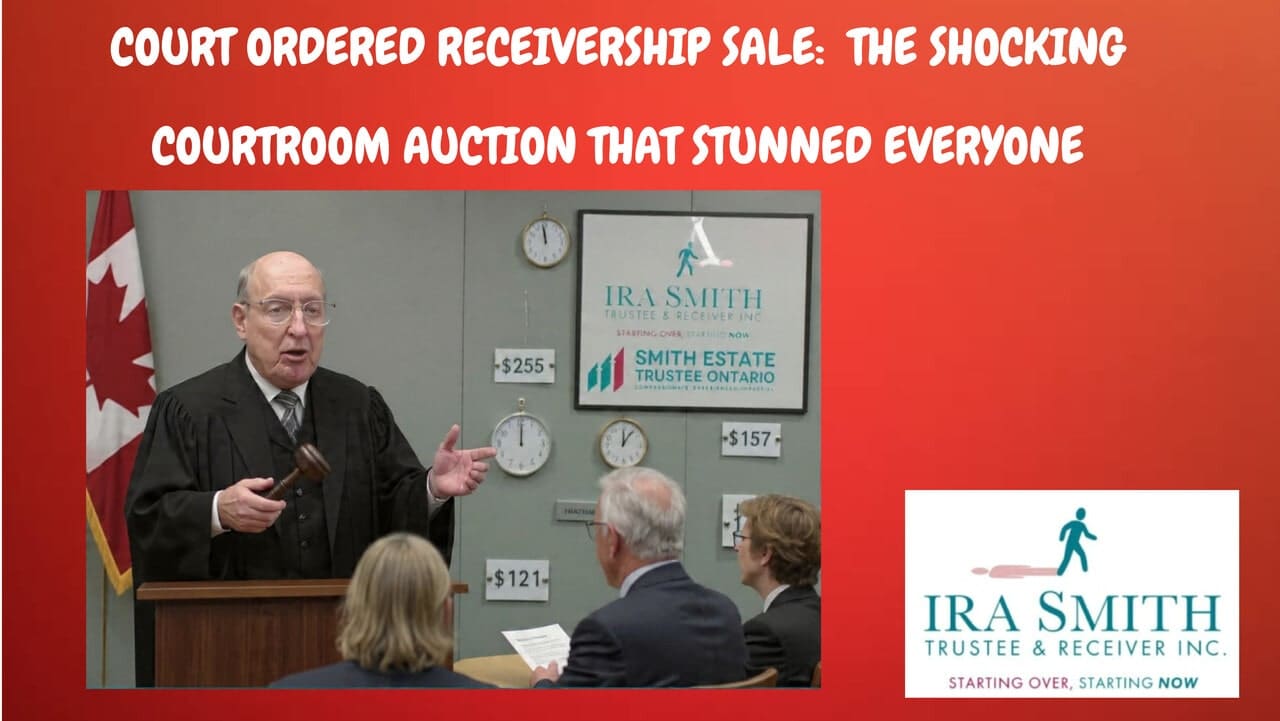
In October 2025, the Court of Appeal for Ontario delivered a landmark decision that fundamentally changes how a court ordered receivership sale works in Ontario. As further discussed below, this is not unique to Ontario. The case answered a critical question that haunts receivers, creditors, and buyers:
Can a judge reject a perfectly executed receivership sale simply because someone offers substantially more money at the last minute?
The answer, according to Ontario’s highest court, is a resounding yes. Section 243 of the Bankruptcy and Insolvency Act provides the authority in Canada for the court to appoint a receiver. Once the court is involved, it is the judge who ultimately drives the process through its court officer, the court-appointed receiver.
In Cameron Stephens Mortgage Capital Ltd. v. Conacher Kingston Holdings Inc., 2025 ONCA 732(CanLII), the court ruled that even when a receiver runs a flawless eight-month sales process, the judge can—and should—reopen bidding if a late offer is substantially higher. In this case, that threshold was 37% more than the accepted bid, representing approximately $3.5 million in additional recovery for creditors.
This isn’t an isolated decision. Courts across Canada, particularly in British Columbia, have been moving in this same direction for years. Together, these cases signal a new era in Canadian insolvency law: maximizing creditor recovery now trumps process certainty.
If you’re involved in a —as a creditor, business owner, receiver, potential buyer or legal counsel for any of these parties—understanding this shift could mean the difference between losing millions and capturing every available dollar.
Court Ordered Receivership Sale: Why This Case Matters to You Right Now
Before we dive into the legal details, here’s why the Cameron Stephens decision demands your immediate attention:
If You’re a Creditor:
- Courts will now aggressively intervene to protect your right to maximum recovery
- Even “late” competing offers will be considered if they’re substantially higher
- The 37% threshold provides clear guidance about when judges will reopen bidding
If You’re a Business Owner Facing Receivership:
- Higher asset values mean less shortfall and reduced personal liability
- The process isn’t over until the judge signs the approval order
- You may have opportunities to challenge sales that seem too low
If You’re Buying Assets in Receivership:
- Your accepted offer isn’t final until court approval
- Courts may reopen competitive bidding even at the approval hearing
- You need to bid your true maximum value from the start
If You’re a Receiver or Insolvency Professional:
- Running a perfect process no longer insulates you from judicial intervention
- Price gaps of 30%+ will trigger intense scrutiny
- Courts expect aggressive value maximization strategies
The Cameron Stephens Court Ordered Receivership Case: A Deep Dive into Ontario’s Landmark Decision
The Background: A Textbook Receivership Process
The facts of Cameron Stephens Mortgage Capital Ltd. v. Conacher Kingston Holdings Inc. began routinely enough. A Toronto property was subject to a court-appointed receivership, secured by a $15,600,000 mortgage held by Cameron Stephens Mortgage Capital Ltd.
The receiver did everything by the book:
Eight-Month Professional Marketing Campaign:
- Comprehensive marketing materials prepared and distributed
- Property is widely advertised to qualified buyers
- Multiple showings conducted
- Professional broker engaged
- Extensive outreach to potential purchasers
Serious Negotiations:
- Multiple offers received and evaluated
- Good faith negotiations with qualified buyers
- Financial due diligence conducted
- Terms and conditions carefully reviewed
Agreement Reached:
- The receiver negotiated an Agreement of Purchase and Sale (APS) with Arjun Anand
- The only condition: court approval
- Price and terms deemed fair and reasonable by the receiver
- All standard protections included
The receiver brought this agreement to the Ontario Superior Court of Justice for approval, expecting a routine hearing. The receiver’s conduct throughout the entire process was later described by the motion judge as “unassailable”—meaning it was beyond criticism, flawless, and professionally executed at every stage.
Everything appeared ready for the judge to simply approve the sale and allow it to close.
The Bombshell: Three Escalating Late Offers
Then, just before the scheduled court approval hearing, something dramatic happened.
A company called 100 Inc.—which was actually a subsidiary of the property owner—submitted not one, but eventually three competing offers:
First Late Offer: 6.7% higher than Anand’s accepted price
Second Late Offer: 14.2% higher than Anand’s accepted price
Third Late Offer (after adjournment): 37% higher than Anand’s accepted price
That final 37% differential represented approximately $3.5 million in additional value that would flow to creditors if the higher offer was accepted instead of Anand’s deal.
The motion judge faced an agonizing dilemma that strikes at the heart of every court ordered receivership sale:
Option 1: Approve the Original Deal (Protect Process Integrity)
Arguments in favour:
- The receiver ran a perfect eight-month process
- Anand negotiated in good faith and had an accepted agreement
- Accepting late bids undermines the integrity of receivership processes
- Future buyers won’t participate seriously if deals can be overturned
- The famous 1991 Court of Appeal for Ontario case Royal Bank of Canada v. Soundair Corp., 1991 CanLII 2727 (ON CA) (Soundair) warns against creating “chaos in the commercial world.”
Option 2: Reopen Bidding (Maximize Creditor Recovery)
Arguments in favour:
- The 37% price gap is enormous—approximately $3.5 million
- Creditors deserve the highest possible recovery
- Approving the lower offer might be “improvident” (unwise)
- The primary purpose of the Bankruptcy and Insolvency Act (BIA) is to maximize creditor recovery
- The late offer appears genuine, not a manipulative tactic
The Motion Judge’s Controversial Decision
After considering extensive submissions from all parties, the motion judge made a bold choice that shocked many that day.
Even though he explicitly found:
- The receiver’s conduct was “unassailable”
- The sales process was “without flaws”
- The receiver had acted properly at every stage
The judge refused to approve Anand’s deal.
His reasoning was straightforward:
The 37% price difference was so substantial that it qualified as “substantially higher.” Approving the lower offer in the face of such a large differential would risk being improvident—meaning unwise and harmful to creditors.
The judge couldn’t ignore $3.5 million that could flow to creditors simply to protect a process that, while perfect, had inadvertently missed the property’s true market value.
The Judge’s Creative Solution:
Rather than simply rejecting Anand’s deal and accepting the 100 Inc. offer (which would be grossly unfair to Anand), the motion judge crafted a balanced remedy:
- Six-Day Bidding Extension: Reopened the bidding process for six additional days
- All Prior Bidders Invited: Both Anand and 100 Inc. could submit new, higher bids
- Level Playing Field: Both parties had equal information and opportunity
- Cost Protection for Anand: If Anand wasn’t the successful bidder, the property owner would reimburse his reasonable legal costs incurred to date.
This solution aimed to:
- Maximize value for creditors (the paramount goal)
- Treat both bidders fairly (maintaining process integrity)
- Compensate Anand for his good faith participation (preventing unfairness)
Critical Insight: This decision shows that even perfect receivership processes can be disrupted when significantly higher offers emerge. Process integrity, while important, takes a back seat to maximizing creditor recovery when millions are at stake. The judge essentially turned Anand’s APS into a stalking horse bid.
Court Ordered Receivership Sale: The Appeal Tested the Limits of Judicial Discretion
Understandably, Arjun Anand was unhappy with this outcome. He had negotiated in good faith, secured an accepted agreement, and now faced having to re-bid against a competitor in a court-ordered auction.
He appealed to the Ontario Court of Appeal, raising important legal arguments that would determine how a court ordered receivership sale would function going forward.
Anand’s Main Arguments on Appeal
1. The Soundair Test Was Misapplied
Anand argued that the motion judge incorrectly interpreted the famous Soundair case. According to Anand, Soundair requires a court to find both:
- A significantly higher price, AND
- A compromised process integrity
He contended that because the receiver’s process was flawless (unassailable), the judge had no authority to reject the sale, regardless of the price differential.
2. Judicial Discretion Has Limits
Anand argued that allowing judges to reopen bidding whenever a higher offer appears—even after a proper process—would:
- Create chaos in the commercial marketplace
- Discourage serious buyers from participating
- Turn every receivership sale into an unwanted courtroom auction
- Undermine the authority and expertise of professional receivers
3. Good Faith Parties Must Be Protected
Anand emphasized that he negotiated in good faith with the receiver, spent considerable time and legal fees on due diligence, and reached an agreement. The Soundair case emphasizes protecting bona fide purchasers. Rejecting his deal, he argued, violated this fundamental principle.
The Court of Appeal for Ontario Groundbreaking Ruling
In the October 27, 2025, appellate court decision, the court dismissed Anand’s appeal and upheld the motion judge’s decision to reopen bidding.
The court’s reasons are crucially important for understanding how a court ordered receivership sale will work going forward:
Key Finding #1: The 37% Price Gap Alone Was Sufficient
The court ruled that the motion judge was correct to focus heavily on the magnitude of the price differential.
The court held:
A 37% higher offer (approximately $3.5 million more) was “substantially higher” and alone created a serious risk that approving the lower offer would be improvident.
Improvidence means approving a sale that is unwise and fails to adequately protect creditors’ interests. When the price gap is this large, it suggests the original offer doesn’t reflect true market value, even if the process was perfect.
The court emphasized: The receiver’s job is to obtain the highest price possible for creditors. When a substantially higher offer emerges—even late—the court must take it seriously to fulfill this mandate.
Practical Implication: The 37% threshold now provides concrete guidance. If you’re involved in a receivership and a late offer exceeds the accepted bid by 30%+, expect the court to seriously consider reopening the process.
Key Finding #2: Soundair Factors Are Flexible, Not Rigid
The Ontario Court of Appeal explicitly rejected Anand’s argument that courts must find both a significantly higher price and compromised process integrity to justify intervention.
The court stated:
The four Soundair factors are flexible and case-specific. They’re not a checklist where all boxes must be ticked. Courts must weigh all circumstances and exercise discretion based on the particular facts.
No single factor is determinative. Different cases will emphasize different factors depending on circumstances.
What this means:
- A flawed process with a moderate price gap might justify rejection
- A perfect process with a massive price gap might also justify rejection
- Courts evaluate the totality of circumstances
- Judicial discretion is broad and entitled to deference
For Receivers: You can’t rely on process perfection alone to guarantee approval. You must also be prepared to justify why your recommended price represents maximum market value.
Key Finding #3: Maximizing Recovery Is Paramount
The three-judge panel reaffirmed what has become increasingly clear across Canadian courts: the paramount objective of any court ordered receivership sale is to maximize recovery for creditors.
The court emphasized that the BIA exists primarily to:
- Preserve and liquidate assets efficiently
- Ensure liquidation results in maximum return
- Benefit creditors who are owed money
When the goal of maximum recovery conflicts with other considerations (like protecting a negotiated agreement), maximum recovery takes priority if the circumstances warrant it.
The court noted that while protecting good faith purchasers is important, it cannot override the fundamental duty to creditors when the price differential is substantial.
For Creditors: This ruling provides powerful protection for your interests. Courts will actively intervene to prevent you from receiving less than maximum value.
Key Finding #4: Deference to the Motion Judge’s Discretion
Finally, the Court of Appeal for Ontario emphasized that the motion judge’s decision was discretionary and therefore entitled to substantial deference on appeal.
Appellate courts don’t second-guess discretionary decisions unless the judge made a clear error in law or reached an unreasonable conclusion.
Here, the appellate court found:
- The motion judge properly considered all relevant factors
- He balanced competing interests appropriately
- His exercise of discretion was reasonable, given the 37% price gap
- The creative solution (reopening bidding with cost protection) was a proper exercise of judicial authority
The bottom line: Judges have broad authority to craft creative solutions in a court ordered receivership sale when necessary to maximize creditor recovery.
Court Ordered Receivership Sale: What the Cameron Stephens Decision Means in Practice
The 37% Threshold: New Guidance for All Parties
Cameron Stephens establishes that a 37% price differential is substantial enough to justify judicial intervention, even when the receiver’s process is beyond criticism.
For a property whose value justified a mortgage loan of millions of dollars, the 37% difference is not a trivial amount. For many creditors, this additional recovery represents:
- The difference between a substantial or full recovery and a significant shortfall
- Avoiding deficiency claims against personal guarantors
- Business survival versus bankruptcy
- Personal financial security versus personal insolvency
Open Question: While 37% clearly justifies intervention, what about lower differentials?
- Would 30% be enough? Probably.
- Would 20% be enough? Maybe, depending on other factors.
- Would 10% be enough? Perhaps, depending on all the circumstances of the particular case.
The Cameron Stephens decision doesn’t establish a bright-line rule, but it provides important guidance about the magnitude of price differential that triggers judicial scrutiny.
Process Perfection Is No Longer Sufficient Protection
For decades, receivers believed that if they ran a thorough, professional process following all best practices, courts would defer to their recommendations and approve their chosen deals.
Cameron Stephens fundamentally changes this assumption.
What This Means for Receivers:
Even when you:
- Obtain a professional appraisal
- Market extensively for many months
- Engage professional brokers
- Conduct comprehensive outreach
- Receive and evaluate multiple offers
- Negotiate terms professionally
- Document everything meticulously
You can still face court intervention if:
- A substantially higher offer emerges (30%+ above your accepted bid)
- The court questions whether your accepted offer reflects true market value
- The judge believes creditors would be better served by reopening competition
New Best Practices:
- Obtain professional appraisals for significant assets to support your pricing
- Document market testing thoroughly to demonstrate that the accepted offer reflects market reality
- Consider stalking horse structures with break fees to encourage early, strong bids
- Build flexibility into timelines to accommodate potential competing offers
- Prepare for potential bidding reopening by having contingency procedures ready
At Ira Smith Trustee & Receiver Inc., we’ve administered receivership processes where both a late higher offer emerges or when there is opposition to a recommended sale but there was no competing offer. We always anticipate potential challenges and build in protections from the start.
Buyers Should Bid Their True Maximum Early
Cameron Stephens sends a clear message to potential purchasers in a court ordered receivership sale: don’t lowball and expect to have the last word.
The New Reality for Buyers:
Your accepted agreement with the receiver is not final until:
- The court approval hearing occurs
- No substantially higher offers emerge
- The judge signs the approval order
What You Should Do:
- Bid aggressively from the start,, realizing the maximum you are prepared to pay
- Don’t negotiate down, expecting no competition
- Budget for legal costs that might not be recoverable
- Be prepared to re-bid if the court reopens the process
- Understand timing risk because approval isn’t guaranteed
The Good News: If you submit a strong initial offer and someone submits a late, higher bid, you’ll have the opportunity to increase your bid through a reopened process. The highest bidder ultimately wins.
The Risk: If you lowball initially and someone else is prepared to offer closer to the property’s true value, you may end up losing the deal entirely or paying more than you would have if you’d bid fairly from the start.
Creditors Have Powerful New Tools
If you’re a creditor in a court ordered receivership sale, Cameron Stephens is excellent news.
Your New Rights:
- Courts will actively protect your right to maximum recovery
- You can challenge sales that appear improvident
- Late offers that are substantially higher (30%+) will be seriously considered
- Judges will use creative solutions to capture additional value
What You Should Do:
- Monitor the receivership process closely from the beginning
- Review the receiver’s reports and ask questions about pricing
- Conduct your own market research to assess whether proposed prices seem reasonable
- If you become aware of potentially higher offers, bring this to the receiver’s and court’s attention
- Attend court hearings to voice concerns about inadequate pricing
- Consider retaining your own advisor if significant money is at stake
Court ordered receivership sale
This Is Not an Isolated Case: B.C. Supreme Courts Have Been Leading the Way in Court Ordered Receivership Sale Process
The Cameron Stephens decision might seem revolutionary, but it’s actually part of a broader trend across Canadian courts. The British Columbia Court of Appeal has been issuing similar rulings for several years, establishing that courts will use creative interventions to maximize creditor recovery in court ordered receivership sales.
Ontario’s highest court has now aligned with this approach, confirming that this is the new Canadian standard, not a regional anomaly.
The BC Trend: Three Landmark Cases
Case #1: The Versante Hotel Live Courtroom Auction (2025)
What Happened:
I would like to express thanks to Eamonn Watson of Dentons Canada LLP in Vancouver, who provided us with information regarding the currently unreported Court ordered receivership sale in the Versante Hotel case.
In International Trade Center Properties Ltd. (the Versante Hotel case), a Richmond, BC receiver had negotiated a $48 million sale of a luxury hotel with Citation Properties. At the court approval hearing, a competing party (Silverport Properties) appeared with a sealed bid higher than $48 million.
The BC Supreme Court judge faced the same dilemma as the Cameron Stephens judge: approve the negotiated deal or pursue the higher offer?
The Court’s Creative Solution:
Justice Fitzpatrick ordered an unprecedented live auction in the courtroom the following day. Both Citation (the original buyer) and Silverport would compete on equal footing with transparent bidding.
The Result:
The bidding was “lively,” going back and forth multiple times. Citation ultimately won but had increased its offer to $51.5 million—a $3.5 million gain for creditors achieved in mere minutes.
Key Parallels to Cameron Stephens:
- Both involved late competing offers
- Both courts prioritized maximizing recovery over protecting negotiated deals
- Both judges created creative solutions (live auction vs. reopened bidding)
- Both resulted in approximately $3.5 million in additional creditor recovery
- Both show courts will intervene dramatically when a substantially higher value is available
The Lesson: When immediate opportunities to capture significantly more value arise, courts have the power and willingness to create extraordinary processes to realize that value quickly and transparently.
Case #2: QRD (Willoughby) Holdings – When Process Flaws and Price Gaps Combine (2024)
What Happened:
In QRD (Willoughby) Holdings Inc. v. MCAP Financial Corporation, 2024 BCCA 318 (CanLII) (Willoughby), a receiver was selling a suspended real estate development in Langley, BC. The receiver marketed the property for less than 2.5 months (described as “markedly short”) and recommended accepting a $35 million offer.
However, a competing proposal from Foundation Residence Society offered $64 million—a staggering $29 million difference, though with significant conditions and a longer closing timeline.
The Court’s Findings:
The BC Court of Appeal found the chambers judge erred by:
- Insufficient weight to the massive price gap: The $29 million differential suggested the receiver hadn’t adequately tested the market
- No professional appraisal: The absence of a valuation undermined confidence that $35 million represented the best value
- Markedly short marketing period: Less than 2.5 months was inadequate for a major development property
The Result:
While the Court of Appeal criticized the process and found it flawed, they still dismissed the appeal because by the time of the appeal, the higher bidder still hadn’t firmed up their conditional offer. Continuing delays would have cost even more in mounting debt.
Key Parallels to Cameron Stephens:
- Price gap signals improvidence: Both courts held that large price differentials (37% in Cameron Stephens, 83% in Willoughby) raise serious concerns about whether the accepted offer represents market value
- Court scrutiny is intense: Even though Willoughby involved process flaws while Cameron Stephens didn’t, both cases show that courts will heavily scrutinize pricing when competing offers differ substantially
- Timing matters: Both cases emphasize the tension between capturing higher value and managing time/cost pressures
The Key Difference:
Cameron Stephens shows that process perfection doesn’t insulate you from intervention when the price gap is substantial. Willoughby shows that process deficiencies combined with price gaps will definitely attract court criticism.
The Lesson: Whether your process is perfect or flawed, substantial price gaps will trigger judicial intervention to prevent improvident sales that shortchange creditors.
Case #3: Peakhill Capital – Creative Structures to Maximize Recovery (2024)
What Happened:
In British Columbia v. Peakhill Capital Inc., 2024 BCCA 246 (CanLII) (Peakhill)the , a receiver was selling valuable real property in a court ordered receivership sale. Rather than a traditional sale, the receiver structured the transaction using a Reverse Vesting Order (RVO).
An RVO is a complex legal structure that:
- Moves unwanted liabilities out of the debtor company
- Leaves the core assets in place
- Sells the company’s shares instead of transferring the land title
The Purpose:
This complicated structure had one clear goal: to avoid approximately $3.5 million in BC property transfer tax (PTT), thereby maximizing the net recovery for creditors.
The Province of BC challenged this, arguing courts don’t have jurisdiction to approve structures designed solely to avoid tax.
The Court’s Decision:
The BC Court of Appeal upheld the RVO, ruling that:
- The of gives courts broad authority to approve creative solutions
- Structuring commercial transactions to avoid unnecessary taxes is legitimate outside of insolvency
- Therefore, using an RVO to achieve this in receivership is appropriate
- Maximizing creditor recovery is a proper purpose under the BIA
- Saving $3.5 million in tax means $3.5 million more for creditors
Key Parallels to Cameron Stephens:
- Maximizing recovery is paramount: Both courts emphasized that the primary purpose of receivership is maximizing creditor returns
- Creative solutions are acceptable: Just as Peakhill approved a novel legal structure, Cameron Stephens approved reopened bidding—both are creative judicial interventions
- Courts have broad discretion: Both decisions emphasize the wide authority courts have under the BIA to achieve optimal outcomes
- The $3.5 million parallel: Interestingly, both Peakhill and Cameron Stephens involved capturing approximately $3.5 million in additional value
The Lesson: Courts will approve unconventional approaches—whether creative deal structures or creative bidding processes—if the goal is to lawfully maximize what creditors receive.
The Emerging Court Ordered Receivership Sale Canadian Consensus: Maximizing Recovery Above All
When we look at Cameron Stephens alongside the BC Court of Appeal decisions, a clear pattern emerges:
Common Principles Across All Cases:
1. Creditor Recovery Is The Top Priority
Every case—Cameron Stephens, Versante, Willoughby, Peakhill—emphasizes that the paramount objective of any court ordered receivership sale is maximizing what creditors recover.
When this goal conflicts with other important values (process integrity, protecting negotiated deals, following traditional procedures), maximizing recovery wins if the circumstances warrant it.
2. Courts Will Intervene Creatively When Necessary
Canadian courts have shown remarkable willingness to create extraordinary solutions:
- Live courtroom auctions (Versante)
- Reopened competitive bidding (Cameron Stephens)
- Novel legal structures (Peakhill)
- Extensions of marketing time (Willoughby—though ultimately denied for other reasons)
The days of rigid, formalistic receivership processes are over. Judges will craft pragmatic solutions tailored to specific circumstances to achieve optimal outcomes.
3. Substantial Price Gaps Demand Judicial Attention
Whether it’s:
- 37% higher (Cameron Stephens – approximately $3.5M)
- 7.3% higher (Versante – $3.5M on $48M)
- 83% higher (Willoughby – $29M differential)
Courts treat significant price differentials as red flags suggesting the accepted offer may not reflect true market value and may be improvident.
4. Process Perfection Is Necessary But Not Sufficient
Cameron Stephens definitively establishes that running a flawless receivership process doesn’t guarantee approval if substantially higher offers emerge.
You need both:
- A thorough, professional process (necessary)
- Pricing that reflects maximum market value (also necessary)
One without the other isn’t enough.
5. Flexibility Over Rigidity
All these cases emphasize that the Soundair factors are flexible and case-specific, not a rigid checklist. Courts evaluate the totality of circumstances and exercise broad discretion to achieve outcomes that serve the BIA’s core purposes.
What This Means: A New Era for the Court Ordered Receivership Sale Process
Taken together, these cases signal that Canadian court ordered receivership sales have entered a new era characterized by:
✓ Greater judicial activism in protecting creditor interests
✓ Less deference to receivers when pricing seems questionable
✓ More creative interventions to maximize recovery
✓ Heightened scrutiny of price, even when the process is perfect
✓ Willingness to disrupt negotiated deals when a substantially higher value is available
✓ Emphasis on outcomes (maximum recovery) over process (following procedures)
For everyone involved in receiverships, this means:
- Uncertainty until court approval is actually granted
- Higher ultimate recoveries for creditors
- More competitive pressure on buyers
- Greater need for professional expertise to navigate complex proceedings
- Increased importance of documentation to justify pricing recommendations
[Need expert guidance navigating these new realities? Contact us to schedule your free consultation.]
Court Ordered Receivership Sale Practical Implications: What You Must Do Now
If You’re a Creditor in a Court Ordered Receivership Sale:
Your Rights Are Stronger Than Ever:
The Cameron Stephens decision, combined with the BC cases, provides powerful tools to protect your interests.
Action Steps:
- Monitor the process actively from the beginning—don’t just wait for the receiver’s reports
- Question pricing if you have doubts about whether the accepted offer reflects market value
- Conduct independent research to assess comparable sales and market conditions
- If you become aware of potentially higher offers, bring this immediately to the receiver’s and the court’s attention before the approval hearing
- Attend court hearings and consider retaining counsel if significant money is at stake
- Don’t assume the receiver’s recommendation is automatically optimal—you have the right to challenge it
What Cameron Stephens Confirms:
Courts will protect your right to maximum recovery, even if that means disrupting processes and negotiated deals. Don’t hesitate to advocate for your interests.
If You’re a Business Owner or Guarantor Facing Receivership:
There’s Both Risk and Opportunity:
Cameron Stephens shows that receivership sales can be unpredictable, but courts actively work to maximize asset values.
What This Means for You:
The Good News:
- Courts will push for higher asset values, reducing deficiency amounts
- Larger recoveries mean less personal liability under guarantees
- You have grounds to challenge sales that seem improvident
The Challenges:
- Process uncertainty can delay resolution
- You have limited control once a receiver is appointed
- Courts prioritize creditors’ interests over yours
Action Steps:
- Get professional advice early—before receivership if possible
- Understand your rights to participate in and observe the receivership process
- Monitor asset sales and question pricing that seems low
- Consider whether alternatives to receivership (proposals, refinancing, restructuring) might be available
- Cooperate with the receiver—obstruction reduces values and increases costs
Critical Timing:
The earlier you engage an experienced licensed insolvency trustee, the more options you’ll have to protect your interests.
[Facing potential receivership? Contact us so that we may provide you with a free, confidential consultation before it’s too late.]
If You’re Buying Assets in a Court Ordered Receivership Sale:
The Rules Have Changed:
Your accepted agreement isn’t final until court approval, and that approval is no longer a formality.
Key Realities:
- Bid closer to your true maximum early—don’t expect to lowball and win
- Budget for uncertainty—approval timelines are unpredictable
- Prepare to re-bid—courts may reopen competitive processes
- Understand cost risks—your legal fees might not be recoverable
- Factor in delay—closing may take longer than anticipated
Strategic Considerations:
- Early participation protects you—engage in the official process from the start
- Due diligence matters—understand true market value before bidding
- Financial readiness is crucial—be prepared to increase your bid quickly
- Relationship with receiver helps—serious, professional buyers get respect
The Upside:
If you bid fairly based on true value, you’ll likely succeed. The Cameron Stephens approach actually rewards buyers who recognize and are willing to pay for true asset value.
If You’re a Receiver or Insolvency Trustee:
Your Job Just Got Harder:
Cameron Stephens raises the bar for what courts expect from receivers conducting court ordered receivership sales.
Requirements:
- Professional Valuations: Obtain appraisals for significant assets to support pricing recommendations
- Enhanced Documentation: Meticulously document marketing efforts, offer comparisons, and provide pricing justification
- Market Testing: Ensure marketing periods are adequate (Willoughby warns against “markedly short” timelines)
- Contingency Planning: Build flexibility into processes to handle late competing offers
- Price Justification: Be prepared to explain why your recommended price represents maximum market value
- Creative Solutions: Consider stalking horse structures, auction mechanisms, or other approaches that maximize competition
The Reality:
Even if you do everything perfectly, courts may still intervene if substantially higher offers emerge. Your role is to:
- Run the best process possible
- Document everything thoroughly
- Recommend the highest supportable price
- Be prepared to adapt to judicial intervention
At Ira Smith Trustee & Receiver Inc., we understand these lessons from our past receivership administrations. We understand what courts expect and how to structure processes that satisfy Cameron Stephens’ requirements.
Frequently Asked Questions (FAQ) About Cameron Stephens and The Court Ordered Receivership Sale Process
Q: Does the 37% threshold mean courts won’t intervene for smaller price gaps?
Not necessarily. Cameron Stephens establishes that 37% is clearly sufficient, but doesn’t set a floor. The Versante case shows courts may intervene for smaller differentials (around 7%) depending on circumstances. Each case is evaluated on its facts. Generally, price gaps of 30%+ will almost certainly trigger scrutiny, while gaps under 10% are less likely to justify intervention absent other issues.
Q: Can receivers prevent late bids from disrupting approved sales?
Not entirely. Courts have ultimate authority over sale approvals. However, receivers can use strategies to minimize disruption:
- Stalking horse agreements with break fees (compensating the initial bidder if outbid)
- Clear deadlines for competing offers
- Auction mechanisms are built into the process from the start
- Professional appraisals supporting the accepted offer
These don’t prevent courts from considering late bids, but they structure processes that make late challenges less likely to succeed.
Q: What if the late higher offer has conditions that might not be satisfied?
Courts will consider the reliability and certainty of competing offers. In Willoughby, the $64 million offer had extensive conditions, which was one reason for skepticism. However, if the conditions are reasonable and the price gap is substantial, courts may grant time extensions to allow the bidder to satisfy conditions. The judge will balance:
- The magnitude of the price increase
- The reasonableness of conditions
- The likelihood conditions will be satisfied
- The cost of delay to the estate
Q: As a creditor, how do I know if I should challenge a receiver’s recommended sale?
Key warning signs that a sale might be improvident:
- The accepted offer is significantly lower than you expected based on market research
- The marketing period was very short (under 3 months for a major sale of assets)
- No professional appraisal was obtained
- You’re aware of other potential buyers who weren’t contacted
- The receiver’s report doesn’t adequately justify the pricing
- A competing offer exists that’s substantially higher (30%+)
If you see these red flags, consult with an experienced licensed insolvency trustee or legal counsel before the court approval hearing.
Q: If I’m the original buyer and the court reopens bidding, am I protected?
Cameron Stephens shows courts will try to balance fairness. The motion judge ordered reimbursement of Anand’s legal costs if he wasn’t the successful bidder. However, this protection isn’t guaranteed in every case. You should:
- Negotiate cost protection into your initial agreement if possible
- Budget for the risk of non-recoverable costs
- Be prepared to increase your bid to remain competitive
- Understand that court approval is required and not automatic
Q: How long does a typical court ordered receivership sale take now?
It varies widely, but Cameron Stephens and the BC cases suggest timelines are becoming less predictable:
- Marketing period: 2-6 months typically (though Willoughby warns against being “markedly short”)
- Negotiation to court hearing: 4-8 weeks usually
- Court approval: Previously routine, now potentially extended if challenges arise
- Total process: 3-12 months, depending on complexity and whether issues arise
The key change is that court approval is no longer a formality—it’s now a substantive hearing where pricing will be scrutinized and competing offers may be entertained.
Q: Does Cameron Stephens apply outside of real estate receiverships?
Yes. While Cameron Stephens, Versante, and Willoughby all involved real property, the legal principles apply to all court ordered receivership sales regardless of asset type:
- Business operations and equipment
- Intellectual property
- Shares and securities
- Inventory and accounts receivable
- Any other assets sold through court-supervised receivership
The Soundair principles, which Cameron Stephens interprets, were established in an airline sale case. The duty to maximize creditor recovery applies universally across all asset types.
[Have questions about your company’s specific financial situation? Contact us for expert answers.]
Court Ordered Receivership Sale: Take Action Now
Don’t wait until you’re in the middle of a receivership crisis to seek professional help. Whether you’re:
- A creditor is concerned about an ongoing receivership process
- A business owner facing potential receivership
- A buyer interested in distressed assets
- A professional needing guidance on complex insolvency matters
The time to act is now.
Contact Ira Smith Trustee & Receiver Inc. today:
905,738.4167
Toronto line: 647.799.3312
brandon@irasmithinc.com or ira@irasmithinc.com
https://irasmithinc.com/
Disclaimer: This analysis is for educational purposes only and is based on the cited legal decisions (Cameron Stephens Mortgage Capital Ltd. v. Conacher Kingston Holdings Inc., 2025 ONCA 732, and the other identified cases) and my professional expertise as a licensed insolvency trustee. The information provided does not constitute legal or financial advice for your specific circumstances.
Every situation is unique and involves complex legal and factual considerations. The outcomes discussed in this article may not apply to your particular situation. Court decisions are fact-specific and depend on the particular circumstances of each case.
Please contact Ira Smith Trustee & Receiver Inc. or consult with qualified legal or financial professionals regarding your specific matter before making any decisions.
About the Author:
Brandon Smith is a Senior Vice-President at Ira Smith Trustee & Receiver Inc. and a licensed insolvency trustee serving clients across Ontario. With extensive experience in complex court ordered receivership sales, corporate restructuring, and insolvency proceedings, Brandon helps businesses, creditors, and professionals navigate challenging financial situations to achieve optimal outcomes.
Brandon stays current with landmark developments in Canadian insolvency law, including the recent Cameron Stephens decision and BC Court of Appeal cases that are reshaping receivership practice. He brings this cutting-edge legal knowledge to every client engagement, ensuring his clients benefit from the most current understanding of their rights and options.