Categories
Brandon Blog Post

LEAVE TO APPEAL A RECEIVERSHIP ORDER IN ONTARIO: WHY IT RARELY WORKS & WHAT TO DO INSTEAD

As Brandon Smith, Senior Vice-President of Ira Smith Trustee & Receiver Inc., I understand the stress and confusion that comes with financial difficulty and legal proceedings. My goal is to provide clear, actionable, and compassionate advice to help you navigate these challenging times. This Brandon’s Blog post will demystify the complex world of seeking leave to appeal a receivership order in Ontario, using a real-world example to highlight the critical steps and why early professional guidance is essential.


Leave To Appeal Key Takeaways

  • A receivership order means a third party takes control of a business’s assets, often leading to their sale. It’s a serious step, usually initiated by a creditor.
  • Appealing a receivership order in Ontario is extremely difficult. You usually need “leave to appeal,” which is not automatically granted.
  • Courts consider strict legal tests, including whether there’s a serious question to be tried, if irreparable harm would occur, and the balance of convenience.
  • The case of Royal Bank of Canada v. 2339366 Ontario Inc., 2026 ONSC 327 (CanLII), shows just how challenging it is to successfully get leave to appeal.
  • Strict deadlines apply, often as short as 10 days for insolvency-related appeals, making immediate action crucial.
  • Proactive measures, like Bankruptcy and Insolvency Act Division I proposals or Companies’ Creditors Arrangement Act Plans of Arrangement, are often a better solution than waiting until receivership.
  • Seeking expert advice from a Licensed Insolvency Trustee (LIT) like Ira Smith Trustee & Receiver Inc. early can help you explore options and avoid the receivership process entirely.

Leave to Appeal Introduction: When Control Slips Away

Imagine building a business from the ground up, pouring your heart, time, and money into it. Then, suddenly, financial pressures mount, and a powerful creditor, normally the senior secured lender, steps in, asking a court to appoint a licensed insolvency trustee as the “receiver.” This receiver takes control, manages the company’s assets, and sells them off. The feeling of losing control can be devastating. It’s a moment when everything you’ve worked for feels like it’s slipping away.

This is the harsh reality of a receivership order. It’s a powerful legal tool for creditors in Ontario. Many business owners, understandably, want to fight back, to appeal the decision. But what does that really mean, and what are your chances of success?

We’ll dive into the complexities of appealing an Ontario receivership order, using the important case of Royal Bank of Canada v. 2339366 Ontario Inc., 2026 ONSC 327 as a guide. This case highlights just how tough it is to get “leave to appeal” a receivership order. More importantly, we’ll discuss how to avoid reaching this point, and why expert advice from Ira Smith Trustee & Receiver Inc. is your best defence. We believe that understanding your options before a crisis hits is the key to protecting your financial future.

Company owner drowned in lLegal papers and judge with gavel, all with the word denied stamped on them, symbolizing the tough challenge of securing leave to appeal an Ontario receivership order.
leave to appeal

Understanding Receivership: What It Is and Why It Happens

A receivership is a legal process where a court appoints a neutral licensed insolvency trustee third party, called a receiver, to take control of a company’s assets or business operations. The receiver’s main job is to preserve the value of these assets and, usually, sell them to repay creditors. This is a serious step, often considered a last resort by a secured creditor seeking to recover their funds.

Why does it happen? Receiverships usually happen when a business is in severe financial trouble and can no longer pay its debts, especially to a secured creditor like a bank. This creditor will then ask the court to appoint a receiver to protect their interests. Common reasons include:

  • Defaulting on loans: The business fails to make agreed-upon payments on its bank loans or other secured debts.
  • Breaching loan agreements: Even if payments are being made, other terms of the loan agreement might be broken, such as not providing financial statements or selling key assets without permission.
  • Mismanagement or fraud: If there are concerns about how the business is being run, or if there’s suspected fraud, a court might appoint a receiver to ensure assets are protected.
  • Disputes among owners: Sometimes, conflicts between business partners or shareholders can threaten the company’s financial health, leading to a creditor seeking receivership.
  • Risk of asset loss: If there’s a risk that valuable assets might be wasted, sold off improperly, or disappear, a receiver can step in to secure them.

The impact on a business is immediate and severe. Once a receiver is appointed, the original owners lose all control over daily operations and decision-making. The receiver steps in to manage everything – from selling inventory and equipment, to collecting money owed to the business, to dealing with employees and suppliers. They make all decisions that affect the business and its assets. The goal is liquidation and repayment, not usually continued operation or rehabilitation.

It’s important to understand that only a Licensed Insolvency Trustee (LIT) can be appointed as a receiver. While a LIT is a Canadian insolvency professional experienced in all insolvency processes, including receivership, their primary role in other insolvency processes, like corporate financial restructuring or corporate bankruptcies, is different. In those cases, LITs focus more on helping debtors restructure or liquidate in an orderly, debtor-focused manner. Receivership, by contrast, is often a creditor-driven process, putting the secured creditor’s interests first, but not exclusively, without regard to the interests of all other stakeholders.

Royal Bank of Canada v. 2339366 Ontario Inc., 2026 ONSC 327 Case: A Closer Look At Leave To Appeal

This Ontario Superior Court of Justice decision, released January 16, 2026, Royal Bank of Canada v. 2339366 Ontario Inc., is a clear example of the challenges involved in trying to stall or overturn a receivership order. It demonstrates the high legal hurdle faced by debtors seeking to appeal such a decision.

What Happened in the Case? In this specific case, Royal Bank of Canada (RBC) had successfully obtained a receivership order against 2339366 Ontario Inc. and other related parties. The statutes relied upon to gain the appointment were the Ontario Courts of Justice Act and the Bankruptcy and Insolvency Act. This meant the court had agreed with RBC that a receiver was needed to take control of the assets of the debtor company and its related parties. The debtor, understandably wanting to retain control, challenged this decision by seeking “leave to appeal” that receivership order. They were asking for permission from the Court of Appeal for Ontario to challenge the original decision that put their business into receivership.

What is “Leave to Appeal”? In many legal matters, especially those involving the Bankruptcy and Insolvency Act (BIA), including the appointment of court-appointed receivers, you don’t have an automatic right to appeal a court’s decision. This is a critical distinction. Instead, you must first ask a judge of the Court of Appeal for Ontario for leave to appeal, which means asking for permission to bring the appeal forward. It’s a vital first hurdle, a gate that must be passed before the actual appeal can even be heard. The court looks at whether there’s enough merit or public importance to justify the time and resources of a higher Ontario Court of Appeal.

To get leave to appeal, the court typically looks at several strict factors. In insolvency cases, and specifically when trying to appeal a receivership order, these often include:

  1. Is there a serious question to be tried? This isn’t just about disagreeing with the decision. It means, is there a real, important legal issue that needs to be addressed by a higher court, not just a minor disagreement about facts or a desire to re-argue the case? The potential appellant must show that their appeal has “arguable merit” and a reasonable chance of success.
  2. Will the applicant suffer irreparable harm if the leave is refused? Would they face damage that cannot be fixed later, even if they were to eventually win the appeal? For example, if assets are being sold off by a receiver, the “harm” of losing those assets is often already happening, making it hard to argue future irreparable harm.
  3. Does the balance of convenience favour granting the leave? The court weighs who would be more negatively affected by granting or refusing the leave – the party wanting to appeal (the debtor), or the other parties (like the creditors and the Canadian insolvency professional receiver who is working to recover funds)? In receivership, delaying the receiver’s work can cause more harm to creditors, who are trying to recover their money and mitigate further losses.
  4. Is there an error in principle? Receivership orders are often considered “discretionary.” This means the original judge had some choice in making the order, based on the specific facts and legal principles. To successfully appeal a discretionary order, you usually need to show that the judge made a mistake in applying a legal principle, rather than just disagreeing with how they used their discretion.

In the RBC case, the debtors argued that since appealing an insolvency order invokes the stay of proceedings, applying for leave to appeal the receivership order must also stay the actions and activities of the receiver. They further argued that therefore, they did not have to cooperate with the receiver, including delivering the books and records and the assets of the company.

The court determined that the debtor’s and the other moving parties’ argument was without merit. The court said that seeking leave to appeal is not the same as an active appeal and did not impose an automatic stay. This meant their attempt to challenge the validity of the receivership order was stopped before it could even begin. The original decision to appoint a receiver under Canadian insolvency law stood at that time. This case highlights how robust the initial evidence for a receivership must be, and why it is in force until a higher court says it was stayed or is no longer valid.

Company owner drowned in lLegal papers and judge with gavel, all with the word denied stamped on them, symbolizing the tough challenge of securing leave to appeal an Ontario receivership order.
leave to appeal

The RBC v. 2339366 Ontario Inc., 2026 ONSC 327 case underscores a crucial point for anyone facing such a situation: simply disagreeing with a receivership order is not enough to have it stayed (or get an appeal heard). The bar for getting leave to appeal in Ontario, especially for insolvency matters under the Bankruptcy and Insolvency Act (BIA), is very high. It’s designed to prevent endless litigation and allow the insolvency process to move forward efficiently.

Why is it so difficult to obtain leave to appeal an Ontario receivership order?

It’s difficult because courts want to ensure that appeals don’t unduly delay the administration of an insolvent estate, which can cause further losses for creditors. The legal system aims for finality and efficiency in insolvency proceedings. For a receivership order, this means letting the receiver do their job of securing and selling assets as quickly and effectively as possible.

The Strict Legal Tests Courts Apply:

When deciding whether to grant leave to appeal, courts apply several strict legal tests. These are not easy to meet:

  1. Arguable Merit (Serious Question to be Tried):
    • You must show that your proposed appeal is not frivolous or simply a delay tactic. It must raise a genuine insolvency law legal issue that has a reasonable chance of success if fully argued.
    • This often means identifying a clear error of insolvency law or otherwise by the original judge, a misinterpretation of a statute, or a significant factual error that led to an incorrect legal conclusion. It’s not enough to say the judge “got it wrong”; you need to show how they got it wrong according to legal principles.
    • For example, you might argue that the original judge did not properly apply the specific conditions required under insolvency law for a receivership under the BIA, or that there was insufficient evidence to prove the debt existed.
  2. Irreparable Harm:
    • You need to convince the court that if the appeal isn’t allowed to proceed, you will suffer harm that cannot be fixed later, even if you eventually win the appeal.
    • This is incredibly challenging in a receivership case because the core “harm” – losing control of your assets and having them sold – is usually already in motion by the receiver. Once assets are sold, reversing that is often impossible. The court will question whether the harm is truly “irreparable” if it could be compensated with money if you were to win the appeal. In many cases, the harm is financial, and the court may see that as reparable by damages, even if that’s a difficult outcome for the debtor.
  3. Balance of Convenience:
    • The court weighs the potential negative impact on you if leave to appeal is denied against the potential negative impact on the other parties (primarily the creditors and the receiver) if leave is granted.
    • In insolvency law, courts often prioritize the interests of creditors and the efficient administration of the estate. Delaying a receivership through an appeal can increase costs, devalue assets, and frustrate creditors’ efforts to recover their money.
    • The court asks: Who will suffer more if the process is stalled? Often, the creditors’ need for timely recovery outweighs the debtor’s desire to appeal a decision already made.
  4. Public Importance (Less Common for Individual Cases):
    • Sometimes, the court will consider whether the case raises a novel or important question of law that has significance beyond the parties involved. This is less common for typical receivership orders, which usually hinge on the specific facts of a debt.
    • Unless your case sets a new legal precedent or clarifies a significant area of insolvency law, this factor is unlikely to swing the decision in your favour.

Tight Deadlines: An Unforgiving Reality One of the most unforgiving aspects of insolvency appeals, especially those related to receivership orders, is the strict timeline. Under the Bankruptcy and Insolvency Act (BIA) Rules, you often have only 10 days from the date of the order to file your notice of appeal or your application for leave to appeal. Missing this deadline can be fatal to your appeal, regardless of how strong your arguments might otherwise be. The courts are very reluctant to extend these short deadlines in insolvency matters, especially if the appeal lacks general importance in insolvency law, as noted by legal experts.

This highlights why time is truly of the essence and why professional guidance is not just helpful, but essential from the very first sign of financial trouble. Delaying action to address debt issues can close doors to crucial legal avenues, making a difficult situation even harder to resolve.

The Proactive Path: Alternatives to Receivership for Businesses and Individuals

The challenging reality of appealing a receivership order emphasizes one critical truth: prevention is far better than reaction. Waiting until a creditor has obtained a receivership order, and then trying to appeal it is often too late to truly save your business or regain control of your assets. By that point, the legal and financial damage is usually significant.

Instead, businesses and individuals facing financial distress should explore proactive restructuring options. This is where the expertise of a Licensed Insolvency Trustee (LIT) like the Ira Smith Team becomes invaluable. We can help you understand and navigate solutions designed to avoid the drastic measures of receivership or bankruptcy. We offer guidance that allows you to take control before others step in.

Key Alternatives to Avoid Receivership:

Consumer Proposals: A Lifeline for Individuals and Small Proprietorships

    • What it is: A Consumer Proposal is a formal, legally binding offer that an individual (or a small business owner with personal guarantees) makes to their unsecured creditors. You propose to pay back a portion of what you owe, over a period of up to five years, without interest. It’s a structured debt settlement overseen by a Licensed Insolvency Trustee.
    • How it helps:
      • Stops collection calls and legal actions: Once filed, a “stay of proceedings” comes into effect. This means creditors cannot call you, garnish your wages, or pursue other legal actions.
      • Reduces debt: You often end up paying back only a fraction of your original unsecured debt.
      • No interest: All interest charges are frozen once the proposal is filed.
      • You keep your assets: Unlike receivership or bankruptcy, you generally keep all your assets, including your home, car, and business property.
      • Avoids bankruptcy: It’s a powerful alternative to personal bankruptcy, allowing you to settle your debts while protecting your credit rating more quickly than bankruptcy.
    • Who it’s for: Individuals with debts of up to $250,000 (not counting a mortgage on a principal residence). It’s an excellent option for consumers and small business owners whose personal guarantees are a significant burden.

Division I Proposals: Restructuring for Larger Consumer Debts and Corporations

    • What it is: Similar to a Consumer Proposal but designed for larger debts, corporations, or individuals with debts over $250,000 (excluding a mortgage on a principal residence). A Division I Proposal allows a company (or a high-debt individual) to propose a restructuring plan to all of its creditors (generally only those who are unsecured). This plan is administered by the LIT, who acts as the Proposal Trustee.
    • How it helps:
      • Business continuity: If accepted, the business can often continue operating, avoid bankruptcy, and repay its debts under new, manageable terms. This is a crucial difference from receivership, which usually means the end of the business.
      • Stops creditor actions: Like a Consumer Proposal, it imposes a “stay of proceedings,” stopping all legal actions, including potential receivership requests, from creditors.
      • Comprehensive restructuring: It can be tailored to address various types of debt and allow for more complex negotiations with creditors, including secured creditors.
      • Preserves value: It allows for the orderly winding down or sale of parts of a business, or the full rehabilitation of a viable business, often preserving more value than a receivership.
    • Who it’s for: Corporations struggling with significant debt, or individuals whose unsecured debt exceeds the Consumer Proposal limit. It’s a powerful tool for business rescue.

Understanding Bankruptcy: When It’s the Right Option

    • What it is: While often seen as a last resort, bankruptcy is a formal legal process that can provide a fresh financial start by clearing most unsecured debts. For businesses, it involves the orderly liquidation of assets to pay creditors. An LIT oversees this process, ensuring all legal requirements are met. It is governed by federal law, specifically the Bankruptcy and Insolvency Act.
    • How it helps:
      • Debt discharge: For individuals, it legally eliminates most unsecured debts, offering a true fresh start. Corporate bankruptcy does not give the company a fresh start.
      • Stops creditor action: Immediately stops all collection calls, lawsuits, and wage garnishments.
      • Orderly asset liquidation: For businesses, it provides a structured way to close down, sell assets, and distribute funds to creditors fairly, rather than a chaotic dismantling.
      • No more interest: All interest on unsecured debts stops.
    • Who it’s for: Individuals or corporations who cannot meet their financial obligations, and for whom a proposal is not feasible or desirable. It’s a powerful tool when other options are exhausted, and a complete reset (consumer) or shut down (corporate) is needed.

These alternatives empower you to take control of your financial situation, often preserving assets, stopping legal actions, and offering a clear path forward. This is incredibly difficult to achieve once a receivership order has been imposed by the court and a receiver is already at work. By speaking with a Licensed Insolvency Trustee early, you gain the knowledge and support to make informed decisions that protect your future. Ira Smith Trustee & Receiver Inc. is here to help you explore these options with dignity and professionalism.

Company owner drowned in lLegal papers and judge with gavel, all with the word denied stamped on them, symbolizing the tough challenge of securing leave to appeal an Ontario receivership order.
leave to appeal

The Real-World Impact: What This Means for You

The lessons from cases like Royal Bank of Canada v. 2339366 Ontario Inc., 2026 ONSC 327 are clear and profound. They highlight the significant consequences of delaying action when facing financial distress.

  • For Business Owners: If your business is struggling, waiting until a secured creditor initiates receivership proceedings means:

Once a receiver is appointed, you lose control of your operations, your assets, and often your entire business. This can lead to a complete loss of the value you’ve built, damage to your reputation, and immense personal stress. Proactive engagement with a Licensed Insolvency Trustee can open doors to solutions that keep you in control and your business viable, or at least allow for an orderly wind-down on your terms, not a creditor’s.

  • For Individuals with Personal Guarantees: Many small and medium-sized business debts, especially to a secured lender, are backed by personal guarantees from the owner. Further, corporate directors are liable for unpaid salary, wages and vacation pay, unremitted source deductions and unremitted HST.

If your company goes into receivership, those personal guarantees don’t disappear. They can lead to personal financial ruin, putting your home, savings, and future at risk. Understanding options like consumer proposals for your personal debts, or a Division I Proposal for you or your business, is crucial to protect your personal finances.

  • For Creditors: While receivership is a powerful tool to recover debt, it can be costly and time-consuming. The receiver’s fees and legal costs can eat into the recovered funds, sometimes leaving less for creditors than expected. Understanding the alternatives and how a debtor might proactively offer a proposal can sometimes lead to a quicker, more efficient recovery of funds and a less adversarial process.

The stress and emotional toll of financial uncertainty cannot be overstated. I’ve witnessed it countless times. Knowing your options and having a clear plan of action provides not just practical solutions but also immense peace of mind. Taking early action with expert guidance can transform a seemingly hopeless situation into a manageable path forward.

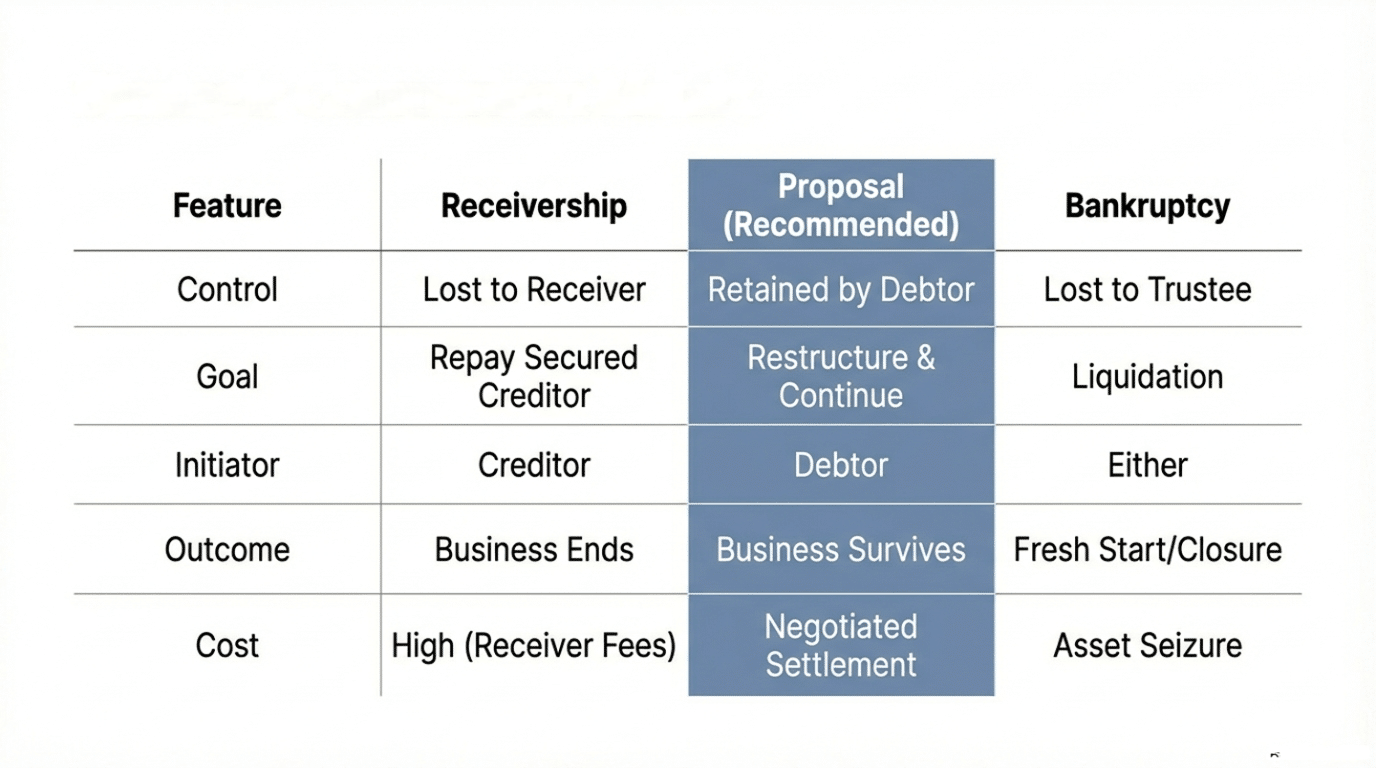
Comparison Table: Receivership vs. Proposal vs. Bankruptcy

Understanding the differences between these insolvency processes is key to making an informed decision. Here’s a quick comparison:

Company owner drowned in lLegal papers and judge with gavel, all with the word denied stamped on them, symbolizing the tough challenge of securing leave to appeal an Ontario receivership order.
leave to appeal
Company owner drowned in lLegal papers and judge with gavel, all with the word denied stamped on them, symbolizing the tough challenge of securing leave to appeal an Ontario receivership order.
leave to appeal

Leave To Appeal FAQ Section

Q1: What does “leave to appeal an Ontario receivership order” mean, and why is it so difficult to obtain?

A: “Leave to appeal” means you must ask the court for permission to bring an appeal; it’s not an automatic right. It’s difficult to obtain because courts want to prevent delays in insolvency proceedings and require you to meet strict criteria. You must show there’s a serious legal question, that you’d suffer irreparable harm, and that the balance of convenience favours hearing the appeal.

A: Courts typically apply a three-part test: (1) Is there a serious question to be tried (meaning your appeal has arguable merit)? (2) Will you suffer irreparable harm if leave is refused? (3) Does the balance of convenience favour granting leave? For a discretionary order like receivership, you often also need to show an error in legal principle by the original judge.

Q3: How is a receivership different from bankruptcy?

A: A receivership is usually initiated by a secured creditor to seize and sell specific assets to recover a debt; the business owner loses control. Bankruptcy, on the other hand, is a broader insolvency process. For individuals, it aims to discharge most debts and provide a fresh start. For corporations, it involves the liquidation of all assets to pay creditors, in priority, leading to the company’s cessation. A Licensed Insolvency Trustee (LIT) administers both personal and corporate bankruptcies.

Q4: What should I do if my business is facing financial trouble?

A: Act immediately. The most crucial step is to seek professional advice from a Licensed Insolvency Trustee (LIT) as early as possible. An LIT can assess your situation, explain all your options (like consumer proposals or Division I proposals), and help you develop a strategy to avoid receivership or bankruptcy.

Q5: How can Ira Smith Trustee & Receiver Inc. help me?

A: The Ira Smith Team specializes in helping individuals and businesses facing financial distress in Ontario. We are Licensed Insolvency Trustees, which means we are licensed by the federal government to administer all insolvency processes. We offer a free, confidential consultation to evaluate your specific situation, explain all your options in plain language, and guide you toward the best solution to gain control of your financial future. We focus on providing clear, actionable, and empathetic advice.

Brandon’s Take On Leave To Appeal

As a Senior Vice-President at Ira Smith Trustee & Receiver Inc., I’ve seen firsthand the stress and heartache that financial problems can cause. The Royal Bank of Canada v. 2339366 Ontario Inc., 2026 ONSC 327 case is a stark reminder that once a receivership order is in place, your options become severely limited. Trying to get leave to appeal is often a long, costly, and very difficult battle with a low chance of success. It’s a fight most people can and should avoid.

My experience tells me that most companies that end up in receivership could have found a better, less disruptive solution if they had sought help sooner. The emotional toll of waiting, hoping the problem will just go away, is immense. But financial problems rarely resolve themselves; they usually get worse, piling on more stress, more debt, and fewer options.

That’s why I strongly advocate for proactive measures. Don’t wait until a creditor is at your door, or a receiver is being appointed. Explore alternatives like consumer proposals or Division I proposals. These options allow you to take charge, protect your assets where possible, and restructure your debts in a way that provides real relief. We are here to listen without judgment and guide you through every step of that journey. Our goal is to empower you to make informed decisions and find the best path to financial recovery.

Company owner drowned in lLegal papers and judge with gavel, all with the word denied stamped on them, symbolizing the tough challenge of securing leave to appeal an Ontario receivership order.
leave to appeal

Leave To Appeal Conclusion: Don’t Face Financial Challenges Alone – Take Control Today

The legal landscape surrounding receivership orders and appeals in Ontario is complex and unforgiving. The lessons from cases like Royal Bank of Canada v. 2339366 Ontario Inc., 2026 ONSC 327 clearly demonstrate that appealing a receivership order is an uphill battle, fraught with strict legal tests and tight deadlines. By the time you’re considering an appeal, a significant amount of control and potential value has likely already been lost.

Your best strategy against financial distress is not to fight a receivership order after it’s been granted, but to prevent it from happening in the first place. Early intervention, comprehensive understanding of your options, and expert guidance are your most powerful tools. With the right information and professional support, you can explore viable alternatives that allow you to regain control, manage your debts, and secure a more stable financial future.

Don’t let financial uncertainty dictate your future. If you or your business is struggling with debt, losing sleep, or facing the possibility of legal action, contact Ira Smith Trustee & Receiver Inc. today. We offer a free, confidential consultation to discuss your situation, explain your options in plain language, and help you develop a clear, actionable plan. Our team of Licensed Insolvency Trustees is dedicated to providing the compassionate, professional support you need to regain control and achieve a debt-free life. Take the first step towards a brighter financial future – call us now.

Ira Smith Trustee & Receiver Inc. is licensed by the Office of the Superintendent of Bankruptcy and is a member of the Canadian Association of Insolvency and Restructuring Professionals.

  • Phone: 905.738.4167
  • Toronto line: 647.799.3312
  • Website: https://irasmithinc.com/
  • Email: brandon@irasmithinc.com

——————————————————————————–

Disclaimer: This analysis is for educational purposes only and is based on the cited sources and my professional expertise as a licensed insolvency trustee. The information provided does not constitute legal or financial advice for your specific circumstances.

Every situation is unique and involves complex legal and factual considerations. The outcomes discussed in this article may not apply to your particular situation. Situations are fact-specific and depend on the particular circumstances of each case.

Please contact Ira Smith Trustee & Receiver Inc. or consult with qualified legal or financial professionals regarding your specific matter before making any decisions.

About the Author:

Brandon Smith is a Senior Vice-President at Ira Smith Trustee & Receiver Inc. and a licensed insolvency trustee serving clients across Ontario. With extensive experience in complex court-ordered receivership administration and corporate insolvency & restructuring proceedings, Brandon helps businesses, creditors, and professionals navigate challenging financial situations to achieve optimal outcomes.

Brandon stays current with landmark developments in Canadian insolvency law. He brings this cutting-edge knowledge to every client engagement, ensuring his clients benefit from the most current understanding of their rights and options.

Company owner drowned in lLegal papers and judge with gavel, all with the word denied stamped on them, symbolizing the tough challenge of securing leave to appeal an Ontario receivership order.
leave to appeal
Categories
Brandon Blog Post

ZOOMING RULES OF CIVIL PROCEDURE FOR SUPERIOR COURT OF JUSTICE TORONTO BANKRUPTCY COURT

rules of civil procedure superior court of justice toronto bankruptcy courtThe Ira Smith Trustee Team is absolutely operational and Ira, in addition to Brandon Smith, is readily available for a telephone consultation or video meeting.

If you would prefer to listen to an audio version of this Brandon’s Blog, please scroll to the bottom and click on the podcast.

Rules of civil procedure introduction

Today’s blog is taking a lighter look at new rules of civil procedure for a Zooming video conference world. These are my somewhat tongue in cheek suggestions for the Superior Court of Justice Toronto bankruptcy court.

I did not make these up. I am taking it from an actual Standing Order For The Conduct of Evidentiary Video Conference Hearings. It was issued by the Honourable D. H. Lester, Circuit Judge in the Circuit Court of the Fourth Judicial Circuit, Clay County Florida. It was sent to me by a Florida bankruptcy attorney friend of mine. I have just amended them for the Ontario Superior Court of Justice Toronto bankruptcy court context.

I have not seen any such pronouncements from the Ontario Superior Court of Justice Toronto Bankruptcy Court (and doubt that I will!). Below would be my proposed amendments to the R.R.O. 1990, Reg. 194: RULES OF CIVIL PROCEDURE (Rules of Civil Procedure) under the Courts of Justice Act, R.S.O. 1990, c. C.43. Everything I am suggesting below was actually in the Florida Standing Order.

New rules of civil procedure 46.02

Rules of civil procedure 46 through 51, sets out the rules of civil procedure for pre-trial procedures. I propose a new rule, number 46.02, to read:

46.02 Prior to any video conference hearing, all counsel, parties and witnesses shall familiarize themselves with the operation of Zoom and its capabilities. Instructions on Zoom operation may be found at https://zoom.us/resources. The following procedure will be followed:

(a) Enter your name on your Zoom profile so that you can be identified by the Judge.

(b) Devices must be fully charged prior to the hearing with a charger accessible in the event it becomes necessary.

(c) Devices must remain muted unless the participant is speaking. All participants must be in a location that is free of extraneous noise or visual distraction.

(d) A virtual background is not permitted.

(e) Hearings are court proceedings. Appropriate courtroom attire for counsel, parties and witnesses is expected.

It is too bad that virtual backgrounds would not be allowed in the Toronto bankruptcy court. I personally would want to attend a bankruptcy court hearing with this background:

rules of civil procedure superior court of justice toronto bankruptcy court
Photo courtesy of Zoom.us rules of civil procedure

As far as appropriate courtroom attire, I asked my friend if a judge has made him stand up yet to see what he was wearing below the waist. He said he has not yet been asked to do so, but it could happen.

New Superior Court of Justice rules of civil procedure for witness testimony

Rule 53 of the Rules of Civil Procedure deals with evidence at trial. I propose a new rule 53.01.1 which would go something like:

53.01.1 (a) At least three business days prior to hearing, the parties shall e-mail to the court a list of all witnesses expected to be called, with full names, e-mail addresses and cell phone numbers. Real names must be used. Court reporters are meeting participants. If a court reporter will be present, the reporter’s name and e-mail address shall be provided along with the witness list.

(b) After any opening statements, when a witness is called, the judge will admit the witness from the waiting room. After testifying, the witness will be removed electronically from the hearing.

(c) Witnesses must be alone. Prior to testifying and after testifying, witnesses shall scan the room to confirm they are the only person in the room. However, if an interpreter is necessary, interpreters may be either in the room with a witness or a meeting participant. The parties list of witnesses should indicate whether a witness will be testifying through an interpreter. The interpreter’s name and e-mail address must be provided to the judge in the list of witnesses.

(d) Passing of electronic notes during testimony and recording of the proceedings is forbidden.

(e) All other electronic devices must be turned off.

(f) A lawyer and a party may be in the same room. However, the camera must capture both. No one else may be present in the room.

New rules of civil procedure for documents in writing in Superior Court of Justice proceedings

I propose new rules of civil procedure number 4.01.1:

4.01.1 (a) At least five days prior to hearing, the lawyers shall confer

to disclose exhibits and other documents in writing expected to be used and to stipulate to as many as possible.

(b) All documents in writing must be delivered, e-mailed to the judge or e-filed at least three business days prior to the hearing. They should be pre-marked, identifying the party and exhibit number. Exhibits over ten pages in the number of pages shall be either delivered to the judge or e-filed in searchable PDF format with computer-generated page numbers. The parties must also provide an index that includes the number of pages.

(c) All lawyers, the judge and the court reporter must have a copy of all documents in writing. Witnesses must have a copy of all documents in writing to which they will testify or for which they will lay the predicate for admission.

(d) Documents in writing can be shared during the video hearing using a shared screen on Zoom.

Rules of civil procedure for the Superior Court of Justice

So this is what was in the Florida Standing Order for a Zooming video environment. I hope you enjoyed this somewhat light-hearted Brandon’s Blog.

The Ira Smith Team family hopes that you and your family members are remaining secure, healthy and well-balanced. Our hearts go out to every person that has been affected either via misfortune or inconvenience.

We all must help each other to stop the spread of the coronavirus. Social distancing and self-quarantining are sacrifices that are not optional. Families are literally separated from each other. We look forward to the time when life can return to something near to typical and we can all be together once again.

Ira Smith Trustee & Receiver Inc. has constantly used clean, safe and secure ways in our professional firm and we continue to do so.

Income, revenue and cash flow shortages are critical issues facing entrepreneurs, their companies and individual Canadians. This is especially true these days.

If anyone needs our assistance for debt relief Canada COVID-19, or you just need some answers for questions that are bothering you, feel confident that Ira or Brandon can still assist you. Telephone consultations and/or virtual conferences are readily available for anyone feeling the need to discuss their personal or company situation.

The Ira Smith Trustee Team is absolutely operational and Ira, in addition to Brandon Smith, is readily available for a telephone consultation or video meeting.

[monkeytools msnip=”https://monkeyplayr.com/playr.php?u=5173&p=22322″]

Categories
Brandon Blog Post

BANKRUPTCY BLOG 2019: OUR MOST FAVOURITE INSOLVENCY TOPICS

bankruptcy blogIntroduction

I first want to wish all of you and your families a healthy, happy and prosperous New Year. As 2019 draws to a close, I thought it would be interesting to do some research in my 2019 Brandon’s bankruptcy blog to see which ones were the most top 10 popular this year.

So, in order counting down from number 10 to number 1, here are my top 10 bankruptcy blog counts for 2019.

#10 – 407 ETR DEBT SETTLEMENT: OUR NEWEST GUILT FREE WAY TO DO IT

This was a blog I wrote in 2015 as a follow up from one in 2014. It was updated for a 2018 Court decision.

In January 2014 in our blog titled 407ETR FAIRNESS-ONTARIO COURT OF APPEAL ENSURES FRESH START I described to you the decision of the Court of Appeal for Ontario in 407 ETR Concession Company Limited v. Superintendent of Bankruptcy (In the Matter of the Bankruptcy of Matthew David Moore) (the Moore Decision).

The highway’s owners appealed that decision to the Supreme Court of Canada (SCC). On Friday, November 13, 2015, the SCC released three decisions all dealing with the same basic issue: does the federal Bankruptcy and Insolvency Act (BIA) take paramountcy over provincial laws purporting to deal with the issue of debt and bankruptcy in Canada. The SCC answer was a resounding YES!

This blog talks about how 407etr deals with the debt owing by an insolvent person filing either a consumer proposal or for bankruptcy.

#9 – SOMETIMES EVEN A SHARK NEEDS BANKRUPTCY AND INSOLVENCY HELP

Not every innovation that is seen on The Shark Tank is bound to be one of the very best. Among the winners, one just entered into bankruptcy and insolvency proceedings. In this blog, I described one such company that got a deal on Shark Tank, but ultimately, went into bankruptcy.

Fizzics is a machine that makes use of sound waves that improves the taste and quality of a beer. Not even a Shark can stop its company from being driven to Chapter 11 bankruptcy protection. This proves that often an ingenious and fantastic invention being marketed with the assistance of a Shark might not truly interest people.

#8 – COURTS OF JUSTICE ACT: COURT OF APPEAL FOR ONTARIO CREATES NEW RULE?

This was a June 2019 blog about a then-recent decision of the Court of Appeal for Ontario that raises certain issues for a Receiver appointed under the Ontario Courts of Justice Act. The question answered in this blog which I focussed on was does the appeal period in the BIA or the Courts of Justice Act, regulates the appeal period from the order of the motion judge in this situation?

#7 – GAMBLING DEBT BANKRUPTCY: CAN GAMBLING DEBT BE DISCHARGED IN BANKRUPTCY?

I am often asked if you can have a gambling debt bankruptcy; can gambling debts be discharged in bankruptcy? In that January 2018 blog, I discussed the issues and provided my views on how best to get a discharge from not only gambling debts but debts related to any addiction.

#6 – CANADIAN REVERSE MORTGAGE: SENIORS MOVING FORWARD WITH INCREASED DEBT

In this August 2019 blog, I discussed the issue of how seniors are flocking to the Canadian reverse mortgage product in record numbers. I described what seniors must know to avoid reverse mortgage problems.

#5 – PRENUPTIAL AGREEMENTS MAKE FAMILIES STRONGER: THEY AREN’T JUST FOR THE RICH & FAMOUS – PRENUPS IN ONTARIO ARE FOR YOU TOO

In this July 2017 blog, I wrote about how prenuptial agreements make families stronger and why anyone can benefit from prenups in Ontario.

#4 – FORM 31 PROOF OF CLAIM: HOW TO COMPLETE THE PROOF OF CLAIM

This blog is from October 2018. I discussed how a form 31 proof of claim form should be completed and discussed why it is important for it, and the related proxy, to be completed properly.

#3 – 40 PARK LANE CIRCLE, 44 PARK LANE CIRCLE TORONTO FOR SALE: ARE FINANCIAL PROBLEMS CONTAGIOUS?

This March 2015 blog asked somewhat tongue in cheek if financial problems could be a result of where you lived. I reviewed some high profile insolvency cases by residents of 40 Park Lane Circle and 44 Park Lane Circle in the toney Bridle Path area of Toronto. I also provided some solutions people could use to solve their own debt issues.

#2 – WHAT HAPPENS TO DEBT WHEN YOU DIE CANADA: ARE YOU FREE OF DEBT

This was a June 2018 blog. In it, I explored what happens to debt when you die in Canada. Does debt survive death or not?

#1 – AVERAGE CANADIAN NET WORTH 2018: MIDLIFE WEALTH SHOCK MAY LEAD TO DEATH

This September 2018 blog looked at household debt at an all-time high, making the average Canadian net worth 2018 is a hot topic. My blog explored a then-recent study showing what could happen if we experience wealth shock.

Bankruptcy blog conclusion

You may have already noticed over the last 10 days or so I have slowed down a bit in the writing of my Brandon’s bankruptcy Blog. The holiday period will do that to me! I will continue in January at a slower pace of blog posting. Come February, I will pick up the pace again.

In the meantime, again, I wish all of my loyal readers and their families a healthy, happy and prosperous 2020.

Categories
Brandon Blog Post

COURTS OF JUSTICE ACT: COURT OF APPEAL FOR ONTARIO CREATES NEW RULE?

[monkeytools msnip=”http://monkeyplayr.com/playr.php?u=5173&p=20995″]

Introduction

On June 19, 2019, the Court of Appeal for Ontario, released its decision in the matter of Third Eye Capital Corporation v. Ressources Dianor Inc./Dianor Resources Inc., 2019 ONCA 508 (the Dianor decision). This case was heard in September 2018. It has to do with a Court-appointed Receiver, appointed under both the Courts of Justice Act, R.S.O. 1990, c. C.43 (CJA) and the Bankruptcy and Insolvency Act (R.S.C., 1985, c. B-3) (BIA).

What the decision stands for

Dianor Resources Inc. (Dianor) was a financially troubled exploration company focused on the acquisition and exploitation of mining sites in Canada. The appointment was made under s. 243 of the BIA and s. 101 of the CJA. Dianor’s secured lender Third Eye Capital Corporation (Third Eye) made the application for the appointment of the Receiver.

Dianor’s primary asset was a collection of mining claims located in Ontario and Quebec. The mining claims were also subject to Gross Overriding Royalty agreements (GOR) in favour of two different corporations. All agreements were registered on title.

There were 2 issues that needed to be decided; one relating to the sale of real property by a Court-appointed Receiver by way of vesting order. The second question was procedural.

The questions to be answered were:

  1. Can a 3rd party interest in land in the nature of a GOR be extinguished by a vesting order approved in a receivership case?
  2. Does the appeal period in the BIA or the Courts of Justice Act, regulate the appeal period from the order of the motion judge in this situation?

I am going to tell you how the Court of Appeal for Ontario answered these questions, but I am not going to describe it in detail. Why do you ask? Because that is not the point of this Brandon’s Blog.

Some lawyers have already written summaries on the detailed thinking of the Appeal Court and I am sure there will be more. The decision is very well thought out one and is described in detail in the Court’s Reasons. I provided a link to the decision above, and if you wish to read it but don’t wish to scroll up, here it is again.

Vesting orders

I have written before on the matter of vesting orders. Simply stated, a vesting order is the means by which the transfer of acquired assets can be transferred to a buyer on a free and clear basis. It maintains the priority of competing interests against the debtor with respect to the money generated by the sale transaction and paid to the Receiver.

The Court of Appeal for Ontario decided that depending on the facts of a specific case, vesting orders approved in a receivership case can extinguish a 3rd party interest registered against the title. However, based on the facts of the Dianor case, the Appellate Court ruled that:

  1. The lower Court Judge had jurisdiction under s. 243( 1) of the BIA to provide a sale approval and vesting order.
  1. Based on the nature of the GORs the motion Judge erred in concluding that it was appropriate to extinguish them from the title.

But that is not the end of the matter.

The appeal period

Under r. 31 of the BIA Rules, a notice of appeal must be filed within 10 days after the day of the order or decision appealed from, or within such time as a judge of the court of appeal stipulates.

Under the CJA, r. 61.04(1) provides for a 30 day period from which to appeal a final Order to the Court of Appeal. On top of that, the appellant would have had to have actually applied for a stay of proceedings of the completion of the sale under the vesting order.

After its lengthy analysis, the Court of Appeal decided that the appeal period is governed by the BIA rules and not the CJA Rules of Civil Procedure. As the appellant filed its notice of appeal after the 10 day period, the appeal was unsuccessful. This is notwithstanding that the Court of Appeal agreed with the appellant that in this case, the GORs could not be extinguished. The appellate court also stated that there were not factors involved for the Court to invoke its inherent jurisdiction to provide relief to the appellant to extend the timeline so that its appeal would be valid.

I discussed this appeal period issue previously in my Brandon’s Blog – MOVE FAST TO OBJECT TO AN ONTARIO RECEIVERSHIP COURT ORDER.

But this aspect of the decision is also not my main point of this Brandon’s Blog.

So what is my point you ask?

As a licensed insolvency trustee (formerly called a bankruptcy trustee) (LIT), what really caught my eye in the Court of Appeal’s decision was something that I doubt any lawyer is going to write about when analyzing this case. What I am talking about is two sentences near the end of the decision under the heading “The Receiver’s Conduct”.

I feel these two sentences are so important that in certain cases, it will create a new rule for Receivers. By extension, it will also affect all stakeholders in the receivership and give all legal counsel something serious to think about. The two sentences are so important, I will show them to you here:

“(2) The Receiver’s Conduct

[132] The Receiver argues that it was appropriate for it to close the transaction in the face of a threatened appeal because the appeal period had expired when the appellant advised the Receiver that it was contemplating an appeal (without having filed a notice of appeal or a request for leave) and the Receiver was bound by the provisions of the purchase and sale agreement and the order of the motion judge, which was not stayed, to close the transaction.

[133] Generally speaking, as a matter of professional courtesy, a potentially preclusive step ought not to be taken when a party is advised of a possible pending appeal. However, here the Receiver’s conduct in closing the transaction must be placed in context.”

The Court of Appeal held that the Receiver’s conduct in completing the sale prior to the expiry of the appeal period was proper.

Why is this so important?

Now I am at the point of this Brandon’s Blog. The reason I am writing this. The real heart of the matter. To understand the importance of these two sentences, I must provide you with some additional background information.

In June 2004, the Ontario Court of Appeal released its decision in Regal Constellation Hotel Ltd., Re, 2004 CanLII 206 (ON CA) (the Regal Constellation case). The main points decided in that case were:

  1. There is no automatic stay of a vesting Order under appeal under the Courts of Justice Act or any other provincial statue. There must be an application to stay it while the appeal is outstanding.
  2. Once a vesting order is registered on the title under the Land Titles Act, R.S.O. 1990, c. L.5, its features as a conveyance prevail and its features are spent.
  3. A registered vesting order cannot be attacked except by ways that apply to any type of order transferring outright title and registered under the Land Titles system.
  4. Appeal from a registered vesting order is moot.

The Court of Appeal for Ontario stated in the Regal Constellation case that a vesting order has a double personality. It is, on the one hand, a court order and also a conveyancing tool vesting an interest in real or personal property as stated in the order. As soon as a vesting order has been registered on title, its features and characteristics as an order are spent. Any appeal at that stage is therefore moot.

So why is it so important? As a result of the Regal Constellation case, Receivers and their legal counsel always ask the purchaser’s legal counsel do they wish to close the transaction immediately or wait for the appeal period to expire? I have been involved in many real estate receiverships where the closing is scheduled to begin as soon as the vesting order is issued and entered. Everyone leaves the courthouse and goes straight to the closing. Registering the vesting order against the lands is part of the closing process.

Some buyers will certainly reject the option to complete the transaction before the period to appeal the vesting order has actually run out. Others are prepared to close immediately due to the fact that the chance of overturning the sale approval and setting the transaction aside is incredibly remote. This is especially so if the closing has actually taken place.

Nowhere in the Regal Constellation case is the conduct of the Receiver scrutinized.

The new rule for Court-appointed Receivers

So the new rule for Court-appointed Receivers is that the Receiver and its legal counsel will carefully have to consider in each situation, is the immediate closing of the transaction a reasonable thing to do. I can think of 8 issues to consider because of those two sentences in the Dianor decision:

  1. Has an actual appeal been filed in time?
  2. Has any party threatened an appeal prior to the 10 day appeal period expiring?
  3. Say the situation is that the vendor Receiver and the purchaser has the option of completing the transaction prior to the 10 day appeal period expiring and there is no threatened appeal. Does the Receiver now have a duty, or at least cover off the point, to put all stakeholders on notice that the closing, including the registration of the vesting order, will take place prior to the expiry of the appeal period?
  4. Should a discussion be held with a potential purchaser who has submitted an Agreement of Purchase and Sale that the Receiver believes it can work with regarding whether the Agreement should stipulate whether or not the closing must take place prior to the expiry of the appeal period?
  5. Should the Court-appointed Receiver’s Terms and Conditions of Sale to be approved by the Court now state that any bidder must stipulate that the bidder must declare whether or not it wishes to have the option to complete a Court approved transaction prior to the expiry of the appeal period?
  6. Similarly, must the Court-appointed Receiver’s standard Agreement of Purchase and Sale to be approved by the Court contain a right for the bidder to be able to elect in writing whether it wishes to complete the transaction prior to the expiry of the appeal period, if its bid is recommended by the Receiver and approved by the Court?
  7. Must such an election be made prior to the Court approving the proposed transaction, so that all stakeholders are aware at the time Court approval is sought that such a possibility may exist?
  8. Is the bidder having such an option to elect prior to obtaining Court approval sufficient, or to better protect the vendor Receiver and the purchaser, must the election be made so that such election can also be approved by the Court?

As I said before, this is not the focus of the Dianor decision. I doubt many or any writers analyzing this case will focus on those two sentences. However, as the LIT who will be the Court-appointed Receiver, in my humble opinion, I think those two sentences in the Dianor decision, now give Receivers things to think about that was not the case based on the Regal Constellation decision.

Courts of Justice Act summary

Is your business in financial distress because you cannot collect your billings? Do you not have adequate funds to pay your creditors as their bills to you come due? Are you a secured lender and your borrower is in default and you are considering your enforcement options? Does it appear that applying to the Court for the appointment of a Receiver is your best realization strategy?

If so, call the Ira Smith Team today. We have decades and generations of experience assisting companies looking for financial restructuring, a debt settlement plan and to AVOID bankruptcy. We also have the same experience in assisting secured creditors in realizing on their security and maximizing the proceeds through a receivership process.

Call the Ira Smith Team today so you can eliminate the stress, anxiety, and pain from your life that your company’s financial problems have caused. End the frustration of dealing with a borrower who can no longer meet the terms of the borrowing agreement with you. With the one-of-a-kind roadmap, we develop just for you, we will immediately return you right into a healthy and balanced problem-free life.

You can have a no-cost analysis so we can help you fix your troubles. Call the Ira Smith Team today. This will allow you to go back to a new healthy and balanced life, Starting Over Starting Now.

courts of justice act

Categories
Brandon Blog Post

MOVE FAST TO OBJECT TO AN ONTARIO RECEIVERSHIP COURT ORDER

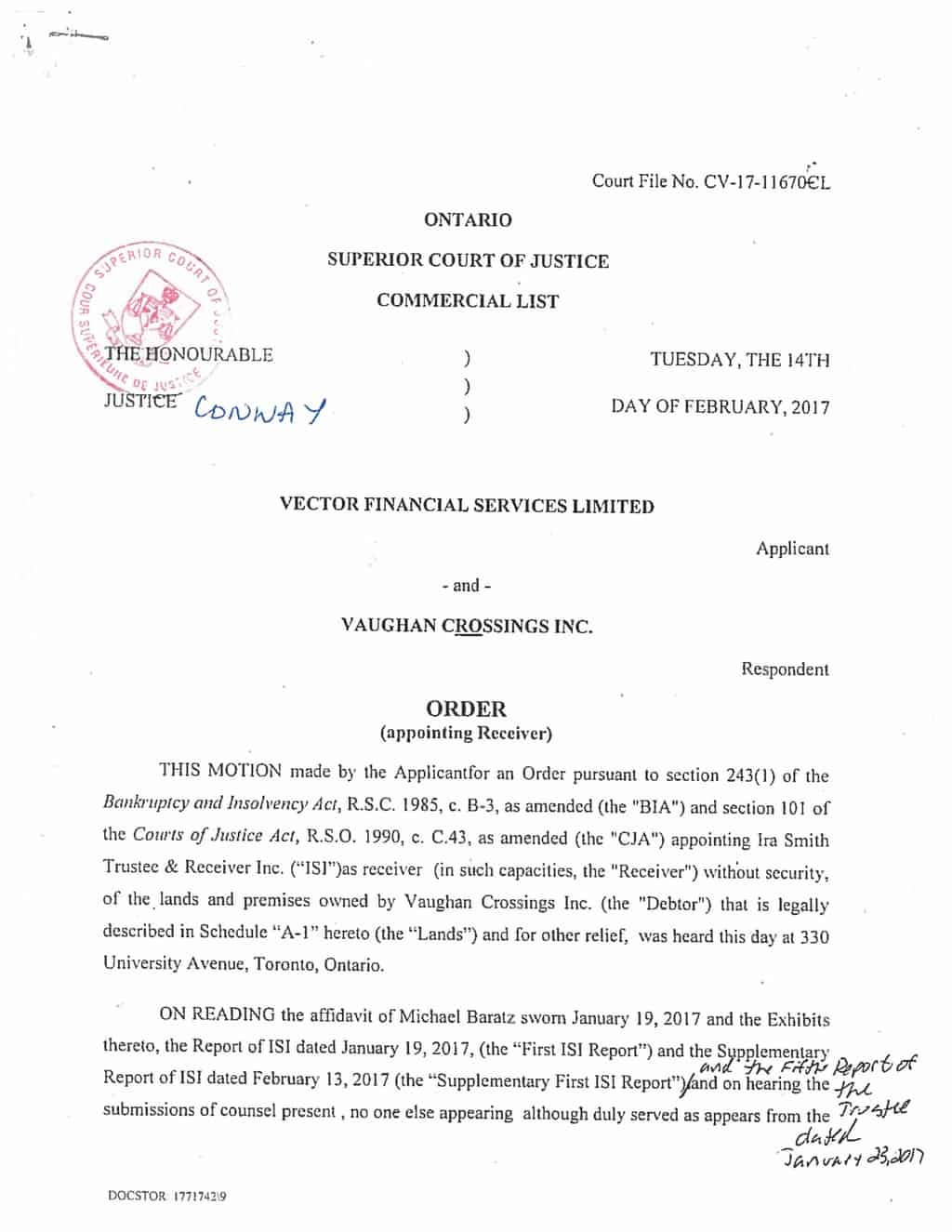
[monkeytools msnip=”http://monkeyplayr.com/playr.php?u=5173&p=20708″]

What is a receiver in insolvency?

A recent case heard in the Court of Appeal for Ontario clarifies what the time limit is to object to an order made in a Court-appointed receivership of a company in Ontario. The bottom line is you better move fast. Before I describe this very interesting decision, I should first remind newer readers on some receiver 101 basics.

What is it?

A receivership is a remedy for secured creditors to enforce their security. In the event, the company defaults on its loan agreement, normally by non-payment, the secured creditor. There are two types of these proceedings in Canada; 1) privately appointed or; 2) court appointed. A receiver might additionally be selected in an investor dispute to complete a task, liquidate assets or market a business.

Typically, the process begins with the secured creditor consulting with a Receiver. If it is decided that there should be a receiver appointed, the secured creditor then makes a choice. They can either appoint the receiver by written appointment letter (privately appointed) or make a motion to the Court for an Order appointing the receiver (court-appointed).

The Bankruptcy and Insolvency Act (Canada) (BIA) states that only a licensed insolvency trustee (formerly called a bankruptcy trustee) can act as a receiver. A privately appointed receiver acts on behalf of the appointing secured creditor. A court-appointed receiver has a duty of care to all creditors.

What are the duties of a receiver?

The receiver’s first duty is to take possession and control of the assets covered by the secured creditor’s security in a private appointment, or all the assets indicated in the court order in a court appointment. The receiver must decide whether it can get a higher value for the assets if it operates the business. Alternatively, the receiver may decide that the risk of operating the business is not worth it in terms of any meaningful increase in the value of the assets.

The receiver then develops a plan to on the running of the business and for the eventual sale of the assets. The type of business and the nature of the assets will dictate what approach the receiver will take. In the meantime, the receiver must inventory all the assets, protect them and make sure there is adequate insurance in place for what the receiver wishes to do in terms of running the business and selling the assets.

In a private appointment, the receiver needs to get the approval of the secured creditor before embarking on the business and asset plan. In a court appointment, the receiver requires the approval of the court.

What happens when a company goes into receivership?

When the company goes into receivership, senior management and the Directors lose most of their authority for decision making. The Directors’ general corporate duty of maintaining corporate records continues, but any decision-making about the running of the business or its assets will not be effective. This is especially true in a court appointment. The subject of Director liability is too broad to start mentioning in this Brandon’s Blog. i am planning to soon write a blog on that topic.

Management’s and employees’ responsibilities about the business in a practical sense will stop upon the appointment of the receiver. Their advice and help are only required if requested by the receiver. They certainly will not be paid for any efforts unless the receiver agrees in writing to make money available for their pay.

Court of Appeal for Ontario says you better move fast

Why the confusion? Isn’t the process for an appeal of a court order straightforward? The confusion comes about because, in the standard model Appointment Order of the Commercial List of the Ontario Superior Court of Justice, the court-appointed receiver is appointed under two statutes:

  1. Section 101 of the provincial Ontario Courts of Justice Act, RSO 1990, c C.43 (CJA).
  2. The federal BIA, section 243(1).

The applicant, in this case, was the purchaser of assets from a court-appointed receiver of a company. One of the standard provisions in the Appointment Order is that anyone wishing to take legal action against the receiver must first get the approval of the court to do so.

They brought an application for authorization to sue the receiver over a disagreement arising from the purchase of the assets from the receiver under the asset purchase agreement. On May 17, 2018, the lower court judge dismissed the application, finding that their allegations were not supported by the evidence. On November 8, 2018, the same judge refused their demand to resume the application based on new evidence.

The applicant filed appeals from both decisions. Its notices of appeal were on time under the provincial CJA, under which there is a 30-day time limit for commencing an appeal. They were late under the federal BIA, which imposes a 10-day time limit.

The lower court judge dismissed the appeals. He held that the BIA was the governing authority for the appeal, not the CJA. He stated that the origin of authority under which the receiver was appointed was section 243( 1) of the BIA and therefore appeals are governed by the BIA, not the CJA. He further went on to say that the appointment also under the CJA did not have the result of ousting the BIA as the source of authority. He further held that it also cannot supersede the federal BIA holds paramountcy over the provincial CJA.

receivership

Business Development Bank of Canada v. Astoria Organic Matters Ltd., 2019 ONCA 269

The Court of Appeal for Ontario decision was released on April 8, 2019. The appeal court found that this was a very narrow issue to decide so that it did not have to get into the merits of the case of the purchaser wanting to sue the receiver over a disagreement arising from the purchase of the assets from the receiver under the asset purchase agreement.

The Court of Appeal rejected the applicant’s appeal and did not find that the chambers judge made any errors. They said that when the order sought to be appealed was made in reliance on jurisdiction under the BIA, the proper appeal path is the BIA.

The lower court, the Ontario Superior Court Justice Commercial List, rejected the purchaser’s demand to sue the receiver, which is the decision the applicant wishes to appeal. The requirement to get leave of the court to sue the receiver comes from the Appointment Order. The court’s authority to include that arrangement order comes from the statutory power to appoint a receiver under s. 243( 1) of the BIA.

The Court of Appeal agreed that the legal power to appoint a receiver is also found in s. 101 of the CJA. But considering that authority for the leave to take legal action against the receiver comes from the BIA in spite of that the receiver was appointed under both laws, the appeal is governed by the BIA as a matter of paramountcy.

Therefore the Court of Appeal for Ontario dismissed the applicant’s appeal and awarded costs against them.

Does your company need to move fast?

Does your company have way too much debt? Is your company’s cash flow not enough to meet all of its financial obligations? Are you afraid that your company’s main secured creditor is about to demand repayment of its loan in full and you just can’t move fast enough to save your company?

If you answered yes, call the Ira Smith Team today so we can end the tension and anxiousness that these financial problems have triggered. We will develop a plan special for your company, to save it from extinction.

Call the Ira Smith Team today. We have years and generations of experience restructuring and saving companies looking for financial restructuring or a debt settlement approach. As a licensed insolvency trustee, we are the only professionals acknowledged, accredited and supervised by the federal government to provide insolvency advice to save companies.

You can have a no-cost analysis to aid you so we can repair your company’s debt problems. Call the Ira Smith Team today. This will certainly allow you to get back to Starting Over Starting Now.

receivership

Call a Trustee Now!