Categories
Brandon Blog Post

PRIVATELY APPOINTED RECEIVER VS. COURT-APPOINTED RECEIVER IN CANADA: THE COMPLETE GUIDE ON THE KEY DIFFERENCES AND YOUR LEGAL RIGHTS

Building a business takes everything you’ve got—money, time, and countless sleepless nights. So, when a privately appointed receiver suddenly steps in to take control of your company’s assets secured under your loan agreement, it’s nothing short of a gut punch. Suddenly, you’re looking at the very real possibility of losing what you’ve worked so hard to create. The chaos, the sudden loss of control, and the sheer complexity of the legal process are enough to overwhelm anyone.

But you aren’t the first to go through this. As Senior Vice-President at Ira Smith Trustee & Receiver Inc., I’ve sat across the desk from plenty of business owners in this exact scenario

Here in Canada, secured lenders can sometimes appoint a private receiver without ever setting foot in a courtroom. This move flips your operations upside down. Naturally, you’re going to have questions: What does this mean for the assets you’ve built up? Can the receiver really sell off your business for pennies on the dollar? And what happens if they botch the sale entirely?

We’re going to break down exactly how a privately appointed receiver operates, what your actual rights are, and how you can protect your interests. The biggest takeaway? Don’t wait until the bank has its privately appointed receiver take possession of your business assets to get professional advice. Bringing in a Licensed Insolvency Trustee (LIT) early is usually your best shot at regaining some leverage and finding a realistic path forward.

Privately Appointed Receiver Key Takeaways:

Privately appointed receivers can only be appointed by secured lenders whose security agreements allow for it to happen. This is based on the loan agreements you signed (like a General Security Agreement) and by definition, happens without a court order.

They have to act in a “commercially reasonable” manner. While they don’t have to hold out for the absolute highest imaginable price, they do have to aim for a fair market value under the circumstances.

An “improvident sale” is a legally negligent sale. If a sale of assets takes place at a price way below fair value because the receiver was sloppy or conflicted, it can be challenged—but you need hard evidence and expert valuations to prove it.

Suing a receiver is an uphill battle. It’s complex, expensive, and if they are court-appointed, you usually need a judge’s permission just to start the lawsuit.

Get expert advice immediately. Speaking with an LIT—like our team at Ira Smith Trustee & Receiver Inc.—is crucial for understanding your rights and exploring alternatives before your assets are gone.

The Shock of the Appointment: What Happens if a Lender Appoints a Privately Appointed Receiver Without a Court Order?

When a business hits a financial wall, one of the scariest prospects is the arrival of a privately appointed receiver. As intimidating as it is, this is a standard and entirely legal method for a secured lender to recoup their money when loan payments stop.

What is a Privately Appointed Receiver?

In Canada, a privately appointed receiver is a third party—who by law must be a Licensed Insolvency Trustee—hired by a secured creditor, like your bank or credit union. Their primary job is to take possession of the specific assets your business pledged as collateral, manage them, and sell them off to repay that specific lender.

This is very different from a court-appointed receiver. A court-appointed receiver gets their power from a judge and acts as an officer of the court to look out for all creditors. A private receiver, on the other hand, gets their authority straight from the fine print of your loan documents (usually a General Security Agreement or a mortgage). Because of this, the privately appointed receiver primarily acts as an agent for the specific lender who hired them.

Legality and Process

Yes, a lender can absolutely appoint a private receiver without a court order, as long as the security documents you signed allow for it. These clauses are standard boilerplate in commercial lending.

However, lenders can’t just show up unannounced. They have to give you at least 10 days’ notice of their intent to enforce their security (via a formal BIA Section 244 demand letter detailing what you owe and that they intend to enforce their security).

Once that receiver is appointed, they take immediate control of the secured assets. Your ability to manage, use, or sell those items—whether it’s heavy machinery, inventory, or real estate—is suspended. While their power comes from your contract, they are still governed by the Bankruptcy and Insolvency Act (BIA) and provincial laws. For instance, they must notify all known creditors about the receivership within 10 days to keep things transparent.

It’s crucial to understand that a receivership doesn’t automatically mean your company is bankrupt or legally dissolved. It does, however, mean you’ve lost control over your core assets, which often brings regular business operations to a grinding halt. This is why you need someone in your corner right away. At Ira Smith Trustee & Receiver Inc., we know exactly how to interpret a receiver’s mandate and can help you figure out what moves you have left.

A distressed business owner looking at documents, symbolizing the challenges of a privately appointed receiver taking control of assets in Canada.
privately appointed receiver

The Asset Sale Dilemma: Can a Private Receiver Sell My Business Assets for Cheap?

One of the most common fears I hear from business owners is that the receiver is just going to fire-sale their life’s work to the first lowball bidder. It’s a valid worry, but Canadian law puts specific guardrails in place to prevent this.

Receiver’s Duty of Care

Under the law, a privately appointed receiver has a strict duty to act in a “commercially reasonable manner.” What does that actually mean? It doesn’t mean they have to hold onto assets for years waiting for a record-breaking offer. Rather, they have to run a fair, ethical, and responsible sales process that reflects current market realities.

When insolvency professionals and courts look at whether a sale was “commercially reasonable,” we look at a few main things:

  • Marketing Efforts: Did they actually try to find buyers? Slapping a “For Sale” sign on the door isn’t enough. They need to advertise in the right channels and give the market enough time to respond.
  • Market Conditions: A receiver can’t magically create a strong market if the economy is tanking. However, they are expected to adjust their sales strategy based on whether it’s a buyer’s or seller’s market.
  • Expert Valuations: Did the receiver get independent appraisals before listing the assets? Skipping this step is a massive red flag.
  • Timing and Strategy: Was there a genuine reason to sell fast (like perishable goods or a business bleeding cash)? Or did they rush a liquidation when selling the business as a “going concern” (an intact, operating business) would have brought in significantly more money?
  • Arm’s Length Transactions: Did they sell the assets to an independent buyer? If the assets were sold at a discount to someone connected to the receiver or the lender, it raises major conflict-of-interest alarms.
  • Transparency: Was the bidding process fair? Did they ignore higher offers without a good reason? What is an “Improvident Sale”? An “improvident sale” happens when a receiver sells assets for substantially less than their fair market value because they were negligent or failed to do their homework.

Keep in mind, just being disappointed with the final sale price isn’t enough to claim an improvident sale. You have to prove the receiver actively dropped the ball.

Examples of an improvident sale

  • Rushing a sale without letting competitive offers roll in.
  • Tossing aside genuinely higher bids without a solid, documented excuse.
  • Selling assets blind, without getting a professional appraisal first.
  • Selling the assets cheaply to an insider or related party.
  • Breaking up the company into parts when a buyer was willing to pay a premium to buy the business whole.

Protecting Your Interests During the Sale

Even though the receiver is in the driver’s seat, you aren’t stuck in the trunk. You can—and should—take an active role in protecting your interests:

  • Watch them closely: Keep tabs on how they are advertising the assets and communicating with the market.
  • Do your own math: Gather your own market data. If you know what similar assets are selling for, keep those records.
  • Document everything: Save every email, report, and letter. Bring them buyers: If you know people in your industry who might want to buy the assets, introduce them to the receiver. The receiver is legally obligated to consider serious offers. Your best defence, honestly, is having your own expert. Getting independent advice from a Licensed Insolvency Trustee like myself gives you someone who can look over the receiver’s shoulder. We know the exact legal benchmarks a receiver has to hit, and we can call them out if they start cutting corners.

Seeking Justice: How Do I Sue a Receiver for an Improvident Sale in Canada?

If you are certain that a privately appointed receiver negligently sold your assets for a fraction of their worth, you might be thinking about a lawsuit. While you do have legal avenues, be warned: suing a receiver in Canada is complicated, stressful, and expensive.

If you take a receiver to court, your lawyers will usually build the case around a few core legal concepts:

  • Breach of Statutory Duty: The BIA explicitly requires receivers to be commercially reasonable. If they ignore that standard and cost you money, they’ve broken the law.
  • Negligence: Receivers have a common law duty to act prudently and in good faith. If their laziness or incompetence results in a massive undervaluation, it’s professional negligence.
  • Breach of Fiduciary Duty: This is harder to prove with private receivers (since their main loyalty is to the lender), but in some specific situations, courts have found that receivers owe a duty to the debtor to maximize asset value. The goal of a lawsuit like this is damages—specifically, forcing the receiver to pay you the difference between what the assets actually sold for and what they should have sold for if the job was done right.
  • Challenges and Burden of Proof: Canadian courts don’t easily second-guess a receiver’s business decisions. The burden of proof is entirely on you, and it’s a heavy lift. You can’t just walk into court and say, “I feel like my warehouse was worth more.”
  • You need bulletproof evidence. The most critical piece is Expert Valuation Evidence. You will have to hire independent, highly qualified appraisers to testify exactly what the assets were worth, and how a proper sales process would have secured that price. You also have to prove specific failings—like showing the court that the receiver completely ignored a valid, higher bid, or intentionally bypassed standard advertising practices.
  • Leave of the Court: There’s a procedural hurdle to keep in mind here. If a receiver was appointed by a court, you can’t just sue them; you have to ask the judge for “leave” (permission) first. This stops angry parties from filing frivolous lawsuits. For a privately appointed receiver, the rules around needing “leave” are a bit murkier and vary by province, but courts will still heavily scrutinize your claim before letting it proceed.

The Process of Suing a Receiver

If you’re going down this road, prepare for a marathon:

  • Gathering Documents: You’ll need every loan agreement, demand letter, receiver report, and internal financial record.
  • Hiring Experts: You need independent appraisers immediately to establish market value.
  • Lawyering Up: You can’t use a general practice lawyer for this. You need specialized commercial litigation lawyers who know insolvency law inside and out.
  • Weighing the Costs: Litigation takes years and costs a fortune in legal and expert fees. You have to be sure the potential payout is actually worth the financial risk.
  • Importance of Proactive Measures: Honestly, it is vastly cheaper and less stressful to prevent an improvident sale than to sue over one later. Engaging an LIT before things go off the rails allows you to explore options like a Division I Proposal, which can restructure your debt and keep the receiver out of your business entirely.
A distressed business owner looking at documents, symbolizing the challenges of a privately appointed receiver taking control of assets in Canada.
privately appointed receiver

Comparison Table: Privately Appointed Receiver vs. Court-Appointed Receivership

Understanding who you are dealing with is half the battle. Here is how a privately appointed receiver and a court-appointed receiver stack up against each other:

Feature

Privately Appointed Receiver

Court-Appointed Receiver

Appointment By

Secured Creditor (e.g., Bank, Private Lender)

Court (usually upon application by a secured creditor)

Legal Basis

Security Agreement (like a GSA) and the BIA

Court Order under the Courts of Justice Act and the BIA

Primary Loyalty

The appointing Secured Creditor

The Court (and by extension, all stakeholders)

Powers

Limited strictly to the assets listed in the loan agreement

Broadly defined by the judge (often covers the whole business)

Oversight

Less formal; reports to the creditor and Superintendent of Bankruptcy

High oversight; requires court approval for major actions

Liability

Can be sued directly (though tough to win)

Usually requires court permission (“leave”) to sue

Goal

Recover the debt for that specific lender

Preserve value for all creditors and stakeholders

Notification

Must notify known creditors within 10 days

Creditors are notified of the initial court application

Privately Appointed Receiver FAQs

Q1: What exactly is a “privately appointed receiver”?

A1: It’s a Licensed Insolvency Trustee hired directly by your lender (like a bank) to seize and sell specific assets to pay off your defaulted loan. Because you signed a contract allowing this, they generally don’t need a judge’s permission to step in.

Q2: What are my rights if a private receiver takes over my business?

A2: You lose control over the collateral, but you still have the right to a fair process. The receiver legally has to act in a “commercially reasonable manner.” You also have the absolute right to hire your own insolvency expert to monitor their actions and advise you.

Q3: How can I prevent a private receiver from selling my assets for too little?

A3: You can’t physically stop a sale without a court injunction, but you can heavily influence the process. Keep detailed records, provide the receiver with lists of potential industry buyers, and hire your own LIT immediately to hold the receiver accountable to market standards.

Q4: What evidence is needed to prove an improvident sale?

A4: Subjective opinions don’t cut it. You need formal, independent appraisals proving the assets were deeply undervalued, combined with paper-trail evidence that the receiver skipped crucial steps (like ignoring bids or failing to advertise).

Q5: Can I negotiate with the lender or receiver after they’ve been appointed?

A5: Absolutely. If you can put together a viable alternative—like finding fresh financing or proposing a formal restructuring plan to your creditors—lenders will often listen. Having an LIT negotiate on your behalf brings instant credibility to the table.

A distressed business owner looking at documents, symbolizing the challenges of a privately appointed receiver taking control of assets in Canada.
privately appointed receiver

Brandon’s Take On A Privately Appointed Receiver

Over the years at Ira Smith Trustee & Receiver Inc., I’ve seen exactly what a sudden receivership does to a business owner. The shock is real, the anxiety is heavy, and it’s completely normal to feel like you’ve hit a dead end. Too many owners assume that once the receiver changes the locks, the fight is over.

That’s rarely the whole story.

The real secret to surviving this is speed. If you sit back and wait to see how the sale goes, you lose your leverage. But if you act quickly, understand your rights, and bring in a professional to help you navigate options like a Division I Proposal to Creditors, you can fundamentally change the outcome. We don’t judge; we just look at the math, the law, and the realities of your business to find the smartest way out of the corner.

Protect Your Legacy: Don’t Face This Alone – Dealing with a privately appointed receiver is easily one of the most high-stakes challenges you will ever face as an entrepreneur. But you are not powerless.

At Ira Smith Trustee & Receiver Inc., we specialize in cutting through the legal jargon and giving business owners a clear, actionable game plan. Brandon Smith and Ira Smith have decades of experience dealing with corporate restructuring, receiverships, and debt solutions. We know the rules receivers have to play by, and we know how to protect your interests.

If your business is struggling, or if a lender has already pulled the trigger on a receiver, you need to act now. Visit our website or call us directly to schedule a free, confidential consultation. Let us help you take back control and find a path forward with confidence. Informational integrity was strictly maintained.

Privately Appointed Receiver Conclusion: Take Action Before Your Bank Does

Business debt doesn’t have to be a dead end. It can be a powerful turning point – an opportunity to restructure, rebuild, and emerge stronger than ever. The journey might seem daunting, and the options complex, but with the right guidance, it’s a path you can navigate successfully.

Don’t wait until it’s too late. The longer you delay, the fewer options become available, and the greater the risk to your business and your personal finances. Taking that first step to seek expert advice is the most powerful and proactive decision you can make right now.

Take action at the first sign of trouble. Before your business gets transferred into your lender’s special accounts group, as the entrepreneur and owner, you know if your business is struggling. That is the time to take action. Don’t wait for your lender to make a demand for full repayment.

Take Action Today: Contact Ira Smith Trustee & Receiver Inc.

We are Licensed Insolvency Trustees, dedicated to providing clear, actionable, and compassionate advice to businesses across Ontario. We offer:

  • Free, Confidential Consultations: Discuss your unique situation without cost, obligation, or judgment.
  • Expert Guidance: Understand all your options for business debt restructuring, from informal negotiations to formal proposals under Canadian law.
  • A Clear Path Forward: Get a personalized, step-by-step plan tailored specifically to your business’s needs and goals.
  • Relief from Pressure: We can help you stop creditor harassment and regain control.

Let us help you lift the burden of debt and guide your business towards a sustainable, successful future. Call us now or visit our website to schedule your free consultation. Your business’s second chance starts here.

Take the first crucial step towards a brighter financial future for your business. Contact Ira Smith Trustee & Receiver Inc. today to schedule your free initial consultation. Your business’s pivot to sustainable success starts now.

Don’t let financial uncertainty dictate your future. If you or your business is struggling with debt, losing sleep, or facing the possibility of legal action, contact Ira Smith Trustee & Receiver Inc. today. We offer a free, confidential consultation to discuss your situation, explain your options in plain language, and help you develop a clear, actionable plan. Our team of Licensed Insolvency Trustees is dedicated to providing the compassionate, professional support you need to regain control and achieve a debt-free life. Take the first step towards a brighter financial future – call us now.

Ira Smith Trustee & Receiver Inc. is licensed by the Office of the Superintendent of Bankruptcy and is a member of the Canadian Association of Insolvency and Restructuring Professionals.

——————————————————————————–

Disclaimer: This analysis is for educational purposes only and is based on the cited sources and my professional expertise as a licensed insolvency trustee. The information provided does not constitute legal or financial advice for your specific circumstances.

Every situation is unique and involves complex legal and factual considerations. The outcomes discussed in this article may not apply to your particular situation. Situations are fact-specific and depend on the particular circumstances of each case.

Don’t hesitate to get in touch with Ira Smith Trustee & Receiver Inc.

About the Author:

Brandon Smith is a Senior Vice-President at Ira Smith Trustee & Receiver Inc. and a licensed insolvency trustee serving clients across Ontario. With extensive experience in complex court-ordered receivership administration and corporate insolvency & restructuring proceedings, Brandon helps businesses, creditors, and professionals navigate challenging financial situations to achieve optimal outcomes.

Brandon stays current with landmark developments in Canadian insolvency law. He brings this cutting-edge knowledge to every client engagement, ensuring they benefit from the most up-to-date understanding of their rights and options.


A distressed business owner looking at documents, symbolizing the challenges of a privately appointed receiver taking control of assets in Canada.
privately appointed receiver
Categories
Brandon Blog Post

GRIPPING ESTATE LITIGATION LIMITATION PERIODS: THE COURT OF APPEAL FOR ONTARIO SPEAKS

Estate Introduction

Have you ever found yourself in a complicated situation, wishing you had understood the legal nuances before it was too late? I was recently reminded of this reality while reviewing the case of Ingram v. Kulynych Estate, 2024 ONCA 678 (CanLII). It serves as a poignant narrative about loss, timing, and the formidable landscape of estate litigation.

This case concerns the limitation period for an equitable trust claim against a deceased person’s assets. It involves a common-law spouse seeking a share of her former partner’s assets, who left her nothing in his Will. The case explores the different limitation periods applicable to estate claims when real property is involved. It examines whether the claim falls under the two-year limitation period for claims or the ten years for land claims.

In this Brandon’s Blog, I explore the case and the findings of the Court of Appeal for Ontario to allow for a better understanding of this complex area.

Types of Estate Litigation

Before getting into the case itself, it would help to understand the most common reasons for estate litigation. Most of this type of litigation can be divided into the following areas.

Will Contests

  • Will Challenges: Contesting the validity of a will, alleging that the testator lacked capacity, was unduly influenced, or was forged or altered without their knowledge or consent.
  • Lack of Capacity: This is raising capacity issues, that the testator lacked the mental capacity to make a Will, or that their capacity was impaired due to illness, disability, or other factors.
  • Undue Influence: Claims that someone exerted undue influence over the testator, causing them to make a will that is not in their best interests.
  • Missing or Lost Wills: Disputes over the location or authenticity of a Will, or allegations that a Will has been destroyed or lost.

Trust Disputes

  • Administration Disputes: Disputes between the estate trustee and beneficiaries over the administration of the estate, including issues related to accounting, tax returns, and distribution of assets.
  • Breach of Fiduciary Duty: Allegations that the estate trustee has breached their fiduciary duty, such as mismanaging assets, failing to account properly for all funds, or making unauthorized distributions.
  • Disputes over Gifts or Bequests: Disputes over the validity or interpretation of gifts or bequests made in the Will, including claims that the gift or bequest was made under duress or undue influence.
  • Disputes over Charitable Bequests: Disputes over the interpretation or validity of charitable bequests, including claims that the charitable organization is not entitled to the bequest or that the bequest is not being used for the intended purpose.

Beneficiary Disputes

  • Distribution Disputes: Disputes over the division of assets and/or distribution of assets, including the interpretation of the will, the validity of certain bequests, or the allocation of assets among beneficiaries.
  • Disputes over Assets: Disputes over the ownership or control of specific assets, such as real property, businesses, or investments.
  • Disputes over Executor or Trustee Removal: Disputes over the removal of an executor or estate trustee, or allegations that the executor or trustee has acted improperly or in a manner that is not in the best interests of the administration or beneficiaries.
  • Disputes over Taxes: Disputes over the calculation and payment of taxes, including claims that the estate trustee has failed to properly account for or pay taxes.

It’s essential to note that each case is unique, and the specific reasons for litigation can vary widely depending on the circumstances. If you’re involved in such a dispute, it’s crucial to seek legal advice from an experienced estate litigation lawyer to protect your rights and interests.estate

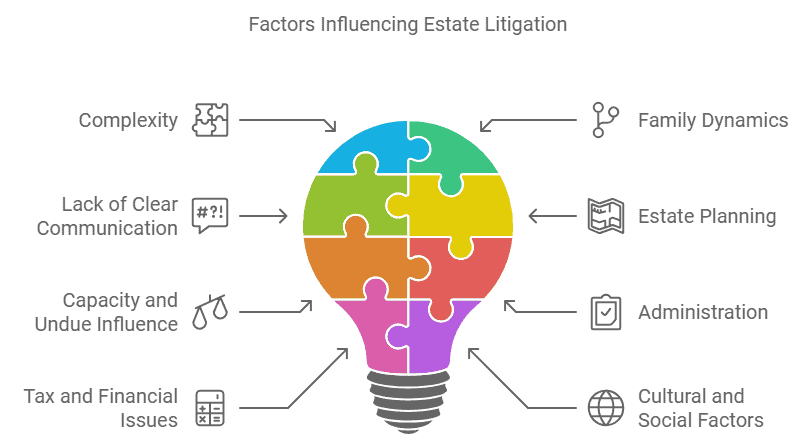
Factors Affecting Estate Litigation

This kind of litigation can be influenced by various factors, including:

  1. Complexity: Multiple assets, beneficiaries, and potential heirs can be more prone to disputes and litigation.
  2. Family Dynamics: Family relationships, conflicts, and power struggles can contribute to disputes, particularly when there are competing interests or claims.
  3. Lack of Clear Communication: Inadequate or unclear communication between the testator, beneficiaries, and estate trustee can lead to misunderstandings, misinterpretations, and disputes.
  4. Estate Planning: The quality and effectiveness of the estate plan, including the Will, trusts, and other documents, can impact the likelihood of disputes and litigation.
  5. Capacity and Undue Influence: Allegations of lack of capacity or undue influence can arise when the testator’s mental or physical health is compromised, or when someone exerts influence over the testator.
  6. Administration: Poor administration, including delays, mismanagement, or misappropriation of assets, can lead to disputes and litigation.
  7. Tax and Financial Issues: Complex tax and financial issues, such as taxes, probate fees, and inheritance taxes, can contribute to disputes and litigation.
  8. Cultural and Social Factors: Cultural and social factors, such as family traditions, customs, and expectations, can influence disputes and litigation.
  9. Technology and Digital Assets: The increasing importance of digital assets, such as social media accounts, cryptocurrencies, and online storage, can create new challenges and disputes resulting in litigation.
  10. Changes in Family Circumstances: Changes in family circumstances, such as divorce, remarriage, or the birth of children, can impact plans and lead to disputes and litigation.
  11. Aging Population: The aging population and increasing life expectancy can lead to more complex planning and administration, increasing the likelihood of disputes and litigation.
  12. Economic Factors: Economic factors, such as market fluctuations, inflation, and economic downturns, can impact the value of assets and contribute to disputes and litigation.
  13. Legal and Regulatory Changes: Changes in laws, regulations, and court decisions can impact litigation, particularly in areas such as wills, trusts, and taxes.
  14. Professional Fees and Expenses: The cost of professional fees and expenses, such as lawyers’ fees, accounting fees, and appraisal fees, can contribute to disputes and litigation over administration and distribution.
  15. Time and Delay: The passage of time and delays in administration can lead to disputes and litigation, particularly if beneficiaries are left waiting for their inheritance.
  16. Lack of Trust and Confidence: A lack of trust and confidence between the estate trustee, beneficiaries, and other parties involved can contribute to disputes and litigation.
  17. Power of Attorney: The use of powers of attorney, particularly in cases where the person who is authorized to represent the not-yet-deceased person has broad powers, can lead to disputes and litigation over the management of the testator’s assets and affairs.
  18. Charitable Bequests: Charitable bequests can create disputes and litigation, particularly if the charitable organization is not entitled to the bequest or if the bequest is not being used for the intended purpose.
  19. Business Interests: Business interests and ownership structures can create complex disputes and litigation, particularly if there are competing interests or claims.
  20. International Aspects: International aspects, such as foreign assets, foreign beneficiaries, or international planning, can add complexity and potential disputes to estate litigation.

These factors can interact with each other in complex ways, making estate litigation a challenging and nuanced area of law.

estate

The Background of Ingram v. Kulynych Estate

The case of Ingram v. Kulynych unspools a compelling narrative regarding inheritance, emotional ties, and legal disputes. It centres on the passing of Henry Harry Kulynych and getting at the value of his estate. Let’s dig into the details to understand the stakes involved and the events that led to this legal action.

Overview of the Estate Case Details

Henry Harry Kulynych passed away in February 2017. His estate was valued at approximately $690,119.59. A notable part of this estate was a house located in The Town of Ajax, which later sold for $475,585.10 in March 2019. The value isn’t just a number; it represents years of life, relationships, and, of course, ambition.

But here’s the twist: he excluded Kathleen Ingram from his Will. Ms. Ingram claimed a common-law relationship with Mr. Kulynych dating back to 1999. This was not just a romantic partnership; she provided extensive emotional and financial support throughout their years together. Yet, despite these claims, his Will distributed his estate to his children from a previous marriage. A question lingers—what does it mean to be entitled to something that you believe you deserve?

Discussion of Kathleen Ingram’s Life Events Tied to Mr. Kulynych

Ms. Ingram’s life intertwines significantly with Henry’s. Their common-law relationship speaks volumes about emotional investments and shared experiences. For nearly two decades, they built a life together, undoubtedly filled with hopes and dreams. However, legally, that time means nothing without recognition in a Will.

Imagine dedicating years to someone you love, only to discover that your contributions are overlooked legally. Ms. Ingram must have felt a whirlwind of emotions. Grief, betrayal, and confusion likely permeated her life as she faced the reality of her situation following Henry’s death. She sought legal representation to voice her claims, driven not only by her feelings but also by the emotional ties that had developed over the years.

In March 2018, Ingram took a crucial step. She communicated her claims through a lawyer, marking a significant moment in her fight for recognition. It was unclear from the case if she was claiming at that time the dependant’s support. Nevertheless, she would not file a formal equitable trust claim until March 2021. This delay raised questions about the applicable limitation periods that govern estate claims.

Just think about it for a moment: the legal system is designed to ensure timely resolutions. The timing of claims matters immensely. As a legal expert once mentioned to me:

“Timing is everything in estate claims.”

This sentiment holds weight in any legal situation, especially in matters involving an estate.

Understanding the Implications

The legal intricacies surrounding this case primarily focus on limitation periods. The appeal primarily questioned whether Ingram should adhere to a stricter two-year limitation under the Trustee Act or the more lenient ten-year rule under the Real Property Limitations Act. These discussions speak to the heart of estate law and how emotional ties can often clash with rigid legal frameworks.

As I reflect on the details, I realize it’s not merely about money or assets. It’s about recognition, acknowledgment, and the right to be remembered. Ingram’s claims highlight the struggles many face regarding what they believe they deserve versus what the law recognizes.

As we analyze it, we’ll see the emotional resonance it carries. After all, every such situation carries its stories, its memories, and, of course, its disputes.estate

Limitation periods can feel daunting. However understanding them is crucial, especially when dealing with estates and legal claims. In the realm of estate law, we often encounter two significant limitation periods: the ten-year limitation under the Real Property Limitations Act, R.S.O. 1990, c. L.15 (RPLA) and the two-year limitation under the Trustee Act, R.S.O. 1990, c. T.23 (Trustee Act). Each has its intricacies that can greatly impact the resolution of claims made against an estate.

The Ten-Year Limitation under the RPLA

Let’s start with the ten-year limitation under the RPLA. This provision allows a party to bring a claim regarding land or equitable interests for a generous span of ten years. Sounds good, right? In many cases, this extended time frame provides a welcome cushion for those who may be hesitant or unable to act promptly. It’s especially beneficial for individuals with claims that might not surface until well after the death of a person and the reading of the Will.

However, using this longer time frame comes with challenges. For example, how do we balance the need for justice with the reality that long delays can complicate the retrieval of evidence and disrupt the administration of an estate? Here, clarity is essential. A lengthy limitation period might not always serve the best interests of all parties involved, particularly when memories fade and records become hard to trace.

The Two-Year Limitation under the Trustee Act

On the other end of the spectrum lies the two-year limitation period, governed by the Trustee Act. This law dictates a tighter timeframe to file claims related to equitable trusts. Under Section 38(3), claimants must act quickly, within two years of becoming aware of their claim. This timeframe applies to many situations where beneficiaries seek to rectify perceived wrongs in the administration of an estate. How might this impact someone who feels wronged but is faced with such a tight deadline?

For instance, in the case of Ingram v. Kulynych, although Kathleen Ingram believed she had a valid claim against the estate, she waited too long. Her claims against the estate needed to be filed by March 2019, as that was two years following the death of Mr. Kulynych, which occurred in February 2017. By waiting until March 2021 to lodge the claim, she was already outside the allowable period to contest under the Trustee Act.

The Impact of Limitation Periods on Estate Claims

So, why do these limitation periods exist? The straightforward answer is: to ensure the speedy resolution of claims. Statutory deadlines are designed to ensure the speedy resolution of claims.

Limitation periods aim to prevent stale claims from arising years after the relevant events, which benefits both the legitimate parties and the estate.

Moreover, limitation periods force parties to act promptly. This is paramount in legal matters, particularly in estates where the administration must proceed efficiently. If a beneficiary feels entitled to a share, they must ensure they are within the relevant time frames to avoid their claims being deemed statute-barred.

Comparing the Two Limitation Periods

As much as these laws serve their purposes, they can also conflict with personal situations. A claimant might feel an inherent sense of injustice if they are barred from pursuing their claims due to limitation periods. What if someone only learned of their entitlements years later? This is the tension at the heart of estate litigation, where limitation periods serve as gatekeepers, but sometimes they lock out genuine claims.

Ultimately, limitation periods shape the landscape of estate claims significantly. They encourage timely legal action and protect against endless liability claims. As we navigate these laws, it’s vital to understand their implications. Knowledge may be power, but it must be coupled with action within the applicable time frames to make a difference.

The Court’s Decision and Its Implications

The recent case of Ingram v. Kulynych has stirred significant discussions in estate law. The conflict centres on the applicable limitation period for Kathleen Ingram’s claims against the estate of the deceased, Mr. Henry Harry Kulynych. Her claims were initially favoured by Justice Jonathan Dawe of the Superior Court. This was before the ruling was overturned by the Court of Appeal. Let’s break down these decisions and what they mean for future estate management.

Summary of Justice Dawe’s Ruling vs. Court of Appeal Ruling

Justice Dawe’s ruling initially allowed Ingram to pursue her claims based on the ten-year limitation period under the RPLA. He distinguished her claims as equitable, asserting that they had merit considering her long-term relationship with Mr. Kulynych. But did he overlook something crucial? The statute of limitations serves as a legal framework ensuring timely action.

On appeal, the justices found Dawe’s ruling problematic. They argued that the two-year limitation under the Trustee Act should apply. The appellate court contended that timing is everything. It’s essential, especially in estate laws where delays can lead to complications and disputes.

Discussion on the Dismissal of Ingram’s Claims

Ultimately, Ingram’s claims were dismissed. She failed to file within the two-year timeframe following Mr. Kulynych’s death in February 2017. By waiting until March 2021, she lost her right to claim. This ruling underscores the judicial emphasis on timely resolution.

Her claims are no longer viable because they are considered *statute-barred*. This situation highlights the importance of acting swiftly in legal matters related to estate management.

Ultimately, the court finds that the shorter limitation period applies to equitable trust claims against estates, even if the main asset of the Estate was real property. This means the claim was time-barred and must be dismissed.

The Reasoning Behind the Two-Year Limit Ruling

The Court’s ruling emphasized the necessity of adhering to statutory periods in estate law. Why is this so crucial? Delays in estate management can lead to family disputes, financial complications, and uncertainty about the deceased’s wishes. The court aims to protect the integrity of estate administration.

Interestingly, this ruling draws parallels with a precedent case, where a strict two-year limit was similarly upheld. The court’s decision aligns to ensure a streamlined process for claims against estates, preventing endless liability. It’s a reminder that courts lean towards predictability and closure in legal disputes.

Key Implications for Estate Administration

I find this decision to be a clear signal to everyone involved in estate matters. Even if you think your claim is justified, adhering to proper timelines is essential. Here are some critical takeaways from the case:

  • The two-year limitation is a key principle in *trustee legislation*. Don’t overlook it.
  • Judicial priorities favour urgent estate management. Delays could work against you.
  • This case reinforces the idea that equitable claims do not supersede statutory limitations.estate

The impact of legal disputes, particularly in matters of estate, can reverberate beyond mere financial losses. They touch hearts, tear families apart, and can often lead to emotional turmoil that eclipses cold legal facts. Acting as a Court-appointed Estate Trustee,

I’ve witnessed firsthand the emotional toll of estate disputes, and it is profound. Each one exemplifies the struggles that arise when laws and personal relationships collide.

Exploring the Emotional Toll of Estate Disputes

Consider this: a family grieving the loss of a loved one, already in pain, now faces a legal battle that divides them. It’s heart-wrenching. When the law turns a family’s grief into a battlefield, the emotional scars can be long-lasting.

  • Emotional Distress: Legal battles can elevate stress levels exponentially. Families often find themselves fighting each other instead of healing together.
  • Financial Burdens: Estate disputes are expensive. The longer the battle, the more legal fees accumulate, draining resources that could have been used for family needs.
  • Division and Isolation: Family members might find themselves on opposite sides of a legal argument. This division often leads to estrangement, which can be devastating.

Have you ever watched a family unravel over a few documents? It’s like witnessing a tragedy unfold in slow motion. I have seen many examples of families torn apart by disputes over Wills and estates. Each story echoes a similar theme — emotional chaos ensues, and relationships disintegrate.

Tips for Avoiding Estate Litigation

Here are some tips to transform a painful conflict into a more amicable solution:

  • Communicate with your loved ones: Discuss your estate plan with your family and beneficiaries to ensure they understand your wishes. Keep them informed about any changes to your estate plan.
  • Avoid ambiguity and vagueness: Use specific language in your will and other documents to avoid misunderstandings. Avoid using vague terms or phrases that could be interpreted differently.
  • Introduce Mediation: Rather than a fierce courtroom battle, complete with the high costs in estate litigation, families should be encouraged to consider mediation. This approach allows for discussions that can preserve relationships. Legal assistance from experienced lawyers is still required in mediation. It is the approach that is different.
  • Encourage Open Communication: Families need to communicate openly about estate plans. Discussions about intentions can significantly lessen the chances of disputes later on.
  • Educate on the Legal Processes: Knowing the law can alleviate fears and misunderstandings. An informed family is often a united family.

It’s crucial to balance emotional needs with legal obligations. After all, how can we expect families to find a resolution when emotions are running high? This is where careful planning can serve as a preventive measure against future disputes.estate

Future Considerations: Learning from Ingram v. Kulynych Estate

When discussing estate management, the complexities can be overwhelming. The case of Ingram v. Kulynych provides a salient example of how crucial it is to be well-informed about estate laws. Let’s unpack the lessons we can derive from this case.

Advice for Individuals Dealing with Estates

First, if you find yourself navigating an estate, knowledge is your ally. Here are some vital pieces of advice:

  • Understand the limitations: Each jurisdiction has specific limitation periods for filing claims related to estates. Familiarize yourself with them to protect your rights.
  • Consult professionals: Enlist the help of lawyers specializing in estate law to ensure you’re making informed decisions.
  • Document everything: Keep records of your interactions and contributions related to the estate. This can play a crucial role in any legal proceedings.

Are you already navigating an estate claim? Don’t hesitate to reach out to a legal expert. It can save you time and resources in the long run.

The Ingram case reminds us of a critical aspect of estate management: timeliness. Justice Dawe initially ruled that Kathleen Ingram’s claim could proceed under a ten-year limitation period. However, this decision was later overturned, emphasizing the point that claims must be filed within specific timelines.

Ingram communicated her claims in 2018, but by waiting until 2021 to formally file, she missed a crucial window. This highlights a broader lesson: being proactive is key.

Future Implications for Equitable Trust Claims

With the Ingram ruling, the Court of Appeal for Ontario clarified that equitable trust claims are not exempt from strict adherence to statutory limitations. This has significant implications for anyone looking to assert claims against an estate. Preparation and awareness are the best tools against legal pitfalls in estate matters.

The Importance of Education in Estate Management

The discussion of the Ingram case leads me to a broader conclusion: we need to raise awareness about estate management education. Understanding the basic principles of estate law is not just for lawyers; it’s for everyone. Workshops, online courses, or community seminars can bridge the knowledge gap.

The new strategies to navigate estate claims focus not only on legal acumen but also on efficient communication and mediation. This proactive approach may save families from future strife and can foster understanding among heirs.

In summary, estates present a complex legal environment. The Ingram v. Kulynych ruling serves as a crucial reminder to be aware of limitation periods, to consult professionals, and to act decisively. The landscape of estate disputes is changing, and we must adapt.

Estate Conclusion

The Ingram v. Kulynych case highlights the importance of timely action in estate claims. Prepare, educate yourself, and seek professional help to navigate complexities. As estate disputes grow, so should our awareness and actions.

I hope you have found the discussion of estate issues in this Brandon’s Blog informative. The death of a loved one is probably the most traumatic life event you will encounter. It is doubly so if family members tie up the Estate with costly estate litigation arguments.

Are you a stakeholder in an estate where the appointment of an independent, neutral court officer can at least unlock the jamming up of assets so that the assets can be preserved and their value maximized for the beneficiaries? If so, Smith Estate Trustee Ontario can help you. Contact us so that we can provide a no-cost consultation to see how we can help you and the other beneficiaries.

Do you have way too much financial debt? Before you get to the phase where you can’t make ends meet reach out to me. I am a licensed insolvency trustee (previously called a bankruptcy trustee). If you understand that you can’t pay your financial debts heading into or in your retirement life, contact us.

We understand the pain and stress excessive financial debt can trigger. We can aid you to get rid of that discomfort as well as address your financial problems by offering prompt action and the ideal plan.

Call Ira Smith Trustee & Receiver Inc. today. Make an appointment with one of the Ira Smith Team for a free, no-obligation consultation and you can be on your way to enjoying a carefree retirement Starting Over, Starting Now. Give us a call today so that we can help you get back to a stress and pain-free life, Starting Over, Starting Now.

The information provided in this Brandon’s Blog is intended for educational purposes only. It is not intended to constitute legal, financial, or professional advice. Readers are encouraged to seek professional advice regarding their specific situations. The content of this Brandon’s Blog should not be relied upon as a substitute for professional guidance or consultation. The author, Ira Smith Trustee & Receiver Inc. as well as any contributors to this Brandon’s Blog, do not assume any liability for any loss or damage resulting from reliance on the information provided herein.estate


Call a Trustee Now!